The American Sentinel, Vol. 11, No. 36.

ROME DEFENDS THE INQUISITION
Earlier text: ROME DEFENDS THE INQUISITION

THE INQUISITION.

Its Nature Misunderstood by Many Bigoted Protestants.

BY JAMES A. CONWAY.
[Written for the CATHOLIC MIRROR.]
[This article is from the Catholic Mirror of August 29. We print it entire for the information of our readers. For editorial comment see our first page article, “Rome Defends the Inquisition.”—EDITOR SENTINEL.]
In these closing days of the nineteenth century when every wind brings news of discovery, and when every word that falls from the lips of humanity adds a gem to the crown bestowed on modern progress, the atheist, the infidel, the heretic, impelled by religious prejudice or blinded by ignorance, still points a finger of scorn at the mediæval ages when the church of Christ ruled with the scepter of faith the civilized world. Many are the charges brought against the peoples of those times, which, if true, must have made those ages sad indeed. Foremost among these charges, most grievous in its nature, and most ready to the tongue of every opponent of Catholicity, is the Inquisition, which we have in purpose to examine. History divides the Inquisition into two distinct tribunals: the Roman Inquisition, and the Inquisition of the Spanish Government. Great care must be taken not to confound the two; one is purely ecclesiastical, the other strictly secular. The one was undertaken and must be defended from a religious standpoint; the other was established and perpetuated by the civil government, and must lean for its justification on national rights and privileges. But to give a fair, unbiased judgment upon either, one must set truth in one eye, and personal disadvantage in the other, and look upon both indifferently. He must identify himself with the customs, habits, and opinions of the people who lived in those ages; he must take into account their education, and, most of all, their religion, and beget in his soul the reverence and love with which they cherished the time-honored traditions of their forefathers. This done, we will see that, in the times of which we speak, all the world embraced the teachings of the Catholic Church. King and subject, prince and peasant, rich and poor, priest and people, all believed her doctrines not only to be true, but incapable of being false. Schools and churches, assemblies and meeting-houses, echoed and re-echoed with her tenets and dogmas. And so, quite naturally, it seemed to all who lived in such surroundings, and rightly too, that anyone who sought to destroy the faith of a nation, which is at all times its most priceless treasure, was as great an enemy to the State as one who contrived to undermine its civil institutions.
Moreover, since all statesmen and public officers were at the same time Catholics, it is most easy to understand that they enacted laws and punishments in keeping with their religious convictions. To put it briefly, in those Middle Ages, there was the greatest union of Church and State. This union was the natural outcome of the beautiful marriage of civil and religious institutions. The State then, as it should now, protected and defended her holy bride from danger and persecution: the church softened the might and impetuosity of her sterner companion with gentleness and mercy. The State made enactments and laws for the government of its citizens; the church inspired and seasoned them with justice and wisdom. All the laws then, had a tinge of Catholicity, and they were carried out in a manner savoring of the principles of that universal religion. Consequently, it is evident, that one who was a heretic then, was by that very fact in opposition to the spirit of the laws and customs of his country—in other words, a disturber of the public peace, and an underminer of civil society. And so it was that in the year 1184, when Lucius III. sat upon the throne of Peter, the Roman Inquisition was formally established to bring to trial the Cathari [the Albigenses]. And at the same time bishops established special tribunals in different places, to examine into the charges against other persons who were suspected or known to be heretics.
But the Inquisition was not fully established until in 1248, Innocent IV. took the tribunal out of the hands of the seculars, and turned it over to the Dominicans who had done great work in converting the Cathari. The Dominicans, according to their mission, introduced the Inquisition into all countries and diligently sifted out and indicted heretics of every description.
There were three classes of heretics, and three were the kinds of punishment meted out to them. The first class were the Jews, who were punished very lightly; the second class were the ordinary heretics, who were condemned to banishment or else imprisoned; the third class, however, those heretics who were at the same time open disturbers of the peace, and enemies to society, were punished to the full extent of the law. The church could suffer the pagans to worship because they erred from ignorance; she could tolerate the Jews because they were the living and most singular witnesses to the truth; but never could she countenance or encourage a formal heretic, a foe to civilization, a barrier in the way to salvation, to scatter his poisons unmolested. But aside from the question of civil society, was the church justified in punishing heretics for that reason alone? Most assuredly. The church is the divinely appointed guardian of the revelations of Jesus Christ, and consequently has the right to rebuke those who, in any way, attack the purity of that faith. Besides, every one will admit that any society has the right to impose certain obligations upon its members and to reprimand and punish; and even exclude them from membership, if they do not comply with these duties. If, then, any society, no matter what may be its nature and aim, is free from blame in so doing, a fortiori, it was not only not unjust but even obligatory and praiseworthy for the Catholic Church, which has been entrusted with the teachings of the Spirit of Truth, to exclude from within her sacred fold the wolves who sought to prey upon the innocent lambs, which she sheltered and guarded therein. Few, very few, are the charges brought against the Roman Inquisition;—it seems as though mankind has ever acknowledged the justice of its punishments.
But when the Spanish Inquisition is spoken of, then Protestantism trembles, her knees quake, her lips falter, and a sickly pallor rushes to her countenance. All the chicanery of popery, all the secrecy of the confessional, all the darkness of deep-laid conspiracy, all the intolerance and oppression and persecution and religious thralldom of Romanism, are embodied in that dread word. Books have been written, libraries filled, talents misused, energies wasted, to picture the imaginary horrors of this wicked, marble-hearted tribunal. The cannons roar, the dungeons ring with the curses and groans of the despairing imprisoned, the streets are flooded, and the executioner’s axe is red with the blood of innocent victims. As to the truth of these accusations, the faintest knowledge of history will show that they are either altogether false and malicious, or else if true, exaggerated and multiplied—the sure outcome of prejudice and envy.
Before however I undertake to refute any of these charges, it is my purpose, most of all, to impress upon the minds of my readers, that the Spanish Inquisition was an entirely royal tribunal, and that, consequently, were the charges as “high as high Olympus,” they could not cloud the glories of Catholicity. And, as in our justification of the Roman Inquisition, we relied much and drew great sustenance from the customs of the peoples who established and were ruled by it; so now, in our defence of the Spanish Inquisition, must we, no less than before, again fall back upon the manners and usage of the epoch in which it flourished. In those ages of faith, as from what has been said before will be easily understood, it was well-nigh impossible for a Jew or Infidel to ascend to prominence in any walk of life. And thus proscription of the Jews was dominant not only in Spain, but in the other Christian countries as well; and resulted, in the mediæval era, as in our own, from the intense feeling which Christians had against the Jews, who were looked upon as the accursed race which had persecuted, mocked, and crucified Jesus Christ, whom they as Christians, adored as the Son of God, the Redeemer of the World, and the founder and preserver of their holy religion. Statesmen and warriors, grandees and noblemen, harboring and cherishing dispositions such as these, would have as their friends and companions only those who were of their own faith. This was most galling to the avaricious Jew, and numbers of them, thirsting for wealth, while secretly remaining Jews, pretended to profess the Catholic faith, were baptized, pushed into the courts and kingly palaces, became holders of large estates, and even were found among the priests and prelates of the church of God. In this hidden, underhand manner, they were seeking to overturn the institutions, not only of the Catholic Church, but also of the Spanish Nation. And, the fact is, that, in time, this consumptive germ did not fail to cause great trouble and danger and alarm in Spain. Such a state of things called for immediate action; but since there was no doubt but that very many of the Jews were honest in their conversion, what to do was a very perplexing question. Hence arose a great difficulty—a difficulty, which, as all will agree, could be overcome only by an inquisition. To establish an inquisition, Ferdinand asked the permission of the Pope, Sixtus I. That pontiff, however, was at first unwilling to grant Ferdinand’s request, but was so urged by the court of Spain, that he finally agreed, and in the year 1478 the Spanish Inquisition sprang into existence.
But before the first trial was opened at Saville in 1481, the pope withdrew his sanction because he had not been consulted as to the plan which had been adopted.
Nevertheless, pleadings on the one hand, and anxiety for the Spanish nation on the other, again prevailed upon him to renew the permission, and from that time on there was a continual controversy between Spain and Rome. Often was the tribunal at variance with the popes, and most frequently were the victims condemned by the Inquisition pardoned on appealing to the successor of Peter—nay, more, so serious were the frictions between them, that several times, the Holy See threatened the Spanish Inquisitors with excommunication.
But here I may be met with a very great objection: What need was there of the permission of the popes? If the Inquisition was purely secular, what had the Pope or the church to do with its actions? Ah! there is just the point. The permission of Rome was necessary for many reasons, but chiefly for two: First, because the men who were appointed as Inquisitors by the court of Spain were priests and prelates and theologians of the church, and were, for that reason, under the jurisdiction of the popes; and secondly, and most especially, because the Inquisition was instituted to try people on matters of faith. Truly, indeed, did Ranke call it a royal tribunal furnished with ecclesiastical weapons. “In the first place,” says that liberal-minded and authoritative Protestant historian (“History of the Popes,” Vol. I, p. 242, etc., in original German edition), “the Inquisitors were royal officers; the king having the right to appoint and dismiss them; the tribunals of the Inquisitors were subject to royal visitations” (which meant royal control), “just as any other authority under the king.” In the second place, all the profits and advantages resulting from confiscations fell to the king. “And in the third place, it was by means of this tribunal that the Spanish nation was completely rounded off and finished. The king obtained a tribunal from which neither grandee nor archbishop could escape.” As the tribunal is founded upon the king’s power, so its exercise redounds to the king’s advantage. It is one of the spoils of ecclesiastical power which the Spanish nation snatched to itself, and by which it has become powerful. In its meaning, object, and aim, it is, above all, a political institution. It is the Pope’s interest to stand in its way, as often as he can, and as he does so; it is the king’s interest always to keep the way clear for it, and he does. So far says Ranke. Leo (“History of the World,” Vol. 2, p. 431, etc.), Guizot (“Cours D’Histoire Moderne”) and Menzel (“History of Modern Germany,” Vol. 4, p. 96). All Protestant writers declare the Inquisition a State machine.
So far we have said nothing of the Inquisition against the Moors for the reason that the same causes and circumstances concomitant to the Inquisition against the Jews in 1481, gave rise to the Inquisition against the Moors in 1500. These Saracens had crossed over from Africa to Spain in great numbers, and had practically conquered the whole Peninsula. They held sway in Spain for a long time, and were not completely driven back until the time of Ferdinand and Isabella. This may be called the reconquest of Spain by Spaniards; and nobly, and like true sons did those swarthy southerners rescue from bondage and oppression—yes, from destruction, the land which had given them birth. To rid their country of the danger, they rose up in their might, and after a long struggle finally succeeded in expelling the infidels. Some of the Moors, however, rather than go were baptized, and in this way the same troubles arose as with the Jews. And if the Inquisition purged the Spanish nation of the plotting Jew in 1481, it proved no less a blessing against the revengeful Saracen in 1500. They were ousted, or imprisoned, or put to death, and Spain was proudly and gloriously out of the dangers which had threatened her with utter destruction. When we review these facts, and take into account the royal advantages and the ecclesiastical disapproval of the Spanish Inquisition, we, as Catholics, maintain, and have for authority, the best and most upright and learned historians, Protestant as well as Catholic, among whom I enumerate, in addition to those quoted above, Balmes, Hefele, De Noso Cortes, Demester and Reuben Parsons; that it grew out of peculiar circumstances; that it was introduced by the State, empowered, fostered, and cherished by the State; that its punishments were inflicted by the brachium saeculare; and that, consequently, no matter what outrages were committed by the Inquisition, they cannot be laid at the threshold of the Catholic Church. But the fact of the matter is there were no outrages committed by the Spanish Inquisition, and let us here refute some of the charges brought forward against it.
They say that the Dominican, Torquemada, the grand Inquisitor, slew 11,400 victims in his time of office, and that during his first year alone as Inquisitor, he put to death 2,000 heretics; and during the whole existence of the tribunal itself, in all 34,100 victims perished. These charges we flatly deny. They are taken from Llorente, a Spanish historian. Now, who was Llorente? He was a renegade Catholic, an apostate priest, an ingrate, who, in order to satisfy his ambitions and glut his own desires, like some of the so-called ex-priests of our day, hesitated not to trample under foot the honor of his family, his country and his church. The history of such a man is not to be credited with authority, even though we had no other reason for doubting his writings. But he attempts to quote Mariana, and here, as the expression has it, we have him “on the hip.”
Mariana says that during the whole Inquisition about two thousand were killed. And as far as Torquemada is concerned, the most honest historians declare him to have been a pure, upright, just, humane, uncorrupted and undaunted Inquisitor. The same Llorente tells us that on February 12, 1486, seven hundred and fifty victims were punished; but even granting these figures to be correct—he does not add that a single one of these victims were put to death. The same may be said of the charge that April 2, of the same year, added 900 more victims in Toledo. Not one was put to death. All that most of the condemned had to do was to make the “autodafe” “autodafe.” This word, so terrifying to bigots, is nothing more than the corruption of the Latin actus fidei, an act of faith. When, then, we say that those found guilty were compelled to make the “autodafe,” we mean that those who had been publicly brought to trial and forthwith condemned and punished, were obliged to make some outward manifestation that they were really and truly members of the Church of Christ. In fact, the Inquisition was a very merciful tribunal, I repeat it, almost a compassionate tribunal. Very few of those condemned were sentenced to death; and a man was only allowed to be racked once, which no one can deny was a most wonderful leniency in those times.
Again they say that the Inquisition, during the time it existed, hung over Spain like a dark, heavy cloud, enslaving the spirit, robbing the poor country of the free manifestation of all that is dear to natural life. The truth is that during the flourishing period of the Inquisition and shortly after, in the arts, the sciences, in knowledge and grandeur, in empire and dominion, Spain was the envy of the civilized world. No nation was more enlightened, more powerful, more extensive. In those days, her sceptre swayed princes and potentates, and the muses seem to have deserted the rest of the earth, and nestled only on her soil. Under their enlightened guidance, the illustrious Lope de Vega, the writer, employed his talents to delight all Christendom with his beautiful works; and the renowned Cervantes, the father of novel writers, brought into the world his famous “Don Quixote.” Up rose the great Himinez, the statesman and orator; and the heroic Columbus braved the unknown seas and opened up to the unknown world a new-found continent. In the midst of the Inquisition was born the conqueror Cortez, and the explorer De Soto. And scarcely had it ceased to exist when the church was enriched with Ignatius Loyola, Francis Borgia, Francis Xavier and the great St. Theresa, the greatest warriors for the faith which Spain has begotten.
O Spain, beautiful, smiling Spain, loaded with calumny, held down beneath the scorn of thy sister nations, struggling and struggling, yet in vain, to regain thy long-lost grandeur; fair mother of saints, warriors, heroes, discoverers, explorers, land of chivalry and conquest; who could but admire and extol thy greatness and fame?
It was such charges and slanders as these that forced the Count de Maistre to exclaim that “history for the past three hundred years has been a conspiracy against the truth.” But truth crushed to earth will rise again, more beautiful from its long obscurity. And the atheist, the infidel, and the heretic, will have to own that Catholicity, after three hundred years of calumny and persecution is yet, as she always has been, as she ever will be, far from being injured, made more glorious and sublime in her struggle for truth and salvation.

WALLA WALLA COLLEGE, COLLEGE PLACE, WASH.

THE new college year begins September 16. A number of important changes have been made in the courses of study which allows the faculty to give its entire strength to the developing of students for the work in a shorter time than we have been prepared to do in the past with the old arrangement of courses. Any one desiring to become acquainted with our work may do so by applying to the president, E. A. Sutherland, for a calendar.

Jesus Answered, My Kingdom Is Not of This World

“JESUS answered, My kingdom is not of this world.”

A FIRST-CLASS HIGH-GRADE BIBLE

$7.00 WORTH FOR $3.50.

We propose to make it possible for each and everyone to be the possessor of

A FIRST-CLASS HIGH-GRADE BIBLE.

The book we offer has large clear type (see specimen page) and is what is known as the

AMERICAN OXFORD SELF-PRONOUNCING REFERENCE TEACHERS’ BIBLE,
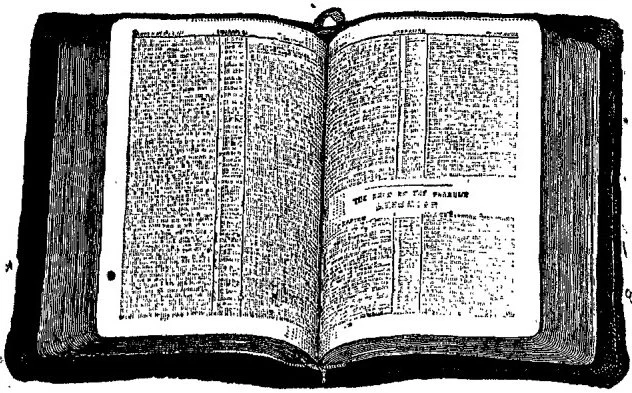
Bourgeois Type, Bound in Imperial Seal Leather, Divinity Circuit, Extra Linen Lined to Edge, Round Corners, Red Under Gold Edges, Silk Headband, Silk Marker, Binding of the Best Quality,
REGULAR PRICE, $6.00
WITH SENTINEL, ONE YEAR $3.50
With this book reading is made easy. No more stumbling over the hard words. All proper names are divided into syllables, and the accent and diacritical marks render their accurate pronunciation a simple matter. With a little study of the Key to Pronunciation to be found in every copy of this Bible, the reader loses all fear of the long, hard names of Scripture, and pronounces them with ease.
As is indicated by the name, this is a teachers’ Bible. It contains fifteen maps and 64 pages of illustrations and diagrams, copious helps of the latest revision, Bible index, concordance, dictionary of Scripture proper names with their pronunciation and meaning, and many other excellent features.
They that sealed the covenant. NEHEMIAH, X. The points of the covenant.
gavest before them, neither turned they from their wicked works.
36 Behold, we are servants this day, and for the land that thou gavest unto our fathers to eat the fruit thereof and the good thereof, behold, we are servants in it:
37 And it yieldeth much increase unto the kings whom thou hast set over us because of our sins: also they have dominion over our bodies, and over our cattle, at their pleasure, and we are in great distress.
38 And because of all this we make a sure covenant, and write it; and our princes, Levites, and priests seal unto it.

CHAPTER X.

The names of them that sealed the covenant. The points of the covenant.
NOW those that sealed were, Nehemiah, the Tirshatha, the son of Hachaliah, and Zidakijah,
2 Seraiah, Azariah, Jeremiah,
3 Pashur, Amariah, Malchijah, 4 Hattush, Shebaniah, Malluch, 5 Harim, Meremoth, Obadiah, 6 Daniel, Ginnethon, Baruch, 7 Meshullam, Abijah, Mijamin, 8 Maaziah, Bilgai, Shemaiah: these were the priests.
9 And the Levites: both Jeshua the son of Azaniah, Binnui of the sons of Henadad, Kadmiel;
10 And their brethren, Shebaniah, Hodijah, Kelita, Pelaiah, Hanan,
11 Micha, Rehob, Hashabiah, 12 Zaccur, Sherebiah, Shebaniah,
13 Hodijah, Bani, Beninu. 14 The chief of the people; Parosh, Pahath-moab, Elam, Zatthu, Bani,
15 Bunni, Azgad, Bebai, 16 Adonijah, Bigvai, Adin, 17 Ater, Hizkijah, Azzur, 18 Hodijah, Hashum, Bezai, 19 Hariph, Anathoth, Nebai, 20 Magpiash, Meshullam, Hezir, 21 Meshezabeel, Zadok, Jaddua,
22 Pelatiah, Hanan, Anaiah, 23 Hoshea, Hananiah, Hashub, 24 Hallohesh, Pileha, Shobek,
25 Behai, Hashabnah, Maaseiah,
26 And Ahijah, Hanan, Anan, 27 Malluch, Harim, Baanah.
28 And the rest of the people, the priests, the Levites, the porters, the singers, the Nethinims, and all they that had separated themselves from the people of the lands unto the law of God, their wives, their sons, and their daughters, every one having knowledge, and having understanding;
29 They clave to their brethren, their nobles, and entered into a curse, and into an oath, to walk in God’s law, which was given by Moses the servant of God, and to observe and do all the commandments of the LORD our Lord, and his judgments and his statutes;
30 And that we would not give our daughters unto the people of the land, nor take their daughters for our sons:
31 And if the people of the land bring ware or any victuals on the sabbath day to sell, that we would not buy it of them on the sabbath, or on the holy day: and that we would leave the seventh year, and the exaction of every debt.
32 Also we made ordinances for us, to charge ourselves yearly with the third part of a shekel for the service of the house of our God;
33 For the shewbread, and for the continual meat offering, and for the continual burnt offering, of the sabbaths, of the new moons, for the set feasts, and for the holy things, and for the sin offerings to make an atonement for Israel, and for all the work of the house of our God.
34 And we cast the lots among the priests, the Levites, and the people, for the wood offering, to bring it into the house of our God, after the houses of our fathers, at times appointed year by year, to burn upon the altar of the LORD our God, as it is written in the law:
35 And to bring the firstfruits of our ground, and the firstfruits of all fruit of all trees, year by year, unto the house of the LORD:
36 Also the firstborn of our sons,
It is only by special arrangement with the publishers of this Bible that we are able to make this

UNPRECEDENTED OFFER.

REMEMBER, the price of this Bible is $6.00. ANYONE, OLD OR NEW SUBSCRIBER, SENDING US $3.50 WILL RECEIVE THIS BIBLE POSTPAID, AND THE SENTINEL ONE YEAR.
Or WE WILL GIVE ONE OF THESE SUPERB BIBLES for seven new names at the regular subscription price, $7.00.
For 25 cents extra we will mark on the Bible in gold letters any name desired.
Address all orders to AMERICAN SENTINEL, 39 Bond Street, New York City.

Pulpit Degraded to Political Stump: Dixon Sermon Clash

THE AMERICAN SENTINEL has no opinion to express as to the merits of the respective candidates or platforms, but it has a decided opinion as to the propriety of degrading the pulpit to the level of the political stump. The practical workings and effect of doing this are well illustrated by the following which appeared in one of the morning papers in this city on the 7th inst.:—
“Rev. Thomas Dixon, Jr., preached a sensational sermon at the Academy of Music yesterday morning on ‘The Political Crisis.’ He said many unkind things of William Jennings Bryan, the Democratic Party and the free silver movement. In doing so he managed to stir up a hornet’s nest and create a scene in which cheers and hisses were about equally mingled.
“Professor Edwin V. Wright, who founded the Anti-Monopoly League and the Bimetallic Association, was in the audience. He has just returned from a stumping tour for silver with George Fred Williams through New England. He listened quietly to Mr. Dixon’s excoriation until the preacher asserted that the Republican Party stood for all that was good and pure, while the Democratic Party was the champion of all that was the absolute reverse. Then Professor Wright jumped to his feet, shook his fist at the pastor and exclaimed:
“‘What you say is false—absolutely false. You don’t know what you’re talking about.’
“All were dismayed for a moment and then a shout of applause arose, followed by a storm of hisses.
“The Rev. Mr. Dixon hadn’t expected all this, and it took him several minutes to discover his own location. Then he proceeded calmly with his dissertation. He complimented the Populists and said the People’s Party had been much maligned.
“‘The Democratic party was in hell,’ said he, ‘when it pulled itself together by tying to the Populists in the Chicago convention. Don’t you believe that all Populists are ignorant. The leaders of the party are men of brains and of education. And they are fine-looking men, too. Many of them are handsomer even than Theodore Roosevelt.’
“This, of course, scored a laugh, and Mr. Dixon continued:
“‘In such a crisis as now confronts us, it is the duty of every patriotic citizen to vote the straight Republican ticket. I voted for Mr. Cleveland, and now before God I acknowledge my sin.’
“‘I’m going to vote for Bryan,’ some one shouted, ‘and’—
“‘Here, too!’ came from another.
“‘However, Mr. Dixon was not taking a straw vote, so he paid no attention to the interruptions.
“‘The proposition of Mr. Bryan and his party,’ said he, ‘to pay off the bonds of the United States, on which 100 cents on the dollar were raised, in coin worth only 53 cents on the dollar, is downright rascality. It is nothing more nor less than bunco steering.’
“‘I won’t stand this any longer,’ said a patriarchal looking gentleman with a long flowing white beard, and he left the building. Fully one hundred others followed. Then Mr. Dixon scored Mr. Bryan for advocating a policy which, he said, would permit insurance companies to pay widows and orphans in depreciated coin. He predicted disaster in case of Bryan’s election, and said that fully 2,000,000 men would be immediately thrown out of work. Every one to whom a dollar was due would get only 53 cents.
“‘It is not true,’ shouted James T. Madden. Then there was more applause, and more hisses. Mr. Madden went to the speaker, gave him his card, and left the place, followed by many more.”
Such scenes should bring the blush of shame to the cheek of every Christian.
Surely “Babylon is fallen, is fallen,” and is fast becoming “the hold of every foul spirit, and the cage of every unclean and hateful bird.”

The Business of Preachers

THE article on another page, “The Business of Preachers,” should be carefully read. The subject is one that should be understood not only by preachers, but by the people.

Eastern Crisis Nears: Concert of Powers over Turkey

AFFAIRS in the East are fast approaching a crisis. Advices from Berlin under date of the 6th inst. state that the recent “conferences between the Czar and the Emperor and the Russian and German diplomats are said to have related to a new concert of the powers with regard to Turkey. It is known in Berlin that Prince Hohenlohe, the Imperial Chancellor, and Count von Osten-Sacken, the Russian Ambassador to Germany, are discussing a plan to place the Sultan under the tutelage of the Ambassadors of the powers in Constantinople, who will be empowered to control the Sultan’s selection of Ministers and also his appointment of provincial Governors. The settlement of the troubles in Crete upon the basis of European supervision appears to have been the keynote of this scheme, which at least would maintain the nominal integrity of Turkey and for a time enable the powers to escape being dragged into a European war over the division of the spoils of the Ottoman Empire.” How much longer the utter extinction of the Ottoman power in Europe and the withdrawal of the Turk to Jerusalem foretold in the prophetic Scriptures, can be delayed, only God knows; but all who have heard the warning may know that “at that time shall Michael [Christ] stand up [reign], the great prince which standeth for the children of thy people; and there shall be a time of trouble, such as never was since there was a nation even to that same time: and at that time thy people shall be delivered, every one that shall be found written in the book.” Dan 12:1.

Alexander Philpott Arrest for Sunday Work in Tennessee

MORE definite information concerning the recent arrest of Alexander Philpott, a Tennessee Adventist, for Sunday work, reveals the fact that it occurred not in Bedford County, but in Rutherford County. Ex-Senator W. P. Tolly, well-known to SENTINEL readers as a staunch and able advocate of religious liberty, is a resident of that county and will doubtless be heard from in defense of freedom of conscience. The trial of this case will not occur until sometime during the week beginning October 19, or possibly not until the following week. Murfreesborough is the county seat of Rutherford County, and the trial will take place there.

SEND FOR A BIBLE CATALOGUE.

THE Kansas City branch of the Pacific Press Publishing Company has gotten out a neat 20 page Bible Catalogue, which they will send free to any address. Send your address on a postal card to the Pacific Press, No. 18 West Fifth St., Kansas City, Mo.

The Preacher's Official Position and Personal Rights

That the preacher as a man has the same rights as other men cannot be denied; but when he uses his official position of an ambassador for Christ for the promotion of interests not within the sphere of his commission from Christ, he is as guilty of perversion as any other accredited agent who uses for one purpose money or influence intrusted to him for quite another purpose.

Politics in the Pulpit Misrepresents the Gospel Commission

The minister who takes politics into the pulpit both misrepresents Christ by going outside of the gospel commission while professing to be acting under it, and imposes upon his congregation who expect him to preach, not politics, but religion.

Politics and the Minister's Divine Commission

POLITICS in its best sense is simply the science of conducting business for the public; and as well might the minister drag the business of rival firms into the pulpit, recommending the one and denouncing the other, as to discuss the policies of parties. The man has a right to do such things in a proper way; the minister has no such right, for it is the divine commission and call that make him a minister, and his commission is not only silent as to politics, but inferentially forbids the theme by assigning the minister his subject, namely, the gospel of the Lord Jesus Christ.

You have reached the end of this edition.

The American Sentinel · Sep 10, 1896