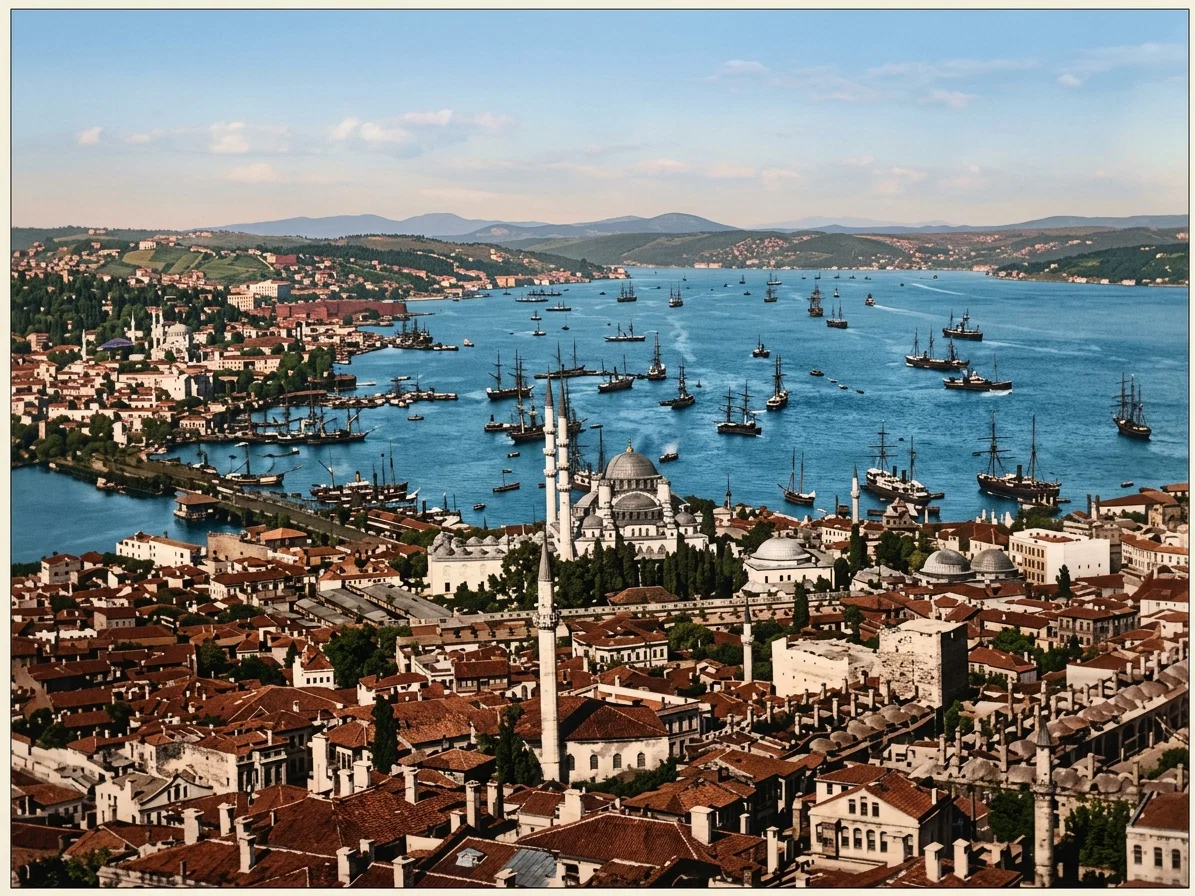
Several times in these columns of late it has been presented that one of the probable results of the new reign in Turkey would be the advancement of the Gospel message. The San Francisco “Examiner” in its issue of Sunday, June 13, announces that “the great revolution in Turkey and the downfall of Sultan Abdul Hamid will have far-reaching results over the world of religion, science, archeology, and culture.”
It seems that great fields of antiquarian treasure of the East are now for the first time to be thrown open to thoro research. Previously it has been very difficult to get permission from the Sultan for archeological research within his dominions. When permission has been given, it was under what was called a firman which usually expired in six months or a year, and placed the guarantees under onerous conditions and costly terms. Furthermore, blackmailing Turkish governors and local officials gave constant annoyance and demanded exactions. Brigands and wild tribesmen might attack them, and the searchers for hidden treasures receive no help from the Turkish authorities; thus many of them lost their lives and more of them lost money and property.
A New Policy
According to the article above mentioned, “the new Turkish government has given assurance that all this will now be changed. Every application to carry on archeological research made by recognized learned institutions will be granted promptly, without charge, and adequate protection will be given to the workers. . . . This new policy of the Turkish government opens up to civilization the greatest art treasures of the ancient world, for the most famous lands of the Bible and antiquity lie within the Turkish Empire.”
Some of the great places of ancient times, names that thrill the seeker after knowledge of the past, such places as Nineveh, Babylon, Ur, Damascus, Jerusalem, and all the cities of Palestine, the Land of Goshen, Tarsus, Tyre, Sidon, Mount Sinai, Arbela and other battlefields of Alexander the Great, are now to be thoroly explored and their fabled treasures brought to light.
New Activity
Archeological associations are already active as the result of this announced policy of the new Turkish government, and plans for joint action are being drafted and formulated for final action. It has been proposed to found two American schools of archeology at Bagdad, in Babylonia, and at Cairo, Egypt, to serve as permanent centers for all the archeological work in Babylonia and Egypt respectively,—just as the American school at Jerusalem and the American school at Athens now serve as centers for the work of exploration in Palestine and in Greece respectively. “How great is the task that lies before these excavators when these schools have been established, and what wonderful things may be discovered, may be appreciated by any one who considers the matter with a map in front of him, and who knows that so far only the surface has been scratched in most places, and that whatever we have is merely a suggestion of what is still to be uncovered.”
A Great Discovery
It might not be out of place to recall the finding of the royal mummies in Egypt in 1879 as an example of what wonderful treasures are sometimes suddenly discovered hid away within the domains of those ancient kingdoms. Nothing in modern discovery has more vividly and suddenly brought the ancient world home to the world of to-day than the finding of the actual bodies of the Pharaohs, marvelously preserved to us by the embalmer’s venerable art. The discovery has bridged the chasm between the ancient and the new, as a flash of lightning suddenly connects the clouds and the earth.
On Wednesday, the 6th of July, 1879, Messieurs Emil Brugsch and Ahmad Effendi Kamal, were conducted by Muhammed Ahmed Abd-er-Rassul to the entrance of the funeral vault containing the royal mummies, the secret chamber found to have been built in the most ingenious fashion by the Egyptian engineer who long ago directed the work. Never was a secret chamber better disguised than this one. The chain of hills which at the spot divides the capital Biban-el-Moluk from the Theban plains, forms, between the Assassif and the Valley of the Queens, a series of natural amphitheaters, of which the best known was, up to that time, the one on which stands the monument of Deir-el-Bahari.
In the wall of rocks that separates Deir-el-Bahari from the succeeding amphitheaters, just behind the knoll of Sheikh Abd-el-Gurnah, about two hundred feet above the level of the cultivated lands, a pit was dug forty feet in depth by six in breadth. At the bottom of the pit in the western side was cut the entrance of the corridor, four and one-half feet wide by nearly three in height. After running the length of about twenty-five feet, it turns abruptly to the north and extends two hundred feet, not always keeping to the same dimensions. In certain parts it is about six and one-half feet wide, while in others it is a little over four. Near the center, five or six roughly hewn steps indicate a sensible change in the level. The gallery at last emerges into a kind of irregular, oblong chamber about twenty-five feet in length.
A Wonderful Find
In the bottom of this pit are found a great many coffins and mummies which bear some of the great historic names of Egypt. Among these some of the most illustrious Pharaohs of Egypt, such as Tehutimes III, Seti I, Aahmes the liberator, and Rameses II, the conqueror. This Rameses II is known to be the great Pharaoh who oppressed the Israelites. He it was who required the great work which was done in enlarging the treasure cities of Pithon and Rameses. They were set to sweat in brick-yards and were beaten by taskmasters until they broke out in insurrection. In the course of time denial of religious privileges complicated and intensified the rebellion.
Just before Moses returned from the wilderness to lead the children of Israel out of Egypt, out of their land of bondage, Rameses died, and Menepta reigned as Pharaoh in Egypt. Historians say that it was under this Egyptian monarch that the children of Israel, numbering more than two million men, women, and children in all, left the land of their sojourn in fulfilment of God’s promise made to Abraham hundreds of years before.
Among the mummies was that of Queen Nefertari. This is without doubt the daughter of Pharaoh who found Moses in the bulrushes, and adopted him as her son. It is the person referred to in the scripture where it says that Moses “refused to be called the son of Pharaoh’s daughter; choosing rather to suffer affliction with the people of God, than to enjoy the pleasures of sin for a season.” Heb. 11: 24, 25.
The world will await with interest the results of these new explorations and excavations. It is expected that more light will now be thrown upon the Exodus when the unexplored peninsula between Egypt and Palestine has been more carefully examined; for this is the scene of the forty years’ wandering of the Israelites in the wilderness.
In these last times God is making the very stones cry out in witness to the truth of His word, and is leaving the world without any11excuse by the clearness of His testimony, by the unimpeachable evidence of the true witness. R.
Suffragette Riot in Parliament Square
It was anything but an edifying picture which the “suffragettes” of London presented in the riot which they aroused in Parliament Square, June 29. Premier Asquith refused to receive them, knowing well of course that such a meeting as that would be futile. The police had been warned of their coming and had gathered there to the number of three thousand to guard the House of Commons and the entrance to Mr. Asquith’s office. Very kind and considerate were the police until some of the leading women began to use violence. One of the chief suffragettes struck Inspector Jarvis on the ear and knocked his cap off. Like a gentleman he picked up his cap and put it on again, when another woman knocked it off. The attempts were made to rush the police cordon. Finally there seemed to be no other way than to arrest the ringleaders, and 112 of them were arrested and thrown into jail. They came prepared for that, too. Several large stones which smashed windows had been carefully wrapped in newspapers. It is difficult to conceive how such methods could further the cause of woman suffrage; rather it must lessen respect for the women who engage in it on the part of both men or sensible women.
The Suppression of Yellow Fever in Cuba.—
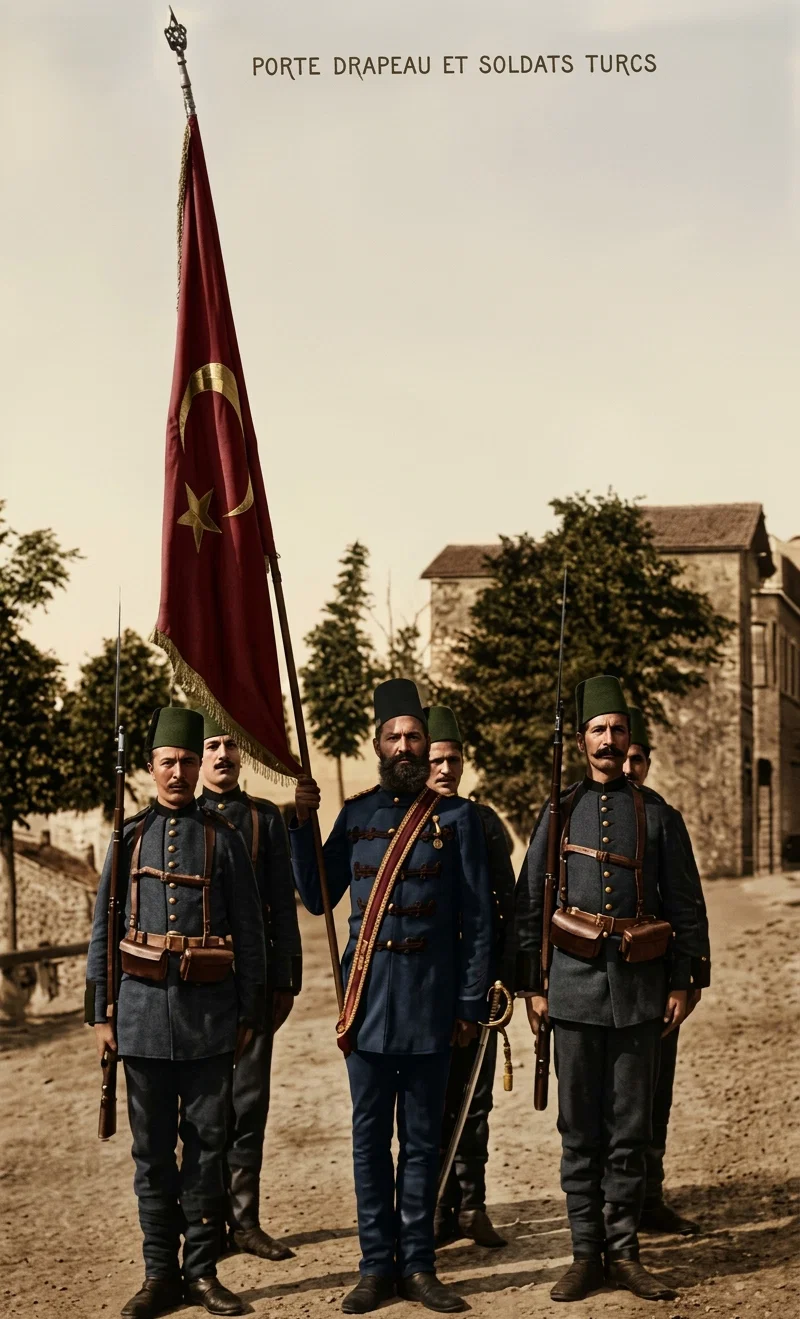
Standard and Soldiers of the Young Turks
The director of public health in Cuba reports very encouragingly concerning the suppression of yellow fever. He states that the “seeds of the fever” are no longer lurking in the island, that the last case occurred in December of last year, and that with the continued watchcare which the government exercises there is very little danger of importation from other countries. Of course there are mild cases of the disease, but not among the Cuban people, the older ones of whom are practically all immune. The child in the Cuban home is protected by a screen of immune persons, so that, even when an infected insect comes into such a house, the chances of its picking out the non-immune child are small. Those who have had the disease in recent visitations were quite generally groups of men, mostly laborers and rather recent arrivals, who lived apart from the Cuban families. Modern methods in the treatment of disease, and more especially improved sanitary conditions, have worked wonders in all tropical lands where wide-awake nations have taken a positive hand to better conditions. Formerly annual epidemics of plague and fever were the rule; now many such quarters of the globe are practically free from danger.
Liberty in Turkey
By Editor
In our issue of May 19, referring to the revolution in Turkey, we said that the meaning of the Turkish situation was that God would have His everlasting Gospel go to the Turks, and all within the border of Ottoman rule, and that even the meaning of the effort of Abdul Hamid to overturn the revolution was to more fully emphasize the need of reform in the Turkish Empire and to settle more firmly the young Turks in the possession of the government. We said then: “Thank God for the revolution; thank God for the open-swinging doors.”
Everything since that time has tended to confirm the fact that liberty is assured in Turkey. Just recently the publishers of “Pearson’s Magazine” sent the well-known world correspondent and publicist, Mr. James Creelman, to Turkey to investigate thoroughly the conditions there. Mr. Creelman reports fully in “Pearson’s Magazine” for August in an article entitled, “The Moslem Answer to Christendom.”
Mr. Creelman found the greatest liberty accorded to him in his investigations. He reports to us the assurances of the present Sultan, Mohammed V. He interviewed the Sheik-ul-Islam, the ultimate authority among Moslems, and whose decree deposed Abdul Hamid. He interviewed the Grand Vizier Hilmi Pasha, and the commanding general of the Turkish army, Mahmoud Chefket Pasha who captured Constantinople and dethroned Abdul Hamid. He interviewed many others, and all of them speak one and the same thing — that there is absolutely no persecution in the future for Christians, and that the Mohammedan religion does not teach it, that only rebellion and treason will be punished, that the recent Armenian massacres were not a religious question, but were instigated by Abdul Hamid for the purpose of overthrowing the revolution and more firmly establishing himself upon the throne; that the Turkish Parliament contains forty-three Christians and four Jews, and that a Christian and a Jew served on the committee that informed Abdul Hamid of his fate at the time of his dethronement. In the future a proportional part of the army will be made up of Christians. Christians now have the right to carry weapons throughout the Turkish Empire.
Mr. Creelman closes his article by asking us to remember that Sheik-ul-Islam and the ulemus, the strongest and most conservative power in all Mohammedanism, were the ones who deposed Abdul Hamid; and the future safety and liberty of Christians in Turkey is guaranteed as much by these devout, educated, and conscientious men as by the army that is now devoted to the defense of the Constitution and the principle of universal equality without distinction of race or religion.
He declares again:
“After careful investigation I feel no hesitation in saying that the Moslem religion and its real teachers are not to be blamed for the massacres in Asia Minor and that it is reasonably certain that Christians are safe in Turkey at last. The Sultan has said it, the Sheik-ul-Islam and the ulemas have said it, the parliament has said it, and the army has said it. Nobody but a blind bigot can be in Turkey to-day without realizing that a new day has dawned here for Christian and Jew alike.”
And so we say again that the meaning of the Turkish revolution is open doors for God’s work, and we thank God for the revolution; thank God that His hand is still guiding the nations, and that it matters not what they may contrive or plan, He will overrule it for ultimate good.
British Matters in India
Despatches from London inform us that a British official was murdered by an East Indian student. The news seems to indicate that the student is a typical representative of the way the great masses in India feel toward the British Government. On the other hand an indignation meeting has been held by Indian residents in London to protest against that murder. Taking a broad view of it, however, there are certain indications that British matters in India are not as smooth as they might be. These things will be considered in future articles of the SIGNS OF THE TIMES.
The Chains of Superstition
“EVERY human being who has any superstition is a slave. He may not feel his chains, but they rattle whenever something in his vicinity seems mysterious. He can't discriminate between prodigy and miracle, and like the savage he measures the natural by his own limited knowledge; all else to him is fate or warning, portent or ghost work.”
A Victory for Justice
There seems to be a unanimity of favorable sentiment among prominent men of the South over the settlement of the locomotive firemen’s strike on the Georgia Railway. The white firemen struck because negro firemen were employed at equal wages. The decision of the board of arbitration is that for equal and competent labor the negro shall have equal pay. His right to earn a living shall not be denied. According to the Literary Digest the Southern press generally regard the decision as favorable.
World’s Highest Chime of Bells
The highest chime of bells in the world is being placed in the Metropolitan Life Insurance building of New York. They will be hung 689½ feet high; their aggregate weight is more than seven tons. The largest weighs three and one half tons and the smallest 1,500 pounds. The bells will be stationary, the clappers will do the swinging. The bells, beginning with the largest, are keyed respectively in E-flat, A-flat, B-flat, and C. Their tone is especially deep, and it is estimated that they can be heard twenty miles.
Drink and Divorce.
According to the United States Census Bureau, nearly one fifth of the divorces of this country are due to drink, and it is doubtless a contributing cause of many more cases. Drink is a source of a multitude of evils.
Daylight-Saving Ordinance
Cincinnati has adopted what is sometimes called the “daylight-saving ordinance;” that is, an ordinance which turns all the clocks in that city one hour ahead of standard time between May 1 and October 1, beginning in 1910. In that case the workman would begin work one hour earlier and in a stated day quit one hour earlier. It is receiving general approbation. After testing, it may be otherwise.
Calvin versus Darwin
There is much discussion in the religious press and in the literary reviews just now over Calvin and Darwin. The real question ought to be between Creation and Evolution. Did all that is good and high and noble come by evolution? We know that much of evil came by devolution. Is the only hope given of God to fallen man the Darwinism hypothesis? Nay, our God is Creator, and Restorer by creative power.
The Hudson-Fulton Celebration
The Hudson-Fulton Celebration is one of the great features of the program for the year 1909. This is to be the tercentenary of the discovery of the Hudson River, and the centennial of the introduction of steam for navigation by Robert Fulton. The celebration embraces a great naval demonstration and a series of events occupying the time from September 25 to October 3.
What Would Be the Result?
The New York Observer says: “When any question of Sunday usage arises, each person should view it from Jesus’ point of view and make out whether or not it accords therewith.” But what would that mean?—Indubitably the Sunday would be regarded as a common work-day, and the Sabbath of Jehovah, the seventh-day Sabbath, would be observed. Amen, say we to the Observer’s advice. Follow Jesus in teaching, in example, and become true Christian Sabbath-keepers.
The Northland Mission in Scandinavia
By J. C. Raft
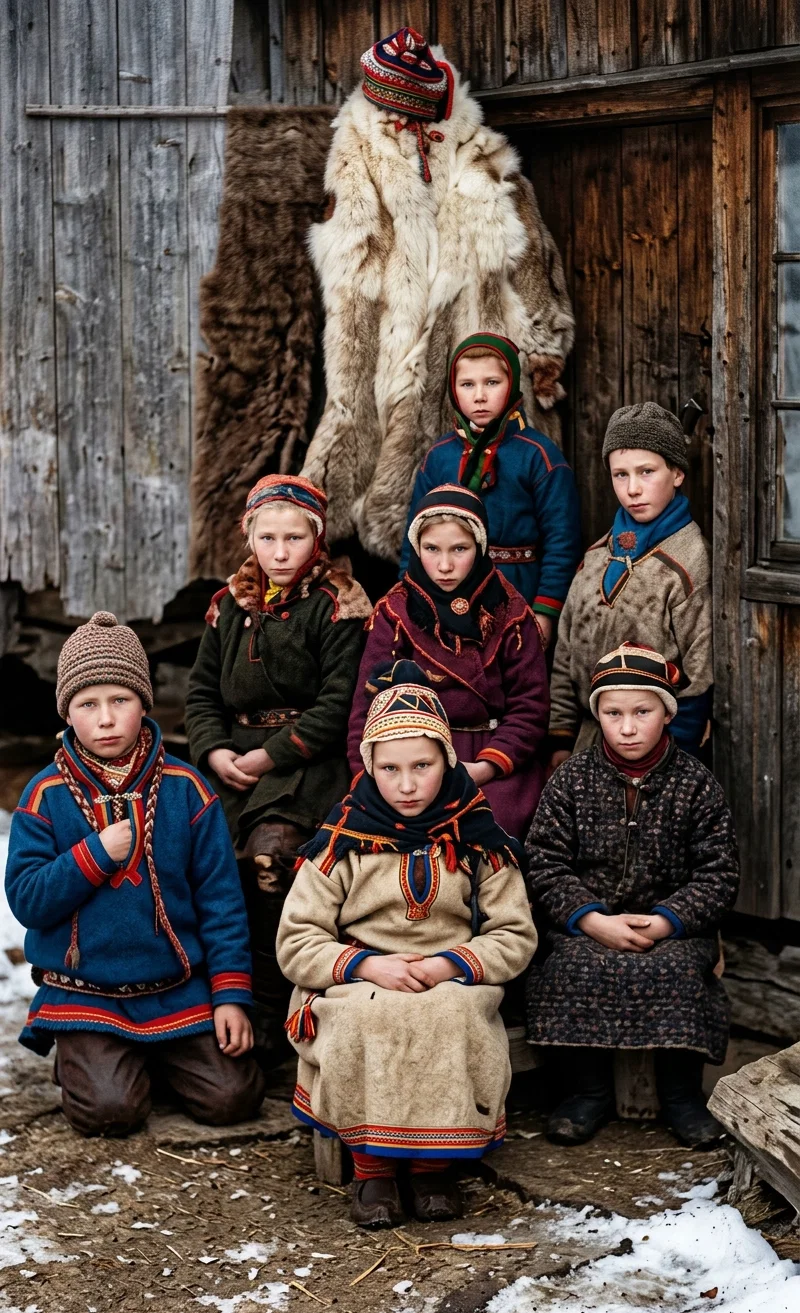
Four years ago it was decided to form the northern part of Sweden and Norway into a mission field. The idea was good; and if the results have not been just what we would have desired, it is largely due to the fact that we have not cared for this field as we should have done. Part of the time it has been left alone. We have 111 members in this field, ninety on the Norwegian side, and twenty-one on the Swedish. Northland has grand natural beauties, and a trip on a steamer among the island of the far North, surrounded by majestic mountains, on a summer night, with the midnight sun so gentle and beautiful, presents a sight worth seeing. I made a trip up there last summer, holding several meetings (on the Norwegian side); and my impression was that here we have a splendid field for work if we only had the laborers. But we have only one on the Norwegian side and three on the Swedish. Something must be done to supply this needy and neglected field with workers; and I beg leave to ask America to give us a good worker for the Northland Mission.
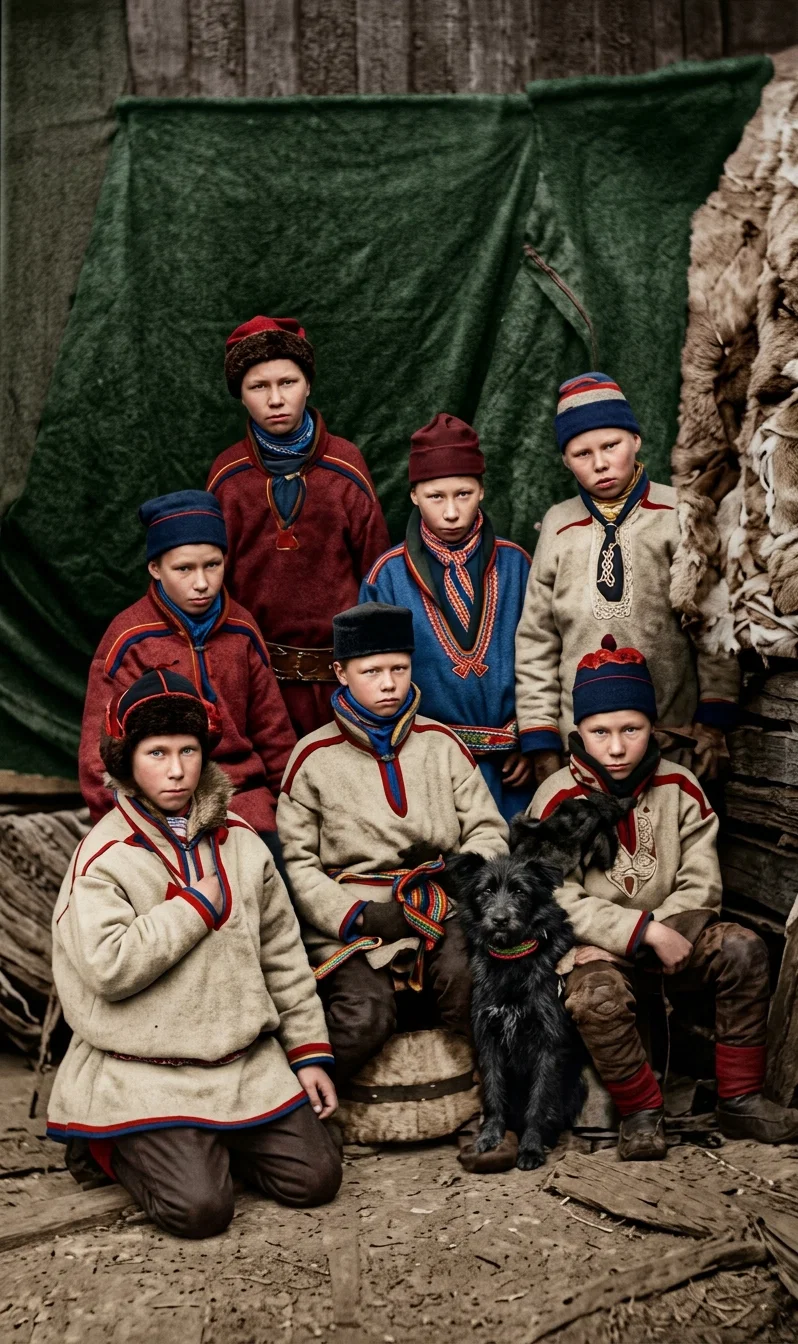
Lapland Boys
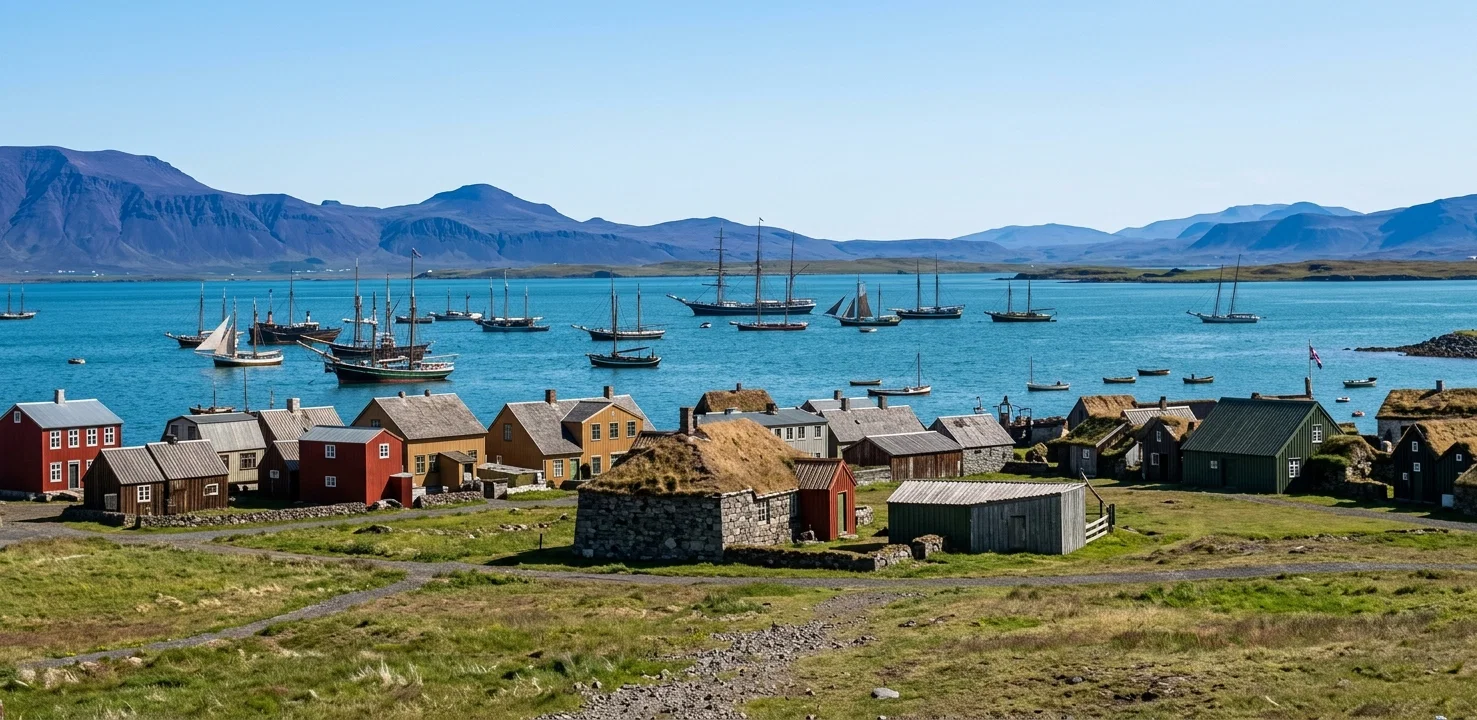
Harbor of Reykjavik, Iceland
S. D. A. Church in Reykjavik, Iceland
Laplanders
Last fall we sent a young man and his wife to the Faroe Islands. He started in as a canvasser, and God has abundantly blessed him, giving him a success far exceeding our highest expectations. He intends to continue his canvassing work till next fall, and will then begin a series of meetings.
Iceland
I visited Iceland last summer. It covers an area of 104,785 square kilometers (or 39,756 square miles), and has some 80,000 inhabitants. The country is very thinly populated, and one may often ride for many miles without seeing a house. It is now about thirteen years since Brother Ostlund first left for Iceland to begin work there. He first had to learn the language. The Lord helped him so that in a comparatively short time he was able to speak and write the Icelandic. Brother Ostlund has been working as minister, editor, translator, and printer. He has had many difficulties to encounter in his work, but God has blessed and prospered him in his efforts, so that we now have forty members, besides fifteen who keep the Sabbath but have not yet been baptized, making the total number of Sabbath-keepers fifty-five. During the last four years, thirty-eight have been baptized and received into the denomination, fourteen of them in 1908. And now that the foundation has been laid, we may be justified in expecting still greater advancement.
In speaking of Iceland, I must not forget to say just a few words about Brother Nils Anderson, who is Elder Ostlund’s right hand. Brother Anderson is busy at work summer and winter, selling books and tracts, and soliciting subscriptions for the Fraekorn (“Seed-Corn”), our Icelandic paper. In the summer he rides horseback all the day long, roaming about in the country; and in the winter he visits the cities along the coast. That the Fraekorn has four thousand subscribers, is partly due to Brother Anderson’s persistent labors. Generally speaking, there are no roads in Iceland, and for this reason traveling is often quite difficult. Brother Anderson does not permit difficulties and hardships to stop him in his work. If, for instance, he comes to a river or a creek, he dismounts, undresses, binds his clothes in a bundle, mounts the horse, and so crosses the water. As to lodging at night, he has to be satisfied with what he can get, and the same is true in regard to food. The houses are so far apart that he can visit but seven families a day, as a rule, if he works ten hours. But he never complains about his difficulties or troubles. Strong in faith, and with a heart full of the love of Christ, he surmounts all obstacles, and searches for his fellow men in order to carry to them the glad tidings that Jesus is soon coming. Brother Anderson studied for several years before he went to Iceland, and last summer I spoke to him about entering the ministry. But his answer was, “Brother Raft, who is then to take up my work? and how will it be with our good paper? No, please let me continue my work for three years more; and if you by that time have another man to put in my place, I will not object to making an attempt in ministerial lines.” He was right: it will be no easy task to find his successor.13
I wish to say here that as there are some 20,000 Icelanders in North America, mostly in Canada, it would be a good thing to have some arrangement made for a united effort on the part of America and Iceland in the matter of the preparation of literature in the Icelandic language.
Iceland is a poor country; and for this reason the prospects for our work over there are not as promising as might be, looked at from a financial point of view. The union must, therefore, be prepared to render some assistance to that field. Indeed, we hardly dare to hope that Iceland shall ever become self-supporting. It is encouraging, however, that also in this respect some improvement may be seen.
As you pray for Scandinavia, dear brethren, do not forget us. As I look upon this field, and hear so many Macedonian calls for help, my heart bleeds. We have done almost nothing yet. I might mention a large number of cities where meetings on present truth have never yet been held; large towns and country districts are also untouched. Everywhere the fields are white for the harvest. But we lack workers, especially young, consecrated workers, who will not shun difficulties. And they must have education; for the people of Scandinavia require much from one who appears before a public assembly.
I love Scandinavia and my people, and thank God for having been permitted to work in that field. I consecrate anew my time and my powers to the dear Saviour and to His cause. It is a glorious privilege to work for God, and nothing can cheer the heart more than to see His cause prosper, to see souls converted to the Lord. The coming of Christ is near at hand. The battle will soon be past; the controversy will soon be over; and then throughout the endless ages of eternity, we shall be in the presence of our dear Saviour! J. C. RAFT.
Hope Ever
By Chas. Mackay
It is better to hope, tho the clouds hang low,
And to keep the eyes still lifted;
For the sweet, blue sky will soon peep through,
When the ominous clouds are rifted.
There was never a night without a day,
Nor an evening without a morning,
And the darkest hour, as the proverb goes,
Is the hour before the dawning.
—Chas. Mackay.
ELO THE EAGLE AND OTHER STORIES
By Floyd Bralliar
BY FLOYD BRALLIAR
THIS new animal book for young folks is receiving an eager welcome by all nature lovers. ELO THE EAGLE is the first of a series of ten interesting stories of animals, wild and otherwise; being, with one exception, the life histories of boyhood friends of the author. Many strange and laughable anecdotes are related by Mr. Bralliar, all of which are strictly true and vouched for by reliable witnesses.
The book is lavishly illustrated by special drawings, with a full-page half-tone design printed in Luxotype at the beginning of each chapter. Two hundred pages, printed on egg-shell paper, beautifully bound in red cloth. Price, post-paid, $1.00.
Easily sold by young people. Agents wanted.
Pacific Press Publishing Assn.
Mountain View, California
Portland, Ore. Regina, Sask., Can. Kansas City, Mo.
Matthew Twenty-four Second Coming of Christ
An exposition, verse by verse, of one of the most striking chapters in the New Testament; covering
Matthew Twenty-four Second Coming of Christ
our Lord’s great discourse on the destruction of Jerusalem, the end of the world, and the special signs of His second His children. The facts of fulfilment given make this pamphlet worth many times its price. 94 pages, price 10c.
PACIFIC PRESS
Mountain View, Cal.
Our Work and Workers
A NUMBER have accepted the truth as a result of meetings in Orland, Ind., recently.
SABBATH, June 26, sixteen were baptized at Newark, N. J., by Elder W. H. Smith.
FOUR new converts to the truth were recently baptized at the Chicago German church.
A VERY pleasant and profitable summer school is in session at the college at Berrien Springs, Mich. About one hundred from the Lake Union Conference are in attendance.
CHRISTIAN EDUCATION is the new organ of the Educational Department, and is to be conducted as a bimonthly magazine, five numbers in the year. Frederick Griggs is the editor, and W. E. Howell, assistant editor.
MEETINGS of an important significance have just begun in Portland, Me. It was from this point that the message went forth in the early days. According to important counsel it is now time to work diligently in the East.
PROFESSOR W. E. HOWELL, lately of Greece, has been invited to take the principalship of the Correspondence School at Washington, D. C. This school is to conduct courses of study in Bible, English, history, New Testament Greek, and mathematics.
WE acknowledge the receipt of the “Second Annual Calendar of the Royal Intermediate School,” of Cottage Grove, Lane County, Ore. The school is located near Cottage Grove, and is a Seventh-day Adventist institution. The school is young and in need of equipment, but is a growing institution. Those interested in helping or who desire to attend should address the principal, G. E. Johnson, Cottage Grove, Ore.
THE following workers have recently sailed for foreign countries: E. F. Forga for England to work on Spanish translations, and to study the Bible in our British training-college. Elder J. W. Hofstra, of West Michigan, with his family, sailed last week for Holland to study previous to going later to Java, in the Dutch East Indies. Max Trummer, of Union College, for South America to labor in the interests of the book work. G. H. Clark, of the Chesapeake Conference, to South Africa in the interests of the book work. Dr. R. H. Habenicht to Argentina to push forward the sanitarium enterprise so encouragingly begun there.
THE work in Haiti began in a wonderful way. In 1879 Elder Loughborough, who was then located in Southampton, England, sent out a box of tracts and papers to Cape Haitien. This literature was not consigned to any one in particular, and so fell into the hands of the agent of the steamship company. This man, taking no interest in religious things himself, turned the box and its contents over to the Episcopal missionary stationed in the city, who distributed its contents among the other Protestant missions. The Sunday following, the Baptist missionary circulated some of this literature among those who were in attendance at his services. Among others to receive an assortment of these pages of truth was a Jamaican, who, after reading what was given him, began, with his wife, to observe the Sabbath.