The Youth’s Instructor, Vol. 31, No. 22.

SIDON

The Youth’s Instructor

May 30, 1883

S. D. A. Publishing Association · Battle Creek, Mich. · May 30, 1883

SIDON

THE blue waters of the Mediterranean have bathed the feet of many a queenly city; but perhaps none have a more interesting history than the ancient town of Sidon, situated on the edge of the beautiful plain of Phenicia, between Tyre and Beirut, and about one hundred and twenty miles north of Jerusalem.
The history of this city stretches far back into the dim past. More than three thousand years ago, when the combined armies of the Canaanites had been defeated by Joshua at the waters of Merom, they took refuge behind the strong walls of “Great Zidon.” Notice that even then it was called great. But further back than this, in the record of Genesis, we learn that this city took its name from Sidon, the great-grandson of Noah. In the days of Solomon it was the men of Sidon who were chosen, because of their great skill, to hew and fashion the fragrant cedars of Lebanon for the temple of the Lord at Jerusalem.
Sidon was situated on a small promontory of land jutting out obliquely into the sea, and thus had one of the finest natural harbors on the coast. Sidon was noted for her shipping, and for centuries was mistress of the seas, finally dividing the honors with her daughter Tyre, situated twenty miles farther down the coast. The fame of Sidon was known in every land, and men of all nations sought unto her; but because of her greatness and glory the inhabitants became proud and lifted up in heart and grossly wicked; and the curse of God fell upon the powerful city. Its punishment, however, has not been so severe as that of Tyre, upon which were pronounced and fulfilled some of the most sweeping and terrible curses in the whole scope of prophecy.
A comparatively small town, numbering about nine thousand inhabitants and known as Saida, now stands on part of the site of Sidon. It is said to be one of the most picturesque towns in Syria, and did we not remember its former greatness, it might be considered quite a thriving town. You approach the city through lovely gardens, orange and lemon orchards, and fields of wheat and barley waving above the buried stones and columns of the once proud Sidon. All this greenness helps to give to the environs of the old city a look of eternal spring.
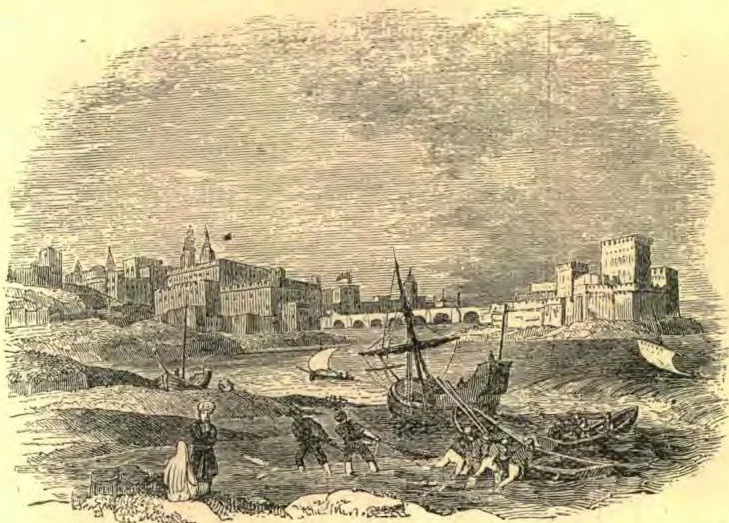
You are charmed with your ride, and rejoice that you have found so beautiful a town in that land of ruins; but as you pass under the arched gateway and enter the narrow, dirty, vault-like streets, with their dogs and donkeys, and shouts and cries, you realize that you are still in a Turkish town. But the inhabitants seem to be better off than those of many of the towns, and the houses are larger and finer. From the flat roofs of some of them a beautiful view of the surrounding country is obtained. The little city is closely packed within its walls, with the blue Mediterranean before it, and rich gardens of fruit trees sweeping in a curve about it landward, while back of them rise the hills of Lebanon, height above height, with many a village, and groves of olive and mulberry trees. One ruined castle crowns the high ground back of the town; another, which was once the defense of the city, stands on a rocky islet amid the waves, and is connected with the land by a broken bridge. Both it and the bridge are plainly shown in the picture on this page, which gives a view of Saida, from the north. The once excellent harbor is so filled with drifting sand that only small vessels may enter; and in place of the mighty fleets that once anchored there, may be seen a few fishing boats and small schooners.
The American schools are an interesting feature of Saida. Some American missionaries have gone there, within the last quarter of a century, and established schools for Syrian boys and girls, where they are taught not only the common branches of learning, and the customs of civilized life, but a knowledge of the Christ who gave his life for them and us. They have both meetings and Sunday-schools conducted in Arabic, the language of the natives. The church edifice is a neat building of cut stone in the very heart of the city, and, strange to say, it stands on the ground where formerly stood a Moslem court of justice.
These good missionaries meet many difficulties in their work, but they have the satisfaction of seeing numbers of the Syrian youth, who must otherwise have come up in the deepest ignorance, fitted, some to build up Christian homes in this land of darkness, and others to go forth as missionaries and teachers to the little villages which are scattered so thickly over the mountains of Lebanon. And in that glad day so soon to dawn, when they shall come from the east and from the west, the north and the south, to sit down with Abraham, Isaac, and Jacob, in the kingdom of God, no doubt many will be gathered in from this part of the great harvest field. E. R. G.

COUNT CONRAD.

“Oh, that God would give me something great and good to do for him!”
Thus mused the young Count Conrad, as he knelt one night at the oak-paneled window of his own old, gray castle. No more beautiful place was there than that same castle, with its broad, shady paths and soft, green sward. The box hedges, cut into many fanciful shapes, were the pride of the gardeners, while the masses of silvery birch, copper beeches, and hoary oaks, were the admiration of the surrounding country. The Count von Edelstein was not thinking of his broad possessions as he leaned with his little hands clasped, and his chin resting on them. Still less did he think of what a pretty picture he made there, with the moonlight burnishing his fair hair and glinting in his blue eyes. He, like many other boys in different positions in life, was longing for some “great and grand event” of his life to happen. But just then it was a small thing that happened. A snow-white dove, wheeling overhead, was pounced upon by a hawk, and fell into the shining mere below. Heedless of the fact that he was half undressed (he was preparing for bed), his velvet doublet off and only in “hosen,” he bounded out. Down to the lake he rushed, but no boat was on the bank. Lying near, however, was an empty barrel, and one or two small planks left by some careless workmen. Quickly Conrad rolled the cask into the water, and using a plank as a paddle, propelled the insecure bark into the center of the little lake. Crazily it rocked about, as he reached the dove, and leaned over and seized it. Poor little thing! its pinions were broken—every feather was drenched and draggled. Carefully Conrad placed it in his bosom; and then, freighted with its precious burden, the frail boat was urged back. Frau Trüdchen, his nurse, watched it with sickening anxiety, only shown by the severe rebuke she administered to her young master as he landed safe and whole.
“Don’t scold, Trüdchen, now the little dove is safe,” pleaded the boy; and as he walked back, he gently smoothed the white feathers. Frau Trüdchen paced behind him, muttering, “He’s made for something great!—such care and tenderness, in spite of his wilfulness!”
Conrad did not muse any more that night on the grand things he wanted to do, but fell asleep, glad to have saved the dove. His hand had found something to do, and he had done it with all his might.
It is forty years after. The same old castle is little altered. A few more mosses on the stones, a broader expanse of gray lichen on the oak bark—that is all. But inside—what a change! No dreamy boy now is Count Conrad. Middle aged, and very happy. “Happy are these thy servants, who stand continually before thee,”—happy with a joy not of this world. He who was faithful in little has also been faithful in much. The beautiful house is now an orphanage, where Conrad delights to teach the children that they have a Father in heaven. The broad, shady walks are pressed by the feet of once sad, sickly children. The carved walls echo with their shouts of joy or hymns of praise. “Mein vater” (my father) the children love to call their benefactor. Fair-haired Elsie and eager Fritz, sober Joan and bright-faced little Eva, all unite in returning him the love he showers upon them. But it is at night, when the merry voices are hushed and the pattering feet still, that the Count von Edelstein reaps his richest reward. Then, on his knees at the mullioned window, where he leaned as a boy, with his head laid on his clasped hands as of yore, he thanks his Lord for the work given him to do. In reply he hears the whisper, “Inasmuch as ye have done it unto one of the least of these, my little ones, ye have done it unto me.”—Selected.

UNDER THE SPRINGTIDE SKY.

BREATH of the wakening year, And waters cold and clear! Mists from the banks of the lake arise To join the clouds in the dim, gray skies; Streams rush down from the mountain side To swell the flood of the river wide; And over the hill-tops high and grand Hastens a breeze from the southern land.
O songs of birds in the air, And sunshine everywhere! High on the maple above my head The blue-bird perches where buds are red, And utters softly his clear, low call. The gray clouds open, and over all The marvelous glow of the sunshine breaks— The robin comes, and the earth awakes!
O forest no longer dumb, The glorious days have come! Afar in the woods the wild vines creep Over the mosses, and cold brooks leap Among the rocks in the wild ravine. Gaily the trees put on their green, And in the branches the blithe birds sing Till the dim retreats of the forest ring! — Henry R. Norr.

PALESTINE POTTERY.

The biblical descriptions of pottery are singularly applicative to the present process of manufacture. Now, in this nineteenth century, the potter sits at his frame, and turns the wheel with his feet. Or, as we read in the Apocrypha: “So doth the potter, sitting at his work and turning the wheel about with his feet: he fashioneth the clay with his arm.” The potter had a heap of the prepared clay near him, and a pot of water by his side. Taking a lump in his hand, he placed it on the top of the wheel, which revolves horizontally, and smoothed it into a low cone, like the upper end of a sugar-loaf; then thrusting his thumb into the top of it, he opened a hole down through the center, and this he constantly widened by pressing the edges of the revolving cone between his hands. As it enlarged and became thinner, he gave it whatever shape he pleased, with the utmost ease and expedition.
It is evident, from numerous expressions in the Bible, that the potter’s vessel was the figure of utter fragility; and to say, as David does, that Zion’s King would dash his enemies in pieces like a potter’s vessel, was to threaten with ruinous and remediless destruction.
We who are accustomed to strong stone-ware of considerable value, can scarcely appreciate some of these biblical references, but for Palestine they are still as appropriate and forcible as ever. Arab jars are so thin and frail that they are literally dashed to shivers by the slightest stroke. Water jars are often broken by merely putting them down upon the floor; and the servant frequently returns from the fountain empty-handed, having had all his jars smashed to atoms by some irregular behavior of the donkey.—Harper’s Magazine.

THE BROOK WITHOUT A BLESSING.

“Well, good-by,” said the brook to the spring; “I am in a great hurry to get to the river. It’s a beautiful morning, and I shall run straight down the mountain. I have no time to go twisting and twirling about like my sister over there.”
“The shortest way is not always the best,” replied the spring. “If you take a straight line through everything, you will miss a great many pleasant places.”
“Never mind; I want to start to the river. If I reach it safely and quickly, it does not signify what I miss.”
“Yes, it does. You’ll fall into the river without a blessing, and not a flower on the mountain will be sorry when you’re gone.”
The brook only laughed, and rippled away in the sunshine.
“Come and bathe my roots,” called a daisy, as he rippled past her like a thread of silver shining in the grass.
“What! lose a precious minute, and make a curve in my course for the sake of a little flower like you? Nonsense!” cried the brook; “wait until the dew comes down to-night.”
So the poor daisy grew weaker and weaker, and when the dew came, she was dead.
“Cool my leaves for me,” said a young birch tree. “I’ve been standing here in the sun for a long time.”
“I cannot possibly take all that jump over those great rocks,” replied the selfish brook. “There is my sister not far off; ask her to come round your way.”
But the sister brook had other leaves to cool, and she could not help all the thirsty trees.
Quickly down the mountain went the brook, only caring for his own will and pleasure, and the flowers and leaves called to him in vain.
“I must get to the river,” he said; “and I really have not any time to waste over my neighbors.”
His sister did what she could, and her course was very winding; for when a flower spoke to her, she turned aside to listen, and the grateful blossoms gathered dew-drops from her, and showered them over her as she passed by. The trees bent down to shade her from the sun when she came near to bathe their roots and cool their hot leaves; and she flowed so quietly down into the river at last that her brother never knew she was there until the river spirit called her by her name.
“What have you done since you left the spring?” he asked.
And the little brook answered that she was sorry that she was so long on the way, but that there were many thirsty flowers, and she could not bear to hear them crying.
Then a beautiful sound came floating through the air like the very sweetest music, and the river spirit said,—
“Listen! the voices of the flowers are singing your praises, little brook, because you waited and flowed for their sakes.”
“But there is not a voice to sing your praise,” he added, as he turned to her brother. “The grass is no greener, and the flowers are no fresher along your course. You have come down into the river, but you are not welcome. You are hard-hearted and selfish,—a brook without a blessing.”
—Exchange.

SAVED FOR GREAT PURPOSES.

One night, in a small town in the north of England, a clergyman’s house caught fire. The fire burned so fiercely that there was only time for the family to run for their lives. Some of them were scorched and burnt as they escaped. But one child, not quite six years old, was left in the house. The light from the fire woke the little fellow up. He jumped out of bed and ran to the door, but the flames drove him back; then he cried for help. His father heard, and tried to get up the stairs to him, but he could not force his way through the fire. The father thought his poor son was lost—he must be burned to death. But he knelt down and prayed to God for him. The little boy ran to the window, mounted a chest that stood under it, and called to the people below. Somebody saw him and shouted, “Fetch a ladder!” But there was no time for that; the flames had seized the roof, and it was plainly about to fall in. So one man leaned against the wall, and another stood on his shoulders to reach the boy down. The boy now leaped into his arms and was saved—“a brand plucked from the burning.” I dare say most of you know who that little boy was. It was John Wesley. God had a great work for John Wesley to do, and he kept him alive to do it.
Two boys were fencing; that is, pretending to fight with swords as though they were soldiers. They had real swords with a button on the point of each, to prevent their hurting one another. One of the buttons broke, and the sharp sword ran through the side of one of the boys, and nearly killed him. But it just missed the most dangerous place, and by and by the wounded lad got better. Another time the same boy was swimming in deep water; the ribbon which tied up his hair got loose and caught his leg; he struggled to free himself, but could not. He was about to sink, when the ribbon loosed itself, and he was safe. Another time, when he had grown to be a young man, he was swimming in the river Rhine, which is a very broad and rapid river; he did not notice where he was going, and soon was in the very midst of its strong current. He said, “The water there was extremely rough, and poured along like a galloping horse.” It carried him on till he struck against the strong timbers upon which a mill was built. The stream forced him under the mill, and he became quite insensible. When he came to, he found himself in a piece of smooth water, the other side of the mill. Some men helped him on shore. He had been carried five miles from the place where he plunged into the water, yet he was not hurt in the least. The person I have just told you about was John Fletcher, afterward one of the holiest men that ever lived. He became a great friend of John Wesley, and did much good as a minister of the gospel. God had work for John Fletcher to do, so he would not let him die.
Perhaps you have never been in such danger as John Wesley and John Fletcher were. But you must remember that God keeps you every day and every hour. Any day an accident might happen to you, or you might be taken ill and die. God keeps you alive and guards you from all harm because he has work for you. Will you ask him, “Lord, what wilt thou have me to do?” And will you try to live so that when you see what he wants you to do, you may be able to do it? But remember, the very first thing God wishes in those who serve him is that they love him; and then, though he may not give you quite as grand and well-known work as he gave John Fletcher and John Wesley, you can all be as good. God will find you the work you can do best.—Covenant.

MAY

I FEEL a newer life in every gale; The winds that fan the flowers, And with their welcome breathings fill the sail, Tell of serener hours,— Of hours that glide unfelt away Beneath the sky of May.
The spirit of the gentle south-wind calls From his blue throne of air, And where his whispering voice in music falls, Beauty is budding there; The bright ones of the valley break Their slumbers, and awake.
The waving verdure rolls along the plain, And the wide forest waves, To welcome back its playful mates again, A canopy of leaves; And from its darkening shadow floats A gush of trembling notes.
Fairer and brighter spreads the reign of May; The tresses of the woods With the light dallying of the west-wind play; And the full-brimming floods, As gladly to their goal they run, Hail the returning sun. —James Gates Percival.

GETTING HELP FROM THE BIBLE.

VERY much depends upon the spirit with which we come to the Bible. Many think if they read a certain portion every day, though they give no thought to the meaning, that they have done a holy service, and are safe for the day. But the mere reading of so many chapters does no one any good. It would be as well to say Latin prayers, and fumble over a string of beads for ten minutes. To receive a blessing from the Bible it must be read thoughtfully with inquiry and meditation. It must be allowed to read itself into our heart and life.
It is important to have a good copy of the Bible, well bound, with clear, plain type and with references. On many passages there is no commentary so helpful as the reading of the references. Scripture interprets scripture. Hence, a copy without references is shorn of much of its value. We want a copy, too, that will last for many years. A book is like a friend; it grows familiar and confidential with use. At first shy and distant, it lets us into its heart after we have long pored over its pages. It opens of itself to the choicest chapters, and it seems to carry its sweetest secrets on the surface for us. A Bible that we have long used seems to say things to us we never hear from a strange or new book. Besides, it is good to mark our Bible as we read it. Any precious passage that we find may be indicated on the margin by some sign or by drawing a line about it or under the sacred words. Thus we write our own spiritual history on the pages of our Bible. These marks are memorials, also, showing where we once found blessing,—stones set up to mark our Bethels and Peniels and Ebenezers. A book thus read, and holding on its pages such treasures, becomes in a few years inestimably sacred and precious. Hence the importance of having at almost any cost a good copy of the Bible,—one that can be used for a lifetime.
No one can afford to dispense with the old-fashioned way of reading the Bible through consecutively. It is well to do this every year. Some open at random, and read whatever comes under their eye, without method or plan. Others read over and over a few favorite passages. In both cases large portions remain neglected, and are never read at all. Reading the whole volume by course, in regular, daily portions, we become familiar with every part, and discover the very richest things in places where we least expected to find any beauty or blessing.
In the daily life of each one there arise peculiar questions and experiences on which we want light, or in which we need counsel and guidance. These should be taken at once to the divine word. Thus we bring the book of life into our daily history. We make it our counselor, our lamp, our guide. This leads to another method of reading and study which is very profitable, and which yields great help.
The habit of having a verse for the day has also been adopted by many, and has been a source of great comfort. Either out of the morning’s chapter, or selected in some other way, let one verse be taken, fixed in the mind, and carried all through the busy day in thought and meditation. It will often prove a fountain of water, a bright lamp, or a rod and staff before the day comes to a close. It is impossible to estimate the influence of a simple passage thus held all day in the thoughts. It keeps us from sin. It is a living impulse to duty. It is an angel of comfort in sorrow. Then its influence, as it pours its soft, pure light all through the life, hour after hour, is full of inspiration, and purifies, cleanses, and sanctifies.
We must come to the Bible in the spirit of docility, ready to be taught. We must hear the voice of God in its words. Some read it, not to learn what they ought to believe, but to find in it what they themselves do believe already, to have their opinions confirmed or their conduct justified. Only those who come as little children, with teachable spirits, to hear what God will say, and be ready to accept it, however it may clash with their own opinions and preferences, can find the Bible an open book disclosing to them its most precious things.—Week-day Religion.

LITTLE FAULTS.

As two ship-builders were sawing away at a piece of timber one day, they found a bit of it worm-eaten.
“We’d better not use that piece,” said one of the workmen.
“Why, we have had trouble enough with it!” said his companion; “’tis a pity to throw it away. Nobody will see it, and it is only a little decayed;” so they put it in.
After a while the ship was finished. With flags flying, and the merry strain of music, she was launched. She went to the north seas to hunt seals and walruses. She was highly successful, and was nearing home, and had almost reached the harbor, when a storm came on. For a while she stood it bravely enough. Then suddenly she sprung a leak. In came the water through the worm-eaten plank. The sailors struggled against it in vain, and but for the life-boat, all of them would have gone down, with her rich cargo, to a watery grave—and all through one worm-eaten plank!
Look after little failings now. It will be too late to mend by and by.—Labor of Love.

NEEDLES' EYES.

In Oriental cities there are in the large gates small and very low apertures, called metaphorically “needles’ eyes,” just as we talk of windows on shipboard as “bull’s-eyes.” These entrances are too narrow for a camel to pass through in the ordinary manner. When a loaded camel has to pass through one of the entrances, it kneels down, its load is removed, and then it shuffles through on its knees. “Yesterday,” writes Lady Duff Gordon, from Cairo, “I saw a camel go through the eye of a needle; that is, the low arched door of an inclosure. He must kneel and bow his head to creep through; and the rich man must thus humble himself.” This explains the meaning of the passage in the New Testament: “It is easier for a camel to go through the eye of a needle than for a rich man to enter into the kingdom of God.”

NEW-TESTAMENT HISTORY.

LESSON 137.—REVIEW.

1. How long was it from the resurrection of Jesus to his ascension? Acts 1:3.
2. How long was it from his resurrection to the day of Pentecost?—About fifty days.
3. How did the disciples spend the time between the ascension of Jesus and the day of Pentecost?
4. Tell how the Lord manifested his power on the day of Pentecost.
5. Give a brief synopsis of Peter’s sermon on that day.
6. How many were added to the church as the result of that day’s labor?
7. How did these disciples prove the genuineness of their conversion?
8. Relate the circumstances attending the miracle performed by Peter and John on the man who sat for alms at the Beautiful gate of the temple.
9. What commotion did this miracle raise among the people?
10. How did Peter explain the miracle, and at the same time show the people their guilt?
11. What hope and consolation did he hold out to them? Acts 3:19–22, 25, 26.
12. What did this course on the part of the apostles provoke the priests and rulers to do?
13. Tell what took place when the apostles were brought before the high priest and all the assembled council of the Jews.
14. Describe the meeting of the disciples when the apostles returned to them, after being released. Acts 4:23–32.
15. Tell how deception was punished in the persons of Ananias and Sapphira. Acts 5.
16. Describe the prosperity that attended the church at this time.
17. How did the high priest and his supporters show their indignation at seeing so many express faith in the despised Nazarene whom they had crucified?
18. Describe the mock trial that came off the next day.
19. When the disciples had become very numerous, what steps were taken to secure an impartial distribution of gifts to the poor?
20. Relate the circumstances that led to the bringing of Stephen before the Sanhedrim.
21. What did Stephen give them in brief outline?
22. What cutting reproof did he subjoin to this history? Acts 7:51–53.
23. What did Stephen bring upon himself by giving this reproof? Verses 54–60.
24. What great persecution followed the martyrdom of Stephen? Acts 8.
25. What part did Saul take in this work?
26. Who went down to the city of Samaria, and preached the gospel there?
27. With what encouragement and success did he meet?
28. What peculiar character was among those who embraced the faith of Jesus in this place?
29. What had been his former occupation?
30. How had he succeeded in deceiving the people?
31. Describe the visit of Peter and John.
32. What course did Simon pursue, and how was he rebuked?
33. Describe the conversion of the Ethiopian eunuch.

Expecting Difficulties in the Path of Obedience

We are not to be surprised at difficulties, even in the path of obedience.

Why Primary Sabbath School Classes Need the Best Teachers

THE younger the scholars, the more important their teaching. It is a great deal easier to get a good Bible-class teacher, than to get a good teacher for a primary class. The lack of good teaching may not show so readily in the younger class as in the older one; but it is only the worse for being concealed. Adult scholars will be likely to quit a poor teacher. Little folks must stay and suffer. Pastors and superintendents ought not to lose sight of this truth in their Sabbath-school management. In looking up teachers, and in assigning them to duty, let the younger scholars always have the preference. Many a teacher will answer for grown-up scholars who is by no means sufficient for a class of little folks.

LACIE’S TRACKS.

MAMMA, what do you keep that ugly stone on the what-not for?” asked Lacie one day, as she was helping her mother dust the parlor.
“That stone! Why, I value that stone very highly,—more than all the rest.”
“I am sure it is not half so pretty as those pink-and-white corals, or those lovely tinted shells.”
“No, it is not a pretty stone. But see here! Didn’t you ever notice it?”
“No. What made that rough place?”
“It is a bird’s track.”
“A bird’s track! A bird make a track in the hard stone!”
“No; this was made ages ago, when the rock was soft like mud. After long years, this mud changed into stone; and as the track remained undisturbed, of course it would appear in the stone just as it had in the mud.”
“Is this the only track that was ever found?”
Fig. 22
Fig. 22
“O no! there have been hundreds of them found. Some of them are very small, as if made by birds no larger than a sparrow; while others are much larger than the feet of any birds we have nowadays. Just by the footprints on the stones we can tell very nearly what kinds of birds lived ages ago.”
“How strange! Do people ever make tracks that will last always?”
“Yes; we are all making them every day.”
“Me! I make tracks! I make them in the dust sometimes, but the winds and the rains soon destroy them. Last winter I made some in the snow, but they melted.”
“I think I saw you make a track yesterday that will last.”
“Me! Where?”
“At the picnic. Do you remember when I asked poor Mary Miller and her little brother to come and eat dinner with us, that you said, loud enough for Mary to hear, ‘No, we don’t want them here; they never go with us’! Don’t you suppose you left a mark upon Mary’s heart that will never be erased?”
“I see what you mean now, mamma. I never thought of that before.”
“Mamma,” said Lacie the next morning, “I have been thinking of what you said about tracks; and I suppose, if you can tell from bird’s tracks what the bird was like, you can tell from a little girl’s tracks what she is like.”
“Certainly. I am glad you have thought so much about it.”
“I am going to see if I can’t make a good track every day. And can’t I begin by having a picnic this afternoon out under the locust-trees?”
“Whom do you want to invite?”
“Mary Miller and little Tommy. I’ll go and tell them I’m sorry for what I said, and ask them to play there was a big rain came and swept away that ugly track.”
“You will drown it with kindness, will you?”
“Yes, mamma. We will have such a good time with my picture-book and dolls and dishes, that she will forget that I ever said anything ugly to her. And can’t we have supper all by ourselves on my little table? Oh, that will be so nice! Where is my hat? Let me go this minute, and tell Mary!”
Mary and Tommy came; and when the time came to start home, they both wore such smiling faces, that mamma said,—
“Well, I guess you have drowned that ugly track.”
“O yes! Mary says she will never think of it again. We had such a good time, and I’m so happy; I think I must have made a track in my own heart too.”—Well-Spring.

BECAUSE

A NOISY young catbird flew up on a spray, And fretted with scarcely a pause; The burden of all that he rattled away Was this, and this only,—“Because!”
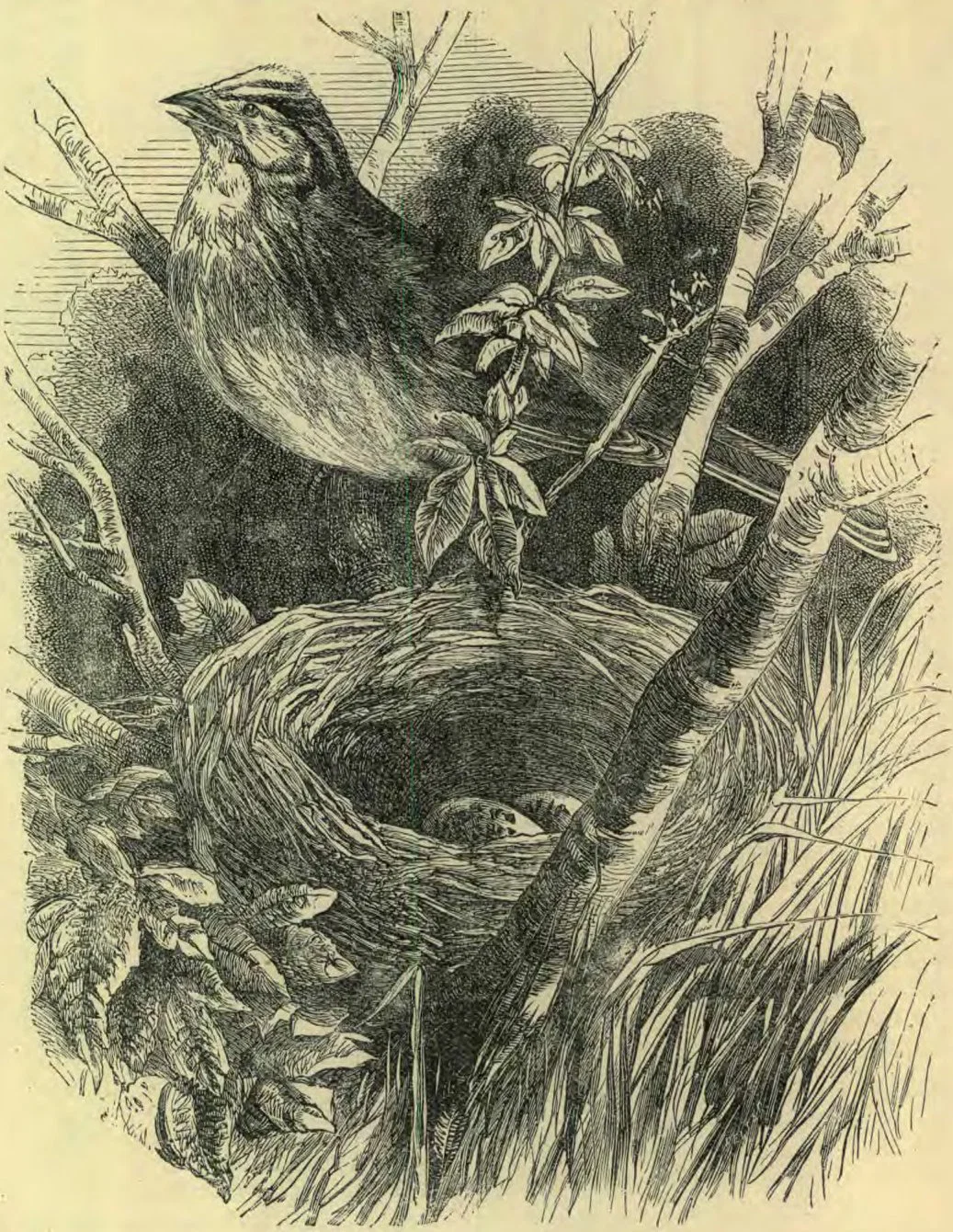
A blithe little robin hopped out from her nest And sang, with an eloquent pause: “Why, berries are plenty, you dine off the best: Do stop this fault-finding Because!”
“It’s not for the berries, but cherries were here The last time I happened to pause; I thought I should find them again.” “Did you, dear? Fine reason for crying, Because! “I know many birds quite as senseless as you,— I’d say girls and boys, but I’ll pause,— Who, when they grow peevish, as sometimes they do, Have but this sole reason, Because!”
—Our Little Ones.

THE SHETLAND PONY:

Do you know where the Shetland Islands are? If you take your atlas, and turn to the map of Europe or to the map of Great Britain, I think you can find them in a few minutes. The winds from the ocean blow over these islands in all directions; the plants and shrubs on them are all small, and nothing grows to as large a size as in warmer climates. The little horses called Shetland ponies, which we sometimes see in this country, are raised here; though small, they are very tough and strong for their size. They wander over the islands, and get their food in summer by browsing on the hills and wide wastes. They are never stabled. The side of a house, or a stone wall, is all the shelter they get. During a long snow, a handful of hay or straw may be given them once in two or three days. The ponies then live chiefly by eating the drift-weed that is thrown up on the beach.
The farmers sometimes allow the little horses to come into their kitchens and lie down. Some are so small that they can easily stand under a dining-table without touching it. The children pet them as they would a lamb.—The Myrtle.

Children Should Avoid Making Excuses

CHILDREN, do not form the habit of making excuses. If you have done wrong, be willing to confess it. Do not try to hide it, or throw the blame on another. A person who is quick at making excuses is not likely to be good at anything else. Be honest, be frank, be truthful.

You have reached the end of this edition.

The Youth’s Instructor · May 30, 1883