It may not be generally known that Queensland extends northward to within about 600 miles of the equator. Not only, however, is this true, but also the fact that nearly the entire colony lies in the torrid zone. It covers 680,000 square miles, being eleven times larger than England and Wales, or nearly ten and one half times larger than all New England. Like New South Wales and Victoria, its eastern portion is very mountainous, the ranges traversing the country from north to south nearly parallel with the Pacific, and at a distance of from fifty to seventy miles from the coast. West of the main range, numerous smaller ones run in all directions, stretching away for hundreds of miles, and not only diversifying and beautifying the country, but forming fertile valleys of valuable pasturage for the extensive flocks and herds of the squatter.
Out of these valleys flow numerous streams which unite to form several good-sized rivers, and thus furnish a water supply to the country. Passing on, the country spreads out into rolling plains, thinly timbered, but covered with an abundance of rich feed for cattle and horses. On the eastern slope of the mountains, looking toward the ocean, much of the country is broken and hilly. Here is found heavy timber and plenty of grass, and nearly all the land is fit for cultivation.
Brisbane, the capital of the colony, is beautifully situated in the extreme southeast, on an elbow of a river of the same name, about twenty miles from its entrance into Moreton Bay. This bay is about sixty miles long and twenty wide. It is well dotted with islands, a few of which are of high land and capable of improvement. One of these is called St. Helena, from the fact that a black man who had received the name of Napoleon, was placed upon it as a punishment for some crime.
The climate of Queensland, is, of course, quite warm, though it is said by those who have long lived there, to be healthful, and conducive to long life. The heat in the extreme north of the country is not so oppressive as its latitude would seem to indicate. It is said to be warmer at times in Sydney, Adelaide, or even Melbourne, in summer, than in this district. This is owing to a prevailing trade-wind from the southeast, which brings cooling draughts from the ocean, over the country. The soil varies from a light, quick loam to that composed of the richest vegetable mold. Its range of products is great. On the same farm are sometimes grown corn, peas, potatoes, oats, coffee, sugar-cane, flax, cotton, peaches, oranges, apricots, figs, grapes, pine apples, and bananas.
From Wide Bay, a little over 100 miles north of Brisbane, to the northernmost extremity of the continent, extends a great coral reef, which renders the navigation of the coast extremely dangerous. These reefs are so high that no vessel can cross them, except at intervals where nature has seemed designedly to leave narrow passages for that purpose. Coasting vessels generally keep between these reefs and the shore, as that is considered safer than to attempt a passage outside the great barrier. Inside the reefs, the water is always comparatively calm, which is considered an advantage in navigating that part of the coast.
From Sydney to Brisbane the distance is about 600 miles, and by steamer is nearly a two days' passage. While one may go overland by train from Adelaide to Melbourne, and from there to Sydney, I believe that no railway trains have yet been run from Sydney to Brisbane, though such a service has been contemplated for some years. But should such an enterprise be carried out, it would be hard to choose between routes; for while one might dread the sickness of a sea voyage, and for this reason prefer to journey by land, he would find few comforts for a long journey, on the railways of Australia.
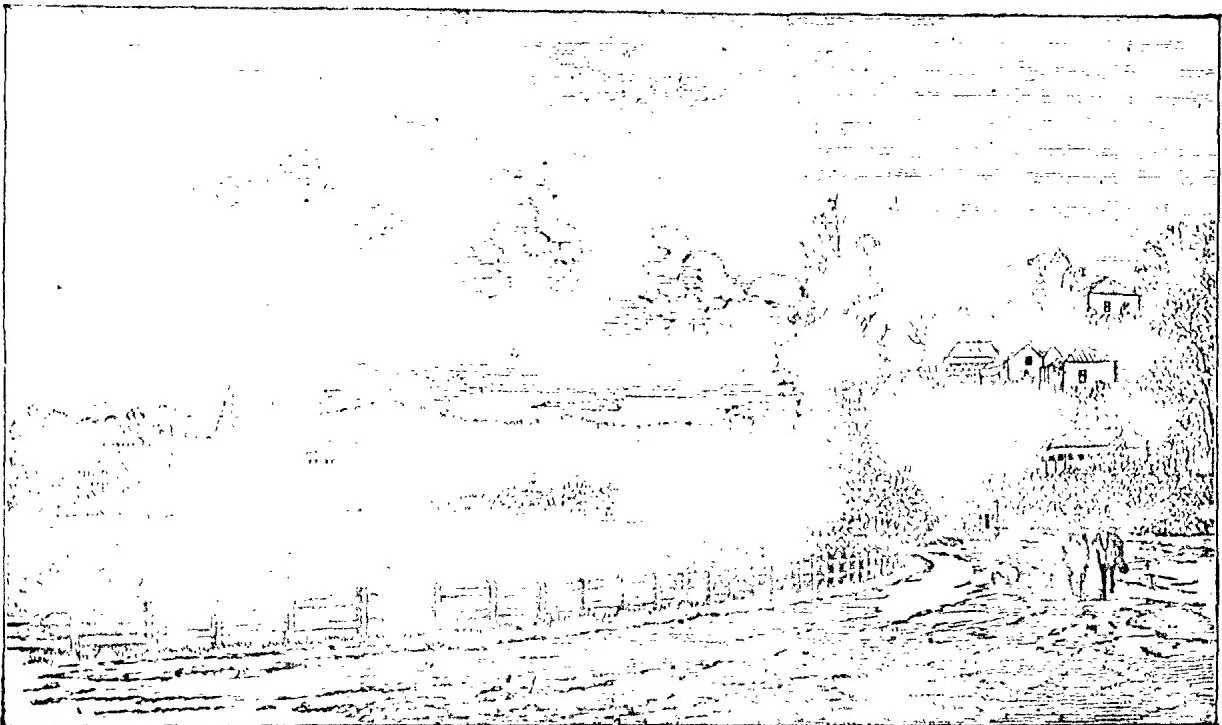
VIEW IN BRISBANE, AUSTRALIA.
The cars there are, according to the English custom, divided up into little compartments, running from one side to the other, and only wide enough for two seats facing each other. You enter these from a side door, and are shut away from every other part of the car, without even a bell-rope passing through the apartment, for you to pull, in case of accident, or disturbance by drunken fellow-passengers. Before the train starts, the “guard” collects the fares, and you are then shut up to your own musings, or to the study of the physiognomy and clothing of your opposite neighbor, whose knees touch your own.
One may be annoyed by indecent language or the fumes of whisky and tobacco, or in danger of being robbed if alone in the apartment with some ruffian, but no assistance is to be obtained. No water-tank is provided, nor any of the other conveniences always found on American cars. Then, again, one must look after his own baggage. No checks are given for it, but the owner must see to its being put on the train, and be present on its arrival at its destination, to remove it, or it will be taken to some general store-house as lost baggage, and sold, unless called for within a certain time.
The sugar plantations are worked by the natives of the tropical islands. For a small sum, they are induced to go there in large numbers, where they often remain for years. On some of the plantations, it is said, there are employed as many as 600 of these Kanaka laborers. Three years ago, it was estimated that there were 32,000 of them employed in different parts of Australia.
While the interior of Queensland is but an arid desert, there seem to be, underneath the soil, hidden rivers and lakes, which if properly utilized, would convert the entire country into a rich and fruitful region. Within a year or two, the idea of having artesian wells in that section has been agitated, and some experiments have been made that may finally solve a knotty problem, which has troubled many minds. Between 700 and 800 miles northwest of Brisbane are the Barcaldine Downs, where thousands of sheep and cattle have perished from drought.
That part of the country is exceedingly rich, and the absence of water has been its principal drawback. Last November, the Government closed a contract with a party, to bore for water. The work was immediately begun, and a depth of over 100 feet was reached at the end of the first twenty-four hours. After this the boring was more difficult, and four weeks were required to reach the depth of 650 feet. At this point, water was struck, which spouted up with irresistible force. At last accounts, it was found impossible to control the supply; and the order of things in that hitherto dry district has been materially changed. Now creeks flow steadily through the low-lying country, furnishing an inexhaustible supply of the needed moisture for purposes of agriculture.
It is evident that a great subterranean reservoir exists, which it was only necessary to tap, in order to set at liberty a copious supply of water. The experiment will prove a new era in the resources of that country; for one attempt having proved successful, the matter will not be dropped until a vast system of irrigation from artesian wells shall have been brought into use. If a proper estimate has been placed upon the supply of water thus discovered, Central Australia will prove to be one of the richest countries in the world. It is stated that each gallon of water per day thus provided is equal in value to an additional sheep. One station has already demonstrated the matter, by providing a well which flows 40,000 gallons per day, thereby enabling the proprietor to keep 40,000 more sheep than his ranch could before sustain.
Of course, this new water supply will so change the condition of the country that it will become an inviting place for many an honest toiler, and this in turn, will make it an enterprising field in which to introduce the truth. Every one of this vast army of shepherds ought to have the truth, either from the mouth of the living preacher or at the hands of the canvasser. The city of Brisbane, with its 50,000 inhabitants, has been canvassed for “Thoughts on Daniel and the Revelation,” but that is only a beginning in the colony. There are thousands of Germans in colonies located in that rich and prosperous country, who ought to have the truth. The hardest question now to be settled, is, who will be found to fill the almost innumerable openings that present themselves? May God help our people to see the needs of the cause, and lead numbers to fit themselves to step into some of these places which so urgently invite our labors.
J. G. Corliss.
VIRGINIA TRACT SOCIETY.
By Amy A. Neff
Report for Quarter Ending June 30, 1888.
No. of members
40
" reports returned
11
" letters written
47
" " received
31
" missionary visits
506
" Bible readings held
25
" persons attending readings
4
" subscriptions obtained
6
" periodicals distributed
154
" pp. books and tracts sold, loaned, and given away
70,679
Received on account and sales, $97.21; on first-day offerings to foreign missions, $3.81.
Amy A. Neff, Sec.
Never Lay Too Great a Stress Upon Your Own Usefulness
—Never lay too great a stress upon your own usefulness, or perhaps God may show you that he can do without you.
God Is Always Punctual to His Time
—God is always punctual to his time. Though his promised messages come not at the time we set, they will certainly come at the time he sets; and that is the best time.—Matthew Henry.
Letting Small Vexations Pass Without Disturbance
—When we meet with the little vexatious incidents of life, by which our quiet is too often disturbed, it will prevent many painful sensations, if we only consider how insignificant this will appear twelve months hence.
THE INDIANA CAMP-MEETING.
As promised last week, we here offer a few more remarks upon the Indiana camp meeting; though as the meeting was not entirely finished when we left, others will speak of its close.
At our last writing the attendance was quite small, and was expected to increase as the meeting progressed; and it did increase somewhat, so that on the Sabbath, there were perhaps three hundred or more present. If all could come so as to be present from the commencement of a meeting, it would be better. If a meeting increases in interest and power, as it ought to do, from its beginning to its close, its later interest depends largely on what has been said and done in the meeting up to that time; and those who enter the meeting for the first time at this point, are not, of course, prepared to enter into its spirit; and as the general rule is that they who come late, go home early, their position all through is pretty much that of mere spectators, and they receive but very little practical benefit from the meeting.
We have never yet known of one who, in words, dissented from this view of the subject; yet many show by their actions that they consider something else of more importance to them than the success of a meeting in these closing moments of time, held by a people who alone hold many essential truths relative to the close of our world's history, and of more importance than a revival of their spiritual condition by such an occasion. Surely it ought to be something very urgent and insurmountable to outweigh considerations like these. But when sifted to the bottom, it is too often found that the hindering cause was some matter of convenience or worldly interest.
Another danger incident to putting off a start to a meeting till late in the week, is that a failure to make connection somewhere, or a little delay of the cars, is liable to delay one's arrival till after the Sabbath has commenced, as was the case with quite a number at the Indiana meeting. We say nothing of driving long distances Sabbath morning, just to be present at the meeting on that day. When reduced to that alternative, it is a question whether one would not do better to remain at home entirely, that his animals might have an opportunity to rest, as well as himself.
The evil of late arrivals and early departures, in connection with our camp meetings, is one against which no remedy seems as yet to be effectual. Presidents of Conferences, Conference committees, and ministers, cannot control it. The scores of exhortations given every season in the REVIEW against it, do not arrest it. We can think of but one remedy for this matter, and that is to have a vivid sense of the fact that the message to the Laodicean church applies at this time, seize upon the soul of this people; to have them feel that it is of the first importance to get out of the condition described in Rev. 3:17, and procure the gold tried in the fire, the white raiment, and the unction from above, that we may be prepared for the crisis before us; and that to avail ourselves of every means which will assist us in this work, should come first and foremost in all our plans. “Seek ye first the kingdom of God [a fitness for that kingdom], and his [God's] righteousness [that is, perfection of character in our sphere of action]; and all these things [things necessary for our present existence] shall be added unto you.”
During Thursday and Friday, the 13th and 14th, there was evidently an influence present which interfered seriously with the freedom of the meeting; but on the Sabbath, a better turn of affairs was secured, and a precious victory was the result. Bro. Rupert and Corliss spoke in the forenoon and afternoon respectively, and the Lord gave them a testimony which reached the hearts of the people. With great freedom they spoke on the duties which pertain to practical godliness, and the signs which will mark a living Christian. Bro. Corliss's subject was the power of God, by which alone we can be kept unto the day of salvation. As a person may enjoy the impressions made by the vivifying sunshine or the aroma of flowers, as they steal, with subtle tread upon his senses, but cannot formulate them into words, so the influence of such a meeting as was enjoyed upon the Sabbath, may be felt and experienced, but cannot well be described.
More than fifty came forward for prayers, when opportunity was given. A much-needed spirit of confession came in, to a considerable extent, the burden of which was that God had been robbed in tithes and offerings, accompanied with a pledge that this should be so no longer. We trust these pledges will be faithfully kept, not only for the financial good of the Indiana Conference, but more especially for the good of the individuals themselves.
When the Saviour, speaking of tithing, says that we “ought” to be careful and prompt in that duty (Matt. 23:23); when the Lord through a prophecy, referring beyond all question to the last days (Malachi 4), says, “Bring ye all the tithes into the storehouse,” and challenges us thus to prove him, and see if he will not open the windows of heaven and pour us out a blessing such as we have not room to contain, what shall we conclude? Shall we decide that we are to have the same blessing whether we do the things pointed out or not? If the conditions mean nothing, why are they expressed? If they do mean anything, what estimate do we place upon the promised overflowing blessing? Is it worth more to us than the paltry sums called for from us in tithes and offerings, or not? Can we suppose that God, having offered blessings upon certain conditions, will then stultify himself by pouring out the blessings just the same, though we, in our selfishness and worldliness, trample the conditions on our part into the dust? God is the great giver,—an infinite and constant giver. He gives many things for a time unconditionally—life and its blessings, and the opportunity for repentance, conversion, pardon, and salvation. But can we expect that he will continue the peculiar gift of the divine regenerating Spirit upon hearts that are inert and unresponsive? Does not the farmer look for returns from the soil which he carefully tills? and expect fruit from the trees which he trims and guards, and nourishes? And if he finds no returns, if his land remains barren, and his trees fruitless, will he take it all as a matter of course, and go on just as cheerfully, laying out expense and bestowing labor year after year in their behalf? No one will hesitate about the answer to such a question. But how about God when our hearts remain hard and callous and unfruitful under the wooings of his Spirit, the invitations of his mercy, and the commands of his power? There is a withholding that tendeth to poverty; and we are satisfied that, not in Indiana only, but in many Conferences, the Lord is withholding many blessings from his professed people, because they are withholding from him his due.
There have been some encouraging features in the work in Indiana the past year, the only discouraging part being here, as elsewhere, the thought of what apparently might and should have been done, that is not. Quite a hold is being obtained in Indianapolis for the truth, a mission house, combined with a meeting house, having been built there. But as we did not have the privilege of seeing this, we cannot speak from observation.
The Indiana Conference and other organizations held their yearly meetings on this occasion. Officers were elected, and other business harmoniously transacted. We believe the effect of the meeting will be good on those who attended, and hope that the spirit of it will be carried to many who were not present. Baptism was to be administered on Monday; but the number of candidates we have not learned.
“HATH EVERLASTING LIFE.”
By Editor
We are happy to receive from the pastor of a U. B. church in Pennsylvania, an inquiry concerning the meaning of the expression that stands at the head of these lines. He states that he has been reading the work, “Man’s Nature and Destiny,” with considerable interest and an unbiased mind; but there are some passages which seem to him to stand opposed to the view advocated in said book; and hence he says:—
We should be very glad to learn how you dispose of such passages as John 5:24; 11:26, etc. According to the Saviour, the believer “hath everlasting life,” “is passed [or hath passed] from death unto life,” “shall never die,” and “though he were dead, yet shall he live.” But according to your theory, this cannot be true, as everlasting is not attainable until the final resurrection.
The rule we seek to follow in the interpretation of Scripture, is to allow the Bible to explain itself, passages in one portion of that word coming in as complements of statements in other portions, which by themselves might seem ambiguous or obscure, but which, taken in connection with these other modifying statements, are shown not to be so in reality. This we feel to be a safe rule: for the same Spirit of inspiration, which is not yea and nay, runs through it all; and when all its testimony is taken together, we have one harmonious whole.
In regard to the time when the followers of Christ shall be made immortal absolutely, we have many direct statements. Thus Paul in 1 Cor. 15:51-54, says: “Behold, I show you a mystery: We shall not all sleep, but we shall all be changed, in a moment, in the twinkling of an eye, at the last trump; for the trumpet shall sound, and the dead shall be raised incorruptible, and we shall be changed. For this corruptible must put on incorruption, and this mortal must put on immortality. So when this corruptible shall have put on incorruption, and this mortal shall have put on immortality, then shall be brought to pass the saying that is written, Death is swallowed up in victory.”
To the Thessalonians (1 Thess. 4:14-18) the same apostle testifies that the trump of God is to sound at the time of Christ’s appearing in the clouds of heaven; that the dead in Christ are then to be raised from the grave; and that we who are living at that time, shall be caught up together with them to meet the Lord in the air, and “so shall we ever be with the Lord.”
To the Philippians (chap. 3:20, 21) he further declares that when Christ shall come from heaven, he will change our vile bodies, fashioning them like unto his glorious body; and then we shall be fitted to dwell with him in his presence and in his kingdom.
These texts state very clearly what change must take place in us before we become immortal; and when that change is to be accomplished; it is at the last trump, when Christ shall appear. Not till then do any (as the general rule), either living or dead, go to be with him; not till then do any put on incorruption and immortality, and thus have everlasting life in the absolute sense.
What interpretation, then, shall be given to certain passages, like those referred to by our correspondent, which speak of the believer as if he already had everlasting life?—It is evident that these must be taken in a modified sense; for those we have quoted, and multitudes of others of the same purport, are too plain and explicit to be taken in any other than their most literal meaning; and if the texts now under notice, are allowed to contradict them, we are involved in hopeless confusion.
Let us see, then, if the Bible gives us any rule by which this latter class of texts may be interpreted in harmony with the first. In Rom. 4:17, Paul lets in a flood of light upon the situation by this reference to Abraham: “(As it is written, I have made thee a father of many nations,) before him whom he believed, even God, who quickeneth the dead, and calleth those things which be not, as though they were.” That is to say, when God has formed a purpose concerning anything, that purpose is so sure, that he may speak of it as already accomplished or existing, though in reality it may lie far in the future. Thus Christ is spoken of as a lamb slain from the foundation of the world. Rev. 13:8. That is, when the plan of salvation was formed, on the fall of man in Eden, that plan involved the sacrifice of the Son of God. The purpose that he should be slain was from that moment as steadfast as the earth, and as sure as time. Hence he is spoken of as slain from that time, although more than four thousand years elapsed before he actually died on Calvary.
So in Isaiah (chap. 9:6) there is a prophecy of the birth of Christ which was to take place more than seven hundred years after the prophecy was written; and yet it is expressed in the present tense, thus: “For unto us a child is born; unto us a son is given,” etc. It is spoken of thus, because it was just as sure as if it had already taken place. Here, according to Paul’s rule, that which “was not,” is spoken of as though it “were,” because it was to come. By the same rule, Abraham, Isaac, and Jacob are spoken of as living (Matt. 22:32), because in the purpose of God they are sure to live again. Thus Christ proved to the Sadducees the resurrection of the dead.
Just so in the case before us. God has purposed that those who believe in his Son shall have everlasting life; and it will be noticed that this everlasting617life is predicated only of those who believe in Christ. Hence those who believe in Christ are said (in anticipation) to have this life; for so long as they maintain their connection with him, this hope is sure to them.
That this is a correct view of the subject is positively proved by 1 John 5:11. Here the apostle says: “And this is the record, that God hath given to us eternal life.” So far this record is parallel with John 5:24: “He that believeth . . . hath everlasting life.” But in what sense is it given to us? and in what sense do we now have it?—The next clause (1 John 5:11) tells us: “And this life is in his Son.” So this life is not in us; we do not yet have it in our own possession; it is in the Son; and if we have a vital connection with him, we have this eternal life in purpose or anticipation. Hence the next verse reads: “He that hath the Son hath life; and he that hath not the Son of God hath not life.” And so if at any time we apostatize from Christ, and lose our connection with him, we lose this eternal life. Therefore no man hath immortality by nature: it all depends on Christ.
John 11:26 demands independent notice, as it is a text of another nature. Jesus is here talking of the resurrection of the dead, and of course carries our minds forward to that event. “He that believeth in me, though he were dead, yet shall he live.” When shall he live?—In the resurrection at the last day. Then Jesus adds: “And whosoever liveth and believeth in me [when?—at the time just spoken of when the dead believers are made alive, he] shall never die.” He will be among those spoken of in 1 Cor. 15:52, who at that time will be changed and made immortal without seeing death.
That the two classes, the righteous dead and the righteous living, are included in the testimony of John 11:25, 26, and that the time referred to, is when the righteous dead are raised and the righteous living are changed, is evident. For those referred to in verse 25 as having believed in Christ, and yet being dead, are such, of course, as believed on him while they were living, before they died. But if verse 26 is to be taken in an unlimited sense, applying to all time, it would include those mentioned in verse 25, as well as all others, and hence they ought never to have died; and it would be impossible to have a class who have believed in Christ and yet were dead, needing to be made alive in the resurrection at the last day. From this consideration we think it will be apparent to all, that our Saviour here refers to a particular time; namely, the time of his coming and the first resurrection. At that time, all in their graves who have believed in Christ during all the ages past, shall be made alive; and those who are living at that time, and are found believing in Christ, shall never die, but step over the grave into eternal life, by the great change from mortal to immortality. Blessed prospect for the living! Blessed hope that we have reached the generation in which we believe it will be fulfilled!
We shall be pleased to consider any other queries which may arise in the mind of our correspondent.
BUDDHISM VS. CHRISTIANITY.
By L. A. S.
The New York Sun speaks of having received the first number of the Bijou of Asia, a paper established in Kioto, Japan, last July, for the express purpose of propagating the Buddhist faith in Christian countries; in other words, to convert Christendom to Buddhism. It is printed in English type, the same as any ordinary English periodical, and makes its appearance without apology of any sort, as if it came in answer to a clearly recognized demand of the times.
“In the leading article,” says the Sun, “the design of the publication is freely and frankly stated.” It indulges in a survey of the four great religions of the world,—“Mohammedanism, Brahmanism, Buddhism, and Christianity,”—speaks of Christianity as “now rapidly declining in Europe and America,” and accordingly looks for the time to come, ere long, when “the Christian faith will disappear, or at least will receive transformation;” when, as “religion is indispensable for man as long as his nature lasts,” “a higher and a purer religion” must take its place, by which, of course, is meant Buddhism.
To us, such a mission perhaps appears like the veriest height of folly and presumption. It may seem to us like an effort wholly without any call, and hopeless from the start. But the surprising truth of the matter is that there exists, in the very midst of this enlightened country, a sentiment which regards such an enterprise with favor, and stands ready to furnish it substantial aid, as shown by the publication of extracts from many letters from America, urging the publisher to persist in his purpose, and calling for direction and assistance in the “missionary” work.
The present chief seat of Buddhism in America is the refined and “cultured” city of Boston, Mass. Here exist, it is said, quite a community of those who prefer to kindle their torches at the “light of Asia,” rather than at the sun of Christianity; and from their midst come urgent appeals to the Bijou for missionaries from Japan, who shall be qualified to admit members into the Buddhist church. To all of which the editor of the Bijou listens very seriously, and in reply promises to publish books and translate Buddhist works “for the American benefit.”
Thus it seems not improbable that, with the development of activity and zeal which the establishment of the Bijou of Asia has occasioned among its supporters, we shall see ere long the American Buddhist church take its place alongside our regular orthodox denominations, while Christian missionaries to India and Japan will pass on their way the missionaries sent out from those countries by the Bijou to look after the spiritual interests of America. When people get so cultured and æsthetic that they sigh for something higher and purer than Christianity has to offer, they might as well go over to Buddhism as any place we know of. And if Catholicism can flourish here, why may not Buddhism also? Certainly it has as much in reason to recommend it.