Your ShelfYour Projects

Review and Herald, Vol. 93, No. 30.

Say the Loving Words Now
Earlier text: The Home of the Saved

Divine Healing

D. H. KRESS, M. D.
THE Saviour’s manner of healing is designed to teach valuable lessons for all time. He once anointed the eyes of a man who was born blind, and bade him, “Go, wash in the pool of Siloam.” The blind man “went his way therefore, and washed, and came seeing.” This man could have been healed without the application of the salve or the water, but Christ evidently made use of these simple agencies of nature, and thus called attention to remedies which are often ignored, and yet within the reach of all. By this act he sanctioned the use of remedial agencies.
Everything that human hands can do in sickness should be done; every agency of value should be employed. It is no denial of faith to make use of these agencies.
When we offer the prayer, “Give us this day our daily bread,” we do not sit quietly down in expectancy and fold our hands. It would be presumptuous to do so. The manna fell every morning, but Israel’s host had to gather it daily. “What thou givest them they gather.” This is the divine order. When we are unable to gather, God can supply our needs in some other way. Faith is shown by works. Faith and works make a divine combination.
There is no question but that mental unrest and dissatisfied feelings are responsible for many physical ills, and that these ills cannot be cured by diet or by treatment alone. Obstinate digestive disturbances may be wholly due to a wrong mental state. He who is in constant fear that the food he eats will disagree with him will remain a dyspeptic until the fear is removed.
The poet-banker Rogers, it is said, caught a severe cold by sitting at a window that he supposed was open. It was not open at all. Most of the colds are caught in this way. That which is greatly feared oftentimes comes upon us. Persons who are always afraid of colds are the ones who are constantly complaining of colds. Those who have no such fears but recognize air as a blessing, seldom take cold.
During every epidemic of disease some are stricken and die who could have lived had it not been for their fear of the disease and of death. Fear may kill more than disease when epidemics prevail.
The mere thought of taking a morning plunge or a cold shower may create a chill while in a warm bed. A cold bath taken with fear of injury may prove an injury. With a different state of mind, the same bath might have been a real blessing. Faith in God’s agencies is essential in order for them to be of the greatest benefit. The physician who prescribes open windows and fresh air for the patient who is afraid of air will be disappointed in the results. Should the patient carry out the physician’s advice, nine times out of ten it would result in demonstrating to his own satisfaction that the physician did not understand the case. The only hope of such patients is in the discovery that their experiences are unreliable unless they are in harmony with God’s Word and with true science.
The gospel heals the diseased mind. It contains the only reliable healing for the mind. To the poor palsied man who was suffering mentally, Jesus said, “Son, be of good cheer; thy sins be forgiven thee.” The Saviour of men understood fully this man’s physical and mental state. He recognized that to heal the palsied body he must first restore the palsied mind. This being done, he could say to the paralytic, “Arise, take up thy bed, and go unto thine house.” There are many who could be healed of their physical maladies if only they possessed the consciousness of sins forgiven. The purpose of the gospel is “to bind up the broken-hearted, . . . to comfort all that mourn; . . . to give unto them beauty for ashes, the oil of joy for mourning, the garment of praise for the spirit of heaviness.”
The knowledge of being a blessing to others is conducive to health. “He that hath mercy on the poor, happy is he.” Many hopeless invalids could be helped if they would think less of self and more about the needs of others. Selfishness and disease are closely related. “The merciful man doeth good to his own soul.” To his own people whose prayers reached no farther than self, and who bowed down their heads like a bulrush and said, “Wherefore have we fasted, . . . and thou seest not?” God said, “Is it such a fast that I have chosen? . . . Is not this the fast that I have chosen? to loose the bands of wickedness, to undo the heavy burdens, and to let the oppressed go free, and that ye break every yoke? Is it not to deal thy bread to the hungry, and that thou bring the poor that are cast out to thy house? when thou seest the naked, that thou cover him? . . . Then shall thy light break forth as the morning, and thine health shall spring forth speedily.”
Selfishness is responsible for much of the chronic invalidism that exists. Benevolence is a benediction to every cell of the body. “If you are feeling blue, something for some one else go do,” and “inasmuch as ye have done it unto one of the least, . . . ye have done it unto me.” “In blessing I will bless thee.”
Wrong habits are frequently responsible for despondency, depression, and lack of faith. The man who desires to get rid of a red nose, must abandon strong drink, if strong drink is the cause of the red nose. The prayer for patience God answers by making men temperate, if intemperance is the cause of impatience. When the nerves are on edge from the use of tea or coffee, and the least annoyance causes a nervous explosion, the remedy lies in the removal of the cause. The one who has spells of depression and despondency and thinks he has committed the unpardonable sin, can often assist in answering his prayer for relief by making a careful study of his food combinations. “As he eateth, so is he,” is an old German adage which has in it much truth.
(To be concluded)

The Opportunity of Giving

EVERY day of the year will furnish occasion to the God of all our mercies to shower of his blessings and good gifts upon us. There will be no day or hour of its long stretch that will not be marked by tokens of his love and care and goodness. There ought not to be any day or hour or moment of it that would not see some response on our part, some upward turning of a grateful face to him, some outward going of sympathy toward those with whom we should share the good he gives. The year will give us much, but the greatest opportunity of all that it will bring to us will be the opportunity of giving back in gratitude and in brotherhood the good that has come to us.—The Christian Guardian.

Central European Union

L. R. CONRADI
This union comprises the very heart of Europe — German Switzerland, southern Germany, and Austria, except Galicia, and has a population of about forty million.
During the month of January the writer attended four local conference meetings in this union, the last one being connected with the union committee council and audit.
All the meetings were splendidly attended. Harmony and a good spirit prevailed throughout, and every one felt encouraged to go forth, in the strength of the Lord, to achieve greater things for him.
Our first meeting was held in Basel, where twenty-six churches were represented by eighty delegates. Four new churches were received into the conference. Seventy-five persons were received into church fellowship last year. The membership at the end of the year was 783. Twenty-two canvassers and six other gospel workers were employed during 1915, with good results.
The South German Conference held its meeting in Karlsruhe, where twenty churches were represented by seventy-three delegates. During the past year 127 members have been received into church fellowship, increasing the total enrolment of the field to 810.
Most excellent growth and increase in members and finances were also seen in the Württemberg Conference. Our hall at Stuttgart was filled to overflowing. Ninety-four were received into church fellowship last year, increasing the membership to 727.
The fifth meeting of the Bavarian Conference was held in Nuremberg. The large hall we had was filled to overflowing. Ninety-six delegates were present. This conference showed the best gain, 185, increasing the membership to 894. In Nuremberg proper are two churches, with 260 members. Near by there is a church of forty-four members. At Munich there are two churches, with 243 members.
The union report showed a good growth also for our work in Austria. Not fewer than 238 members were received in the five Austrian fields last year, increasing the total membership to 1,200. They also had a good financial showing. At the present rate of growth it will not be long until Austria will develop into a strong field of its own. Great difficulties were encountered in the work during the year. Our meetings were stopped and interfered with, our workers were unable to travel, and our canvassers were brought into all sorts of trouble that hindered them in their work. Yet, in spite of all this, the work of God is onward.
The union as a whole received 723 new members, increasing its membership to 4,414. Its tithe amounted to more than $53,000. It turned over to the division conference $13,000 in offerings, and in second and surplus tithe more than $15,000.
This union now stands third in the European Division, both in membership and in means. In a short time it has become a strong factor in our work. The presidents of the four conferences remained the same as formerly. Brother J. Erzberger is doing what he can in his home conference in Switzerland. He has been troubled considerably with his eyesight. Some of the fields have very few workers, and some are without even a director; hence the union president has to look after several mission fields as well as a local conference of which he is president.
The prospects were never brighter for this union than they are at the present time.

Sabbath School in Juiz de Fora, Brazil
MRS. R. M. CARTER
WHEN we were here in Juiz de Fora six months, we organized our first Sabbath school, which consisted of those who had been brought into the truth by the faithful efforts of a native canvasser who lived with us, he and Mr. Carter having sold them books. Evenings this canvasser would visit those whom he found interested, and give them Bible studies. The Lord blessed his earnest efforts, and ten adults began keeping the Sabbath; hence the organization of the Sabbath school.
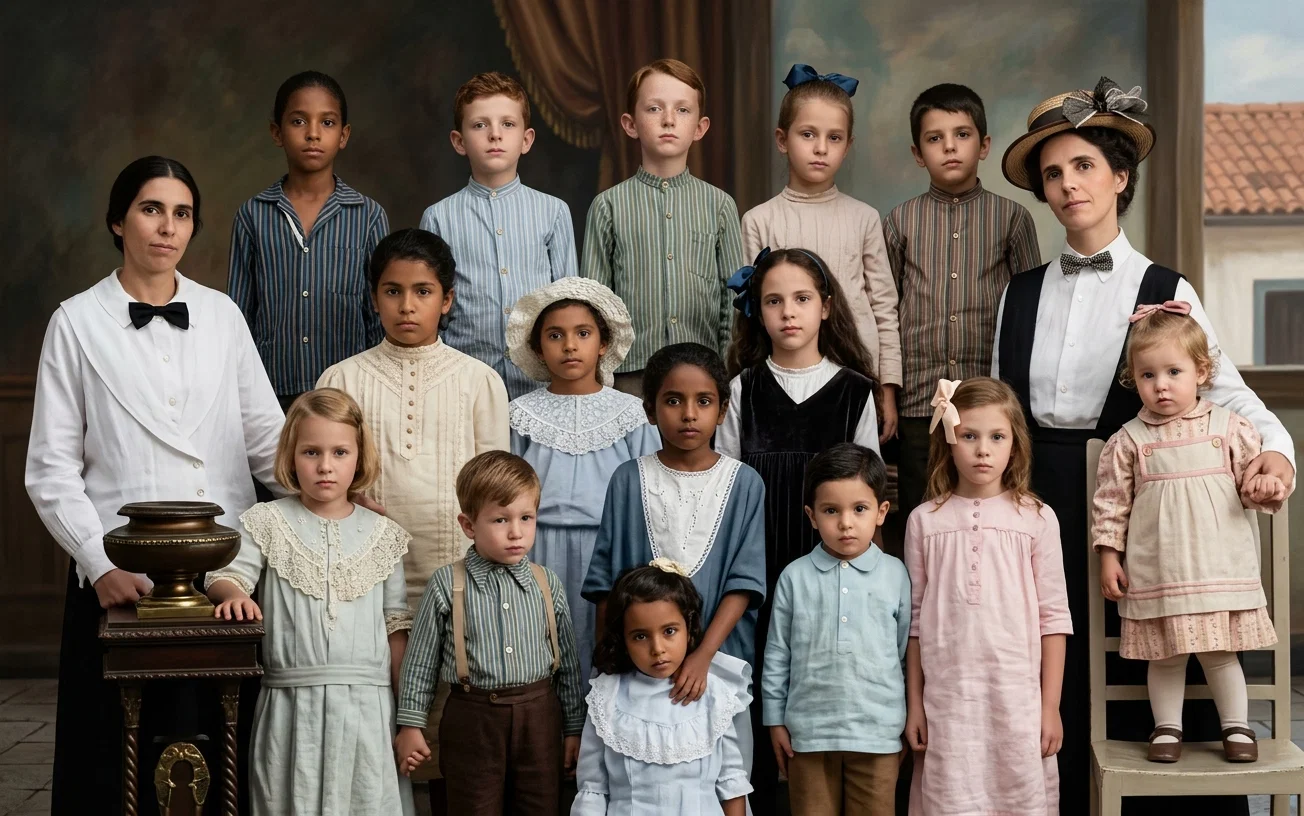
My object in writing this is to tell you of the dear children of the flock in whom I am always most interested. I undertook to teach, as there was no one else to do so, although I hardly knew how to speak the Portuguese language. But I loved them all, and my heart went out to teach them. I wish you could have seen them, so intelligent, lovable, and quiet, showing such reverence for God's Word although all except one were reared Catholics. I could see it was God's Spirit working upon their hearts. There were seven in all, besides Imo, our daughter. At first we could not do much but sing, pray, and memorize Bible verses. They memorized a verse for each letter of the alphabet, making of course twenty-six verses. Then I gave a small present to each of those who could recite every verse without mistake. Five were successful. Gradually I became able to teach them simple Bible truths, and they each learned to pray. It would do your soul good to hear the earnest little petitions which they send forth each Sabbath, and to see how attentive they always are. The membership has now increased to seventeen, and I have an assistant, one of the new Sabbath keepers. Some Sabbaths we have twenty children to teach. We are sending along a photograph of the school, but four of our largest children were unable to meet with us for this picture.
This year we are using the Sabbath school chart and cards, and the children enjoy them immensely. We have no Little Friend in Portuguese, so I give them the Scripture assignment, and they study from the Bible, preparing their lessons alone, as their parents do not know how to help them as yet. Each Sabbath they recite their memory verse, and I use the “ladder” as given in the October Sabbath School Worker to secure attention and good lessons. They are desirous of reaching the top of the ladder, and you ought to see their bright, sparkling eyes, which show that they have diligently studied their lessons.
SABBATH SCHOOL CHILDREN AT JUIZ DE FORA, BRAZIL. SISTER R. M. CARTER AT THE RIGHT, HER ASSISTANT AT THE LEFT.
Last Christmas we had a tree in harmony with the article Sister White wrote in the REVIEW of Dec. 9, 1884. Three months before, I had given each one hundred reis (three cents English money). They made little missionary gardens, and thus increased the money. Imo bought a Portuguese magazine and sold it, and then bought more and sold them. Thus she had an offering that she had earned.
I prepared envelopes for each one's offering, and instead of buying presents for one another, each brought a gift to Jesus. The twenty-four cents I invested was increased to fourteen milreis, or almost five dollars. We had a good time. The desire to help in God's great work was also instilled into their young minds.
I might add that the parents of some of these children permitted their children to attend the Sabbath school, though they themselves were not interested enough to come. As a result, the parents became interested, and are now keeping the Sabbath. Some are already baptized, the rest soon will be, and I believe the children have done their part in exciting an interest in this truth by their earnest prayers at home. This is what we are doing in Juiz de Fora, away in the interior of Brazil, and I believe that as much or even more could be done in each city here. What we need is workers, and means to support them. Surely the harvest is great, and the laborers are few.

The Kimberley Baths

J. V. WILLSON
[This report, the first received from Brother Willson in a long time, was just in hand at the Mission Board office when the sad news of his death came by cable.]
WE are just past the great heat of the season. This has been the hottest season known in Kimberley for many years. It has been difficult to keep the flower garden from entirely burning up by the hot sun, which is nearly straight overhead here in midsummer, or during December and January.
When the great war in Europe first began, our patronage decreased, but after the first shock was over, it came up again, but has not fully recovered the usual volume. Our treatment-rooms have had an influence for good far and near. Many have been relieved of pain and sickness by the treatments, and that always has a good effect for the truth. We keep the reading rack in our reception-room well supplied with our publications, and we find it has to be refilled frequently. Since the war the people are more ready to read our publications, and more interested to converse in regard to the truth. Many copies of “The World’s Crisis” are being sold in town by the members of the local church. It meets with a ready sale. There is a widespread interest to know the meaning of events now taking place.
It is seventeen years this month since we arrived in Kimberley and began work in the treatment-rooms. Since then a debt of $6,000 has been liquidated. Additions to the building have been made, at a cost of more than $10,000, and additional real estate purchased at a value of $3,200. The Lord has blessed the work in many remarkable ways. Many times we have been in difficult places, but in answer to prayer the Lord has opened the way for the work to go forward.
This church is the first Seventh-day Adventist church established in Africa, and some of the charter members are still connected with it. It was from this place that the money was sent to bring the first laborers to Africa. May the light of the third angel’s message shine brightly from this center till the Lord comes to gather his people home.
April 1, 1916.

C. A. MEREDITH

Burma

C. A. MEREDITH

BURMA came under British rule as the result of the wars of 1836 and 1852. The people belong almost entirely to the Tibet-Burman race, those of the interior consisting of wild uncivilized tribes. Among its population of ten and one-half million there are only about three hundred believers of the truth to herald the message. Are we able to do the work without help from outside? — Certainly not.
About the only means for reaching the people with the truth is a quarterly paper issued in Burmese, called Kin Soung. The canvasser goes out to sell this paper to the people, who will never give “No” for an answer, as this would be impolite. They would rather evade the truth. They dally, and when the canvasser learns to take advantage of this, he is in a fair way to success. Nearly all of these people want some one to decide for them, and usually the canvasser takes that some one’s place. If he does, he succeeds. When a Burman is approached to buy a paper, he decides that he does not want it, and seeks for an easy way of saying so. At the same time he will give his address, and money for the paper for the year. Afterward he is not sorry that he took it. So the paper is read and reread in his family.
In most of the stations in this province there are missions of various denominations, and to one of these there used to go a thuggi, or a headman of a village, to listen to the preaching, and though very nearly seventy years of age, he became one of the favorites of the converts; yet he remained an unbeliever. He told the converts that he was not enthusiastic about their teaching; but when the paper Kin Soung found its way into his hands, he read and reread it and wanted more copies. He tried to find out the source of the paper. He became interested, and wanted to study the Bible. He was given a tract, “The Near End of the World.” He has now read it so many times that he has it about committed to memory. Since learning the Bible teaching on the Sabbath question and the second coming of Christ, he is telling these truths to his friends. He is now asking for baptism.
I recently went to visit an old friend. When I reached his home, there was a lad talking to my hostess about the great war and the great loss of life it is causing. But he said that more people die of disease than of fighting, and he ended by asking her why so many deaths are taking place. When she expressed ignorance, he said it is because the world is waxing old, and its end is near. I was surprised to hear this, as he is not a church member. So I asked him how he knew it. He gave me a very simple answer. He said, “I am a Kin Soung reader;” and he further told me that he was a stray boy, and had never thought of praying to God until he began to read this paper; since then he has prayed regularly morning and evening. May he and many others of this land be among the redeemed company when Christ comes.
Rangoon.

Japan

ELDER F. H. DEVINNEY, superintendent of the Japan Mission, writes:—
“We recently printed in the Japanese language a small edition of a series of Bible readings covering the main points of the gospel message. These were put in print for the benefit of our workers, but there was such a demand for them by the Japanese people that our first edition is exhausted, and we have published a second edition, which is selling very rapidly. We are just issuing a tract covering the same points given in the Bible reading series. This tract is written by a Japanese, and will be used extensively in Japan.”
“We are sending out two tents this summer for an evangelistic effort. We planned for a general meeting and institute, to be held in September, which will be attended by all our workers.”
“We are now endeavoring to raise money to build a church adequate to the needs of our growing work here in Tokio.”
“Our Tokio training school is doing splendid work in preparing Japanese young people for colporteur, Bible, and evangelistic work. Our need of workers is great, and with more funds we could plant the banner of the cross in many places which now lie enshrouded in heathen darkness.”
“Sixty were baptized last year, and added to our twelve churches.”

Missionary Asphyxiated by Charcoal Fumes

One of the native helpers in Shanghai, a young man of eighteen years, who had been connected with the institutions there about two years, was found dead in his room the morning of February 24. Averse to the cold air, he had tightly closed his window and also his bedroom door. To provide some heat during the evening study hour, he had a fire in an open charcoal stove, some coal cinders being mixed with the charcoal. He retired with the fire burning, and the gases in his closed room were sufficient to produce asphyxiation before morning. This may serve as a warning to some missionary in some other field.

A Mother's Confession

My little boy stood before me with lines of perplexity plowing deep furrows into his brow as he said, “Mother, please don’t always tell me what not to do. Tell me what to do, and I will do it.”
In that way I discovered that I was not the only one who had a problem. He had one, too, and I was his problem. It became evident to me that I was not the right kind of mother.
On another occasion I had a lesson which I recall bitterly even now, and again my boy was the teacher. It was his little household task to prepare the kindling. It wasn’t much to ask a sturdy, active boy to do,—to prepare the kindling,—but sometimes the kindling box was empty, and there was considerable censure from me; for it was very annoying to need kindling, and find none ready.
One day he was taken very ill, and I hung over him for weeks. In his delirium he was haunted by the kindling. In the silent night when I was keeping vigil, he would start up from his pillow, saying, “Let me go now, mother, and chop the kindlings for you. I’m so sorry I forgot it. Please don’t scold me, mother. I’ll make it for you right away. The kindling—the kindling! I forgot the kindling—forgot—forgot—I forgot!” He was only six. He forgot at six!
Well, God was good to me, for he let him get well. But there came another lesson. There are closed rooms in my heart, and in every room is the proof that I was not worthy to be a mother. I have had time, years, in which to reflect.
In one of the rooms I see the chairs standing about in orderly fashion, the chairs he loved to disarrange to make his train of cars, his noisy cars that made me nervous. He left a trail of disorder wherever he went; toys, the mud on his shoes, the scratches on my furniture, all annoyed me. In the closed room the chairs now stand silently about in orderly fashion to rebuke me. There are no toys, no rusty little muddy shoes, no scratches on the furniture; all is as orderly as a showroom in a shop window. It is not a comforting room. He said one day that his lesson was about toys, noise, joys, and boys, and that his teacher had said they all belonged together. I wish I had laughed more with him at the little joke.

The Way of the Transgressor

Once he invited a boy who had come to play with him to stay for dinner, and when they came in, he was so full of hospitality and proud that he had the liberty to invite a guest, I sent the guest home. A look I had never seen before came into his face that day. I sent his guest home! Well, it was my opportunity, and I lost it. That lost opportunity occupies one room by itself in my heart. Iron went into his soul that day. How simple it would have been for me to invite his guest and make them both happy! I have for many years been convinced that my approving smiles were the fount of his happiness. This is what I find when I look into that room: regrets for a great opportunity which I lost.
He has been gone a good many years now. Whenever I see a postman, I glance at his packet of letters: there might be one there for me—from him. Whenever I am in the crowd, I am watching; or on the street, or anywhere, I scan the faces of all the men I meet, for it has been so many years that it may be I shouldn’t know him, and maybe he wouldn’t know me. Sometimes he seems so near to me that I go out into the yard around the corner of the house and call his name aloud. But there is no answer, no answer. I dream of him at night; he is falling, and I am reaching out, and we both fall. I awaken in alarm, a nightmare upon me. When the doorbell rings, I am expectant, and always when I have leisure I sit by the window and watch. At night I leave the curtains up; and if the night is very dark, or if it storms, or if I have been thinking about him a great deal, I place a lamp in the window for him. It may be that he will come sometime. If I could just see him long enough to apologize for the mistakes I made! It might seem strange for a mother to apologize! But he is a man now, and what I have to say to him, were he to come in tonight, would be, first, about the kindling; and then I should tell him how sorry I am that I ever scolded; and how sorry I am that I sent his little friend home that day when dinner was all ready. I remember how he couldn’t eat. He said a lump was in his throat, and he couldn’t swallow. That I should have so hurt his pride! I wonder he didn’t hate me. Maybe he did.
Both of those incidents were important, for they were my God-given opportunities to get into his heart. I seemed to have an idea that, because he was in my heart, that was all that was necessary. Really, that was not important, for my love for him was a foregone conclusion, merely a selfish mother-love. It was his love for me that counted. I disappointed him as well as myself. I know now that unless you get into a boy’s heart early, the door of his heart closes, and you are left, waiting, on the outside. I could have gotten in so easily! Then he grew to be a big—a big, middle-aged boy. He was neither child nor man, but just between. As I was not inside his heart, I could not understand him; neither could he understand himself. No middle-aged boy can understand himself. His sole chance for interpretation is through his mother, and even that is best accomplished through her silence; for the loving thought of a mother is the most outspoken voice there is in the silences of the soul.
We must be very considerate of the adolescent boy. He is passing from childhood to manhood. He doesn’t like to be questioned. He doesn’t like to be asked where he is going when he goes out, nor how long he will be gone. His confidences cease. He becomes reserved and silent. This is the time for the mother to trust her son. The boy in him dies, and the man is born. The man’s thoughts are almost as new to him as the child’s thoughts were when the mental process began to form. The new man is overwhelmed by the consciousness of himself. He is an individual.
I have read in biographies of great men what power the sympathetic mother had in their rearing, and in this way the great fault of my lack of sympathy has been revealed to me. Oh, my son, my son!
There is a letter from the mother of Phillips Brooks, written to a young mother who wrote to her for advice, and in it she speaks of her sons at this middle-aged time of their youth:—
“I have always believed that it was during this period that the Creator was speaking to my sons, and that it was good for their souls to be alone with him, while I, their mother, stood trembling, praying, and waiting, knowing that when the man was developed from the boy, I should have my sons again, and there would be a deeper sympathy than ever between us.”
To go a little deeper into the testimony of a mother of good men, let me say that after her death Bishop Brooks wrote of her, “The happiest part of my happy life has been my mother.” And then on the stone at her resting place he had carved the wondrous words, “O woman, great is thy faith: be it unto thee even as thou wilt!”
I shall now speak of my last-closed room.
As I am now white-haired and have learned my lesson, I am persuaded to tell what is in the darkest chamber of my heart. If there were no remedy, no sure specific, I should not now reveal what I am about to tell. What good would it do?
But there is a specific, and I here cry hope to others, to some other mother who may be reading this; to some other mother whose heart aches with the same anxiety that once possessed mine.
The wrong influences of the world early claimed my boy. They wove their meshes about him, and he was unable to extricate himself alone. I was powerless to help him; I didn’t know how. All I knew how to do was to disapprove. I attended dutifully to his material wants; kept his clothes in order, made his bed, cooked his food, and waited for him to come home. Oh, the hours I have lain awake listening for the sound of his footsteps, for the uncertain hand to click the key in the lock! I have known times when I gave way to frenzies of despair. The disgrace of it! That the neighbors should see him! That my son should be a drunkard! That I should be thus cursed of God! But it was no use. There was no hope.

The End

One day a stranger came to my door, and told me that a young man was lying in the gutter in front of my house.
“What is that to me?” I replied, and closed the door.
Thoreau says, “Why say that a man’s heart is as hard as a stone when stones are infinitely soft compared to some men’s hearts?”
Finding no help at home, no sympathy, no understanding, no protection, no love, he went away. That is all there is to tell. He went, and he has not returned. That was a quarter of a century ago. Twenty-five years is a long time to spend in reflection, in study upon one lesson.
And so I am waiting.
My gateposts are marked, and every morning a man raps at my kitchen door. I am expecting him, and so I have a breakfast ready and waiting. They are curious-looking fellows, these derelicts that apply for the plate of steaming food I hand out to them, and sometimes I talk with them, for they are God’s children, as I am his child.
Had I understood the spirit of sympathy, had I understood childhood and unfolding youth, my boy need not have gone away. This, then, is the message of my story.
Many a mother mistakes her selfishness for love. No real love exists which does not feel the joy of self-sacrifice. This is the test. I failed in love.
Now I will light the lamp and put it in the window.—Farm and Fireside.

Where are the Children Tonight?

OUT on the street, we know not where, Nobody seems to know or care, Spending the time we know not how— Hasten, some one, and find them now.
Share in their pleasures, join in their play, Give them a happy hour today; Make the home cheery and warm and bright, Hold them by love from the street tonight.
Boys and girls must have something to do, Find them something,—take part in it, too; Make them feel they are welcome at home, That you miss them truly when they are gone.
Don’t say too much about the noise, Let girls be girls, and boys be boys. The time may come when much you’d give To have them at home once more to live.
Read to them something nice and new, And let your words of reproof be few And wisely chosen. A little praise Will often win in these precious days.
Chide them kindly when they do wrong, And do not keep at the chiding long; Try to think of some better scheme Than always making their faults the theme.
It is well to house and to clothe and feed, But the mind and the heart have also need; And to freeze the heart and starve the mind For the want of good care is most unkind.
You may not have riches; it matters not, For home is home, be it palace or cot; So keep the heart warm and make the home bright, And hold the dear children with you tonight.
— H. Elizabeth Jones.

Home Life Department

Conducted by Mrs. I. H. Evans, Takoma Park, Washington D. C.
Assisted by Miss Lora E. Clement
Through the columns of this department, hints will be given on all matters pertaining to the home life. Short articles and letters are solicited from home makers, telling of their everyday experiences.—their joys and sorrows, their failures and successes.

A Woman’s Work

MARTHA E. WARNER
CARMEN SYLVA, the late Queen Elizabeth of Roumania, once said: “A woman is made for the home. Her hands should be trained to do beautiful things, things which she can do by her own fireside, and there her husband should find her.” But how many women of today are neglecting the things they can do at home, in order to have time for outside interests!
One mother of four children leaves her little ones to care for themselves out of doors when they are from two and a half to three years of age. Their home is on a busy street, where automobiles, trolleys, and drays pass constantly. Many a time an anxious neighbor has rescued the youngsters from the very jaws of death. If they go into the house, they are greeted with the words, “Get out of my sight. I told you not to come in until dinner time. Now clear out!” And what does this mother do? Oh, her time is fully taken up with her numerous clubs, her sewing, shopping, and calling! Her children never trouble her, for she refuses to “be tied down” to them.
There is another home where at nine o’clock at night the twins were missed. The mother sent an older child to find them. After calling at several places he finally found them, but instead of taking them home, he joined the crowd, and stayed until ten o’clock. Were the parents alarmed?—Not at all. They confidently believed their children safe “somewhere.”
“One evening another father and mother put their children to bed, locked the house, and went to a whist party. The children did not stay in bed, and in some way overturned a lamp. The house caught fire, and neighbors came to their rescue. It took hard work to save the house.
If God has given us children, nothing should keep us from faithfully caring for them. The first business of life is home missionary work. One writer has said, “The home of your children should be the most desirable and happy place in the world to them, and the mother’s presence should be the greatest attraction.”
Clintonville, Conn.

Look Around You

GET outdoors all you can these early summer days. Study the trees. Can you name the maples on your own street, the different oaks (but this is far more difficult!) that you pass in a walk to town, the various “pines” on your near-by hillsides? Do you love apple trees for any other reason than their pink-and-white beauty in the spring, their wide-flung shade in the summer’s heat, and their store of fruit in the fall? Why is the elm an object of admiration winter or summer? Can you name at sight the tulip and poplar, the willows and beeches and birches? A world of interest, ever extending and widening, lies just outside your closed door. Open it, and see! MRS. I. H. E.

The Child’s Problem

“You don’t know what a problem that child is!” said a tired mother to her caller. “I punish her and scold her until I am fairly ashamed of myself. Then her father takes her in hand, only to make matters worse. What can I do?”
So much for the mother’s side. No doubt her child does present a problem that looks hard to solve. All parents know how it is. But what of the greater problem that the father and the mother present to the child?
If we could put the child’s own thoughts into words, we should probably get something like this: “What a world of perplexity and contradiction! How can I ever learn anything helpful from father and mother? Last night they scolded me because I did not eat when I was not hungry; this forenoon they spanked me because I ate when I was hungry. They send me out to play when I am sleepy and put me to bed when I want to go out. Father often tells me to do something that mother forbids. Neither of them sticks to the same thing for two successive days. I have to suffer in turn from their love, their ignorance, and their digestion. What can I do?”
Thus to a child, with its eagerly active mind groping everywhere and grasping at everything in its effort to learn the ways of life, the parents are often a problem that fills his young heart with discouragement and despair,—a problem that leads him to cultivate a “goodness” that is the result of fear, and a “badness” that is the product of example and environment.
If parents would honestly try once in a while to get the point of view of the child, how much more reasonably they would exercise their authority! And how it would simplify their own task to recognize that the child, too, faces a big problem!—Youth’s Companion.

Korea

THE message is certainly going to the people of Korea as well as to those elsewhere. The native preachers and colporteurs on the east coast have done faithful work the past year, and have souls for their hire. I am glad to be able to say that the faithful lives of the lay members have also borne fruit. One brother, in order to obtain work, went from his home to a village about ninety miles distant. Here he earned his living by making brass dishes during the spring, summer, and fall, and he now has a company of nine believers keeping the Sabbath with him.
Another brother left Wonsan early last spring and went to a village one hundred and eighteen miles distant, and now has a company of fifteen rejoicing in the truth with him. Aside from these, there are two other companies that have learned the truth from lay members the past year. Truly “the good seed are the children of the kingdom.” W. R. SMITH.
Continue reading: Borneo