Your ShelfYour Projects

Signs of the Times, Vol. 27, No. 36.

ENDING OF HUMAN DREAMS
Earlier text: DEGENERATE CHRISTIAN CHARACTER

WHAT ARE WE DOING FOR OUR CHILDREN?

(Elizabeth A. Lewis, in Industrial Educator.)
This is a question that we, as parents, ought to ask ourselves. Are we letting them come up as the weeds by the wayside that are left uncultivated? Are we allowing their minds to be beclouded by the dust of doubt and unbelief thrown up by every passing influence? The words they hear, the books they read, and the company they keep, all form a part of their training.
What the world is suffering for to-day, perhaps more than for anything else, is good fathers and mothers who will conscientiously train their children in the right methods of thinking and acting.
We must not wait till they are old enough to be sent away to the college or academy before we begin this educational work. Is it not a sad thought that we exercise more judgment in the cultivation of our crops than we often do in the care of our children? What would you think of a farmer who would let the weeds grow almost to maturity before he plowed the field and prepared it for good seed?
Let us learn a lesson from the florist. He has choice and dainty plants. He carefully prepares a place in his greenhouse, works the soil, sees that every weed and hard clod is removed, and then transplants his plants into a larger place. They begin to grow and promise to be beautiful specimens.
But by and by noxious weeds spring up. The florist is occupied with some coarse crop, from which he expects larger returns. He forgets his rare plants, and lo! he wakes up some morning to find the beautiful things almost choked with these weeds. What a helpless task he has on his hands. The little plants are dwarfed and stunted; and even when, after much labor, the weeds are removed, it is doubtful if ever these plants will be what they might have been under different treatment.
The wise florist looks well to the early days of his plants; for he knows if he puts them out in the open garden weak and stunted, they will not be able to resist the wind and storm.
So ought parents to look well to the early training of their children. First impressions are most lasting, and if we sow good seeds of truth in the minds of our children, there will be no room for evil influences to get a foothold.
May the Lord help us to do faithful work before the enemy sows tares.

THE GIRL NOBODY LIKED.

She was sure that nobody liked her. She had told herself so again and again, with a queer tightening about her heart that was like a real pain. And then she had tossed her head and set her lips in a defiant little smile. Nobody should know that she cared. Never!
It was on her eighteenth birthday that Aunt Elizabeth made a suggestion which caused the girl to open her eyes, and then to laugh a little. It was such an odd idea—so much like Aunt Elizabeth!
“Then I’m to ‘hold up’ everybody I meet till I’ve said something brilliant?” she observed.
“Not exactly;” and Aunt Elizabeth smiled, unruffled. “But I’ve noticed that you pass your acquaintances with a mere nod or a curt ‘good morning.’ I wish you would try the experiment of saying something pleasant to each one, unless there is some good reason against it.”
“It will grow rather tiresome,” said the girl, and she shrugged her shoulders.
“Try it for a week,” suggested Aunt Elizabeth; and, rather to her own surprise, the girl found herself promising.
She came very near forgetting her pledge when she met Mrs. Anderson on the street, the next morning. In fact, she had passed with her usual uncompromising nod, when the recollection of her promise flashed into her mind. She prided herself on being a girl of her word, and she turned quickly. “How is Jimmy to-day?” she said, speaking out the first thing that came into her head. There was a good deal of detail in Mrs. Anderson’s answer. Jimmy had been sick with the measles, and then had caught cold and been worse. Mrs. Anderson poured out her story as if it was a relief to find a listener, and as she talked on, that particular listener found herself more interested than she would have believed possible in Jimmy and his mother. She said that she had some old scrap-books which Jimmy might enjoy looking over, and Mrs. Anderson flushed and thanked her with more gratitude than the slight favor seemed to warrant.
At the very next corner was Cissy Baily, and the girl wondered if her promise covered the washerwoman’s daughter and people of that sort. But she did not let herself wonder very long.
“It was very kind of you to bring home the clothes so early last week, Cissy. I was in a hurry for that shirt-waist.”
Cissy Baily did not know what to answer. She smiled in an embarrassed way, and looked up and then down. But the girl whom nobody liked had seen something in the uplifted eyes which warmed her heart, and made that one-sided conversation something to remember.
The day went by, and she did not find opportunity to say anything brilliant. She stopped Mrs. White to ask her if she would like to read the book she had just finished, and she patted little Barbara Smith’s soft cheeks as she inquired if the new baby sister had grown at all. When she could think of nothing else, she said, “Hasn’t this been a beautiful day?” and her earnestness rather surprised some people who had not had her opportunities for realizing that there was anything unusual about the day.
By the time the week was over, the girl whom nobody liked had learned a valuable lesson. She had found out that hearts respond to cordiality and kindness, just as the strings of one musical instrument vibrate in unison with the chord struck in another. It is not a new discovery, since long ago it was written in a certain wise book: “A man that hath friends must show himself friendly;” yet this is one of the truths that each person must rediscover on his own account. And the girl who was learning to love every one, and was tasting the joy of being loved, thanked God that she had not waited any longer before finding out the wonderful secret for herself.—Young People’s Weekly.

A WAIF'S STORY.

It happened on a Wabash railroad train. The lady, a Mrs. G—— of Texas, was on her way to the town of G——, in Missouri. She had in charge a little boy of seven years who was being sent by the Children's Home Society in Missouri, to a good Christian family at F—— for adoption. Mrs. G—— had drawn about her a party of friends, and was passing the time pleasantly, when the attention of all was turned toward the little boy.
The lady, in her cheerful mood and being moved by solicitude on the part of the little fellow, turned toward the lad and asked if he had no home, and was told that he had none.
“Have you no mother?” asked the lady.
“No, ma'am,” came the slow and gentle answer.
“Have you no father?” was her next interrogation.
“Yes, ma'am,” he replied.
“Where is he?”
“Down in Joplin or somewhere.”
“You don't mean to tell me that you have a father, and that he can't take care of a nice little boy like you? Why, I could do that myself, and I'm only a woman!” The little boy raised his large brown eyes, which were always floating in tears, to the lady's face and said, “Yes, but maybe you don't drink.”
And as the train sped on, nothing more broke the silence for a time, save its rapid rumble, and the occasional shriek of the engine at the crossing. The little boy munching a banana little knew that he, in four words, had delivered a great prohibition address and shown the duty of a Christian.—Children's Home Finder.

ALCOHOL AND INSANITY.

It is announced by a cablegram that one of the leading officials of Scotland has come to the conclusion, says the Christian Work, that alcoholic drink is the chief cause of the alarming increase of insanity in that country. It has long been a recognized fact that whisky-drinking is one of the greatest evils, if not the greatest evil, that afflicts the land of Scott and Burns. Among all their great and admirable traits of national character, the Scottish people have this weakness for intoxicating drink, and it has brought nothing to them but misery, shame, and disgrace. It is to be hoped that the time is not far distant when the sturdy good sense, the moral courage, and the determined will which are so largely characteristic of the Scotch people will manifest themselves in the crushing out of the liquor traffic, which has brought upon them such a burden of woe.

AN EVERLASTING LOVE.

It passeth knowledge, that dear love of Thine, My Jesus, Saviour; yet this soul of mine Would of Thy love, in all its breadth and length, Its height and depth, its everlasting strength, Know more and more.
It passeth telling, that dear love of Thine, My Jesus, Saviour; yet these lips of mine Would fain proclaim to sinners, far and near, A love which can remove all guilty fear, And love beget.
It passeth praises, that dear love of Thine, My Jesus, Saviour; yet this heart of mine Would sing that love, so full, so rich, so free, Which brings a rebel sinner such as me Nigh unto God.
I am an empty vessel—not one thought Or look of love I ever to Thee brought; Yet I may come, and come again to Thee, With this, the empty sinner’s only plea: Thou lovest me.
—Anon.

COLLAPSE OF A RAW-MEAT SANATORIUM.

A few months ago there was opened in Belgium a sanatorium for the special purpose of treating tuberculous patients according to Ricket's method, which consists chiefly in feeding the patient upon a diet of raw meat. Three months’ experience was sufficient to convince those in charge of the hospital that “there was no efficacy whatever in the method.” The experiment has accordingly been abandoned, and the institution has been closed.
The astonishing thing is that medical men can be found who are so devoid of physiological knowledge and scientific training, not to say ordinary good sense, as to be willing to risk their reputation in connection with an effort of such a sort. It has long been asserted by physiologists that human beings can not live on an exclusive meat diet without seriously imperiling the health. Even dogs, which are supposed to be carnivorous animals, become sick if fed exclusively upon meat. If a dog is wanted for hunting purposes or to perform in an animal show, meat is carefully excluded from his dietary, it being well recognized that a non-flesh dietary gives a dog better wind, greater endurance, and renders him more intelligent and tractable than does a flesh dietary. Diabetics fed upon a meat diet become comatose, and die of autointoxication, a fact which the medical practitioners of France were the first to recognize, but which has now become known to the whole medical world. That a meat diet increases the frequency of the fits or paroxysms in epilepsy is so well known that for more than twenty years no physician has been so far behind the times as to prescribe flesh foods to a patient suffering from this condition. The medical profession is fast awakening to the fact that many diseases are either produced or augmented by the excessive use of animal foods.—Herald of Health.

Stimulants and Borrowed Strength

“RESORTING to the use of stimulants to secure strength is like placing a mortgage on one’s property. It provides ready cash for the present, but sooner or later the mortgage is foreclosed.”
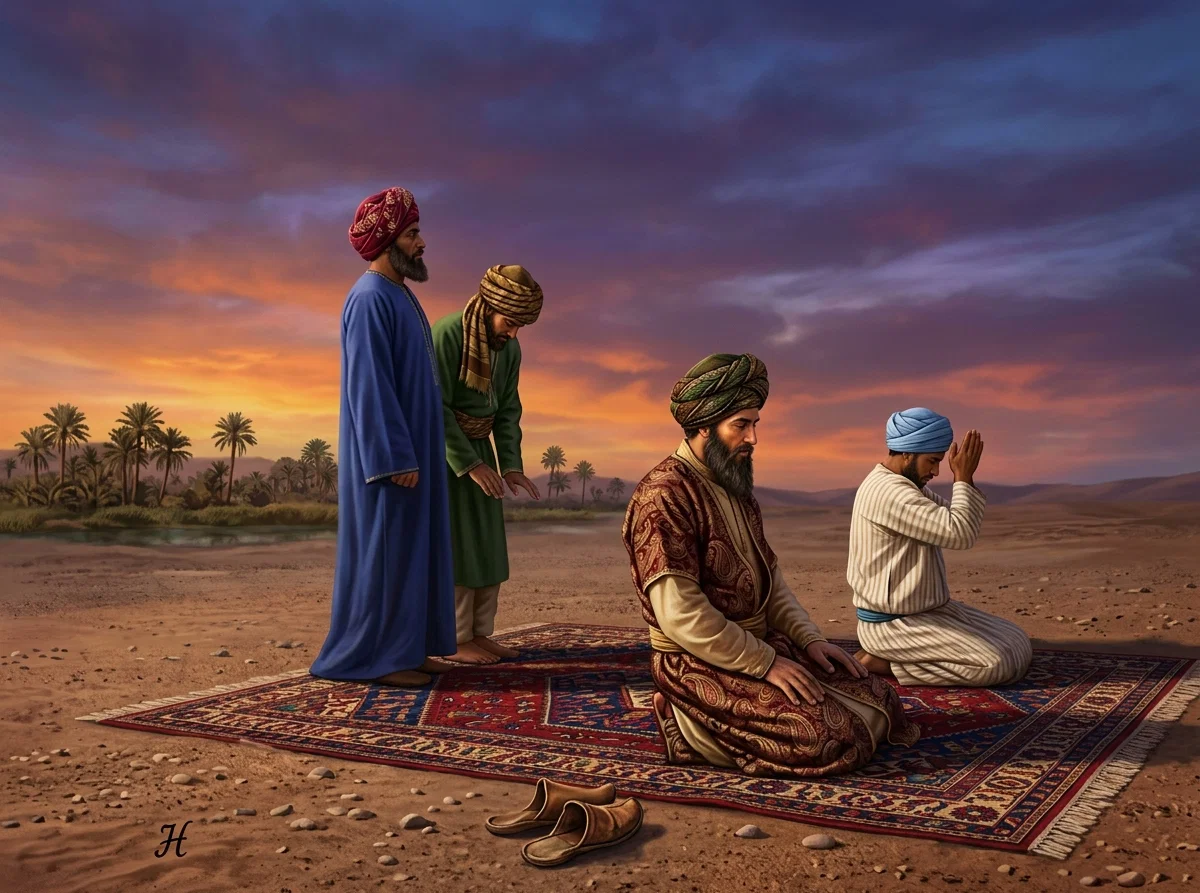
Mohammedans at Their Devotions.

MOHAMMEDANISM

MOHAMMEDANISM is the religion of about 180,000,000 people. Its adherents predominate in the countries of Western Asia, where it had its birth and made its earliest triumphs. India has about 50,000,000 of them; they are numerous in the northern and western provinces of China, and there are not a few of them in the islands of the Eastern archipelagoes. “Islamism is the predominating religion of the entire north of Africa, and its rule extends far down eastward, and into the center of the continent.”
The City from the Harbor. Howling Dervish. A Turkish Bazaar. Residence of European Ministers.
Europe has a share of Mohammedans, including the sultan of Turkey, the most powerful of Mohammedan rulers, and about 4,500,000 of his subjects. Another 2,000,000 Mohammedans reside in European Russia.
The followers of “the prophet” are not so aggressive now as they were when they were building up great Moslem empires; but a religion so widely dispersed, and with so many adherents, could not fail to exert a very strong influence. And this leads to the inquiry, What is the character of the religion that sways so many human minds? and how does it meet the needs of the soul?
Mohammedans boast of the excellence of the Koran, and no doubt it enjoins many good and moral practices. But it is a religion of form. The Sheik ul Islam, or Doctor of the Mohammedan Law, at Constantinople, divides religious duties into two classes,—those to which “great attention must be ‘paid,’” and those “‘obligatory on all.’” The moral duties come in the first class; the ceremonial observances in the second.
Rev. Henry Otis Dwight, LL.D., gives an illustration showing how easily the moral precepts can be evaded. He says:—
In traveling in Turkey I once fell in with a pasha, governor of one of the provinces of Asia Minor. He was a most agreeable and even attractive man; and during a voyage which lasted several days, we talked on almost every conceivable subject of interest to plain and decent men.
This sensible and well-meaning man showed me the corner-stone of his character one evening, at table in the cabin. He asked me to take a glass of wine with him. I declined. Then the pasha said: “You may think it strange that I, a Mohammedan, should ask you, a Christian, to drink with me, when wine-drinking is forbidden by our religion. I will tell you how I dare do this thing.” He filled his glass and held it up, looking at the beautiful color of it, and said: “Now if I say that it is right to drink this wine, I deny God’s commands to men, and He would punish me in hell for blasphemy. But I take up this glass, admitting that God has commanded me not to drink it, and that I sin in drinking it. Then I drink it off, so casting myself on the mercy of God. For our religion lets me know that God is too merciful to punish me for doing a thing which I wish to do, when I humbly admit that to do it breaks His commandments.”
Mr. Dwight continues:—
The Mohammedan sinner is taught that he is fit without reform of his fleshly tastes for admission to God’s eternal favor. God’s mercy may even spare him the pains of punishment. There is little in such a doctrine of man’s relation to God which can check the pursuit of self-gratification.
But in the Mohammedan rules of life, the importance of self and the interests of self are everywhere presupposed. Provision to spare the Moslem the pains of self-denial and self-control is found in the permission to pray but once in the day, providing that tally is kept, and the whole number of repetitions due for the five times of prayer is carefully made up. It is found again in the arrangement of the rules for the great fast, so that men may recoup themselves for abstinence through the day by gorging themselves all night. It appears again in the rules for alms-giving and sacrifice as a part of worship, when the man is definitely told that he need not give the best of his flock to God, but a medium animal; and when he is reminded in the Koran that sacrifice does not mean self-denial, since he has had the use of the beast before sacrifice and has the use of it for food afterward.
The same tenderness of self-interest is shown in the categorical instruction of the Koran for men to take revenge for injuries, promising divine aid where retaliation proves difficult. And the climax for such provisions for serving God without self-abnegation is reached in the carnal gratifications promised by the Koran as the reward of the faithful in paradise, and repeatedly urged upon their study and meditation through life, in order that any deprivation here may be felt to be but temporary.
Yet among Mohammedan thinkers one often meets with telling admissions of the harm to be expected from such ethics. They, as well as we, have observed that with exaltation of self-seeking goes the sure companion of its ill-gotten gains and indulgence of the animal appetites.
The dervish orders, the Babis of Persia, and the Wahabis of Arabia have all wrestled with this question, and thousands still wrestle with it, sometimes reading the Christian Bible as an aid to feeling after God, if haply they might find Him. And Mohammedans are often attracted by the virtues of Christians, intimating that they are near to God’s grace and will reach it, if they only believe in Mohammed, so as to learn the need of ablutions and genuflections and the rest.
Surely this is a religion in harmony with the natural heart; for it makes ample provision for fulfilling “the lusts of the flesh.” But does it meet the needs of the soul? Does it give the heart courage in the trials and vicissitudes of life, and hope and peace in view of the awful and inevitable ordeal of death?
“A notable convert from Islam,” who has gone to rest, has answered these questions. When from the study of the Koran he “had become brimful of Mohammedan bigotry,” but had not found peace in God, he was told that what he had already learned was merely the outward ordinances, but that if he wished “to attain to the true knowledge of God, he must go to the fakirs and Mohammedan saints, and remain in attendance on them for many years, because they possess the secret science of religion.”
He says:—
As soon as I was entangled in this subtle science, I began to practise speaking little, eating little, living apart from men, afflicting my body, and keeping awake at nights. I used to spend whole nights in reading the Koran, and constantly performed the special repetitions of the Koran, and all the various penances and devotions that were enjoined. I used to shut my eyes and sit in retirement, seeking by thinking on the name of God to write it on my heart. I constantly sat on the graves of holy men, in hopes that, by contemplation, I might receive some revelation from the tombs. I used to go even to the dreamy and intoxicated fanatics, in the hope of thus obtaining union with God. I did all this, besides performing my prayers, and always was repeating the salutation of Mohammed and the confession of faith. In short, whatever afflictions or pain it is in the power of man to endure, I submitted to them all; but nothing became manifest to me after all, except that it was all deceit.
The thought of utterly renouncing the world then came into my mind with so much power that I left everybody, and went out into the jungles and became a fakir, putting on clothes covered with red ochre, and wandered here and there, from city to city, and from village to village, alone, for about two thousand cos (two thousand five hundred miles). Faith in the Mohammedan religion will never, indeed, allow true sincerity to be produced in the nature of man; yet I was then, altho with many worldly motives, in search only of God.
I wrote the name of God on paper during this time one hundred and twenty-five thousand times, performing a certain portion every day; and I cut out each word separately with scissors, and wrapped them up each in a little ball of flour, and fed the fishes of the river with them, in the way the book prescribed. During half the night I sat up and wrote the name of God mentally on my heart, and saw Him with the eye of thought. When all this toil was over, I had no strength left in my body; my face was wan and pale, and I could not even hold up myself against the wind. The treasurer, Taj Mohammed, and Fazl Rasul Khan, the minister of the Rajah of Karuli, and many people of the city became my disciples and gave me much money, and reverenced me greatly. But still my soul found no rest, and I only felt daily a growing abhorrence of the law of Mohammed.
This victim of a false faith was led to investigate Christianity; and in Christ he found great peace, and also improved health, for his mind was no longer perplexed and harassed.
Truly “godliness is profitable unto all things, having promise of the life that now is, and of that which is to come;” but every false way shall perish.
E. J. BURNHAM.

A MISSIONARY HYMN.

(Tune, “Wesley.”)
MANY the hearts who of error are weary, Longing for Him who is waiting to save; Many the lost ones in wilderness dreary, Many who, Christless, now haste to the grave.
Bear to the lands that in bondage are lying, Tidings of Jesus, the Saviour of all; Speed with the Gospel, on love’s pinions flying, Haste, O ye reapers, the Master doth call.
Go to all nations: no longer delaying, Go, with His message of love and of light; Go, for the systems of error, decaying, Herald the passing of heathendom’s night.
Go in the name of the Saviour confiding, Who for the sinner once suffered and died; Death can not harm who in Jesus abiding, Refuge their souls in the cleft of His side.
Harvest draws near. Hath the Master not told us? Haste, O ye reapers, the fields are now white. Fear not. His love and His power enfold us; Strong is the Christian in Jesus’ own might.
—Ernest G. Wellesley-Wesley.

THE BIBLE IN JAPAN

FOR a number of years the work of publishing and circulating the Bible in Japan was carried on by three Bible societies working separately. It was found that in so small a field such a system was attended with serious difficulties, as well as much extra cost.
In order to render the work more systematic and less expensive, and at the same time do away with all rivalry or competition, a union of the three Bible societies was effected in 1899, and has now completed ten years of joint work. . .
Since the beginning of this union there has been circulated 1,010,300 Bibles, Testaments, and portions of the Scriptures, and the cash receipts were upward of $25,000. The year 1909 was much the best of all. During that year the total circulation was 136,029, and receipts $4,213.
One important fact in connection with this distribution of the Scriptures is the eagerness with which they are being read and studied. . . . Many of these students of the Bible are priests, officials, and other persons who would not at present attend a Christian service, or have it publicly known that they are interested in the subject. But when they come to understand what Christianity is, and accept its teachings, they become bold and earnest followers of Christ.—H. Loomis.

OUR WORK AND WORKERS.

NINE members were recently added to the church in Halifax, N. S.
AT Calais, Maine, five converts are reported to the Vineyard by the tent laborers.
DURING the recent camp-meeting at Rogers, Ark., twenty-one persons were baptized.
THREE persons have taken their stand on “the ‘commandments of God and the faith of Jesus’” at Fayetteville, N. Y.
A SUCCESSFUL term of German church-school has just been closed at Lincoln, South Dakota. It was conducted by Brother F. G. Specht.
THREE candidates were baptized after three meetings held in one day at Wolf Lake, Ind., by Brother I. J. Hankins, president of the conference.
FROM the Workers’ Record we learn that Brother Dan. T. Jones recently returned from Guadalajara, Mexico, to his old home at Kingsville, Mo.
TEN candidates were baptized at Hicksville, Ohio, on a recent call from Brother F. M. Roberts, who was laboring at St. Joe, Ind., near the State line.
A CHURCH of twenty-four members has been organized at Wilton, South Dakota, under the labors of Brethren J. W. Westphal and C. Reiswig.
A DANISH edition of “Christ’s Object Lessons” has been issued by the Review and Herald Publishing Co., Battle Creek, Mich. Price $1.25; postage, 15 cents.
ADVICES from Brethren T. H. Watson and A. M. Dart, who are now located in Douglas City, Alaska, state that the Lord is blessing them in a marked degree in getting the SIGNS before the people of that place. They sold 208 copies in eight hours, fifty copies being sold in the first two hours.
THE “Third Annual Announcement of Woodland ‘Industrial Academy,’” for 1901-1902, is at hand. It is a neat, illustrated pamphlet, filled with interesting information concerning this prosperous young institution. The fall term of twelve weeks opens September 11. Address, Woodland Academy, Bethel, Wis.
THE State of Louisiana has been organized into a conference, with officers as follows: President, S. B. Horton; secretary, W. T. Hartsock; treasurer, Frank Peabody; canvassing agent, C. F. Dart; superintendent of church-schools and secretary of Sabbath-schools, Ruby Roach; secretary of Medical Missionary Department, W. T. Hartsock; executive committee, S. B. Horton, C. A. Watkins, E. S. Brousard, Solomon Brousard, J. R. Hudson.
WHAT it means to be a missionary in the heart of Africa is well illustrated in the following extract from a letter written by Mrs. W. H. Anderson, about four months ago:—
One year ago the last of March, Mr. Anderson and myself and little daughter left the old home station [in Matabeleland] and went to an out-station, where Brother Chaney was staying, about twenty-five miles from the farm. When we went there, there was a small two-roomed building that served for a store and a place to live in. The two men began to get ready to make bricks for some buildings, but Brother Chaney was only there about half of the time that we were there. This left Mr. Anderson alone with the work. The bricks had to be made and burned, and then came the building. The water for making and laying the bricks had to be brought in a wagon for two miles. This required eight oxen and took a great amount of time. The house was so we could move into it about the middle of November. While the preparations for building were progressing, there was a school of twenty-five pupils to teach, the store to tend, twelve black children to look after and do the sewing for, besides the work for Mr. Chaney, Mr. Anderson, myself, and baby one year old. We each, besides some of the native children, had our turn at being ill. One of the most promising young men died. We had meetings for the natives Sabbath morning, and our Sabbath-school. Friday evening we would have prayer and social meeting for both whites and blacks. These were special seasons, when God came very near, and we would hear thanks returned to Him for the missionaries He had sent to them to bring them out of darkness into the light of the cross. Confessions of wrong were also made at this time. If those in the home land could only hear some of these things, they would feel repaid for all they have done for those who are in darkness, and would renew their efforts to spread the Gospel of Christ in the earth. The work looks brighter as we see it through the eyes of faith. Jesus is soon coming to this earth for the faithful few, and may each one of us, with some of those for whom we have worked, be ready to meet Him with rejoicing.

ISLAM IN INDIA.

More than one-third of the adherents of Islam are in India. Nowhere else are Moslems so accessible. Nowhere else is there such immunity to the missionary from hostile resistance to his work, and from lawless effort to destroy the result of his labor. Nowhere else is the Moslem, from the force of circumstances, so powerless for mischievous aggression and malevolent resistance to the peaceful efforts of evangelism. Perhaps in no other land do we find Islam in a more orthodox form, and with so many followers in a reasonable and enlightened frame of mind to meet the advances of the missionary in the prosecution of his work. Perhaps no land has yielded so many converts to Christianity with so large a number of enlightened and faithful workers for Christ.—Rev. T. G. Scott.

THE GREATEST BIBLE SOCIETY.

The British and Foreign Bible Society is not only the oldest (1804), but also has the largest income ($1,107,675 last year), and prints the largest number of copies of the Word. In 1900 the issues were over 4,900,000 copies. For the eighth time the annual figures have exceeded 4,000,000—in 1899 they were over 5,000,000 copies. Out of every 100 copies issued last year, 17 were Bibles, 27 were New Testaments, and 56 were Scripture portions, chiefly Gospels or Psalters. The sales by over 850 colporters in 30 different countries exceeded 1,600,000 copies; while 616 native Christian Bible-women in the East read the Scriptures to 40,000 women every week, and taught 2,700 to read for themselves. Every great British foreign mission is supplied from this source with the bulk of the Scriptures it needs for its work abroad.—Missionary Review of the World.

A NEW CONFERENCE.

DURING the camp-meeting held at Los Angeles August 4-17, a new conference was organized, Pastor W. T. Knox, the president of Pacific Union Conference, presiding. This organization, called Southern California Conference, includes, generally speaking, that part of the State south of the Tehachepi range.
The officers elected are as follows: President, Clarence Santee; secretary, C. A. Pedicord; executive committee, Clarence Santee, Roderick S. Owen, William M. Healey, Dr. F. B. Moran, Dr. H. S. Whitelock, T. Sterling, and M. C. Morgan. The number of churches in the conference is 13, with a membership of 1,000. The number of ministers in the new conference is 4; the licentiates number 6 (possibly 8), and the Bible workers 3. The address of the conference headquarters is 516 South Hill Street, Los Angeles, Cal.
The camp-meeting was probably the largest ever held in Southern California, and the evening outside attendance was good. The laborers from abroad were Pastor W. T. Knox, president of the Pacific Union Conference; J. J. Ireland, the secretary; Mrs. E. G. White; Pastor N. C. McClure; E. S. Ballenger, representing the educational work; H. S. Osborne, representing the book work; A. Boker, the health-food work; and the editor of this paper. The preaching was instructive, practical, and inspiring.
A goodly number of young people were in attendance, and the meetings held with them were of interest, as souls responded to the voice of the Lord's invitation. These bright young people will be a mighty power for good in the coming years, if they are only consecrated to God. So may they be.
Many sought the Lord, some for the first time, on the last Sabbath of the meeting. Forty-one willing souls followed their Lord in baptism.
Steps will be taken soon greatly to enlarge the sanitarium and health-food work, for which there is great demand in Southern California.
The Southern California Conference starts out under favorable auspices in a most promising field. May God bless and prosper it abundantly. W.

Distributing Tract Literature

“As I wish to know more what the Bible teaches on the eternal state of the wicked, I wish you would send me your tract, ‘Tormented Forever and Ever.’”
So writes an inquirer to us. There are thousands of just such inquirers all about you, and there is no better way to enlighten them than by a judicious distribution of tract literature. It is a work that every one should engage in, young and old.
Send for the booklet, “Silent Messengers,” mailed free on request. It contains full lists and prices, with suggestions for work.

Nameplates, Signs, and Numbers

WANTED.—General and local agents. Nameplates, signs, numbers, readable darkest nights. Samples free. Right Supply Co., Englewood, Ill’s.
Continue reading: LESSON XI.—SEPTEMBER 14.—THE SEVEN LAST PLAGUES