The Youth’s Instructor, Vol. 48, No. 15.

OUR SCHOOL FARM

The Youth’s Instructor

Apr 12, 1900

Review and Herald Publishing Company · Battle Creek, Mich. · Apr 12, 1900

OUR SCHOOL FARM

Since last May we have been living on a farm at Avera, Raiatea, and have enjoyed our quiet country life among the hills. Raiatea is next to the largest island in the Society Group. Tahiti, which is the largest of the group, is one hundred and twenty miles from this place. For several years we have felt that we needed a farm, where some of our most promising young people might be given an all-round education, and prepared to work for the Master. Our whole object in getting this farm was to provide a place for a school of this kind. It is situated about six miles from Uturoa, the settlement, and a mile inland. We are surrounded with quiet, beautiful scenery, and the farm is just the kind of place the Spirit of prophecy says is best for our schools. Our nearest neighbor, who is a white man and a Sabbath-keeper, lives about a quarter of a mile away. Our native neighbors are still farther away, as they never go far from the beach to live.
When we bought the farm, there were no buildings on it. The house in which the previous owner had lived was burned during the war between the French and the natives, three years ago.
As there are about four thousand cocoanut trees on the place, and the principal use of the nut is for making copra, one of the first things to do was to build a copra-house. Perhaps all do not know that copra is the dried kernel of the cocoanut, and is the chief export of these islands. It is shipped to Europe and to the United States, where its oil is extracted, and used for manufacturing purposes. Brother Stringer came up from Tahiti to build the copra-house, and it was finished the first of the year. It is made with a drier, where the nuts are well dried with artificial heat from a furnace. We can also use the drier for fruit, corn, or anything of that kind, and have experimented in drying bananas with the best of success.
We make copra about once a month. During the month, as the ripe nuts fall from the trees, they are gathered in piles, and afterward hauled in a cart to the copra-shed. We seldom pick the nuts from the trees, but use only those that have fallen. Those who have seen a cocoanut tree, or the picture of one, know that it is not easy to climb; for it has a smooth trunk with no limbs, and the leaves and nuts are all together at the top. But as the nuts always fall soon after they become ripe, it is unnecessary to climb for the ripe ones.
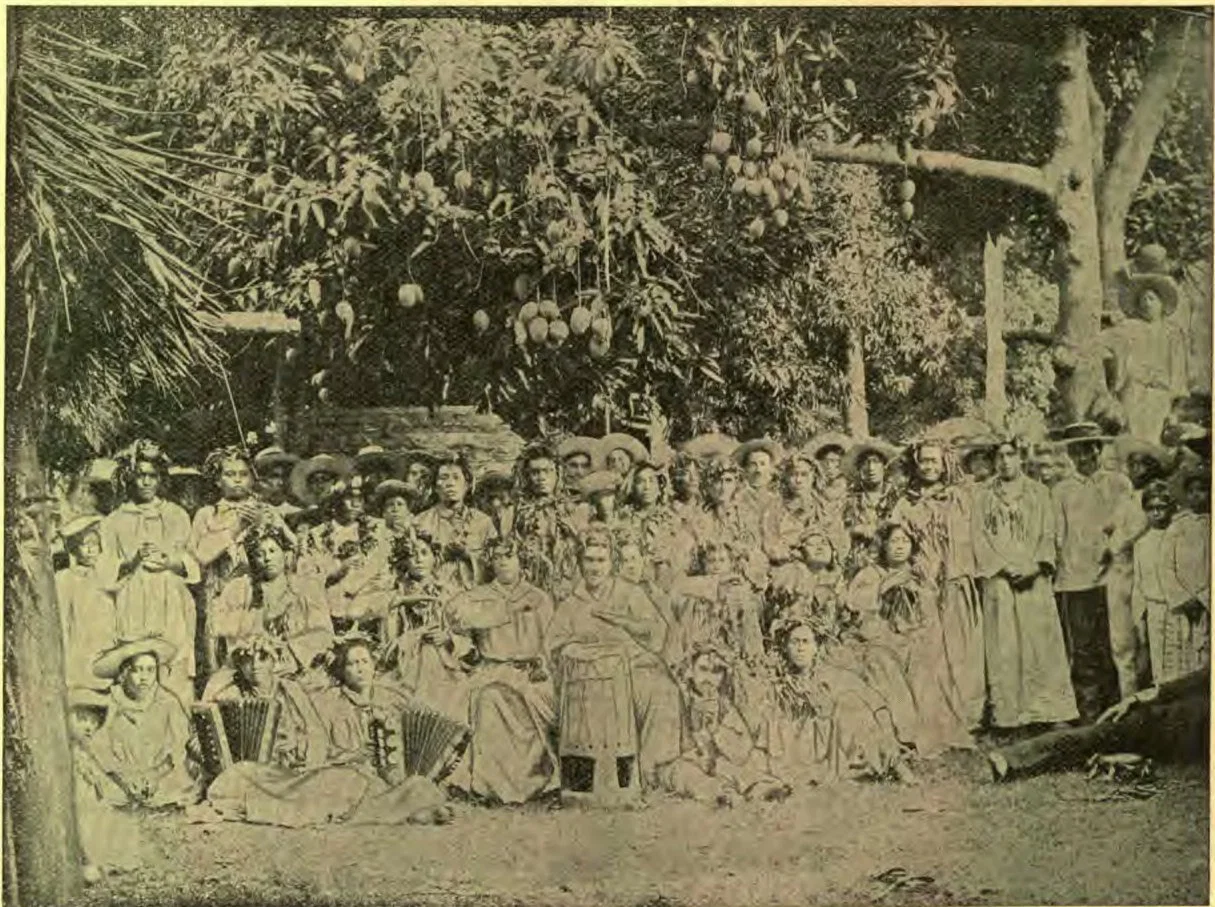
A HOLIDAY OCCASION — UNDER A MANGO TREE.
When the time comes to make copra, we have several workers dig the meat out of the nuts as they are cut. One or two men split the nuts open with an ax, while the others dig out the kernel with small iron instruments made for the purpose. We do not husk the nuts, as the meat is taken out anyway; but some husk them, then break the nut in halves, and dry the meat in the shell, removing it afterward. Some nuts are found that have lain so long on the ground that they have begun to grow. The hollow in the center of the nut, where the water was, is then filled with a white, spongy substance, which is very palatable. It is tender and juicy, and is delicious eaten just as it is when taken from the nut; it is also served in other ways by baking or boiling.
The meat that has been taken out of the nuts is carried in boxes to the drier, and spread on racks, where it is dried by the hot air from the furnace beneath. The fuel used for the fire is the husks of the cocoanuts. If the fire is kept burning day and night, the copra will be dry and ready for sale in forty-eight hours.
There is no more useful tree in the islands than the cocoanut, and we have found our trees a great help to us in more ways than one. The money that the copra brings in helps in making improvements on the place; and there are many other ways in which the nuts can be used. From the grated meat we make a sort of milk, which is rich in fat, and is an excellent substitute for cow's milk. Water can be added to thin it to the desired consistency; we use it like cream in shortening and flavoring all kinds of food, and believe it to be quite wholesome. When made thin like milk, it is insipid to drink as a beverage; but if prepared with little or no water, so that it is quite rich, it makes a good substitute for cream to eat with bread. If salted, it somewhat resembles butter in taste. In fact, its flavor is much more like good, fresh butter than is the rancid, canned butter that we get here in the stores. The butter used here is shipped in from the United States, New Zealand, and France, and of course is seldom fresh. Yet such strongly flavored grease is liked so well by the natives that when they can obtain it, they use it lavishly.
A fine oil is extracted from the meat of the cocoanut, which can be used for everything for which oil is required. The meat is also much used for feeding fowls and other domestic animals.
When the nut is still green, the meat is tender, and can be eaten with a spoon. It then has the appearance of, and a flavor somewhat resembling, the cooked white of egg. The inside of the nut is filled with sweet, clear water, which nearly every one enjoys drinking. As the nut matures, the water is absorbed by the growing kernel, so the ripe nut contains but little water, and that little is strong in flavor.
Cocoanut shells are used for making charcoal with which to heat flatirons. These irons are large, and have a cavity inside to hold the charcoal with which they are heated. This coal is kept burning during the ironing process, to keep the iron hot. As stoves are very scarce here, these irons are the best kind for the people.
A piece of the husk makes a good brush for washing vegetables, woodwork, and many other things. Ropes and door-mats are also made from the fiber of the husk.
I can not take time to tell all the ways in which the cocoanut is useful, but will tell you of some other native trees next time.
MRS. B. J. CADY.

BEREAN LIBRARY STUDY

Dan. 11: 40-43; “Thoughts on Daniel,” pages 273-280

NOTES ON LESSON 20

(April 15-21)
1. 1798.—The events which mark the close of the twelve hundred and sixty years of papal supremacy are an emphatic testimony to the unfailing accuracy of the prophetic word. Established in 538, the papacy was to continue its supremacy for twelve hundred and sixty years, and the establishment of this prophecy calls for an event to take place in 1798 which would deprive the papacy of its power. Did such an event occur at that time?
2. The Prophecy Fulfilled.—The French soldiers under Bonaparte had conducted a most successful campaign in Italy, but one feature of it had not been satisfactory to the French government; namely, the sparing of the pope. General Berthier was at length ordered directly to Rome; and Feb. 10, 1798, he entered the city, and the pope, Pius VI, and the cardinals, were taken prisoners. Papal independence was abolished, and the son of Napoleon declared king of Rome. The French soldiers were little disposed to spare the treasures of the Eternal City, and boldly took possession of the priestly finery. The robes of the priests and cardinals, richly decorated with gold lace, were burned, that the gold might be gathered from the ashes. The personal property of the pope was sold at auction. The churches were pillaged, and a reign of violence followed which the French general was unable to control.
3. The Pyramids of Egypt.—Along the plateau west of Memphis about seventy of these mighty monuments were erected. Three of these were pre-eminent in size. The largest is said to contain ninety million cubic feet of masonry. The structures are built of successive layers of stone, each layer being less in area than the one upon which it rests, so that on either side of the pyramid, the appearance is that of a series of stone steps, narrowing and receding to the top. It is said that three hundred and sixty thousand men were employed for twenty years in the building of Khufu, the largest pyramid. The interiors of the mammoth structures were divided into numerous apartments, and in the solemn stillness of these chambers were deposited the stone coffins containing Egypt’s royal mummies.
4. “The Battle of the Pyramids.”—The decisive battle between the soldiers of France and the Egyptian army, thirty thousand strong, which is referred to in our lesson, was so called because the battle field was within sight of the pyramids. Just before beginning the battle, Bonaparte aroused the enthusiasm of his men by an impassioned appeal. “Soldiers,” he said, “from yonder pyramids forty centuries look down upon you.” In the struggle that ensued, the field was hotly contested; but the Mamelukes finally gave way before the invincible courage and discipline of the French troops.
5. A Valuable Discovery.—During this invasion of Egypt by Bonaparte, a French engineer, while digging entrenchments on the site of an old temple near the Rosetta mouth of the Nile, unearthed a black marble tablet upon which an inscription was written in three different characters,—hieroglyphic; demotic, the common writing of the Egyptians; and Greek. From the Greek it was discovered that each of the writings was a translation of the others, and by a comparison of the Greek and Egyptian texts, a system of interpretation was established. Finally the translation of the Rosetta Stone was completed, and the whole field of Egyptian hieroglyphics thus opened up to the long-baffled scholars of the world. It was always supposed that the strange figures and characters so numerously carved upon the stone obelisks, monuments, and temples of Egypt, were but pictures of the things intended to be represented. To the astonishment of the learned, it was discovered that the strange writing was really a complex system of phonetic spelling.
6. Napoleon Bonaparte.—We have space for but a few words concerning that man whose complete biography would be the history of Europe for more than twenty turbulent years. He was born on the Island of Corsica, Aug. 15, 1769. His favorite plaything was a small brass cannon, and he loved to drill his playmates in battles with stones and wooden sabers. At the age of ten he was sent to a military school. In disposition he was resolute, quarrelsome, gloomy. He entered the army as a lieutenant, and his military operations immediately gave France the ascendency among the nations of Europe. In 1799 he became first consul, and a few years later emperor, of France. Then came the most gigantic undertakings recorded in history, to gratify his ambition for power. The earth trembled under the tremendous armies organized. For a time it seemed that his dominion would be universal, but it was not to be. After unparalleled successes, he was finally defeated and forced to abdicate his throne. He was banished by the English to the Island of St. Helena. Here he died on the night of May 5, 1821, while the most terrible storm was raging that had ever been known on the island. Such was the end of the most remarkable character of modern history.

APRIL STUDY OF THE FIELD

PART III: "AMONG THE EGYPTIANS"
(April 15-21)
1. The Third Angel’s Message in Egypt.—The truth was first introduced into this field by Dr. H. P. Ripton, but he had scarcely begun his work when he was killed in an Alexandrian riot. Later, because of the Armenian massacres, some Armenians who had accepted the third angel’s message fled into Egypt. Through their efforts a number began to observe the Sabbath, and loud calls were made for the living preacher. A colporteur and ship missionary settled there about two years ago, and literature in English, French, German, Italian, Greek, Russian, and Arabic has been circulated quite freely. Elder H. P. Holser and family, with three other laborers, went to this field last November, but their work is yet in its beginning. Pray that some from the “land of Ham” may be found among God’s people through the efforts of these workers.
2. The Mohammedan’s Devotion to His Religion.—There is something profoundly impressive in the devotion of the Mohammedan to his religion. It governs his actions, and pervades his thoughts, conversation, business dealing, and the conduct of his everyday life. He reads his Koran faithfully, for it lays down his standard of morals, and is the foundation of his code of laws. See him at prayer, in the mosque, field, or busy street, addressing his supplications to Allah, through his prophet, face turned to Mecca—his faith is complete, and his sincerity unquestionable. He cares not how the onlookers may regard him. The peasant in the field utters the same fervent, heartfelt prayer as the pasha prostrate upon his silken rug within the Mehemet Ali mosque. This describes the faithful Mohammedan; there are many such.
3. The Great School of the Mohammedan World is one of Cairo’s important sights. Cairo is the educational center of the religion of Islam. Its records extend from the year 975 A. D. The period of instruction may be indefinitely extended, even for a lifetime; but from three to six years is the usual course. One may see old and grizzled men there, as well as children of four years. The institution is so richly endowed, and owns such valuable property,—for few true Mohammedans of fortune die without leaving something to El-Azhar (The Splendid), of Cairo,—that no student is compelled to pay anything, although many from choice contribute to the expenses. Religion pervades every branch of study. Students who come from abroad toil for years to learn the Arabic grammar, after which they take up religious science, with the Koran as text-book. Then follows jurisprudence, religious and secular. Literature, syntax, philosophy, prosody, logic, and the intricacies of the Koranic teaching, as directed to an upright life, round out the course. Juvenile pupils are taught little but the Koran. When far enough advanced to write, favorite quotations from the Koran, such as, “There is no God but God, and Mohammed is his prophet,” and, “I testify that Mohammed is God’s apostle,” are given them as exercises.
4. Water-Carriers.—The daily procession of young women to the Nile bank before the going down of the sun, to obtain the water required for the evening and early morning in their homes, presents a beautiful picture of womanly grace. These Rebeccas hold themselves erect, and walk with superlative grace and majesty. Egyptian girls begin early to perform their share of the work of the home, and at seven or eight years begin to carry half-filled water-jars, and at twelve think nothing of balancing a full half-hundredweight on their heads, walking leisurely homeward, chatting with neighbors bent on the same errand. For thousands of years their ancestors have done the same; but they carried the water-jars represented in Biblical pictures. Many of the present generation, discarding these, prefer the square two-gallon tins in which kerosene oil is shipped to Egypt. These are lighter than the pottery jars; and if the carrier becomes excited in discussion, the petroleum tin never breaks in its fall.
5. Why Egypt Is a Good Missionary Field.—The Nile Valley is as bountiful in rest and recreation to the invalid as in matchless sights to the tourist. These attractions bring people of all nationalities into this country, for the greater part of the year at least, and especially through the colporteur can the message be given to the people of many lands. He also finds a fruitful field in ship missionary work, as from three to four thousand vessels pass the Suez Canal each year. Almost all these stop at Port Said, a coaling-station at the mouth of the canal. Then, too, in various ways the Egyptians themselves are being prepared to understand the third angel’s message. “The Bible has been translated into the language of the natives, and is being circulated quite extensively. Mission schools have been established, in which thousands are learning something about the gospel. The land is under the control of a nation that makes life and property reasonably secure, and that recognizes a good degree of liberty. A strong foreign element is doing much to break the bands of servitude and fatalism in which the Moslems are held. Although these things can not of themselves save the people, the Lord can use them in making the work of the gospel less difficult. The Lord is certainly at work in this field, and we should follow his leading.”

PRAISE YE THE LORD

WINTER winds, that moaning go, Clouds and vapors hanging low, Frozen stream and falling snow, Chant, with single voice and mind, “Praise the Lord, for he is kind!”
Spring the earth has newly drest; And above his new-built nest, Robin, with exultant breast, Carols to his little mate, “Praise the Lord, for he is great!”
Summer fields with promise gleam; Sunlight lies on heath and stream, Health and life in every beam. Hark! from vale and hill and wood,— “Praise the Lord, for he is good!”
Harvest reaped from fields well tilled, Autumn finds her garners filled; All disquiet hushed and stilled, Sing above the gathered board, “Praise the Lord! Oh, praise the Lord!”
MRS. ELIZABETH ROSSER.

THE SHIP THAT COMES IN

“It is useless to wait for ‘your ship to come in’ unless you have sent it out.”
We had hardly expected to get a new idea from that hackneyed phrase, yet here it was, straight as the flight of an arrow, sharp as its barbed point. And the most striking thing about it is its undeniable truth. For what is the use of waiting around the wharves for a ship to come in laden with a rich cargo, unless we have one sent out?
“When my ship comes in.” That is the catch-word of the believer in luck. “Sometimes circumstances will change, and all sorts of good fortune will come to me through no effort of my own. Perhaps at this very moment, from some unknown port, in an unknown bark, a cargo of good things is starting in my direction.” Pleasant material for day-dreams, such fancies, but that is all. For ships do not drift about in this hit-or-miss fashion. Whenever one comes into port, laden with such things as we all desire, it is safe to conclude that an owner is expecting its return.
It is only the old distinction between luck and pluck. Ships come into the harbor every day, and some of the cargoes are rich enough to arouse twinges of envy in the hearts of the idlers who watch the unloading. But each one represents an expenditure of some kind, something risked, something done. Not one of them came from dreamland.
Are you waiting for your ship to come in? Would it not be wiser to be getting ready to send one out? Pluck and industry make returns sooner or later. And though storms may delay the ship so that long months or even years pass before you sight its white sail above the horizon, there is no reason for discouragement. You may look hopefully and happily for its coming if with honest effort and earnest prayer you sent it forth.—Young People’s Weekly.

3—Symplocarpus Foetidus, or Skunk Cabbage
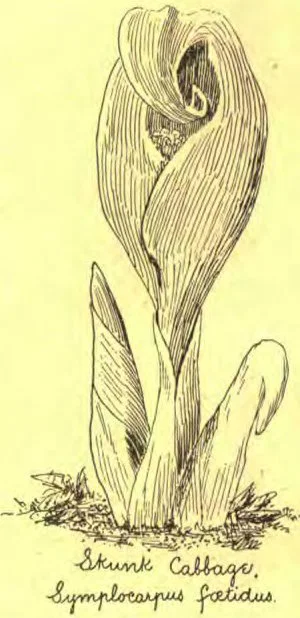
There is probably no flower that blooms earlier than the skunk cabbage. I suppose the children will hardly care to call the peculiar blossom of this plant a flower, for it looks more like a huge curly leaf. This seeming leaf is called a “spathe,” and it envelops and shields the true flowers, which are within, and which are arranged on a fleshy club called a “spadix.”
The leafy spathe is shell-shaped, veined with purple. The real leaf is from one to three feet long, but appears later than the flower, and grows from a short root-stock. The leaves are clustered at the roots, and are almost as broad as they are long.
The early Swedish settlers near Philadelphia called the plant “bearweed.” Its peculiar odor has been termed a “skunk and garlic combination.” The children love to kick it over, as the odor is thus increased for the moment.
One would hardly suppose this plant to be a relative of Jack-in-the-pulpit and the beautiful white calla, but such is the case. Its green spadix corresponds to the arching pulpit of Jack, and to the white cup of the calla.

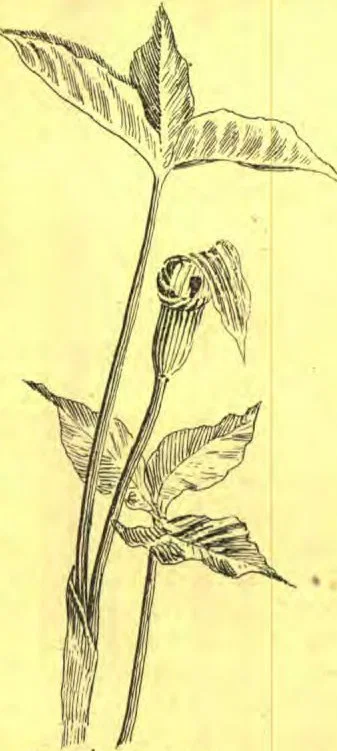
4—Arisaema Triphyllum, or Jack-in-the-Pulpit
“Jack-in-the-pulpit Preaches to-day Under the green trees Just over the way. Squirrel and song-sparrow High on their perch Hear the sweet lily-bells Ringing to church.
“Come hear what his reverence Rises to say In his low, painted pulpit This calm Sabbath day. Fair is the canopy Over him seen, Penciled by nature’s hand, Black, brown, and green. Green is his surplice, Green are his bands; In his queer little pulpit The little priest stands.”
We know that Jack-in-the-pulpit must be a strictly orthodox preacher. It is not every one who understands or cares to listen to his sermons. Some one says that his text is Cant. 2:11, 12: “Lo, the winter is past, the rain is over and gone; the flowers appear on the earth; the time of the singing of birds is come, and the voice of the dove is heard in our land.” But I am sure he sometimes takes his text from Matt. 6:30: “If God so clothe the grass of the field, which to-day is, and to-morrow is cast into the oven, shall he not much more clothe you, O ye of little faith?”
Jack-in-the-Pulpit.
Arisaema triphyllum.
Jack-in-the-Pulpit. Arisaema triphyllum.
The plant grows from a corm, or solid, bulb-like root, which is turnip-shaped and filled with farinaceous matter. The root loses its acridity on being boiled; and as it was occasionally used as food by the Indians, it is sometimes called “Indian turnip.”
There are usually two leaves on long petioles, divided into three ovate, wavy, margined leaflets.
In time Jack loses his pulpit, and is changed into a thickset club, studded with brilliant red berries. L. A. REED.

Foundryman Who Memorized the Bible One Verse at a Time

THE story is told of Robert Garry, a poor foundryman of Lockport, N. Y., who, forty years ago, began to commit the Bible to memory. Each day he wrote down one verse from the Scriptures, and pinned it on the wall, where he could turn to it often. This verse he learned by heart, and studied its hidden meaning all day. Following this plan, he learned almost the entire Bible. Now he is an evangelist, speaking largely in Bible language; and his work is very successful.—Well-Spring.

A SERMON ON THE LEAF

By all the winds of heaven The homeless leaves are driven Like chaff from winnowed grain; Till, sodden by the rain, They lie with seasons old That knit the forest mold— Ten autumns all in one! Their use is never done, But only now begun; For they must shield the grass When frost and sleet-wind pass; And they must house the seeds In the rich woods and meads, And fold the violet In a warm coverlet, And keep back forward flowers Till seasonable hours, When gleams of April sky Are shed through clouds on high. — Edith M. Thomas.

THE SABBATH AND NATURE

IN our studies thus far we have learned the different steps of creation, which brought the world from its chaotic condition into one of beauty and harmony. The Creator employed six days in creating this world and the things that are therein. We have spent some time in studying these wonderful creations, yet there is much more that might be said about each one. I trust we shall never get too old to admire and think about the wonderful works of God. After God had created light, firmament, land and water, plants, sun, moon, and stars, water animals, air animals, land animals, and man, he spent one entire day, the seventh day, in beholding the harmony and perfection of his handiwork. The Creator was not weary nor exhausted from the labor he had performed, but he rejoiced to see in his creation the ministry of love that prompted him in creating all things. John, the Revelator, speaks of all things being created for the pleasure of God. Moses, in describing the rest that God enjoyed upon the seventh day, says that the Creator rested and was refreshed.
We can get some idea of the satisfaction it was to God to look upon his works when we bear in mind the satisfaction it is to us to note the success that has followed the efforts we have put forth to accomplish a certain work. Each thing that God made on the six days, he pronounced good; but when all was completed, each carrying out its God-given work, the whole was pronounced very good. Then God set apart every seventh day, that man might employ it in beholding the wonderful works of his Creator, and thus each week be led to love and adore his Maker more fully. I sometimes think that we look upon the Sabbath as an institution that God made for man after he had sinned, but it is not so. The Sabbath had its origin in creation week, and therefore would have been observed by Adam and his children if sin had never entered our world. When the earth is made new, its inhabitants will “remember the Sabbath day, to keep it holy.”
To keep the Sabbath in the way the Lord designed in the beginning, is to spend its hours in study and meditation upon his power, wisdom, and love, as revealed in his created works. Since the world has been cursed by sin, it is necessary for us to read God’s word, in order to understand better the mars, scars, and blots that we now see upon the once fair creation of God.
Some seem to have the idea that in order to keep the Sabbath holy, we must stay indoors, and read nothing but the Bible and religious books; but this is entirely out of harmony with the original idea of the Sabbath. Children should go out with their parents into the groves, along the streams, and listen to the songs of the birds and the music of the brooks, which will direct the thoughts to the Creator, who wishes us to “call the Sabbath a delight, the holy of the Lord, honorable.” We are not to think our own thoughts, speak our own words, nor do our own pleasure, but to think God’s thoughts and do his will.
The Sabbath is holy because God blessed it, sanctified it, and set it apart for a sacred use. How many of us have been keeping the Sabbath in the way the Lord wishes us to observe it? Has it been to us the best day of all the seven? or have its hours been tedious, and have we looked forward to the time when the day would pass away, because we found so little enjoyment in it? I am sure that if we keep the Sabbath as the Lord has told us to, it will be the most delightful day of all the week. We shall hail its weekly return with delight, knowing that it brings to us another opportunity to go out into the woods and fields to behold the expressions of God’s love to his creatures.
The first Sabbath that Adam and Eve enjoyed was a wonderful Sabbath. The condition of the earth is altogether different now. What brought about this change? This we will study in our next lesson. M. E. CADY.

"A NEW COMMANDMENT"

“A NEW commandment I write unto you, which thing is true in him and in you: because the darkness is past, and the true light now shineth. He that saith he is in the light, and hateth his brother, is in darkness even until now. He that loveth his brother abideth in the light, and there is none occasion of stumbling in him.”
Christ has specified the measure of the love we are to show for one another. “A new commandment I give unto you,” he declared, “That ye love one another; as I have loved you, that ye also love one another.” By this practical love, seen by the world, “shall all men know that ye are my disciples.” When the softening, subduing influence of the Spirit of God rules the hearts of those who are connected with his service, they will honor him by keeping the new commandment,—new because Christ said, “As I have loved you, that ye also love one another.” The disciples did not realize Christ’s love for fallen man until they saw it expressed on the cross of Calvary,—until he rose from the dead, and proclaimed over the rent sepulcher of Joseph, “I am the resurrection and the life.” The lessons that Christ gave in regard to this love are just as new to us, as far as practice is concerned, as they were to the disciples before his death and resurrection. When these lessons are brought into the practical life, when God’s people love one another as he requires, there will be an entire change in their experience.
If we would be true lights in the world, we must manifest the loving, compassionate spirit of Christ. To love as Christ loved means that we must practice self-control. It means that we must show unselfishness at all times and in all places. It means that we must scatter round us kind words and pleasant looks. These cost the giver nothing, but they leave behind a precious fragrance. Their influence for good can not be estimated. Not only to the receiver, but to the giver, they are a blessing; for they react upon him. Genuine love is a precious attribute of heavenly origin, which increases in fragrance in proportion as it is dispensed to others.
But while we are ever to be kind and tender, no words should be spoken that will lead a wrongdoer to think that his way is not objectionable to God. This sympathy is earthly and deceiving. No license is given in the word of God for undue manifestation of affection, for sentimental pity. Wrongdoers need counsel and reproof, and they must sometimes be sharply rebuked.
God desires his children to remember that in order to glorify him, they must bestow their affection on those who need it most. None with whom we come in contact are to be neglected. No selfishness, in look, word, or deed, is to be manifested to our fellow beings, whatever their position, whether they be high or low, rich or poor. The love that gives kind words to only a few, while others are treated with coldness and indifference, is not love, but selfishness. It will not in any way work for the good of souls or the glory of God. We are not to confine our love to one or two objects.
Those who gather the sunshine of Christ’s righteousness, and refuse to let it shine into the lives of others, will soon lose the sweet, bright rays of heavenly grace, selfishly reserved to be lavished upon a few. Those who possess large affections are responsible to God to bestow them, not merely on their friends,—this is selfishness, which has no place in the life of Christ,—but on all who need help. Self should not be allowed to gather to itself a select few, giving nothing to those who need help the most. Our love is not to be sealed up for special ones. Break the bottle, and the fragrance will fill the house.
There are many in the world who hide their soul-hunger. These would be greatly helped by a tender word or a kind remembrance. Coldness and hard-heartedness are not to be regarded as virtues. Those who cherish the attributes of Christ’s character will never be cold, stern, and unapproachable in demeanor, confining their sympathies to a favored few. The souls of those who love Jesus will be surrounded with a pure, fragrant atmosphere. Like the Master, they will go about “doing good.”
Christ’s love is deep and full, flowing like an irrepressible stream to all who will accept it. In this heaven-born love there is no selfishness; and those in whose hearts it is an abiding principle will reveal it, not only to those they hold most dear, but to all with whom they come in contact. This love will lead us to make concessions, to perform deeds of kindness, to speak tender, true, encouraging words. It will lead us to bestow sympathy on those whose hearts are hungering for sympathy. The heavenly gifts that God has so richly and freely bestowed on us, we are in turn to bestow upon others.
“If there be therefore any consolation in Christ, if any comfort of love, . . . fulfill ye my joy, that ye be likeminded, having the same love, being of one accord, of one mind. Let nothing be done through strife or vainglory; but in lowliness of mind let each esteem other better than themselves. Look not every man on his own things, but every man also on the things of others. Let this mind be in you which was also in Christ Jesus.” “Be ye kind one to another, tender-hearted, forgiving one another, even as God for Christ’s sake hath forgiven you.” MRS. E. G. WHITE.

NIGHT FLOWERS

As weary travelers on a train That stops they know not where. Catch sometimes through the windows borne Along the still night air
A breath so sweet, their tired hearts, Reviving ’neath its power, Know well that hidden somewhere near, The wild grape-vine’s in flower;
So, oft a hidden sweetness here Breathes through life’s pilgrim gloom, And we, too, know that somewhere near God hath a soul in bloom.
— Selected.

HAPPY CHILDHOOD

THEY say the world's a dreary place, But I have never found it so: The flowers smile into my face, The butterflies glance to and fro. The pebbly brook that babbles by; The leaves that crimson grow, then fall; The clouds that float across the sky,— I love, I love to watch them all. The meadows full of clover hay, A swing beneath the maple trees, The days all full of work and play,— What could I wish for more than these?
They say that life's a weary thing, But so it never seems to me. The air is full of birds that sing, Hums drowsily the honey-bee; By night the starry skies above Look down on me with kindly gaze; And mother-toil and mother-love Are spent to gladden all my days. By day and night, by night and day, My Father bears me on his breast, And showers his blessings o'er my way,— What further good could I request?
AUNT BETTY.
Continue reading: HOW A BOY HELPED