The Youth’s Instructor, Vol. 48, No. 15.

OUR SCHOOL FARM
Earlier text: OUR SCHOOL FARM

HOW A BOY HELPED

“Ten years from now, when I get to be a man,” said John to his grandmother, who was winding up the tall clock, “I’ll do that for you; I’ll do lots of things. I wish I was a man now.”
“John!” called Uncle Will from the yard, “come here!”
John ran out, and found his uncle standing beside the woodshed with a large dish partly filled with eggs. “I want you to help me,” he said. “The old speckled hen has made a nest under the shed, and I don’t want her to stay there. I’m too big to get into such a small place, but you’re just about the size to reach under. Take this stick and push the hen off gently.
John lay flat on the ground, and edged himself partly in under the shed. Far back in one corner old Speckle had made herself a nest, sure enough. She sat there very comfortably and did not move; for she thought no one could reach her. You see she did not know that a helpful little boy had come to stay at grandmother’s. John took his stick and brought it carefully round, little by little, not quickly enough to strike old Speckle,—for John was always kind to animals,—but just enough to push her off the nest slowly and gently. How surprised she was! She ruffled up all her feathers and pecked at the stick, but it was of no use; she had to come out from under the shed. She was very angry, cackling and flying about in a great flutter.
But Uncle Will caught her as John drove her out. How she struggled and flapped! John was glad he did not have to do that part of it; for an angry hen is not an easy thing to manage. But big Uncle Will only laughed. “Poor old Speckle!” he said, “you’re disappointed, aren’t you?” and he shut her up safely in a coop. Then John crawled under the shed and got all the eggs, not breaking a single one.
When they went into the house, Uncle Will said to grandmother, “I don’t know how I should have got that hen off the nest if it hadn’t been for John.”
“Now, John,” said grandmother, “you see you needn’t be in such a hurry to be a man. There are some things little boys can do better than grown-up folks—that is, little boys who are willing and careful.”—Selected.

WHAT BERNICE LEARNED ABOUT THE TWELVE APOSTLES

VI

The next time the little company met to talk over all they had been able to learn concerning the twelve apostles, grandpa was the first to speak:—
“We will talk about the life, labors, and death of the great apostle Matthew. We learn that he was at one time a very worldly man; but after he was converted, he regarded no sacrifice too great that he could make for the sake of his beloved Master. He gladly renounced the world and all its treasures, giving up the lucrative position of tax-gatherer to become a disciple of the lowly Nazarene, who had not where to lay his head. Do you think we should learn a lesson from this, Bernice?”
“It seems as if we ought to be willing to give up everything for Christ,” said Bernice, “even if our worldly prospects are not so good.”
“Sometimes we hear people say that if they should keep the Sabbath of the Lord, they would lose their position in life, and come to want,” said grandma; “but Matthew did not allow any such thought to prevent him from following Christ.”
“No,” said grandpa. “We notice that the other evangelists seemingly could not bear to call him Matthew before he was converted, when he was a selfish, greedy man; but then they called him by his other name, Levi. At last this devoted servant of Christ was put to death in a city of Ethiopia. It is generally believed by Bible historians that he was murdered with a halberd, or sort of battle-ax.”
“That seems awful,” said Bernice; “but I have been studying about the apostle Thomas, and I think his death was just as cruel; for his body was thrust through with a lance while he was praying. He must have had much more faith than he did when he refused to believe the good news that Christ had risen; for he was patient and kind, like his Master, even when he was being persecuted. While he was preaching, he went into Persia, and it is believed that he met the very wise men who came to find Christ when he was a babe.”
“That’s all I learned this time,” said Bernice, drawing a long breath; “now, Aunt Emma, it’s your turn.”
“I have been quite interested in what I have read this week about the life and death of James, who was called The Just. This man was indeed an exemplary character, being a pattern of piety and devotion. He was much in prayer, a modest and humble man, beloved by the Lord, whom he served, and by those to whom he ministered. Finally the Sanhedrin determined to force him to deny Christ in a public manner. So they took him to the top of the temple; and when he refused to do anything that would so dishonor his Lord, they threw him over the battlements, and afterward dashed out his brains with a fuller’s club. He prayed for his murderers with his last breath. He was in his ninety-sixth year when he died, and he was buried on the Mount of Olives,—that mountain so hallowed by tender memories of the Master;” and Aunt Emma sighed as she continued:—
“I have read that Simon, the Canaanite, belonged at one time to a sect called ‘Zealots.’ These people were not liked at all, particularly by the Romans; for they constantly tried to excite the Jews to throw off the hated yoke of their rulers. These Zealots were a noisy, riotous people, fond of disturbing the public peace. But when Simon became converted, he was zealous only in the cause of his Master. It is supposed he died upon the cross, a martyr to his faith in Christ.”
“Jude was the brother of James the Less, or the Just,” said grandma. “He was generally called Thaddeus, or Lebbæus, because it is supposed that, as the name Jude was similar to that of Judas, who betrayed his Lord, and afterward hanged himself, the disciples did not like to call him by this name. The manner of his death is not certainly known, though the general belief of the writers of the Latin Church is that he was cruelly killed in Persia.”
“Only one more of the twelve apostles,” continued grandma, “remains to be mentioned, and that is Matthias. He was solemnly appointed by the Holy Spirit to fill the place of Judas. This noble man was stoned to death by the fierce inhabitants of Ethiopia.”
“Well,” said grandpa, lifting Bernice to a seat on his knee, “we see that not one of the apostles enjoyed an easy time, as the world looks at it,—in all probability all of them except John died the death of a martyr,—but they were willing to endure all things for the sake of carrying the gospel of Christ to their fellow men.”
Then Bernice repeated part of a little poem that she had found in an old number of the Review and Herald:—
“Others have yielded up their life In dungeon dark or field of strife, By rack or fire or cruel knife: Say, wouldst thou make A sacrifice of blood like this For His dear sake?”
“Oh make me willing, Lord, to bear The yoke of burdens, grief, or care, And meekly all thy sorrows share. Or joyful make A willing sacrifice of life For Jesus’ sake.”
MRS. L. D. AVERY-STUTTLE.

UNBELIEF OF THE DISCIPLES

(April 21, 1900)
Memory Verses.—John 20:21, 22.
Time: A. D. 31. Place: Jerusalem. Persons: Jesus, disciples.

QUESTIONS

1. When the two disciples returned from Emmaus to Jerusalem, under what circumstances did they find their brethren gathered? John 20:19, first part; Mark 16:14, first clause. How was their report received by the eleven? Mark 16:13.
2. While the events of the day were being discussed, who appeared? What did he say? Luke 24:36; note . How was Jesus’ presence regarded by the disciples? V. 37. What did he do? Mark 16:14; note .
3. What questions did he ask them? Luke 24:38. To what did he refer them as proof that he was truly their Lord? Vs. 39, 40. What further evidence was given to strengthen their faith? Vs. 41–43. What was the effect upon the disciples? John 20:20.
4. To what previous teaching did Jesus then refer them? Luke 24:44. What wonderful blessing was then granted them? V. 45; note . What important truths did Jesus then place before them? Vs. 46–48.
5. What benediction did he again pronounce? What did he say relative to their call to labor? John 20:21. What did he then do and say? V. 22; note . What authority was thereby given them? V. 23.
6. Who was absent from this meeting of Jesus with the disciples? V. 24. Upon his return, what word did the brethren communicate to him? In what emphatic words did he express his unbelief? V. 25.
7. How long after this did Jesus again manifest himself? V. 26. Knowing Thomas’s thoughts, what did Jesus say to him? V. 27. What did Thomas now say? V. 28. What contrast did Jesus then place before Thomas? V. 29.

NOTES

EXPOSURE

BEFORE going into the details of this subject, it may be well to say a few words about the loading of plate-holders.
Most writers on the subject of photography advise a beginner to load his plate-holders in absolute darkness. This is not necessary, but it is advisable to have the light of your dark-room lantern turned low, and to load the holders several feet away from it. Be sure that the plate has the film side outward, or the picture will be reversed. Both sides of the plate will be the same color in the light of your lantern, but the glass side will reflect sufficient light to make it glisten, while the film side will look dull. If you work without the light, moisten the tip of your finger, and touch it lightly to the surface of the plate at one corner. The moistened finger will cling to the film, but will slip freely from the glass side. Be sure to confine this test to the corner of the plate. Wherever the film is touched, the finger-marks will be seen in the finished negative. If they are anywhere else than on the corners or edges of the plate, an otherwise good negative may be irreparably ruined. The plate should always be dusted with a camel's-hair brush, or, what is just as good, a clean old muslin or flannel cloth. If this precaution is not attended to, the negative may be covered with “pinholes,”—little spots and patches where the particles of dust have kept the light from reaching the surface of the film.
Before attempting to take pictures, you should study your camera until you thoroughly understand every part of it. If you are confident of your ability to put it together again, it would be well to take it apart, in order to become better acquainted with its construction.
In the selection of a subject for a picture, your artistic taste will be called into active service. If deficient in “artistic taste,” you should begin at once to cultivate, with care and perseverance, what you have. Study every picture you see, be it photograph or painting, with a critical eye. Criticism does not necessarily mean fault-finding. In one way, that is included; but “the true object of criticism is to call attention to the excellent.” Examining pictures with this end in view, and mentally reproducing them with whatever change fancy may dictate, will be a wonderful help in your own picture-making.
As a rule the light should not fall upon your subject from directly above, behind, or in front; but there are exceptions to this rule, as to all others. Make a mental photograph as you would like to have it, and then look at your subject from different points to see how nearly the real and the imaginary coincide. If you are still undecided, set up your camera at different points, and examine the image thrown upon the ground glass. It will be inverted,—upside down, and right side left,—but a little practice will enable you to see its merits and demerits in that position as readily as if it were right side up.
If the image is too small, move the camera nearer; if too large, move it back. If the image is too high or too low on the ground glass, adjust the rising and falling front, or tilt the camera backward or forward until it is brought to the right position. If the latter plan is resorted to, remember to tilt the swing-back in the opposite direction until it is perpendicular. If the image falls too far to one side, the tripod need not be moved. Simply loosen the tripod screw, and rotate the camera until the desired position is reached.
When the position of the image has been satisfactorily adjusted, the next thing is to get it in focus. This is accomplished by increasing or decreasing the distance between the ground glass and the lens. As the ground glass approaches the focal plane, the image grows sharp and clear; as it recedes, the image grows more blurred and indistinct. By moving it back and forth a few times, closely watching the image in the meantime, a clear, sharp picture can easily be secured.
You will remember that the distance of the image varies with the distance of its object. So no two objects at different distances will be in focus at the same time, unless both are so far away that the light-waves are practically flat when they reach the lens.
The interest in a picture usually centers in one particular object. That object should be in focus, regardless of the rest of the picture. When the interest is divided between two or more objects at different distances, it may be necessary to focus on a point between them, and then reduce the aperture of the lens by using a small “stop,” or diaphragm. This admits a shorter section of each light-wave, and it is consequently brought more nearly to a point. But where a part of the light is shut out, the plate must be exposed a proportionately longer time.
When the image is in focus, and the proper stop in position, it is best to try the shutter, to make sure that it is in working order, before inserting the plate-holder and making the actual exposure.
The time required for exposure varies so greatly under different conditions that it is quite impossible to give any definite information on that point. Complete exposure tables are published; but you can learn from experience how long to expose a plate under different conditions about as easily as you can learn to use the exposure tables.
J. Edgar Ross.

HYMN FOR A CHILD

God gave me a little light To carry as I go; Bade me keep it clear and bright, Shining high and low Bear it steadfast, without fear, Shed its radiance far and near, Make the path before me clear With its friendly glow.
God gave me a little song To sing upon my way; Rough may be the road, and long, Dark may be the day; Yet a little bird can wing, Yet a little flower can spring, Yet a little child can sing, Make the whole world gay.
God gave me a little heart To love whate'er he made; Gave me strength to bear my part, Glad and unafraid. Through thy world, so fair, so bright, Father, guide my steps aright! Thou my song, and thou my light, So my trust is stayed.
— Laura E. Richards.

HE HUMBLED HIMSELF

It is the tenderest thing I think I ever read. It is in Bishop Simpson's Yale lectures on preaching. He tells of an exhibition he once attended, the most marvelous, he said, in all his life. There was a young man who, when schools for imbeciles began to be opened in Europe, moved with benevolence, and possessing wealth and leisure, went to Europe to study the methods; and finding they were feasible, came back to open a like institution on our shores. He advertised for the most imbecile child that he could possibly get, and the worst one that came was a little fellow five years old, who never had stood, or taken a step, or chewed a hard substance; had no power of movement; could only lie a helpless mass of flesh on the floor. That was the child whom this man was to cure somehow, and whose latent ability he was somehow to bring forth. He tried in every way, but did not succeed. At last he determined to have the boy brought up at noon half an hour every day, and laid on the carpet in his room, and he would lie down beside him to see if he by any means could stir any sort of suggestion in the helpless lump of flesh. That he might not waste his time, he was accustomed to read aloud.
It went on this way for six months, and there was no sign of recognition, until, one day, utterly wearied, he stopped reading, and noticed that there was a strange restlessness in the little mass of humanity. At once he put himself in connection with it, and there was a trembling movement of the hand; he put his head down toward the little hand, and at last, after great effort, the helpless child laid his fingers tremblingly on his lips, as if to say, “I miss that noise, please make it.” Then he knew that he had control of the boy, and by careful manipulation of his muscles he taught him to walk. Five years after that, Bishop Simpson saw him stand on a platform, and read, repeat the names of the presidents of the United States, and answer accurately many questions concerning the national history of this country.
Said the bishop: “Was there ever such condescension?” And then he thought again within himself: “Yes, there was one other condescension, when he who was God himself, lowered himself to my capacity in the incarnation, and lay down beside me, and watched me, and helped me, and waited twenty years, until at last I put my fingers on his lips, and said: ‘Speak, Lord; for thy servant heareth.’” Blinded and smitten and made imbecile by sin, we could not know God were it not that Jesus Christ has lowered himself into our humanity, and that he waits for us, that he may wake us into life.—Wayland Hoyt.

The Helping Spirit: God's Precious Gift

“The helping Spirit is the most precious of God’s gifts to his children. We are weak in every respect, yet strengthened mightily by this ever-present and all-powerful assistant. The consciousness of the Spirit’s help should make us brave and confident to undertake anything in the Master’s name.”

Self-Pronouncing S. S. Teachers’ Reference Bible.
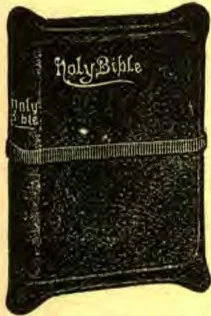
CONTAINS the celebrated Teachers’ Helps, comprising nearly 400 pages. Also a complete series of fifteen new maps.
Description. — Imperial Seal Binding, Tuck Edges, known as “Divinity Circuit,” Rounded Corners, Full Red under Gilt Edges.
We offer this Bible, post-paid, for only SIX NEW YEARLY SUBSCRIPTIONS at 75 cents; or TWELVE NEW SIX MONTHS’ SUBSCRIPTIONS at 40 cents.
We will also send it, post-paid, with the INSTRUCTOR one year for $2.25. For 20 cents extra we will stamp your name in gold upon the cover.

To Reach BATTLE CREEK FROM CHICAGO, BUFFALO, DETROIT, OR TOLEDO,

Purchase Tickets Reading over the MICHIGAN CENTRAL “The Niagara Falls Route.”
A First-class Line for First-class Travel between Chicago and New York and Boston. Elegantly equipped through trains pass Battle Creek in each direction daily.
R. N. R. WHEELER, Ticket Agent, Battle Creek.
O. W. RUGGLES, Gen'l P. and T. Agt., Chicago, Ill.

TAKE THE Canadian Pacific Railway

for . . CHATHAM, OTTAWA, MONTREAL, LONDON, GALT, QUEBEC, WOODSTOCK, TORONTO, BOSTON, PORTLAND, and
All points in New England, the Maritime Provinces, Great Britain, and the Continent.
Illustrated literature, time-tables, and full particulars, upon application to—
J. FRANCIS LEE, GEN. AGENT, Passenger Dep't. 228 SOUTH CLARK ST., CHICAGO
Branch Offices: 76 Ottawa St., Grand Rapids, Mich. Room D, Chamber of Commerce, Cincinnati, Ohio. 315 Chestnut St., St. Louis, Mo.

Cincinnati Northern Railroad Co.

TIME TABLE NO. 3.

IN EFFECT SEPT. 24, 1899.
Trains Pass Battle Creek, as follows:

WEST-BOUND.

No. 21, Mail and Express ................. 6.58 P. M. No. 23, Accommodation ..................... 2.07 P. M. No. 27, Local Freight ..................... 8.25 A. M.

EAST-BOUND.

No. 22, Mail and Express ................. 8.25 A. M. No. 24, Accommodation ..................... 1.45 P. M. No. 28, Local Freight ..................... 5.30 P. M.
Direct connections are made at Toledo with all roads diverging. Close connections for Detroit and Cincinnati.
J. L. READE, Ticket Agt., Battle Creek. B. R. SMITH, City Pass. Agt., 6 West Main St.

CHICAGO & GRAND TRUNK RY

E. W. Meddaugh and Henry B. Joy, Receivers.

CHICAGO & GRAND TRUNK RY.

Trains arrive and leave Battle Creek.

WEST-BOUND FROM BATTLE CREEK.

No. 9, Mail and Express, to Chicago. 12.15 P. M.
No. 1, Chicago Express, to Chicago. 9.00 A. M.
No. 3, Lehigh Valley Express, to Chicago. 3.40 P. M.
No. 5, Pacific Express, to Chicago, with sleeper. 1.10 A. M.
No. 75, Mixed, to South Bend. 8.20 A. M.
Nos. 9 and 75, daily, except Sunday.
Nos. 1, 3, and 5, daily.

EAST-BOUND FROM BATTLE CREEK.

No. 8, Mail and Express, to Pt. Huron, East, and Detroit. 3.45 P. M.
No. 4, Lehigh Express, to Port Huron, and East. 8.27 P. M.
No. 6, Atlantic Express, to Port Huron, East, and Detroit. 2.25 A. M.
No. 2, Leh. Exp., to Saginaw, Bay City, Pt. Huron, and East. 6.50 A. M.
No. 74, Mixed, to Durand (starts at Nichols). 7.15 A. M.
Nos. 8 and 74, daily, except Sunday.
Nos. 4, 6, and 2, daily.
A. S. PARKER, Ticket Agent, Battle Creek.

THE GIRL WHOM NOBODY LIKED

SHE was very sure that nobody liked her. She had told herself so again and again, with a queer tightening about her heart that was like a real pain. And then she tossed her head, and set her lips in a defiant little smile. Nobody should know that she cared. Never!
It was on her eighteenth birthday that Aunt Elizabeth made a suggestion that caused the girl to open her eyes, and then to laugh a little. It was such an odd idea, so like Aunt Elizabeth! “Then I’m to ‘hold up’ everybody I meet till I’ve said something brilliant?” she observed.
“Not exactly.” And Aunt Elizabeth smiled, unruffled. “But I’ve noticed that you pass your acquaintances with a mere nod or a curt ‘Good morning.’ I wish you would try the experiment of saying something pleasant to each one, unless there is some good reason against it.”
“It will grow rather tiresome,” said the girl, as she shrugged her shoulders.
“Try it for a week,” suggested Aunt Elizabeth; and, rather to her own surprise, the girl found herself promising.
She came very near forgetting her pledge when she met Mrs. Anderson on the street the next morning. In fact, she had passed with her usual uncompromising nod, when the recollection of her promise flashed into her mind, and she turned quickly.
“How is Jimmie to-day?” she said, speaking out the first thing that came into her head.
There was a deal of detail in Mrs. Anderson’s answer. Jimmie had been sick with measles, and then had caught cold, and been worse. Mrs. Anderson poured out her story as if it was a relief to find a listener; and as she talked on, that particular listener found herself more interested than she would have believed possible in Jimmie and his mother. She said she had some old scrap-books that Jimmie might enjoy looking over, and Mrs. Anderson thanked her with more gratitude than the slight favor seemed to warrant.
At the very next corner was Cissy Baily, and the girl wondered if her promise covered the washerwoman’s daughter. But she did not let herself wonder very long.
“It was kind of you to bring home the clothes so early last week, Cissy. I was in a hurry for that shirt waist.”
Cissy Baily did not know what to answer. She smiled in an embarrassed way, and looked up and then down. But the girl whom nobody liked had seen something in the uplifted eyes which warmed her heart, and made that one sided conversation something to remember.
The day went by, and she did not find opportunity to say anything very brilliant. She stopped Mrs. White to ask her if she would like to read the book she had just finished, and she patted little Barbara Smith’s soft cheek as she inquired if the new baby sister had grown at all. When she could think of nothing else, she said, “Hasn’t this been a beautiful day?” And her earnestness rather surprised some people, who had not had her opportunities for realizing that there was anything unusual about the day.
By the time the week was over, the girl whom nobody liked had learned a valuable lesson. She had found out that hearts respond to cordiality and kindness, just as the strings of one musical instrument vibrate in unison with the chords struck in another. It was not a new discovery, since long ago it was written in a certain wise Book, “A man that hath friends must show himself friendly;” yet this is one of the truths that each person must rediscover on his own account. And the girl who was learning to love every one, and was tasting the joy of being loved, thanked God that she had not waited any longer before finding out the wonderful secret for herself.—Young People’s Weekly.

SOME BOER WORDS DEFINED

To abate somewhat the havoc that ensues when the average reader encounters a dispatch filled with Boer names and expressions, an exchange has explained the meaning and pronunciation of the Boer words that most frequently occur in the news reports. Some of these are herewith given:—
“Oom Paul means Uncle Paul, and is pronounced Ome Powl.
“Bloemfontein means Bloom Spring, and is pronounced Bloom-fone-tine.
“Majuba, a Kaffir word, is pronounced Ma-yoo-ba.
“A veldheer, or field lord, is a Boer general.
“The veld is the field.
“The veldwachteren are the field-watchers, or military police.
“Kloofs is pronounced klofes, and means clefts, or ravines.
“Joubert, the name of the Boer general, is pronounced Yow-bert.
“The Jonkheeren, pronounced yonkhairen, are the young lords or members of the first and second orders of the legislature.
“The Raad Huis, pronounced Rahd Hoys, is where they meet.
“Uitlander is pronounced Oyt-lahn-der.
“The rand, where so much gold is found, means the border.
“Kopje means little head, and is used to describe a hill or small eminence.
“A laager, pronounced lah-her, means a camp.
“A trek is a journey.
“Boer means a rustic.”

Cold Air Fails to Kill Disease Germs

A REMARKABLE investigation by Professor Dewar and others has thrown doubt on the common idea that disease epidemics may be checked by freezing weather. A great number of disease germs were cooled by liquid air to 190° C. below zero, but the microbes survived twenty hours of even this great cold, and were afterward as active as ever.
Continue reading: FOR EVERY DAY OF THE WEEK