The Youth’s Instructor, Vol. 65, No. 43.

A Priceless Name

The Youth’s Instructor

Oct 23, 1917

Review and Herald Publishing Assn. · Takoma Park Station, Washington, D. C. · Oct 23, 1917

A Priceless Name

NAMES have their value, and are often held at invaluable prices. It was the Ephesians who so loved and worshiped their civic cry, “Great is Diana of the Ephesians!” and who had such great reverence for their temple which was dedicated to Diana the goddess, that they refused to inscribe on it the name of Alexander the Great, though he offered them the whole spoil of his Eastern campaign if they would do it.
To watch some pious Hindu laboriously washing away his sins in a turbid stream of water, or measuring his body on the ground through mud and dirt for miles to reach some sacred spot with a name dearer than life to him, helps one to love the great “Name” which is invaluable and worth more than anything on earth.
This should appeal to Christians, who can claim the greatest name in all the world, the name of Jesus, the only name worth while, with a priceless value, worth more than the spoils of all the victorious armies put together.
The apostle Luke recognized this when he wrote: “There is none other name under heaven given among men, whereby we must be saved.” The wise man knew the value of a name, for we read: “A good name is rather to be chosen than great riches.”
Jesus is a good name, one tried by every temptation known to man and at last brought to bear the shame of the whole world. Are we parting from it for the spoils of some campaign? Are we selling it for pleasure, for position, for power, or for a place in society? Or are we loving it with the same zeal that the Ephesians of old loved the name of their goddess? Are we willing to labor and sacrifice as the heathen of India to reach a place where we can have sweeter and closer communion with the One we love so much? This is the question we must ask ourselves, Is the name of Jesus a priceless name to me?
RAY L. KIMBLE.

“Topsy-Turvy Land”

JUST think, if we were boys and girls in “Topsy-Turvy Land,” we should be getting up just at the time when people here are going to bed; we should eat our food with our fingers instead of with knives and forks. There, a boy takes off his shoes at the door instead of removing his hat, and a girl is careful to wear a thick veil over her face although her feet are left bare. These and many other odd customs have given the name of “Topsy-Turvy Land” to Arabia. Their religion is as topsy-turvy as their habits of life, and it is very hard to make them understand about a loving Saviour. Only a few missionaries have entered this field, yet the third angel’s message must be given to them as well as to other countries. This entire little book is a plea for earnest work to be done in making this people at one with God.

Miscellaneous Facts and News Notes of the Day

Forty races are fighting in the world's greatest war.
One fourth of Oregon's almost 60,000,000 acres is covered with merchantable timber.
A hammer has been patented to which nails are fed from paper strips, so that a carpenter can nail laths at many times the usual speed.
Rubber tires were used on a carriage in Boston sixty years ago. The police stopped the experiment as being too dangerous to women and children.
The muskrat of Africa has habits like those of its American relative; but it is larger and much better looking, and is pure white in color, rather than being of a sable brown.
Children under eighteen years of age have on deposit in the 180 savings banks connected with the public schools of New York City the immense sum of $250,000.
One of our medical students, Harold Lewis, son of Prof. C. C. Lewis, delivered $1,325 worth of books this fall as the result of his canvassing work in Canada during the summer vacation.
A barrel of flour will ordinarily make two hundred loaves of bread. At this rate the year's wheat crop is estimated to provide grain for 38,000,000,000 loaves, or about 3,800 loaves for every man, woman, and child.
A giant Bible, said to be by far the largest ever printed, has just been bound by the Oxford University Press in England. It is five feet two inches high, three feet six inches wide, and ten inches thick. It took twelve goatskins to make the binding. The volume is to be used in a Bible crusade in London.
Art treasures and pictures valued at 5,000,000 rubles have been stolen from the great historical museum of the late Grand Duke Michael Nicholaievitch. A painting by Corregio, valued at $250,000, was taken. Early this month six armed robbers stole silver statues and antiques valued at $750,000 from the senate building.
For the last ten years, Prof. Dayton C. Miller has been at work inventing an organ which will actually sing words. He has already formed combinations of pipes to speak the vowels and to say “mamma” and “papa.” “I have only to perfect the instrument to say some simple sentence,” says Dr. Miller. “Then the problem [of having an orchestra and chorus in one] will be solved.”
Huge shade trees covered with lilac blossoms will be familiar sights at Glenellyn, Illinois, if the recent discovery of Dr. Frank Johnson, village forester, proves practical on a large scale. Dr. Johnson announced that after a long series of experiments he had at last succeeded in budding lilacs to a common variety of shade tree. He refuses for the present to tell which variety, but exhibited a sprig with a lilac bud grafted to it. “I can cover an entire tree with lilac blossoms,” he asserted, “and ordinary varieties of bugs will stay away from it because the blossoms are so bitter. Six trees so budded will blossom next spring at Glenellyn.”

What Successful Men Say Gives Success

What Successful Men Say Gives Success — No. 3

One known as “a man with an idea and energy,” says: “There are three important factors in commercial success. One is to give one’s employees a bonus as an incentive to better efforts; another is to do and say anything in a different way from the other fellow; and the third and most important is to give the people an article which is unexcelled in every way.”
An Ex-United States Senator
attributes his success to his acquired love for cleanliness, and his friendly relations with all sorts of people, the latter expressing itself in friendly, thoughtful service for the humblest folk. The story of his acquisition of these traits is more interesting than fiction. As a boy at the age of twelve he began work as “a porter and general roustabout in a railway station restaurant.” The beginning of his career he attributes to a friendly suggestion made to him by the wife of a railroad division superintendent about his personal appearance. “You are too untidy,” she declared. “Why don’t you keep yourself neat, as your brother does? Just because you sweep floors is no reason why you can’t have your face clean.”
His first impulse was to take the view that his personal appearance was none of her business. But on second thought he said to himself, “Maybe you’re right about that.” “The more I thought about it, the more I decided that the woman had given me some first-rate advice. From then on, though my clothes were shabby, I contrived to look surprisingly clean. And I carried the propaganda still farther by taking especial pains to keep dirt out of remote corners of the lunchroom. People began to comment on what a painstaking little worker I was. And I found that when I was neat and clean, somehow I felt more sure of myself, more as if I were just as good as anybody else.”
“I had to work about half of each day. I could go to school the other half. But it was so difficult to keep up with my classes under this handicap, that I made up my mind to quit school and abandon the idea of getting any further education. My teacher, it seemed, had been favorably impressed with the way I had suddenly begun to keep my hands and face clean. She regarded it, I suppose, as a commendable effort on my part to maintain the appearance of a self-respecting boy, regardless of my rather humiliating kind of work. At any rate, though I had been a somewhat mischievous youngster and caused her a lot of trouble, she began to display an interest in me. She called me aside one day and told me that if I would come to her home two or three evenings in a week she would coach me so that I might keep up with the rest of the class. I took advantage of this great kindness, and she helped me in that way for two or three years, until I was in high school. This teacher, as it happens, is still living, and when I landed in the United States Senate she sent me a nice letter of congratulation. I received a great many such letters, but none that pleased me so much as hers. It was the first one I answered.”
“The proprietor of the restaurant stopped me one day, and told me he had noticed I kept both myself and the floors clean. He added that there was a vacancy behind the station lunch counter, and I could have a place as clerk!”
“I should rather have had that clerkship than any job that could possibly have come to me. For one thing, it meant that I should have greater opportunity than ever before to get acquainted with the railroad men and the traveling public. Almost everybody I saw, rich or poor, appealed to me as a person I should enjoy knowing.”
“The day after I became clerk I knew precisely what I wished to do in life. I would learn how to provide people with what they wanted to eat. And when I got old enough, and money enough, I would run a hotel. I found that I not only had a great opportunity to meet people, but also to ingratiate myself with them by serving them just the food they wanted. It was really a lot of fun to try to give a man exactly what he sought, and thus permanently attach him as a friend. I enjoyed making friends, I guess, just as a person might enjoy catching fish. Having a natural liking for humankind, I was able, as I discovered, to remember people’s names and, what proved to be still more important, to remember what kind of pie a man liked. If there was a frequent customer whose favorite pie was apple pie, and who liked two spoonfuls of sugar in his coffee, I aimed to put just the right food before him without waiting for his order.”
“This may have been a small matter, but it was astonishing how it pleased people. They felt flattered that their personal tastes should have made so deep an impression on a clerk whom they met only casually. Come to think of it, if you dine at a home where the hostess recalls that you will take neither cream nor sugar in your coffee, you are quite likely to think of her as a more charming hostess than if between visits she forgot all about your eating tastes. Without having any particular motive, in fact without even realizing that I did it, I developed this little aptitude for remembering people’s likes and dislikes, and trying to humor them. This proved immensely valuable to me later on.”
“The habit of neatness, too, had grown upon me. I know now that it had a great influence on my entire future career. I got so that I couldn’t bear the sight of a flyspeck. When not waiting on customers, I busied myself polishing glasses or scrubbing the counter. I saw to it that everything about the place glistened with its spotless cleanliness. We had big glass domes which we used as covers for cakes. I kept those so bright and shiny as to excite comment by traveling men. One of my duties was to prepare the sandwiches. I carefully cut away all the fat, and people got to liking my sandwiches better than those served at other stations.”
“The owner of this station restaurant where I was employed also operated similar eating places at two different towns over in an adjoining State. I was transferred to the smaller of these, and a little later to a much larger one—in the union station at the State capital. In connection with this trip to the State capital there occurred a little incident that, while trifling, was to prove of importance to me. Another employee was transferred along with me, an old Irish woman who had worked for many years as dishwasher. The trip was made partly at night, and the old-fashioned railroad coach was not well heated, though it was bitter cold weather. I noticed that the old woman had dozed off in her seat, and that she looked half frozen. Naturally I felt sorry for her, and so I took off my overcoat and threw it over her. When she woke up and found what I had done, tears came into her eyes and she said:
“‘Lord bless ye, me b’y. Mebby I’ll get even with you some day.’ Years passed, and I had a chance to run for county auditor. One morning, when I was wondering whether to make the race or not, I received a call from my old friend the Irish dishwasher, whom I had completely lost track of.
“‘You’re fixin’ to enter politics,’ she began, ‘and you’ll need money. I’ve saved a bit, and I want you to take it. I hope it’ll help you to win.’”
“And she reached into her bosom after a soiled, crumpled, one-hundred-dollar bill, every cent she had in the world, which she pressed into my hand.”
“That comprised my first campaign contribution, and it was on that money that I entered politics. Later on it was my proud privilege to pay the old woman back her one hundred dollars with one hundred per cent interest.”
“On the day that I went to work in the union station restaurant in the State capital, one of the other clerks was somewhat annoyed by the fact that I appeared to him rather needlessly well dressed.”
“‘I guess we’ll have to initiate you by givin’ you a lickin,’ he remarked.”
“‘All right,’ I agreed. ‘Let’s step right back here and get it over with.’”
“I really had a good deal of confidence in my boxing ability. I was successful in dodging his blows, and got in a couple of right good little slaps at his face.”
“Well, he and I right then and there became great friends. I think the main reason we at once grew so friendly was because I did not gloat over my success in our little boxing bout. On the contrary, I offered to show him all I knew about boxing. Early in life I learned never to gloat over an adversary when I had been successful. I have always followed this rule in politics, and it has helped a great deal. I have always figured that there is no reason why I shouldn’t be pleasant and agreeable to an adversary, especially if he has received more scars in the political battle than I have.”
“While on the job in this big restaurant I tried to apply the same scheme that I had in the smaller places—of keeping everything almost uncannily clean, remembering people’s names, and the kind of pie they liked—and I really made a great many friends. Business men living in that great city got into the habit of coming to the union station restaurant for their noonday lunch, because they were sure of clean, well-prepared food and of courteous treatment.”
“One day a business man said to me: ‘I didn’t really want anything to eat, but I thought I’d drop in and have a bite just for an excuse to chat with you. You seem so genuinely interested in everybody’s welfare that you’re a tonic.’”
“I consider that one of the highest compliments that I have ever received.”
“After a time I became manager of the restaurant. I saved my money, and later on I was able to buy out the proprietor. Then some of my friends got me to run for county auditor, and I was elected. ”
“The auditor’s job was a wonderful opportunity for making friends, because people were constantly coming to the office to consult records, and all that was necessary to do was to wait on them courteously—to be accommodating.”
“I was also able to apply to a large extent my policy of neatness that had succeeded in the restaurants. Our books and records always looked so neat and shipshape that they couldn’t help but excite the favorable attention of those who came to examine them.”
“Then, while in my second term as county auditor, I was elected mayor of our city. Again I made cleanliness almost a paramount issue. It may sound boastful, but I am certain that the city had never seen such clean streets. I used to get up at half past five in the morning and drive around town in a buggy, hunting for back alleys that needed tidying up.”
“While mayor, I still kept my station lunchroom, looking after it in spare time. Later on I sold it and bought a hotel up in the business section of town. There again I featured cleanliness. We had clean food, clean beds, and clean floors. I had become a bit of a fiend on the neat-and-clean proposition. One day I told an employee to clean up the kitchen. He did so fairly well, but left some little collections of dirt in corners. So I asked the chef for a potato, cut it up with my pocketknife, and placed a potato eye in each dirty corner, remarking:
“‘If we’re to have dirt, we might as well have something growing in it.’”
“That had the desired effect.”
“Nothing can equal a wide acquaintance, to my notion, in affording pleasure. No matter where you go, you run across an old acquaintance or make a new one. It is great sport. This reminds me of one of the most enjoyable surprises of my life.”
“Some years ago I happened to be traveling through New Mexico on business. At a small settlement, which seemed to consist chiefly of a dingy little railroad station, a man drove up in a buckboard, deposited a woman and baby on the train, and then hastened on his way. The man was a mining prospector who was desperately poor. His wife had been obliged to make a long journey. I noticed that she was making preparations to spend the night in an ordinary train seat with the baby in her lap, and arranged for her to have a berth. She was very grateful for this slight favor, and insisted on knowing my name.”
“Several years later I received a letter from a miner in New Mexico, who said he wished to thank me for the little assistance that I had given his wife and baby on the train.”
“‘I don’t know whether you’re the man I want to write to or not,’ he said. ‘I used to go to school with a boy having your name, but I don’t suppose you could be the same one.’”
“I looked at the signature, and the name was that of a boy I had played shinny with and sat alongside of in school back in the little town where I grew up.”
“Later on he struck it rich in mining. And the first money he took out of his mine went to buy a handsome stickpin, which he sent to me for old acquaintance’s sake.”
“I have the pin yet. It is one of my most highly prized possessions.”

On Holding a Friend's Attention Through Conversation

A WRITER recently said: “If you talk about yourself for fifteen minutes to a friend, his attention wanders. But if you talk about him for fifteen minutes, he is so fascinated with your choice of subject that he would gladly listen an hour.”

A Tongan Wedding

H. L. TOLHURST
The brother of one of our church members was to be married; and as we desired to learn all we could of native customs and ceremonies, we were glad that the opportunity would be ours of seeing this wedding, which was to take place in our village. A Tongan wedding conducted according to native style, is worth traveling far to see.
Days of preparation precede the event, but the preliminaries proper begin the day before the wedding. First, the female relatives of the bridegroom convey to the home of the bride’s parents a present consisting of a roasted pig, with other foods, cooked in a native oven. Then his male relatives bear a similar present to the bride’s parents.
The wedding ceremony was performed in the Tongan Free Church. The building was well filled with expectant friends and relatives. After a lengthy delay, owing to the nonattendance of the bride’s father through indisposition, a substitute was found. When everything was ready, the contracting parties entered the church by a side door, the bride walking behind the groom.
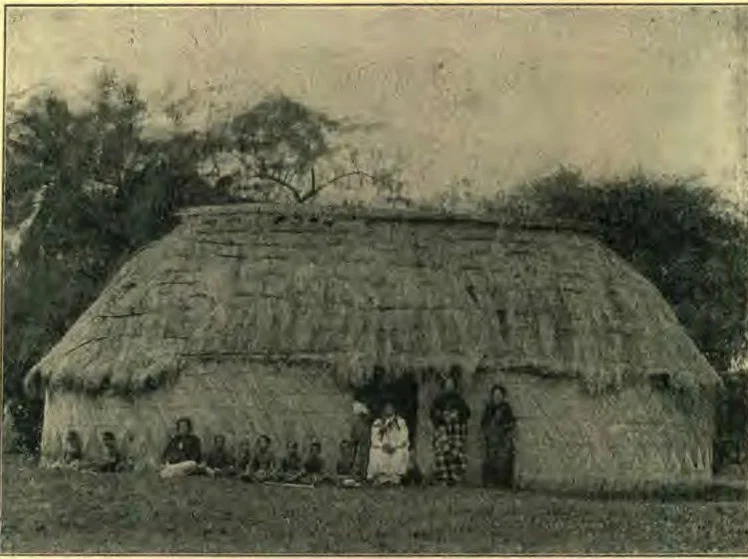
NATIVE HOUSE, TONGA
NATIVE HOUSE, TONGA
The bride wore few of the dainty things worn by European brides; but according to native fashion, both she and the bridegroom were well dressed. Over her dress, which came a little below the knee, were several valuable native mats, woven from the long, slender leaves of a certain plant. These mats were so fanned out at the bottom that a few inches of each was showing beneath the one above it. The top one was finely woven and beautifully ornamented with red feathers, and must have been quite an expensive article. These mats were turned over in a huge roll under the arms, preventing the hands from hanging by the side. The groom was similarly attired in native mats. He wore a singlet with short sleeves. In fact, both had bare arms and legs, which were plentifully besmeared with scented oil.
The two who were that day to unite their destinies took their places in front of the officiating minister, each sitting on the knee of a relative, though this custom is not always followed in the church. Certain preliminaries which usually are attended to in the vestry were performed. When the groom was asked his age, he excitedly turned to one of his relatives and asked, “How old am I?”
The service was about the same as others we had witnessed in Australia. When the minister asked, “Who gives this woman to be this man’s wife?” the one fulfilling this function stepped forward and taking her hand placed it in the hand of the bridegroom. After prayer, the minister kissed both the young people, as did also several relatives.
The ceremony being over, all left the church, the bride repairing to a building where she changed her attire, and the bridegroom going to a house in another part of the village. Soon a procession bearing a large basket of food passed along the street toward the house which the bride had entered. They were cheering as they went, and two of them were decorated with native mats. These were relatives of the bridegroom, and were bearing a present from his family to that of the bride.
Later a large procession approached with great noise and much cheering. It was the groom with his attendants, on his way to meet the bride. She had rearranged her toilet, and was awaiting his arrival. He marched in front, attended by a young relative of his mother, who carried a basket containing a bottle of oil. Frequently the attendant called a halt, while he oiled the bare legs of his charge. This seemed to be an essential proceeding. The head of the groom had been anointed with oil and liberally sprinkled with sandalwood sawdust. Next came a column of women dressed in native cloth, marching two abreast. One row consisted exclusively of the bride’s relatives and the other of the groom’s, and between them they bore a large native mat, measuring perhaps thirty feet by eight feet. Upon reaching the place where the bride stood waiting, they all turned and came toward us a little way, and then turned back to meet her. The whole procession then marched to the proposed scene of the feast. Sometimes this wedding feast does not take place till some weeks after the marriage ceremony is performed.
The procession was headed by relatives of the bride, bearing aloft enormous rolls of native cloth and other presents. The bride and groom followed, and after them was carried the huge mat before mentioned. Bringing up the rear were several male relatives of the bride, carrying thirty-two pigs of various sizes, two baskets of fowls, and one of fish, all cooked. After taking these to the place of the feast, they returned for the large pig, which is never absent on such an occasion. Soon they appeared, dragging it on a sledge made from the branch of a tree, the idea being that it was too large and heavy to be carried.
At the place where the crowd assembled, we found the bride and bridegroom each seated on the knee of a relative beneath a booth erected to shelter them from the sun. The presents were spread out before them on the grass, and the baskets containing pigs and other food were arranged in two long rows, with the largest pigs at the head of the lines to the right of the bridal party, and the smallest ones on the extreme left, at the bottom of the lines. The people sat on the grass near at hand.
As they sat thus, an influential member of the bride’s family began calling out such expressions as, “Good work,” “Good food,” a member of the groom’s family repeating the words in the same tone of voice. Shortly the order was changed, the member of the bride’s family repeating the call made by a member of the groom’s family.
The master of ceremonies, who was of the bride’s family, ordered the baskets of food to be examined. Each basket must contain other food besides the pig. Such omission is counted an unpardonable offense. After the examination, the presents were counted. There were found to be sixty-three pigs in all, besides twenty-nine baskets of fish and fowl.
The kava bowl was now brought into requisition. The root of the kava plant is pounded between two stones and then mixed with water in the bowl, which is a wooden vessel shaped much like a washbasin. It is fashioned from a single piece of wood, and is often handsomely carved. After being thoroughly mixed, the kava is strained through fiber. The latter is held in both hands and drawn through the bowl toward the operator, gathering up the particles of pounded kava root in its meshes. It is then wrung out and the small pieces of root shaken out of it, and the process repeated. The movements of the operator’s hands are very graceful. On such an occasion as this a complete kava plant, leaves and all, had to be provided; though, of course, the root only was used in the preparation of the beverage.
While the kava was being prepared, a gap was made in the lines of baskets through which the bridegroom passed, wearing a mat that trailed far behind him. He was accompanied by a female relative. Having reached the place where stood those in charge of the proceedings, the mat was taken as a present for the bride’s father. The two then departed, but soon returned with a long piece of native cloth, perhaps twenty yards long, which had one end fastened round the groom’s waist. This article went to the bride’s mother. They were both presents from the bridegroom.
At this stage the large pig was cut up and divided between the two families. Then all the food was distributed, each family receiving its share, to be taken home and there eaten. Very rarely do the Tongans at their feast eat together after the style of our picnics.
The preparation of the kava having been completed, one man filled a coconut-shell cup with kava, and called out in a very loud voice, “The kava is poured out.” The one in charge of the kava party answered him, “Take it for Jone.” Jone claps his hands to indicate his whereabouts in the kava ring. The vessel is handed to him by an attendant, who turns away while he drinks the contents, and then returns for the cup.
When the bride’s kava was announced, the bridegroom served her. No one else might do so, though it is quite permissible for him to wait upon others also, as he did on this occasion. The bride was the third to be served, as the person of highest rank, or the one being honored, is always the third served. This is the rule with the Tongans. Tradition explains the origin of the practice thus: One of the ancient kings, having heard of kava for the first time, procured some and decided to try it for himself. But desirous of having it tested first, he had some given to two of his officers. After waiting for some time, and observing that no harm befell them, he ventured to drink. So it became an established custom for the one in whose honor the kava party is given to drink third.
We were surprised on preparing to leave for home, to have presented to us a portion of the food. It is customary thus to provide for any visitors or strangers who might be present. Knowing our views on the question of unclean foods, they did not include swine’s flesh in what was given to us.
We praise God for a message that is calling out from the Tongans a company who forsake the feast of unclean things, the kava bowl, and the pipe, in preparation to meet their coming Master.

How I Went Through College on Nothing
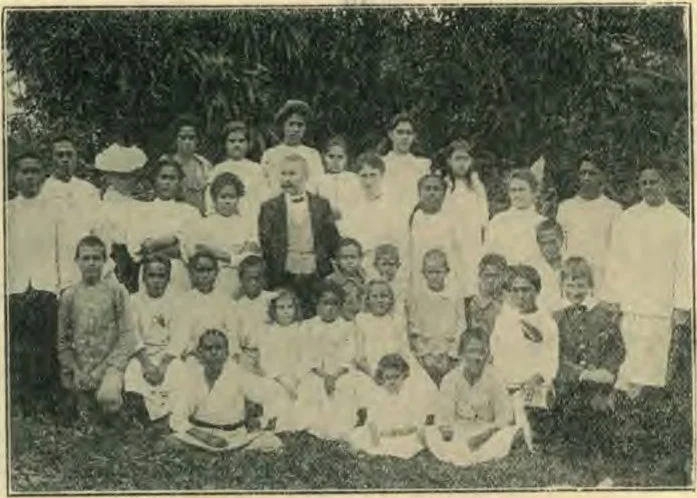
TEACHER AND PUPILS AT SCHOOL, NUKUALOFA,
FRIENDLY ISLANDS
TEACHER AND PUPILS AT SCHOOL, NUKUALOFA, FRIENDLY ISLANDS
IN a hospital where I recently had to spend some time I overheard a young man telling a friend that his failure to secure an education, because of his poverty, had been the greatest misfortune of his life. It had put him in a class with the common day laborer, he said, which meant that he must work long hours and receive poor pay.
After his departure, his friend came over to my bed and said: “What do you think? That fellow you saw me talking with a bit ago is twenty-five years old, and he can neither read nor write.”
Among those who heard the remark, some said, “What a pity!” others, “What a mistake!”
It was neither a pity nor a mistake: it was a crime against manhood. I know from my own experience that that man, if he had really wanted it hard enough, could have had a college education.
In the earlier years of my life I was denied, as thousands of others have been denied, the privileges of a common-school education, owing to the fact that I was almost a helpless cripple, due to an injury to my spine.
My father and mother — both hard-working people, though extremely poor, with a family of seven to feed, clothe, and educate — sacrificed as only parents must sacrifice in order to provide me with competent surgical aid necessary to effect a cure, while at the same time seeking to fulfil their obligation to the rest of the children. As soon as my physical condition would permit it, I was put to work.

It Was “Up to Me”

I knew that my parents had done for me all that was in their power.
It was now up to me to make good — to get for myself the education that they had been unable to give me.
How was this to be accomplished when I was twenty-four years old and working from ten to twelve hours each day in a blacksmith shop?
There was a free night school that held out an opportunity to me; but the question of buying clothes, books, and paying board raised difficulties that seemed sometimes too great to be overcome, and yet they must be overcome.
I purchased at a secondhand store the books that were needed in the night school, and resolutely started in. The course of study covered a period of six weeks.
As soon as the school closed, I interested one of the teachers in my ambition, and enlisted her aid. When I laid my plan before her, she gladly gave me the aid I was seeking. Thus, after weeks of self-denial and sacrifice on her part, she made it possible for me to pass the required studies admitting me to college.

Not Even Railroad Fare

But my hardest fight was yet to be fought. I had the qualifications necessary for admittance; but, as the time drew near for the opening school term, I became painfully aware of the fact that I did not have enough money to pay even my railroad fare, let alone the matriculation fee, board, room rent, books, clothing, etc.
It was a discouraging situation. Yet I held to the hope that, if only I could continue to raise the money necessary to get me to the college, I should surely be able to find some work, out of school hours, that would assist me in meeting my expenses while there.
So, with this thought in view, I sought out a publishing house, and succeeded in getting a line of religious books and Bible cards to sell. The books retailed at one dollar each, and the cards sold for one dollar a set, paying me a fifty-per-cent commission.
I put in a month with the books and cards, and succeeded in getting together enough to pay my railway fare and the first term’s tuition fee. However, when this was done, it left me nothing with which to pay board, buy books, clothing, etc.
Nevertheless I determined to let the future care for itself, and set out for the college.
I introduced myself to the president, who listened attentively to my story, and said:
“I am deeply interested in the struggle that you are making for an education, and would gladly help you if it were in my power; but you are only one of the many that have asked for work. However, if you desire to return in September and try it out, I will promise you the first opening that we have.”
It occurred to me that I might possibly pay my way with the books and cards that I had been selling. I asked him what he thought of that plan, only to receive the unhappy information that the same books and cards were being sold in the territory adjacent to the college by another student, who was working as I was to secure an education. Of course I could not infringe on his territory.

Getting a New Grip on Myself

It seemed to me that my last hope had been taken away. But I was unwilling to admit defeat.
I think that college president must have known something of my disappointment, for he said, as he placed his hand on my head:
“Never mind, my boy. Remember, the darkest hour is just before day. You have the mettle in you that makes men, and I’m sure that you will win out.”
These words put new life into me. I took a new grip on myself, and determined that I would win out.
I paid the entrance fee out of the money I had on hand, and decided to trust to my ability to find work to pay for everything else. I would go as far as the money I had on hand would carry me. At the end of that time, if I could not make it go, it would be time enough to think of failure.
There were still three weeks before the term opened, and I continued the book business as vigorously as possible in territory near my home. I was successful in making enough money to pay my board while at home and to buy a new suit of clothes and an overcoat.
When the time came for me to say good-by to my friends, I took an invoice of what I had on hand, and discovered that I had my railroad ticket and $19.75 in money as the grand total of all my earthly possessions. Yet I was happy. Indeed, it seemed to me that I never was so happy in all my life as when, on the opening day, I took my seat beside the other students.

Managing on Twenty Dollars a Month

By close figuring, I found that by doing my own washing, ironing, and cooking I could manage on twenty dollars a month; so, with my $19.75 as a working capital, I realized that I had at least one month’s grace, in which I could organize myself and have an opportunity to find work.
I opened a “pressing parlor,” and charged the students twenty-five cents each for pressing their trousers. This was the only source of revenue I had the first month of school.
At the end of that period the president of the university, true to his promise, notified me that the faculty had elected me to fill the position of college postmaster.
My duties were to gather the outgoing mail from the college and carry it to the post office in the village, a distance of a mile. I made three trips each day — at 7 A. M., 12 noon, and 7 P. M.
This gave me a six-mile walk each day, and provided me with needed exercise, besides paying me a salary of ten dollars a month.

The Hardest Years of My Life

I next started a stationery business in connection with my office. The mail route paid my tuition, ninety dollars a year. My stationery business paid my food bill for the year, fifty-five dollars. My pressing and repair department averaged me thirty-five dollars a year.
This covered the cost of my clothing, twenty dollars; books, ten dollars; and left me five dollars over. These figured a grand total of one hundred and eighty dollars a year, and by close application and hard work I completed the four years’ course of study in three years. My books were bought secondhand from the upper-class men.
Those three years were the hardest of my life, but they have paid large dividends, and they lifted me permanently out of the ranks of helplessness and despair onto the road that leads to success.—Thomas F. Everhart, in Every Week.
Continue reading: The Cross