As the aged apostle Paul, when a prisoner at Rome, was about to pass the threshold of time into eternity, we hear him proudly saying, as he is soon to seal his testimony with his blood, “God forbid that I should glory, save in the cross of our Lord Jesus Christ.”
Some glory in riches, others in position, still others in knowledge, and again others in the blood that runs in their veins. The only thing in which man has any right to glory is the cross of Jesus.8
While Sir John Bowring was governor of Hongkong, he stood one day at the ruins of an old cathedral in the Portuguese colony of Macau, and was moved to write these beautiful lines:
“In the cross of Christ I glory,
Towering o’er the wrecks of time;
All the light of sacred story
Gathers round its head sublime.”
We hear much these days of the Red Cross. Perhaps no other society for the physical uplift of mankind, is more widely known, and no other has done more to relieve the world’s burden of pain, sorrow, and suffering.
But there is another cross even more widely known. It stands alike as a symbol of pain and suffering and of peace and love,—a cross that nearly nineteen hundred years ago was raised on Calvary and upon which Christ died.
It was here that mercy and truth met together, and righteousness and peace kissed each other. Some one has said, “If sin was man’s fatal act, the cross was God’s vital act.” “The tragedy of the cross is God’s answer to the tragedy of sin.”
While in the office of the British and Foreign Bible Society in Hongkong a few days ago, I noticed a picture that stood in a prominent place. I studied this picture for a long time. It presented a sleeping-room in an English home. On the bed was a bright little boy of perhaps eighteen months. He was playing with a tin soldier. Above the bed was a large picture of his father in uniform. The baby was unconcerned about his weeping mother who was kneeling broken-hearted by the bedside. She had just received from headquarters her cross — the iron cross. What consolation in an iron medal? As I thought of the many thousands today experiencing in fact what the picture represented, I said, “Oh, if they would only turn to Calvary’s cross, there is peace and rest for the broken-hearted.”
Young friends, think more of the cross. Think of Jesus uplifted between heaven and earth for the sins you daily continue to commit.
“Behold Him bear the rugged cross,
Until he sinks beneath the load;
While onward o’er Calvary’s hill
His bloody footsteps mark the road.
And neath Golgotha’s darkening skies,
The Majesty of heaven dies.
O suffering Christ, and wilt thou give
Thy life that guilty man might live?
Thou through whose word the worlds were framed
And all the starry hosts were named?”
“Thou before whom bright seraphs fall
In love and adoration deep,
Didst leave thy many mansions fair,
To seek and save the one lost sheep.
O infinite, O gracious love,
As high and vast as heaven above;
Thou canst not know, O heart of mine,
Nor reckon up such love divine.
What wonder that the heavens bent!
What wonder that the rocks were rent!
That nature gasped and held her breath
While Christ on Calvary bowed in death!”
What does the cross mean to you? I remember when, as a boy, we lived in the Middle States, how often we were in danger from prairie fires. When we saw that we should be unable to contend with the oncoming flames, we would burn off a section of land and all get over where the fire had been. Then we were safe. Amid this world of sin there is but one safe place for any of us. Nearly nineteen hundred years ago the fire of God’s wrath burned over Calvary. If you will take your stand by the cross of Christ, you are safe for time and eternity.
In every heart there is a cross and a throne. If Jesus sits on the throne, Satan is on the cross. Is it thus in your heart, dear reader? But if Satan sits on the throne, Jesus is on the cross, suffering. “If any man will come after me,” said Jesus, “let him deny himself, and take up his cross daily, and follow me.” Another translation reads, “If any man will come after me, let him deny self and nail it to the cross daily, and come and follow me.”
“The cross of Golgotha will never save thy soul;
The cross in thine own heart, alone can make thee whole
Christ rose not from the dead, Christ still is in the grave.
If thou for whom he died, art still of sin the slave.”
S. A. Nagel.
Camp Meeting in the Bay Islands
By Henry F. Brown
“BEAUTIFUL for situation” indeed was the site chosen for the camp meeting in Coxen Hole, Ruatan, the ninth annual meeting of the North Honduras Mission. The tent was pitched on a hill above the bay. By aid of coconut-covered keys and a submerged coral reef, the shore was protected from the breakers. From the tent could be seen the tossing Caribbean Sea, but the water of the harbor was perfectly calm.
The story of the entrance and planting of the truth upon the Bay Islands is very interesting. The believers told how thirty-three years ago they received literature, without knowing whence it came. Then an islander who had accepted the truth in California visited her relatives, and persuaded some of them to observe the Sabbath. We were told of the faithful work of the Hutchins, Willis, and Goodrich families, and others who labored among these islands. At the Sabbath school convention portions of Mrs. Hutchins’s diary, written while in the field, were read. Thus we heard pioneer experiences read on the spot where they were written twenty-five years previously.
The population of this group of islands is about five thousand. The English language is used, as the people are mainly descendants of early English settlers. We were surprised to find the tent filled to overflowing with an interested and interesting audience, very similar to a camp meeting audience in any of our Western States. The young people especially seemed to appreciate their meetings. While there are only about two hundred Adventists in this field, more than fifty young people were present at the camp meeting, and we were informed that half as many more were detained at home.
Very little has been done for these young people. A few societies were organized, but soon died out for lack of care. As a result of this camp meeting many made new determinations, and fifteen were baptized in the sea. Others promised to present themselves for baptism soon.
Life in these islands is very circumscribed. The ideals set before the young people are limited. Education consists of five years in the native school, taught by native teachers. Those who would receive a higher training must go to the United States, a voyage which is almost unthinkable to these people. A few have accepted the government’s offer of free scholarships in the National Normal School at Tegucigalpa. To get to this school, they have to travel two days by sea and six days on a mule.
Plans for a school to meet the needs of the young people of this field were discussed, and a resolution6was passed, asking the General Conference to consider the advisability of strengthening the school at Siguatepeque, pledging the support of this local field. The young people were most enthusiastic over this proposition, as also they were when the securing of a young people’s leader for the mission was suggested. Two of their number were chosen to assist in the work in the North Honduras Mission, and one in the South Honduras Mission. This is the first that any of their number has been called to a part in public labor in the cause.
This field has a promising future, in its young people, who, rightly trained, would be the strength of the work soon. If a school were provided for their education in their field, the problem of evangelizing Central America would be almost solved. Such a school would also be patronized by many young people who are not of Adventist parentage, but who recognize that we have the truth.
In addition to the force of workers belonging to the North Honduras Mission, Elder R. W. Parmele, general superintendent of the Northern Latin American Missions, and the writer were present to assist in the religious work of the meeting. At this writing Elder Parmele and I are on our way to Siguatepeque to look over the school enterprise that has been conducted there for some years past by Brother and Sister Karl Snow. Siguatepeque is quite centrally located in this field, and if properly strengthened, it could become a training center for all of Central America.
HENRY F. BROWN.
Platinum: Uses, Value, and Wartime Demand
Platinum
PLATINUM points! What are platinum points, Uncle Henry?”
“Why, my boy, they are the points, or ends, of the wires in the magneto between which the electric spark jumps.”
“I see, Uncle Henry, but is platinum always used for these points?”
“Platinum or some alloy is commonly used. Did you know that platinum is worth twenty times what it was a few years ago, one thousand dollars now not being sufficient to purchase a pound of it? It is called ‘the metal of nobility,’ and watch chains, bracelets, and other jewelry made of it are worth several times as much as 18-carat gold.”
“Is this because so many motor trucks and automobiles have been used by the armies of Europe?”
“Hundreds of thousands of auto trucks and other service cars have been supplied to the fighting forces; and all these have required platinum; but platinum is also necessary for the manufacture of cordite, a kind of smokeless powder, which in its manufacture demands perfectly pure sulphuric acid, and this acid is purified only in platinum vessels, some of which cost $15,000. It is being used by the dentist to make plates for artificial teeth; and is also used for wire, foil, and munitions.”
“A peculiar property of platinum makes it of use in automatic lighting. As a sponge will absorb water, so a platinum sponge—that is, platinum in a finely divided form—will absorb as much as a thousand times its own volume of oxygen. It is used therefore as a carrier of oxygen. If a current of hydrogen is directed against the platinum sponge, or into platinum black, so rapidly does the metal drink up, or absorb, the hydrogen that it becomes red hot, and in two or three minutes the gas will burst into flame. The self-lighting mantles for gas burners, are based upon this quality of platinum.”
“We have one of those, and I have often wanted to know how it worked.”
“Platinum has other interesting qualities. It, like gold, is unaffected by any of the single acids. It is also very hard to melt, a heat of seventeen or eighteen hundred degrees being necessary to melt it. The hardest steel fuses at several hundred degrees lower. Platinum does not rust, which makes it highly serviceable. When heated, it expands less than any other metal and at about the same rate as glass, so wires of platinum are thrust into and through the soft glass and remain tightly embedded in the glass tubes. This is the way globes, or bulbs, are made for our incandescent electric lights.”
“Is platinum always the color of that in the magneto, Uncle Henry?”
“No, that has been mixed with some other metal. Pure platinum received its name from its resemblance to silver, the Spanish word for silver being platina, platinum ore having been originally discovered in South America. Platinum, however, is not so white as silver nor so gray as steel. When powdered it is black.”
“It is one of the heaviest of metals, being three times as heavy as iron and more than twenty-one times as heavy as water. It is soft as copper, and can be hammered into sheets, or drawn out into wire that is invisible to the naked eye. This is done by embedding the metal in a silver bar and then drawing them both out into wire. After the proper fineness is obtained, the silver is dissolved away from the platinum by the use of an acid.”
“Have you ever seen that done, Uncle Henry?”
“No, but I hope to see it sometime. I have a friend who does this very work, and I am planning to visit him in his home and shop on my way to California in the spring.”
“I wish I could be with you in his shop, uncle. Is platinum found in our country?”
“Yes, small quantities have been obtained from California, Oregon, New York, and North Carolina. Alaska, British Columbia, and Australia have yielded small quantities, but the Ural Mountains of Russia really furnish the world supply, which does not exceed 200,000 ounces. The supply is so small compared with the present demand that the British government requires one to secure a permit before dealing in it. Everything that contains platinum is being melted over for use in munitions. Every Week tells of an English gentleman who years ago received a bad coin. Because of the platinum in it he recently sold it for eleven dollars.”
Conservation Notes
“She wants not, because she wastes not.”
MILLIONS of loaves of bread are baked by our commercial bakeries. Government investigations showed that one loaf out of every twenty furnished the retail stores was returned to the baker. While the bread returned has not been entirely wasted, the uses to which it was put represented a considerable loss of value of materials and labor. In ordinary times it was of no great consequence; but just now every grain of wheat is worth saving. The government, therefore, did a wise thing when it asked all the bakeries to discontinue the practice of permitting dealers to return all loaves unsold. The bakeries have10acceded to this request in the interest of the national food supply.
Baking potatoes in the “jackets” means a loss if the jackets are not eaten, since the meat sticks to the stiffened skin and is discarded. Drop washed potatoes into a vessel of rapidly boiling water and allow them to remain for ten minutes. Remove, and strip the thin skin as when potatoes are peeled after thorough cooking by boiling. The potatoes will still be practically raw, and may be handled like raw peeled potatoes in preparing any dish, as scalloped or French fried potatoes, potato chips, etc. The entire skinned potato, including the thin, golden-brown crust, then may be eaten.
A Filipino Arrow
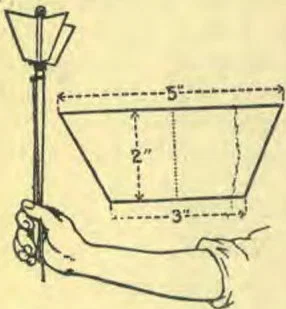
A FILIPINO boy who came to the United States to study, taught some of his American friends how to construct an arrow that has furnished them with a good deal of fun. Cut a straight stick of alder or willow about ten inches long and tapering from half an inch to quarter of an inch in thickness. Point the smaller end, and split the other end into four equal parts for a distance of two and a half inches. Make two wings of stiff writing paper on the plan shown in the diagram. Fold each at right angles on the dotted lines and fit it into the split end of the stick, with the narrow edge toward the point of the arrow. Bind the arrow with stout string above and below the wings, and a little below the wings cut a shallow groove completely round the shaft.
To fly the arrow, take a string about fifteen inches long and make a heavy knot in one end. Place the knot in the groove and wind the string once round the stick; then carry it down toward the point of the arrow and wind it round your hand. Hold the arrow by the pointed end and throw it straight before you.
— Youth’s Companion.
Making Garbage into Fuel
MR. HERBERT HOOVER announces that in a recent month the garbage records of a number of leading cities showed a reduction of about thirty-two per cent. In other words, a third of what was formerly thrown away as garbage, is found, under war economy, to be worth saving as food.
We can go a long way farther in reducing our kitchen wastefulness before we shall compare in thrift with the peoples of Europe. And when we have done that,—when we have cut down our garbage to the smallest possible amount,—then the garbage itself ought to be taken and turned to use.
San Antonio has solved the problem. Its garbage is hauled out to a plant on the edge of town, where it is converted into a fuel brick known as “oakoal,” which is said to burn excellently. The time will certainly come when the garbage that is now wasted will be burned, and from its heat electricity manufactured to light our cities: and the sewage now dumped into our rivers will be spread across the farms as fertilizer.
Little by little, the world is getting itself organized on the basis of real efficiency, which means no particle of waste.—Selected.
The Bird on the Hat
It is a baffling psychological mystery why woman wants a bird on her hat.
It is a confession, carried aloft like a banner, that she needs unnatural aids to make her beautiful. For the bird adorns the woman; no woman adorns a bird.
To refined minds, the woman is prettier without the bird; to all minds, the bird is prettier without the woman.
The bird on the woman’s hat is a constant reminder that the vanity of woman can ruthlessly throttle the sweetest music that ever kissed the soul, enslave the most perfect type of freedom, mar the purest thing of beauty in the world, and can then place the evidence of her heartless crimes above her brow and ask us to look and think her more beautiful!
Is it, then, to be wondered at that humanity has sickened of it, and is saying, through the law and the game wardens, that the song birds shall stay where God put them—in the fields and the woods?
There, in their native element, the song birds are our first and sweetest inspiration. . . . They are the greatest optimists in all the world, teaching always cheer and hope. They croak no melancholy dirges, but sing only songs of love and praise. They bring into our hearts nothing but brightness, and drive from us naught but gloom.
Now let them stay where God put them—in the brightness of the fields, in the deeps of the woods, and in the brightness and the deeps of human souls.
— Christian Herald.
An Island Inhabited by Rats
THERE is a curious situation in South Georgia, the big island that lies in the South Atlantic a thousand miles due east of the lower end of South America.
Thirty years ago it became the base for the Antarctic whale fisheries, with the result that every year a thousand or two dead whales, stripped of their blubber, were turned adrift on the shore.
Also, sundry rats landed from the whaling ships.
Now the rats own the island. There are millions upon millions of them. They have all they want to eat—fresh-killed whale in summer, cold-storage whale the rest of the year. They have worn well traveled roads all over the island, which they keep open in the winter as tunnels under the snow. And they have killed off every living creature in fifty thousand square miles, except the whalers who come in summer, and an occasional bird.—Every Week.
Harvest Song
By James Montgomery
THE God of harvest praise;
In loud thanksgiving raise
Hand, heart, and voice.
The valleys laugh and sing;
Forests and mountains ring;
The plains their tribute bring;
The streams rejoice.
Yes, bless His holy name,
And joyous thanks proclaim
Through all the earth.
To glory in your lot
Is comely; but be not
God’s benefits forgot
Amid your mirth.
The God of harvest praise;
Hands, hearts, and voices raise,
With sweet accord.
From field to garner throng,
Bearing your sheaves along,
And in your harvest song
Bless ye the Lord.
JAMES MONTGOMERY.
Chippy and Other Pets
By N. Martha Steadman
ONE cold winter day our dog chased a pair of gray squirrels into an old hollow tree. Father had promised to secure one of these pretty creatures for a pet; so after stopping up the entrance to the tree, he hurried home for buckskin gloves and a sack. With the help of the gloves he secured the squirrels in spite of their sharp teeth, and brought them home in the sack.
To one of the pair was given its liberty, as it was an ill-tempered, battle-scarred veteran, with dingy fur, only half a tail, and one whole ear. The other squirrel was a beautiful creature, perfect in every way, and gentle and unafraid from the first. Father built a large cage the height of the living-room, and in it fastened a small tree for the squirrel to play on.
Chippy, as I had named her, was an accomplished acrobat, and delighted to perform stunts for our amusement. She would hang by both hind feet, and, doubling up, would grasp her bushy tail in her little gray “arms” and whirl around the branch like a wheel on its axle. Then she would hang by one foot, head downward, and holding a nut in her forepaws, calmly proceed to crack and eat it. She was very fond of sweets, and would sit for a half hour at a time, sucking a sugar rag made of a lump tied up in a bit of white cloth.
Tobacco she hated. A relative of mine who uses the weed liked to tease her by offering her a piece. She would smell it, then turn away, wrinkling her nose in disgust. If it was again offered her, she would fly at it, scolding and chattering in a rage. Animals are wiser than men in this respect. They will not touch a poison with which men are willing to endanger their health.
Chippy seemed perfectly contented in her roomy cage, and grew plump and sleek. But the fourth spring she began to grow thin for some unaccountable reason. I had a runway made from the cage to an open window, so the squirrel could go in and out at will; but she preferred to stay indoors, sleeping the greater part of the time, though sometimes making a pathetic attempt to perform her acrobatic stunts when she saw me looking at her.
One day aunt and I were in the flower garden and the squirrel was with us. She frolicked more than she had done in days, and played with aunt; peeping out from her hiding place beneath my arm, then dodging back out of sight when aunt looked in her direction. The next morning I saw the squirrel come out of her nesting box and hurry out of doors. She had not returned in an hour; so I went in search of her, but she was nowhere to be found. At last I caught a glimpse of gray fur at the foot of some steps leading to an outside cellar door.
“Ah, you naughty Chippy, I’ve found you!” I exclaimed. But no bright eye met mine, and the little form lay motionless. My pet was dead.
On a June day, the following summer, I was seated at a drawing table in a closed-in piazza, which I called my studio. Hearing the patter of tiny feet, I glanced up from my work, and saw a little hackee, or chipmunk, which had come in through the open door and was investigating my workshop. It disappeared into a jardinière, then bobbed out and continued its tour of inspection. Finding a cake crumb, it nibbled at the dainty a moment, then stowed it away in its cheek pouch. Then the little creature came up to me, and perched upon the toe of my slipper. Suddenly it gave a quick spring and came scrambling up into my lap and from there to my drawing board, where it sat down in the very center of the design I was working upon, and leisurely ate the cake crumb! Its meal finished, it returned to the floor the way it had come, and soon disappeared through the door. It returned several times that afternoon, and carried away all the grains of corn which I scattered.
The next day I tried an experiment. From the open door I made a trail of corn to my feet, then placed a grain in the fold of my skirt, another on my knee, one in a tuck in my blouse, one on my shoulder; another I held between my lips, and the last kernel was placed on the top of my head. Soon my little friend arrived, and at the third trip had reached my feet and taken the kernel from the toe of my slipper. Then his sharp eyes discovered the grain on the skirt and he quickly secured that. Up he came to my knee and found the kernel there, and it did not take him long to find the one in the blouse. From there he went to my shoulder; and then from the corner of my eye I saw that the little creature had discovered the grain between my lips. Two little paws were laid against my cheek, I felt the pressure of a soft little body, and the grain was stored away. Would he find the one on my head, I wondered? Yes, up he went, and I felt his little feet in my hair. A moment later he sped down and across the floor, his cheek pouches distended with sixteen large kernels of corn, by actual count. How he managed to stow away so many was a mystery to me.
When fly time came, I had a small hole bored in the bottom of the screen door for the use of my little friend, and all that summer he continued his visits. He never failed to make himself perfectly at home; and I often sketched the wee creature, once painting his portrait on a design for a magazine cover. With the cool days he ceased to come, and I never knew what became of him.
On another June day I sat down to rest by a spring beneath a spreading oak tree. Before me was a moss-covered log, and I almost jumped when a loud “Kerplunk! kerplunk!” sounded from beneath the ferns which shaded it. Looking more closely, I saw a green frog with a vest the color of yellow cowslips. Turning over an old board, I found two large earthworms, and tossed one of them to the frog. It fell not more than four inches from his nose; yet he did not stir until the worm began to wriggle. Then something12happened. Froggie’s mouth opened with a loud “plop;” I caught a glimpse of a long tongue; and the worm was gone, while froggie sat winking and gulping, with two loops of worm projecting like mustachios from the sides of his mouth. But soon the squirming loops disappeared, and his frogship was ready for more dinner.
The next day I again visited the spring, taking a can of earthworms with me. Yellow-vest was sitting on the log, as hungry as ever. As the second worm struck near him, another frog, which I had not seen, jumped and seized it. The newcomer had a snow-white vest, and was Yellow-vest’s mate.
In a short while I had these frogs so tame they would allow me to handle them freely. I would put down my hand, and Yellow-vest would jump upon my palm, and settling himself contentedly, look up at me as if to say: “Well, I’m ready. Bring on the worms.” He was very jealous of White-vest, and she never dared to eat before her lord had dined. One day I put Yellow-vest down before his appetite was quite satisfied, and placed a worm on the log before White-vest. She quickly seized it, and then something unexpected happened. Yellow-vest sprang to her side, and raising his little green “hand,” gave his spouse so vigorous a slap that she flew through the air and landed with a splash in the spring. Then Yellow-vest jumped into my hand, and settled down with a satisfied “Kerplunk! kerplunk!” which said plainly: “There! I’ve taught my wife her place!” After he had eaten until he could not hold another mouthful, he allowed White-vest to eat her dinner undisturbed. One day, when I visited the spring, no little frogs were awaiting me, and several stones lying scattered about were plain evidence that my pets had met an untimely end at the hand of some thoughtless lad.
Those of my readers who have lived in the country can remember some chicken that was a special pet, I am sure. I had many pets among the fowls, and one of the most interesting was a large plymouth rock rooster, which answered to the Indian name of Tomaquag. An Irish peanut peddler often came to the house, and it was Tomaquag’s special delight to provoke an outburst of wrath by stealing nuts from the old man’s basket and running away with them to the waiting flock of biddies, unmindful of the threat, “Oi’ll wring yer neck, ye thavin’ burrd, if Oi catch ye stalin’ another o’ me paynuts.”
One day a hungry tramp came to the door, and among other eatables given him were two good-sized pancakes spread with butter and jam. When the tramp seated himself on a box to eat, Tomaquag was near, and saw him lay one of the pancakes down. In a moment the rooster had it in his beak and was running away, with the man in hot pursuit. Around and around they went; but at last the exhausted bird dropped the cake, and the panting tramp picked it up and proceeded to eat it, after brushing off some of the dirt, while Tomaquag watched and scolded his disapproval.
Another pet, a handsome Rhode Island red cockerel named Beppo, was a great favorite with our baker. Whenever the baker’s cart stopped at the door, Beppo would fly up on the step or wheel, and wait patiently for the doughnut, which his friend never failed to give him.
This article would not be complete without a brief reference to one of my latest pets, which is still in our possession. This is a gray and white goose named Polly. We bought her when a gosling; and as the age limit of geese is said to be eighty years, I suppose she will live a long time, barring accidents. She is an excellent watchdog, seldom failing to warn us when any one is about, and we easily taught her a number of tricks. One was to stand on a chair and extend her foot to shake “hands;” another trick was to bring a basket which we threw; and still another was to select words. In a stand made for the purpose we would place cardboards bearing the words “wise” and “silly;” and when we asked Polly to tell us whether she was a wise or silly goose, she would select the word “wise” and bring it to us. No one has time to give her practice in these accomplishments now, but sometimes a member of the family throws the basket, so that visiting friends can see the goose carry it. I taught her to take it always by the handle, and she has never forgotten the lesson. It is really wonderful how quickly birds and animals learn, but their teacher must possess infinite patience and a real love for all worthy living creatures. No pet is bright and interesting if abused and mistreated.—N. Martha Steadman, in Christian Endeavor World.
— Southern Churchman
If
If you were busy being kind,
Before you knew it you would find
You’d soon forget to think ’twas true
That some one was unkind to you.
If you were busy being glad,
And cheering people who are sad,
Although your heart might ache a bit,
You’d soon forget to notice it.
If you were busy being good,
And doing the very best you could,
You’d not have time to blame some man
Who’s doing just the best he can.
If you were busy being true
To what you know you ought to do,
You’d be so busy you’d forget
The blunders of the folks you’ve met.
If you were busy being right,
You’d find yourself too busy, quite,
To criticize your neighbor long
Because he’s busy being wrong.
— Southern Churchman
Services at the Front
SERVICES at the battle front are held in curious places, and about them there is a new simplicity and reality.
One chaplain says the “white cloth has often been spread on God’s own table among the trees of a wood, and we have got very near to the great heart of God, despite the booming of the guns. Sometimes we have held our services in a deep cellar in a shell-torn village.”13
Another speaks of a service “under a torn oiled sheet and a single wall of sandbags. All present had to stand. We had three candles and plenty of draft, but the singing was hearty. Twenty men who desire fellowship sufficiently to plunge through darkness, and mud a foot deep, over a wide valley, can sing.”
In one case the only available place for morning parade was the village brasserie, or brewery. “The proprietor,” writes the chaplain in the Recorder, “was somewhat apprehensive lest the men should breach the casks. I was easily able to set his mind at rest.” There among the beer barrels they had service and communion.
In another place a dancing-room behind the bar of an estaminet had to serve as a church.
“There was a touch of the ludicrous at the service, for at frequent intervals in the sermon, madame would brush past on her way to the cellar to get fresh supplies of beer. However, she evidently appreciated the efforts, for she refused to take any payment for the room, but asked for some little souvenir. Among other things the chaplain gave her a small hymn book.”
In dirty disused stables, in a battered sugar factory, in a dismantled mill with piles of rusty machinery, and in many other strange places, have men sung the old hymns and repeated the old familiar prayers. And all agree that the very novelty of their surroundings has thrown a new light on old words, and often in very truth has the ladder been let down and men have felt, as that ancient fugitive with a stone for his pillow and the stars for his canopy, that the Lord was in this place. It was Bethel, a house of God.—Christian Endeavor World.
A Little Witness
By H. L. Tolhurst
FEHOKO is a little girl of seven summers; and half the year is summer where she lives, and the other half is spring. Her life has been like one long spring, with nothing to mar her happiness. But spring is restless — restless with awakening life. So it was with this little Tongan maiden: she was almost as restless as the great waves that beat upon the reefs of her native land.
She was not five years of age when she first attended Sabbath school, and she seldom sat still for more than a few minutes at a time, and paid no attention whatever to the lesson. After several months, however, an improvement was noticed. She changed completely as far as giving attention was concerned; and now she is able to go home to her parents, who are church members, and relate to them what she has learned.
When she was about six years of age, some of the neighbors tempted her with swine’s flesh, hoping to persuade her to eat some of it. But in this they were mistaken; persuasion had no effect upon her. Young though she was, Fehoko resolutely declined to defile her body with the smallest particle. Her tempters were very much surprised to find such firmness in one so young, seeing it is so seldom found here in those of older years.
Dear young friends, when a little Tongan girl, who has enjoyed very few of the privileges that have been ours, can take such a firm stand for right, declining what is here considered a great delicacy, shall we find it easy to deny our Lord and our profession by partaking of the unclean thing? Let us determine that with God’s help, we will not dishonor him thus.