Notes and clippings from the daily and weekly press
— Another serious earthquake is reported from the vicinity of Chalhuanca, southern Peru.
— The government parties in the German Reichstag have agreed to appropriate $125,000 this year and a similar sum in 1914 for the German participation in the Pan-American exposition at San Francisco in 1915.
— Excessive rains in Texas last week resulted in a disastrous flood along the Brazos and Colorado Rivers. Thousands of persons are homeless, and the damage to date is estimated at $40,000,000. Reliable authorities state that the death list will probably reach 150.
— The number of unemployed working men and women in Germany is increasing almost unceasingly. Sixteen great trade-unions report that 46,893 members had no work on November 1. This is one per cent more than the number idle at the same date last year.
— A severe snow-storm blockaded traffic in central Colorado and New Mexico December 4 and 5. The total snowfall during the storm was given officially at 45.5 inches. Shortage of fuel made it necessary for a number of hotels and office-buildings in Denver and Colorado City to close down.
— The egg boycott in Chicago has been very effective. On December 2 the price of eggs had dropped from sixty-five cents a dozen to thirty-one and thirty-two cents. Other cities are joining in the fight against the “egg trust.” About 12,000 women in Washington, D. C., also agreed to refrain from purchasing eggs until the price at the national capital is lowered.
— When Mrs. Emmeline Pankhurst, the English militant suffragist leader, landed in Great Britain on December 4, returning from the United States, she was at once taken prisoner by the authorities and lodged in Exeter jail. Immediately she started a hunger-and-thirst strike, and her militant adherents instituted a campaign of revenge for her imprisonment. Several disastrous fires in the vicinity of London and Liverpool have been the result of their efforts. December 7, Mrs. Pankhurst was released on seven days’ license, because of ill health, and the suffragists declare that they will never permit the government to confine her again.
— Rather than endure starvation, the Mexican federal troops evacuated the city of Chihuahua on December 1, and it has fallen into the hands of Gen. Francisco Villa, the rebel leader. It is authoritatively stated that a number of the federal army leaders are ready to make terms with the revolutionists. A recent plot in the federal prison at Mexico City to release the deputies imprisoned some weeks by Huerta, was discovered just in time to prevent the jail delivery. Orders to proceed immediately to Mexican waters were cabled last week from Washington to Rear-Admiral Badger, commanding the American squadron in the Mediterranean. — Dottoressa Maria Montessori, one of Europe’s foremost authorities on child education, has just arrived in America. While making a passing study of some of our systems of education, she will lecture on the famous Montessori system, in which all aggressive educators are deeply interested.
— Two dreadnaughts, eight destroyers, and three submarines is the yearly naval building program that Secretary of Navy Daniels recommends in his first annual report to President Wilson. Mr. Daniels believes that this is as heavy an expenditure as the revenues of the government will permit.
— A new arrangement of stars in the American flag has been accepted by the War Department. The design is on the order of the Union Jack and affords more room for additional States. In the center is a huge five-pointed star composed of thirteen stars. About this is a circle of stars representing the remaining twenty-five States. The new design has been submitted to President Wilson for approval.
— It is a remarkable fact that a part of the territory of the United States has just found it necessary to pass a law to suppress slavery. On November 15 the Philippine national assembly, after a heated debate, enacted a measure reaffirming the old Spanish statutes and incorporating the American laws. The New York Tribune, for one, interprets the action as a confession that slavery has been in existence in the islands in spite of the denials of Delegate Quezon and other ardent advocates of “immediate independence.”
— Heads of the various governmental departments of the United States have estimated that it will cost $1,108,681,777.02 to carry on the business of this country during the fiscal year ending June 30, 1915. This amount is $22,864,067 in excess of the sum which the last Congress appropriated for the current year’s expenses, and is about $2,000,000 more than was called for last year, the closing year of the last Republican administration. However, it is predicted that the present Democratic Congress will use its “economy knife” freely.
— George Washington has been proved in many ways to have been a workman of absolute integrity, with a genius for doing what was right and best. In 1751, when a youth of nineteen years, as a surveyor he ran lines through the Virginia wilderness for Lord Fairfax. His work has recently been checked up by government surveyors, who have found it perfect. Washington, running his lines with primitive instruments and bonfires on hilltops, left monuments and boundaries to which technically educated surveyors, using high-power transits and all the methods modern instruments allow, have been able to find no variation. From the top of Middle Mountain in the Massanutten range, the old Fairfax line may be distinguished without the use of instruments, and can be followed by boundary fences dating from the earliest days, and by blocks of timber. Washington’s survey blazes, cut into the trunks of trees and long grown over, have been rediscovered, and all are several feet higher from the ground than those the woodsmen of today make. The government has been retracing the old1229lines, because it is buying lands in that territory for the new Appalachian forest reserve.
— The color-line is causing serious trouble in Natal and the Transvaal, South Africa. Over 100,000 laborers of East Indian blood stopped work as a protest against their treatment by the whites, and some rioting and burning of sugar plantations occurred. For the most part, the general strike took the form of passive resistance, against which Western methods could make no headway. British accounts tell how the East Indian laborer, without the suggestion of a labor-union, when he has done what he considers enough, ceases work. If urged to continue, he declines. If told he will lose his job, he makes no objection. The threat of starvation, suffering, or death seems to have no terrors for him. He has no greed of possession nor material ambition. As these Asiatics do practically all the menial labor in Natal on farms, plantations, railroads, and mines, and are also mechanics and domestics, the situation proved embarrassing to the “higher” races. Natal needs their labor, but refuses them full citizenship. Groups of these Orientals journeyed from one outlying estate to another, spreading terror among the scattered white residents, and necessitating the calling out of the troops. Some 2,000 coolies who attempted to cross the border from the Transvaal to Natal were arrested for violating a white man’s law prohibiting the emigration of Asiatic laborers from one state to another of the South African Union. The Asiatics also refused to pay a $15 poll-tax. Nearly every British colony has laws against this class of immigrants from India, yet their cheap labor has proved an attractive bait to large employers, and until the coolies developed “class consciousness” all went well. An official commission composed of members of the British Indian government and an East Indian of industrial experience, is now investigating the crown colonies where indentured immigration is permitted.
What God Can Do Through You
Let there be no thought of what you can do for God, but all thought of what God can do through you. Nothing will make you so intense and ceaseless in your activity as this.—F. B. Meyer.
A Good Health Journal
By L. A. H.
It is unnecessary to say anything about the merits of our excellent health magazine, Life and Health, to those who are readers of it. One is rendering a good service to those who are not acquainted with the magazine to call their attention to it in such a way that they will become readers of it. This magazine is one of those that one cannot well afford to do without. It gives help rather than calls for it.
The January number of the new volume is a good sample of the regular issues of the magazine, dealing with topics of current interest and need. The leading feature is a symposium on “What I Know About Reducing the Cost of Living,” including seven good articles by as many writers, and a most practical editorial on the subject. The article on “The Danger of Amateur Doctoring” is good. The current issue begins a series of twelve articles on “Healthful Cookery,” by George E. Cornforth. The first article presents menus for a week in January, with eighteen recipes for various dishes called for in the menus.
In the department of Questions and Answers, help is offered to the subscriber either by personal reply through the mails or by a general reply in this department to any queries on health.
An up-to-date News Notes department presents short items of interest that help to keep the reader intelligent on the progress of health, hygiene, and medical missionary work.
The Editorial department also gives attention to subjects of timely interest, and is characterized by a comprehensive but discriminating selection of what is really worth while, together with a liberality of discussion that avoids narrow views or extreme positions. The magazine is living up to its aim, “To assist in the physical, mental, and moral uplift of humanity through the individual and the home.”
We can consistently and conscientiously urge this journal on the attention of those who are not reading it. Those who are making up their list of reading matter for the coming year should include Life and Health, the National Health Magazine. It is only one dollar for the year. Address Life and Health, Washington, D. C. L. A. H.
Mrs. Hannah Loftfield
Obituaries
Mrs. Hannah Loftfield
Mrs. Hannah Loftfield was born Feb. 22, 1877, near Mondovi, Buffalo Co., Wis., to which place her parents, John J. Gilbert and wife, had immigrated from Norway. When she was two years old, the family moved to Polk County, Minnesota. Here on a pioneer farm, near Crookston, Hannah Gilbert passed her childhood and received her early education in the public and parochial (Lutheran) schools. In 1892 she entered Concordia College, a Lutheran school at Moorhead, Minn. Later she went to Crookston Normal College to prepare for the special work of teaching, for which she was so well adapted by natural endowment. During vacations she taught in the public schools with excellent success. When Crookston Normal was moved to Minneapolis, she continued as a student and embraced the opportunity for special training in elocution and oratory. She also spent some time in the University of Minnesota. While a student at Crookston, Miss Gilbert first met Prof. Gabriel Loftfield, who was a member of the college faculty. They were married in St. Paul's Lutheran Church in Minneapolis, Dec. 28, 1895. The following year the Minnesota Normal School was organized, with Mrs. Loftfield as secretary and director of the department of elocution and oratory. She remained in this position for six years, when her husband's failing health required a change. In the year 1904 they removed to Southern California, where later they heard and both embraced the third angel's message through the preaching of Elder Simpson, and united with the church at Los Angeles in the spring of 1906. The following year they spent in San Fernando Academy, and in 1908 came to Takoma Park, in response to a call from the General Conference, to connect with the Foreign Mission Seminary. Here Mrs. Loftfield acted as instructor in elocution and public speaking for two years. It has been two years and a half since the dread disease to which she finally succumbed first laid hold on her. After her return from southern California last May she gradually sank lower and lower. Her last hours were passed in the full consciousness of her true condition. She counseled her husband and children with regard22to their future, and urged that they do all in their power to lead her relatives to prepare to meet the Lord, a burden which had been on her heart for a long time. To her many friends she left the message that she was dying in the consciousness of full acceptance with God through the grace of Christ. She fell asleep on Thursday morning, November 13, to await the coming of her Lord. Besides her sorrowing husband and two children, Cordelia and Hamlet, she leaves to mourn their loss a father, two brothers, and a host of friends in many places. The funeral services were conducted from the Takoma Park church, Sabbath, November 15, by Elder F. M. Wilcox, assisted by Elders A. G. Daniells and W. T. Knox and the writer. Special music was rendered by Prof. and Mrs. Clement Hamer, Mr. N. D. Staughton, and Mrs. A. J. S. Bourdeau. Beautiful floral offerings were made by the Seminary-Sanitarium and Takoma Park churches, as well as by many individuals. Sister Loftfield was laid to rest in Rock Creek Cemetery, Washington, D. C.
J. N. Anderson.
Herman Feaster Ketring
Herman Feaster Ketring was born in New Enterprise, Bedford Co., Pa., Sept. 3, 1873, and fell asleep at the home of his mother in Escondido, Cal., Nov. 5, 1913. He was baptized when fourteen years of age at a camp-meeting held in Williamsport, Pa., the third angel's message having been brought to his family by Elder Joel Robinson three years previous. Shortly after this the family moved to Moline, Kans., where at the age of eighteen he entered the canvassing work, spending some time in this line of work in Arkansas and Kansas. Later he entered Union College to prepare for the ministry, which work he entered upon in the State of Kansas when twenty years of age, during the presidency of Elder C. McReynolds, to whose kind encouragement he always felt greatly indebted. Brother Ketring also labored some time in the Wyoming Mission field with Elder O. S. Ferren. April 18, 1896, he was married to Miss Elva Riggs, and returned to work in Kansas, where the Lord greatly blessed his efforts in different places. At the General Conference held at Battle Creek in 1901 he volunteered for work in South America, and soon after the meeting, in company with Elders J. W. Westphal and A. R. Ogden, sailed for Chile. He labored in the West Coast Mission field from the fall of 1901 until the spring of 1905. The last two years of this period he served as superintendent of the field. After attending the first General Conference held in Takoma Park, in 1905, he engaged in labor for a time in the Kansas Conference again, but later accepted a call to the presidency of the New England Conference. Having acquired a good command of the Spanish language, he had an earnest desire to labor again in some Spanish-speaking field, but circumstances hindered. In his work in New England the burdens he carried in connection with the Melrose sanitarium, which was then passing through a crisis, and the administrative work, proved to be too heavy for his strength, and in the fourth year his health failed. Brother Ketring then spent some time at the Massachusetts State Sanitarium for Tuberculosis, and left it apparently well. However, on the advice of friends and physicians, he went to Denver, Colo., with his family, and undertook to build himself a home while doing pastoral work in the Capitol Hill church of that place. However, he overrated his strength and endurance, and during the severe winter weather exposed himself too much in his work of building. Later he exhausted his remaining strength in a protracted debate with a Christian minister at Greeley, Colo. Pneumonia and nervous prostration followed, and he never again, during the three years left to him, rallied to any marked degree. The last four years of his life were long and weary, attended with alternate periods of hope and dejection, and of peculiar trials and sorrows. The deceased spent the winter of 1910-11 in Cuba with our family, returning the following year to Denver. However, he could not endure the severe climate, and finally decided to accept the invitation of the writer and his sister, Mrs. Snyder, to pass last winter at our home in California. Finding the climate favorable, he was very anxious to have his family with him, and accordingly last June he returned to Denver, though not strong enough for so long a trip, to arrange for moving. He returned in a weak condition, and following the advice of his physicians at Glendale, went with his mother and younger sister to Escondido, Cal., to spend the winter. At first he seemed to improve, but the disease gradually conquered. He fell asleep at peace with God and resigned to his will. “Not my will, but thine be done,” he repeated to his mother and sisters, to whom he was so dear, and he often spoke of the short time he would be asleep before the Master would come to awaken him. His last message to his absent brother and his children was, “Meet me when Jesus comes.” Words of comfort were spoken by Elder R. S. Owen, of San Diego, assisted by Elder Black, of Escondido. At our brother's request, he was laid to rest in the cemetery at Escondido to await the call of the Life-giver. He is survived by a wife, three children, a mother, two sisters, and a brother. They sorrow, however, not as those who have no hope, believing that they will meet him when Jesus comes.
E. W. Snyder.
A Pioneer Laid to Rest
Sister Marion Stowell Crawford died at the home of her sister, Mrs. P. F. Chase, in Monroe, Wis., Oct. 25, 1913. Sister Crawford was born in Paris, Maine, in the year 1829. Her education was obtained in the schools of North Paris. She was an ambitious young woman, and her keen mind improved every opportunity for advancement. The truths of the three angels' messages were very dear to her, and she was a teacher of them throughout her long life. When the publishing work was carried on in Rochester, N. Y., she was closely associated with Elder Uriah Smith, Elder J. N. Andrews, Sister White, and others. In the year 1854 the family moved from Maine to Warren, Ill., where Miss Stowell was united in marriage with Delos Truesdail. Later she and her husband moved to northern Missouri, where they lived for nearly twenty years, until the death of Mr. Truesdail. Following this, she spent several years in Battle Creek, Mich., where in the year 1892 she was married to Mr. Franklin Crawford, a childhood friend. Until the death of Mr. Crawford she lived in Kankakee, Ill., where she was an active member of the Seventh-day Adventist Church. She was always true to the message, and was unusually active as a home missionary. Thousands of pages of literature have been scattered by her, and her letters and her articles for local papers have brought the message to a great many persons. For the past forty years it has been her custom to take clubs of our various publications and send them out from week to week, and this was continued until a few weeks before her death, even though for the last two years she was nearly blind. Sister Crawford had no children of her own, but from time to time she had in her home a number of orphan children. My own knowledge of the truth is the result of her faithful care of two children, who, bereaved of a mother, had been placed in a Catholic convent for lack of a better place. Her daily instruction led us to become Sabbath-keepers, although all our relatives were opposed to it. Various phases of the message appealed very strongly to her. Elder F. C. Gilbert's work for the Israelites elicited her generous support. She was generous in helping the colored work, and today a students' cottage on the Hillcrest School farm witnesses to this interest. She has assisted one or more of the highland schools in the South, and in many places her help will be missed. Sister Crawford spent the last year of her life at the Madison (Wis.) Sanitarium, leaving there only a few weeks before her death. She has a wide circle of friends among the older Sabbath-keepers. She is survived by her brother, Oswald Stowell, who now lives with some of his children in Riverside, Cal., and who belonged to the Review and Herald Office force in its earliest years. A second brother is still living in Chicago, and she has three sisters—Mrs. P. F. Chase, of Monroe, Wis., Mrs. Augusta Barton, of Warren, Ill., and Mrs. Lizzie A. Day, of Lewiston, Maine. Sister Crawford followed the history of the third angel's message from its very beginning, and always expressed a hope that she might live to see the coming of the Saviour. She fell asleep with a strong hope in the resurrection.
M. Bessie DeGraw.
Harry Lyman Tenny
Harry Lyman Tenny was born April 24, 1890, in Belleville, Ontario, and died in New York City, Nov. 7, 1913, aged 23 years, 6 months, and 13 days. From an early age he manifested a determination to prepare himself for a place of usefulness in the Lord's work. Most of his education was secured in our own schools, first at Lorne Park, Ontario, and then at South Lancaster Academy. After serving some time as an office assistant in connection with the Greater New York Conference, he was called to fill the responsible position of conference and tract society secretary and treasurer, which position he held at the time of his death. It was unusual for one so young to have such responsibilities placed upon him, but he was equal to every demand of his position. When he left the office for the last time, his books were all posted and every entry made. For some time he had been troubled with a nasal affliction; and after consultation with one of New York's leading specialists, an operation was advised. He went to the hospital Friday, November 7, and was operated on, the operation lasting from 2:30 to 4:30 P. M. For a time he rallied, but about 7:15 P. M. he had a sinking spell, and died suddenly without having regained consciousness. The relatives in Canada were communicated with and arrangements immediately made for sending the remains home for burial. The writer accompanied the body and remained until after the funeral, which took place on Tuesday, November 11, at 2:30 P. M. Elder M. C. Kirkendall, president of the Ontario Conference, assisted the writer in the services. Brother Tenny is survived by his father, mother, and four sisters, who deeply mourn the loss of an affectionate son and brother. He was beloved by all who knew him, and his many friends unite with the family in mourning the loss of this devoted young life.
J. L. McElhany.
NOTICES AND APPOINTMENTS
By S. E. Wight; E. H. Rees
Southern Missionary Society
The fifth biennial meeting of the constituency of the Southern Missionary Society, a body incorporated under the laws of the State of Tennessee, will be held in the Seventh-day Adventist church on Fatherland Street, Jan. 8, 1914, at 10 A. M., for the election of officers, and for the transaction of such other business as should legally come before this meeting.
The members of the executive committee of the Southern Union Conference are the members of this society, and under the statutes of the State of Tennessee each member is entitled to one vote, either by person or by proxy.
S. E. WIGHT, President;
E. H. REES, Treasurer.
NOTICES AND APPOINTMENTS
Annual Meeting of the Southern Publishing Association
By S. E. Wight; L. A. Smith
NOTICE is hereby given that the sixth annual meeting of the constituency of the Southern Publishing Association of Seventh-day Adventists will be held at 7 P. M., Saturday, Jan. 3, 1914, at the Nashville Memorial Church, Fifth and Fatherland Streets, Nashville, Tenn., that for the purpose of electing a board of directors for the ensuing year, and for the transaction of such other business as may properly come before the meeting.
S. E. WIGHT, President;
L. A. SMITH, Secretary.
Southern Union Conference Association
By S. E. Wight; E. H. Rees
NOTICE is hereby given that the fourth biennial session of the constituency of the Southern Union Conference Association of Seventh-day Adventists will be held at the Seventh-day Adventist church on Fatherland Street, Nashville, Tenn., Jan. 8, 1914, at 9 A. M., for the purpose of electing a board of directors for the ensuing biennial term, and for the transaction of such other business as may properly come before this meeting.
S. E. WIGHT, President;
E. H. REES, Secretary.
Clinton German Seminary
By E. T. Russell; E. C. Witzke
THE constituency of the board of directors of the Clinton German Seminary is called to hold its next annual meeting at the seminary in Clinton, Mo., Tuesday, Jan. 6, 1914, at 9 A. M. This meeting is called for the election of officers for the next term, for the appointment of a faculty for the next school year, and for the transaction of such other business as may properly come before this meeting.
E. T. RUSSELL, President;E. C. WITZKE, Secretary.
Biennial Meeting of Boulder-Colorado Sanitarium Association
By E. T. Russell; E. J. Baker
NOTICE is hereby given that a meeting of the Boulder-Colorado Sanitarium Association will be held at College View, Nebr., in conjunction with the regular biennial session of the Central Union Conference Association of Seventh-day Adventists, Jan. 13-24, 1914.
The constituency, or membership, of this association consists of the board of trustees and the regularly elected delegates to the biennial session of the Central Union Conference Association.
This meeting is called for the purpose of electing officers and a board of trustees for the ensuing two years and of transacting such other business as may properly come before the meeting.
E. T. RUSSELL, President;
E. J. BAKER, Secretary.
Publications Wanted
THE following-named persons desire late, clean copies of our publications, sent post-paid, for missionary purposes:—
Mrs. Mary Weil, General Delivery, Colton, Cal. Papers, tracts, and books.
Inita S. Chilson, R. F. D., Canon, Ga. Literature for circulating library.
C. D. Chapman, Glenwood, N. C. Continuous supply of papers, tracts, and magazines.
Pearl E. Oppy, Star Route, Siloam Springs, Ark. Little Friend and Instructor especially desired.
Mrs. J. Bontz, Watertown, S. Dak. Continuous supply of tracts and papers, except the REVIEW.
Elder W. F. Schwartz’s New Address
Notice
ELDER W. F. SCHWARTZ, of Hollidaysburg, Pa., has changed his address to 2402 Pennsylvania Ave., Erie, Pa. If any of the readers of the REVIEW have relatives or friends in this city who are interested in the truth, or upon whom they would like to have him call, please send such addresses and he will be glad to do any missionary work possible for them.
Address Wanted
Any one knowing the address of William Hagle will confer a favor by sending the same to his brother, B. Hagle, at Corunna, Mich.
Business Notices
WANTED.— Single man to help in bakery. Should like man with some experience. Address Geo. A. Keppler, 419 Chestnut St., Hamilton, Ohio.
FOR SALE.— Owing to its buyer’s misfortune, which prevented him from going to California this winter, my “Bide-a-Wee” home, near the Pacific Union College, St. Helena, Cal., is again on the market. For quick sale will take $2,000. Write for description and terms. C. C. Lewis, Takoma Park, Washington, D. C.
“SHILOH, THE MAN OF SORROWS,” published three years ago in the Signs, will soon be published in book form, if sufficient additional advance subscribers can be obtained to warrant it. I wish to thank those who have already sent in orders. The book will be neatly bound in cloth, 350-400 pages. Prices, from $1 to $1.50. Agents wanted. Send no money, but address the author immediately. Mrs. L. D. Avery-Stuttle, 1215 Vermont Ave., Lansing, Mich.
FOR SALE.— A beautiful home in eastern Tennessee, one and one-half miles from a progressive prohibition town. There is a fine new house, with eight rooms, and large porches. There are ten acres of fine new land set out to strawberries and grapes, and to apple-, pear-, plum-, and cherry-trees, all young and healthy. This place will be sold cheap, and a large part of the proceeds will be used for the advancement of the message. For further particulars and terms, address Cumberland Conference, S. D. A., Graysville, Tenn.
THE WORK AND THE WORKERS
By Editor
NEARLY 10,000 new yearly subscriptions have been received for Liberty magazine during the past three months. Let the good work go on. Special price for 10 subscriptions, only $2.00.
THOUSANDS of copies of the beautiful January Life and Health are being ordered. Have you seen this “Reducing the Cost of Living” number?
ONE thousand copies of Protestant Magazine and Liberty magazine were used in connection with the recent series of three religious liberty lectures delivered in Grand Army of the Republic Hall, Washington, D. C., by Wm. Lloyd Clark, under the auspices of the Guardians of Liberty.
THREE striking features in the January Protestant Magazine that you cannot afford to miss: President Attends Mass, Rome Denounces Our “Lying Constitution,” and Mr. Bryan’s Speech to the Knights of Columbus, in Philadelphia, on Columbus day. While they last, the October, November, and December, 1913, numbers will be added free to all yearly subscriptions for 1914.
YOU would better reserve 20 copies ($1.00) or 50 copies ($2.00) of the January Protestant Magazine before the entire edition is exhausted. Anticipating an unusual demand for this “President at Mass,” “Lying Constitution,” and “Mr. Bryan and the K. of C.” number, we have printed a large edition. Single copies, 10 cents. SPECIAL HOLIDAY OFFER: 5 six-month subscriptions, to five addresses, only $1.50—regular price, $2.50.
Two priests were recently seen in one of the Washington, D. C., public libraries taking note of the fact that the Protestant Magazine is displayed there. The American Federation of Catholic Societies, the Knights of Columbus, and other Roman organizations are endeavoring to exclude all truly Protestant literature not only from the United States mails but also from our public libraries. Failing to have it excluded, they next endeavor to have it placed upon the “special” list, where it will not be seen, but will have to be called for to be obtained. Is this the case in your town? Investigate, and help to remedy the situation. Liberty, the Protestant Magazine, and Life and Health should be on the reading-table of your public library. Special library rate for the three magazines, one year (regular price, $2.35), only $1.90. To obtain this reduction, be sure to mark your order “library rate.” Remember the Y. M. C. A. when making up your list.
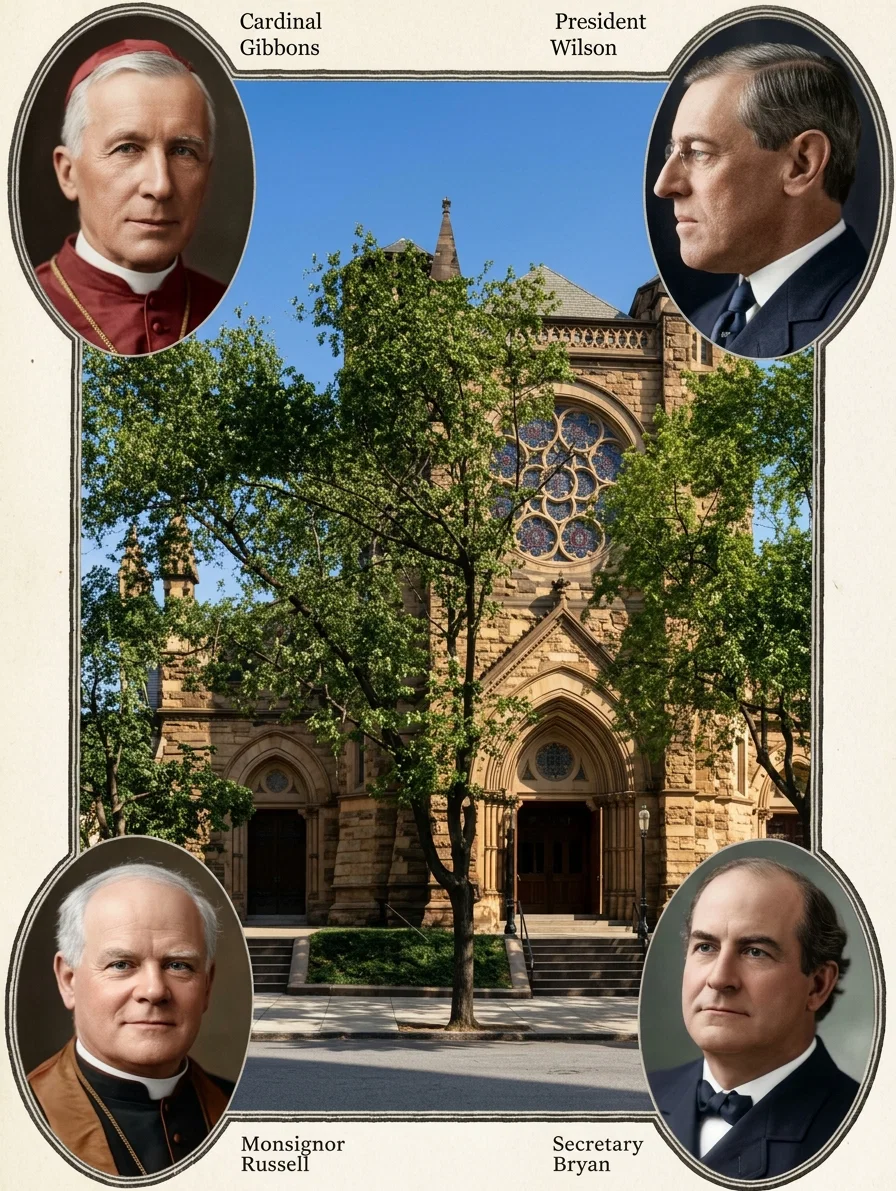
ST. PATRICK'S CHURCH, WASHINGTON, D. C., AND SOME OF THE NOTABLES WHO ATTENDED THE PAN-AMERICAN MASS IN IT
ARE you having a hard time to make ends meet? Read the symposium of seven helpful articles on “What I Know About Reducing the Cost of Living,” found in the beautiful January Life and Health. Why not order 20 copies for $1.00, or 50 copies for $2.00. “Send at once 1,000 more January number,” writes our Chicago agency. “Have already disposed of 1,000. Rush these.” Order 50 today. A good seller!
IT was a remarkable coincidence that on Thursday, November 27, while our Protestant President was attending the Fifth Pan-American Mass, in St. Patrick’s Church, Washington, D. C., the nominally Catholic king of Italy, Victor Emmanuel, was delivering his speech from the throne at the opening of the Italian parliament, in which he outlined his policy on church and state relationship thus: “The amplest religious freedom, with no interference on the part of the church in the functions of the state, which is the sole representative of the totality of the citizens and possesses unlimited sovereignty.” See New World (Catholic), Dec. 5, 1913. If you wish to study church and state principles further, send 20 cents for the current issues of Liberty and the Protestant. Or send $1.30 for both magazines one year.
DURING the holidays we will let down the bars a bit and let you send in five six-month subscriptions for the Protestant Magazine for only $1.50, or 30 cents each. Place it in your public library and in the hands of your friends. Ask the librarian to place it on the reading-table, along with the other magazines. Drop in occasionally and notice where it has been placed.
Adventist Work Advances in China and Solomon Islands
Most encouraging reports come from Elder W. F. Hills, of progress in the newly entered Swatow district of China. While the reports await their turn for insertion in our columns, we quote one paragraph: “We have had four very severe typhoons within two months. Many people were killed, and much damage done to buildings and crops. Our ‘Hayes Gospel Boat’ (for river service) was upset, with five workers in her, forty-five miles inland. We praise the Lord that not a life was sacrificed, and the boat was recovered, with less than five dollars’ loss. While scores of buildings around us were wrecked, not one of our chapels was injured, and our new mission home, which is perhaps more exposed than almost any other building in the city, was not damaged. We give God the praise for his protecting care. Many times we have had positive assurance that God is tenderly protecting us.”
At a meeting of the Australasian Union Conference Committee, in council closing in October, plans were laid to open work in the Solomon Islands, Elder G. F. and Mrs. Jones, formerly of the Malaysian Mission, being appointed to pioneer the work in this field. These islands have received very little missionary service from any quarter, and are decidedly heathen territory. We rejoice to know that the standard is to be lifted there.
Faith Through Trial
By Editor
MANY perhaps of those who will read the personal experience of Dr. D. H. Kress in this number are passing through similar experiences. We have reached, as never before in this world's history, the time of testing. God is proving his children. Many there are today in the ranks of his chosen people who are beset by fierce temptations. Let all such remember that it is their blessed privilege to pray and believe for a glorious victory. In the hours of darkness God does not forsake his faithful ones. Sometimes it is necessary to stand still and wait for the Lord's moving providence, for his revelation; but if faith is maintained in his providences, in his own time and way this revelation will surely come. The path of duty will be made plain, and darkness and trial and perplexity will be made to work together for our highest good. This experience by Brother Kress was written on Thanksgiving day, and we trust that many of our readers had on that occasion, and will have during all the days to come, occasion to thank our God for turning their captivity.
SENDING two articles for publication in the REVIEW, Elder J. N. Loughborough says that while he does not have the vigor of earlier years, he thanks the Lord for freedom from pain. May the Lord bless and sustain the aged pioneers who for long years have been connected with this movement, and grant them the desires of their hearts in witnessing the speedy triumph of the cause for which they have so long labored.
Change of Meeting Dates
ATTENTION is called, on page 21, to the change of dates in the meetings of the Southern Missionary Society and the Southern Union Conference Association.
Gospel Finance
By Editor
IN this number we conclude the excellent series of articles on Gospel Finance, by Elder E. K. Slade. These articles have contained much practical instruction, which has been appreciated by our readers.
Russian Union Divided Into Two Unions
We note in the report of the European Division Committee meeting held recently in Budapest, Hungary, that the Russian Union Conference is now resolved into two unions, the East Russian and the West Russian.
God Opens the Way for Colporteurs
A STRIKING illustration of the manner in which God opens the way for our faithful colporteurs is afforded by the article from Elder F. W. Spies, on page 12. We serve a living God, and he desires to come into such relationship to every one of his children that he can direct and guide in their every experience.