The Youth's Instructor, Vol. LIII, No. 8

Visit to Finland

The Youth's Instructor

Feb 21, 1905

Review and Herald Publishing Assn. · Washington, D. C. · Feb 21, 1905

Visit to Finland
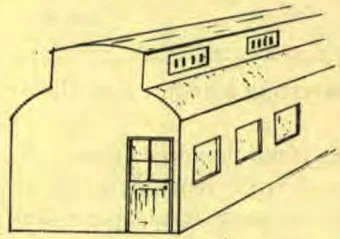
ELDER CONRADI and I left Hamburg, Germany, September 26, to catch the steamer for Helsingfors, Finland, where our first meeting was to be, September 29 to October 4. As we were to be on the train only one hour and forty minutes, we went fourth-class. You may not know what fourth-class is, so I will tell you by giving a description of our apartment. It was on a small, four-wheeled car, perhaps eighteen feet long by eight feet wide. Our apartment was occupied by men and women, thirty-six of us in all. There were hard, one and three-fourth-inch boards extending the length of the apartment on either side, making room for about twenty-four passengers. The rest who came in stood up, or sat on their luggage, of which there was quite a quantity in the open space in the center. The door was in the end, near the side of the car, and had movable glass windows, that could be let down from the top. This part was open all the time. There were two windows on either side, opened from the top. There were ventilators, three on a side, made of simple wooden boards about four inches wide and eight inches long, in which were four small holes, to admit air, if opened. A ventilator is shown in the illustration. This is a movable slide, and these air-admitters are closed by pushing the slide to the right or to the left, as the case may be. The end projection of a car is shown in the drawing. A good class of people sometimes travel fourth-class, though of course a “gentleman” goes second- or first-class. The middle class generally ride third in Germany.
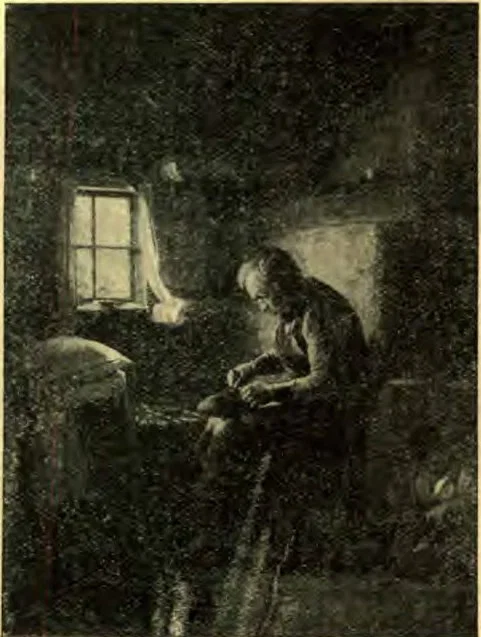
A FINNISH COBBLER
A FINNISH COBBLER
In a few minutes from Hamburg we were in the province of Holstein. The country through which we passed is rolling,—now and then there are level stretches,—and reminds one of parts of Ohio. The land, while more fertile than between Hamburg and Hanover, for example, is yet not rich soil as Americans understand that word. I was interested in observing, instead of the universal pre-eminence of the German village so prevalent in southern Germany, that there are now and again isolated country cottages along the route, as in the States. Another sight reminding me of America was a genuine threshing-machine where there was a steam-power machine at work, in the neighborhood of sixteen small, round stacks. As it is so damp here, the customary large wheat-stack of the West would not give the best returns. In the German threshing and farming operations, the peasant women have a more active part than do the women in the States.
Lubeck is a city of about ninety-six thousand inhabitants. It is one of the “free cities” (Bremen and Hamburg are the other two), which were established during the Middle Ages, and belonged to the Hanseatic League.
Upon calling for our tickets, we were asked if our passports had been viseed. This is very important to one going to Russian territory. My pass had just been renewed in Berlin in May, and yet I had to go to the American consul and pay him 4.25 marks (one mark equals about twenty-four cents) to get him to certify to its present validity; and I also had to swear that I am a Protestant, and bring a certificate to that effect to the Russian consul, who, in turn, viseed the passport, charging me 4.90 marks. As we are to return via Rumania, we secured from the Rumanian consul in Hamburg a similar vise—four marks.
Our ticket, second-class, to Helsingfors cost us, including two dinners, which we were obliged to pay for whether we ate or not, 46.40 marks.
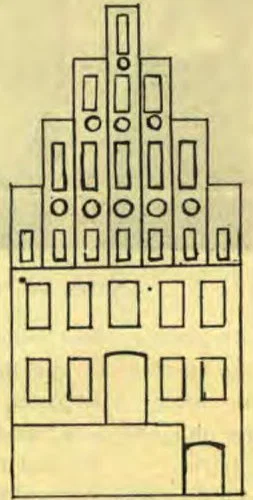
After buying our ticket, we called on our missionary in the city, Brother O. Stoye, who expects to begin a course of lectures there this evening. Lubeck is an old city. I was much interested in some of its unique architecture. I give here a rough sketch of the gable ends of some of the houses. (See second page.) Our work in Lubeck is just beginning, but we hope a church may soon be raised up. There is quite an amount of commerce carried on with Lubeck. It ranks in this respect as third or fourth city in the empire.
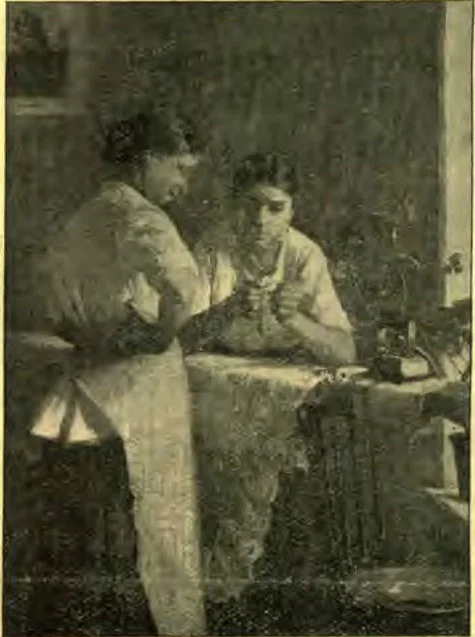
LADIES IN FINLAND
LADIES IN FINLAND
Once on board the steamer “Lumea,” we waited a while for the customs officer to accompany us to the Baltic. The Trave River is quite winding here, so that at least an hour was consumed before we could put on full steam in the open air. On either side the river are large tracts of made land, and three dredgers were still at work, deepening the channel, the sediment being conducted to shallow water, where, little by little, the government is converting marshes into tillable soil.
The vessel carries four hundred tons. Its cargo was made up of fruit, machinery, furniture, chemicals, small evergreen trees, spirits, and musical instruments, with some other things, to the value of one quarter of a million German marks.
Finland will export lumber, tar, wood, paper and pulp, spools, butter, meat, leather, some granite, and a little oats and rye, in good seasons. The Finns are just beginning to introduce a system of replanting their forests, as in Germany, Denmark, and other European countries. In some parts there has been a ruthless destruction of the trees. In others only the large trees have been taken, so that there may be another lumber harvest, in twenty years or so.
END OF A RUSSIAN CAR
The fogs so delayed us that we reached Helsingfors fourteen hours late, having made one stop; and after our passports were accepted, and we had received a small piece of stamped paper to give out as we left the boat, we were allowed to land. The customs officers were kind, and in one minute we were able to go out and take a small Finnish carriage for our mission.
Helsingfors is a fine city. It contains about one hundred thousand inhabitants. It is built upon granite rock,—in this respect Finland reminds one of Norway,—and during the last twenty-five years the city, as well as all Finland, has made rapid advancement. Things, however, are fast becoming Russianized. There are outward signs of this. Recently new street names were put up, and these are printed in Russian, Finnish, and Swedish. Formerly the Swedish stood first, and Russian last. The police must be dressed in Russian uniforms. The Finnish regular soldiers were ten times as numerous as now—there is but one battalion of five hundred. All state and city officers must learn Russian, or give up their positions. Now, of course, many can not learn Russian, and many will not attempt to do so. So it comes about that there are hundreds and hundreds of Finnish and Swedish emigrants who leave their country, many coming to America. As fast as the Finns go away, the Russian colonists arrive. Especially do Russian soldiers who have been detailed here, remain after their time has been served, as this country offers advantages they might not enjoy in their native provinces. To patriotic Finns these changes forbode much evil to the future of their country.
There is some building going on in the city.
Most of the houses are of wood, but some are constructed of granite, and a few of brick. There are some as fine business blocks in the city as I have ever seen. The main buildings are of granite, brick, and cement. The stores are, many of them, large and well stocked. I was surprised when I saw the modern air of the city. The university, the senate house, the czar’s residence when he chances to visit Helsingfors, the soldiers’ barracks, the new Finnish theater of Finnish granite, the observatory, the St. Niccolai church, the two Russian churches, the hospital, museum, a few large hotels, the electric street-railways and lights, give to the place an air of prosperity which is surprising to one whose attention has been called only to the darker side of the political situation.
There is coeducation here. Many young women visit the higher schools, and become teachers, government employees in post-offices, or engage in other lines of work. As so many men are leaving, some of the work which they would do were they more numerous, is now done by the women. There are women street-sweepers, hod-carriers, and freight-forwarders and handlers. The nurses are all women, as well as the bath attendants. In some parts, especially in the north, it is no rare thing to find house after house destitute of male inhabitants. Women in Finland seem to enjoy more liberty than in other European lands I have visited.
Race rivalry is not dead. The Swedes and Finns often fail to see things through the same eyes, and the increasing immigration of the Russian element only adds another foreboding cloud to the already dark political horizon.
As I write, I hear blasting on either side of me. They are cutting a subway through the ground (here the “ground” means Finnish granite), for the electric cable now in process of construction. This blasting is carried on under the very eaves of the houses where people live. It costs something to do excavating in this city.
Their art work also surprised me. Not only are there fine painters in the land, but there are skilled earthenware and chinaware manufacturers. I visited the art collection in the city—a collection of Finnish and foreign pictures which a city of much greater size might well prize.
GUY DAIL.
(Continued)

Woman Invented Condensed Milk

IT was a woman who invented “condensed milk,” which, while nobody wants it who can get the original article, is nevertheless of great value on journeys, on shipboard, and for emergencies.
It was such an emergency that led to the first condensed milk; for Mrs. Albert Cashingor, of New Orleans, fifty years ago had a sick baby, and must get expert medical attendance if it were to live. That could not be had nearer than New York City, and it was a long sea voyage away. How to keep the little baby alive through that voyage she did not know. But she had put up many preserves and many jellies in her time, and she began to experiment on milk, and succeeded, and put up a lot of jars of her original condensed milk, which fed her child through the voyage.
The fact interested several persons in New York, and finally Mrs. Cashingor gave her process away to a pack of sharp fellows, who made fortunes out of condensed milk and never gave her a cent.—Springfield Republican.

Making Glass Walls for Buildings

An architect, in the State of Iowa, has devised a method of using glass for the outer walls of residences and public buildings superior to all other materials. His system provides for a steel framework supported by brackets attached to the beams of the floors, in duplicate, making two walls of opalescent wire glass, the glass being set in the framework. The glass walls are, approximately, a foot apart, making an insulating dead-air space to prevent loss of heat in winter and undue heat in summer.
This system of construction allows of any arrangement of floor plan, because windows are unnecessary. The exterior will admit of any style of treatment. The glass wall is fire-resisting to a practical degree. It has been demonstrated that wire glass will resist a hot fire.
The inside treatment allows of a marble wainscoting half-way to the ceiling, with glass over, so that wall space is available for desks, counters, and shelving on all sides of a room. At the same time more light is produced than with windows. The cost, compared to stone, terra-cotta, or brick, would be from a quarter to a third less for the outer walls.—Search-Light.
GABLE END OF HOUSES
GABLE END OF HOUSES

Snow: Its Uses and Its Burdens

Snow

IN the cities snow is a source of great expense to the municipality. The cost of clearing the streets after a single heavy storm often reaches, in the larger cities, into the hundreds of thousands of dollars. But on the other hand, that money goes into the pockets of an army of laborers, most of whom have no regular work. To them the snow is a real blessing.
But how various have been the comments! To the ordinary city man the frequent and heavy falls of snow have meant bad walking, delayed transportation, and general discomfort. To the railroads and the trolley-lines the snow is always an enemy that must be fought, and can be conquered only at heavy expense—an enemy, too, that never knows when he is beaten, but returns undaunted the day after he is put to flight.
It is to the country, however, that one must go for general appreciation of a snowy winter. The farmer finds the great white carpet his easiest highway, over which he can draw a much heavier load than over bare ground; and he knows that his plants will be the better next summer for having been well covered. In the woods snow is absolutely necessary to the lumberman for hauling both his supplies and his logs, and a heavy fall gives him the assurance which he needs that there will be water enough in the spring to float his cut down the great rivers to the seaport towns.
Nor should the pleasures of the snow be forgotten. They are wholesome and attractive, and conduce to the happiness of several million people—most of whom, however, are under seventy-five years old.
One might say other good words for the snow, but in the general rejoicing at the disappearance of the last of it they would be unheeded. So unreasonable is man!—Youth’s Companion.

Germs as Friends and Enemies

What We Require – Food

IF you want to keep a horse, or a cow, or a dog, or a cat, or even a canary, you find that it costs something to feed it. It costs nothing to feed germs—except your health. Goats will live on weeds, paper boxes, rags, old rope, and some even say—but I do not believe it, do you?—that they eat oyster cans! Germs will live where a goat might starve. Anything that has once been alive—what we usually call decaying matter, such as you find in the barnyard, or in the wash-tub, or in the garbage barrel, or in the ice-chest, possibly—will do to feed the germs.
It may be as large as the stove, or so small it can not be seen; the germs will find it. Not because they have eyes and nose and wings, but because they are so plentiful—floating around in the air—that there is no spot, no matter how small, on which they are not constantly lighting. Everything that would be food for any animal would be food for some germs, and many things that no animals can utilize are foods for germs. Some germs are very choice of their foods, and can not grow except on specially prepared foods, or upon some live animal’s body. But there are always large numbers of germs in the air which live on almost anything, or I might say, upon almost nothing.
Distilled water, prepared by condensing steam, is very nearly pure water; and yet it contains enough other matter to afford nourishment for some kinds of germs. Other germs seem to multiply in well water and spring water as it comes out of the ground; but such germs, as a rule, do not thrive in the body.

Moisture

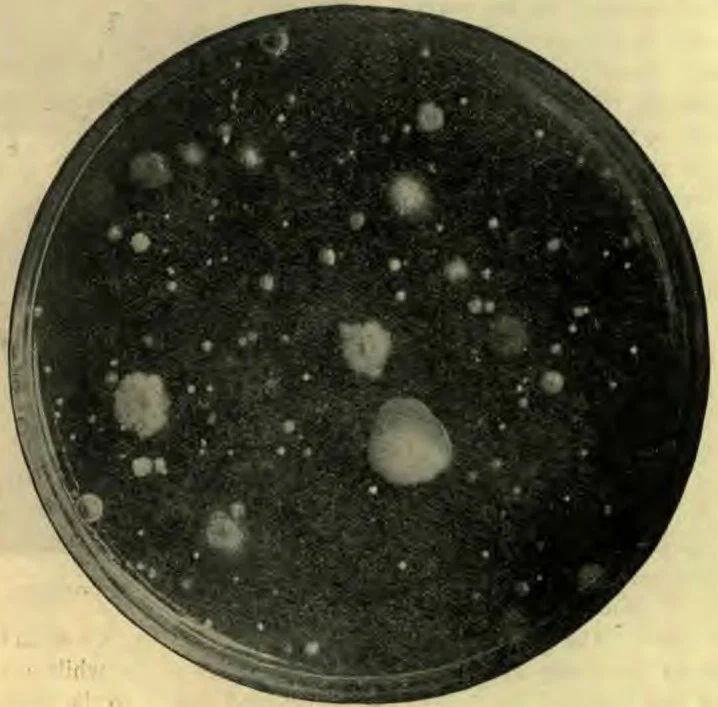
IMMEDIATELY AFTER SWEEPING A CARPET
Perhaps you have wondered how we, having no mouths, can use food. We take it the same as any other plant, drinking it in through the skin, or outside covering. All our food must therefore be in a liquid form. Have you ever wondered why it is your mama dries her fruit in order to keep it, and why it is that drying meat and fish preserves them? The reason is this: We germs—some of us—are floating around in the air all the time, and lighting on everything. When we fall on any liquid containing something that nourishes us, we begin to absorb it, and grow; at the same time we give off substances that break down the thing we fall on. If it is meat, it begins to soften and smell bad. If it is fruit, it begins to soften and decay. If it is a dish-cloth hung up wet, it soon sours. Now if these are dried out so there is no moisture left, we can not grow, any more than can a lot of dry corn in a tin can. The dryness may not kill us, but it keeps us from growing. Perhaps you have noticed that if dried fruit gets damp, it is liable to sour. Some foods which contain much water have so much other matter present that the water is too “thick” for us to utilize it, so we can not grow. Sugar is a very good food for us; but when it is dry, we can not use it, or when it is in too thick a sirup. Honey will not sour for this reason. When the bees first gather it, it is then so thin that it will run out of the combs easily. If it is drawn off in this condition, it will sour readily; but the bees are wise enough to leave it uncovered until it evaporates to such a thickness that it will keep; then they cap it over. Do you suppose the bees understand anything about germs?

Darkness

I think I told you that we germs do best where there is no light. Green plants must have sunlight in order to thrive, but we do better in the dark. Some of us are killed in a very short time by the direct sunlight. You will understand, then, what a nice place a dark, damp cellar is for us, or a dark sink closet where there is a leak, or how we delight to have a little of the dinner leavings left in the sink, or to have a wet dish-cloth hung up under the sink. We enjoy it hugely, and are glad the people are so accommodating; but we do not show our gratitude in a very becoming manner. In our joy at having such good things as darkness, and dampness, and some particles of left-over food to eat, we have a good time, and then the poor people who provided such a rich feast for us have to suffer. Mean, isn’t it?

Temperature

You do not see many banana plants or pineapple trees growing in this country. If you were to plant them in the open air, the chances are they would not grow; it is too cold. But you can grow in hothouses many plants which would not thrive outside. Most plants do as well or better when outside. There are among the germs some that demand so high a temperature that they may be called hothouse plants. They do not grow or thrive in springs or rivers, nor in fruits and other foods, but only where the temperature is at or near that of your body. Among these delicate creatures, are some which are most dangerous to man and to animals.
These are called parasites, because they live in some living animal. These germs (the germ of diphtheria, for instance), while they grow with more or less difficulty outside of the body, will grow in a susceptible body—one which does not resist or throw off the disease—very rapidly and produce poisons which cause the disease.
AFTER THE DUST HAD SETTLED THREE HOURS
Some germs can grow at temperatures much higher than that of the body, as in some of the warm springs. They have probably become accustomed, gradually, to this temperature. Others can grow and thrive at quite a low temperature; but, so far as is known, no germs grow at the freezing temperature, though they may continue to live indefinitely in ice, ready to grow as soon as it thaws.
Some people think that germs can not live in ice, but this is not so. They may live for months in ice, but they will not grow until the ice melts. People who use ice from a pond or lake, on the supposition that all the germ life has been killed by freezing, are running considerable risk. There have been numerous cases of typhoid fever traced to the use of ice from some infected pond or stream.

Oxygen

Bacteria, or germs, differ very much in their requirements. Some, as you have learned, prefer a warm climate; others do better in a moderately cool climate. Some thrive best on one kind of food, others do better on a very different food. Some there are that require abundance of oxygen. They need air, though not necessarily as much as a person. Others can not exist if there is much air present. They grow deep down in animal tissues,—under the skin, in the blood, or in some place where the air can not reach them. There are still others that can live either with or without air. The germ of lockjaw is one of the germs which grow only in the absence of air. It is not so liable to secure a foothold in the body where the skin is bruised off as where a nail or a tack goes up deep into the flesh. Such a wound as this is much more dangerous than one which is made by a knife, and bleeds freely. It is commonly supposed that lockjaw is caused by a wound from a rusty nail; but it is not the rust, but the germs, which cause the lockjaw. Boards containing nails sticking up should never be left around, as they may cause dangerous wounds. When one has run a nail or a tack in his foot, the safest plan is to have the wound opened by a doctor, so it will bleed freely.
It may be apparently well, and then after nearly three weeks an attack of lockjaw may come on. It is too late then to save the patient. The time to treat lockjaw is before you know that the patient has lockjaw.

Where We Are

We grow wherever we can find food—wherever there is organic matter in moist condition. We may be found thriving on the waste matter in rivers, lakes, and ponds, in the streets of cities, in houses and stables. We grow rapidly where people are careless and leave decayable matter around. When the wind blows, we are carried everywhere, as dust—not that dust consists entirely of microbes, but that it contains microbes in great numbers.
We may be found in the greatest abundance in the soil; for every rain brings us down from the air in countless millions. Perhaps you have thought of rain-water as being the purest kind of water; but that which falls the first part of a storm, especially after a long dry spell, is filthy from the amount of impurities washed out of the air. Such water will spoil on standing a few days, because of the decay of the organic matter, through the action of the germs.
Well, the rain falls on the earth, and many of the germs are left there; for as the water percolates down through the soil, the germs are filtered out and left behind. While, near the surface, the soil is so thick with germs as to be almost all germs, at the depth of twelve feet it is said to be entirely free from germ life.
But the filtration can not be relied on where the liquid is too badly contaminated. For instance, if a well is located near a privy vault, you may be quite sure some of the obnoxious matter from the vault will get into the well. The same is true of a barnyard, or a cesspool, or similar surroundings.
In addition to the germs carried into the soil by the rain and by gravitation, there are varieties that live chiefly in the soil, and change the nature of the soil, making it more fertile. Without germs to carry on a certain part of the work, it is probable that plants could not long exist on the earth.
IMMEDIATELY AFTER BED MAKING
At the tops of high mountains, in the air over the middle of the ocean, down deep in the earth, and in the icy regions near the poles, there are no germs, but elsewhere they are present. In the middle of desert regions they are probably present in small amount, if at all.
MIKE ROBE.
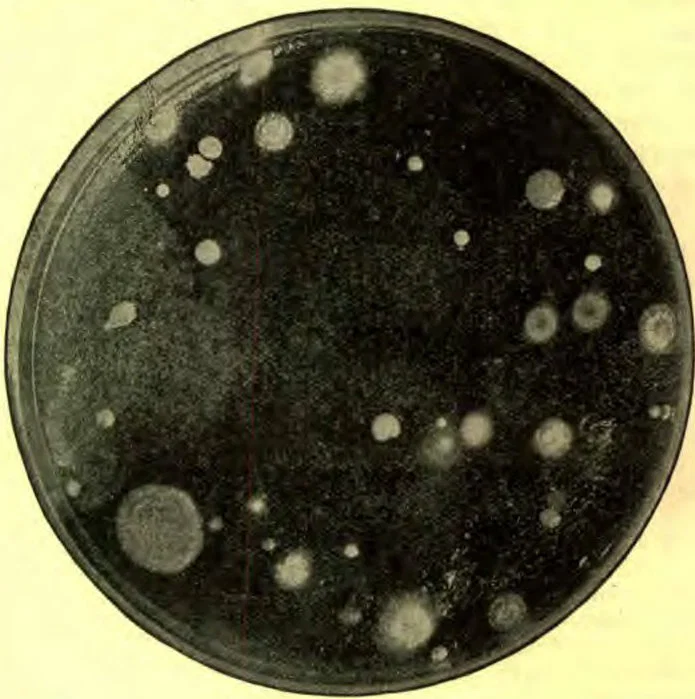
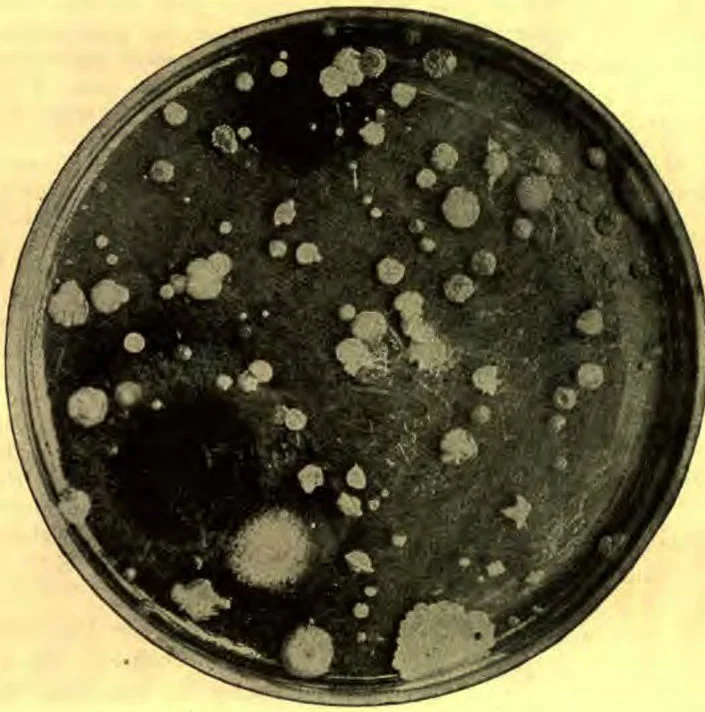
The illustrations in this article, borrowed from Household Bacteriology, through the courtesy of The American School of Household Economics, Chicago, are reproductions of photographs taken from gelatin plates which were exposed to the air under varying conditions. The exposure in each case was for ten minutes.
Each spot is a “colony” developed from a single germ, or ancestor, which has fallen onto the gelatin; so the number of spots represents the number of germs which fell on the plates in ten minutes, and is a fair index of the comparative number of germs floating in the air.
The sweeping was done with a well-moistened broom. With a dry broom, or with careless sweeping, the number of germs afloat would have been much greater. It will be readily seen that sweeping and bed making stir up a large number of germs.

“Stand Up, Stand Up for Jesus!”

IN the spring of 1858 there was a great revival in Philadelphia, and one of the leaders of it was an earnest, manly young minister, not quite thirty years old, named Dudley A. Tyng. One day Mr. Tyng’s arm got caught in some machinery, and was fearfully torn. The arm was amputated, but in a few days the noble young man died of his injuries.
As he was dying, he sent a message to the ministers who had worked with him in the revival , and the message began with these words: “Tell them, ‘Let us all stand up for Jesus.’” The words made a deep impression. They were quoted often before large assemblies, and they were made the basis of more than one poem.
Among Mr. Tyng’s most devoted friends was Rev. George Duffield. A few weeks after the sad accident he preached in his own church in Philadelphia, taking as his text Eph. 6:14: “Stand therefore, having your loins girt about with truth, and having on the breastplate of righteousness;” and closing his sermon with the hymn which he had just written, “Stand up, stand up for Jesus.” The song at once became popular, was introduced into the hymn-books, and became an especial favorite of the soldiers during the Civil War.
Here is the hymn just as Mr. Duffield wrote it, including the two stanzas that are now never printed:—
“Stand up, stand up for Jesus, Ye soldiers of the cross; Lift high his royal banner, It must not suffer loss: From victory unto victory His army he shall lead, Till every foe is vanquished, And Christ is Lord indeed.
“Stand up, stand up for Jesus, The solemn watchword hear; If while ye sleep, he suffers, Away with shame and fear; Where’er ye meet with evil, Within you or without, Charge for the God of battles, And put the foe to rout.
“Stand up, stand up for Jesus, The trumpet call obey; Forth to the mighty conflict In this his glorious day: Ye that are men now serve him Against unnumbered foes; Let courage rise with danger, And strength to strength oppose.
“Stand up, stand up for Jesus, Stand in his strength alone; The arm of flesh will fail you, Ye dare not trust your own: Put on the gospel armor, Each piece put on with prayer: Where duty calls, or danger, Be never wanting there.
“Stand up, stand up for Jesus, Each soldier to his post; Close up the broken column, And shout through all the host: Make good the loss so heavy, In those that still remain, And prove to all around you That death itself is gain.
“Stand up, stand up for Jesus, The strife will not be long; This day the noise of battle, The next the victor’s song: To him that overcometh A crown of life shall be; He with the King of Glory Shall reign eternally.”
Mr. Duffield was the father of a poet, Rev. Samuel W. Duffield. He was a Presbyterian, and during his long life (1818-1888) he served Christ faithfully in many churches; but probably the most fruitful of all his labors was the writing of this hymn, which has inspired so many to speak and act boldly for their Saviour.
The reference, in the second stanza, to the disciples’ sleeping in Gethsemane, recalls a sermon preached from that passage by Mr. Tyng during the revival, not long before his death. Note especially also the sixth line of stanza four, which is often changed (foolishly) to, “And watching unto prayer.”—Amos R. Wells.

“We All . . . Are Changed.” 2 Cor. 3:18

Manners rare and lovely, Thoughts serene and sweet, Are acquired by sitting At the Saviour’s feet.
Voices full of music, Gentle ways that win, Are but outward tokens That Christ dwells within.
Words like healing balsam, Patient deeds of love, Own us to be children Of the King above.
We are imitators, In this world below, Whom we pattern after All our actions show.
MRS. J. C. BROWER.

Life's Devotions

I WISH I could persuade every young girl at the outset of her life to spend a little while morning and evening in purely devotional reading. A silent time is set apart in some of our schools so that each girl, in her own room, may have a space for the morning watch before the day begins, and for the evening hush at its close. We are best prepared for the duties and pleasures of the day by quiet thought and prayer before we meet and talk with others. Our Saviour should be the first whom we greet and praise in the freshness and renewed strength that follow restful sleep. We do not know what is before us in any day, of joy or sorrow, of accident or danger, of temptation or pain. Let us ask Jesus Christ to go with us where we go, and stay with us where we stay. And when the day has ended, and we have had its opportunities and performed its tasks and known its sweetness, shall we not spend a little while in thoughts of our dearest Friend? Prayer is not to be all an asking for what we desire; some of it is a quiet listening to hear God's voice, and some of it is communion.
If we have a dear friend with whom we are very intimate, we do not always need to talk when the friend is with us. Often we sit in silence together, yet have no sense of distance or absence. That is communion.
I recommend to the girl who wants to realize her Saviour as a presence ever near that she read often the story of his life on earth, as told in the four Gospels. The little volumes of the Modern Reader's Bible are so small that they may be easily slipped into a bag or suit case when one goes from home, and they are unobtrusive little books to read on a journey. The Bible is itself our best devotional book. Do not forget that while it is one book, it is also a group of books, with something in it for every hour and every need.—Margaret E. Sangster.

The Character Stamped by Our Free Choices

OUR character is but the stamp on our souls of the free choice of good and evil we have made through life.—Geikie.

The Orb of Night Going Down

“THE orb of night is going down, The crescent hastes to set; For where the Arab prophet ruled, The men of God have met. The Persian mollah seeks for light, The Tartar waits to know If Christ’s command hath been repealed: ‘Go preach my gospel, go.’”
Continue reading: THE WEEKLY STUDY