The Youth’s Instructor, Vol. 33, No. 2.

SOME THINGS ABOUT RUSSIA

The Youth’s Instructor

Jan 28, 1885

S. D. A. Publishing Association · Battle Creek, Mich. · Jan 28, 1885

SOME THINGS ABOUT RUSSIA.
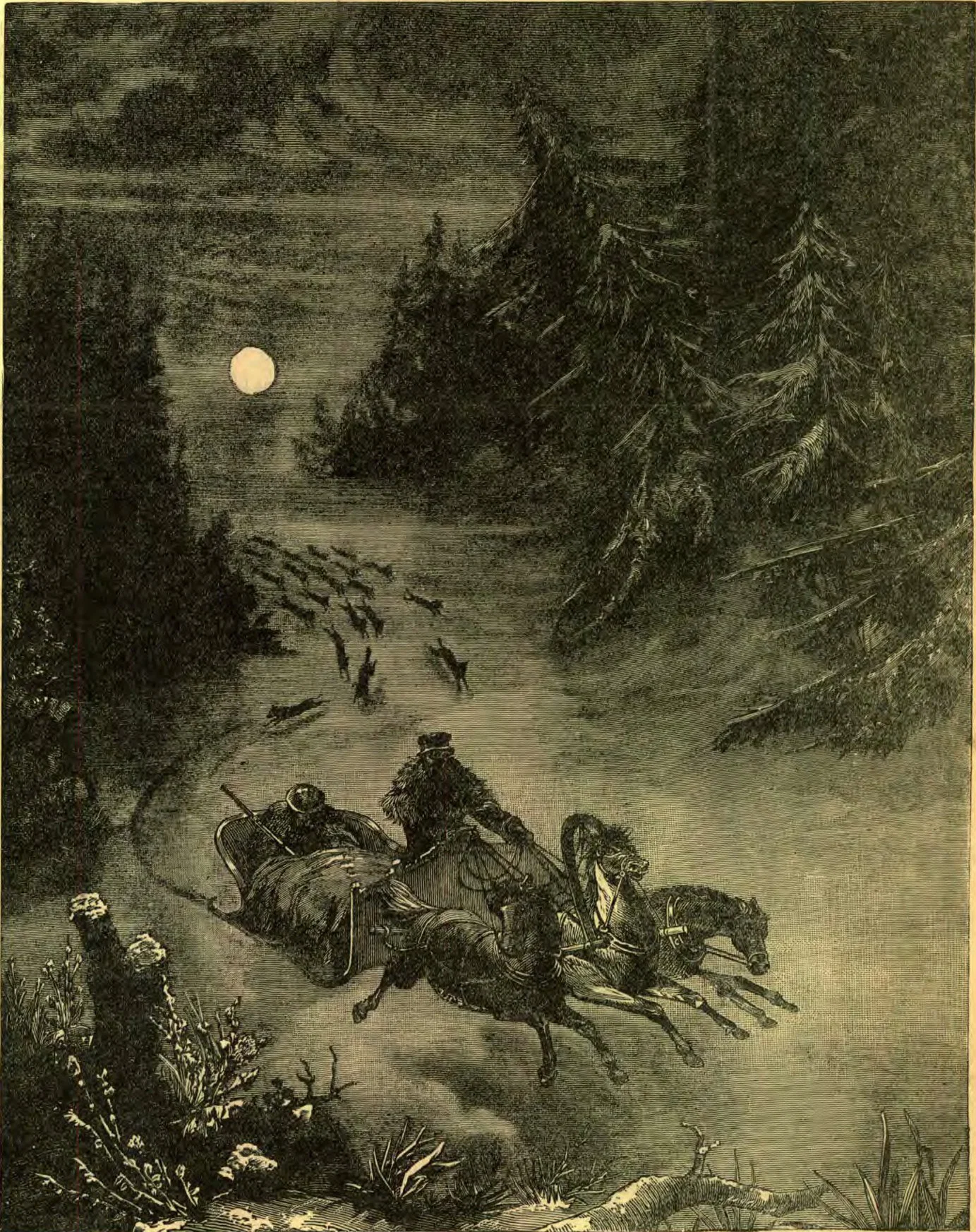
The accompanying engraving represents a Russian traveling scene. How many of our young friends can locate Russia?
Please take your maps, and see what a vast extent of territory it comprises. Beginning with the Baltic Sea and Sweden on the west, it stretches eastward 6,000 miles, quite to the Pacific Ocean; and from the Arctic Ocean on the north, it extends as far south as the Black Sea, its greatest breadth being about 2,300 miles. This includes both Russia in Europe and Russia in Asia; and together, they form the Russian Empire, the largest and most powerful empire in the world. It is equal in size to about the whole of North America.
This vast region of country affords a great variety of soil and climate. The northern half of European Russia is a land of forests and marshes, plentifully supplied with lakes and rivers, and furnishes some valuable tracts of land for tillage. The southern half is a great expanse of rich land, with occasional tracts of sand and forests. Siberian Russia consists almost entirely of marshes and steppes, or plains. With the exception of the southern and western portions, it is quite barren.
Of the early history of Russia, but little is known. It is supposed the empire was founded by Rurik, about one thousand years ago. It has for a long time been divided into “governments,” and several provinces not yet formed into governments, which comprise one hundred different nations and tribes, who speak about forty different languages.
With some exceptions, Russia is not remarkable for its fine scenery. English travelers usually visit St. Petersburg, Moscow, attend the great fair at Nizhni Novgorod, and make the voyage of the Don and Volga Rivers. But what the scenery lacks in beauty and interest is usually made up in curious traveling companions, who are always ready to engage in conversation, and impart their simple stock of knowledge. One can sometimes spend a portion of time quite profitably in the society of these good natured, common-sense peasants.
Russia has such an abundant supply of water privileges, one might think navigation would not be difficult. Although it has been much improved during the last twenty-five or thirty years, and steamboats now run on some of the larger rivers, it has many drawbacks. One is that during the long, cold season the rivers are covered with ice; another, when the snow melts, many of the villages can only be reached by boats; but the warm weather comes so suddenly that the streams, most of which are fed by the rains and melting snow, fall rapidly, and by the middle of summer it is difficult for the steamboat to pick its way between the sandbars. The River Neva alone has a plentiful supply of water during the dry season.
The public roads in Russia, unless in some of the central parts, are represented as the worst in existence,—no changes having been made in them in centuries, only as the ruts shift their position. When the ruts become so deep that the wheels cannot reach the bottom, the people begin a new pair, on one side or the other of the old ones, the roads being so broad as always to furnish room for others. Soon the old ruts fill up again, ready for service when needed. Winter improves the traveling by filling the ruts with ice and snow. The greatest inconvenience of winter traveling is the prevalence of strong winds when the thermometer is many degrees below zero. The severity of the climate renders thick, warm furs a necessity.
In taking an overland journey in a country where there are no railroads, the Russian makes use of a vehicle called a “tarantass,” which is usually drawn by three horses. It somewhat resembles a phaeton without springs. A useless apology for springs consists of two parallel wooden bars fastened lengthwise to the body of the tarantass. He is expected to take with him a pair of sheets, one blanket, a pillow, and towels; also his tea and sugar. His pillow is a sort of air cushion, which answers the double purpose of a pillow, and to ease the jolts of the springless vehicle. On those overland routes, the Russian would sooner think of traveling without his portmanteau than his pillow.
Regular post-stations are located every ten and twenty miles, on all the principal thoroughfares, where horses, vehicles, and drivers are kept for the accommodation of travelers. A good driver seldom uses a whip, except to flaunt it over the heads of the animals. He guides his team by talking to them as he would to a person. At one time he calls them “little doves;” at another, “cursed hounds;” and so varies his titles according to his state of mind.
Since the construction of railroads in Russia, or during the last thirty or forty years, traveling has been made very comfortable and convenient. The railway carriages are made with double windows and doors, besides being heated with iron stoves; so that even during the severity of winter, one can travel with ease.
An incident in connection with the building of the railroad between St. Petersburg and Moscow is worthy of notice here. This road extends a distance of four hundred miles, without turning to the right or left. Formerly, a person could travel fifteen hours without seeing but once what he could call a town, and scarcely a human habitation would be visible on the route. A tedious journey, surely, at their slow rate of speed! Branch roads now connect with the main line in many places. When the survey was made for this great stretch of road, the “Minister” laid a map of the proposed road before the Czar in order to explain the route. The Czar at once laid a ruler on the map, from St. Petersburg to Moscow, and drew a straight line, saying, in an authoritative tone of voice, “You will construct the road so!” and it was so built.
We can give but a few of the many interesting things concerning Russia in one short article. You may have an opportunity to read its history sometime. We will only add further that wolves frequent some portions of the country. Formerly, they were the terror of all Europe, and it was unsafe to travel during the winter and spring months; but now they are common only in the mountainous regions and those most thinly populated.
M. J. C.

THE PEN.

“O FATHER!” cried Edith, rushing into the study and standing before him. “Do look at my beautiful gold pen that I have won as a prize for the best composition in my class!”
Mr. West laid down his book, and drew her to his side. “Indeed, I am much pleased,” he said, taking the pen in his hand. “A beautiful pen, certainly; but the ability to use it is of greater value than the instrument.”
“Yes, father; but it is a pretty pen, and I do believe I can use it better than if it was ugly and valueless.”
“Perhaps,” said her father, with a smile. “It certainly ought to inspire you to do your best. This gold pen, with its diamond tip and stem of pearl, is one of the triumphs of civilization in this nineteenth century. In all the ages past, no warrior, statesman, or prince had one so costly or perfect as this which my little girl may use. Though pens have not been fine, they have done mighty and wonderful things. The pen that wrote the psalms of David has moved the hearts of men for thousands of years. The pens that wrote the life of Christ secured to the world its greatest blessing. But the work of the pen has not all been good. A few strokes have often ruined not only individuals, but whole nations.”
“Yes, father,” said Edith. “I know it is said, ‘the pen is mightier than the sword,’ but it is pleasant to remember it has never been put to bloody work. If it has done evil in the hands of wicked persons, it is itself an innocent little thing.”
Mr. West smiled. “All pens have not been such innocent little things as this, my dear. Though never very formidable as weapons, there is a story that one man, at least, was killed by them.”
“Please tell me about it,” said Edith.
“A thousand years ago, when good King Alfred reigned in England, after he had driven away the plundering Danes, he was very anxious to advance his people in learning and civilization. For this purpose, he established schools where the young men might be taught to read and write. There was a school in the royal palace, where the young people of the highest rank were instructed; but the most of them were in the monasteries, and the monks, who had nearly all the learning in that age, were the teachers. The schools of Ireland had been for centuries the most celebrated in Europe, and King Alfred brought from that country a renowned scholar, named Scot, to teach in the abbey at Malmesbury. History says ‘he was a great arguer, and a great philosopher;’ and he seems to have been very dogmatic, and impatient of contradiction. We cannot doubt but he had a great deal of trouble with his pupils, who were a rough set of young men, much more familiar, and much better pleased with crossbow and lance, than with books and pens. I suspect he had a fiery temper, and the usual determination to rule; and when those big, lawless fellows were careless or insolent, perhaps he tried to reform them with ferule or rod. We are not told how it came about; but one day they flew upon him, and regardless of his philosophy and his arguments, in their fury they really killed him with their iron pens.”
“Oh, how could they!” cried Edith, with wide open eyes of astonishment and horror.
“I cannot tell you how they could be so wicked as to do such a deed; but when they had the disposition, it was not so very difficult for them to commit it. You must remember the pens they used were sharp pointed spikes of iron, with which they were learning to write on tablets covered with wax. Perhaps this poor schoolmaster is the only man who has been literally stabbed to death with pens; but many have suffered a worse fate from the use of this little instrument. Venom in the heart may be distilled through this, and become more dangerous than the poison of asps. Be careful, my dear child, and never suffer this beautiful pen to record a false word or a malicious thought.”—The Little Star.

INCIDENTS IN THE LIFE OF DR. ADAM CLARKE

In these days, when people generally give so much time and thought to the subject of healthful living, it is quite a surprise to know that some who lived nearly a hundred years ago, were almost as far advanced as we are in this matter. Such a man was Dr. Adam Clarke.
Soon after Dr. Clarke began to preach, John Wesley wrote a tract against the use of tea and coffee. Dr. Clarke read this tract, and became convinced that tea and coffee were hurtful. He gave up the use of both, as Wesley had done, and never touched them again while he lived. Toward the close of his life, he said that this habit had saved him four years of time that would otherwise have been spent at tea-parties. Besides all that, he had better health.
He would not eat any pork. Once he went to preach to some people on an island. He found the people very poor,—so poor that all they could offer him to eat was hard bread and salt pork. He utterly refused to eat the pork; and at last, after hunting all over the island, he found some eggs, that he cooked and ate with the bread.
It was customary in those days for ministers to drink wine and beer. He gave these up also; so you see he was a good temperance man. People thought it very strange that he should make himself so peculiar; but he thought he was right, and so continued steadfast.
He was a kind-hearted man, and always tried to do people good. One time, when he was visiting Ireland, he passed through a large gate to watch some work that was going on on the wharf. A drunken man stepped up and accosted him in Irish. Dr. Clarke answered him in French. The man then spoke in French. The Doctor answered in Arabic, and then passed out of the gate. Then the man cursed him in Irish and French. The Doctor turned back to him, and put two shillings in his hand, whereupon the man blessed him in Irish and French and English. “Truly,” said the Doctor, “out of the same mouth proceed blessings and curses.” J. R. CALKINS.

HAVE YOU EVER THOUGHT?

Did you ever well consider, As you journey on life's way, Of the vast results dependent On the things you do and say? Have you ever learned the magic Treasured in one little word, Fitly spoken, wisely chosen, How it into being stirred?
And a soul, almost desponding, New, fresh inspiration caught, Grasped anew life's heavy burden, By your bright example taught! How a cold and icy nature, Like a northern wintry blast, Brings a blight where might be blossom; Heaven's own blue is overcast!
Possibilities of greatness May be crushed by ruthless hand! Every aspiration withered, Ere it ventures to expand? And the grandeur of a life-time May be smothered in its bloom, For the lack of proper culture And a genial, sunny home?
Then, don't call these trifling matters, These small, every-day affairs; Words will eat as doth a canker, Life, at least, has many cares; All our actions, words, and manners, With great results are rife, For in each a soul is hindered Or advanced in higher life.
—Boston Budget.

IMPORTANT BIBLE SUBJECTS.

LESSON 29.—PUNISHMENT OF THE WICKED.

[NOTE TO THE STUDENT.—Do not consider the lesson learned until you can give at least the substance of every text, with the correct reference for each. The references in black letters indicate those texts that should be committed to memory. A little diligent application each day will enable you to do this.]

EVERLASTING FIRE.

1. WHEN will all the nations of earth be gathered before the Lord?
2. How many classes of people will there be?
3. Name and describe them.
4. What will be said to those on the right hand,—the righteous? Matt. 25:34.
5. What will the Lord say to those on the left? Verse 41.
6. Have any people ever yet been punished with everlasting or eternal fire? Jude 7.
7. Describe the fate of Sodom and Gomorrah. Gen. 19:24, 25.
8. How long a time, in comparison with eternity, did it take to accomplish this overthrow? Lam. 4:6.
9. As the result of being overthrown by “everlasting fire,” what did those cities become? 2 Pet. 2:6.
10. After the cities became ashes, what must have become of the fire?
11. Then does “everlasting fire” necessarily burn to all eternity?
12. What did the prophet Malachi say of the fierceness of the fires of the last day? Mal. 4:1.
13. As the result of this fire, what will the wicked be? Verse 3.
14. When this takes place, what will have become of the fire which devoured them?
15. What wonderful promise was made concerning Jerusalem, on condition that the people should obey the Lord? Jer. 17:24, 25.
16. What did the Lord say that he would do if they did not obey him? Verse 27.
17. What did he say that this fire should do? Ib.
18. What did he say should not be done to the fire? Ib.
19. What is the meaning of the word “devour”?
20. If the fire, when kindled, had been quenched, would the gates and palaces have been devoured?
21. When that upon which the flames were feeding was “devoured,” what must have become of the fire?
22. What did Christ say of the fire into which the wicked are to be cast? Mark 9:45.
23. Since the fire is not to be quenched, what will it do? Rev. 20:9.
24. Then how much of the wicked will there be left? Mal. 4:

NOTES.

ASHES are “the earthy or mineral particles of combustible substances remaining after combustion;” therefore ashes cannot burn. So, then, when we learn that anything has been reduced to ashes, we understand that it can no longer burn, because it no longer exists, and that the flames which devoured it have gone out.
WEBSTER defines “devour” thus: “To eat up with greediness; to consume ravenously; to feast upon like a wild beast or a glutton.” Its synonyms are, “to consume; waste; destroy; annihilate.”
WHEN a fire is quenched, that which it is burning will be at least partially preserved; but if it is not quenched, it will continue to burn as long as there is any combustible material for it to feed upon, and then it will necessarily go out. This will be when that which it was burning has become ashes.

THE FIRST PRINTED BIBLE.

In the National Library at Paris there is a copy of the first Bible that was ever printed. It is a great, clumsy affair, in two volumes folio, about 600 pages a volume, printed in Latin, Gothic type. The words are very black, and many of them are abbreviated and packed so closely together as to puzzle the eye; but it is a very valuable Bible, worth several thousand dollars, at least. It is without the name of printer or publisher, and without date; but it was the work of a poor old Dutchman named John Gutenberg, who was put to much trouble and suffering through his printing.
The real story of printing began several years before, in 1420, when an old gentleman, in the city of Haarlem, first conceived the idea.
He was walking in the woods, one day, when he found a smooth piece of beech bark, upon which he cut several nice letters; and when he returned home, he inked the letters, and stamped them upon paper for his little boy to use as a copy. After that, he made stamps of all the letters on paper; and this set him to thinking, planning, and finally working.
At that time there were only a few books; and as they had to be written with pens on parchment, they were very expensive, and it was a most tedious affair to write one. Now, this old gentleman, whose name was Lawrence Coster, knew that if books could be printed, they would be better and cheaper in every way; so he went on cutting letters on blocks of wood and trying his experiments.
He worked secretly; and though he had several apprentices in his employ, he charged them to say nothing of the trials he was making. One of his apprentices, however, was dishonest; and after a while, he ran away into Germany, carrying off a lot of his master's blocks and several pages of his manuscript. Thus it was that poor old Lawrence Coster lost the credit of the invention of printing. He did not give up his work, however; and several old, roughly printed books of his are now in the State House at Haarlem.
About this time, Gutenberg began working with letter blocks too. Some folks think that he was the dishonest apprentice; but there is no proof of it, and I am inclined to think that Gutenberg was honest, for he was cheated himself by a man named Peter Schoeffer. Other folks think that this Peter Schoeffer was the same man who robbed Lawrence Coster.
Gutenberg borrowed money from a rich silversmith named Faust; and when Faust wished to be paid, Gutenberg was unable to satisfy him; therefore Faust seized his tools, presses, and unfinished work, among which was a Bible, nearly two-thirds completed. This, Faust, with Schoeffer's help, finished, and this was the first Bible that was ever printed.
But perhaps you will be glad to know that John Gutenberg succeeded at last. He did not grow disheartened, but toiled on; and before he died, he sent out books as good and clearly printed as those of Faust.
But Faust deserved some credit, too; for he was a clever worker on metals, and acting on the suggestion of Schoeffer, he ran types into a mold. However, the great credit should be given to Gutenberg; and in the old town of Mayence, where he labored and succeeded, the people are so proud of his memory that they have raised a statue to his honor; and in the city of Strasburg, some forty years ago they erected another statue of him—a great bronze affair, that is one of the sights of that wonderful city.—Selected.

THE BEST RECOMMENDATION.

“Let me see the book, my boy,” said Mr. Harvey. Raymond started up in surprise. He had opened his satchel, and while taking out his note of reference from his former employer, his Bible fell out onto the floor.
Mr. Harvey looked at the book, and said, “This will do; you need not mind about the paper;” and Raymond soon found himself engaged as office-boy and under-clerk in Mr. Harvey’s office.
What do you suppose made Mr. Harvey so ready to take Raymond into his employ? You think it was his Bible. I suppose Mr. Harvey reasoned like this: If a boy reads his Bible and profits by its teachings, he will be apt to be a faithful worker. This Bible reader will be honest, and can be trusted alone in the office. His word will always be reliable, and he will not be found in bad company.
Raymond probably obtained his position, because he carried his Bible with him. If that book had been a novel or some wild story, Mr. Harvey would not have been so ready to engage him. It is very true that a person is known by the company he keeps; and it is exactly as true that you will be known by the books you read. Never read anything that you are ashamed to have found out. People will think better of you if you read only good, sensible literature. But you ought to have a nobler motive than merely to keep a good reputation. Your reading molds your mind; you are made either better or worse by it. Get the best, then, by all means; and be sure that you read nothing but the truth.—Selected.

THE TALLEST CHIMNEY IN THE WORLD.

The tallest chimney in the world is at Glasgow, Scotland. The breadth of the huge tower is forty feet at the base, or equal to the space occupied by a large house; and at the top, eleven feet. The height is four hundred and fifty-four feet. Only two structures built by man are higher,—the steeple of the Strasburg Cathedral, which is four hundred and sixty-six feet above the ground, and that of St. Stephen’s church in Vienna, which is four hundred and sixty-five feet high.
The most wonderful thing about this chimney is that, having been twisted out of the vertical line to the extent of more than seven feet before the mortar was hardened, human skill reduced it to a perfect perpendicular again. The mortar was sawed out on the windward side so as to allow the chimney to settle enough to balance things again. Two millions of bricks were required in building the chimney, out of which volumes of smoke pour night and day.—Golden Days.

Avoid the First Wrong Step

Avoid the first wrong step. Yield not to a single temptation, or you will be less able to resist subsequent ones. If you have already started in the way of disobedience and vice, retrace your steps at once. It will be easier to do so now than at any future time.

The Importance of Careful Preparation

MANY a noble enterprise has fallen to the ground, simply because some one did not think it worth while to make those needful preparations, which, though seeming to cause unnecessary delay at first, are essential to the complete success of the enterprise. It is a poor policy to attempt to save time in foundation-laying; for a mistake there may, bring the whole building to the ground.

THE TWO ANGELS.

DAILY are two angels writing What we do for good or ill; One with smiles for good inditing, One the evil, sad and still.
Where repentance boweth lowly, Long they wait at close of day, Blotting out the deed unholy, Ere they bear the book away.
—Selected.

HISTORICAL GEESE.

YOU little goose!” said Harry, as he stood with his hands in his pockets, watching his sister Jean cracking some nuts on the end of the wood-box. “Why don’t you take hold of the hammer head, and done with it; you might as well!”
“There!” he exclaimed, as the hammer slipped and came down on Jean’s thumb, “I knew you’d do that. Girls’ve no business with hammers, anyway.”
“They have, too,” Jean replied, spitefully.
“You needn’t think, ’cause you’re a boy, that you know everything.”
“Take your old hammer,” she added, as she gave her thumb another unmerciful whack; “if you know so much about it, crack ’em yourself. I guess I’m not any more of a goose than you are,” and she turned toward the door.
Just on the threshold she met her mother.
“Why Jean!” said Mrs. Walling, as she noticed the little girl’s flashing eyes and scarlet cheeks.
“I don’t care!” Jean replied; “Harry’s just as mean as he can be, and he called me a goose.”
“Well,” said her mother, with a quiet smile, as she sat down in an arm-chair, “I should not feel very bad, if I were you, even though he did call me a goose.”
“O mamma!” said Jean, with wide-opened eyes.
“No,” replied her mother, “I don’t think I would. Geese are not so stupid, after all, as people usually think they are. They really know a great deal. I once read of a flock of geese that saved a whole city.”
“Tell us about it, please,” said Harry, as he came over and stood by his mother’s side.
“Many centuries ago,” said Mrs. Walling, “almost three hundred and ninety years before Christ, the Romans had a terrible war with the Gauls. The Gauls, you know, were a people who lived beyond the Alps.
“This battle I am telling you about took place on the banks of the River Allia, nearly seven miles from Rome. The Gauls were really better soldiers than the Romans; but the Romans did not think so, and they went out very bravely to meet these ‘barbarians,’ as they called them.
“Then there followed such a dreadful battle! Everywhere lay the dead and the dying. The Romans were badly beaten, and many of them were drowned in trying to swim the Tiber to get home.
“A few of them got there, however. They found the city deserted. There were not men enough even to defend the walls. What should they do! The enemy was right behind them. All they had time to do was to hurry to the Capitol building, and try to save that. Just then the Gauls came up, and rushed into the city to plunder it.
“The Romans that had fled from Rome heard how these citizens were shut up in the Capitol. They wanted to help them; so they formed an army to go to their aid. They thought they could not succeed unless Camillus, their old leader, stood at the head of the army. But he had been sent away from Rome years before, and could not return without the consent of the rulers. The rulers were shut up in the Capitol. What was to be done? Who would dare face the Gauls, and get the Senators to let this man come back?
“At last a bold youth named Pontius Cominius said he would go. So he swam the Tiber by night, and climbed up to the Capitol over a precipice that no one thought a man could get over. After he had finished his business with the Senate, he went back the same way he came.
“In the morning some Gauls were passing that way. Their keen eyes very soon saw that some foot had disturbed the rocks and clinging vines. ‘Oho!’ said they, ‘some Roman has been over this crag. We’ll see if a Gaul can’t do as much as a Roman can.’ So when night came again, a line of soldiers began, one by one, to climb up the precipice as the Roman had done, that they might kill the brave men imprisoned in the Capitol.
“At the top of the wall hung some cages of geese, sacred to the goddess Juno. Everybody seemed to have forgotten the geese in the excitement. There they hung, just as in times of peace. As the first man’s head appeared above the wall, the geese were ready for duty, and set up a cackling that echoed and re-echoed over the sleeping city.
“The Gauls did not expect such a greeting. The noise of the geese woke up a brave man named Marcus Manlius. He rushed to the wall just as two Gauls reached the top. He thrust his shield against one, and his good sword against the other, pushing them both down. They fell against those who were toiling up behind them; and so one kept falling against another, until they all lay in a heap at the bottom.
“After a time the Roman army reached the city, and succeeded in taking it away from their enemies. You may believe that they thought more of the geese than ever, after that.”
“Well,” said Jean, as her mother finished talking, “I shall not get angry now when Harry calls me a goose. I’ll just ask him if he remembers what geese have done, and how much they really know.” W. E. L.

Letter Budget.

FLORA L. HAMMOND writes from Bolton Glen. She says: “I have never written to our dear INSTRUCTOR. I want to write and tell my little friends about the good school we have in Canada. The school room is in the church. There are about twenty scholars, who all seem to love their teacher very much, and I think she loves them too. There is a ‘boarding club’ connected with the school, and their rooms are in the upper part of the church. I have one brother who is twelve years old. He goes to the school, and I went with my mother yesterday to see him. I stayed and ate dinner with them. One of the young boys asked a blessing at the table. I think they all love the Lord. I am lonely without my brother, for I have no sisters. But we are not alone, for my grandma and grandpa have come to live with us. My grandpa is eighty-three years old. He has a broken hip, and cannot walk; but we do all we can for him. I like the INSTRUCTOR, and I want to get subscribers for it when I am older. I am ten years old now.”
We are glad to know of another school for Sabbath-keeping boys and girls. The little friends will be pleased with your account of it. Did you ever try to canvass, Flora? I have known younger children than you who have obtained many subscribers.
LUCY ELLEN SPEAR, of Union Co., Iowa, writes: “I am a little girl ten years old. My papa died last spring with quick consumption. I have three sisters and two brothers. My mamma is poor, and so lets me stay with Mrs. Sylvester. My mamma keeps the Sabbath, and the family I live with keep it too. We live three miles from the church, but we go to Sabbath-school most every Sabbath. I have studied in Book No. 2 to where God opened the Red Sea to let the Israelites pass through. I think it is so nice to learn all about Moses, and the wonderful things God did for the children of Israel, and how he punished wicked Pharaoh. This is the first letter I ever wrote. I love to read the INSTRUCTOR, and the letters from the children. I want to be a good girl, and meet the INSTRUCTOR family in the new earth.”
The story of Moses is very fascinating; indeed, there is no more interesting book to read and study than the Bible. We believe that many who spend their time reading foolish stories, would enjoy Bible stories much better if they could be induced to make the exchange.
GRACIE ROBINSON writes from Monroe Co., Wis. She says, “I am twelve years old. I take the INSTRUCTOR, and like it much. My mother is dead, but I have a stepmother. I have one own brother, one half brother, and two half sisters. I go to Sabbath-school every Sabbath, and learn lessons in Book No. 3. I am trying to be a good girl, and want to meet my mother in heaven. She embraced the Sabbath about a year before she died. I keep the Sabbath with my stepmother. I hope my father may keep it sometime. Pray that I may live so as to encourage him to do right. I would like to canvass for the INSTRUCTOR.”
We have sent you circulars for canvassing, Gracie, as you desired, and hope you may get subscribers enough to entitle you to one of our best books.
Written for the INSTRUCTOR.

FROST PICTURES.

Silent and slow the snow came down, Covering earth and tree and town, All night long,—’twas a lovely sight When the sun rose clear and bright, And the rays from his radiant face Shot out across the quiet place.
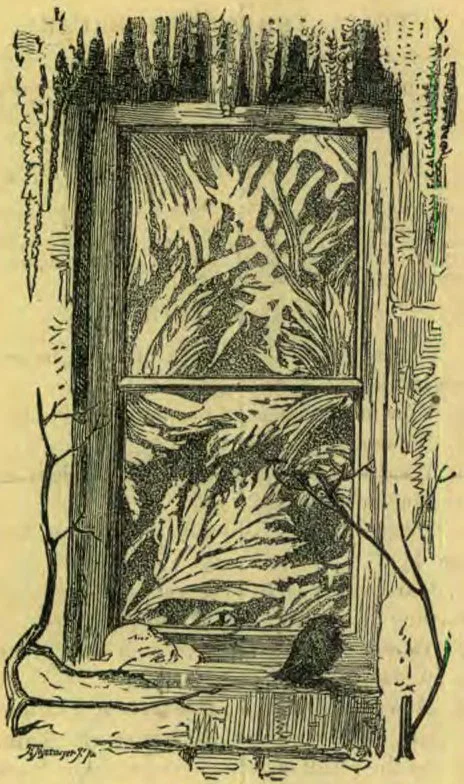
They came to my window, glancing in Under the icicle lambrequin; O, the pictures they painted there! Human skill ne’er made so fair. There were fern leaves traced by fairy hands; And palms and shrubs from foreign lands; A forest up on a mountain side; And stately oaks in all their pride; A waterfall of frozen foam; A shy young hare that had lost its home; Long pine needles here and there, And bits of crystal everywhere.
The sleeping town awoke at length; But the sun was up in all his strength, And the pictures on the window-pane Had faded ne’er to come again. A little bird on the window-sill Chirruped awhile, and then was still. The village life was soon begun Where it had stopped at set of sun.

You have reached the end of this edition.

The Youth’s Instructor · Jan 28, 1885