The Youth’s Instructor, Vol. L, No. 39

Fisk University

The Youth’s Instructor

October 2, 1902

Review and Herald Publishing Company · Battle Creek, Michigan · October 2, 1902

Fisk University
CLINTON BOWEN FISK, after whom this celebrated institute of learning was named, was born at York, New York, in 1828, and died in 1890. Entering the army, he rose to the rank of a brevet major-general. After the War of the Rebellion he became attached to the Freedman's Bureau as a commissioner, and later assisted in the opening of the institute which bears his name. The work of founding this university was begun in 1865, and it was incorporated in 1867. It was then known as the Fisk school, and was opened for the reception of pupils in the old Federal Hospital Buildings, Jan. 9, 1866.
This opening was a most thrilling affair. The newly emancipated colored people, for whose education it was intended, gathered by thousands about the grounds and upon the streets. “Thousands of ex-slaves were there. One passion animated this dusky throng. To learn to read was the ambition of the bright colored boy, of his sedate but none the less eager sire, and of the veteran grandparent with white hair, and with eyes that must learn the alphabet with the aid of spectacles.”
The first agency, and the most successful, in the perfecting of this grand undertaking was the American Missionary Society of New York City, founded in 1846 as a distinctly antislavery missionary society; but the real worker, the one who was instrumental in bringing the university up to its present standard of excellence, was Treasurer George L. White, who was instructor in music in the Fisk school from its opening.
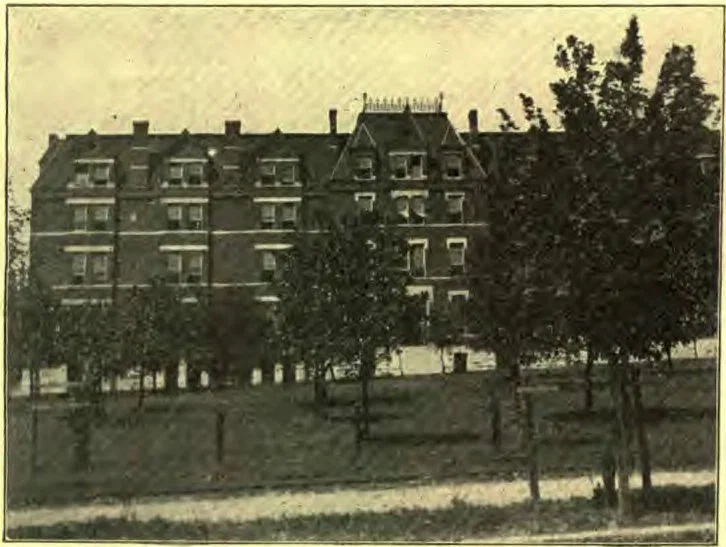
DORMITORY — FISK UNIVERSITY
With a faith in the result, and a courage invincible and unshakable, he organized, from among the male colored students, a band of nine singers, and started out with these in 1871 to raise money for the enlargement of the institution. Only for his faith and courage, and the prospering care of God, the enterprise would have proved a lamentable failure; for the first few weeks of their journeyings was a constant record of loss and discouragement. Mr. White had named his company “The Jubilee Singers,” and they could sing with incomparable sweetness, and with a pathos to melt the stoniest heart; yet as they went from town to town singing their melodies, they were often penniless, and on the verge of starvation. At last they reached Oberlin, and were permitted to sing before the National Council, then in session at that stronghold of the colored man. This turned the tide. Plymouth, Brooklyn, and scores of other prominent churches in the North opened their doors to receive them, and money poured into the treasury.
Crossing the Atlantic, Queen Victoria welcomed them. Germany and France received them, and at the end of seven years they returned to Nashville with the sum of one hundred and fifty thousand dollars, which was expended in the erection of Jubilee Hall, and in paying for the ground occupied, comprising thirty-five acres of what was formerly a slave plantation. The hall itself is surrounded with eight acres of land. There are seven other buildings.
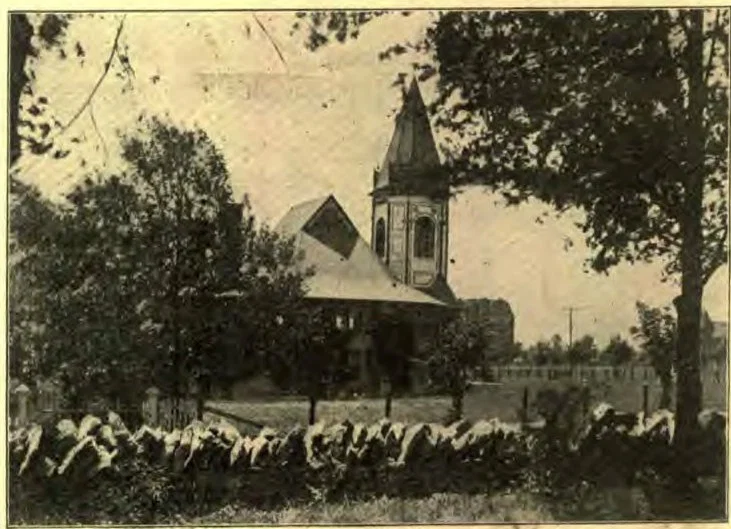
FISK MEMORIAL CHURCH (SIDE VIEW)
Jubilee Hall was erected in 1876, and cost over one hundred thousand dollars. It is 145x128 feet, five stories high, and contains dormitories for the girls, and the boarding department. The principal of the women's department has the oversight of this building, and an experienced woman is employed to look after the health of the young women, and to give individual advice.
Livingstone Hall, the second of the eight buildings comprising the Fisk University group, cost sixty thousand dollars, and is the gift of Mrs. Valeria G. Stone, of Malden, Massachusetts. It was opened in September, 1882, and contains one hundred and twenty large, well-furnished, and comfortably warmed rooms for men. In addition it has the chapel, study-room, library, museum, laboratory, classrooms, and the president's and treasurer's offices.
MAIN ENTRANCE — FISK UNIVERSITY
The Gymnasium and Workshop was erected in 1889, at a cost of five thousand dollars, through a legacy of a Mr. Howard, of Philadelphia, and other gifts.
In the fall and winter of 1890-91, a band of Jubilee Singers canvassed for funds for the erection of the fourth building, the African Missionary Association assisting, and in 1892 Theological Hall was erected, at a cost of twenty-five thousand dollars.
In the same year, through a legacy of General Clinton B. Fisk, the Fisk Memorial Chapel was built. It will seat one thousand persons.
The sixth building, the president's house, was built with money contributed by the widow of General Fisk, and Miss Mary F. Penfield, a teacher in the institute, who sold her home for two thousand dollars, and gave the proceeds to the building fund.
The seventh building, the Daniel Hand Model School, was erected in 1895, at a cost of five thousand dollars, the funds being contributed by the African Missionary Association, from the income of the Daniel Hand Fund. It is designed for the instruction of children under thirteen years of age.
Magnolia Cottage, the eighth building, containing four rooms, is the beginning of a hope for a “Department of Music.” It is used for instruction in music.
These eight buildings, with thirty-five acres of ground, and with the apparatus and furnishings, cost three hundred and fifty thousand dollars.
The most formidable obstacle encountered in the work of this institute is the extreme poverty of the colored people of the South; for the income of the institution falls short of its requirements.
The State of Tennessee provides sixty-six scholarships for colored men in the State, and each State senator has the right to appoint two men to scholarships during his two years of service. This scholarship enables a student from any recognized school to enter Fisk University on a credit of $6.25 a month of the total expense for board and tuition.
The library contains seven thousand one hundred and forty-two bound volumes, and a large number of periodicals, and is catalogued by the card system.
The faculty consists of seven regularly appointed professors, and twenty instructors, graduates of Northern universities.
The aim of the founders and supporters of the Fisk University has always been “to make its students strong, earnest, broad-minded Christian men and women, who shall give their lives to the uplifting and benefiting of their people;” and the result, so far, is that out of four hundred and nine graduates in the college and normal departments in the last twenty-five years, three hundred and nineteen have become college professors, teachers of high-grade schools, principals of normal or grammar schools, ministers, doctors, lawyers, or are still students in professional schools. Only ten remain yet at home, unprofessionally employed. W. S. CHAPMAN.

Just Where Thou Art

Just where thou art lift up thy voice, And sing the song that stirs thy heart; Reach forth thy strong and eager hand To lift, to save, just where thou art. Just where thou standest light thy lamp, 'Tis dark to others as to thee; Their ways are hedged by unseen thorns, Their burdens fret as thine fret thee.
Out yonder in the broad, full glare Of many lamps thine own might pale; And thy sweet song amid the roar Of many voices slowly fail; While these thy kindred wandered on Uncheered, unlighted, to the end. Near to thy hand thy mission lies— Wherever sad hearts need a friend.
—Isabel Darling.

“It Is My Way”

Sometimes one who professes to be a follower of Christ is heard saying, “You must not be surprised if I am rough, if I speak bluntly, if I manifest temper: it is my way.”
You ask us not to be surprised! Is not Heaven surprised at such manifestations, since the plan of salvation has been devised, since an infinite sacrifice has been made on Calvary’s cross, that you might reflect the image of Jesus? Will “your way” enter heaven? Suppose some one comes up to the pearly gates, and says, “I know that I have been rude and unkind, and that it is my disposition to lie and steal; but I want an entrance to the heavenly mansions.” Will such a disposition find entrance through the portals of the heavenly city?—No, no! only those who keep God’s way will enter there.
The manifestation of natural and cultivated tendencies to wrong-doing can not be excused by the plea, “It is my way.” Christians realize that in order to bring the principles of Christianity into the daily life, they need much of the grace of Christ.
The youth who co-operate with Christ will find that their way is full of errors needing to be corrected. Brought into the character-building, these errors are as rotten timbers. Let no one allow them to remain. Let no one plead for the privilege of clinging to his imperfections, excusing himself by saying, “It is my way.” Those who please self, refusing to give up their way for Christ’s way, will suffer the sure result. They will find themselves strengthless, Christless.
Are you striving to walk in the way of truth and righteousness? Then be not discouraged by temptation. True, you will be tempted; but remember that temptation is not sin; it is no indication of the Lord’s displeasure. He suffers you to be tempted, but he measures the temptation by the power which he imparts to enable you to resist and overcome. It is in the time of temptation and trial that you are to measure the degree of your faith in God, and to estimate the stability of your Christian character.
Do not say, “It is impossible for me to overcome.” Do not say, “It is my nature to do thus and so, and I can not do otherwise. I have inherited weaknesses that make me powerless before temptation.” In your own strength you can not overcome, but help has been laid upon One that is mighty. Breathe the prayer, “Show me thy ways, O Lord; teach me thy paths.” Then believe the promise, “The meek will he guide in judgment: and the meek will he teach his way.” Yes, the Lord says, “I will instruct thee and teach thee in the way which thou shalt go: I will guide thee with mine eye.”
In order to receive the virtue of the blood of Christ, even the forgiveness of your sins, you must consent to the conditions he imposes. “If any man will come after me,” he says, “let him deny himself, and take up his cross, and follow me.” Seeking pardon of sin from his cross, you will seek direction from his throne. Looking to and believing in Christ as your personal Saviour, is your only hope of salvation. Receiving Christ in all his completeness, you are in truth able to sing:—
“I will follow thee, my Saviour, Whereso’er my lot may be. Where thou goest, I will follow; Yes, my Lord, I’ll follow thee.”
God has given his Holy Spirit as a power sufficient to subdue all your hereditary and cultivated tendencies to wrong-doing. By yielding the mind to the control of the Spirit, you will grow into the likeness of God’s perfect character, and will become an instrumentality through which he can reveal his mercy, his goodness, and his love.
Whatever may be your defects, the Holy Spirit will reveal them, and grace will be given you to overcome. Through the merits of the blood of Christ you may be a conqueror, yes, more than a conqueror. Will you who read these words resolve never again to excuse your defects of character by saying, “It is my way”? Let no one again declare, “I can not change my natural habits and tendencies.” Let the truth be admitted into the soul, and it will work to sanctify the character.
Beholding Christ, we are changed through the power of the Holy Spirit. When this change takes place, the hands, the tongue, the feet, act in accord with the heart’s spiritual advancement. Faith is a shining light, shining more and more unto the perfect day. We no longer plead for our will to be done, or for our old ways and habits to be left undisturbed. The converting power of God molds us after the divine similitude,—after the likeness of the One who is “the Way, the Truth, and the Life.”
MRS. E. G. WHITE.

The Little Latch-Key

It was March and midnight. The air was full of driving sleet, and the streets were vacant. Not even the form of a policeman broke the monotony of slippery pavements glittering under the waving shadows of electricity. Presently a boyish form emerged from a dark corner, and crept slowly up the steps of a corner house. It was a large, handsome residence, now utterly dark and quiet.
What business had one to creep stealthily into that house at that hour? Was the boy a burglar?
He fumbled in his pocket, and drew forth a tiny key. Yes, it opened the door, and he stood within. The hall was dark, but warm. He moved eagerly to the register,—he seemed to know just where to find it,—and crouched shivering over its delightful warmth. After some moments he started up the stairs, oh, so carefully, lest there should be a sound. But the steps were padded and carpeted, and his old wet shoes sank into them noiselessly. At the head of the stairs he felt his way to the door. It was closed, and he hesitated, leaning against the frame, and breathing heavily. At last he laid his hand on the knob, then turned it a little. Was the door locked?—No, it swung open quietly, and the boy stepped in.
The street light shone upon a dainty bed all made, and turned open ready for an occupant. A dressing-gown hung on a chair near the bed, and a pair of slippers stood before it. The rest of the room was in darkness. The boy gave a great sob, and fell on his knees by the side of the bed.
No, he was not a burglar, only a sick boy stealing home under cover of midnight.
It was nearly two years since he knelt by that bed. His mother had died; he had thought his father stern and cold, so he had run away to live as he liked. Once in his miserable wanderings a much-forwarded letter from home had reached him. It contained no writing, just the tiny latch key to the home door. For months the little key had burned as it lay in his pocket. It had reminded him that, though a prodigal, he still had a home. It had reminded him of the Saviour whom his mother trusted, and in the time of his deepest distress he had said, I will trust him. Still he was afraid; but the little key had still lain in his pocket, and at last had drawn him home.
The next morning Mr. Kane opened his son’s door, as he always did since he had sent the latch-key. He expected nothing, but it had become a habit, so he opened the door. Did his eyes deceive him?—No, it was true. Ralph was in the bed asleep. The face was thin and worn. The father fell on his knees, and the boy opened his eyes.
“O father!” he sobbed, “I’ve come home to die. I’ve been wicked, wicked, wicked. Can you forgive me?”
“Indeed I can. And God—have you asked his forgiveness?”
“Yes, and I wanted to tell you before I die.”
“Die!” said the father, gathering him into his arms. “No, indeed.”
“The doctor at the hospital said that I would not live long.”
“We’ll see about that,” said Mr. Kane, stepping to the ’phone.
When the family physician had looked Ralph over, he smiled. “The hospital doctor knew that you had little chance wandering about with no care,” he said, “but we’ll send you off to Florida; and if you lead a sensible, pure life, you’ll live to be the stay of your father’s old age.”
When the physician had gone, Ralph turned to his father. “I’m so glad you sent the latch-key. I never would have come home by daylight. But when I was out in the cold, wet night, I could not resist the comfort at the end of that key,” he said.
“It was God who gave me the thought, my boy. I asked him what to do.”
“How good God is!” replied Ralph.
“And you have your whole life before you in which to show your love for him,” replied the father.—Selected.

The Secret of a Quiet Heart

THE secret of a quiet heart is to keep ever near God. Stayed on him, we shall not be shaken, and our “hearts shall be fixed, trusting in the Lord.” We get above the fogs when we soar to God, and circumstances in their wildest whirl will not suck us into the vortex if we are holding by him, and know that he is at our right hand.—Alexander Maclaren.

The Brave “I Will”

AMEN to the effort that says “I will,” Whoever the boy with a purpose high; Amen to the spirit that dares fulfill The promise that glows in a brave “I’ll try.”
Wherever the runners their race begin, Few goals can be won at a single bound. Success to the boy with a mind to win, Contented if only he’s gaining ground.
Then up with a purpose for every day, An earnest look toward the sun-crowned hill— A prayer for endeavor that wins its way. Amen to the effort that says, “I will.” — Frank Walcott Hutt.

Casabianca: The Boy Who Stood on the Burning Deck

Casabianca

THE history of the hero of the poem beginning, “The boy stood on the burning deck,” is not generally known, yet the tragic story has thrilled the heart of many readers, both old and young, and not a few have wished to know more of him. A few years ago the following was prepared for the Morning Star, by Mr. F. M. Colby:—
“Owen Casabianca was a native of Corsica, on which island he was born in the year 1788. His father was Louis Casabianca, a distinguished French politician, and naval commander, and the friend of Napoleon, who, you will remember, was also a Corsican. He was, at this time, captain of the ‘Orient,’ one of the largest vessels in the French navy, a magnificent ship of war, carrying one hundred and twenty guns and five hundred seamen.
“Of Casabianca’s mother we know little save that she was a young and beautiful Corsican lady, and devotedly attached to her son. Owen was her only child, a handsome, manly little fellow, with her beauty in his flashing eyes and dusky hair. She died while he was yet very young; and when the green sod was placed above her grave, the boy left the pleasant valley under the smiling hills of Corsica to go with his father, and tread the hard deck of a war vessel.
“Mere child as he was, Casabianca soon grew to love his father’s dangerous calling, and became a favorite with all on board. He was made a midshipman, and at the early age of ten years participated with his father in the battle of the Nile.
“The ship caught fire during the action. Soon afterward Captain Casabianca, the father, was wounded by a musket ball. Not yet disabled, he was struck in the head some minutes later by a splinter, which laid him insensible upon the deck.
“His gallant son, unconscious of the chieftain’s doom, still held his post at the battery, where he worked like the hero he was. He saw the flames raging around him, and the ship’s crew deserting him one by one. The boy himself was urged to flee; but with a courage beyond his years he refused to desert his post. Worthy son of Louis Casabianca, he fought on, and never abandoned the ‘Orient’ till the whole of that immense vessel was in flames. Then, seeking refuge on a floating mast, he left the burning ship behind him.
“But it was too late. With an explosion so tremendous that every ship felt it to the very bottom, the ‘Orient’ blew up, and from among the wreckage the next morning was picked up the mangled body of the young hero whose story romance and poetry can not make more heroic than it was.
“His tragic fate has been related in millions of homes, and the father’s glory has been overshadowed by that of the son’s brave, faithful heart. He rests now far beneath the waters in that classic sunset land; and it may be that the rushes of the Nile whisper his requiem where they tremble in the fragrant Orient breezes that sweep from the Midland Sea. And who shall say that it is not a noble grave?”
MRS. J. A. CORLISS.

Smoking Made Easy

I once knew a little boy who decided to run away from home because he did not want to chop any more wood. It had never occurred to him that it was not the proper thing for him to chop the wood, until another boy gave him the erroneous information that he was being imposed upon, as his father was amply able to hire it done. So he frankly told his mother that she would get up some morning, and find him gone. Good, sensible mother that she was, she did not want her boy to undertake such a disagreeable task alone, so she told him that of course she did not want to part with him, but if he had really decided to run off, he would better go in the daytime, and she would help him get ready to start. Then he would not be ashamed to come home, being assured that they would all be glad to see him at any time.
“PLEASANT TO THE SIGHT, AND GOOD FOR FOOD”
A boy does not always realize how much his mother is willing to do for him if he will only make her his confidante. This boy seemed much surprised at his mother’s manifestation of kindness under the circumstances, even offering to pack his satchel; and it may not be surprising to learn that he finally decided that he would rather chop wood occasionally than be deprived of the companionship of such a kind and loving mother. That surely was a very wise conclusion, although his mother showed him a much easier way to run off than he had ever dreamed of.
Some way, so many times when a boy wishes to enter into some new experience, he prefers to undertake it alone, rather than have his mother know anything about it. But surely this is not the easiest way; while the common practice of confiding in some boy friend can not possibly result in the receiving of any valuable assistance.
Boys, if you think of doing anything that you really do not want your mother to know about, you may be pretty sure there is something wrong about it, and that you will never be any better off by the doing of it. Whenever a boy is confronted by such a temptation as this, he needs help; and he will find the easiest way out of the difficulty by telling his mother all about it. It is sometimes surprising how, with the help of a true Christian mother, a boy may realize success from what would seem an inevitable failure.
So if you really decide that you are going to learn to smoke, be sure to tell your mother. Then when you get sick,—everybody gets sick when learning to smoke,—you will have somebody to sympathize with you. And, too, your mother will know that you have tobacco poisoning, and she or some good physician will know what to do to get you over it. You see, if you did not tell her beforehand, you might be ashamed to tell her the cause of your illness. Then no one would know what to do for you, and you might suffer severely, and possibly die, as the result of your experiment.
Of course I do not wish any boy to understand that I am advising him to learn to smoke; for I am not. Smoking ruins the health, and besides, it calls for the expenditure of a great deal of money. Many of you would have to work hard—perhaps chop wood—to get money enough to meet this useless expense. As the result of smoking, you might have cancer of the mouth or throat, or you might become a confirmed invalid on account of organic heart disease or nervous prostration. So I am not recommending you to learn to smoke; but if you really decide that you are going to do so at the risk of money, health, and life itself, then be sure to choose the easy way by telling your mother about it.
MRS. M. A. LOPER.

“I Was Wrong”

ROBERT flung himself out of the door noisily and angrily, and started down the street. His heart was full of bitterness and resentment. He was deeply disappointed, and the refusal of his request seemed to him unreasonable.
Inside the house, a soft-eyed little woman was standing at the vine-trellised window, looking after him sadly enough.
To herself she was saying, “My dear Rob! He didn’t mean to hurt me so. He will understand some day that mothers can not always say ‘Yes’ to a boy’s demands. We must do what is best—but sometimes it is very hard.”
Then she turned away, and, as was her wont when deeply disturbed, opened her piano. Softly and sweetly she sang one after another her favorite melodies—all her soul in her voice, for her heart was full of tears. It was a mellow voice of appealing sweetness and tender charm.
Robert had gone but a short distance before he met a companion.
“Where are you going?” his friend asked.
“Nowhere in particular.”
“Then let’s walk back to your yard. I want to talk to you about something.”
On the far end of the lot was a shaded retreat where the slightly rolling ground was covered with green grass and protected by shrubbery. Here the boys threw themselves down to chat.
“Rob, I think the time has come for me to leave, and look out for myself. I’ve been thinking about it a good while. You know how it is, I guess, at the place I call home. A fellow can’t complain, and maybe I am some to blame, but—well, it’s not like yours. Then there was a pause.
Robert’s heart smote him, and his companion’s voice was thick and choked with emotion as he presently continued. “It was not that way before mother died, but now—O Robert, when I remember some things,—the hateful things I used to do and say,—I would give the world if I could take it all back again. She was sweet and reasonable, like your mother. She always makes me think of her whenever I see her.
“I was such a hasty-tempered, stubborn fellow, and she had such patience with me. She understood me, and she always stood between me and the trouble I made for myself, saying it would be different when I got older, and could understand that I made more sorrow for myself than any one made for me.
“Well, I begin to understand it now; for whenever I get over my tempers, and see a thing as it is, I hardly ever find it just as I thought it at first. Remembering that has helped me to hold myself level, and to pray for more patience and knowledge.
“Mother said it would all come right in time, and she was so patient! But the older I get, the more I understand what a real mother she was, and how she hated to cross me when she had to. And to think that I——” But he could say no more. Through all their conversation they had been dimly conscious of music, but now clearly and plaintively came the strains of a prayer for consolation adapted to the exquisite music of “The Angels’ Serenade,” once heard, never to be forgotten, and it touched the deeps of his nature. His tears fell, and Robert felt his own heart full.
They had long been friends, and, though no complaints had ever been made, Arthur having the reticence of a manly boy, Robert knew something of the hard conditions of his life, and now, for the first time, realized his loneliness as well. He could think of no words that would express his sympathy.
There was silence for quite a time. Finally the music ceased, and they took up conversation again, but this time to discuss plans as yet but partially formed in Arthur’s mind.
But now, in spite of his interest in his friend, Robert’s thoughts were beginning to wander. He felt an irresistible impulse toward his mother. His heart was softened, and his cheeks burned with shame as he remembered his disrespectful words, and his rudeness to that tender mother, the very best and dearest thing on earth to him. He longed to tell her all that he felt and to ask her forgiveness.
For there is just this difference between a low and a high nature: that the one refuses to admit its fault, and is ashamed to confess error; while the other can not rest until it has set matters right, and said, “I was wrong; I am sorry.”
Presently the boys parted. Robert leaped up the steps, and rushed joyously into his mother’s presence with an overwhelming sense of gladness.
“Mother! Mother!”
“O Robbie! I knew you would come! I hoped you would understand! God is good!”—Selected.

October Study of the Field

Suggestive Program for Young People's Meeting

(October 5-11)
SONG SERVICE.
Prayer.
Responsive Scripture Reading—Revelation 14.
Song—Hymns and Tunes, 1055.
Our Matabele Mission (a paper).
The Malaysian Field (a paper).
The Apostle to the Indians of British Guiana (a talk).
Song—Hymns and Tunes, 1263.
History of the Third Angel's Message in the Cook Islands (a paper).
Work among the Women of India (a talk).
The Missionary Campaign, or Every One a Part in This Work (a talk by the leader. For notes, see Review and Herald, September 16, page 24).
Closing prayer for the work.
Song and benediction.
NOTE.—There is an abundance of material this month which may be used as the basis of a most excellent missionary meeting. No society need confine itself entirely to the subjects suggested in the program. Any one of them would provide sufficient matter for an hour's service. Besides, many other fields are mentioned. Above all, endeavor to enlist as many on the program as possible. If there is one who does not study the field, ask him to present the subject of the “Apostle to the Indians of British Guiana,” or the “Story of our Matabele Mission,” telling him where to find the material for his talk or paper, and you will find his interest growing. The study of the field each month should serve to extend our vision of the great work intrusted to us, and stimulate to earnestness of preparation, that soon all our powers may be used in giving this last message in the most needy fields.
If the church has not adopted the use of the weekly offering envelopes suggested in the article “The Missionary Campaign,” Review and Herald, September 16, page 24, the Young People's Society might take the initiative. The Mission Board will be glad to supply a sufficient number of these so that every young person may have one every Sabbath. E. H.

This Page

Belongs to our young people. It is your page, dear young friends, all you who are doing something, whether near or far, to give to the world the advent message in this generation. It does not matter whether you are working in an organized company or “all by yourself,”—if you are working, if you are sowing, the Lord of the harvest will give fruit, and you will receive a blessing. Then tell it—write a report of your work, of its results if any are seen, of the influence that your efforts for others have had on your own experience. What you say will be a help to others, an incentive to them to do likewise; for the influence of helpfulness does not cease with the performance of the first act, but increases, in ever-widening circles of blessing and helpfulness.
We know there are hundreds of young people who are interested in this work, who are giving their time and best efforts to carrying it forward. Now we want to hear from them. Perhaps you are of the number. Will you not do your part to encourage and cheer and inspire other young people, who would like to work, but yet feel that they do not know how to begin, by telling them how you began, and what you are doing?
Do not put this matter off. Think what has helped you, write it out, and send it to the INSTRUCTOR for this department.

The Unseen Witness

The gospel declares the abolition of secrecy. “No man saw me do it,” says the sinner. “It was only a thought. I would not dare to express it. I did not express it. No one knows that I cherished it.” “It was only a desire. I have not done the thing. No one knows.” “I did it in the dark. It will never be found out.”
Not so. No public act of our lives was ever so open, or under such universal observation. What do the unseen spectators care for the drama of our acts? They watch the battle-ground of the inner life. When once evil has conquered there, the evil act will follow in its course.
We may be sure that it is precisely that part of our life which we deem secret, and in which, therefore, we tolerate what we could not endure that men should see, that interests God and the unseen witnesses. They see most clearly and watch most acutely, what we think we have hidden from all sight.—Robert E. Speer.

Why Study the Field?

As young people, especially, we need to be thoroughly informed with reference to the progress of the third angel’s message in the world. “Facts carry with them inspiration.” Why are we not more thoroughly awake to the cause that should be nearest our hearts—the giving quickly of this message to all the world? Why, with so many open doors, are we not able to enter, and answer the Macedonian cry? Is it not because we do not know the needs—because we are not more thoroughly informed?
There are many ways of gaining a knowledge of this work. A visit to the field would certainly enlarge our vision, and give us a clearer view of our duty. But few, except those who have already studied the field, and been aroused to its needs, and with consecrated lives go to answer that need, have the privilege of going. The instruction from one who has visited the field and seen the need, brings a knowledge of the work to some, and touches their hearts. But all do not have that privilege.
There is one method by which we can not fail to deepen our interest in the world-wide work, and that is, read,—read every article and every report from missions that appears in our own papers, or any others to which we may have access. We should allow no information to escape our notice.
The giving of the gospel of the kingdom quickly to all the world is the only work to which we as young people should devote ourselves. It should be the absorbing passion of our lives. No other plan should be allowed to supersede it. When this message has been preached to all the world, our work here will be finished, whether we have had a part in giving it, or have been engaged in some selfish pursuit.
Study, pray, and give. No one will engage in any one of these exercises without engaging in the other two. Begin where you will, the one will lead to the rest. The young person who does this will very soon be led to consecrate himself to the greatest work ever intrusted to human beings,—the giving of the third angel’s message to every nation, kindred, tongue, and people,—and he will be among those who with rejoicing will come to meet the Master on his return, bringing their sheaves with them.
E. H.
Continue reading: October Life Boat to Feature Home and Purity