The October number of The Life Boat will be by far the most important one ever issued. The August number was a fifty-five thousand edition. This October number will probably attain a circulation of seventy-five thousand. It will be a Home and Purity number, and will have contributions from such well-known writers as Dr. Mary Wood-Allen, Dr. and Mrs. J. H. Kellogg, Lucy Page Gaston, A. T. Jones, Eva Shontz, Mrs. W. S. Sadler, Fannie Emmel, and others. It will contain interesting and inspiring accounts of homes that have been reunited by the gospel. It will also have a children's department, in which will be told something about what the children are doing for The Life Boat.
Why not send for a liberal quantity at two cents each, and circulate them among your friends? See that your county jail, poorhouse, and other public institutions are supplied, as well as the homes of your neighbors.
Address The Life Boat, 28 Thirty-third Place, Chicago.
Getting the Answer
By Viola E. Smith
My grandma’s hair is almost white,
And it seems hard to realize
That it was once as brown as mine,
And bright and youthful shone her eyes.
Such curious things they used to do,
When she was just a schoolgirl small;
The schoolrooms then were low and dark,
No lofty or ornamented wall.
A row of benches lined the side,
And all day long, early and late,
My grandma sat and read and spelled,
And “did her sums” upon her slate.
She says a triumph sweet was hers,
And in her heart a rare delight,
When, after toiling long and hard,
At last she “got the answer right.”
She tells me many a problem hard,
Upon life’s page will meet my sight,
And if at last I hear, “Well done,”
I’ll know I “have the answer right.”
VIOLA E. SMITH.
A Chapter from the Life of a Meadow Spider
By Floyd Bralliar
As a child, I played with many spiders, though I have never really “made friends” with but one. When I was ten years old, we were making hay about two miles from home, taking our dinners with us. All I could do was to ride a horse to drag in the haycocks; and so when there was a stack to top out, I had nothing to do. In southeastern Iowa there is a large meadow spider that is very beautiful. It is yellow and golden, dotted with green and barred with jet-black, with legs as black as a raven’s wing.
One of these, and one of the largest that I have ever seen, had made her web behind the haystacks in the fence corner where I liked best to rest. There was a reason for her choice, as I soon found out. During the night, hundreds of grasshoppers would climb on these stacks; and in the morning when we began work, they would jump off, many of them tumbling right into her nest. She had a very large net, with a spread of fully ten feet, and she always sat in the middle, so that she could see all that was going on. Her several husbands were compelled to stay at the edges.
Every meadow spider has from three to a dozen husbands; but they look so different from her that many people fail to recognize them as of the same species. They are not one tenth as large as she, although their legs are nearly as long. In color they are a dull-brown—it is a very old one that has any bright colors. Their mistress reserves the right to wear all the finery, and to rule the household, but in return for this they let her do all the work. Occasionally one will help a little, but usually, like the lazy fellows they are, they contentedly eat the food she has worked to get.
Whenever by mishap a grasshopper fell into the net of my meadow spider, no time was lost. The net was strong, but what was that to an unchained grasshopper? So while he was struggling, the old spider would run down, and keeping out of the way of his legs, would wind web after web around him till he could not move. Then she would suspend him by a thread, cut him loose from the remainder of the web, repair the web, and again station herself in the middle. But though she worked quickly, she did not capture all of them, by any means. Often her victims would escape, leaving her a half-hour’s work repairing her net, and not a grasshopper to show for her pains.
AND “DID HER SUMS” UPON HER SLATE
By and by I began throwing grasshoppers into her net. At first she resented this, and paid no attention to them. Soon she began to capture all I threw in; and then, as she was so well supplied, she began cutting off and dropping those that had begun to decay. We worked there over two weeks, and she finally became so tame that she would take grasshoppers out of my fingers. That is to say, I would hold the grasshopper in the net so that he could not kick and break it, and she would come down and spin threads around him till he could not move, when he was hung up for a future meal.
Spiders are very careful of their web; and if one becomes broken, they often wind it up into a ball, which they carry till they have occasion to use it again. When one drops on a strand, as from a tree, he almost always takes the cord up again when he returns.
My spider came to look for me; and if I paid no attention to her, she would immediately begin to shake her web, and would soon be swinging back and forth so furiously that she could not but attract notice. I have often seen these spiders do this for other reasons; but I know she was trying to attract my attention, for if she apparently failed, she would run about from place to place on the web, and signal again, and really become quite excited. When I finally noticed her, she showed her pleasure quite plainly. I never tried to handle her; for I had been taught that the bite of a spider is poisonous. I know now that she was harmless.
Only an all-wise God could give so much wisdom to so little and despised an insect. Truly his ways are past finding out.
FLOYD BRALLIAR.
Hallie and the Fluttering Heart
By Edith O. King
Hallie
HALLIE’s cheeks are not pink and dimpled. She is a little colored girl, with a very black face and short, woolly, black hair. She is a happy little girl, however, for she loves Jesus.
Her soft, dark eyes sparkle and shine as she sings her favorite song,—
“I am Jesus’ little lamb,
Happy all day long I am,
He will keep me safe, I know,
He will wash me white as snow,
For I’m his lamb.”
Hallie’s kindergarten teacher, Miss Ada, said to her class, one Sabbath: “Each of you place your hand on your chest as I do. Do you not feel a fluttering there? That is your heart beating. The motion you feel is the blood passing into your heart and out again. It goes to every part of your body, and keeps you alive. God never forgets you for one minute. He is always watching over you, and it is he who makes your heart beat. Even when you are asleep, he is near you, keeping you alive. He says that he ‘neither slumbers nor sleeps,’ but lovingly watches over you night and day.”
It was something new and startling to Hallie to feel her heart beat. She had never before noticed that wonderful throbbing within her breast.
The next Sabbath, Hallie’s mother told Miss Ada that she had been a brave little girl all the week. She had overcome one of her gravest faults. For some reason, though she never knew why, Hallie always had been afraid to stay alone in the dark. A light had to be left burning in her room every night. They had tried many times to quiet her fears; but when the light was taken out, she was so frightened that it had to be brought back.
The evening after her lesson, when her mother kissed her good-night, Hallie said: “You need not leave the light, mama; I am not afraid any more. Miss Ada told me to-day that if ever I was tempted to be afraid, to put my hand over my heart; and when I felt it beating, I would know that Jesus is right there with me to keep me alive. Nothing can hurt me when Jesus is near,310so I am not going to be afraid any more.”
Hallie goes to sleep now in the dark room with her chubby little hand laid over her heart; for she says, “I know that Jesus is with me.”
EDITH O. KING.
China’s High Priest
By J. N. Anderson
The case of Melchisedec affords a very remarkable example of an earthly priest-king. He was king of Salem, or Jerusalem, and at the same time “priest of the most high God,” showing that he acted for the people in a twofold capacity,—as temporal ruler and spiritual intercessor. For that and other reasons he was set forth as a type of Christ, who is also both Priest and King.
The emperors of Rome never failed to associate with their other high-sounding titles that of Pontifex Maximus, which ascribed to them the religious headship, as well as the civil supremacy, of the entire Roman world. The emperor thus became the father of the people, and the embodiment of all temporal and spiritual authority and power, identifying the church with the state.
This same authority has been exercised by the sovereigns of China from time immemorial. At the very time when Abraham met Melchisedec, and by the payment of tithes recognized him to be God’s priest-king, the emperors of this ancient nation acted for their subjects as both king and high priest.
As might be expected, this prerogative invested the emperor’s person with an almost unapproachable sacredness. Touching the great mass of common gods with which China abounds, the emperor has power to make and unmake them at his pleasure; but in the presence of Shang Ti, the supreme ruler of the universe, too great and too sacred for ordinary mortals to approach, this high priest of China prostrates himself in self-surrendered humility, confessing himself a subject of law, and therefore responsible for the exercise of his authority. The emperor is thus virtually a monotheist; for, while he does worship at other shrines, it is only to Shang Ti that he approaches as a humble, responsible servant. And that he is Shang Ti’s vicegerent is seen by the fact that while others may worship Shang Ti, yet the emperor alone is allowed to make use of the prescribed ritual. An attempt on the part of any other person to imitate that ritual would be regarded an act of high treason, having for its object the overthrow of the throne and the sovereign.
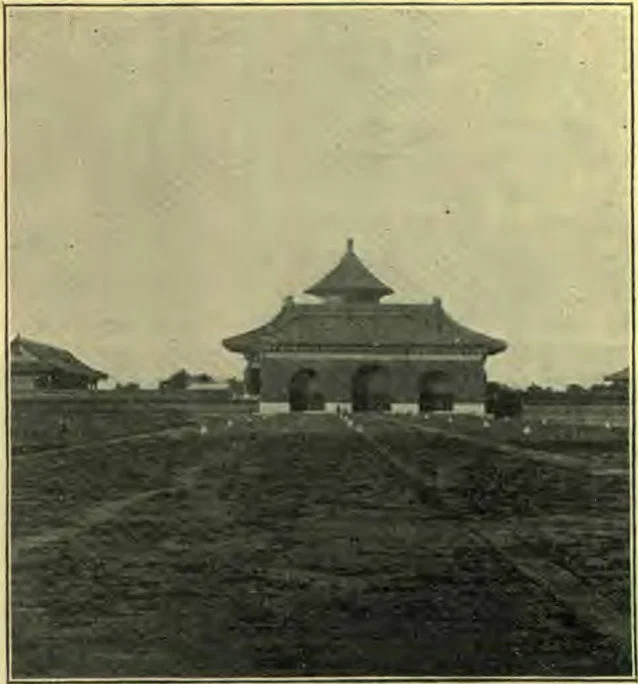
Since both the emperor and this service are so very sacred (too sacred for profane eyes), all foreigners are officially invited to be absent during the service, although at other times both the altar and the temple are accessible to foreigners. This Altar of Heaven and Temple of Heaven are said to be in some respects the most sublime structures built by human hands. They stand within the gates of the capital, surrounded by a sacred grove sufficiently extensive to insure a profound silence as the high priest performs his service. The Temple of Heaven “consists of a single tower, whose tiling of resplendent azure is intended to represent the form and color of the aerial vault. It contains no image, and the solemn rites are not performed within the tower; but on a marble altar which stands before it, a bullock is offered once a year as a burnt sacrifice, while the master of the empire prostrates himself in adoration of the spirit of the universe.” This is China’s most holy place, and this occasion is to the whole empire much the same as the day of atonement was to the Hebrews.
When the Tai-ping rebellion was at high tide in 1853, the Emperor Hsien Feng proceeded to the Altar of Heaven, where, having first confessed his own sins, he made intercession for his suffering people, imploring the Ruler of the universe that peace might again prevail. In the same capacity, Emperor Kuang Hsu officiated at the same temple on Dec. 22, 1887, having on the preceding day visited the temple accompanied by the grandees of the court, three elephants drawing as many chariots gracing the procession. He spent one whole night in fasting and meditation as a preparation to approaching Shang Ti, before whose name, inscribed on a tablet, he prostrated himself nine times, and also offered an ox, whose bones were consumed in a furnace.
How thankful we should be that we not only know that the true God of heaven has opened a way for each one of us to approach him personally, but also that he has by his holy word and Spirit caused us to know the way of access, and respond to his gracious invitations. Our Great High Priest, from whom all our blessings flow, is Jesus of Nazareth, who ever lives to make intercession for us. J. N. ANDERSON.
Things to Remember about Japan
1. JAPAN is about the size of California.
2. It is a beautiful country, and so mountainous that not more than one tenth is under cultivation.
3. There are more than forty-five million inhabitants, or more than in Great Britain or France.
ONE VIEW OF THE ALTAR OF HEAVEN
4. The population is rapidly increasing without immigration.
5. The government is a constitutional monarchy. Suffrage is limited by property qualifications. The country is well governed.
6. Japan has all the scientific machinery and inventions that mark modern civilization.
7. It has an excellent school system, with eighty-one per cent of the boys and fifty-one per cent of the girls under instruction.
8. Heathenism is still strong in Japan.
9. The people are without Christ, “walking in the vanity of their mind, having the understanding darkened, being alienated from the life of God through the ignorance that is in them, because of the blindness of their heart.”
10. Roman Catholic missionaries entered about 1550, and were expelled in 1597. Protestant missions began in 1859, the first convert was baptized in 1864, the first Scripture portion published in 1871, and the first church organized in 1872.
Whom Shall We Thank?
A LITTLE boy had sought the pump,
From which the sparkling water burst,
And drank with eager joy the draught,
That kindly quenched his raging thirst.
Then gracefully he touched his cap—
“I thank you, Mr. Pump,” he said,
“For this nice drink you’ve given me.”
(This little boy had been well-bred.)
Then said the Pump: “My little man,
You’re welcome to what I have done;
But I am not the one to thank—
I only let the water run.”
“O, don’t thank me; for what I am
(Polite he always meant to be),
“Cold Water, please accept my thanks;
You have been very kind to me.”
“Ah!” said Cold Water, “don’t thank me;
Far up the hillside lives the Spring
That sends me forth with generous hand
To gladden every living thing.”
“I thank thee, Spring, then,” said the boy,
And gracefully he bowed his head.
“O, don’t thank me, my little man,”
The Spring in silvery accents said.
“O, don’t thank me; for what am I
Without the dew or summer rain?
Without their aid I ne’er could quench
Your thirst, my little boy, again.”
“O, well, then,” said the little boy,
“I’ll gladly thank the rain and dew.”
“Pray don’t thank us: without the sun
We could not fill one cup for you.”
“Then, Mr. Sun, ten thousand thanks
For all that you have done for me.”
“Stop,” said the Sun, with blushing face,
“My little man, pray don’t thank me.
’Twas from the ocean’s mighty store
I drew the draught I gave to thee.”
“O Ocean, thanks!” then said the boy—
It echoed back: “Not unto me,—
“Not unto me, but unto Him
Who formed the depths in which I lie—
Go give thy thanks, my little boy,
To him who doth thy needs supply.”
The boy then took his cap, and said,
In tones so gentle and subdued:
“O God, I thank thee for the gift—
Thou art the Giver of all good.”
— Selected.
To the Girl Who Would Be Loved
If we want to be loved, we must love. Love God who made us, and gave us the inestimable privilege of life in this wonderful world of opportunity. Love the parents and brothers and sisters and friends with whom God has surrounded us. Love our home, love our church, love our school, love our work, love everybody and everything. Don’t say you can not do this. Say you will try. Make a beginning. Love is magnetic, it is life-inspiring. To a girl who loves much, much will be forgiven,—plain looks, poverty, lack of brilliancy, of accomplishments, lack of grace. The girl we like best is not the girl who can do everything and say everything better than anybody else. Truly, truly, as Henry Drummond tells us, Love is “The Greatest Thing in the World.”
If you have a true, loving heart, you will be loved. If you are not loved, if people shun you, and stop their familiar chatter when you appear, then you know why. If you plant the seed of love in your heart, and tend it well, so that the beautiful flowers will blossom in your character,—patience, kindness, good temper, unselfishness, courtesy, sincerity, humility,—you will be as welcome as sunshine wherever you go.—Selected.
Little Children Can Overcome Their Foes
By F. B. Meyer
LITTLE children can overcome when there is in them a Stronger than their foes.—F. B. Meyer.
Funeral Procession of Li Hung Chang Leaves Peking
The body of Li Hung Chang, in a coffin borne by sixty carriers, and accompanied by a military and religious procession, left Peking, June 1, for the ancestral home of the deceased statesman.
Bookkeeping at Home
The Quickest; the Best
A FULL course in “Fireside Accounting” by our correspondence method for $3.
One valuable feature given in the Examination Set is a Special Column Journal showing how the transactions common to any family may be accurately and easily recorded by the Double Entry method of bookkeeping.
A certificate is given when the course is completed.
Solicitors engaged on commission or salary.
For particulars address—
FIRESIDE ACCOUNTING INSTITUTE,
29 N. Washington Ave., Battle Creek, Mich.
5. What is said of the throne of the Ancient of days? What chapter in Ezekiel further describes the wheels?
6. How many ministered before him?
7. What is there to show that verses 9 and 10 describe the judgment?
8. What books were opened? Read Rev. 20: 12. From this verse notice that the dead are judged out of those books which record their works, and that another book was opened, which is the book of life.
9. What is to be done with all those whose lives are not written up in this book? Verse 15.
10. What did Daniel see happen to the beast which had the little horn? Rev. 19: 20 says the same thing.
11. What called his attention to this beast?
12. What other references in this chapter are made to this?
13. What happened to the other beasts?
14. Whom did Daniel next behold in vision?
15. To whom did the Son of man come?
16. What three things were given to him?
17. How do the dominion and kingdom of this king differ from all other kingdoms and powers?
18. How did this scene affect Daniel?
19. What especially troubled him?
20. How did he seek for an explanation?
21. What did the angel do for Daniel?
22. What did he say of these four beasts, about which we have been studying?
23. Who finally takes the kingdom?
24. How long will the saints keep that which they take?
Are you getting ready to take this kingdom?
Note
Babylon took the kingdom, but could not keep it; Medo-Persia did the same; Grecia likewise failed, and also Rome. The kingdom is now in the hands of all nations, and from these it is to be taken by the saints of the Most High. What the power of all other nations has failed to do, the people of God are to do by the power of faith. 1 John 5: 4.
MEMORY VERSE: “Commit thy way unto the Lord; trust also in him, and he shall bring it to pass.” Ps. 37: 5.
(The chapter given as the Lesson Scripture is the lesson to be studied. Read this every day, and think over it until you know just what it teaches. Then the following notes, which should be read several times, will help to a fuller understanding of the lesson. Lastly, go over the questions carefully, and be sure that you can answer each in the words of Scripture.)
Although Esau did not love God, but cared only for the things of this world, his father Isaac was determined that he should have the blessing and the birthright that God had given to the seed of Abraham. Even when Esau married idolatrous women of the land of Canaan, Isaac did not change his mind. Esau was his favorite son. We are told that he loved Esau because he brought him “savory meat.” It may be that this was what clouded Isaac’s mind, and made him for a time go against the will of the Lord.
But their mother Rebecca remembered the words of the angel before the twins were born,—that the older (Esau) should serve the younger (Jacob). She knew from the character of the two as they grew to manhood that God meant Jacob to have the birthright. But instead of trusting God to give it to him in his own time and way, she was afraid that he would lose it altogether when she heard Isaac making plans to bless Esau. So she thought that she was doing a good deed, and saving her husband from going against the will of God, when she deceived him as she did.
The name Jacob means “supplanter.” This name showed that it was Jacob’s nature to try to get good for himself at the cost of others. In this matter he thought that he was but carrying out the will of God. But both Rebecca and Jacob suffered much for their mistake. Because of it they had to be separated, and we are not told that they ever met again. Besides this, it laid a sin upon Jacob’s conscience that he bitterly repented of in after years.
In the blessing that Isaac gave to the son that he thought was Esau, he said: “Be lord over thy brethren, and let thy mother’s sons bow down to thee.” This was just what God had before said about Jacob, and Isaac was really only confirming the words of the angel about Jacob, when he thought he was speaking of Esau. This shows how useless it is to try to change the mind of the Lord, or to keep his word from coming to pass.
The Holy Spirit of God rested upon him as “by faith Isaac blessed Jacob and Esau concerning things to come,” and nothing could alter the blessing that he put upon them. In our lesson last week we learned that “Esau despised his birthright,” and so God took it from him. He had been willing to sell it for a “morsel of meat,” and “afterward when he would have inherited the blessing, . . . he found no place of repentance, though he sought it carefully with tears.”
Questions
1. What was Isaac determined to give Esau? How might he have known that God meant the blessing of the firstborn to be given to Jacob?
2. What did Isaac tell Esau to do when he was going to bestow the blessing on him? Who heard what he said to Esau? Tell how she tried to prevent it. Gen. 27: 1–10.
3. What made Jacob think that his father would find him out? Verses 11, 12. What did Rebecca tell him to do to make himself seem to be Esau?
4. What difference did Isaac notice when Jacob went in to him? Verse 22. How was he deceived? Verse 23.
5. What blessing did Isaac give to the son that he thought was Esau? Verses 28, 29.
6. What did Esau do when he found out what Jacob had done? Verse 34. Was it possible to change the blessing? Verse 33, last part; Heb. 12: 17.
7. What did Isaac say about Jacob? Verse 36. What had God said about Jacob, that Isaac repeated in the blessing?
8. Was Esau left without a blessing? Verses 39, 40.
9. What did he determine to do when his father was dead? Verse 41. What plan did his mother make to save Jacob’s life? Verses 42–46.
Growing More like Jesus
By Eva Williams Malone
Am I growing more like Jesus,
As the days and years go by—
Do I feel his gentle Spirit,
Do I catch his purpose high?
Am I each day more forgiving
To him who hath wrought me ill?
And when anger burns within me,
Can my hasty lips be still?
Do I think of those forgotten
By the world in its mad race?
Do I seek the souls that wander
Without home or resting-place?
Do I tell them there is comfort
Where they ne’er have sought before?
Could I e’er forget this message,
Were I like him more and more?
MEMORY VERSE: “God shall judge the righteous and the wicked.” Eccl. 3: 17.
Questions
1. What scene is next presented to Daniel in his vision? What chapter in Revelation records the same scene?
2. What name is given to the One who sits as Judge? How appropriate is his name? Ps. 90: 2.
3. What exalted description does Daniel give of the appearance of the Judge?
4. Where in Revelation is a similar description given? See also Dan. 10: 5, 6.
Resting at His Feet: A Poem on Waiting
“Christ never asks of us such busy labor
As leaves no time for resting at his feet;
The waiting attitude of expectation
He oftimes counts a service most complete.”
SOLID THROUGH TRAINS OF
WIDE VESTIBULE COACHES and PULLMAN SLEEPING CARS BETWEEN
Battle Creek and Chicago, Buffalo, New York, Philadelphia, Toronto, Montreal, Boston
Toronto, Montreal, Boston
For time-tables, descriptive matter, and information, apply to any representative of the company.
SENT ON THREE DAYS' TRIAL FREE! THE CO-RO-NA MEDICATOR CURES CATARRH
By E. J. Worst
TWO-THIRDS ACTUAL SIZE.
Head-Colds, Pains and Roaring in the Head, Partial Deafness, Sore Throat, HEADACHE, La Grippe, and all Diseases of the air passages by inhalation. The most perfect appliance ever offered.
SPECIAL OFFER.
For a short time I will mail to any reader naming this paper, one of my new improved CO-RO-NA MEDICATORS, with medicines for a quick home cure, on three days' trial FREE. If it gives perfect satisfaction, send me $1.00 (half price), if not, return it at the expired time, which will cost you only three cents postage. Could any proposition be fairer? Address,
E. J. WORST,
16 ELMORE BLOCK,ASHLAND, OHIO.
AGENTS WANTED.
EDITORIAL NOTE.—If you have the slightest symptoms of Catarrh, or are easy to take cold, you should send for a Co-Ro-Na on the easy terms offered. In writing be sure to name this paper.