Insects and Their Habits, and What Harold Learned About Them
By Mrs. L. D. Avery-Stuttler
“When I get to be a man, I’m going to study insects and know all about them, like Uncle Frank,” said Harold to his mother, the next morning at breakfast, for the little boy had thought much about what he had seen and learned during his walk of the day before.
“You need not wait to become a man before beginning, my dear,” said mama.
“No,” added his papa, “for if you do, there is great danger that you may never begin at all.”
“O, I have begun, already!” declared Harold enthusiastically. “I like that study ever so much better than the multiplication table. And besides, papa, I shall never be a farmer. I just can’t bear to dig potatoes and hoe corn and weed the garden as I had to yesterday, a whole hour in the hot sun,—I just hate it. O, I’m going to be a great entomologist!” and the little boy glanced hopefully at Uncle Frank, expecting nothing but words of commendation.
Instead, however, his uncle only replied very quietly:—
“I am afraid, my lad, that you would have use for the multiplication table, even if you were a great scientist; you could certainly never be very learned without it. And as to farming, it would be a great pity for a tiny insect to know more about it than you; don’t you think so?”
“Why, uncle! what could a little mite of a bug know about farming? I guess you’re just laughing at me now.”
“Well, my lad, suppose we choose this very subject for our study to-day. If you are willing, I will tell you about a certain kind of insect called the agricultural ant; this name was given it solely on account of its knowledge of farming.”
By this time the little fellow had crept up close to uncle, and two round, eager eyes watched him closely as he took a large volume from his trunk.
“This book will give you many interesting facts about insects of all kinds, and I hope you will learn while you are young to find more pleasure in studying such volumes as this than in reading foolish, trashy books. These farmer ants, as we may call them, are rather large, brown fellows, and are especially noted for their skill in doing whatever they undertake, and in building their nests. But the strangest thing is that they make preparation for every season of the year.”
“Why, I don’t see how they know when every season comes, though I know the ants get their food ready for the winter,” Uncle Frank.
“Yes, and let me tell you how the farmer ants manage. They select a spot for their house where there is growing a certain kind of grain-bearing grass, which grain the insect uses for food. Here they build their house, carefully clearing off a little farm before their door.”
“Why, they can’t plow, can they?”
“No, but they can keep the weeds down, and they do, and do it very skilfully.”
“Do they hoe them out? O Uncle Frank! how funny! to think of little ants hoeing weeds in their garden.”
“They can not hoe, exactly, but they cut off the tiny weeds when they first appear, with their sharp pincers. They pay such close attention to their crop and give it such care that it generally pays them well, the same as is the case with the industrious human farmer,” said Uncle Frank, giving his little hearer a questioning glance from his kindly eyes. But Harold was too anxious to hear more about the strange insects to notice it.
“But how do they get their crop harvested?”
“Well, the little fellows are not a bit afraid of hard work, or they never could manage it. But they do it as neatly as if they had a new-fashioned machine, just like a real farmer. Then they take the seeds, chaff and all, and store away in their little granaries.”
“Then I suppose their work is all done, and they can rest a while, and have a good time to play,” said Harold, who was inclined to prefer two hours of play to one of work or study.
“No, they are not ready to stop yet. They then take each grain and carefully remove every bit of chaff with their pincers, and repack the grain, while the chaff is carefully carried away beyond the limits of their farm.”
“Maybe they don’t want to litter their door-yard,” said Harold.
“Probably; for they are very neat and particular. But sometimes, in spite of their care, the grain which they have so nicely stored away, becomes damp, and begins to sprout. Then what do you think they do?”
“I should think they would give it up as a pretty bad job and let it spoil, I’m ’most afraid I should, uncle.”
“I will tell you how they manage, to-morrow, because our study hour is up now; but meanwhile, I wish you would learn a little text of Scripture which you will find in Prov. 6:6.”
MRS. L. D. AVERY-STUTTLER.
(To be continued)
Mr. Bumblebee's Mistake
By L. B. Merritt
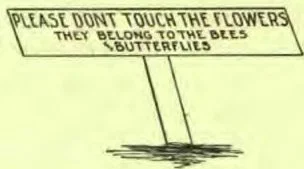
It was early morning in the spring-time. The dew sparkled on the grass, the trees had donned a new suit of green, the flowers were opening at the kiss of the morning sun, and the air was full of the songs of birds. A little bee came swiftly winging his way toward a beautiful flower garden, where he had been successful the day before in gathering a large load of pollen. His heart beat merrily in his breast at the thought of the rich store awaiting him. But just as he was entering the garden, his eye fell upon this sign.
“What does that mean?” he said, as he alighted on a stalk to think the matter over. “Now that was not here last night. And who could have put it up? I am sure it was not the owner of the garden, because I was told by Mr. Bumblebee that he was pleased to have us about. It must have been some one else. I can not imagine who it could have been. But let me see. Now that I think upon it, it must have been Mrs. Butterfly. Yes, that is just who it was. I met her as I was leaving here last night, and I thought that she did not seem pleased to see me. She wants all the honey for herself, the selfish thing! I'll never speak to her again. But she could not use it all anyway, and then we bees can not starve! No, we will not keep off the flowers. And besides, I'll change that sign so that none of the Butterfly family will dare to come around here any more.”
So off he flew, and soon returned with a brush and some paint, and added a line to the sign.
“Now, then,” said he, “I don't believe the Butterflies will dare show themselves around here any more, and it will not be well for them to do so either.”
The words were scarcely out of his mouth, when, looking up, he spied Mrs. Butterfly coming directly toward him. “Good morning, Mr. Bee,” said she. “I am so glad to see you! What a delightful morning! How beautiful everything is! It is a joy to be alive such a morning. What a fine day we shall have in the garden, and what lots of flowers! By the way, did you read the sign the gardener put up last night? Some rude little boys were picking the flowers and destroying them, and he thought he would put a stop to it. There will be lots of flowers for us all, and I wish you success.” So saying, she was gone.
“My!” said the bee, “I am glad she did not notice that sign. I felt real mean all the time she was talking. I'll not be so quick, next time, to charge others with wrong-doing, and I'll never do a mean thing myself, even if others do. But what am I to do about that sign? I know. I will make it read as it should.” And he did.—L. B. Merritt, in Sunday-School Times.
When Rachel Came Home
By Mabel Nelson Thurston
(Concluded)
That was while the two of them were washing the breakfast dishes, Rachel laughingly setting aside all mother's protests. “Of course I'm going to work; I love to work,” she declared. “But where are the children? Don't they help?”
“Oh, yes,” mother answered quickly, “they're a real help when I need them, but Bessie isn't strong yet, and the doctor said she'd ought to be out of doors all she could, now she has stopped school. So I was thinking I wouldn't make her do dishes this vacation; and I let Lottie go with her, because she's so forlorn without her.”
Rachel's eyes widened with surprise. “Why, mother, don't you think a little work adds zest to the play-time?”
“But the kitchen's so hot in the summer,”6the mother explained, apologetically. “Bessie doesn't complain, but sometimes she'll get real white, and say she's too tired to play afterward. I guess I wouldn't make her, Rachel.”
“All right,” Rachel replied, cheerfully. But somehow her voice made mother a little anxious; it was the same way that she had spoken about the breakfast food.
After the dishes were washed, Rachel disappeared in the parlor with broom and duster. When she returned, she began to tell her mother of the changes she had planned, but stopped suddenly. “I suppose we'd better plan dinner first,” she said. “What were you going to have, mother?”
“I thought for one thing I'd make a blackberry rolly-poly. We haven't had one this year yet. You used to be real fond of rolly-poly, Rachel.”
“But I'm not any more,” Rachel answered. “I've learned better. Why don't you make a rice pudding, mother, or sago? They're much more wholesome.”
“I suppose I can,” her mother answered. “I thought you'd like the rolly-poly, Rachel.” It was very foolish of her, but she couldn't help being disappointed; nobody cared very much for rice pudding.
But Rachel had already forgotten the food question. She was looking reflectively at her mother.
“This afternoon,” she said, “I want to fix your hair for you. I know a way that will be a good deal more becoming.”
A sudden dismay filled the mother's eyes. “I know I ain't good-looking, Rachel, but I've worn my hair this way ever since I was married. I shouldn't feel right with it any other way. I 'most know your father wouldn't like it.”
“Oh, yes, he will,” Rachel said, confidently. “You have no idea how ‘good-looking’ you will be, mother, when I fix you up. You'll get positively vain when you see yourself, and father'll think you've gone back to your girlhood.”
“I—I guess mebbe I'd rather not,” the mother repeated helplessly.
But Rachel only laughed. “You foolish little mother!” she said, affectionately. “Don't you know that you have a big daughter who is going to take care of you now? What are big daughters for, I'd like to know?”
As the days passed, Rachel's eager young spirit set itself to planning improvements in a dozen ways. She suggested changes in the furniture and a better way of making the children's dresses; physical culture exercises for Bessie, and a summer study course for Ned, and a system of diet for grandma. Finally, just before supper, one afternoon, she “fixed” her mother's hair; a parting and knot at the back of the head was so old-fashioned, she explained; nobody wore the hair so now. And mother's was so pretty, with that little crinkle running through it; it would look lovely fluffed about her face and done up high. All the time that Rachel was talking her fingers were busy; finally she pulled her mother across to the glass.
“There!” she cried, triumphantly, “tell me if that isn't a success!”
Her mother glanced timidly into the mirror, and then stood looking, with bewildered color creeping into her face. Was this really she? She felt as if in this strange day she had lost even herself. And oh, what would the others say—the children and father, who had always liked the old-fashioned parting! But Rachel gave her no time for thought. She gently pulled her into the dining-room where the others were gathering for supper.
It was worse than mother had feared. Father looked at her in perplexity, and Ned gave a long whistle of surprise. Lottie, to be sure, smiled at her comfortingly—Lottie was a sensitive little creature who always “felt” things; but outspoken Bess had no restraining intuitions.
“O, mother, you look so queer! It doesn't seem to fit you, somehow.”
The quick tears came to mother's eyes; she felt “queer,”—nobody knew how queer,—and hurt, and bewildered. Then she thought of Rachel, and resolutely smiled through the tears; Rachel's home-coming must not be spoiled by the selfishness of a mother who was old-fashioned and behind the times.
When the long, strange first days were ended, mother again lay awake thinking it over and over. It had all been so different from what she expected! There had not been any of the long talks she had longed for; Rachel had been too busy; and all the little homely “celebrations” she had planned—the rolly-poly and the children's Saturday treat, and things like that—had been pushed aside. There had not even been any singing; Rachel said that “The Old Kentucky Home” and “Flow Gently, Sweet Afton,” were not music, and if she couldn't have real music, she didn't want any. Of course Rachel knew best, Rachel's mother acknowledged; only father and the children liked things the old way. It seemed kind of hard to disappoint them. But the idea of talking of disappointment when Rachel was home! Suppose, instead of being so interested in everything, she had not wanted to leave all her fine mates and good times and come back to a plain, old-fashioned farmhouse? It wasn't every girl that would come back eager and interested, the way Rachel had. And so mother's loving, loyal heart found its song again.
As the weeks went by, however, and Rachel's calm decision turned and overturned, there were things that even mother dared not let herself think about. The most terrible thing was that nobody seemed quite so happy as in the old days. More than once mother slipped away by herself, to come back after a few minutes with a smile that bravely ignored her dewy eyes. And grandma grew almost fretty at the restraint; it was strange to see grandma fretty!
But if mother worried over the situation, there was one other who thought over it scarcely less, and that was Rachel herself. She was sitting in the hammock one afternoon, her straight young brows drawn together in perplexity. Rachel, too, was realizing that things were not going well, and she was trying to understand the reason. Surely she had worked as hard as she knew how, since she came home, yet nobody seemed to appreciate it. Perhaps mother did, but even mother clung absurdly to the old ways. Why, she would go and comb her hair in the old way to-morrow if she had her way. As for Ned and the children and grandma—Rachel sighed. It was very hard to do things when there was no one to help you. If only—then her thoughts were suddenly interrupted.
It was Bess, blazing-eyed and flaming-cheeked, all her small figure eloquent with indignation, who was the interruption.
“I think you're just as mean as you can be, Rachel Palmer!” she stormed, “and I just will say it, so now! You're making mama cry all the time; that's what you're doing. She hates things the way you fix them, and so do all of us! And I don't care if you are the oldest and have been to school; I guess mama and grandma are older than you are. How would you like to be dictated to in every single thing, I'd like to know? Just as if you knew more than anybody in the world! I just wish you'd go back to school, and let us be happy again,—that's what I wish.” And then the small, storm-driven figure, having exhausted its courage, ran tempestuously around the corner of the house.
Rachel sat utterly still. She could not seem to think at first. Then gradually she understood, and, still half-dazed, went up to her room and locked herself in. Rachel was no coward, she must settle this thing at once, no matter what it cost. And hour passed—two, three. The children called to her down in the yard, and once her mother came to the door, but Rachel did not answer. She was occupied with Rachel Palmer, and could not leave her task.
It was almost supper time when at last she left her room, and her mother was stepping about in the dining-room below; she could hear her talking with grandma between the clatter of dishes. Rachel ran lightly down and followed her out into the kitchen.
“Do you suppose there'd be time to make some waffles to-night, mother dear?” she asked. The color rose to her face at mother's astonished look. “I thought the children might like them, and grandma,” she said, meekly.
“Why, I thought you said—” her mother began in confusion, but Rachel interrupted her.
“I've said more foolish things than I like to think about; I wonder how you put up with me at all. It took Bess, plucky little thing that she is, to open my eyes. Some day we'll talk it all over, mother, but now—suppose you go and fix your hair the old way, while grandma shows me how to make the waffles. And to-night, if you and father would like it, we'll have some of the old music.”
“I guess we'll all like it, Rachel,” mother said, simply. But as she went to her room to “fix” her hair, her eyes were deep with happiness. Rachel had come home at last!—Mabel Nelson Thurston, in Young People's Weekly.
The Glory on Her Head
By Charles Willis Thompson
A shower of pattering little steps,
And in the room she flies;
Upon her sunny head there rests
A toy, worn halo-wise;
A little circlet, golden-hued,
Edged with a band of red;
“Oh, look at me!” she cries; “I’ve got
A glory on my head!”
I nod, and smile; she patters off;
I put my paper by,
And listen to her far-off voice
With a smile that’s half a sigh,
“See, gran’ma!” shouts the baby voice;
“You don’t heard what I said;
Look at me; see; see here; I’ve got
A glory on my head!”
O baby voice! what truth you speak;
A glory so alight
With holy innocence, I stand
Abashed before the sight.
My head before that snow-pure soul
Is bent, and soft my tread;
How long it is since I have worn
A glory on my head!
— Charles Willis Thompson.
Although Our Rank Is Lowly
“ALTHOUGH our rank is lowly, And our power for good is small, We will not idly fold our hands.”
The Preparation of Diphtheria Antitoxin
By Mike Robe
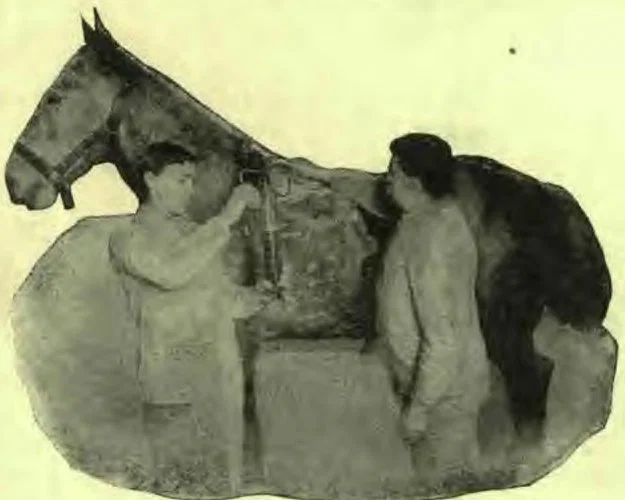
Last week we gave a description of the process of preparing diphtheria toxin. In order to prepare antitoxin, the fluid containing the toxin is injected into a horse, beginning with a very minute dose, and gradually increasing the amount of the dose as the horse is able to bear it. Each dose produces a slight illness in the horse, but in a few days he is over it, and ready for the next dose. The process is repeated at intervals of a few days, the quantity being increased each time, until at the end of a number of months, the animal can take enough diphtheria toxin to kill several hundred ordinary horses. The horse is now immune to diphtheria toxin, the immunity being due to large quantities of antitoxin which have formed in the animal as a defense.7
Now a large quantity of blood (but not enough to endanger the health of the animal) is drawn, in a way not to cause it any particular pain. The blood is drawn with every care to avoid contamination with germs, into sterile test-tubes. The blood, after a time, coagulates, or clots. The accompanying illustration shows four such tubes. At the bottom may be seen the clot. The clear liquid, or serum, seen at the top of each tube, is drawn off, and put into sealed tubes, each tube containing the right quantity for one dose.
This serum, known as “diphtheria antitoxin,” is kept by druggists, ready to be called for when needed by physicians for a case of diphtheria.
Physicians generally have now such great faith in antitoxin, that a doctor who fails to use this remedy in a case of diphtheria is considered inexcusable; and in case his patient dies, his neglect to use the antitoxin may get him into trouble. Still, there are intelligent doctors who have no faith in antitoxin, as there are those who do not believe in vaccination.
When the physician gives you a tonic or a cough mixture, he tells you to take so many drops, or spoonfuls, as the case may be. Antitoxin is not dosed out by spoonfuls, nor even by drops. The reason is that no two lots of antitoxin have the same strength. One lot may be twice as strong as the other, consequently some way had to be devised for ascertaining the exact strength of each lot. This is done by testing the antitoxin on guinea-pigs; thus its strength is determined and indicated on the package in “units.” The usual dose is one thousand to three thousand units, though a smaller amount is used to prevent well people from “catching” diphtheria.
The accompanying cuts were kindly furnished by Parke Davis & Co., of Detroit, Mich. One picture shows the operation of injecting the toxin into a horse; the other shows four of the large tubes in which the blood is collected. The proportion of serum and clot may be readily observed. MIKE ROBE.
MEMORY VERSE: “Again, the kingdom of heaven is like unto a merchantman, seeking goodly pearls, who, when he had found one pearl of great price, went and sold all that he had, and bought it.” Verses 45 and 46.
“Another parable put he forth unto them, saying, The kingdom of heaven is likened unto a man which sowed good seed in his field: but while men slept, his enemy came and sowed tares among the wheat, and went his way. But when the blade was sprung up, and brought forth fruit, then appeared the tares also. So the servants of the householder came and said unto him, Sir, didst not thou sow good seed in thy field? from whence then hath it tares? He said unto them, An enemy hath done this. The servants said unto him, Wilt thou then that we go and gather them up? But he said, Nay; lest while ye gather up the tares, ye root up also the wheat with them. Let both grow together until the harvest: and in the time of harvest I will say to the reapers, Gather ye together first the tares, and bind them in bundles to burn them: but gather the wheat into my barn.”
“Another parable put he forth unto them, saying, The kingdom of heaven is like to a grain of mustard seed, which a man took, and sowed in his field: which indeed is the least of all seeds: but when it is grown, it is the greatest among herbs, and becometh a tree, so that the birds of the air come and lodge in the branches thereof.”
“Another parable spake he unto them; The kingdom of heaven is like unto leaven, which a woman took, and hid in three measures of meal, till the whole was leavened. . . .
“Then Jesus sent the multitude away, and went into the house: and his disciples came unto him, saying, Declare unto us the parable of the tares of the field. He answered and said unto them, He that soweth the good seed is the Son of man; the field is the world; the good seed are the children of the kingdom; but the tares are the children of the wicked one; the enemy that sowed them is the devil; the harvest is the end of the world; and the reapers are the angels. As therefore the tares are gathered and burned in the fire; so shall it be in the end of this world. The Son of man shall send forth his angels, and they shall gather out of his kingdom all things that offend, and them which do iniquity; and shall cast them into a furnace of fire: there shall be wailing and gnashing of teeth. Then shall the righteous shine forth as the sun in the kingdom of their Father. Who hath ears to hear, let him hear.”
“Again, the kingdom of heaven is like unto treasure hid in a field; the which when a man hath found, he hideth, and for joy thereof goeth and selleth all that he hath, and buyeth that field.”
“Again, the kingdom of heaven is like unto a merchant man, seeking goodly pearls: who, when he had found one pearl of great price, went and sold all that he had, and bought it.”
“Again, the kingdom of heaven is like unto a net, that was cast into the sea, and gathered of every kind: which, when it was full, they drew to shore, and sat down, and gathered the good into vessels, but cast the bad away. So shall it be at the end of the world: the angels shall come forth, and sever the wicked from among the just, and shall cast them into the furnace of fire: there shall be wailing and gnashing of teeth.”
“Jesus saith unto them, Have ye understood all these things? They say unto him, Yea, Lord.”
“And it came to pass, that when Jesus had finished these parables, he departed thence.”
Questions
1. What parable did Jesus speak after he had explained the parable of the sower to his disciples? To what did he liken the kingdom of God? Who came into his field? What did he sow among the wheat? What time did he choose for his evil work?
2. What was seen when the seed had begun to grow? Who came to the householder? What did they ask him? By whom did he say this evil work had been done?
3. What did the servants ask if they should do? Why did the householder not have the tares gathered out at this time? How long did he say they should grow with the wheat? What would be done with them at the time of the harvest? Where would the wheat be taken then?
4. Relate the parable of the grain of mustard seed, and explain its meaning. To what did Jesus again liken the kingdom of heaven? What is leaven? What does it do? How is the kingdom of heaven like leaven?
5. When Jesus had sent the people away, what did the disciples ask him? In the parable of the tares, whom did Jesus say he meant by the man who sowed good seed? What was this good seed? What did the tares represent? Who was the enemy?
6. What was meant by the harvest? Who were the reapers? What becomes of evil-doers? Where do the righteous dwell?
7. To what did Jesus again liken the kingdom of heaven? What would one be likely to do who knew of great treasure hidden in a field? What will those do who rightly value the kingdom of heaven?
8. Relate the parable of the pearl of great price, and tell its meaning. To what common object did Jesus next compare the kingdom of heaven? What is done when a net has been filled? How did Jesus explain the parable of the net?
9. What question did Jesus ask his hearers when he had finished speaking to them in this way? What did they say? What did Jesus then do?
IV—The Spirit of Sacrifice
(July 22)
MEMORY VERSE: “For ye know the grace of our Lord Jesus Christ, that, though he was rich, yet for your sakes he became poor, that ye through his poverty might be rich.” 2 Cor. 8:9.
Questions
1. What did Jesus tell the rich young man that he must do to inherit eternal life? Matt. 19:17.
2. What reply did the young man make? What further question did he ask Jesus? Matt. 19:20.
3. What one thing did Jesus say was still necessary? Matt. 19:21.
4. How is the necessity of giving up all for the kingdom of heaven illustrated in the parable of the treasure hid in the field? Matt. 13:44.
5. How is the same truth taught in verses 45 and 46?
6. What price was paid to redeem man and his lost possessions? 1 Peter 1:18, 19.
7. How great was the sacrifice that Jesus made? 2 Cor. 8:9; note .
10. What does he say those who become his disciples must do? Luke 14:33.
11. What examples in the matter of forsaking the things of this world are recorded for our instruction? Luke 5:10, 11.
12. What precious promise is left for those who are willing to forsake all? Matt. 19:29; note .
Chinese Brethren's Appeals for Preachers and the Gospel
By Editor
“THE gospel needs a voice; a book will not do. Behind the Bible must be a believer, behind the gospel a herald.” The two appeals sent to the General Conference by Chinese brethren witness to the truth of these words. These appeals were in the form of two silk scrolls upon which were printed in Chinese characters the significant questions: “How shall they believe in Him of whom they have not heard? and how shall they hear without a preacher?”
PROF. W. J. McGEE, the geologist, estimates that the world is fifteen billion years old. Lord Kelvin, the great physicist, estimates that the maximum age of the earth is a hundred million years. And there are about as many other estimates as there are other great men. True, it requires only one hundred and fifty of Lord Kelvin’s one hundred million years to make Professor McGee’s modest estimate of fifteen billion; but even this slight discrepancy does not afford sufficient definite data to allow one to discard the record of the earth’s age as given by Moses in the first chapter of Genesis.
IN the INSTRUCTOR of June thirteenth, a rather strong statement was made relative to the amount of tithes and offerings given by our people as compared with the amount used by Mr. Muller in his work. The statistical secretary of the General Conference informs me that the tithes and offerings to foreign missions have amounted to $8,779,508.12 during the last eighteen years. The offerings made to the work in the home land would considerably increase this amount. We would not unduly exalt the liberal spirit of our people, neither would we fail to appreciate the spirit of sacrifice that has characterized the believers of the third angel’s message from the very beginning of the work.
YOUNG men and women who have been in school the past year are planning to canvass this summer. We know of one young man who has to walk upon crutches who is expecting to canvass among the hills and mountains of West Virginia. There are two young women who have chosen to remain in the hot city to canvass instead of going to their father’s summer cottage at the Thousand Islands. Friends and surroundings entice them; but even these with their father’s electric launch on the beautiful St. Lawrence, and a Teachers’ Summer Institute at their very door, were not sufficient to make pleasure seem paramount to duty or privilege. Devotion to duty is heaven-born, and its reward is our Father’s approval, and the giving of truth to hungry souls.
A GIRL living near the Ogowe River, West Africa, came one day with two bunches of plantain to sell to the missionary. As she was going away, the missionary’s wife spoke kindly to her, bidding her to remember that she had promised to come every week to the Sunday services. “Yes,” said the girl, “I will surely come.” On Saturday evening her canoe was stolen, and none of her friends would lend her one to visit the missionary; but she had promised to go, and she felt that she must do it, so swam all the way. The current was swift, the water deep, and the river fully a third of a mile wide; but by swimming diagonally, she succeeded in crossing it. Were all promises regarded as sacred, and as earnest effort made to fulfil them, this world would be a far better place to live in than it now is. No promise is ever broken in heaven. Where, then, is the habit of promise-keeping to be formed?
Prayer the Key to the Christian’s Treasure-House
THE measure of our praying is the measure of our growth.—A. R. B. Lindsay.
“GEORGE MULLER prayed, and built a whole village of orphanages. What prayer has done in these cases it will do for missions.”
“THE China Inland Mission was founded through the prayers of Rev. J. Hudson Taylor. God threw open one by one the doors of China’s closed provinces before his prayers. Mr. Taylor believes so thoroughly in prayer for everything that he once told a friend that he would ask God for a pin if there was need of it.”
“ABRAHAM and Jacob and Joshua and Elijah and Daniel and Paul got what they asked for in prayer. Luther prayed three hours a day, and then went forth to shake the papal throne. John Knox prayed all night for Scotland, and God answered his prayer. A familiar saying is that Baxter strained the walls of his study with praying breath, and sent a tide of salvation all over England. Finney prayed for a solid week, and then delivered his ‘Revival Lectures.’”
It was in hours of solitary prayer that Jesus in his earth-life received wisdom and power. Let the youth follow his example in finding at dawn and twilight a quiet season for communion with their Father in heaven. And throughout the day let them lift up their hearts to God. At every step of our way he says, “I the Lord thy God will hold thy right hand. . . . Fear not; I will help thee.” Could our children learn these lessons in the morning of their years, what freshness and power, what joy and sweetness, would be brought into their lives!—Mrs. E. G. White.
“ABOUT the time of the annual meeting of the Baptist Missionary Society in London, William Carey, in India, was greatly distressed for want of another missionary. Dr. Ryland at this meeting referred to Dr. Carey’s two sons, Felix and William, who were devoted missionaries. ‘But,’ said he, ‘there is a third who gives him pain; he has not yet turned to the Lord.’ Then, after a solemn pause, he exclaimed in a voice full of emotion, ‘Brethren, let us send up a united, universal, and fervent prayer to God in solemn silence for the conversion of Jabez Carey.’ As if the Holy Ghost had suddenly fallen upon the assembly, the whole congregation, of at least two thousand persons, betook themselves to silent intercession. One of the first letters afterward received from Dr. Carey bore the news of the conversion of this son, and the time of his awakening was found to accord almost exactly with the hour of this memorable intercession. He at once presented himself for missionary service at the very place where his father so much needed a helper.” Our God hears prayer.
Take Ye Heed
By Clarence E. Kelsey
“Take ye heed; watch and pray.”
Live this motto every day.
Mark thirteen thirty-three,
Read this chapter—learn and see—
One half each day. Good doesn’t count,
Look to Christ, the living Fount.
Love to do the errands found,
Making sunshine all around.
Watch for chances to do right,
And never quarrel, tease, or fight.
When temptations come, resist;
Never, never, forget this.