The Youth’s Instructor, Vol. 38, No. 23.

FACE TO FACE WITH TROUBLE

The Youth’s Instructor

Jun 4, 1890

S. D. A. Publishing Association · Battle Creek, Mich. · Jun 4, 1890

FACE TO FACE WITH TROUBLE.
You are face to face with trouble, And the skies are murk and gray, You hardly know which way to turn, You are almost dazed, you say; And at night you wake to wonder What the next day's news will bring; Your pillow is brushed by phantom care, With a grim and ghastly wing.
You are face to face with trouble; A child has gone astray; A ship is wrecked on the bitter sea; There's a note you cannot pay; Your brave right hand is feeble, Your sight is growing blind; Perhaps a friend is cold and stern Who was ever warm and kind.
You are face to face with trouble! No wonder you cannot sleep; But stay, and think of the promise,— The Lord will safely keep, And lead you out of the thicket, And into the pasture land. You have only to walk straight onward, Holding the dear Lord's hand.
Face to face with trouble! And did you forget to look, As the good old father taught you, For help to the dear old Book? You have heard the tempter whisper, And you've had no heart to pray, And God was dropped from your scheme of life, Oh! for many a weary day!
Then face to face with trouble— It is thus He calls you back, From the land of dearth and famine, To the land that has no lack. You would not hear in the sunshine; You hear in the midnight gloom; Behold His tapers kindle Like stars in the quiet room.
Oh, face to face with trouble, Friend, I have often stood, To learn that pain hath sweetness, To know that God is good. Arise, and meet the daylight; Be strong, and do your best, With an honest heart, and a childlike faith That God will do the rest. —Selected.

GRETA, THE GOOSE-GIRL.

“Ah, me!” sighed the good mother Gretchen, “what will become of us all I cannot tell, with the poor father ill with the fever, and the hungry geese cackling to be taken out. If only thy brother Fritz were here, all would be well; but he must be away a-soldiering, and I suppose it is needless to fret because all the others are girls.”
“Mother, why cannot I take the geese to the meadows? I know the way quite well,” spoke out sturdy little Greta.
“No, no! my child. I cannot let thee wander all day after those restless creatures, but then—if the flocks are not taken out, our neighbors will get some one else to tend them, and we can ill afford to lose the money.”
There seemed to be no other way out of the difficulty, so the mother consented to let Greta act as gooseherd.
Her sisters tried to dissuade her, saying, “Thy friends will laugh at thee;” but Greta replied: “They are not friends if they despise me for trying to help father and mother, and moreover it is honest work.”
Hans Burger and his family lived in a pretty village near the Rhine, just far enough from the railroad and great city of Strasburg not to be disturbed by their bustle and noise.
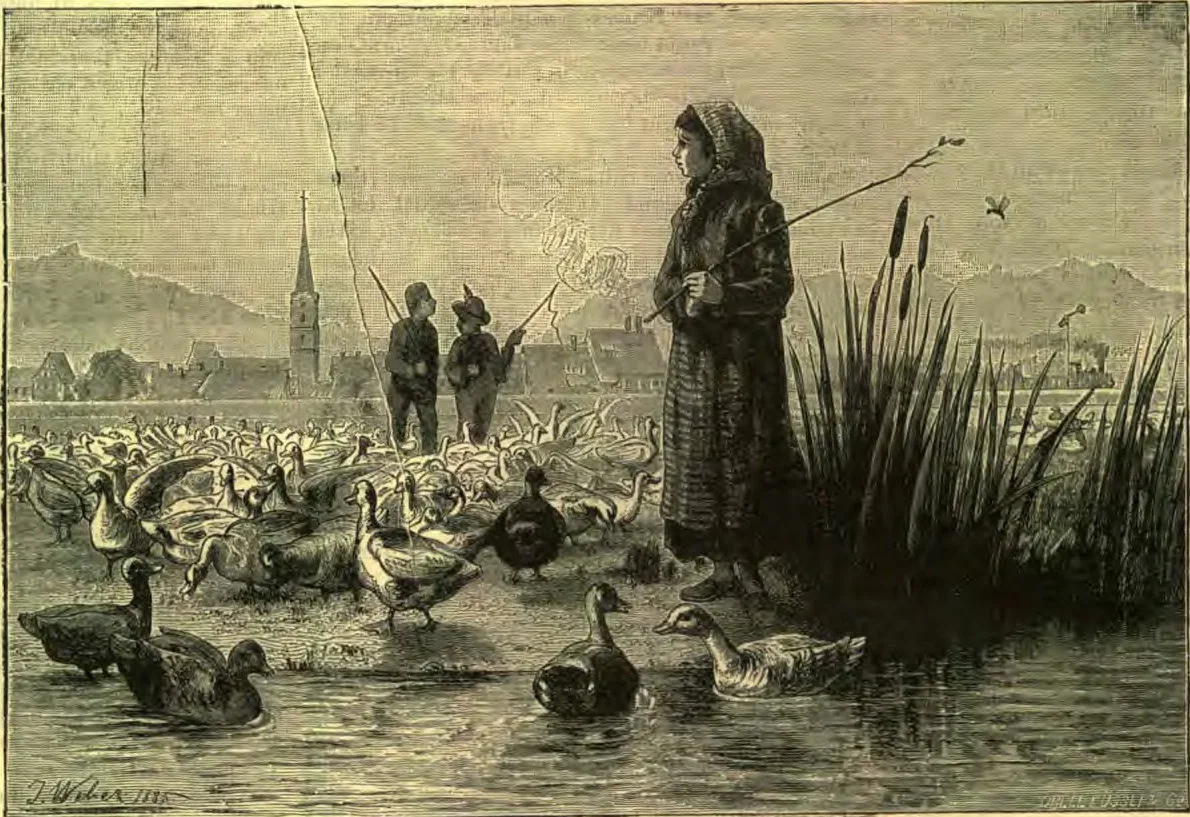
It is customary in some parts of Germany where geese are raised, for each owner to mark his flock, just as sheep are marked; then every day during the summer all the flocks in the village are driven out to the gänseanger, or green spot, by the person they employ, who is called the gooseherd.
Greta, having gained permission to take her father’s place, drove her flocks out of the village. She made a picture which would have charmed the eye of an artist if he could have seen her surrounded by her feathery flock.
Her hair was neatly plaited beneath a peasant cap. The apron which covered her blue dress contained two pockets; these held her midday lunch and her knitting. She was not idle, but knit industriously and thought of many queer things as she watched her cackling charge.
The showers which occasionally caught her without shelter did not make her complain, but cheerfully and faithfully she performed the work she had set herself to do.
When the village boys tried to tease her, calling her “goose girl,” and made coarse jokes, she kept silence, which was far better than to have answered them in the same strain. Greta very wisely thought, “I must respect myself if I would have others respect me.”
Twice that summer the flocks were plucked, and the soft feathers and quills were taken to the city and sold. The cool autumn days brought new strength to Greta’s father, and he was able to care for the geese himself.
Greta’s loving service, so cheerfully and willingly performed, cheered the hearts of her father and mother. When she related the experiences of the day, her father would say, proudly, “Thou hast done well; Fritz could have done no better.”
She had done what she could, and had her reward.
—The Well-Spring.

ROUND THE WORLD.

No. 15.

NATAL.

The colony of Natal is on the south-eastern coast of Africa, and is 800 miles from the Cape of Good Hope and 7,500 from England. It is bounded on the north by Zululand, on the south by Pondoland and East Griqualand, on the west by Basutoland, Orange Free State, and the South African Republic, and on the east by the Indian Ocean, and has an area of about 21,500 square miles.
It was on Christmas Day, 1497, that Vasco Da Gama, the celebrated Portuguese explorer, while visiting the coasts of Southern Africa with a squadron of three small ships on his way to India, discovered this previously unknown territory, and gave to it the name that it has since borne in honor of the nativity of our Saviour. The coast is low and flat, but in the distance are seen undulating mountains, adorned with verdure, and somewhat rugged. It abounds in trees, among which are the wild olive, and in the valleys and on the borders of the rivers, mint and beril are found. The soil is rich, and a large percentage of it fit for cultivation. There is no heavy timber, but one sees many forests of bamboo.
It was Christmas eve when the German arrived, and the weather was far different from anything to which we had previously been accustomed at this season of the year. The thermometer stood at nearly 100 in the shade, and on account of the warm currents coming down the coast from Zanzibar, the heat was of that damp kind similar to what is artificially kept up in greenhouses, when all the windows are closed, the steam turned on, and the floors and walls well watered. That night, instead of sleeping with doors and windows closed, and stoves burning brightly, everything was open, so as to catch every breath of air that was available, and the mosquito curtains were spread over the beds.
Durban is a large and thriving town of some 9,000 inhabitants, not including the natives. It is at present the port for the gold fields of the Transvaal, and the harbor is crowded with shipping, daily bringing adventurers and machinery to work the mines. The streets are broad, and the town is well laid out. The business part of the city lies beneath the level of the sea, and if ever a big tidal wave were to sweep in from the Indian Ocean, Durban would be no more. The town hall is a very handsome building, with a clock tower, containing a beautiful chime of bells, which ring the hours, halves, and quarters. The residences are situated on a hill to the north, called the Berea, but to all appearances the inhabitants search more for the almighty dollar than they do to know the Scriptures, as did the Bereans of old.
Pietermaritzburg is the capital of the colony. It is up country, some fifty miles from the port, but as the railroad was built by the mile, one goes over seventy miles to reach it. It winds in and out on the sides of the hills, in a very snake-like fashion. The rails are narrow gauge, and the speed is not more than eight miles an hour. The country is very pretty; there are many fields containing acres upon acres of ground, on which nothing is growing save pine-apples and bananas. Near the coast there are large sugar and tea plantations. The land is undulating, but instead of the red hematite soil, seen in Cape Colony, with nothing on it but rocks and bare bushes, there is beautiful rich grass and lovely flowers. The road to Pietermaritzburg is up grade, sometimes as steep as one foot in thirty, the city being four thousand feet above the level of the sea. It is an old cathedral town, but does not have the thrifty appearance of its sea-port. The British government keeps a large number of troops there, to be ready at any moment in case of an attack from the natives. Zululand is close by, and it was there in 1874 that so many of the British were massacred at the battle of Isandhlwana. Excitement ran high at the time, and the inhabitants of Pietermaritzburg barricaded their city against an attack. The general opinion is that if at the time the natives had made an onslaught on the capital, there would not have been a soul left to tell the tale. The same fears existed at Durban, but there some of the people might have escaped to the ships, and put to sea, until help could have been obtained from England.
The Zulus are by far the finest race of all the South African tribes. In physique they are much in advance of the average American or European, and their strength is something marvelous. They will take a box weighing nearly two hundred pounds, place it on their heads, and trot off with it as if the weight were nothing, and they will carry this for a mile or more without stopping to rest. They are very proud and haughty, and in manner and customs differ considerably from the natives further south. A Zulu in full dress wears a “moucher,” or loin cloth, which is generally made of skins, the ankles and arms covered with bangles, and the neck profusely decorated with beads. The hair is twisted into small pig-tails, which are often threaded over with beads, or little pieces of quill, giving a remarkable appearance to the wearer. A hole is punched in the lobe of one ear, and in this is stuffed a snuff-box about as thick as a man's index finger, and three inches in length. Under kind treatment they are good-hearted and obliging, and become greatly attached to their masters.
P. T. M.

THE GIRL FROM NORWAY.

TRANSLATED FROM THE SWEDISH BY D. OMAR BELL.
You ask, Who was this “Girl from Norway”?
She was the only child of King Erik of Norway; granddaughter of Alexander III., king of Scotland and ally of the first prince of Wales. Her mother, a daughter of the great English commander, Edward I., died at the birth of Margaretha, leaving her heiress to two thrones, Scotland and Norway, and with good prospect of becoming heiress to the English crown.
The little Margaretha lived in Norway, at that time the most uncultivated of her two kingdoms. Ragnhild, her foster-mother, was of the same nationality, and watched with unceasing diligence over her handsome but frail queen. When very small, she loved to play with the beautiful mosses which grew on the rocks by the sea-side, and used to gather the reindeer moss, that spreads its silver flowers over the cold soil where grass cannot grow. From infancy the little princess was as simple-hearted as a farmer’s daughter. She used to laugh at the swains, when they came a-wooing from her mother’s land, and clapped her hands, when, as she said, “Their ringing music came down from the skies.” She laughed at the wild geese, who, with rustic haughtiness, alighted and strutted along the shores of the fjords, and she called them “papa’s courtiers.”
How sorry the little girl was when she was obliged to leave for a time her country, home, and friends, and go to live with her father. She loved to sit on her cushion of eider-down, and wear easy clothes, but she did not like to bow constantly to the fine lords and ladies who were in attendance at her father’s court. She was much happier at “Fogelön,” a little island not far from shore, where the eider-ducks built their nests on the rocks. They were called St. Cuthbert’s birds, and it seemed a sin to her to kill them, because she thought that the saint had given them the “blessing of peace.”
When the sea was calm, Margaretha was often rowed out to this island. It was uninhabited, and at one time when the weak little princess was tired of the rolling waves, and did not wish to return till the sea was smoother, her servants built a little house, where she might rest till she was ready to return. The birds knew her, and she gave them food. They were as tame as the chickens in the door-yard. During her visits on this island, her nurse and one or two of her father’s servants used to stay with her and sing songs, or tell her some old saga.
“My beloved princess, look at these little mothers,” said Ragnhild, her nurse, one day. “I have seen them pluck down from their own breasts to make their nests warm and comfortable; and if any one steals the soft lining, the dear mother-bird again plucks the down from her breast. If the birds do thus, what will a mother do for her child?”
“Margaretha has no mother,” said the little girl solemnly.
“My little queen, I would pluck out my very heart for my foster-child,” said the faithful nurse.
“Then I will call you my Eider-duck mamma,” said the child playfully.
The little princess looked at nature as her good old nurse told her to, and her awaiting crown cast no shadow over her. She seldom thought of the land over which she should one day reign. But in September, 1290, a strange ship anchored at Trondhjem. It bore ambassadors from Scotland, who brought with them a multitude of rich presents to King Erik’s court, and laid claim to the girl as their queen. Ever since that stormy night when Alexander III. was thrown from his horse, and was found dead at the foot of King’s Crag, had his little granddaughter been their rightful ruler, and now these Scottish knights had come to swear allegiance to her, and take her to the throne. “I will not be a queen,” said the girl, and cried bitterly at the thought of leaving her father and friends.
One of the noblemen who had come to get her was Sir Michael Scott. Wonderful stories were told of him. It was said that he had learned the occult arts in the East, and could compel others to obey him, and with their help he could remove mountains, and still the sea at night. This terrible man was very large. He wore a suit such as is commonly worn by the astrologers of the East. His beard, white as snow, reached to his waist. His piercing eyes read men’s thoughts, and when he fastened his steady gaze upon little Margaretha, she was compelled to give heed to his words.
He spoke complaisantly:—
“What, little girl, are you afraid of your subjects? why should you be afraid of our beautiful land?”
“I am afraid,” answered the trembling girl. “The thistles which you gave me are like needles in my hands.”
“They are weapons to defend us from our enemies,” answered the wise man. “They once did good service for your mother’s people. The Danes were stealing into our camp one night, when a soldier trod with his naked foot upon one of these little sentinels, and his shrieks aroused and alarmed our army. But see, the heart of the thistle is soft—soft as eider-down,—soft as the fine draperies which the Persian worm wraps about himself before going to sleep, to awake with a pair of angel-wings. And in our land the mountains are covered with heather, the rosy dew sparkling on it all day long. A warm welcome awaits our queen in the land where her mother was once a ‘bonnie lassie;’ and all the people are now waiting for our little princess, whose commands shall be law.”
The child could not be pacified; but alas, it was decided by her father and the court that she belonged to Scotland, and consequently she, together with her faithful nurse and a few of her old servants, was taken aboard the ship. It was all carried on in the most jubilant manner possible, and her father and a few of his noblemen accompanied her to Calnefjord. As the father and daughter sailed away together, they looked back to the hills of red sand-stone and the royal parks which encircled their beloved capitol, and so the walls and towers of the child’s home slowly sank from their sight. Margaretha hid her face in her nurse’s bosom, and every convulsive sob had an echo in the heart of the faithful old woman. She felt within herself that she was lost.
The ship sailed calmly and pleasantly till it came to the “Skury Circle Rocks,” which rise like a wall out of the sea. The days were beautiful, and a bright glow covered the waters at night. The strangers sought to reconcile the discontented and homesick girl; they told her wonderful sagas; they described the beautiful palace in which she was to dwell; and Ragnhild never left her.
The sea rolled and tumbled fearfully, and Margaretha felt a deep longing for her little nest on Bird Island. Michael Scott might command the spirits of the earth and air as much as he chose, but the sea would not obey him. The child grew worse every day, till one morning a stream of blood gushed from her mouth. The captain was much alarmed for the life of his precious passenger. He had witnessed the terrible scenes of the battle-field, where heaps of wounded and slain dyed the grass scarlet, and rivers were gory with human blood; but all this was not so hard to bear as to see this innocent life pass away in the midst of that roaring and dashing sea. Seamen whose cheeks had not been wet with a tear for many a year, cried aloud. With broken hearts they stood and knelt around the helpless child.
“Make for the nearest harbor!” cried Michael Scott. “The queen languishes. Scotland’s hope must not go under.”
The coast of the Orkney Islands could barely be seen through the foggy atmosphere. With all haste the ship sailed for the northern shore, and anchored among the rocks which project far out into the sea; and immediately the sailors rowed the child to land.
“Cheer up, my little bird,” said the heart-broken nurse, “you are now in your mother’s country. See, it is like your own Norway—the same eider birds await us here upon the rocks. Revive, revive, my darling, for the sake of your ‘Eider-duck mamma.’”
The child smiled faintly, and twined her arms about her nurse’s neck. She could neither see the dripping rocks, nor hear the roar of the billows as they reached out their long arms to reclaim their prey. With a look of the most heartfelt love, the life of the child-queen was extinguished until it should burst forth anew in “the land where there is no sea.”
The Scottish noblemen cared not for the child, only for the queen; and now since their mission had come to such an unlucky end, the lifeless body on the shore was no more to them than a piece of drift-wood which had been cast up by the waves.
Sir Michael Scott wrapped the wasted body in the rich mantle, and left it for the Norwegians to look after. The Scottish chiefs again went aboard the vessel, and hurried to the capitol, where the inhabitants were prepared to receive their queen with flowers and flags, music and feasts.
Margaretha of Norway, who, perhaps, if she had lived, would have changed the history and been the hope of three nations, received after she was dead not even a loving remembrance, save in the heart of the devoted and faithful nurse.

THE TREES THAT GROW STRONGEST.

As I was traveling along a country road a few weeks ago, I noticed a plantation of a few years’ growth, which I had frequently passed before. “How nicely those trees are growing!” I remarked to the driver.
“Wonderfully!” he replied; “especially at this part,” he continued, as we passed further along the road. “They are nothing like so good here.”
“Not so well sheltered, perhaps,” I remarked.
“Not that,” he said, “but these plants were too old when they were put in. The ones we saw before were quite young when they were planted. They always make the strongest trees.”
Ah! thought I, here is an old sermon from a new text. I think the lesson is so plain that almost the youngest could guess it.
We must all be transplanted out of nature into grace, “out of the kingdom of darkness into the kingdom of God’s dear Son”—out of self into Christ.
Sometimes this may be done late, and the plant become a strong, healthy tree; but it is not often so. The young plants are the healthiest and best—those that have longest sent their roots downward, and their branches upward, without having had their growth disturbed.
May each little reader be ready to pray, “Oh, satisfy us early with thy mercies, that we may rejoice and be glad all our days!” The Bible says: “Those that be planted in the house of the Lord shall flourish in the courts of our God.” God will bless them, and make them a blessing to others.—Selected.

Diligence Against Idleness: A Maxim on Work

Work constantly and diligently at something or other, for idleness is the Devil’s snare for small and great.—Life of Perthes.

WHO TOLD?

Of course Dolly had no business to go into the pantry. That was the first part of her wrong-doing; for she had often been told never to step over the threshold, and if she had only minded, then this story would never have been told.
Grandmother had been making pies that morning—huckleberry pies, the kind Dolly liked best, with a little criss-cross of pastry across the top; and then, when the big pies were all in the oven baking, she had taken the scraps of pastry that were left, and made two little turnovers. Dolly knew whom they were for just as soon as they came out of the oven, and she did wish that grandmother would let her sit right down and eat hers then, while it was hot.
The next afternoon a school-mate was coming over to take tea with her, and Dolly knew that grandma had made these turnovers so that she and Ruth might have a little tea-party in the attic, and eat their supper from the cunning little doll-dishes that had been Dolly’s mamma’s when she had been little enough to play with dolls.
Dolly knew she would want to have the turnovers then, but she could not wait, and when grandma put the baking away in the pantry, a pair of blue eyes followed her very wistfully.
“I think I’ll just go and look at them,” Dolly said to herself, presently, and the little feet pattered away to the pantry, where they stood obediently upon the threshold, not breaking the injunction never to go any farther.
“If I could only just smell them once!” and Dolly’s inquisitive nose sniffed vigorously, as a breeze coming through the open window carried to her the appetizing odor of hot pies.
“Of course I wouldn’t touch a teeny crumb of them, but I must just smell them, and in a moment more Dolly was standing on tiptoe by the lowest shelf, looking intently at the coveted turnovers. On one side of the largest turnover there was a slight projection of pastry, and Dolly eyed it greedily.
“It wouldn’t really be taking any of the turnover, just to break off that little piece, because it don’t really belong to it,” and the mischievous fingers picked off the coveted morsel.
Can’t you guess what happened next? The delicious bit of crisp pastry was so good, and melted so quickly in the hungry mouth, that Dolly soon found another little piece to take, and presently she was shocked to find that she had really broken into the turnover itself, and that a narrow stream of rich purple juice was trickling out.
“I guess I’d better eat it all up,” Dolly said, as she tried to stop the juice by putting her finger against the opening, “‘cause grandma’ll know I took some anyhow.”
It was so good! The little girl ate up the last crumb, and then looked wistfully at the other turnover.
“There won’t be enough for the tea party, any way, and I may as well eat that one too.”
Pretty soon they were both gone, and Dolly went out and sat on the broad porch, trying to be happy again. Somehow the turnovers hadn’t left a very pleasant taste in her mouth, and the sunshine wasn’t as bright as it had been an hour ago. Dolly thought she must be homesick, her heart felt so heavy and sad.
Grandma feared that the little girl might be ill, seeing her sit so quietly instead of running, as was her wont, but when she went into the pantry a little later, and saw that the two turnovers were missing, she guessed at the truth. Presently she called, “Dolly, dear, come in the house; I want you.”
Very slowly Dolly came in, with her head drooping. Was grandma going to ask her about the turnovers? How could she ever confess that she had been greedy enough to eat up her own and Ruthie’s, too?
But grandma only took the little girl up in her lap, and rocked slowly backward and forward in the large rocking-chair, fanning the little flushed face that rested on her shoulder in silence for a time. At last she asked, “Is there anything you would like to tell me, Dolly?”
“Grandma!”
Dolly sat up straight, with a red spot burning on each cheek, and talked as fast as she could, while her eyes looked away from grandma:—
“I never touched those turnovers! I truly never did. I do think Zip took them; for I saw him jump through the window, and I s’pose he didn’t know any better than to eat them up. You wouldn’t whip him, would you, grandma?”
“Not for my little Dolly’s fault,” said grandma; then she added, sorrowfully, “O darling, why do you tell grandmother a story?”
“Who told you I took them?” Dolly asked, bursting into tears.
Grandma did not answer, but she led the little girl over to the long mirror in the parlor, and there Dolly saw her reflection, and she knew who had told.
There were purple huckleberry stains all over her mouth and chin, and on the front of her white dress. She sat down on the floor, and hid her face in her hands, so ashamed that she thought she would never want to look into grandma’s loving, sorrowful face again. Oh, how wicked she had been! and her heart ached at the remembrance of that dreadful lie.
Dolly never forgot the next half-hour, when grandmother took her up into her lap again, and talked to her gently, telling her how wicked a thing it was to tell an untruth, and that though she might sometimes deceive people, God could see the stain in her heart just as surely as grandma had seen the stain on her apron. Then they knelt down, and in her childish language Dolly asked that she might be forgiven, and the stain washed from her heart, for Jesus’ sake. The burden on her mind was gone then, and the sunshine grew bright again; but Dolly did not forget that when she did wrong, there was a stain made on her heart which God could always see, though others might not, and that only the blood of Christ could wash away that stain.—Minnie E. Kenney.

GRANDPA'S SNUFF-BOX.

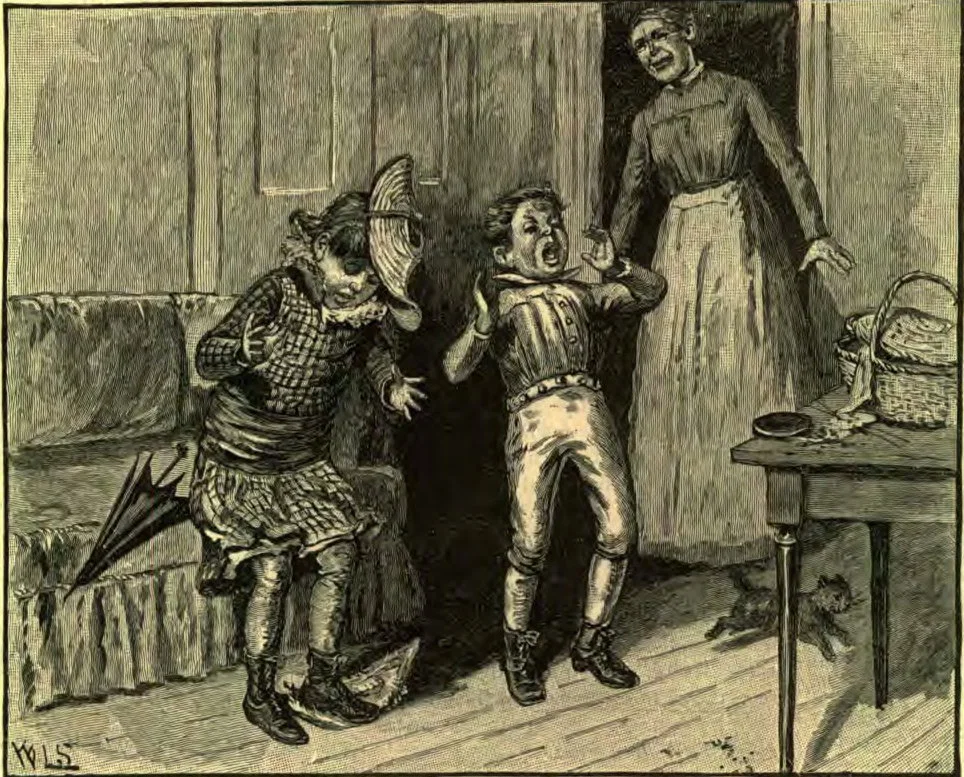
“Oh, dear!” sighed little Dilly Burton to her brother Joe, as they were trudging home from school one day. “It’s so hot! Let’s go into grandma’s and rest.”
“And get a ginger-cake, may be,” said Joe, wiping his sweaty little face. “O Joe! you’re always wanting ginger-cakes! Now don’t you ask for a single one, for it isn’t polite.” And Dilly looked very wise as she shut her mite of a blue silk parasol, and tapped lightly at grandma’s door.
Grandma was not in the kitchen; but the children went in, and sat down on the wide old lounge to rest and wait for her.
Joe’s eyes were very bright, and always very restless, and he had no sooner sat down than he spied a small box, black and shiny, standing on the table beside grandma’s work-basket. In a moment it was in his hand.
“O Dilly, it smells just like mamma’s sweet-box!”
“It’s grandma’s snuff,” said Dilly. “There’s the scent-bean in it;” and the children sniffed long and deep at the powder in the box.
Then Joe’s nose began to tingle, and tears came into his eyes, and Dilly sneezed.
Then Joe sneezed, and the powder flew out of the box upon grandma’s knitting.
“Oh, dear!” cried Dilly.
“Dear, dear!” echoed little Joe.
“Ah-chew!”
“Nuh-cho!”
Joe’s hat fell off, and Dilly stepped on it. Then Dilly’s hat fell over her eyes, and she dropped her parasol. The gray kitten crawled out from under the lounge and stared, then ran off with a big tail. Just then grandma came in.
“Why, Dilly! Why, Joe! What are you crying about?”
“We a’n’t crying, grandma! It’s the bo-ox!” sneezed Dilly.
“O you silly children!” cried grandma. “You have been at grandpa’s East Indian root, that he smells of for the headache.”
“Will it ever stop, grandma?” cried Dilly.
“Certainly,” said grandma, smiling a little.
Then she took the children to the kitchen sink, and bathed their poor, red eyes and swollen noses till they were quite cool again.
“I am very sure, my dears, you will not meddle any more with things that you should not,” grandma said, as she gave them each a ginger-cake, and tied on their hats.
And Dilly and Joe knew they never should again—never!—Our Little Ones.

POLITENESS

“O, HE’S just as polite!” said little Mabel. “He picks up things, and runs for things, and says, ‘Excuse me.’”—
“Who?” I asked.
“That Carver boy,” she said, pointing to a handsomely-dressed little fellow across the room.
“That boy?” I cried. “Why, I’m visiting at his house, and he bangs the doors, and whistles while his mother is talking, and says ‘Don’t bother me’ when she asks him to shut the window. Are you sure it is that boy?”
“Yes,” answered Mabel, mournfully. “Though folks do say his manners are all put on away from home.”
Just so.
When do you put on your manners? And when do you take them off?—Selected.

DANDELION

DANDELION in a meadow grew. Among the waving grass and cowslips yellow, Dining on sunshine, breakfasting on dew, He was a right contented little fellow.
Each morn his golden head he lifted straight, To catch the first sweet breath of coming day; Each evening closed his sleepy eyes, to wait Until the long, cool night had passed away.
One afternoon, in sad, unquiet mood, I paused beside this tiny, bright-faced flower, And begged that he would tell me, if he could, The secret of his joy through sun and shower.
He looked at me with open eyes, and said, “I know the sun is somewhere shining clear; And when I cannot see him overhead, I try to be a little sun, right here.”
—Selected.

THE FIRST WRONG BUTTON.

“Dear me!” said little Janet, “I buttoned just one button wrong, and that makes all the rest go wrong,” and she tugged and fretted, as if the poor buttons were at fault for her trouble.
“Patience, patience, my dear,” said mamma. “The next time look out for the first wrong button, then you’ll keep all the rest right. And,” added mamma, “look out for the first wrong deed of any kind; another and another is sure to follow.”
Janet remembered how one day, not long ago, she struck baby Alice. That was the first wrong deed. Then she denied having done it. That was another. Then she was unhappy and cross all day because she had told a lie. What a long list of buttons fastened wrong, just because the first one was wrong!—Sel.
Continue reading: ELIAS HOWE AND THE SEWING-MACHINE