Relaxing Our Diligence — Is Religious Freedom Endangered?
W. H. EDWARDS
"Up, make us gods, which shall go before us; for as for this Moses, the man that brought us up out of the land of Egypt, we wot not what is become of him." Ex. 32: 1, last part.
After a sojourn in the land of Egypt for more than two hundred years, much of the time under the most distressing servitude and slavery, the Hebrew nation were miraculously brought out into a condition of liberty. With free provision for temporal sustenance, inside of a year they demand that they make their way back to Egypt and slavery in preference to the unrestrained liberty they were enjoying. And this, too, with the Angel of the sanctuary hovering over them day and night to protect them.
Not an Optimistic Destiny
This favored United States of America is facing a destiny not at all optimistic nor one to be coveted. She has risen to the most exalted eminence as a haven of toleration for the oppressed of all nations. In this she has differed in spirit and operation from anything before known in the political combinations and policies of men. She has had "a state without a king, and a church without a pope." She has been a land where there has been freedom to worship God according to the dictates of conscience, but she now is, perceptibly developing the reactionary principle, and is making fast progress backward toward the Dark Ages.
The Constitution of the United States and the Declaration of Independence, enunciating the divine and humane principles of civil and religious liberty, are coming to be discounted. Unrelenting efforts have for years, as all know, been waged to tamper with the Constitution, and so change it as to admit the evil principle that would be the undoing of American independence and personal liberty.
Some See the Danger
For many years, this paper has sent out the warning cry, Hands off the religious liberty portions of the Constitution, voicing the noble Grant, "Keep the church and the state forever separate." What the Signs preached decades ago in regard to the overthrow of religious freedom, the patriotic people of the nation now see, and are organizing against the power that would turn this nation Romeward. "The watchman waketh but in vain."
Nineteen hundred years ago, the prophet John, on the isle of Patmos, foretold this time, and declared that this favored nation, in which God has worked out such divine principles, described by the prophet as lamb-like, would in the end speak as a dragon. As the prophecy can not be negated, it will surely come to pass. As a nation, the United States is doomed, according to the prophecy of God's word; but the throne of God is available, and the ear of the Lord is open to the cry of all who wish His help.
When nations in the past have become God-defying, and have filled up the cup of their iniquity, they have gone down in ruin. The same fate awaits this nation; but when her punishment is due, the whole world will be involved, and destruction from the Lord will be universal, for it will be the end of the age. It will be the time when the Lord will settle His controversy with the nations that have refused His proffered aid and have chosen death rather than life.
"Blow the Trumpet in Zion"
In six years, the tercentenary of the landing of the Christian Pilgrim Fathers at Plymouth, Massachusetts, will occur. Three hundred years only of benign influence! And after giving liberty a trial, like the children of Israel, the people have relinquished their vigilance, and are in danger of losing it. Yet many do not believe there is anything startling in the situation that confronts us.
You are alarmists, say they. If they would say "alarmers," we would admit the impeachment. "Blow ye the trumpet in Zion, and sound an alarm in My holy mountain: let all the inhabitants of the land tremble: for the day of the Lord cometh, for it is nigh at hand." Joel 2: 1.
The failure on the part of the people to hold to their liberties, and to protest stoutly and continue protesting against the encroachments5of the enemy to civil and religious liberty, — liberty of speech and of the press, — and a vicious proscription of the study of the Bible, and inveighing against the public school, is a sign of the times, — a sign of the last days, when Satan is about to take captive all the unwary, and those who are ignorant of what the Scriptures describe so clearly as about to burst upon the unprepared world.
In the world, might is right, and numbers, money, and votes are power. The Christian can not stay the advancement of wicked power, nor powerful wickedness; but he can be patient until the coming of the Lord (James 5: 7, 8), when he will be popular and on the right side, and all the wicked will be in confusion.
In view of the situation, should not every one who is acquainted with God, and who knows the loveliness of our Lord Jesus Christ, labor to bring souls to Christ while opportunity still remains?
"Careless seems the great Avenger. History's pages but record
One death-grapple in the darkness 'twixt false systems and the Word.
Truth forever on the scaffold, Wrong forever on the throne;
Yet that scaffold sways the future, and behind the dim unknown
Standeth God within the shadow, keeping watch above His own."
The Only Way
By Mrs. Carrie K. Butcher
Mrs. Carrie K. Butcher
WE walk so sweetly, hand in hand,
My Lord and I!
And O, He helps me understand,
And daily try
To do His will, with all my might,
And keep unspotted in His sight!
He whispers precious things to me,
That cheer me so,
And just the lesson helps me SEE,
I needs must know!
And hour by hour, His strength I prove,
And praise Him for His matchless love.
I am so glad I've learned to love
This blessed way!
There's just one way His love to prove.
'Tis, hear, obey.
If in unbidden paths we tread,
Dark clouds will gather overhead.
Nor pleading prayer nor burning tear
Will e'er suffice
To cause our Lord to lend an ear
Or heed our cries.
Turn where we will, try as we may,
Obedience is the only way.
So when our stubborn nature yields
To love and grace,
Then, O, how quick our Lord reveals
His smiling face!
And all our idols lose their charms
When safe we nestle in His arms.
Beloved, this lesson came to me
Through years of strife.
I pass it on, that you may see
And shun the life
That vainly tries to walk with God,
Yet will not "pass beneath the rod."
No matter what our Lord demands,
'Tis for the best;
And if in His we place our hands,
We'll sweetly rest,
And feel and know, from hour to hour,
The wonders of His keeping power.
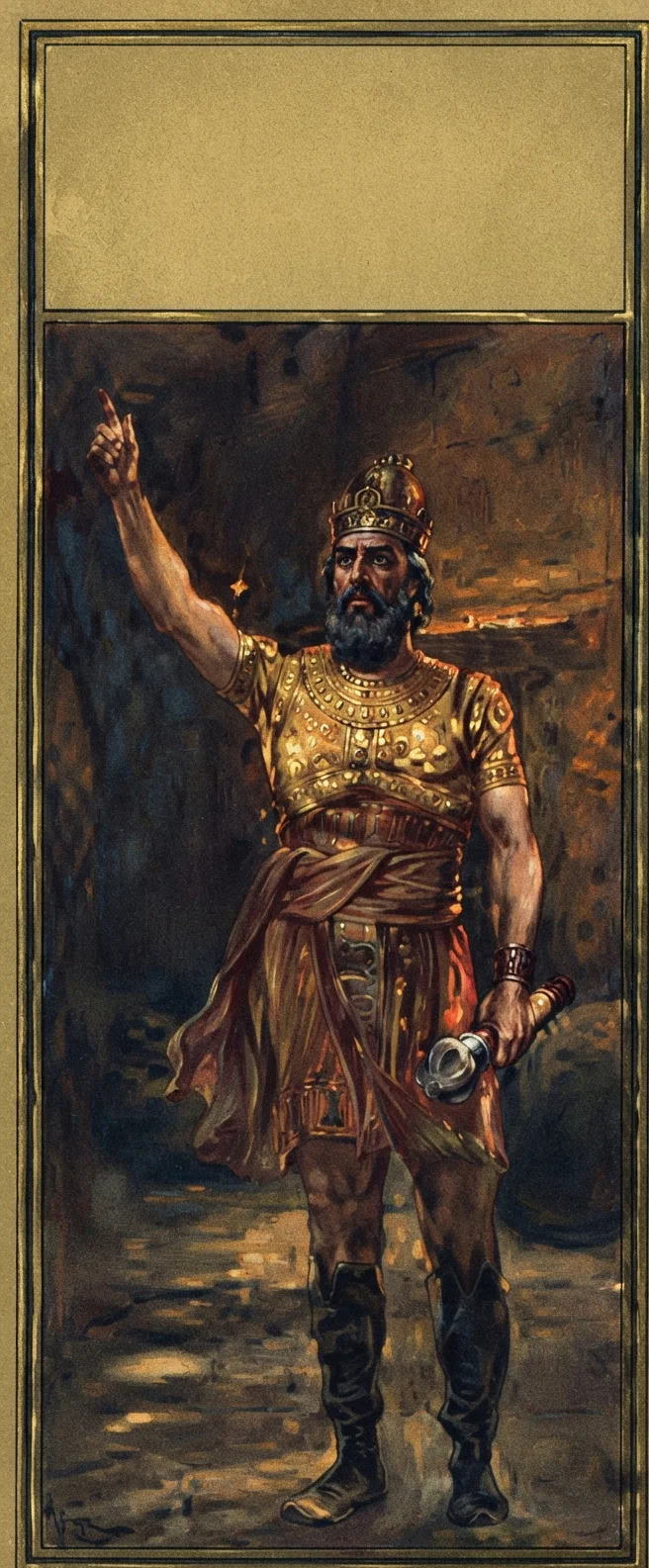
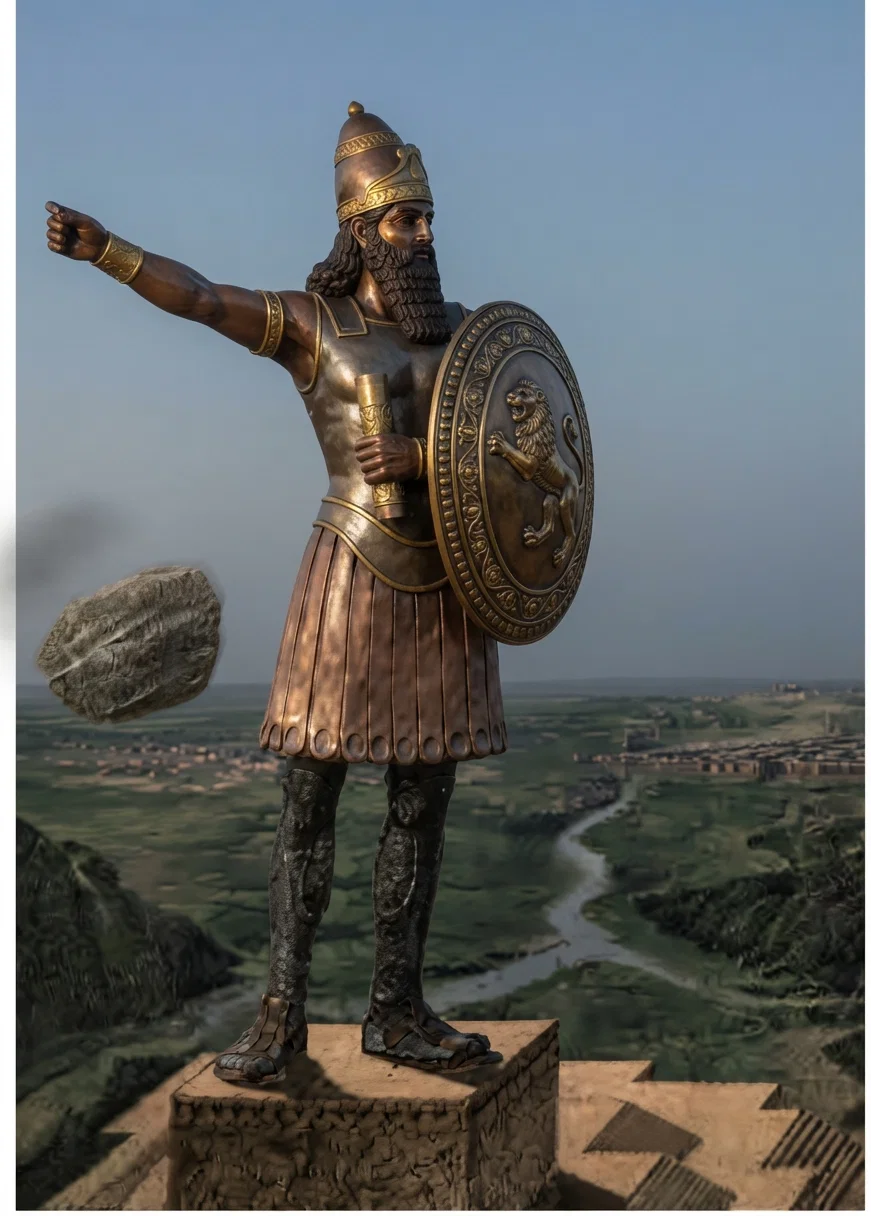
King's Mind Engrossed by Metal Image
By Jean Vuilleumier
The Statue Stood Before Him in a Dream—A Young Hebrew Prophet Comes in as Interpreter—The Future of the World Unrolled Before Him
JEAN VUILLEUMIER
THIS is the first of three articles by Mr. Vuilleumier on that remarkably clear prophetic chapter, the second in the book of Daniel. This article introduces the prophecy, and lays the foundation, to show in the two succeeding articles how strikingly it has been fulfilled. These three articles will be followed by others dealing with some of the further prophetic portions of the book of Daniel.
N
O more absorbing, no more harrowing thought can come to the thinking men of this generation than that so often voiced by the questions: What is the world coming to? What are we as a nation and as individuals coming to?
HE HAD CONQUERED THE WORLD
There is an answer to these solemn questions. It has long been written in a document hoary with age. It was given 2,500 years ago by a young prophet to a mighty monarch. Let me tell you this curious story.
It was in the year 603 before Christ. Nebuchadnezzar, king of Babylon, had just completed the conquest of the known world by the sack of Jerusalem. This proud successor of Nabo-palassar was standing at the head of the mightiest empire ever seen since the fall of Nineveh, and he lived in a capital the grandeur of which seems to us fabulous.
A DREAM THAT AROUSED HIM
One night, on his royal bed, the king had a dream which startled him, but which he could not recall. And when his magicians and astrologers could not help him out, Nebuchadnezzar, in his despair, sentenced them to death. At this juncture, the whole dream was revealed in a vision to a young Jew, a captive in Babylon, the future prophet Daniel, who hastened to the palace of the king. Nebuchadnezzar immediately recognized his own dream, and showered favors and honors on Daniel.
THE UNFOLDING OF THE FUTURE
It is this dream and its interpretation that will give us, even after 2,500 years have gone by, the unfolding of the future. Let us hear it, then, with reverence, as Daniel told it to the king.
He begins by revealing the source of this wonderful revelation. "The secret which the king hath demanded," he says, "can neither wise men, enchanters, magicians, nor sooth-sayers, show unto the king; but there is a God in heaven that revealeth secrets, and He hath made known to the king Nebuchadnezzar what shall be in the latter days." Dan. 2: 27, 28.
THE YOUNG PROPHET REPEATS THE DREAM
Then he goes on to say: "As for thee, O king, thy thoughts came into thy mind upon thy bed, what should come to pass hereafter; and He that revealeth secrets hath made known to thee what shall come to pass. . . . Thou, O king, sawest, and, behold, a great image. This image, which was mighty, and whose brightness was excellent, stood before thee; and the aspect thereof was terrible. As for this image, its head was of fine gold, its breast and its arms of silver, its belly and its thighs of brass, its legs of iron, its feet part of iron, and part of clay. Thou sawest till that a stone was cut out without hands, which smote the image upon its feet that were of iron and clay, and brake them in pieces. Then was the iron, the clay, the brass, the silver, and the gold, broken in pieces together, and became like the chaff of the summer threshing-floors; and the wind carried them away, so that no place was found for them: and the stone that smote the image became a great mountain, and filled the whole earth.
HE TELLS HIM THE INTERPRETATION
"This is the dream," said Daniel; "and we will tell the interpretation thereof before the king. Thou, O king, art king of kings, unto whom the God of heaven hath given the kingdom, the power, and the strength, and the glory; . . . thou art the head of gold. And after thee shall arise another kingdom inferior to thee [the bust of silver]; and another third kingdom of brass, which shall bear rule over all the earth. And the fourth kingdom shall be strong as iron, forasmuch as iron breaketh in pieces and subdueth all things; and as iron that crusheth all these, shall it break in pieces and crush." Verses 29-40.
Then comes the interpretation of the feet, of iron and clay, which represented a division of the fourth kingdom into several smaller kingdoms, partly strong and partly weak, mingled among themselves, but unable to "cleave one to another."
AN ETERNAL KINGDOM THE CLIMAX
And now the vision tells us the end of earthly things: "And in the days of those kings shall the God of heaven set up a kingdom which shall never be destroyed, nor shall the sovereignty thereof be left to another people; but it shall break in pieces and consume all these kingdoms, and it shall stand forever. Forasmuch as thou sawest that a stone was cut out of the mountain without hands, and that it brake in pieces the iron, the brass, the clay, the silver, and the gold." Verses 44, 45.
Daniel closes with this emphatic declaration: "The great God hath made known to the king what shall come to pass hereafter; and the dream is certain, and the interpretation thereof sure." Verse 45.
THE WHOLE SUCCESSION OF EMPIRES
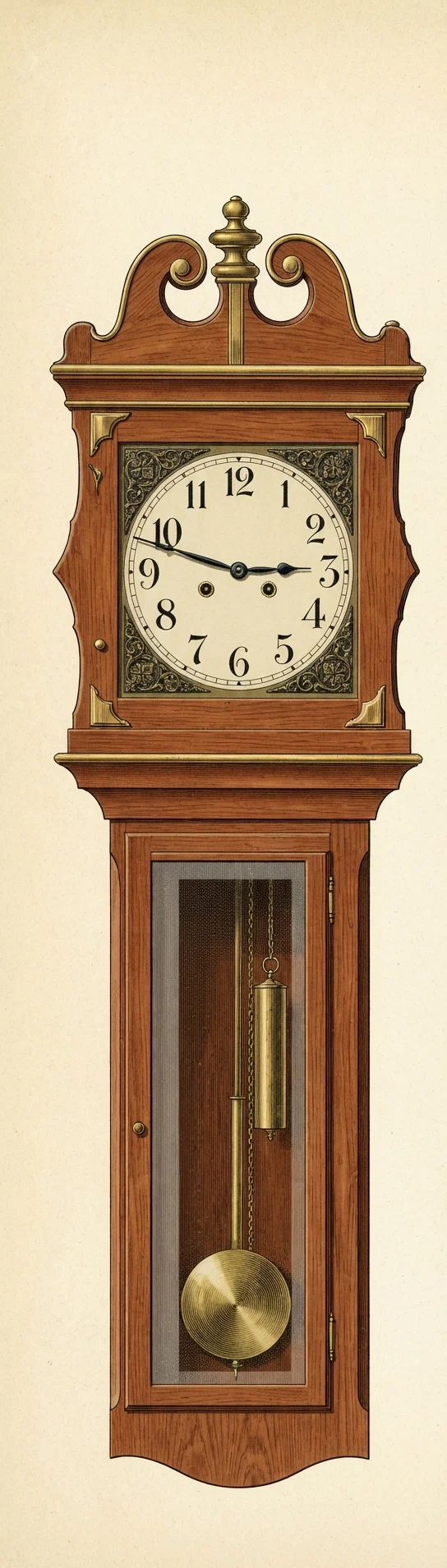
We see that this mysterious image is intended to represent the whole succession of earthly empires clear down to the establishment of God's kingdom. This dream, then, to use the words of the late Professor Gaussen, of Geneva, is really the "great clock of history," or its "general chart," or yet its "universal chronology." Herein is found the "general plan of divine Providence for the government of nations," "the program of the great drama of empires as the mighty Ruler of all things traced it thirty centuries ago."
Such a bold claim for a simple dream may seem to some amusingly daring. "When Daniel wrote his book," says Gaussen, "Persia was a country without power and without fame; Greece was nothing; Italy, less still.
WHO COULD HAVE BELIEVED IT?
"Who could have believed then that the obscure horde of the Persians would overthrow the mighty empire of Babylon, and would seize and hold for a hundred years the scepter of the civilized world? Yea, who could have believed that, after the Persians, the insignificant nation of the Greeks, and especially their barbarian province of Macedon, would rule the earth and carry its soldiers as far as the Indus River? Who could have believed that, after the Greeks, the Italians, from the remotest regions of the West, as they thought, would establish the greatest, the most terrible and enduring of empires; would make of a puny village, called Rome, and built on a small river, called Tiber, the queen of nations, the new Babylon, the so-called eternal city; and that finally this kingdom, divided among ten kings, would last, under this strange arrangement, until the end of time?"
IS OUR TIME OUR OWN?
By G. D. Ballou
Can the State of Right Tell Us When to Work and When to Rest?
Sunday Laws Come from Usurped Authority
G. D. BALLOU
LAST week Mr. Ballou showed that each individual has a right to his life, which embraces his time, and a right to his property, and also to the protection of his character. He showed that the liquor business and the drink evil invade these rights. The men who sell liquors spread crime, insanity, and misery, and millions of innocent people are made to suffer. It is right to suppress the liquor business and thereby abate this invasion of natural rights. Building upon the foundation of last week, he shows, in this issue, that Sunday laws, as well as the drink curse, are an invasion of our natural rights.
THERE is a class of excellent religious people who favor the making of laws to enforce certain religious observances, particularly the keeping of Sunday as a sabbath. Most of the states in our Union have such laws now on their statute-books. There is no just foundation, in human rights, for such laws; and true religion, as well as judicial sentiment, forbids the making and enforcing of such laws.
When we send men to the legislature to make laws for us, we delegate to them all the authority of the personal rights we possess, and no other authority. There are many relationships of life which are essential to human happiness, that are matters for advice and persuasion, and not for command.
To illustrate: It is the duty of every head of a family to provide good clothing and proper food, but I may not dictate to him what his choice shall be. He has a wide range of choice open before him, and it is none of my business what he chooses, only as I may, by his invitation, advise and persuade. He must run so far aside in his duties as positively to endanger the life and health of his dependents, before any outside authority can justly interfere.
Every man has more or less of property and money, which it is his privilege to use as seems best to himself, so long as his use of it does not interfere with the rights of others. Again we may advise and persuade, but most of us are wise enough not to attempt to command. He may buy stocks, or bonds, or lands, or cattle and horses, or automobiles, whether he needs them or not. What matters it all to us, unless a friendly word of counsel might stay a course of unwise purchasing?
HIS TIME HIS OWN
It is the bounden duty of every man, before God, to take proper rest at night. But I may not command him to spend eight hours in bed out of every twenty-four. His time does not belong to me, nor did I give it to him. So I can not help to pass laws concerning personal hygiene, except in those cases where human neglect endangers others.
We hear much, in our times, of enforcing the observance of Sunday by statute. Of late it has taken the form of securing to the laboring man one day of rest by hindering the employer from compelling the man to work seven days in the week in order to hold his job.
EVERY MAN'S PRIVILEGE
It is the privilege of every man to have one day or more to himself out of every week, and no man may rightly compel him to use any portion of his time in a manner different from his own choice; for all his time is his own, and he is not responsible to any human authority, but to God only, who gives him time and life. If he chooses to sell his time six days in the week to another, and keep one day for himself, that is his right and privilege, and no man has a right to compel him to sell all his time.
Nor may any human power rightly compel a man to rest one day in seven. None of us has the personal right to command a neighbor to desist from labor on the Sabbath or any other day. We did not make the Sabbath, nor give our fellow man his time, and hence it is not for us to say how he shall use it. Since we have no personal rights to command, we have no authority to delegate to the legislators to make Sunday laws or laws to enforce any day of rest. We may proclaim holidays, but man remains free to use them as best pleases him.
WHY UNDERTAKE WHAT GOD LEAVES ALONE?
To God alone is man responsible for Sabbath observance; and if the Creator does not see fit to enforce idleness on the day we call the Sabbath, why should we poor mortals undertake to do what God Himself refrains from doing? From the common citizen to the legislator and the judge on the bench or the juryman, all have the right to defense of property, chastity, and reputation, as was shown last week; but not one has a right to dictate how his fellow shall spend his time, much less how he shall worship God, on the Sabbath or any other day.
Not one of us would be justified, personally, in using force to make our neighbor desist from work on the day we regard as the Sabbath. What reason, then, have we for asking the sheriff or the constable to use the same kind of force? He can only exercise the authority people have delegated to him.
THEY HAVE NO AUTHORITY TO DELEGATE
But in this matter, the people having no authority to delegate, he is powerless to interfere rightfully in the matter of Sabbath-breaking. The legislators, when importuned to make Sunday laws, can only reply, We have not the personal right to do it, and no such authority can be properly delegated to us by our constituents, so we can not pass such laws without exceeding the bounds set by the Creator for us.
To illustrate more fully: If any person should shoot a man down who persisted in applying the torch to his neighbor's house, when that person was brought up before the judge for examination, the verdict would be, "Justifiable homicide."
But if some religious zealot should shoot down his neighbor because that neighbor did not heed the personal command to cease laboring on Sunday, when this one was brought to trial, the verdict would be, Murder in the first degree, unless he was cleared on the plea of insanity. This ought to make plain the proposition that the civil command to cease laboring on Sunday or any other day is not founded in personal rights, and hence can have no just place in civil law.
You may ask, How about the Sunday laws now on the statute-books? Well, they were placed there by usurpation of authority. The priests and the religious zealots of a darker age clamored for these laws until kings enacted them; and then because of precedent, they were brought into the statute-books of modern representative governments. But it is plain, from the considerations before us, that they are not founded on personal rights, and hence will not stand the test of constitutional authority.
WOULD HAVE SAVED WAR AND BLOOD
If these facts had dawned on human minds a few centuries ago, an untold amount of religious war and bloodshed would have been avoided. It does not appear possible that a follower of the meek and lowly Man of Nazareth would ever clamor for power to compel his fellow men to observe any religious ceremonies, or set apart any time for worship, which they did not voluntarily see fit to choose for themselves.
While we labor, within our personal rights, to free the community from the blighting curse of intoxicants and narcotics, and thus protect helpless humanity from harm, let us not step without the bounds of our personal rights, and undertake to compel our fellows to a course of conduct of our choosing, when we ourselves would strongly resent their compelling us to follow a course of their choosing.
Taken to Pieces, but Not Destroyed
By Adelaide D. Wellman
A Parallel
MY watch having failed of late to keep accurate time, I take it to a reliable watchmaker. I do not fear to trust it to his care, for I know him to be not only an honest man, but also a capable workman.
He may take the watch apart utterly, but I am not at all solicitous, for I know he is fully able to put it together again. Some part may be broken or worn out, but the repairer can supply the lack.
True, I must forego the use of my watch for a while. That is inevitable. But I console myself with the thought that the time will not be long. I never before so much appreciated that little piece of machinery as after having been for a few days without it.
These bodies of ours are sure to become impaired eventually, but the most skilled practitioner is a bungling workman to be trusted with the repair of so intricate a machine. And when once its action ceases, only the Maker is capable of restoring it. But, happily, He is able.343When, like a watch, the body of a dear one is reduced to its elemental components, there is no occasion to fear that he can not be restored, though we must be for a time without his presence.
Some who would fain comfort us, declare that the one who has been taken from us is not really dead — that the soul lives on, and will be near us still. But the Scriptures of truth do not beguile us with such statements, and we know, as did David, “I shall go to him, but he shall not return to me.”
Yet we are by no means without comfort; for “I know whom I have believed, and am persuaded that He is able to keep that which I have committed unto Him against that day” — the day when our disintegrated bodies shall be reorganized, and resume their functions of brain and muscle, not as old machines repaired, but in the fulness of a new life.
ADELAIDE D. WELLMAN.
Fermented and Unfermented Wines
By Mrs. S. N. Haskell
May We Know Which Is Meant in Any Given Bible Text? — The Wine to Be Used in the Sacrament
MRS. S. N. HASKELL
We judge of the use of the word "wine" the same as other terms, — by the connection in which it is used. "Meat" in Gen. 1: 29 we understand to mean vegetable food, while the same word in Ps. 78: 30 is understood to mean flesh.
FERMENTED WINE WAS USED
We know that it was fermented wine that Nadab and Abihu drank, for it made them incapable of discerning between holy and unholy things. Lev. 10: 9. In the death of these men, God gave an object-lesson for all time, that He would have those who serve before Him, free from all fermented liquors.
The wine of Dan. 1: 5 was also fermented, because Daniel said that it would defile him if he drank it. Dan. 1: 8. It was of the same character as that served at Belshazzar’s feast, which, as soon as they had drunk, they desecrated the holy vessels of the Lord. Dan. 5: 1-4.
REASON DETHRONED THEREBY
Fermented wine dethrones reason and debases the drinker. Unfermented wine "maketh glad the heart of man." Ps. 104: 15. It was unfermented wine with which the Saviour instituted the Lord’s Supper. This is shown from the connection in which it is given. The last supper was eaten by the Lord and His disciples at the time of the Passover. Matt. 26: 17-28. God had commanded that all leaven of any form should be excluded from the homes of His people at this time. Ex. 12: 15-19. Fermented wine, as well as leavened bread, was thus excluded.
After the return from Babylonian captivity, the Jews introduced the custom of drinking fermented wine at the Passover feast. This was no doubt included in the "many other such like things" referred to in the Saviour’s rebuke: "Howbeit in vain do they worship Me, teaching for doctrines the commandments of men. For laying aside the commandment of God, ye hold the tradition of men, as the washing of pots and cups: and many other such like things ye do." Mark 7: 7, 8.
FOR THE COMMUNION SERVICE
The pure unfermented wine was given to the church as a memorial of the blood of Christ. Through the influence of the earnest efforts of the Woman’s Christian Temperance Union, and other temperance workers, unfermented wine is now used by most churches in the communion service. This is an important reform.
A SAD CASE
The writer was personally acquainted with a reformed drunkard, who fell from tasting fermented wine in the communion service. Surely temptation and sin should not lurk in the cup that represents the most sacred thing ever given mortals, — the redeeming blood of Christ. Pure water and unfermented wine are beverages that the redeemed will drink in the kingdom of God. Rev. 22: 1, 17; Matt. 26: 29.
Since the last supper with His disciples, Christ has not tasted of the fruit of the vine. His last words before they sang the closing hymn were, "I will not drink henceforth of this fruit of the vine, until that day when I drink it new with you in My Father’s kingdom."
CONTRASTS OF THE TWO
While unfermented wine has been taken to represent the purest thing connected with the religion of Christ, fermented wine is a representation of corrupt doctrines given to the world by the apostate church. Rev. 17: 4-6. All nations "drink of the wine of the wrath of her fornication." Rev. 14: 8. It is more than a national test, — "the inhabitants of the earth have been made drunk with the wine of her fornication." Rev. 17: 2.
The fires of the last day will sweep from the earth the last trace of sin, and the redeemed of the Lord will "plant vineyards, and eat the fruit of them." Isa. 65: 21. Fermented wine will never enter the new earth, for "there shall be no more death." Rev. 21: 4. Fermentation only feeds on decaying matter, and will have no part in the new earth.
Throughout eternity, as the redeemed drink of the pure blood of the grape, they will remember that they were not "redeemed with corruptible things, as silver and gold, . . . but with the precious blood of Christ." 1 Peter 1: 18, 19.
The Law of God
Some Questions with Answers in Bible Texts
1. What is God’s law?
It is the expression of His will, summarily embodied in the Ten Commandments.
2. Does the Lord call the Ten Commandments a law?
“And the Lord said unto Moses, Come up to Me into the mount, and be there: and I will give thee tables of stone, and a law, and commandments which I have written; that thou mayest teach them.” Ex. 24: 12.
“And He wrote on the tables . . . the Ten Commandments, which the Lord spake unto you.” Deut. 10: 4.
3. Was the moral law complete, or did He add thereto?
“These words the Lord spake unto all your assembly in the mount . . . with a great voice: and He added no more. And He wrote them in two tables of stone.” Deut. 5: 22.
“Which voice they that heard entreated that the word should not be spoken to them any more.” Heb. 12: 19.
4. What, then, is the nature of this law?
“The law of the Lord is perfect, converting the soul.” Ps. 19: 7.
5. How does law have to do with one’s conversion?
“Whosoever committeth sin transgresseth also the law: for sin is the transgression of the law.” 1 John 3: 4.
6. What cooperates with the law in convicting the sinner?
“And when He [the Holy Spirit] is come, He will reprove . . . of sin.” John 16: 8.
7. Why is the perfect law of liberty compared to a mirror?
“For if any be a hearer of the Word, and not a doer, he is like unto a man beholding his natural face in a glass: for he beholdeth himself, and goeth his way, and straightway forgetteth what manner of man he was. But whoso looketh into the perfect law of liberty, and continueth therein, he being not a forgetful hearer, but a doer of the work, this man shall be blessed in his deed.” James 1: 23-25.
“Is the law sin? God forbid. Nay, I had not known sin, but by the law: for I had not known lust, except the law had said, Thou shalt not covet.” Rom. 7: 7.
NOTE.—As a mirror points out soot on the face, so God’s law (mirror) points out sin (soul tarnish). The Holy Spirit convicts, and Christ is the open fountain from which comes cleansing.
“In that day there shall be a fountain opened . . . for sin and for uncleanness.” Zech. 13: 1.
“If we confess our sins, He is faithful and just to forgive us our sins, and to cleanse us from all unrighteousness.” 1 John 1: 9.