The evening of October 24, I left Alexandrodar, going to the station to take the train for Tiflis, Transcaucasus. It was agreed that the other laborers should visit the various churches easy of access, while I was to visit Tiflis. About twelve years ago I made the trip to that city, crossing the range from Wladikawkas by stage. At that time the railway via the Caspian Sea and Baku had not been built. The distance by rail from Alexandrodar to Tiflis is nine hundred and twenty-five miles, and it requires forty-six hours to make that trip on the cars. As I passed through the German colony Chassaw-jurt, where we have lately raised up a church, I did not dream that a few days later at that very place the same train I was riding on would be held up by Tartar brigands from the mountains, and the baggage and mail carried off, while twelve people would be murdered and a large number wounded, and all of the passengers robbed. For the first time I passed along the shores of the Caspian Sea, the greatest inland sea in the world. I tried to get some snap-shot kodak pictures along the way, but was hindered by the police, as everything was under martial law; however, I succeeded in getting one picture showing a policeman in his uniform.
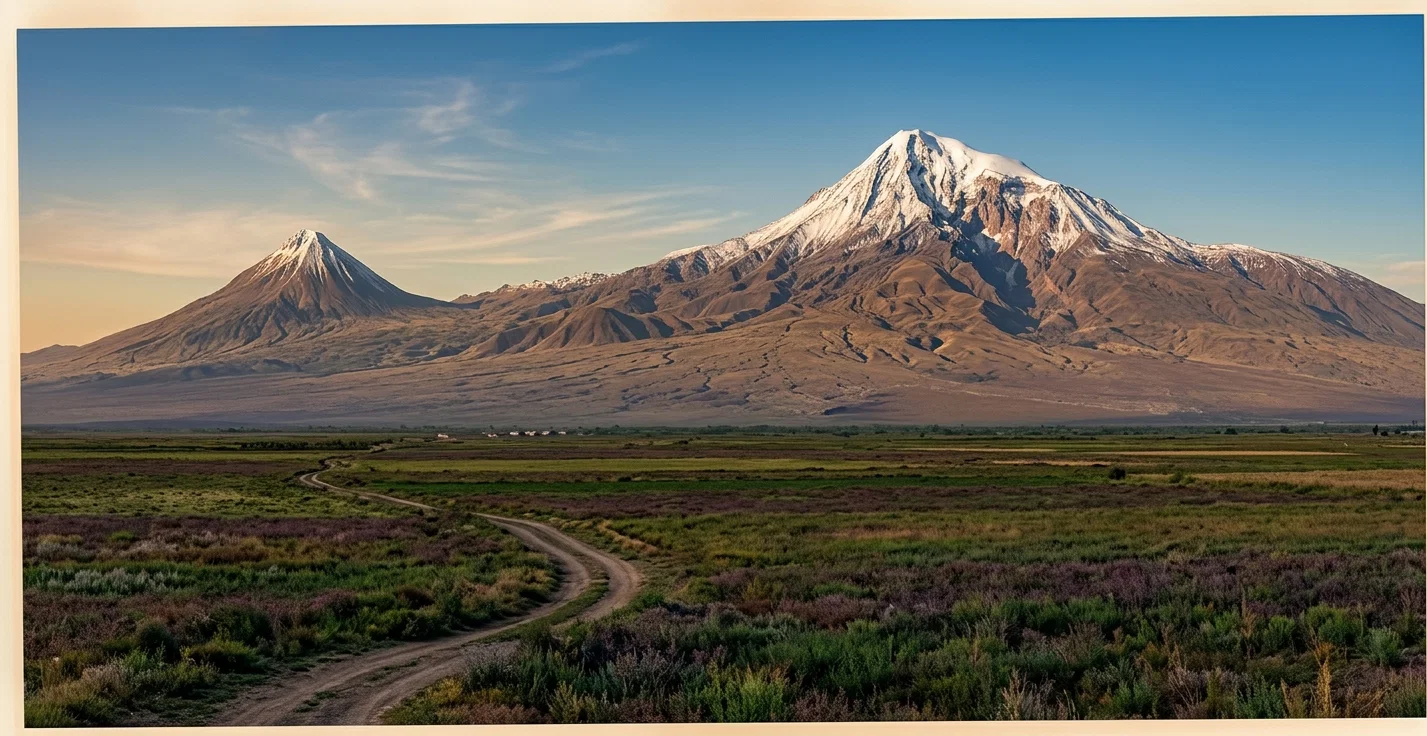
Upon my arrival at Tiflis on the night of the twenty-sixth, I was met at the station by both the Brethren Pampaian. The doctor had lately moved to Etechmiansin, near Erevan, the headquarters of the Armenian Church, where their catholicos, who is chosen by the whole nation, dwells, but this choice must be confirmed by the Russian czar before the catholicos dare take his seat. Here is also their leading educational seminary, where students from India, Turkey, Russia, etc., are trained for the priesthood. This has been a strong Armenian center since 1441. About twenty-five miles south of Erevan towers Mt. Ararat, 15,160 feet high, and beyond that is Little Ararat, as shown in the picture. Ararat is on the borders of Turkey, Russia, and Persia; thus to-day in the very shade of the mountains where the ark rested we have a laborer proclaiming present truth.
I found Tiflis in an uproar. A few days previously to my arrival the mayor of the city had given permission for a large meeting of the citizens to be held, in which the present situation of Russia was discussed by many very intelligent and enlightened people of the neighborhood; but when this peaceful meeting closed, the Cossacks, who were guarding the exits to the building, began to fire into the defenseless crowd as they came out. One could still see the marks of the bullets. Blood streamed down the steps of the building. The corpses were buried by the government; and it was possible for but one man (he was a general) to secure the dead body of a relative or friend. Although the mayor had granted the permission, yet the government had sent the Cossacks. Of course the natural outcome of such an outrage would be an insurrection and the explosion of a lot of hand grenades.
MOUNT ARARAT
At noon, next day after my arrival, we learned that the trains in the Transcaucasus district had also stopped running. We spent several evenings with a German family where the Brethren Pampaian were stopping. They had awakened some interest in the truth here, and so we had a Bible study at the house, while the soldiers were riding up and down the street and heavily guarding the station and all public buildings. Sabbath we went to see some interested readers of our literature, but we found a number of the streets closed by the soldiers. Some officers had been killed, and an investigation was in progress.
There being no opportunity for me to leave by train, I decided to secure passage over the mountain pass to Wladikawkas with the mail-couch. I would exchange a thirty-six hours' ride on the railway for a trip taking forty-eight hours by stage. By the time we got back near the railway station, we found that section of the city also closed by soldiers. Just then the station-master came up, and called to an official, who permitted us all to pass accompanied by armed soldiers. From a boarding-house right across from ours, shots had been fired, and several policemen had been killed, and the soldiers had shot several innocent persons, who, from curiosity, had looked out of their windows. The military and police officials were investigating whence the shots had come.
We found all the houses in that district, including our own boarding-house, closed; so we returned to the family where our brethren stopped, and glad indeed we were that evening to secure my luggage from the boarding-house. We spent the night with the German family and the Brethren Pampaian.
During our stay we had had ample time to counsel over the work. It was decided that while the doctor would continue work among the Armenians at Erevan, his brother, the nurse, had better go to Bulgaria and work among the Armenians there. His wife's home is there, and she had gone to that country some weeks before. Although we have still a worker in this part of the German Union District, yet we found that there was an urgent demand for a German Russian worker to labor in this field, where, as stated before, I found about fifty Sabbath-keepers. There are nearly five millions of people here, and we have about eight Sabbath-keepers at Tasehkent in Asiatic Turkestan. There are also some of our brethren in the Russian army in Manchuria; we have learned positively that five of these were able to have the Sabbath free, and so far as we have been able to ascertain, none of the Sabbath-keepers in the army were even wounded. Thus the Lord is caring for his truth, and it is extending from the north to the south and from the west into eastern Asia, where Russian soldiers have been sowing the good seeds of the kingdom, and some have been converted.
Early on Sunday, the twenty-ninth, having previously secured a second-class ticket, we started on the stage-coach trip across the mountains. I was surprised to find that I was the only through-second-class passenger (there were no first-class passengers at all). The second-class passengers ride on the front seat under cover, although the body is not very well protected, while those going first-class ride inside, where they can be quite comfortable.
In Tiflis the weather was rather hot, yet; for the first twenty miles we followed the railroad toward Batum, but we saw no trains of any kind. Then we turned into the mountains toward Mlety, where we stopped for the night in a pouring rain, after having made about seventy miles during a ride of fifteen hours. We were at an elevation of about five thousand feet.
By daylight next morning we were again on the way; we crossed a mountain stream, and climbed the mountainside by a road making eighteen sharp turns, when we reached Gudaur, nine miles from our last stopping place, and twenty-three hundred feet higher. About five hundred and seventy-five feet higher up we had to pass under strong snow-sheds, built to protect the road against snowslides. As we ascended, we got into a blinding snow-storm. It soon13became so cold that the conductor asked me inside with him. When we reached the summit of the pass, we were over eight thousand feet high; we then began a rapid descent, through romantic defiles, viewing here and there small villages, perched like swallows' nests among the mountains, in full sight of Mt. Kasbek, towering 16,800 feet high. Late at night we reached Wladikawkas, where we were again near the railway.
Mission Work in Sierra Leone
By D. C. Babcock
D. C. BABCOCK
Mission work in Sierra Leone upon organized plans, began about the year 1792, when the first settlement was made on the present site of Freetown, by the Baptists and Methodists.
The negroes who had left the slave plantations in the Southern States during the Revolutionary War, and associated with the British army, went to Nova Scotia, expecting homes to be given them, upon promises made; but never realizing the fulfilment of the promises, they became dissatisfied, and applied to the British government to send them to their native land.
The request was granted, and in the early part of 1792 several ship-loads landed in Sierra Leone. Some of these had become Baptists, and some Methodists, while in America, and immediately upon their arrival in Africa, they organized, and at once built churches. The Methodists have made some advancement, and have several churches. Here in Sierra Leone was the first effort made to plant the gospel in West Africa, but now mission stations may be found all along the coast, from the Bight of Benin to Senegal.
The Church Missionary Society
Probably the first systematic organization for real missionary efforts made in West Africa, was organized in England in the year 1799. The society took the name, The Church Missionary Society for Africa and the East.
The question at once arose, in what part of Africa should they begin work. Circumstances pointed out that West Africa should first be entered. Probably the greatest inducement to begin on the west coast was brought about by a Scotch missionary, a Mr. Brunton who had performed some labor among the Soosoos.
As Mr. Brunton had acquired the Soosoo language, he offered his services to the Church Missionary Society, and was employed by them to prepare a grammar and vocabulary, and such other books as could be used among the natives.
At the African academy at Clapham, England, were several Soosoo boys, who had been brought from their native land to be educated. When portions of Mr. Brunton’s books were read to them, they understood them perfectly. Thus the accuracy and value of his writings were fully tested.
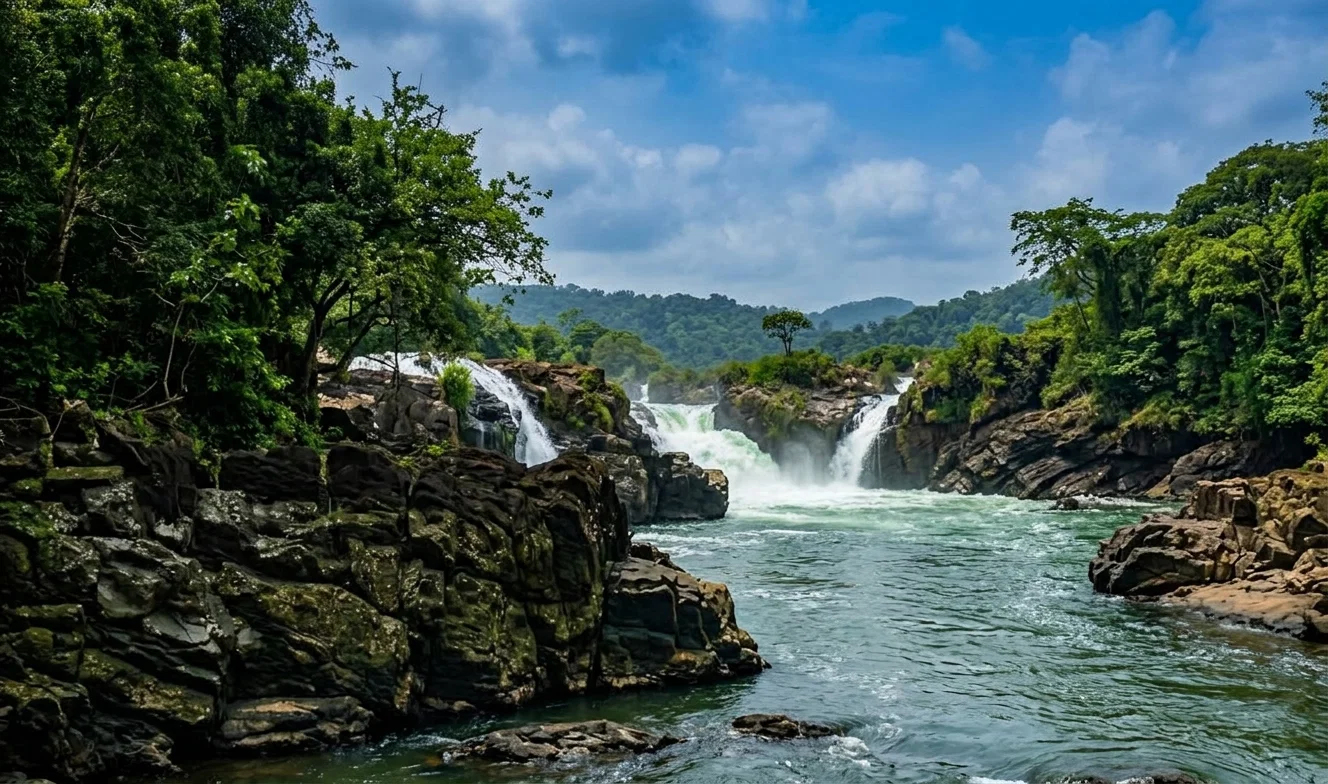
KIRIMA FALLS, FREETOWN, SIERRA LEONE
This was the first effort ever made to reduce the native languages of West Africa into writing, the Soosoo language being largely spoken in the territory lying to the north of Sierra Leone, and understood by the Foulah and Mandingo natives, and the vernacular tongue of the country of Jollonkadoo (a large kingdom in the mountains on the head waters of the Niger River).
The next step taken by the Church Missionary Society was to find suitable men to go to this dark land, to open mission stations. This was no easy task. Calls were made throughout England for men who were willing to take up the work of the Lord in this distant land, which meant a life of sacrifice, hardship, and perplexities. Bishop Ingham in his book “Missionary History of Sierra Leone” makes the following statement: “Men, however, were not to be found. The climate of West Africa was known to be generally fatal to Europeans; missionary work was known to be difficult and trying, even under the most favorable circumstances; and an opinion prevailed very extensively that the negroes of West Africa were by nature so nearly allied to beasts that all attempts to elevate them in the social scale must prove fruitless, and all attempts to convert them to Christianity must end in grievous disappointment.”
Bishop Ingham here makes a forcible comparison. He says, “At the time of which I am writing, our country was waging war in another part of Africa, against the great military despot who had usurped the supreme authority in France.
“Sir Ralph Abercromby had landed an army in Egypt to oppose the plans of eastern conquests that had been formed by Napoleon Bonaparte. For this expedition there was no difficulty in procuring volunteers. Thousands were willing to die in defense of their king and country. But not one came forward to risk his life in western Africa, in defense of the Christian faith.”
All efforts having failed to find men willing to face the difficulties necessary to be met among the tribes of western Africa, the Society turned to Germany, the birthplace of those noble defenders of the faith of Jesus, Luther, Melanchthon, and other faithful men to the cause of God.
In the city of Berlin there was a school to educate young men wishing to enter the missionary field. At the time that the missionary society for West Africa became acquainted with this institution, there were only six young men in training.
Correspondence was opened at once with the professor, Rev. John Jœnick, to secure help for the new missionary society in West Africa. Two young men out of the six were ready to heed the call, Melchior Renner, a native of the Duchy of Wurtemberg, and Peter Hartwig, a Prussian.
They at once went to England, and for some time studied the Soosoo language at the school of Mr. Graves at Clapham. In 1803 they returned to Germany and received ordination after the order of the Lutheran Church. On their return to England, they sailed from Portsmouth, landing in Freetown, Sierra Leone, March 8, 1804. The next missionaries, three in number, were also secured at the same school in Berlin. They were Gustavus Nylander, a Pole, Leopold Butscher, a Suabian, and John Prasse, a native of Lusatia. They sailed from Liverpool on the twelfth of February, 1806. They soon encountered a severe storm, and were stranded on a sand-bank off the coast of Ireland. The Lord saved them, and on April 22 they sailed again from Bristol.
The vessel stopped at Falmouth, and waited for some time to be taken under convoy. While the missionaries were on shore at Falmouth, the convoy came in sight, and without notice or warning the captain set sail.
The young men secured a small boat, hoping to reach their vessel, but everything seemed against them, and they were compelled to return to Falmouth. No sooner had they reached the shore, than the wind suddenly changed, and the whole fleet was compelled to return to Falmouth, and the young missionaries were, by God’s special providence, permitted to get on board again.
Northern Illinois Conference
By Wm. Covert
A FEW items with reference to how the message is going in the Northern Illinois Conference will doubtless be of interest to our people. I will give a very short report of the work.
A few weeks ago there were eight baptized in the South Side church by Elder Williams after a sermon by Elder Warren. Next Sabbath several are to be baptized in the South Side church. I think eight have already given in their names for the ordinance. About six weeks ago Elder H. Hansen baptized five in the Erie Street church, and next Sunday evening eight or ten others are to be baptized by Brother Hansen in the Humboldt Park church. Elder Santee is expecting to hold quarterly meeting and baptize a number of candidates at Moline next Sabbath. There are also six or eight to be baptized at Streator. Some of the Germans in Chicago who have lately embraced the truth are getting ready for baptism. In our Swedish church there was baptism a few weeks ago, and others are expecting to be baptized soon.
Elder Warren is holding meetings in Chicago, and is also organizing a training-school for workers, and his labors are beginning to bear fruit. We frequently hear of individuals who are just beginning to keep the Sabbath. Large congregations attend the services at the Forty-sixth Street church on Sunday evenings, where the message in its strength is presented.
We have paid for and installed a small printing-press, and the various features of the third angel's message as presented by Elder Warren in his lessons are being published in leaflets upon our press. Many thousands of these are given to the people who attend the meetings, and they are also being distributed in the city by those interested in this work. The printing is done free of charge by a number of our own members who are practical printers. We have an organization of about forty brethren and sisters who agree to pay one dollar a month for the purpose of meeting the expense of material and power connected with the printing work. We hope to increase this company till they number one hundred or more, so as to have one hundred dollars a month for this work in the city.
We learned last week that a special Earthquake number of The Signs of the Times was to be printed, and our churches in Chicago took this matter up in their meetings last Sabbath, and as a result of the effort, more than twenty-five thousand copies of this special number of the Signs was subscribed for. We have already sent in an order for twelve thousand copies, and will order more as fast as these that have been ordered can be disposed of. At Moline, where we have a small church, one thousand copies of this special number was ordered. We have just received an order this morning from Streator for three hundred and sixty-five. We trust that other churches will do their full part in the same good work.
The church at Kankakee has sent in an order for 1,175 copies of April Liberty. Some special interest there caused this order to be made. We hope that our churches everywhere will take an active interest in the religious liberty work, and make all out of it that the times demand.
The interest in the various features of the message is increasing, and yet there is much room for improvement, especially in some departments. The things taking place in the world surely indicate that the time to arouse has fully come. May our dear people be faithful to the trust that the Lord has committed to them. WM. COVERT.
Panama
By I. G. Knight
BOCAS DEL TORO.—I have just returned from quite an extended trip for these parts, a few items of which I thought would interest the readers of the REVIEW.
I traveled, in all, about one thousand miles, changing from one vessel to another several times. Schooners and sloops (sailing vessels) were my means of travel, and much of the time I was compelled to remain below in order to keep dry, on account of heavy seas which washed the decks.
I visited the following places: St. Andrews Island, where we have a church of about twenty-five members; from there I went to the Nicaragua coast, visiting Bluefield, Prinzapolka, and Waunta. At the last two places are located some believers who have waited seven years to meet with some Seventh-day Adventist minister, having a strong desire to be baptized. I think I never saw any more anxious for this ordinance than they, but some were away and could not be reached at this time, so only two could have this privilege. In company with a brother we walked from Prinzapolka to Waunta, about twelve miles, along the beach at low tide. At this place I had for the first time an Indian audience, and who had said they “wanted to hear a white man preach what these brethren had been teaching them.”
I must tell you a little of the meeting held with these Indians. It was about three o'clock when we reached their place. They planned a meeting that night. I thought they had better let their friends know of the appointment as early as possible, but to my surprise they said, “No; if we tell them now, they will come at once. It is better to wait until evening.” So at evening they sent out their boys to notify the Indians, and sure enough they came filing in till the house was full, and some were standing outside. They listened with good attention. I told them we would have baptism on the morrow at eight o'clock. I was reminded at once to show them where the sun would be about that time, as they know more about that kind of time.
It was gratifying to note that these isolated believers were up to date on all points of the message for this time. I attribute it largely to the fact that they had been readers of the REVIEW. They had saved up some tithe, and also paid my fare back to Bluefield. From there I went to Corn Island, where I met a brother who had been a believer for about four years. He greatly rejoiced to meet me, and also to have the privilege of being buried with Christ in baptism. He gave me a subscription for the REVIEW. From there I sailed for Bocas, arriving home after an absence of a little over three weeks.
Our work and interest are greatly scattered, with few helpers. We are planning for a general meeting for this field to be held in Bocas, September 7-16. We shall pitch our field tent for the meetings, and shall try to find sleeping15quarters for all who come. Through this medium we wish to extend an invitation to all who can come to do so; we want at least one from each nook or corner. I. G. KNIGHT.
Central America
By A. N. ALLEN
LA CEIBA, SPANISH HONDURAS.—I have just returned from an eighteen-days' trip to Olanchito and the surrounding towns. It has been one of the hardest journeys I ever made. I traveled nearly two hundred miles, the most of the way on foot, selling a few Bibles and a good many portions of Scripture, besides giving some tracts and papers away, and selling a few of our books. The people through the interior are very poor at present, on account of crop failure last year. The valley of Olanchito presents everything that could be desired by those wishing to settle in a healthful climate. The lands are level, well-drained, and cheap. I wish a few good families could be induced to locate here and live the truth. There is an opportunity for a good work to be done by the right persons. I would be glad to communicate with such families.
A. N. ALLEN.
Mexico
By Mrs. M. C. McCulloch
TAMPICO.—We thought perhaps those of our people who have so kindly responded to our request for reading-matter, would be interested to know what use we were making of it. We arrived here April 5, and secured a house at once. The next week being holy week, we could not do much, as all were absorbed in their devotions at the church; but we began our ship work. We have placed papers on Norwegian, English, Mexican, Cuban, and French vessels, and are watching for the arrival of some German steamers. Those receiving the papers seem thankful, and promise to read them.
We also have a rack in the American hotel, and have taken some papers to a private hospital belonging to an American physician. We distribute Spanish leaflets and tracts to the houses as we pass, and hope soon to be able to do more personal work, giving Bible readings from house to house, etc. But as we are doing self-supporting work, I am spending five hours a day in giving English lessons. This is a prosperous place. There are many wealthy people here, and money seems plenty, but living is quite expensive.
The dreadful catastrophe in California has stirred the Americans here very much, and many are inquiring, “Why are such things permitted?”
MRS. M. C. McCULLOCH.
Missionary Work in the South
By D. T. Shireman
As I have received many letters of inquiry from friends in the North who wish to locate in the South, I would like to say a few words through the columns of the good old REVIEW for the benefit of others; for I have no doubt there are many who are considering the practicability of settling in the South as a means of spreading a knowledge of the truth among this people. My experience in this field has been a long one, and I have found this method most successful in firmly establishing the truth in isolated places. It is to such localities that I would at this time call the attention of brethren who contemplate moving to the Southern field. There are hundreds of rural communities here which have not as yet received the warning, and will not hear it until some self-supporting missionary carries it to them. Scores of such workers are urgently needed.
To those who feel a burden for this needy field, I would offer a few suggestions. Unless you have children whom you must educate, I would not advise you to settle where there is a Sabbath-keeping community, but seek a locality where the truth must be introduced, and sow the seed both by word and by act. One consecrated family by consistently living the truth and doing house-to-house missionary work as often as is possible, will in a short time see an encouraging result from such labor, and will in this way establish a work the influence of which will never die. If you have children, be careful to keep them under control; much harm has been done the cause of present truth in the past because of failure in this respect.
There are openings everywhere in this field for consecrated men and women whose only desire is to let their light shine. The people are social and friendly, very kindly disposed to those who exhibit a friendly disposition toward them, and will gladly welcome you into their neighborhood regardless of religious beliefs.
In many places land may be obtained at small cost, and homes built very cheaply. Water is excellent, and the climate very healthful. While the soil is not very fertile, it readily responds to proper treatment, and with intelligent industry can be made to produce all the good things which man requires. It is not a section where one can accumulate a bank account in a short time, but one that presents a splendid opportunity to do missionary work.
This is what I am doing at the present time in a new field. My buildings are on both sides of the county line, which runs through the land on which they are built; and there is not a Sabbath-keeping family in either of the two counties, except ourselves.
I feel that this is my last work. I am growing old. I have spent most of my time during the last forty-eight years moving from place to place, always locating where the truth had never been introduced. If in the history of our work there was a time for men and women to find their place and fill it, that time is now.
How can we sit carelessly idle, knowing that the time is fast shortening, and that the judgments of God are abroad in our land? No one is excused. The humblest child of God can be instrumental in the salvation of many souls. Now is the time to pray, as the Lord has commanded us, for laborers to enter the vineyard. The harvest is white; the laborers are few. It is not necessary for all to be preachers. The truths for our time, lived out and simply told, will, by the blessing of God, bring the promised reward. D. T. SHIREMAN. Toluca, N. C.
J. C. LITTLE
By J. C. Little
India
Since coming to Karmatar, I have visited some among the babus. This is quite a health resort during the cold weather season. Lawyers and wealthy merchants come here from Calcutta, to enjoy the cool country air. New bungalow are going up rapidly, and this promises to be a large station before long. People who come for a rest stay from about the middle of October until the first of March. This gives opportunity for work among them during the most pleasant part of the year. And as many of them speak English, we have the additional lever of our literature, which, in some respects, might prove more effective than personal work.
In conversation with one of these men, the subject of the state of the dead was suggested, and he was agreeably surprised to learn that the real teaching of the Bible is not eternal torment. These men are all Hindus or Mohammedans, so we can not appeal to them as believers in the Scriptures. Their ideas are based upon philosophy and heathen mysticism, and they are close reasoners. When once they see the reasonableness of Christianity, it gives opportunity to press home the truth that the God who made the worlds is not a creation of human intellect, or of man's device. How often do we meet such specious reasoning as: “God is power; therefore, power is God.” “There is no such thing as evil; it is all only perverted good. If we had the right education, we should know better than to pervert good.” Of course this puts the power all in human hands, does away with Satan, and acknowledges no need of a Saviour. The Lord gives wisdom to meet all these things.
Among the students of the school we have been holding a weekly prayer-meeting, and it has been a real help to a better life, for most of the boys and girls, we believe. They have freely taken part, both by prayer and by testimonies.
Sister Whiteis is doing medical work among the natives about Karmatar. Never before has there been such an interest in her work. During the hot season she administered from three hundred to four hundred treatments each month. The Lord blessed these, and but few cases were unsuccessful. She has one of the girls of the school helping her.
Looking at the work as a whole, we can truly say it is onward. Of course everything necessarily moves slowly in this country. The native has inherited and an easy-going disposition, and the climate furthers this. But in God's own way this work shall be cut short in righteousness here in India.
We have kept well thus far. The climate is trying, but we are doing our best to husband our strength and vigor. We have just had a month's rest, and feel much better for it.
J. C. LITTLE
Brazil
By F. W. Spies
PARANA.—After the close of the Brusque general meeting, I left the province of Santa Cathrina, arriving at Curityba, Parana, on the twelfth of January. There I found Brother Emil Hoelzle awaiting my arrival. We spent four days in that place. They were days of much blessing to both us and the church. During our stay we baptized three Brazilians, one of whom is a colporteur of the American Bible Society. We also had the Lord's supper, and, following this, a business meeting, at which the officers of the previous year were re-elected. The harmony and unity of sentiment that prevailed at this business meeting was a source of refreshing to us.
January 17 we left Curityba for Ponta Grossa, a city of about eight thousand inhabitants. Here Brother Hoelzle has for some months been residing and endeavoring to bring to the people the message of present truth. In Curityba the Brazilians—the natives—are becoming more and more interested, so that during our short stay we had a goodly number of them in attendance each evening, but it seemed as if those in Ponta Grossa had decided that they would not give ear to the truth. The town had been worked from house to house, but it was possible in this place to interest only a few German families. And as these families were members of the Lutheran Church, the pastor, who also resides in the city, bitterly opposed the presentation of the truth, and in this he was seconded by other Germans, who were professedly unbelievers. This opposition resulted in intimidating some and persuading others, so that finally only three German families accepted the truth.
During my stay at Ponta Grossa four persons of these three families were baptized. We hope the things that hinder the others may soon be overcome, so that they may also follow the Saviour in this ordinance.
Having sent Brother George Kuntze on ahead to Jaguariahyva with the mules, in order to save time, Brother Hoelzle and I took the train at 8 A. M. on January 23, and at 2:30 P. M. we were at Jaguariahyva, which, had we made the entire distance by mule, would have required three full days. When the train arrived, we found Brother Kuntze at the station, with the mules all ready; so we arranged our baggage, and rode that same day several leagues farther toward Itarare. We halted just before night at the edge of a little wood, built a temporary tent, using for a roof part of an ox-hide, a piece of oilcloth, and such other material as we had with us, and turned our animals loose on the campo (prairie). We next built a fire, ate a little supper, and lay down to sleep. About midnight I was awakened by water falling on me, and a little investigation showed that our roof was not16waterproof against the rain, which was coming down quite heavily. I got up, adjusted matters a little, and then, although it rained until almost morning, there was no further trouble. When the sun rose, the clouds and rain had disappeared, and all nature seemed to praise the Creator. It was, indeed, a lovely ride across the campo, everything having been refreshed by the shower of the night before.
About 4 P. M. on the twenty-eighth of January we reached Itarare, glad to be once more on the scenes of our former labors, and to meet those with whom we had at different times, during several years, labored and prayed. We were glad to find that all but one of those who had been baptized had remained faithful, and that since our last visit, a year before, others had begun the observance of the Sabbath.
At Itarare we stayed ten days, and had the privilege of baptizing thirteen souls and organizing a church of thirty-six members. By the amount of tithes and offerings paid by some of the members of the church at that place, it was evident that they sensed their duty and the importance of the time and work. And as we impressed upon the minds of all the importance of faithfulness in this, so that more workers might be sent out into the white harvest-field, and their love for God and their fellow men thus be revealed, all consecrated themselves anew to the Lord. There are still a number of souls keeping the Sabbath. We hope that by the time of our next visit these may be wholly in harmony with us, and have overcome the things that until now have made it impossible for them to unite with us.
After our work at Itarare was finished, we journeyed on to Salto do Riberao Grande. It was two years and three months since we had been in this place. The road to Salto was very bad and mountainous, and much of it had to be traveled on foot, and my health was not the best during this trip. But when we had reached our brethren, and found that, even though they had been left alone so long a time—two years and three months—they had remained faithful to the truth, we felt compensated for the fatigue of the three and one-half days of hard journey, and we praised the Lord, and took courage.
We spent three and one-half days there, encouraged and strengthened the brethren, celebrated the Lord's supper, baptized four souls, had election of officers for the ensuing year, and then, having finished our work, went on our way rejoicing, reaching Curityba, after two days and a half more of traveling over mountains, on February 15.
In view of our attending the South American general meeting, to be held in Parana, Argentina, we had hastened on our trip, and embarked at Paranaguá for Rio de Janeiro. The ocean voyage was a very rough one, perhaps the worst I had ever made, especially on the last day. While an awful cloud-burst and thunder-storm wrought havoc and destruction in Rio Janeiro, which we were approaching, we had a terrible storm at sea. It seemed at times that our vessel, which was only a small coast steamer, would be engulfed by the mountain-like waves that rolled in upon it. Women shrieked, calling on God and saints, children cried, and men swore, but to us it was a comfort to know that no hair falleth from our heads without the Father's will.
On February 19, at noon, we entered the harbor of Rio de Janeiro, thankful that the dangers and perils of another voyage had been safely passed, and that we could once more greet our loved ones and spend a few days with them, and, above all, thankful that during the trip that had then ended, we could once more encourage, strengthen, and instruct the Lord's waiting children, and thus help them on their onward journey. May they all prove faithful, and be among the overcomers at last, is our prayer.