The Youth’s Instructor, Vol. 48, No. 38.

A TRIP TO PARIS

The Youth’s Instructor

Sep 27, 1900

Review and Herald Publishing Company · Battle Creek, Mich. · Sep 27, 1900

A TRIP TO PARIS

III
Among the objects of interest that all tourists visit in Paris are the Church of the Madeleine, Notre Dame Cathedral, and the Louvre. These were visited the next day by our travelers At the Madeleine the wealthy gather on Sundays to see and to be seen. The effects of the action of the elements are seen on this building, as on St. Paul's and Westminster Abbey, and workmen are almost constantly employed in making repairs. Notre Dame Cathedral, situated near the Palais de Justice, or the police headquarters, as it would be called in this country, is the seat of the archbishop of Paris. Its architecture is striking, but can not be carried in mind sufficiently to give a detailed description several years after a visit. One thing that impresses an American is the great number of candles of all sizes used in the place. Many of these are kept continually burning.
The Louvre is the great picture-gallery of France, and of the world. Like the National Gallery in London, it has an international reputation, but it is much more extensive than the latter. Here are found the great masterpieces of dead artists. An extensive museum of antiquity is also connected with the Louvre. It was in a window of this building that Charles IX stood and fired on the fleeing victims of the St. Bartholomew massacre. The old palace of the Tuileries, with its beautiful gardens, is close by. This is the place from which Louis XVI was taken when led to imprisonment and execution.
On Tuesday a visit was planned to Versailles, and the beautiful palace and grounds of Louis XIV. It was soon learned that in order to be understood in Paris, when speaking of Versailles, one must pronounce it “Versa,” as softly as possible. It is much easier to make one's self understood by writing than by speaking, as French pronunciation is so different from English. When asking for railway tickets on this side-trip, one of the men wrote on a card: “Versailles and return; two; second class.” Without hesitancy the young woman attendant handed out two second-class, round-trip tickets.
This palace of the Louises, with its surroundings, is one of the grandest sights in France. It is said that at one time during its construction there were six thousand horses and thirty-six thousand men employed. The palace contains some of the finest paintings of war scenes in the world. One picture, which makes a lasting impression on the mind, is on a large canvas about fifteen by thirty feet in size. In the center are three life-size horses with their uniformed riders, apparently charging at breakneck pace. As the room is entered at one end, they appear to be coming directly toward the visitor. As the middle of the room is reached, they all appear to have changed positions entirely, still looking at the one approaching. At the other end of the room they appear to have turned squarely around. A good artist can so paint one figure as to make it present this deceiving appearance; but it is a mystery how three horses abreast, with their riders, could be made to have this appearance.
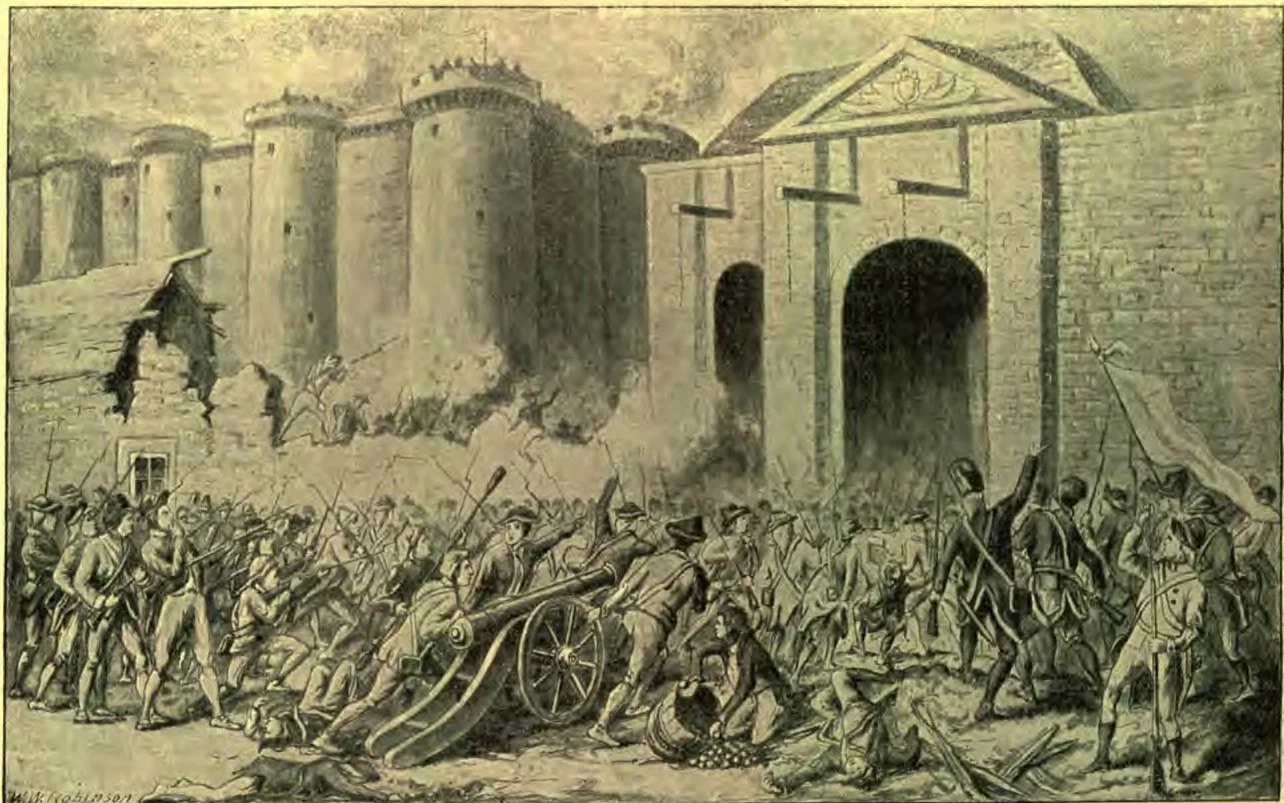
STORMING OF THE BASTILE, IN THE FRENCH REVOLUTION.
The grounds back of the palace are beautifully laid out, in sections, each of which is covered with trees of a different kind. Having been growing so many years, these have now attained a great size. As the grounds are higher than any others in the immediate vicinity, the thought suggests itself, Where does the water for the ponds and fountains come from? The explanation given is that it is brought many miles in underground aqueducts. The place is a beautiful sight to behold, but one can not repress a thought of pity for the poor laborers who were so terribly oppressed by the proud monarchs of France when it was built. The fact that royalty reveled in luxury, and hesitated at no extravagance in carrying out its ambitions and pandering to its desires, was the most potent cause of the terrible Revolution in which France forgot all justice, religion, and morality.
The accompanying illustration, “Storming the Bastile,” gives some idea of the fury of the insane mob that took things into its own hands in that memorable year 1789. La Bastile, situated in the Faubourg Saint-Antoine, was built in the fourteenth century, and was originally used as a fort, but later was made a prison, in which inconceivable tortures and cruelties were perpetrated. The people utterly destroyed the whole structure; and after peace was restored, a monument was erected on the spot, which still stands as a reminder of the great struggle between princes and paupers, rulers and subjects, labor and capital.
On the banks of the Seine in the heart of Paris stands a statue of Voltaire. His greatness, commemorated by this elegant work of art, consisted largely of his infidelity. His character is so common throughout the country that the expression, “Infidel France,” has become a stereotyped phrase. This unbelief in God followed as a natural result of the selfish actions of rulers who, while they professed Christianity, lived such wicked lives, and indulged in such unrivaled excesses, that men were led to think that if this was Christianity, they did not care to have it. What a lesson for all who profess to follow the meek and lowly Jesus of Nazareth!
A beautiful boat ride for a distance of several miles to St. Cloud and return, on the ever-turning Seine, was enjoyed on one of the last days of the visit. Hundreds of little launches run up and down the river continually, and a ride on one of them the length of the city gives views of life among certain classes not well seen in any other way.
At seven o'clock on Tuesday evening a train was entered at the Station du Nord for the homeward journey. Being “excursionists,” our tired travelers were obliged to occupy a compartment well filled with men who could not understand how the odor of bad tobacco could be objectionable to any one. Just before going into the car, a loaf of Paris bread was purchased by the younger man, which he took home and varnished, to preserve as a souvenir and curiosity. It is a yard long, about the size of a man's wrist, and is still well preserved.
The passage across the Channel was even rougher than before, and the boat was smaller. As a result, both tourists were thoroughly seasick, and had to repair to couches in the cabin. Once the waves broke entirely over the boat, and the water came pouring down the carpeted stairs into the cabin. During the violent tossings of the boat, a lighted lamp broke its fastenings, and fell, striking within a few inches of the older tourist's head, and breaking into many pieces, the oil running all over the couch and out upon the floor. It was a narrow escape both from the fall of the lamp and from fire.
As the early morning fog began to lift from the steaming Thames, and the hundreds of butcher's carts were hurrying away with their day's supply from the Smithfield market to their respective shops in every part of the great city, the two travelers alighted from the train, and boarded another on the Underground Railway for Holloway Station, near which was a place where some good cooking and an opportunity to sleep were appreciated to their fullest extent. H. E. Simkin.

WE ARE HIS WITNESSES

I

For three years and a half the disciples of Christ were learning lessons from the greatest Teacher the world ever knew. As Christ’s work of ministry drew to a close, and he knew that he would soon leave them to work without his personal presence, he sought to encourage and prepare them for this work. He knew also that they would meet with persecution and loss, and he would prepare them for these. “If the world hate you,” he said, “ye know that it hated me before it hated you. If ye were of the world, the world would love his own: but because ye are not of the world, but I have chosen you out of the world, therefore the world hateth you. Remember the word that I said unto you, The servant is not greater than his lord. If they have persecuted me, they will also persecute you; if they have kept my saying, they will keep yours also. But all these things will they do unto you for my name’s sake, because they know not him that sent me. . . . But when the Comforter is come, whom I will send unto you from the Father, even the Spirit of truth, which proceedeth from the Father, he shall testify of me: and ye also shall bear witness, because ye have been with me from the beginning.”
Christ left a great work in the hands of his followers, but he left this promise with them: “Lo, I am with you alway, even unto the end of the world.” In his prayer to the Father for them, he said: “I pray not that thou shouldest take them out of the world, but that thou shouldest keep them from the evil. . . . Sanctify them through thy truth; thy word is truth. . . . Neither pray I for these alone, but for them also which shall believe on me through their word.” The lesson that Christ wished to impress indelibly on the minds of his followers was the importance of the agency of the Holy Spirit, and the field of usefulness that would open before them through the influence of this gift.
The parting interview of Christ with his disciples was an occasion of deepest interest. Clustering around him, a lonely company, expecting they knew not what, they were saddened as they realized that their beloved Master and Friend was soon to be separated from them. During the three years he had been with them, they had looked to him for guidance in all their difficulties, and for comfort in all their sorrows and disappointments, and they were greatly oppressed at thought of parting from him. Forebodings of evil filled their hearts, but the words of Christ were full of hope: “Let not your heart be troubled: ye believe in God, believe also in me. In my Father’s house are many mansions: if it were not so, I would have told you. I go to prepare a place for you. And if I go and prepare a place for you, I will come again, and receive you unto myself; that where I am, there ye may be also.” Christ’s only thought was to offer consolation to his followers. He knew that in their coming trials their faith would be terribly shaken, and he appealed to them to believe in God as they had believed in him.
For forty days after his resurrection, Christ remained on earth, comforting his disciples, and opening to them the Scriptures. “Thus it is written,” he said, “and thus it behoved Christ to suffer, and to rise from the dead the third day: and that repentance and remission of sins should be preached in his name among all nations, beginning at Jerusalem. And ye are witnesses of these things.”
“And he led them out as far as to Bethany, and he lifted up his hands, and blessed them.” As he stood on the mount of Olives, his hands outstretched in blessing, a cloud descended, and received him out of their sight. As the disciples watched to catch the last glimpse of their ascending Lord, two angels stood by them, who inquired: “Ye men of Galilee, why stand ye gazing up into heaven? this same Jesus, which is taken up from you into heaven, shall so come in like manner as ye have seen him go into heaven.” Thus the disciples were encouraged with the promise that their Master would come again. They returned to Jerusalem with great joy, not because they had lost the companionship of their Lord, but because of the promise that he would come again. This was a precious thought to them in the trying future.
MRS. E. G. WHITE.

“HANGING ON” TO HIM

THE city missionary was standing on the corner, waiting for a car. He had been called to see a dying man in the tenement-house district, had stayed with him till the end, and it was now almost midnight.
While he waited, an old woman, with a shawl thrown over her head, came across the street, and stood on the corner, as if undecided which way to go. The missionary had often been in the neighborhood, and recognized the woman as one he had seen before.
“You are out late,” he said.
“Yes,” she replied, in a troubled tone, “I’m a-lookin’ for some one, an’ I can’t find him.”
“Who is it you’re looking for?”
“My grandson. I’ve been trailin’ ’round ever since dark, tryin’ to find him. I can’t bear to go home without him, I’m so afraid he’ll get into trouble again.”
“Then he has been in trouble?”
“Yes, he’s served three months in prison, and him only seventeen! He’d been arrested three times before, but he never got sent to the island but once. I got hold of the money to pay his fines the other times. Some folks think I’m a fool to hang on to him so, after the way he’s carried on; but I promised his mother that I’d never give Robert up, an’ I ain’t goin’ to. He’s wild an’ reckless, an’ he does wrong all the time; but that’s no reason why I should give him up, an’ I don’t intend to.”
“Where do you think he is to-night?”
“I don’t know. He said he would come home by nine o’clock, but he didn’t. Mebbe he’s in the police-station, an’ will be sent to jail again; but if he is, I’ll still hang on to him when he gets out. I’m his grandmother, you see, an’ he’s only seventeen.”
The car came along, and the missionary boarded it and went his way. It was his business to carry help and comfort and good advice to those in need; but this time, he felt, it was he who had been helped; and now, when loving efforts fail, and those whom he seeks to reform go wrong again, he thinks of that faithful old soul on that street corner, and “hangs on.”—Companion.

WHAT ARE YOU DOING WITH THEM?

WE mean what are you doing with your INSTRUCTORS? We know just what some are doing with theirs, and that the Lord is blessing them in so doing; and we wonder what you are doing with yours. Some of the INSTRUCTOR family—yes, a considerable number of them—after carefully reading and digesting the many good things that appear in this paper from week to week, give their copies out to their neighbors to read, calling their special attention to some of the excellent articles therein contained. Others, after having read them, send them away through the mail to distant friends, knowing that the precious seeds of present truth found therein will germinate in the fruitful soil of some honest heart, and bear fruit in the eternal kingdom of God. Again we ask, What are you doing with yours?

THE PATH OF THE JUST

High up above the world There is a narrow way; A glorious light doth shine thereon, Bright from the realms of day. Though narrow is the path, Yet there is room for all. Follow the light that shines before, And thou shalt never fall.
They in this shining path Look not unto the world. The banner of the cross of Christ Above them is unfurled. There are the good and true; Pure, blood-washed robes they wear. No room for those who walk in sin; The just alone are there.
Unto this shining path The Saviour is the door; And all along throughout the way He goeth on before. And those who keep that path, And do not step aside, Will in a glorious, blessed home For aye in peace abide.
MARY E. INMAN.

Saturn and Its Rings

ASTRONOMICAL STUDY—NO. XIV

Saturn and Its Rings
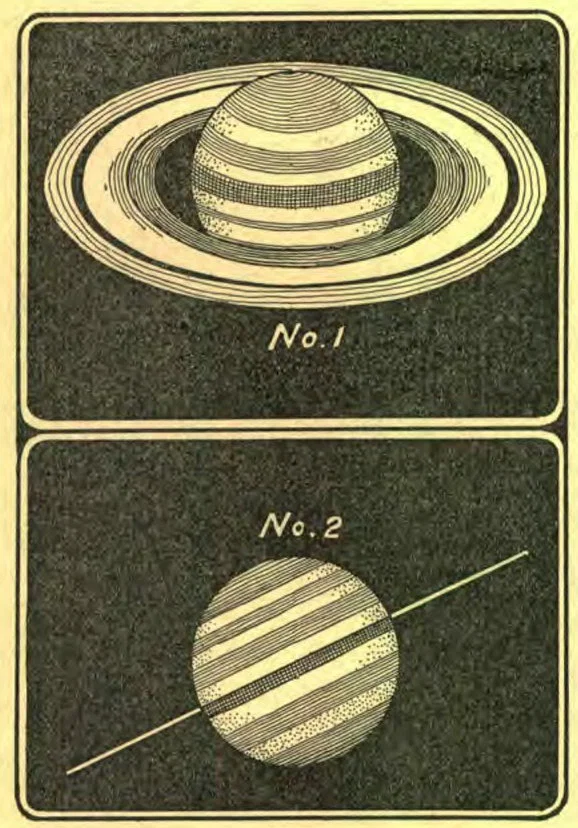
IN our last study about Saturn we learned some interesting things concerning this, the most beautiful of all our solar brothers. That which makes Saturn especially attractive when seen through the eye of the telescope is its accompanying system of satellites and rings. The rings compose the feature that becomes the special object of interest and attraction. The first illustration shows the rings as they appear to us when the planet is in such a position as to give us their fullest view; while the second shows them as they appear when their thin edges are turned exactly toward our earth, which occurs once in fifteen years. The extreme thinness of these great rings makes them almost invisible to us at such times, only the larger telescopes showing them at all. Their appearance then is merely that of a fine thread of light. These rings are estimated to be about one hundred miles in thickness. At present the rings are widely exposed, as shown in the first illustration, and a beautiful sight they are, when viewed through even an ordinary telescope. They will grow less and less conspicuous, until, in 1907-08, they will present their thin edges again, as they did in 1892-93.
These rings, as shown, are three in number, the inner one being extremely thin, and seemingly of a vaporous substance. This innermost of the three rings was not discovered until the year 1850, by Astronomer Bond, of Cambridge. This ring has a width of about nine thousand miles, and its inner circle is between nine and ten thousand miles distant from the equator of the planet. The middle ring, which is the broadest of the three, is about seventeen thousand miles wide, while the outer ring is about ten thousand miles broad. This outer ring has a diameter of about one hundred and sixty-eight thousand miles. The distance between the central and outer rings is estimated at about seventeen hundred and ninety miles; through this space the distant fixed stars are plainly discernible. These rings each revolve about the planet in about the same time, and in nearly as short a period as the planet makes its own axial revolution,—which time was mentioned in our last study on Saturn.
As to just what these rings are, we do not know. We learn, however, by the aid of the spectroscope, that they are not solid, continuous planes; but are composed of small particles, which move among themselves as the whole ring revolves about its primary. Each ring might be said to be composed of a swarm of small meteors, or some substance of that nature. We know the rings are not solid; for in their daily revolution around the planet the outer edge of each ring falls behind the inner edge, which could not be the case were they composed of solid materials, firmly bound together. They differ also in thickness, as is seen when their thin edges are turned toward our earth.
We believe the object of these rings to be not only to give light,—that is, to reflect light,—the same as do its moons, but also to produce its changes of seasons; for, personally, we can not see how Mercury, with its axis perpendicular to the plane of its orbit, can have any marked changes of seasons other than as they would be effected by the long-continued reflected light received from its rings when in a certain position, and then the withdrawing of that extra amount of light, and those parts of the planet being thrown in the darkness of the shadow that is cast so strongly by these rings, for another period of time.
We can have but little conception of the beauties of the heavens of a world furnished with such objects as these rings of which we have been studying, circling inside a retinue of eight moons, all making their eastward journey about their primary in different periods of time, and undergoing the various phases through which we love so much to watch our own one moon make its beautiful changes. Again we repeat the text, “The heavens declare the glory of God, and the firmament showeth his handiwork. Day unto day uttereth speech, and night unto night showeth knowledge.”
Dr. O. C. GODSMARK.

SMALL THINGS AND GREAT CHARACTERS

SMALL things are not infrequently agents in the development of great characters; and, on the other hand, it would appear that mere trifles have become the agencies whereby strong characters and noble aspirations have been eternally wrecked. Faithful and conscientious attention to the small things of life; an earnest endeavor to live by principle and not by impulse; the guiding of one’s life by the helm of faith instead of the rudder of feeling,—these are among the most powerful of influences for the development of great, strong, trustworthy characters.
Great characters often dwell in insignificant houses. Those who pride themselves on being cultured, refined, and educated, may often regard these truly great characters as uncouth, unlearned, and uncultured. The greatness of these noble characters consists in nothing more nor less than the true grace and culture that the God of all grace gives, together with that learning which is the knowledge of him “whom to know aright is life eternal.” Such a person is truly cultured, truly learned; for the elements of eternal greatness are being daily woven into the character-structure; while the character of the worldly critic is being built of the weak and beggarly elements of this world,—human pride, self-indulgence, and the study of culture and science, falsely so called.
It is faithfulness in little things that determines our fitness to enter into the great things of the future life. He who is faithful in that which is least, is made ruler of that which is much.
Young men and women of to-day can be faithful to every sacred trust and to every missionary opportunity; they can do nothing more, and surely God will be satisfied with nothing less. If we are faithful, God will be successful. Every character that has been made truly great by great faithfulness, even in small things, will by and by arise on the horizon of the eternal morning; and it will then appear, although it may not have appeared before, that by being faithful in the small things of life, planks of eternal endurance were placed in the ship of character. W. S. SADLER.

THE SONG AT THE OPEN DOOR

My neighbor sits at her open door, Under the leaves of the locust tree; And the joy of life grows more and more, For the song she sings to me. The song she sings is a song with wings; And the blasts may beat, and the floods may pour, But the skies are blue in the song she sings As she sits at her open door.
My neighbor's cottage across the way Is cozily builded of straw and strings, Of sticks and feathers and love and clay And the beautiful song she sings; But never a nest, though ever so blest, Could hold her heart's divine outpour, And heaven bends down to the low brown nest As she sings in her open door.
I wonder oft as I hear her sing: “My little neighbor, have you no care?” A cherry ripe and a moth a-wing Are all her dainty fare. Fain would I do some service true For the song that has blessed me o'er and o'er; But Heaven does all that love can do For the bird at the open door.
— The Independent.

Light Travels Slowly: Seeing Celestial Bodies as They Were

We do not see the moon as it is, but as it was a second and a quarter before; that is, were the moon dispersed into atoms, we should still see it entire and perfect for more than a second. We do not see the sun as it now is, but as it was eight minutes before; Jupiter as it was fifty-two minutes since; Uranus as it was more than two hours before; the star in Centaur as it was three years ago; Vega as it was nine and a quarter years ago; and the star of the tenth magnitude as it was four thousand years ago.—Selected.

Sorrow Without Bitterness

SOME sorrows, for all their intensity of anguish, have no element of bitterness in them; they bring suffering, pure and simple, but they are poisoned by no taint of sin. If such sorrows have been allotted us, let us thank God for them on bended knees!—H. E. Belin.

SOWING FOR SOMETHING BETTER THAN BACKSLIDING

First harrow the soil of your heart thoroughly with Job 33:27: “If any say, I have sinned, and perverted that which was right, and it profited me not [that is, I have received no benefit from it].” Read this verse over eight or ten times, and then see if, down in the very depths of your heart, you have some definite supposition of what it means to have sinned; which virtually means to have touched the apple of God’s eye (Zech. 2:8), and next, consider what an awful thing it is to have “perverted that which was right.”
Has God given you a gift of speech? and have you been using it principally for the purpose of gossiping about your neighbors and associates?
Have you been given the gift of knowledge, so that you can readily stand at the head of your classes, and easily win the educational prizes? and then, instead of thanking God for this gift every day, have you looked down upon and despised those who could not do as well as yourself?
If you possess a beautiful face, have you recognized that God gave it to you to represent to the world a little of the glory of the divine Architect? or have you simply felt flattered and vain?
Have you attractive and winning ways? and have you simply used them that you might become recognized as a leader in society, or have you used them to inspire discouraged souls to seek higher ideals?
If not, you “have perverted that which was right;” and if you carefully weigh the whole matter in the balances of the sanctuary, you will probably come to the conclusion, “It profited me not.”
When you have taken this stand, then just as truly as God’s throne is in the heavens, he will carry out his part, found in verse 28,—he will deliver your soul from going into the pit.
It may be that, in being dragged out from that pit, your shoulders will occasionally scrape against the edges of it, and this may sometimes be a source of bitter discouragement to you. Occasionally you will be tempted to look down into the pit from which you have been taken, and it will appear just as dark as it was when you were down there; but remember that your part is to live out the attitude indicated in verse 27, which you have the power in yourself to do. Then God will bring to pass the blessed results pointed out in verse 28, which you do not have the power to do; for no one can deliver his own soul.
Another way to prepare the gospel soil in your heart is to meditate upon the truth which is found in 2 Cor. 8:12: “For if there first be a willing mind, it is accepted according to that a man hath, and not according to that he hath not.” You can not change your mind, but you can be willing. Notice in how simple a manner God deals with chronic backsliders. He simply asks them to do the things they can do, and then he works a miracle to accomplish that which they can not do for themselves. When you have done your part, simple though it may be, you have a right to reckon yourself to be dead indeed unto sin, but alive unto God through Jesus Christ our Lord. Rom. 6:11. You may not feel very much alive, or recognize your old self to be very dead; and, therefore, it is necessary to reckon that it is so. But the moment you do this, that moment God reckons, or counts, this to you for righteousness. Rom. 4:3. In other words, Christ takes your place, and God treats you as Christ deserves to be treated.
Sometimes you will be anxious to feel and see your own progress much faster than God can trust you to see it. If so, you should bear in mind that Paul had discouraging obstacles to meet until only a short time before his death; and that God has said, “My strength is made perfect in weakness.” 2 Cor. 12:9.
Let us, then, instead of spending our time being dissatisfied with our advancement (we shall never be fully satisfied with it in this world), learn in whatsoever state we are therewith to be content, when we know we are carrying out God’s principles in reference to growth. Not content with ourselves, but content with God; for we know that he is watching our growth; and to the Christian everything does not necessarily have to appear in this world. God can not yet trust us with all the lessons he has for us. It is enough for us to know that the process is going on under divine guidance. Our part is to sit at the feet of Jesus, and hear his word.
DAVID PAULSON, M. D.

FUN WITH “DUTCH TEARS”

“It is a great wonder to me,” said an old chemist in his laboratory the other day, “why more boys do not take up chemical experiments as an amusement. Why, I can do things with the common materials of everyday life that really seem more magical to the uninitiated than many of the wonders performed by magicians on the public stage.
“Now there are those curious little bubbles of glass known as ‘Prince Rupert’s drops’ and ‘Dutch tears.’ Apparently, they are merely little globules of glass, with elongated tails, made by heating a small glass rod in a flame, and allowing the molten drops to fall into water. After they have cooled, you may pound the thick part with a hammer or mallet without breaking it. On the other hand, if you break a little piece off their tails, or prick any part of them with a quartz crystal, they will disappear into the surrounding atmosphere quicker than snow will melt on a hot fire. To the person who does not know the reason, the performance is most astonishing.
“And yet it is all very simple. It is due to what is known as ‘surface cohesion.’ Glass, when heated to a molten state, has naturally reached a very high temperature; and when the drops of melted glass are allowed to fall into the cold water, the sudden change produces a really terrific stress all over the surface of the drop. This stress, however, must be considered as a whole. It is strong when taken altogether, but it is exactly as if a piece of very thin rubber was stretched over the surface of the glass. If you punctured the rubber, its haste to resume its normal condition would pull it off the glass.
“So when you break off the tail of the drop, or cut through the film of hard glass with a crystal, its endeavor suddenly to resume its normal condition results in its own destruction, and it breaks up into particles finer than the finest sand. It seems like a wonderful performance, but it is no more wonderful than many another that any youngster could perform if he would study even the simplest forms of chemical action.”—Selected.

BE COURTEOUS

NOT long ago I attended church services in a city not far distant. I was a stranger to most of those present, but I shall not soon forget a young boy who sat near me. When the hymn was given out, he found it each time, and gracefully handed me his book. He was not tall enough to share it with me, so he gave it wholly for my use. As I took the book, I could not but think, Here is a boy who is courteous; he has been well trained by a careful mother, who has taught him to be kind to strangers. His earnest face has often been in my thoughts since then; and my prayer is, God bless him; and as he grows in years, may he not forget to remember others, and seek to make them happy.
When a young girl, I was standing one afternoon with a group of young friends at the forks of a road, when a stranger rode up, and being undecided which road to take, asked the way. One girl gave him a pert answer, which would have misled him had he followed her direction. A quiet, plain-looking girl then stepped out from the group, and answered his question. With a smile he thanked her, and said, “You reflect credit upon your mother and your home training, miss,” as he turned and rode away.
This incident made a deep impression on my mind, and led me to ask myself if my conduct to others was such as to bring honor or dishonor upon my own dear mother? Would people judge of my home training by my manners abroad?
Have you ever thought of this? If you are rude and boisterous on the streets, will it be said, “She has been brought up in a refined home; that boy has been gently trained”? Sometimes young people do not follow their good home teachings; they get into bad company, and say and do things they would be ashamed to have their parents know. Mother is not to blame for their rudeness; but some one will misjudge her, and she will have to bear the blame of their ill behavior. Remember this, dear young friends, when tempted to be pert or rude. MRS. M. C. DU BOIS.

READY FOR BED

WHERE have the little feet been to-day? Out to the field where the lambs are at play; Down to bring grandma a drink from the brook; Up the long stair after mama's new book; Now they are ready for bed.
What have the little hands done to-day? Gathered the roses and pansies so gay; They had Rover to pat, and Dolly to dress, And pictures to show to wee baby Bess: Now they are ready for bed.
What have the little eyes done to-day? Smiled all the frowns and teardrops away; Old Speckle's nest they spied on the ground; Grandpa's lost spectacles, too, have they found: Now they are ready for bed.
ELIZABETH ROSSER.

LOOK FORWARD

An old man sits sighing to live his days over (Ah, boys! could you see him, you'd pity him, too); He grieved that he'd lived like a purposeless rover, And squandered his substance in riot and rue.
He wished he could find in a misspent existence A year that would something of evil requite; Alas for the seeds of a willful persistence! Alas for a field with its tares and its blight!
The right way, you'll find, is the way of the sages, Whatever the doubter and scorner may say. The test of to-morrow, the verdict of ages, Are found in the purpose and strength of to-day.
In action, be prompt for the long life before you; In thought, be secure for the evils that hide; In speech, be on guard for the tempters that lure you; And stand undismayed with the true and the tried.
FRANK WALCOTT HUTT.

YET EVEN SO DO I

“What does this spell?”— so asks my little son, As, bending o’er a book with earnest air, He tells the letters one by one—“‘L-I’?” “There must be other letters printed there,” I say: “Yes, ‘F;’ and now what does it spell?” “What else?” I ask. Impatient with the strife For knowledge, with a frown he murmurs, “‘E;’” And then—and not till then—I answer, “Life.”
Yet even so do I. With book in hand, Wherein the Master has my small task set, I tell its hard words singly, asking, “What? Why? When?” And oftentimes I fret, And deem the answer needlessly delayed. But this I know: When life’s last word is told, Then will the Master turn, and unto me The meaning of the mystery unfold.
— Young People’s Weekly.
Continue reading: MABEL'S SECRET