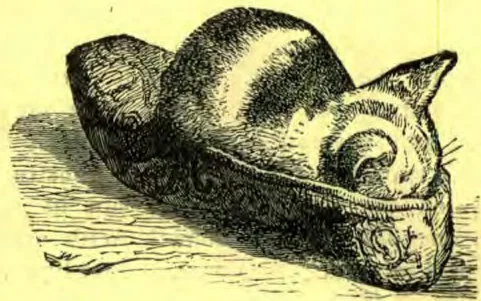
The first day of the New Year, and the children were quarreling! A bad beginning, truly!
“Alice and Harriet, take your knitting-work. John and Henry, you may each bring nine armfuls of wood into the woodshed. Mabel, you may take your slate and write; and I guess if they are left alone, the two babies can take care of themselves. Now, for half an hour let us have silence. If anybody speaks, let it be in a whisper.”
So there was silence in the kitchen, except the pleasant clatter the little mother made with her pie-making, and the occasional prattle of the two babies.
There was generally considerable noise at Number Thirteen; and sometimes — pretty often — it wasn’t pleasant noise. The children were all young, and all wanted their own way. But they had learned to mind their mother.
Little Mabel sat with her slate on her knee, looking thoughtful. She wrote and erased, and wrote again, with much painstaking labor. At last she seemed satisfied, and going to her mother, said, in a whisper: “May I have a little piece of white paper and a pencil out of your drawer? I want to copy something.”
“What is it? Let me see,” said her mother.
Mabel hesitated and blushed, but held it up to her, saying, “You won’t tell, will you, mother?”
Her mother read it twice over. Tears gathered in her eyes.
“No, no, certainly not; it shall be a little secret between you and me.”
“You won’t tell anybody, will you?” entreated little Mabel
She got a clean piece of paper, and sharpened the pencil anew for the child, although she was pie-making.
Mabel copied it very carefully, and laid it away in the bottom of her handkerchief-box, saying: “I shall see it often there, and nobody goes there but mother and me.”
But it happened one day that Harriet was sent to distribute the pile of clean handkerchiefs from the ironing into the different boxes; and as Mabel’s was empty, she saw the writing. It was so short that she took it in at a glance:—
“Resolved, To Alwas spek pleasant when Enny body speks cros. MABEL FORD.”
Somehow it fixed itself in Harriet’s mind; and that evening she was busy with pen and ink. The result was a paper in Harriet’s handkerchief-box, with the resolution written more neatly, but the same in effect.
“Resolved, That I will try this year to return pleasant words for cross ones.”
“HARRIET FORD.”
It made a difference that was easy to see when two of the children began to practice this resolution. There was less of quarreling.
“That’s mine! You’d better mind your own business!” said John to Harriet, one day, when she took up his top, and was putting it in his drawer.
“But, John, mother wants me to clear up the room,” said Harriet.
“Well, I want the top to stay there,” said John, obstinately.
“Well, perhaps it’s no matter. A top isn’t much litter,” said Harriet, pleasantly.
John was fully prepared for a contest. I’m afraid he would rather have relished one. He stared. Then he looked ashamed.
“What made you say that, Harriet?”
Harriet laughed, and colored a little.
“Tell me! what made you?” John insisted.
“Come here, and I’ll show you,” said she.
She took him into the clothes-press, where was the row of pretty handkerchief-boxes, each labeled.
She opened little Mabel’s and took out the clean, soft pile of handkerchiefs. “Look there!” said she. John read.
“The good little thing! She never does quarrel anyhow,” said John.
“So I thought I’d better put one in mine, too,” said Harriet, and she showed hers.—Youth’s Companion.
READY FOR BED
A HOME
By Grace M. Tilden
ONE sunshiny afternoon when Leil and her friend Katherine were playing in the yard, they noticed a little round hole in the ground near the barn door, and piled up beside the hole a tiny mound of fresh brown earth. Leil went into the house, and told mama about it; and mama said, “A gopher must be digging himself a home in our yard.”
She went out with the little girls, and they all stepped softly until they were close to the hole, then stood very still and waited. Soon a little brown nose appeared above the top of the hole, and two bright eyes looked inquiringly at the children.
“Oh, isn’t he cute!” Leil said.
The gopher heard her voice, and was so frightened that he slipped down out of sight before Leil could wink her eyes; but he soon got over his fright, and came again and again to the top of the hole with the dirt he had scratched loose with his sharp forefeet. He pushed out the dirt with his head.
Once the gopher came entirely out of his hole. Then Liel saw that he was about as large as a big rat, and Katherine noticed that his back was black and brown striped; but neither said a word, for fear of frightening him again.
For an hour the little fellow worked with all his might, while the girls watched him.—Grace M. Tilden.
THE INDIAN MORTAR
When strolling in the foothills near Santa Barbara one day, we found an Indian mortar. Being of stone, it was rather heavy, but we managed to carry it down to our buggy, and, bringing it home, for the want of anything better to do with it, we placed it under the hydrant near the big palm-tree on the lawn, and thought little more about it.
Naturally, the dripping water soon filled it, and then we had reason to remember with great pleasure our setting it there. On warm days the big dogs, trotting wearily behind a farm wagon, their tongues lolling out, would run into the yard,—our gate was nearly always open,—and eagerly lap up the water from the mortar, and then trot on again, in evident satisfaction. It soon came to be the general watering-place for our four-footed friends; and we wondered that it had never occurred to us how few places there are where dogs can get a drink, and how they must sometimes suffer from thirst.
But the birds appreciated the new convenience even more than did the dogs; and it would be difficult to say which experienced the greater enjoyment,—they in reveling in the mortar, or we in watching them. Though several years have passed, it is still my delight to sit at the window, and see the birds taking their morning bath. Madam Linnet comes to take a plunge, and, lighting on the mortar, steps carefully in at the edge to ascertain the depth, and then boldly plunges into the middle, where she flutters her wings and tail, and ducks her head, sending such a shower of pearls over her back that one would think she would almost drown. Mr. Linnet ventures timidly near, as if to remind her that he, too, is entitled to a bath, and that she is appropriating more time than properly belongs to her; but she deliberately drives him away, and goes on with her toilet.
But here comes a larger bird, with a striped head, and takes possession of the bath-tub as if it were not already occupied; and Mrs. Linnet, with an air of having had all she wanted anyhow, flies away with Mr. Linnet, leaving the new bird, and several friends who have joined him, in possession.
When they are gone, a robin flies down to the water, and is sipping away at his leisure,302when a tiny brown bird lights by him, and pecks him saucily. The big robin looks around somewhat startled, and, seeing his little rival, flies away. The brown bird hops in as if it were his right, and takes a glorious bath. He evidently feels that the robin has not made the most of his opportunities.
And so the little bird drama goes on, with variations, day after day. Would you like to see it? Then place some kind of basin of suitable size and depth in a convenient place, and the birds will be almost sure to utilize it.—Selected.
Notes and Comments
By A. J. Bourdeau
Wu Ting Fang's Ability.— It is stated upon good authority that Mr. Wu Ting Fang, the Chinese minister at Washington, D. C., is a law writer of ability. Among other things, he has “codified the body of international law for the Chinese, and has prepared a body, or code, of common law for that empire.” He has also been “a prolific writer in Chinese on historical and literary topics,” and is “a graduate of a European law school, as well as of an English university.” He is becoming popular in this country as an after-dinner speaker.
The Trouble with Liquid Air.— The advantages of liquid air are many, but it has one disadvantage,—it is impossible to keep it from evaporating rapidly. Its tendency is to rise rapidly to the surrounding temperature. In evaporating it will, if confined, exert a much stronger power than steam under pressure. According to Mr. Carl Linde, small quantities may be preserved in well-exhausted and silvered double-walled glass vessels for a relatively long time. “One liter of liquid air requires for its evaporation in such a vessel, about fourteen days.” On the other hand, “the ordinary sheet-iron vessels used industrially, holding about fifty liters, and covered with felt or wool, allow about two liters to evaporate hourly. Experiments are being made with a view to building large double-walled and silvered sheet-iron holders; and we may expect that holders will be constructed in which the evaporation will not be more than one per cent an hour.” With such a prospect in view, it would seem that liquid air has a great future of usefulness before it.
Keeping up with the Fashions.— According to a German newspaper, a woman in that country recently said, in a public assembly, that “out of every hundred women convicts, ninety-nine are brought into prison by an inordinate passion for fine dress.” In visiting the departments for women prisoners, she questioned the inmates regarding the cause that had brought them there, and almost invariably found that “they had stolen articles of luxury, in order to keep up with fashion.” Such is quite likely to be the case with women convicts in other countries besides Germany.
A Man of One Book.— It was John Wesley who said: “To candid, reasonable men, I am not afraid to lay open what have been the inmost thoughts of my heart. . . . I want to know one thing,—the way to heaven; how to land safe on that happy shore. God himself has condescended to teach the way; for this very end he came from heaven. He has written it down in a book! Oh, give me that book! At any price, give me the book of God! I have it: here is knowledge enough for me. Let me be homo unius libri (a man of one book). Here, then, I am, far from the busy ways of men. I sit down alone: only God is here. In his presence I open, I read, this book; for this end,—to find the way to heaven. Is there a doubt concerning the meaning of what I read? Does anything appear dark or intricate? I lift up my heart to the Father of lights! ‘Lord, is it not thy word, “If any man lack wisdom, let him ask of God”? Thou “givest to all men liberally, and upbraideth not.” Thou hast said, “If any man will do his will, he shall know.” I am willing to do; let me know thy will.’ I then search after, and consider, parallel passages of Scripture, ‘comparing spiritual things with spiritual.’ I meditate thereon, with all the attention and earnestness of which my mind is capable. . . . And what I thus learn, that I teach.” A. J. BOURDEAU.
OCTOBER STUDY OF THE FIELD
PART 1: “RELIGIONS OF CHINA”
(September 30 to October 6) *
1. The God of Office.—The Chinaman worships his gods mainly with the hope of obtaining personal benefit. Those who are fortunate enough to secure literary degrees in competitive examinations go to the Confucian temple, and prostrate themselves in worship for this blessing bestowed. And it is Confucius they worship with the view of getting official position.
2. The Temple and Grave of Confucius.—In Kewfoo, the native city of the philosopher, is the most famous temple in the empire. In this inclosure are the well from which Confucius is said to have drunk, the stump of a tree which he planted, and a pavilion marking the spot where stood his schoolhouse, in which many of China’s philosophers were educated. Here are also the large gilded image of the great teacher, the images of his twelve most celebrated apostles, and those of his seventy-two disciples. The grave is marked by a mound twelve feet high and thirty in diameter. The Chinese emperors have frequently made pilgrimages to this spot and worshiped there.
3. The Founder of Taoism.—The official title of Lao-tsze is “Great Supreme Venerable Prince.” He was probably born about 604 B. C., in the province of Honan. Though so much is known of the founders of Confucianism and Buddhism, but little can be ascertained of the life of this man. Having been made the emperor’s librarian, he studied diligently ancient books, becoming acquainted with the rites and histories of former times. He gained a large number of students, and as a teacher of philosophy became famous. The great work of this man is the “Tao Teh King,” or “Canons of Wisdom and Virtue.”
4. The Elixir of Immortality.—In the writings of the ancient Taoists are found allusions303to “spiritual medicine,” “pearly food,” and “fountains of nectar.” One recipe required that several hundred ounces of gold and silver, with red coloring-matter, lead, and mercury, be put in a crucible, over a steady fire. On the forty-ninth day they would unite. Dipped out with a ladle, placed on a waiter, and rolled, pills would be formed. If in time of poverty one of these pills were put into lead or mercury, it would change the whole to gold or silver. After five hundred years its virtue was supposed to be lost, and any one holding it then would “eat bitterness.” The “golden elixir” was a mixture of stone and metals, and was to be eaten dry and hot. It was supposed to prolong life indefinitely.
5. The Taoist Pope.—The first Taoist pope was Chang Taoling, or the Heavenly Teacher. He is the “chief of the wizards,” the “true [or ideal] man.” The Taoist pope is at the head of the one hundred thousand priests. Like the emperor, he confers buttons. He also promotes priests who come to him, giving them titles and seals of office. He is supposed to control all demons, and destroy them with his two-edged sword. (See illustration in Missionary Magazine for October.) The demons all fear this weapon, and he who wields it can catch them and shut them up in jars. The emperor and wealthy men often call upon him to go to their homes, and expel these troublesome visitors.
6. The Gods Not Sinless; Marriage; Promotion.—Men have sins, and why should not the gods? say the people of Sinim. The mandarins may lose their official buttons, and why do not the gods deserve the same punishment when they improperly direct the affairs of the upper world? It is the chief priests of Taoism who have the right to judge the gods, and sentence them when they permit calamities or pestilence to visit their earthly domains. The gods, according to the ideas held by the devotees of Taoism, may marry. An old woman was so pious that, when she died, her friends thought it fitting for her to be a goddess. The priests acted as go-betweens. By communicating with the other world, they ascertained that a certain god wanted a bride. Although the old lady was buried, yet by means of paper figures and a paper bridal chair, the ceremony was conducted, and the priests received the usual fee. Just as the mandarins are promoted, so may the gods rise from humble to exalted position for ruling well.
7. The Superstition of Taoism may be illustrated by a delusion which swept through Central China in 1877. Persons were said to have mysteriously lost their queues while walking along the streets. The Chinamen were aroused at the thought of losing their national badge. They left their houses, and slept in the streets or under the trees in groups of fifty or one hundred. Gongs were kept going all night in the hamlets, and processions with lanterns and torches passed from village to village. Men in the towns were afraid to sleep in their houses at night; for it was said that paper men would come through the roof, expanding until as large as a cow, and would crush the sleeper. The wildest rumors were afloat about these paper men. During the two months of this panic, the Taoist priests were kept busy selling genii powder. A little package of this was put in the queue as a charm to frighten away the paper men.
AN ANIMAL ALPHABET
A stands for animals,—all kinds in one,—
B beasts, birds, and fish; all that swim, fly, and run.
C stands for cat, cautious and sly;
D stands for dog, who for duty will die.
E is for elephant, with clumsy sway;
F is for fox, who will steal night or day.
G stands for goat, full of mischief and fight;
H for hyena, who slinks from the light.
I stands for ibex, so wild, fleet, and pale;
J stands for jay, and jackass, and jackal.
K's kangaroo, with his legs low and high;
L is for lion, whose roar shakes the sky.
M stands for mastodon, perished and gone;
N is for mavis, whose song wakes the morn.
O is opossum, so cunning and sleek;
P stands for piggy, who speaks in a squeak.
Q is for quail, with its soft, plaintive cry;
R is for rat, with his bright, vicious eye.
S is for sturgeon, with no backbone;
T stands for tiger, the biggest cat known.
U is for unicorn, known only in story;
V is for vulture, with beak sharp and gory;
W stands for walrus, who lives to be hoary.
X is xenurin, seen in the zoo;
Z stands for zebra. Small friends, adieu.
— Pets and Animals.
MODERN IMPROVEMENTS
A WRITER from Washington tells us that for years two large doors of entrance to the White House have been grained to represent black walnut. This year the person having the matter in charge ordered them scraped and cleaned, in readiness for repainting; and now it is discovered that the doors are of solid mahogany, of a most beautiful natural grain. Who in the forgotten past could have had them painted?
Doubtless it was some one with a mania for modern improvements; and there are many other things, naturally beautiful, which are improved out of existence in much the same way. A young girl had a sweet, clear voice, which was always at the service of her friends, a joy in home gatherings and at local entertainments, until she was seized with an ambition to cultivate it. Instead of developing its natural beauty, she has overlaid it with a mass of affectations. A distressing tremolo and a frantic straining after high notes have taken the place of the old sweet melody.
Many a boy or girl, many an older person also, mistakes sham for improvement, but it never is. “Stir up the gift that is in thee”—that is right; but do not attempt painting it into an imitation of something else.—Well-Spring.
Preparing Hearts for Heaven Through God's Grace
“We can do nothing now to build the streets and gates; but by God’s grace we can do much, very much, now to begin to become the men and women to whom heaven shall be possible.”
OUR MISSIONARIES
The tender light of home behind,
Dark heathen gloom before.
The servants of the Lord go forth
To many a foreign shore;
But the true Light that can not pale
Streams on them from above,—
A light divine, which shall not fail,—
The smile of him they love.
A wreath of love and prayer behind,
Far-reaching hope before,
The servants of the Lord go forth
To seek a foreign shore;
And wheresoe’er their footsteps move,
That hope makes sweet the air;
And all the path is paved with love,
And canopied with prayer.
Christ is the fondly-loved “behind,”
Christ is the bright “before.”
Oh, blest are they who start with him
To seek a foreign shore!
Christ is their fair, unfading light,
Christ is their shield and sword,
Christ is their keeper, day and night,
And Christ their rich reward.
This lesson includes the last three verses of the preceding lesson, as the connection is very close. See how many new thoughts you can draw from these verses; also review the lesson learned from them last week. We shall find new beauties in them as we study them in connection with the lesson of the day.
QUESTIONS
1. How is the Spirit ministered? How are miracles worked? Is it by the works of the law, or by the hearing of faith? Gal. 3:5. What is “the hearing of faith”? Rom. 10:17; note 1.
2. Who is mentioned as having thus believed God? What did the hearing of faith accomplish for him? Gal. 3:6.
3. What are they called who have the same faith that Abraham had? V. 7. What was the significance of this title? Note 2.
4. What was foreseen in the Scriptures? Because of this, what was done? In what words was the gospel preached to Abraham? V. 8. Who are meant by heathen in the Scriptures? Eph. 2:11, 12; note 3.
5. Who are blessed with Abraham? Gal. 3:9. What is the blessing of Abraham? Rom. 4:3-8; note 4.
6. Who are under the curse? Why are they cursed? Gal. 3:10. Upon how many does this curse rest? Rom. 3:10, 19, 23; note 5.
NOTES
1. The answer to the question in verse 5 is plain when we understand how faith works. “Faith cometh by hearing, and hearing by the word of God.” God in his word gave the promise of the Spirit. See Joel 2:28. The word also contains the promise that the believers shall all work miracles. See Mark 16:17, 18. The Galatians had been well instructed in the gospel by Paul, and he knew that they could give but one answer to his question.
2. The Jews made much account of being the children of Abraham. But they claimed this distinction because they were his literal descendants, and had been circumcised. Paul shows that it is faith, not works nor natural descent, that makes one a child of Abraham and a partaker of the same blessings.
3. The word translated “heathen” in the lesson is translated “Gentiles” in Eph. 2:11, 12, and means literally “the nations.” As used in the Scriptures, it refers to all who are astray from God. The Father gave his Son for the world. John 3:16. Abraham was himself a heathen till he found the Lord. His forefathers were idolaters. Joshua 24:2.
4. The blessing of Abraham, as shown by this text in Romans, is the forgiveness of sin, and the gift of righteousness, by faith in Christ. So when God gave Abraham the promise, “In thee shall all nations be blessed,” he meant this blessing of forgiveness and righteousness, which is offered to all who will receive it.
5. Those who are of faith are blessed with faithful Abraham. But all who do not have faith are under the curse, because they stand condemned as sinners. Christ came that he might save us from this curse. This he does by offering us a free salvation by faith in his name. If we willfully reject this, or seek salvation in some other way, we remain under the curse.
TO SAVE DOCTORS’ BILLS
Use “Garland,” Stoves and Ranges.
Subscription Renewal Form for October 1900
By Editor
OCTOBER, 1900
If the yellow address-label on first page of this paper, or on the wrapper, bears this month and year (John Brown Oct. 1900), it indicates that the following blank should be filled out by you now, and mailed to Review and Herald, Battle Creek, Mich., before the end of this month:—
Inclosed find $........ (money-order, express order, registered letter, or bank draft), for which please send ...... copies of the YOUTH'S INSTRUCTOR ...... months to above address.
P. S.—If you object to clipping this out of your paper, or wish to forward other subscriptions, please write names and full addresses on a separate sheet, stating amount inclosed for that purpose.
To Reach BATTLE CREEK
FROM
CHICAGO, BUFFALO, DETROIT, OR TOLEDO,
Purchase Tickets
Reading over the MICHIGAN CENTRAL
“The Niagara Falls Route.”
A First-class Line for First-class Travel between Chicago and New York and Boston. Elegantly equipped through trains pass Battle Creek in each direction daily.
R. N. R. WHEELER,
Ticket Agent, Battle Creek.
O. W. RUGGLES,
Gen'l P. and T. Agt., Chicago, Ill.
TAKE THE Canadian Pacific Railway
for . . . CHATHAM, LONDON, WOODSTOCK, PORTLAND, OTTAWA, GALT, TORONTO, and MONTREAL, QUEBEC, BOSTON.
All points in New England, the Maritime Provinces, Great Britain, and the Continent.
Illustrated literature, time-tables, and full particulars, upon application to—
J. FRANCIS LEE, GEN. AGENT., Passenger Dep’t. 228 SOUTH CLARK ST., CHICAGO.
Branch Offices: 76 Ottawa St., Grand Rapids, Mich.; Room D, Chamber of Commerce, Cincinnati, Ohio; 315 Chestnut St., St. Louis, Mo.
Cincinnati Northern Railroad Co.
TIME TABLE NO. 3.
IN EFFECT SEPT. 24, 1899.
Trains Pass Battle Creek, as follows:
WEST-BOUND.
No. 21, Mail and Express ........................ 6.58 P. M.
No. 23, Accommodation .......................... 2.07 P. M.
No. 27, Local Freight .......................... 8.25 A. M.
EAST-BOUND.
No. 22, Mail and Express ........................ 8.25 A. M.
No. 24, Accommodation .......................... 1.45 P. M.
No. 28, Local Freight .......................... 5.30 P. M.
Direct connections are made at Toledo with all roads diverging. Close connections for Detroit and Cincinnati.
J. L. READE,
Ticket Agt., Battle Creek.
E. R. SMITH, City Pass. Agt., 6 West Main St.
E. W. Meddaugh and Henry B. Joy, Receivers,
Chicago & Grand Trunk Ry.
By A. S. Parker
Trains arrive and leave Battle Creek.
WEST-BOUND FROM BATTLE CREEK.
No. 9, Mail and Express, to Chicago — 12.15 P. M.
No. 1, Chicago Express, to Chicago — 9.00 A. M.
No. 3, Lehigh Valley Express, to Chicago — 3.40 P. M.
No. 5, Pacific Express, to Chicago, with sleeper — 1.10 A. M.
No. 75, Mixed, to South Bend — 8.20 A. M.
Nos. 9 and 75, daily, except Sunday.
Nos. 1, 3, and 5, daily.
EAST-BOUND FROM BATTLE CREEK.
No. 8, Mail and Express, to Pt. Huron, East, and Detroit — 3.45 P. M.
No. 4, Lehigh Express, to Port Huron, and East — 8.57 P. M.
No. 6, Atlantic Express, to Port Huron, East, and Detroit — 2.25 A. M.
No. 2, Leh. Exp., to Saginaw, Bay City, Pt. Huron, and East — 6.50 A. M.
No. 74, Mixed, to Durand (starts at Nichols) — 7.15 A. M.
Nos. 8 and 74, daily, except Sunday.
Nos. 4, 6, and 2, daily.
A. S. PARKER, Ticket Agent,
Battle Creek
CLUBS OF “INSTRUCTORS”
By O. C. G.
WHEN we consider the extremely low price of the YOUTH’S INSTRUCTOR, especially when taken in clubs of ten or more, we wonder how any Sabbath-school in our whole denomination can think of getting along without a good club of this excellent paper. We are glad that our people are waking up to the fact that the INSTRUCTOR is not only a first-class youth’s paper; but that it is also publishing the Bible doctrines of present truth, and that many are taking hold to help this instrument of his creating, and are sending in their subscriptions both for single copies and for clubs to use in the missionary field.
It is proposed to make the INSTRUCTOR just what the Lord intended it should be,—a means of teaching the truths for these times to the people; and while it is a youth’s paper, we find that our older brethren and sisters think just as much of reading its pages as do the younger members of the family. We are glad to see our people taking hold of this matter, and believe the good work will continue to go forward.
O. C. G.
THE MISSIONARY READING CIRCLE
By Mrs. L. Flora Plummer
THE time has now come to begin again the Reading Circle Bible study in connection with the field study. Last year many were unable to find time to prepare carefully two Circle lessons each week; and as each study is important, it has been thought best to change the plan so that each lesson shall receive its due proportion of time. We are sure this change will be appreciated by our busy young people, who may now carry both series of lessons as easily as one of these studies was followed last year.
The plan now provides for but one lesson each week. There will be three lessons each month in Bible study, and one lesson each month on the field. The first lesson under the new arrangement will be a lesson on the field, and will appear in the Review of October 2, and will be studied during the week of October 7-13. The next lesson will be a Bible study to be learned the following week. The lessons will be published in both the Review and the Missionary Magazine, and the INSTRUCTOR will contain notes of interest upon the lessons. The Bible lessons will be upon the book of Revelation, with “Thoughts on Revelation,” of the Berean Library, as the text-book. The Missionary Magazine is the text-book used for the field studies.
Now we ask the INSTRUCTOR family to take hold of the Reading Circle work with all the energy of which they are capable. It is impossible to estimate the extent of the influence which each one of you may have in pushing a work of this kind. Study the lessons yourself. Encourage the study of them in your home. Talk of them to your associates. Encourage those who are less earnest than yourself, and you will be doing missionary work just as truly as he who goes to a foreign field. May the Lord bless our dear young people, and give them a “willing mind” to do his service.
Mrs. L. Flora Plummer.
THE INSTRUCTOR MISSION FUND
By Editor
We are glad to record an appreciable addition to this fund this week. The gift comes from the Sabbath-school children of Fallow, Nev., and was, as the one sending the money says, “earned by their own hands.” This money will be applied on the fund for continuing the club of INSTRUCTORS to the school at Bombay, India, and we hope those who have given it will remember to ask God’s blessing on the papers. We hope to hear from other schools, as well as individuals, for this fund.
Battle Creek College Calendar for 1900–01
THE twenty-fifth Annual Calendar of the Battle Creek College for the year 1900–01, has come to our desk. While departing widely from conventional outlines, the result is an attractive and readable booklet of over one hundred pages, full of interest from cover to cover. Under the different chapter-headings, the object of study, principles underlying true education, the result to be sought in all educational effort, etc., are set forth; and the opinions held by those in charge of the school are supplemented by extracts from the writings of many prominent educators and reformers. Thus a pleasing variety of expression is brought to the subject, and the ideas are so clearly set forth as to make a more than usual impression on the reader. Outlines of study, and the usual explanations and directions, are fully given. The Calendar will be sent free to all prospective students, and to others who are interested. Address the president, E. A. Sutherland, Battle Creek College, Battle Creek, Mich.