S. D. A. Publishing Association · Battle Creek, Mich. · May 18, 1887
THE QUESTION OF THE PRIESTHOOD SETTLED.
By George W. Amadon
About twenty years after the children of Israel had left Egypt, while they were wandering in the wilderness, there arose a spirit of jealousy and murmuring about the priesthood. The Lord had long before settled this matter, and conferred the sacred office upon Aaron and his sons by “a statute forever.” But he again condescended to give the people another standing evidence that the priestly office was lastingly placed in the house of Aaron, and so cause all their murmurings about this matter to cease.
He therefore directed Moses that each tribe should take a rod, or scepter or staff, and write upon the rod the name of the house of their fathers. And the name of Aaron was to be written upon the rod of Levi. These twelve rods were then to be laid up over night in the great tabernacle of the congregation, before the ark containing the testimony, the ten commandments. And the Lord said that the man's rod whom he had chosen to minister in the priest's office, his rod should bear blossoms. “And it came to pass that on the morrow Moses went into the tabernacle of witness, and behold the rod of Aaron, for the house of Levi, was budded, and brought forth buds, and blossomed blossoms, and yielded almonds.” The Lord then directed his servant Moses to take the rod of Aaron, all filled with buds and blossoms and fruit, and lay it up near the ark as a memorial to take away murmuring and rebellion from the people.
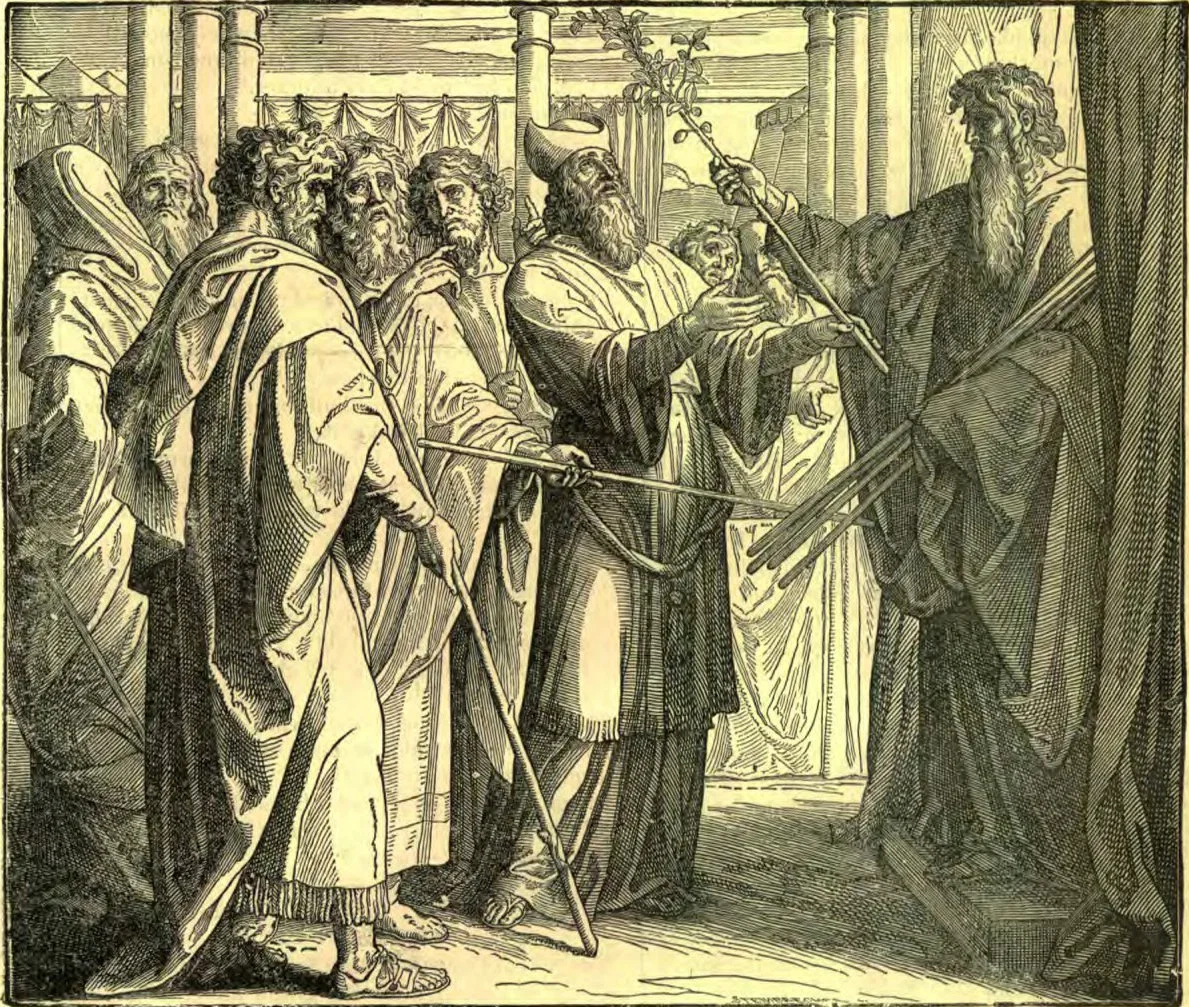
In the illustration we see the miracle of the rod being placed before the head men of the tribes. Moses, with a nimbus of light about his head, is handing the wonderful rod to Aaron, who with delighted countenance is about taking it in his hands. The others, by their dejected looks, show their disappointment in the matter. Several have their rods; one has turned away to hide his mortification, and Moses has a number of rods still in his hand, which, as he returns them to the owners, will give the silent reproof that these persons are not the ones whom the Lord has chosen, and delights to honor.
In this miracle we may note several interesting things: 1. It is an honor even to great men to be employed in the service of God. 2. The Lord having previously wrought numerous miracles to punish sin, now works one more to prevent it. 3. When Moses was directed to prepare this test for the people, he did not object that the matter was already sufficiently settled, nor did he attempt to determine the controversy himself, but he did just as the Lord had bidden him. 4. The rod of Moses, with which he worked so many miracles, was not preserved, for the keeping of it would only serve to gratify men's curiosity. But the rod of Aaron, that which carried its miracle along with it, was carefully preserved, because that would be of standing use to convince men's consciences, to silence all disputes about the priesthood, and to confirm the faith of God's people in his institutions. 5. The Lord told Moses that the man's rod whom he had chosen “should blossom;” but lo! it did much more: it “brought forth buds, and blossomed blossoms, and yielded ripe almonds.” We may also note here that the buds of good desires, the blossoms of holy resolutions, and the ripe fruit of faith, love, and obedience, all spring from the priesthood of Christ the Lord.
It has been conjectured by learned men that the rods or scepters of all the tribes of Israel were made of the common almond tree, or amygdalæ communis. In favorable soil and climate this grows to some twenty feet in height, and is a beautiful appearing tree. The Jews still carry rods of almond blossoms to the synagogues on great festival occasions.
Anciently it was customary to write inscriptions or names upon sticks or batons of office. Thus the prophet Ezekiel was directed to take two sticks, and write upon one the name of Judah and on the other the name of Ephraim. (Chap. 37:16.) A traveler in Sweden once saw several flat sticks, like straight swords, with Runic inscriptions on both sides. And the ancient Britons wrote verses on their staves or batons, which were made triangular or square according to the metre. It may also be interesting to add that the ancient heathens regarded it as totally impossible for a dry rod or stick to be endued again with life, and so they swore by their scepters, to confirm their oaths, after this manner:—
“But harken! I shall swear a solemn oath:
By this same scepter, which shall never bud
Nor boughs bring forth, as once; . . . .
And shall never grow again.”
This snatch of verse from the poet Homer dates as far back as King Solomon’s time.
Paul, in Hebrews 9:4, speaks of Aaron’s rod as being connected with the tabernacle. What became of this wonderful rod the Scriptures do not inform us. It may be that it was laid away with the sacred ark of ten commandments before the removal of the children of Israel down into the Babylonian captivity. But the history of this miracle will remain with the church94till time shall be no more. The Apostle Paul says “that the things written aforetime, are for our admonition and learning upon whom the ends of the world are come.”
G. W. AMADON.
A HEBREW PROVERB.
By Miriam K. Davis
SEE the swarthy toilers sweating under Egypt’s burning skies,—
Not a moment for repining, not a breath to spare for sighs;
Hope itself so long quiescent, they forget it has not fled;
Faith so long reviled and taunted that it surely must be dead.
Human strength can bear these burdens till they weigh it to the ground,
Human patience still endureth, till deliverance is found;
When the task ordained by Pharaoh heart and soul and sense benumbs,
“When the tale of bricks is doubled, Moses comes.”
Homely toil and sudden longings—what to us such lowly things?
Shall the soul that strives for freedom o’er them droop her fluttering wings?
Ay! for never work so lowly but of life it is a part;
Never trials grow so petty but they fret the human heart.
As the winter follows summer, after labor cometh rest,
And the Voice divine has told us that the mourner shall be blest.
Surely, though he needs no herald, clash of arms, or beat of drums,
“When the tale of bricks is doubled, Moses comes.”
Comfort ye, whose hearts impatient long for better things than these;
In the future waits deliverance that no mortal vision sees.
Though the daily task oppress thee, others yet have labored more;
Thou canst bear, and strength not fail thee, what has been endured before.
Something dear has still been left thee, as the drudging thousands see
Stars unclouded shine in promise of the nation yet to be;
And, if all but faith should fail thee, thus the sage his wisdom sums:
“When the tale of bricks is doubled, Moses comes.”
—Miriam K. Davis, in S. S. Times.
“DON'T YOU TOUCH IT.”
“JUST think!” said Fannie Eames, rushing into the room where her brother Jimmy and her mother were sitting.
“Well, what is it you want to think?” said the mother, with a smile.
“Think that Jimmy has an invitation to take dinner at Capt. Buswell’s! The captain, you know, sometimes asks the young people to come to dinner, because he likes them; and now it is our Jimmy’s turn. The captain himself just told me. Just think! you will have such a nice dinner, Jimmy!”
“Don’t you wish you were going, Fan?” said Jimmy.
“Wishing won’t do any good, Jimmy. You are the lucky one this time.”
“Well,” said Mother Eames, “we will get Jimmy ready. I believe there is one stitch to be taken in his best suit.”
Capt. Buswell was an old bachelor, and as he kept house and liked to keep an open house, he would, at times, ask some of the young people, and old ones also, to come and enjoy his hospitality. Before Jimmy went, there was the one stitch to be taken in his best suit. His mother had taken her work to the window, and when there, she saw a man staggering by.
“Do you know who that man is, Jimmy?” Mrs. Eames asked.
“The boys call him ‘Old Joe,’ mother. Oh, he is drunk!”
“He didn’t look like that when he was young, Joe.”
“No, indeed, mother.”
“Jimmy,” said his mother—she spoke in husky tones, the tears gathering in her eyes—“I have seen among my relatives trouble enough coming from liquor, and I want you never to have anything to do with it.”
“Oh, I won’t, mother.”
“Don’t touch it, Jimmy.”
“Didn’t I promise, mother, a year ago?”
“Yes, that was when Cousin George was here—”
“Only I didn’t see him. Never did.”
“You were gone down street when he called. It was the same day he made his call that you promised. Poor Cousin George! I used to ask him to promise, but he never was ready, and drink has made him much trouble. He is trying to do better now. He will visit us soon, and you will see him then.”
“Don’t you worry about me,” said Jimmy, laughing. “Whenever anybody offers me liquor, I will remember your words, ‘Don’t you touch it, Jimmy.’”
The best suit was mended, was worn, and at the dinner-party made a very creditable appearance.
That dinner-party was in Jimmy’s eyes a wonderful affair. Several of the young people were there, and all thought it a remarkable dinner. Such beautiful dishes, and not empty, either, but heaped with delicious food! Several were there whom Jimmy had never seen before; old friends, Capt. Buswell said, whom he chanced to meet in the street, and sailor-like, he said he “just towed them into port.” The captain spoke of one as an “old chum, out of town, and happening along, he had been towed into port.”
Jimmy did not catch his name, but he liked the man’s face. He would have been still more interested in the man if he could have heard a conversation between this man and his wife before he left his home in another city.
“Husband, you’ll promise me you won’t touch any liquor while you are gone?” said the wife.
“Mary, I give you my word on that. You know I have made up my mind to quit drinking. I shall keep my word. God help me!”
“And you help yourself, too.”
“I’ll try, Mary.”
Somehow, Jimmy could not keep his eyes off from this guest at Capt. Buswell’s table. Jimmy liked his handsome face, his very agreeable manner, his cheery voice. He sat quite near Capt. Buswell, and he could hear distinctly the conversation between the captain and the handsome, affable stranger. At last, Jimmy heard the captain say,—
“There! I almost forgot one thing! I believe I am losing my memory.”
He called aloud, “Bob!” A tall colored waiter, whose face Jimmy had seen several times on the street, sprang forward to receive the order, as briskly as if his master had fainted and needed help.
“Bring up a few bottles,” Jimmy heard the captain say. Then the latter added something about “beer for the young folks.”
Jimmy opened his eyes wide. Going to be drinking at that table? What would Jimmy do? “Don’t you touch it, Jimmy,” he heard his mother say. If that mother had understood what a gauntlet her boy’s principles must run at the captain’s table, she would not have permitted him to go.
However, there was Jimmy at the table, and “beer for the young folks” was coming. Jimmy was uneasy. He had felt like a very strong temperance boy at home; but somehow when he saw the colored waiter slip forward with the bottles that the captain ordered, when he heard Charlie Evans whisper “good!” to Bob Tuck at the sight of the beer, Jimmy’s temperance principles began to waver. It was so much easier at home by his mother’s side, watching from the window that old drunkard, to be an enthusiastic teetotaler. But here! Jimmy’s face reddened with excitement.
And, somehow, the stranger looked uneasy. Jimmy saw him drop his fork on the floor, pull his handkerchief out of his pocket, wipe his face, hem, blush—plainly the stranger was embarrassed in view of the bottles.
“Ha! ha!” said Captain Buswell, elevating a bottle with a purple fluid that gurgled into a dainty wine-glass next him. “I must have the pleasure of filling it myself personally for you,” he said to the stranger. He handed his neighbor the glass, filled a second for himself, and bade the waiter to give “a little harmless beer to the young folks.”
What would Jimmy do? He looked at Steve Ames, another youthful guest, and Steve looked at him. Steve took his beer and lifted it to his lips. What would the stranger do? What would Jimmy do? “Don’t touch it,” Jimmy heard his mother saying, and allowed his glass to remain untouched. The stranger nervously played with his wine-glass, while Captain Buswell praised his portion, and smacking his lips, said he “must have another.”
“Hem-m-m!”
It was the stranger. He had lifted his glass toward his lips, coughed, and then set it down again. Jimmy’s glass was still unnoticed.
“Jimmy, Jimmy,” said Capt. Buswell, patronizingly, “Are not you going to take your beer?”
“No, I thank you, sir.”
Everybody at the table looked up in astonishment. To think that at the great Capt. Buswell’s table just a boy should refuse what was set before him!
“Are you afraid of it, Jimmy?”
The stranger’s glass was half-way up to his lips, but at this question his hand halted.
“Yes, sir,” rang out Jimmy’s answer, prompt and bold and clear. The stranger’s glass went down so suddenly that a part of the wine was spilled on the table.
“Indeed!” said the captain. He tried to laugh, and others joined, but it was forced merriment. If Jimmy had noticed, there was not much drinking after his declaration that he was afraid. The stranger did not reach out his hand again to his glass.
But who was he?
The next day after school, when Jimmy returned home, his mother said, turning to a caller, “Cousin George, this is our Jimmy.”
It was the stranger at Capt. Buswell’s party.
“Jimmy,” he whispered, “thank you for your example yesterday.”—Interior.
CHILDREN'S DAY.
By L. E. Orton
The twenty-fourth of May is the day set apart by the city of Brooklyn for the grand annual Sunday-school parade. It is called the May Anniversary. All the schools, public and private, are closed; and when the great bell in City Hall strikes eleven, it is echoed by the sweet church bells in every part of the city, and groups of gaily-dressed children begin to fill the pavements, hurrying along to the meeting place of their several schools. The city is divided into districts, and each one has a general gathering place for its schools, where they have addresses and songs before the parade.
This year is the fifty-ninth anniversary, and more than one hundred and twenty schools will take part. There are seventy thousand children's names enrolled on the books. Think of it! Enough to make three small cities, and have all the population children!
Weeks before the “Anniversary,” special songs are practiced, and young hearts are eagerly anticipating the joys of that holiday. Some of the finest streets are given up to them for the procession. The wee ones march three abreast, all kept in line and in safety by a rope which each one holds and which passes up around the forward three and down the other side. Some of the faces are as lovely as Raphael’s cherubs. They hardly seem a part of this sinful world.
Every division has a brass band, and with silken banners flying, and bands playing their finest music, the watchword really is—
“Onward, little soldiers!
Marching as to war,
With the cross of Jesus
Going on before.”
Prospect Park division is the largest, two of the schools alone having more than three thousand members. One of the large Park meadows, with its velvety sward, is staked off for the children, and good-natured policemen keep the crowd of spectators from pressing too closely.
In the center of this meadow is a raised platform where the mayor and prominent clergymen of the city review the parade as they march past them.
Then the children are served with a nice picnic dinner, and after that they are free to enjoy themselves each in his own way, some boating on the lake, some riding the Park ponies, and some at games. All kinds of innocent recreation are theirs till the afternoon sun, shedding his latest rays on the tender green of the huge old trees, and on the lovely spring flowers, warns them it is time to leave. After joining the robins in one sweet sunset song, they take the homeward path.
Though the little feet may be tired, the heart is happy, and all look forward with gladness and hope to the next May Anniversary. L. E. ORTON.
THE TIME FOR THEE.
“Time was” is past, thou canst not it recall;
“Time is” thou hast, improve the moment small;
“Time future” is not, and may never be,—
Therefore, “Time present is the time for thee.”
COURTESY IN SCHOOL.
Many young girls who are elsewhere well-behaved and charming, seem to fancy that a school teacher has no claims upon their courtesy which they are bound to respect. It is a strangely warped sort of public sentiment among school girls which allows a professedly well-bred maiden to leave her good manners on the door-steps when she goes into school. The teacher expects inattention and insolence from those whose birth and training have been of an unlovely and vulgar sort; but it is unfortunately true that the most wayward and disagreeable pupils are too often those from whom one might expect to receive the most graceful respect and co-operation.
Girls who would pride themselves on lady-like deportment at a reception or party, and would be ashamed to pay a clergyman or a lecturer the incivility of open inattention, will often be flippantly inattentive and impertinent to the teacher of English history or algebra.
Yet, while the school is in session, its teacher is a hostess, her pupils are, properly, guests; and, setting aside the personal, religious reasons for decent demeanor in church, the teacher is as much entitled to respect at her desk as the clergyman is in his pulpit.
The secret of this wrong probably lies in that unwritten tradition of school-life which makes teacher and pupil ex officio enemies; somehow opposed in interest by virtue of their very relation. But the tradition is as foolish as it is unkind.
There certainly are some school teachers who are incompetent and ill-tempered; but they are the exceptions to a multitude of wise, kindly, earnest, and conscientious men and women who are daily giving the strength of their lives to help other lives.
School rules are necessary, because no valuable work can be well done in the confusion that would reign where each did as he chose; and to rebel against rules and evade or defy them is not a mark of fine spirit, but of foolishness. Fun and frolic are the rightful share of healthy youth, but youth that is sensible as well as healthy will see that there is a time for other things also.
It is not uncommon to hear school-girls treating, as a great joke, some infirmity of temper in a teacher, and relating with relish the tricks played and plots arranged to aggravate a teacher’s quick temper or to arouse some personal prejudice.
This, too, is a practice unfortunately not confined to the ‘petty vulgar or vicious members of a school. But if the thoughtless, fun-loving girls who enjoy making eyes flash and color come and go behind the teacher’s desk, ask for themselves, when the careless day is over, “Lead us not into temptation,” the word may come to them after awhile, which shall show the petition implies a duty.
Can they ask safety for themselves, and then, “just for fun,” put danger in another’s way?—Companion.
THE WORD INDWELLING.
IN the Scriptures much is said of the indwelling of the Word of God in those who receive it. No one can dwell in a house while its doors are shut upon him; and it is clear that the word must really get into our hearts before it can dwell in us. This it can do only through our own deep study of it. Carrying a well-bound Bible in one’s hand or in one’s pocket is not letting the word into one’s heart. Nor is it enough to read the Scriptures in a formal, hurried way, merely skimming the surface. There are rivers in Africa that carry gold in their swift currents, and they deposit the precious grains in the still eddies. The Bible is a gold-bearing river, but when its stream pours swiftly through our lives, it does not enrich us; it is only when it lingers in quiet, restful eddies that it leaves the heavenly treasure in our hearts. We rob our souls of infinite blessing when we do not make in our lives daily “silent times” for thoughtful pondering of the word of God.
It seems strange that intelligent people, with the inspired Scriptures in their hands, should ever be content to read them so indolently and superficially as many do. Men spend long years in the study of other things—of art, of science, of music, of other literature. There are those who devote their whole life to the study of a single author. If there be such vast fields of research in the writings of uninspired authors, how can we expect to become acquainted with the rich and wondrous truths of God’s inexhaustible word in the few hurried moments which so many of us devote to its study? To the training of ourselves in all other directions we give months and years of untiring toil; but how many of us give much pains to the disciplining of our religious life? Canon Wescott asks: “Must the eye and the hand of the artist be trained through long years to discern and to portray subtle harmonies of form and color, while the spiritual faculty, by which we enter on the unseen, may be safely left unexercised, till some sudden emergency calls it into play?” The soul has eyes, but how many of us learn to see with our souls, to discern unseen things, and to behold the glories and eternal realities which the word of God describes?
Bible students ought not to be content with anything less than such deep, patient, and painstaking research and pondering as men give to human sciences and letters. We should not be content to stay forever in the primer of religious knowledge, knowing only the first things which we learned at our mothers’ knees. “Milk for babes,” but surely we ought not always to be babes. We should go on to know the deeper things of the Holy Scriptures which even the angels are represented as being eager to look into.
If we really get the word of God into our hearts it will transform our life. Its truths are not merely for knowledge, but every one of them has to do with life. Canon Wescott says again: “The noblest truths are not given us for an intellectual luxury, still less for a moral opiate or spiritual charm. They are for the inspiration of our whole being, for the hallowing and for the bracing of every power outward and inward with which we are endowed, and for use in the busy fields of common duty.”
The words of Christ are spirit and life. A little grain of musk hidden in one corner of a large drawer filled with garments will soon pour its pungent odor through the whole drawer, saturating every thread. So does the word of God, truly hidden in the human heart, touch and saturate with its holy sweetness the whole life. In a German tale a wonderful lamp set in a fisherman’s hut changes the rude hovel and all its poor furniture to silver. The divine word is a heavenly lamp which, when set in a sinful human life, transforms it all, from glory to glory, until it stands at last in transfigured beauty before God.
One invariable effect of this indwelling will be the cleansing of the life. We must be clean to be “polished shafts” in God’s hand for his use. An old writer said: “Be thyself blameless of that which thou rebukest. He that cleanses a blot with blotted fingers makes a greater blot.” And no earthly word will cleanse us, because in the purest human word there is sin, which will leave a stain on the life our hand touches. But the word of God is cleansing. It keeps us from sin and purifies the heart’s fountains.
Rubenstein, the great musician, said, “If I neglect practice a single day, I notice it; if two days, my friends notice it; and if for three days, the people notice it.” It requires just as diligent watchfulness and as faithful, continuous practice in all duties, to keep our spiritual life always up to its best. After one day’s careless conduct, one day’s neglect of duty, one day’s disregard of the principles of God’s word, the tone and temper of our life may require weeks for restoring.—The Westminster Teacher.
A WONDERFUL PHENOMENON.
A RESIDENT at Niagara Falls relates that upon one occasion about forty years ago the great falls “ran almost dry.” His account of it was published in Golden Days for Feb. 5, and reads as follows:—
“The winter of 1848 had been one of the coldest on record, and such ice had never been known on Lake Erie since, I guess, as formed that season. It was of enormous thickness. It was quite late in the spring before the ice was loosened, even about the shores of the lake. One day—I think it was near the end of April—a very stiff northeasterly wind came up, and its force was so great that it moved the great fields of ice, then entirely separated from the shores, up the lake, piling the floes in great banks as they moved. The sight of those ice banks is described yet by those who witnessed it as one of most awful grandeur. Toward night the wind changed suddenly to the opposite quarter, and grew into a terrible gale from that direction. The lake’s surface was packed with miniature icebergs, and these were hurled back by the gale with such tremendous force that an impenetrable dam was formed in the neck of the lake from which Niagara River flows, and the great current of water which finds its way from the lake in the rushing channel of that stream, to be dashed over the gigantic precipice at the Falls, was so held in check that not more than one-quarter of its usual volume could find a passage through the immense pack of ice. As this pack was stubborn, it was naturally but a very short time before the falls had drained nearly all the water out of the river. This, of course, occurred during the night, and we people who lived at Niagara Village knew nothing of the phenomenon until next morning. I remember that I awoke very early that morning, with a sense of something exceedingly strange oppressing me. It was some time before I discovered that the feeling came from the fact that the noise of the cataract was almost missing. I jumped out of bed, and on leaving the house, I found that scores of others had been awakened by the same circumstance, and were hurrying toward the Falls to see what the trouble was. We found that the great Niagara Falls was only about one-quarter of its former volume. The scene was at once desolate, strange, and awful to contemplate. The picture will never leave my mind. The whole village was out exploring caves, dark recesses, curious formations in the rocks, and other remarkable features of the cataract and rapids that no mortal eye had probably ever gazed upon before. These explorations were made safely to the very brink of the Horseshoe Rapids. This remarkable condition of affairs at the cataract continued all day, and showed no signs of a change when the people went to bed that night. When we arose in the morning, however, the old familiar thunder of the Falls was again shaking the earth as before, and the river and rapids were again the seething, whirling, irresistible torrent of old. The ice in the lake had shifted again, and some time in the night the long-restrained volume of water had rushed down and claimed its own.”
FAITH
LESSON 7.—FAITH AND WORKS.
1. Is faith, apart from works, acceptable to God? Jas. 2:17, 18.
2. How does James describe the worthlessness of faith without works? Verses 14-16.
3. How does he show that there may be a faith which does not lead to righteousness? Verse 19.
4. What is faith when separated from works? Verse 20.
5. How are faith and works illustrated? Verses 21, 22.
6. How are they related?—Faith makes real the blessings promised, and the person possessing it acts accordingly.
10. What will be the result of a living faith in Christ, and what will it lead a person to do? Rom. 10:9.
11. How does the apostle John say the martyrs overcome? Rev. 12:11.
12. How does the apostle Paul tell us to overcome evil? Rom. 12:21.
13. How can these expressions concerning overcoming be harmonized?—Faith brings the strength to overcome, and the works which result from it form the character.
14. How will a saving faith in Christ manifest itself? 1 John 2:6.
15. How can we know that our faith is well grounded? 1 John 3:22.
16. What gives permanency to Christian character? Ps. 37:31.
17. After the law is received in the heart, is faith necessary? Heb. 10:38.
18. How can we know when the carnal mind still exists? Rom. 8:7.
MARVELS OF THE HUMAN BODY.
While the gastric juice has a mild, bland, sweetish taste, it possesses the power of dissolving the hardest food that can be swallowed. It has no influence whatever on the soft and delicate fibers of the living stomach, nor upon the living hand, but at the moment of death it begins to eat them away with the power of the strongest acids.
There is dust on sea, on land, in the valley, and on the mountain-top; there is dust always and everywhere; the atmosphere is full of it; it penetrates the noisome dungeon, and visits the deepest, darkest caves of the earth; no palace door can shut it out, no drawer so secret as to escape its presence; every breath of wind dashes it upon the open eye, yet that eye is not blinded, because under the eyelid there is incessantly emptying itself a fountain of the blandest fluid in nature, which spreads itself over the surface of the eye at every winking and washes every atom of dust away. But this liquid, so mild and so well adapted to the eye itself, has some acridity, which, under certain circumstances, becomes so decided as to be scalding to the skin, and would rot away the eyelids were it not that along the edges of them are little oil manufactories, which spread over their surface a coating as impervious to the liquids necessary for keeping the eye-ball washed clean as the best varnish is impervious to water.
The breath which leaves the lungs has been so perfectly divested of its life-giving properties that to rebreathe it unmixed with other air, the moment it escapes from the mouth, would cause immediate death by suffocation, while, if it hovered about us, more or less destructive influence over health and life would be occasioned. But it is made of a nature so much lighter than the common air that the instant that it escapes the lips and nostrils, it ascends to the higher regions above the breathing point, there to be rectified, renovated, and sent back again, replete with purity and life. How rapidly it ascends is being fully exhibited every frosty morning.—Anon.
EAR LORE.
Some persons claim that the ear is the best guide of all the features by which to estimate human character; that its shape, size, position on the head, etc., are each indicative of some individual trait of character. The following practices concerning the ear we clip from the Boston Budget:—
“Cutting off ears was among the Romans the common punishment of thieves, pillagers of temples, fugitives, and slaves. A survival of this is traceable in the English mode of lopping off the ears of public offenders while standing in the pillory, down to comparatively recent times. Another Roman practice was the pulling of the witnesses’ ears in court of law as a reminder of the gravity of their situation when vacillating or hesitating in their evidence. Children’s ears were likewise wont to be pulled or soundly ‘boxed’ by their masters.
Another costume was the wholesale stuffing up of the ears of unoffending gentle women in time of war. This was essentially of Roman origin, first brought under British notice by the followers of Julius Caesar; and thenceforth frequently perpetrated by the soldiery, particularly during the English subjugation of Wales, until it in due time gave way to less sportive and infinitely more barbaric practices. Though time-honored these several observances may appear, they must nevertheless be regarded as modern side by side with one that carries us back to the primitive periods of Jewish history. This was the boring of the ear of every slave who, his term of servitude (six years), having expired yet declined to claim his freedom, preferring to remain with his lord and family for an indefinite period. In such a case his master was bound to take him to the door-post, and there bore his ear with an awl, as a sign of his voluntary attachment to that house.”
WHAT WAR HAS DONE.
In the Napoleonic battles 6,000,000 men were killed; in the “thirty years’ war,” 12,000,000; under the wars of Sesostris, 15,000,000; in those of Justinian, 20,000,000; in the Jewish wars, 25,000,000; in the crusades, 80,000,000; and in the Roman wars, 180,000,000. These are estimates, but probably less than the real truth. In all wars since time began 3,500,000,000 of men are supposed to have fallen. This number of men would engirdle the earth, counting ten to a rod, single file, forty-three abreast. What an awful sacrifice to the god of war! and how fearfully the hate of man against his fellows is illustrated by it! But soon—and let us thank God for it—the nations shall learn war no more.—Home and School.
Sunrise and Sunset at Quito on the Equator
The sun rises and sets at six o'clock the year around at Quito, the only city in the world on the line of the equator. Clocks may break down and watches stop, but the sun never makes a mistake there. When it disappears for the night, it is six o'clock, and you may set your watch by it.