Declaration of Independence: Self-Evident Truths and Rights
Page 1
The American Sentinel
Jul 1, 1897
Pacific Press Publishing Company · New York · Jul 1, 1897
Declaration of Independence: Self-Evident Truths and Rights
JULY 4, 1776. We hold these truths to be self-evident: that all men are created equal: that they are endowed by their Creator with certain unalienable rights; that among these are life, liberty, and the pursuit of happiness.
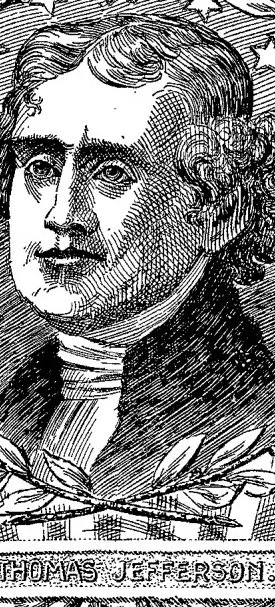
THOMAS JEFFERSON
That to secure these rights, governments are instituted among men, deriving their just powers from the consent of the governed.
Separation of Religion and the State.
ISRAEL’S venture of conducting a kingdom, a State, like all the nations, was a complete, a deplorable, and a ruinous failure.
Israel was the church at that time: and this awful failure in her attempt to conduct a State was traced in full detail as an instruction to the church in all ages.
The essence of that instruction is that it is not possible for the church properly to conduct a State or to manage a kingdom.
The result of that attempt of the church to conduct a State and manage a kingdom, was the ruin of the kingdom and the annihilation of the State, which they had created, and the subjection of the church to heathen powers forever after.
Then from all this the plain lesson plainly and emphatically taught is, that the heathen are better qualified to conduct States and manage kingdoms than are the people of the church: that the people who are of this world are better qualified to perform the things that pertain to this world, than are the people whose calling and profession are those of another world.
If any one will say that this is not so, then let him tell why it was that when the State which the church of Israel had established, had failed and perished, and the people had risen to the dignity of a church once more, they were put by the Lord, and kept, in subjection to the heathen powers—Babylon, Medo-Persia, Grecia, and Rome—as long as they existed as a distinct people. And why He commanded the Christian church forever after, “Let every soul be subject to the higher powers.”
No, the church is not in the world to rule men; but by love to serve men. It is not the office of the church to govern States, but to serve the Lord. She is not here to compel men, but to persuade men. She has no commission to enforce the law, nor to preach the law, but to preach the gospel. She is not to condemn men, but to save men. This has ever been God’s will concerning his church: and whenever she has lost sight of this, and departed in any degree from it, she has only frustrated the grace of God, and spoiled herself.
It became necessary however for the Lord to teach the heathen nations and rulers that they could not of right exercise jurisdiction in religion.
Nebuchadnezzar set up a great image and commanded all to worship it.
Among the people present were three of the captives of the church of Israel, who refused to obey the command of the king.
He called the three men and repeated to them distinctly the command to worship his god, or else be cast into a furnace heated seven times hotter than usual, especially for them.
They replied that their God was able to deliver them; but that whether he would deliver them or not, they would not hearken to his decree nor worship the golden image which he had set up.
He therefore commanded that the three men should be cast into the roaring furnace. But immediately he was almost struck dumb with astonishment at what he saw.
He cried out to his counsellors, “Did we not cast three men, bound, into the burning fiery furnace? They answered, True, O king. But lo! I see four men, loose, walking in the midst of the fire: and the form of the fourth is like the Son of God.” He then called them forth, and they were taken up out of the furnace, and there was not so much as the smell of fire upon them.
“Then Nebuchadnezzar spake and said: “Blessed be the God of Shadrach, Meshach, and Abed-nego, who hath sent his angel, and delivered his servants that trusted in him, and have changed the king’s word, and yielded their bodies, that they might not serve nor worship any god, except their own God.”
This thing happened unto them for an ensample; and it was written for the admonition of kings and people who should come after. It happened, and it was written, to teach all kings and people, that though people be subject to the power of States and kingdoms, this power does not in any sense extend to the religion of the people. It tells all, that when the law of king or State touches the religion of anybody, such law is to be disregarded by the people, and must be changed. The religious right of the people must stand, and king and State must yield. It happened and was written to teach all kings and people that there must be no union of religion and the State.
When the kingdom of Babylon had passed away, and the united powers of Media and Persia had come in, the same lesson had to be repeated for their benefit. A law was enacted by Darius the Mede and his counselors that for thirty days nobody should ask any petition of any god or king, but King Darius. Daniel was chief minister of the empire, and he paid no attention to the law; but went just as before, and presented his petition to God three times a day. He was arrested, prosecuted, convicted, and the penalty according to the law was executed: he was cast into a den of lions. But God sent his angel and shut the lions’ mouths, because that before403God innocency was found in him; and also before the king had he done no hurt.
Thus God regards, and declares, the man innocent who knowingly and openly disregards any law touching his duty or relationship to God, who disregards any law touching religion. And this second example happened and was written to teach all kings and States that they never can rightly have anything whatever to do with any question of religion: to teach all kings, States, and people that God requires the absolute separation between religion and the State.
And that it was done twice, is significant: when God showed to Pharaoh, by the seven thin ears of corn, and by the seven thin kine, the seven years of famine that were coming on the land, it was said to him, “The dream is one. . . . And for that the dream was doubled unto Pharaoh twice; it is because the thing is established by God.” And when God has doubled unto kings and States for all time, the lesson upon the separation of religion and the State, it means that the lesson is one; and for that the lesson was doubled, it is because the thing is established by God.
And if kings and States, and churches, professing to know God, go directly contrary to this thing that has been established by God; if they will yet put forth edict and law touching religion, it can only be, because they are blinder than Pharaoh. For “the unjust knoweth no shame.”
Jottings from Jefferson.
“No man has a natural right to commit aggressions on the equal rights of another.”
“THE idea is quite unfounded that on entering into society we give up any natural right.”
“OUR civil rights have no dependence on our religious opinions, more than opinions in physics or geometry.”
“Our legislators are not sufficiently apprised of the rightful limit of their power; that their true office is to declare and enforce only our natural rights and duties, and to take none of them from us.”
“THE impious presumption of legislators and rulers, civil as well as ecclesiastical, who being themselves but fallible and uninspired men, have assumed domination over the faith of others, setting their own opinions and modes of thinking as only true and infallible, and as such endeavoring to impose them on others, hath established and maintained false religions over the greatest part of the world, and through all time.”
“THE spirit of the times may alter, will alter. Our rulers will become corrupt, our people careless. A single zealot may commence persecution and better men be his victims. It can never be too often repeated, that the time for fixing every essential right on a legal basis is while our rulers are honest, and ourselves united. From the conclusion of this war we shall be going down hill. It will not then be necessary to resort every moment to the people for support. They will be forgotten, therefore, and their rights disregarded. They will forget themselves, but in the sole faculty of making money, and will never think of uniting to effect a due respect for their rights. The shackles, therefore, which shall not be knocked off at the conclusion of this war, will remain on us long, will be made heavier and heavier, till our rights shall revive or expire in a convulsion.”
The Declaration of Independence.
EVERY reader of the AMERICAN SENTINEL is doubtless familiar with the fact that on July 4, 1776, the representatives of the English colonies of America formally declared to the world their independence of all foreign rule, and in justification of their action asserted the doctrine that all men have the same unalienable rights, and that to secure these rights is the proper purpose of civil government.
The situation as it was in 1776, and that which exists to-day in the American nation, cannot however be properly appreciated without looking beyond the action which has made the fourth of July a national day, to the antecedent conditions out of which that action was evolved.
The Declaration of Independence was not simply the result of a determination on the part of the American colonies to separate themselves from British rule, for the sake of being independent. At the time when that Declaration went forth, the civilized world was just emerging from the long reign of civil and religious despotism which had characterized the Middle Ages. One by one, as the spirit of liberty developed and asserted itself in the minds of the people, the chains of that despotism had been broken; until in the Declaration of Independence the world heard a bold assertion of the doctrine of the right of all mankind to complete individual freedom.
This was not an accident of the times. It was a providence. It has been well said that “History is the progressive disclosure of the self-government of man as the providential design.” The Declaration of Independence appealed to the established decrees of Providence for its justification. “We hold these truths to be self-evident,” it says, “that all men are created equal; that they are endowed by their Creator with certain unalienable rights; that among these are life, liberty, and the pursuit of404happiness; that to secure these rights, governments are instituted among men, deriving their just powers from the consent of the governed.” It asserts this as the order of government which God himself has established.
It was by a religious power that this order of government was perverted. There was never a despotism on earth until men had established false religions. The religion of love which God set up is in perfect harmony with free government. It must be so, for otherwise He who endowed men with the unalienable rights of “life, liberty, and the pursuit of happiness” would antagonize Himself. And anything which antagonizes that religion—which is Christianity—antagonizes free government.
It was a religious despotism which antagonized free government in the Middle Ages. The papal church dominated the States of Europe, and the civil power was employed to enforce her decrees. By her the Inquisition was established, and the power of the civil arm was made to invade conscience, the most sacred temple of human liberty. Under the tutorship of the church, the civil powers learned to disregard one and all of those unalienable rights with which the Creator had endowed the humblest being who bears His image.
The Declaration of Independence asserted again these rights before the world. It asserted not the rights of governments, or of organizations, but of the individual. And against nothing did it strike more directly or forcibly than against that ecclesiastical despotism which had so long claimed the right to control the conscience, and put fetters on the wings of the mind. It asserted the eternal truth of God against the error which had long enslaved mankind.
The value of the Declaration of Independence lies not in the fact that it accomplished our separation from the empire of Great Britain and our independence as a nation. Indeed, it was only by hard fighting that these things were accomplished, and if these be the things to be commemorated, the anniversary of Cornwallis’ surrender at Yorktown would be a more fitting date than the fourth of July; for it was only then that our national independence had become, practically, an accomplished fact. But national independence means nothing to the slave. Personal liberty, the enjoyment of the unalienable rights of the individual, is the thing of value, and it is the assertion of these that gives its value to the immortal Declaration.
No one can justly appreciate this great document who views it merely in the light of its national significance. Whether this Government be a better one to live under than the government of Great Britain, or what benefits have resulted from our national independence, are questions to which we can find no definite answer. Concerning these there may exist much difference of opinion. But all know, from their own experience, the individual blessings which are secured by a free government. And these blessings are as valuable to the inhabitants of one country as to those of another. The providential design in the Declaration of Independence was not that this nation should be made the greatest nation on the earth, by being different from all the others; but that all the others should become like it, in securing to the people of other lands the enjoyment of their God-given, unalienable rights.
As the Charter of individual liberty, the Declaration of Independence is as appropriate to our own time as to the year 1776. To-day, more fully perhaps than at any time in the past, it needs to be borne in mind that the proper purpose of civil governments is to secure to the individuals under them, the enjoyment of the unalienable rights bestowed upon them by the Creator. The crisis of 1776 was not greater than that which confronts the American people in 1897. The rights which were threatened then were not more sacred and valuable than those which are in jeopardy to-day. The Declaration of Independence asserts those rights, but it does not secure them against invasion, even in the very name of liberty.
As Independence day is celebrated, then, let it be with an appreciation of the blessing of individual independence—individual freedom from all despotic control, and a lively sense of the perils by which that independence is now threatened. Let it be remembered that religious apostasy, which has become a feature and sign of the times, will breed despotism in government to-day as surely as it did in the past; that already this evil work is far advanced, as seen in an ever-widening stream of religious legislation. And may there be many who, with these facts and reflections in mind, shall gather from the day new inspiration and zeal to do faithful duty as sentinels around the camp of freedom.
The Sentinel Opposes Religious and Civil Despotism
THE SENTINEL is against every form of despotism,— religious or civil.
Religion Combined With Force Breeds Despotism
WHEN force is combined with religion, or religion with force, the result is religious despotism.
God Used Thomas Jefferson.
By A. F. B.
THOSE who oppose the doctrine of separation of Church and State, advocated by Jefferson and embodied in the Declaration of Independence and the Federal Constitution, attempt to make a point against the doctrine by declaring that Jefferson was an unbeliever.
This point has no force even if true, when we remember that God has used men according to his own word who did not know him, to accomplish his will. Isa. 45: 1-6. The Lord was compelled to do this because those who professed to know him were more ignorant of his will than those who did not profess to know him.
When Jefferson battled for separation of Church and State in Virginia, the influential religious teachers were so drunk with the “wine of Babylon”—with the adulterous doctrine that the Church should wed the State—that God was compelled to select a man whom the world-embracing church declared to be an infidel, to teach his truth to the nations. It is true that there were Baptists405and Quakers and Presbyterians, who united with Jefferson in promulgating right principles of religious freedom, but they were all a despised lot of dissenters.
Let no man glory in his shame by condemning the gospel principle of separation of Church and State because God was compelled to go outside of his professed church to find a man of influence with clear enough views of gospel truth to teach complete separation of Church and State. A. F. B.
Only the Gospel Is Free From Despotism
EVERY religion except the religion taught by Jesus Christ, is a despotism. There is no despotism in the gospel invitation.
God’s Service Not Compulsory.
By Editor
A LETTER from Ticonderoga, N. Y., dated June 24, takes exception to a recent utterance in the SENTINEL, as follows:—
“Dear Sir: In the SENTINEL of this date and under the heading ‘Compulsory, Yet Free!’ you say that the divine command of Sabbath observance is not compulsory; at least you say that we are granted liberty in the matter by the Lord. Now I would like very much to have you show by the Bible where we are granted this liberty.
“The Sabbath observance is a divine command and not a divine permission.
“You might as well say that man has his liberty in regard to any of the commandments.
“WM. H. BROWNE.”
We reply that every person is at liberty to disregard the fourth commandment and every other precept of the Decalogue, just as he is at liberty to disregard the laws of health, which are no less truly God’s laws. In the end, of course, if he turns not from his disobedience, the consequence will be death; but he has perfect liberty meanwhile to obey or disobey, just as he may choose. And this is just as God has ordained that it should be.
“Choose ye this day,” says the Scripture,—“Choose ye this day whom ye will serve.” “To-day, if ye will hear His voice, harden not your hearts.” “Whosoever will, let him take of the water of life freely.” In every word and by every act, Jesus Christ invited sinners to turn from their sins and find life in him; but he never sought to compel anybody. And in his life as the man of Nazareth Jesus was a perfect revelation of his Father. He again and again expressly stated that he did nothing of himself, but that his Father who dwelt in him, did that which was manifested in his life. “God was in Christ, reconciling the world unto Himself.” Every invitation which Christ uttered, was from his Father. The Father would no more compel men to do anything, than would Christ.
And the reason of this is plain. “God is love,” and only love satisfies love. A forced service could not be acceptable to God; it is not even acceptable to one like ourselves. No father who was worthy the name would be satisfied to know that his children obeyed him because they were forced to do so. We recognize the service of love as the noblest, highest and best service; and can God be satisfied with anything short of the best? Will we dare offer Him anything but the best? Will we offer Him forced obedience, in place of the obedience of love?
Such a thing would be but a mockery in the sight of God, if not in our own sight. The whole purpose of God, as embraced in the plan of salvation, is to reveal Himself to mankind so that man shall be drawn and bound to Him by the cords of love. And therefore it is absolutely necessary that every one should be given perfect liberty to choose whether he will serve God or not. For the service must be of love to be acceptable, and love cannot be anything else than free choice.
And therefore any law of man which presumes to compel men to keep God’s commandments, is anti-Christian,—contrary to the gospel and against every interest of God and man. This is the real character of every human sabbath law.
God sets before all men life and death. The ten commandments are the way of life, and God wants every man to walk in that way. But He cannot compel any one to keep them; for only through love can they be kept at all. And love is always an expression of free will.
Proposed Taxation of Church Property.
THE assessor of King County, Washington, in which the city of Seattle is situated, has announced that he will assess taxes on church property in that city. The authority under which he will attempt to carry out this innovation is a recent decision by the Supreme Court of the State, which annuls a legislative provision under which church property secured exemption. A Washington paper states the case as follows:—
“The constitution of the State does not exempt church property. It leaves a loophole for unjust exemptions, however, when it says: ‘Provided, that the property of the United States, and of the States, counties, school districts, corporations (municipal), and such other property as the legislature may by general laws provide, shall be exempt from taxation.’
“Acting upon this clause in the constitution, the first legislature enacted a law by which personal property to the amount of $300 became exempt from taxation, along with church property, charitable institutions, and quasi-public property. Last winter the legislature increased this exemption on personal property to $500, and also exempted improvements on real estate to the extent of $500. This act was by the Supreme Court recently pronounced unconstitutional, together with the former act which permitted a $300 exemption on personal property.
“Now the $300 exemption proviso and the proviso to406exempt church property are in the same clause, and are read in the same breath. There are many who contend that when the Supreme Court ruled against the clause providing for the $300 exemption on personal property it also knocked out the proviso for the exemption of church property.”
Repudiating Taxation Without Representation: Against Sunday Laws
Our forefathers repudiated the principle of taxation without representation; they refused to be taxed in money to support a government. A Sunday law is a tax of one day in every seven to support a religion—and not the Christian religion either. Let us repudiate the tax and declare our independence.
The Sabbath: What Its Reception or Rejection Involves.
“Present Truth,” London, Eng.
In the beginning “God blessed the seventh day, and sanctified it,” and thus made it a blessing and a channel of sanctification or holiness to man. He then taught man to “remember the Sabbath day to keep it holy,” or to sanctify it. God made the day holy and He instructed man to treat it as holy that he might thus receive the blessing of holiness through it; but when man treats the day as common time he fails to receive the Sabbath blessing through God’s appointed channel.
It is not in the power of man to make a day holy, neither can we receive the blessing of holiness through a day which the Lord has not made holy, even though we should outwardly treat it as though it were holy. So when we turn away from the day which the Lord has made holy and accept any other day in its stead, we are thus turning away from the Lord’s own channel of holiness for us. This is the great loss with which we meet in following the traditions of men instead of obeying the Word of God.
So intimately related is the “holy Sabbath” to “the holy Scriptures” and to the “holy child Jesus,” that it cannot be consistently disregarded by those who profess to receive the other two for what they really are, and it is worth noting that the power which professes to have changed the Sabbath has practically put itself above the Bible and Christ. So long as the Bible is received as the Word of God, and the example and instruction of Jesus is followed, so long the seventh-day Sabbath will be observed, and when the seventh-day Sabbath is knowingly disregarded, the logic of this act really demands that the Bible and the work of Jesus should be set aside.
The Roman Catholic church in its teaching openly states that the Bible commands the observance of the seventh day and no other, and that there is not a word in the Bible authorizing a change of the day, and it just as openly teaches that the church changed the Sabbath from the seventh to the first day of the week, and that there is no other authority for the change. It is only consistent therefore for it to treat the Bible as of secondary importance as compared with its own traditions, and to make the intercession of the Virgin Mary of more value than the intercession of Christ.
In all this the Roman Catholic church puts itself above God, but it is consistent in the way in which it does it. So long as one receives the Bible as the Word of God, and acknowledges its authority as supreme, so long will he see that the seventh day is the Sabbath, and that the intercession of Jesus is all that is needed for man or that can avail anything for man, and when one rejects the Lord’s Sabbath, the logical result will be to reject the authority of the Word of God, and to receive the word of man instead, and to accept a supposed human helper as of more value than is the help of Him who alone is able to save.
But this is not a question simply of cold logic. In thus turning from God’s appointed blessings and channels of blessing man meets with an irreparable loss. If we receive the salvation of God at all, we must receive it through the channels which He Himself has established, and the blessing of holiness should be so highly prized that we should be glad to receive it in any way which the Lord may appoint.
The original Sabbath still remains as a sign and a pledge of God’s power to make holy, and the true keeping of the Sabbath, the entering into His rest, is the experience of His presence who only can make and keep us holy. God’s purpose in the gospel has always been the same, that we should be “created in righteousness and holiness of truth,” and His means of accomplishing this result have always been the same in making us “partakers of the divine nature,” and so the Sabbath remains unchanged and unchangeable, a channel for this blessing of holiness to man.
How Consistent!
“LET no man judge you in meat, or in drink, or in respect of an holy day, or of the new moon, or of the Sabbath days,” quotes the Michigan Christian Advocate, of June 19, in reply to a correspondent who wanted proof for Sunday observance; and on the same page the Advocate expends a column of severe invective against the people of Mt. Clemens, Mich., for being “profaners of the Lord’s day.” “Has Mt. Clemens gone mad?” exclaims the Advocate. Oh no, Mr. Advocate, we reply; Mt. Clemens has not gone mad; but they believe in letting no man judge them in respect of an holy day or of the Sabbath days, and have been conducting themselves accordingly.
The sabbath desecration against which the Advocate declaims consists in playing baseball on Sunday. A majority of the citizens of Mt. Clemens, it is said, are in favor of Sunday baseball; but, says the Advocate, “There is a good precept somewhere on record to ‘follow not a multitude to do evil.’” But it may be that the Mt. Clemens people have fortified themselves with this argument which the Advocate gives on the same page in its reply to correspondent aforesaid: “The whole Christian world, except the Jews and a few Adventists, is observing the Lord’s day Sabbath all right;” and “This big world was not fooled, as they would fain have us believe, away back in the early centuries.” The Mt. Clemens people probably407reason that if the example of the multitude constitutes a standard of right, it is all right for them to have Sunday baseball when the multitude want it; and they are doubtless aware that the vast majority in “this big world” do not believe in or practice the observance of “the Lord’s day.”
When religious journals put arguments in the mouths of the people which justify them in disregarding the Sabbath, such journals should be the last to condemn them for sabbath desecration. If the word of man is to prevail in the matter, then the practice must be governed by the principle of majority rule. But if the Word of God is to decide it, let there be an appeal to that Word and not to the customs of the majority. The Advocate well knows that the Word of God commands, “The seventh day [not the first] is the Sabbath of the Lord thy God; in it thou shalt not do any work.”
They Would Rule or Ruin.
An Omaha correspondent writes us the following concerning the plans of the Omaha Ministerial Association for securing Sunday closing of the “Trans-Mississippi and International Exposition,” now in progress in that city:—
“I attended the Omaha Ministerial Association to day [June 21]. The topic of discussion was the closing of the gates of the Trans-Mississippi Exposition on Sunday; or rather, the time was mostly taken up on this theme. The chairman said, We must be actively at work, or it won't be done; we must have a whole loaf if we can get it, but if not, we will demand a half loaf—the gates must be closed till after service hour Sunday morning. The president is the pastor of the Good Shepherd church here (Episcopalian). The Christian minister said, We must demand that the gates be closed all day Sunday or we will make the Exposition a failure. Others said, The disgrace of having the gates open on Sunday must not be, etc. The excitement ran almost to a white heat, and the gathering seemed more like a political caucus than a meeting of Christian men.
“A committee was appointed to visit the directors and ascertain what their mind is in the matter. Then when the ministers meet again, if the directors will not assure them that the gates will be closed, the committee are to present plans whereby the directors will be compelled to close up, or the preachers will see to it that the thing is a complete failure.”
Religious Legislation Charged With Promoting Atheism
THE following words from a writer in the Truth Seeker, of June 26, present religious legislation in the character of a promoter of atheism:—
“But what are we to think of a religion that purports to be of divine origin and claims divine indorsement and support in its perpetuity, and yet is obliged to appeal to the civil law for support and maintenance? For the Christian religion to appeal to the power of the civil law for support and protection is a tacit admission that God is impotent and incapable of perpetuating his religion on earth. It is also an admission that the devil is more powerful, and a hundred times more popular than God, for he never found it necessary, under any circumstances, to appeal to the law, or any other compulsory or restrictive measures to keep his soldiers in line and facilitate their advancement and strengthen their adhesion to his cause.”
Persecution in Florida.
THE following letter comes to us from a member of the Seventh-day Adventist denomination in Florida:—
“Bartow, Fla., June 17, 1897.
“TO THE AMERICAN SENTINEL: One of our brethren, Thos. Furman, was fined to-day $5 and costs or 10 days’ labor on the public streets, for ‘disturbing the peace’ last Sunday. The facts in the case are as follows:—
“Last week I engaged Brother Furman to do some work for me, commencing Monday morning; and he found it necessary first to get up some wood for his wife. I sent my boy with a team to deliver the wood Sunday afternoon.
“The road runs within a few feet of the church building. There were two loads hauled. There were four witnesses at the trial, who all swore they were disturbed and that it was the first load that disturbed them. At the time of the disturbance the four witnesses were all engaged inside the house making a table to use in taking the sacrament.
“There was one wagon before and two behind the load of wood. Brother Furman asked one of the witnesses if any of the other wagons disturbed him. The mayor, who presided, told the witness he need not answer that question. Brother Furman himself was not in the wagon nor on that road, but took a near path some two hundred feet on the other side of the church.
“The complaint to the mayor was (as he told me afterwards) that this work was done on Sunday, but he said he advised them to bring in the complaint as above stated. The mayor was a swift witness in the case, no doubt having in view his fees; and after pronouncing the sentence, he told the prisoner, by way of advice, that he must in the future be more quiet on ‘our Sunday.’
“The town ordinance says no work shall be done on Sunday except in case of necessity or charity. When the mayor was informed by the prisoner that this was a case of necessity, he said, ‘Why did you not stop when you hauled one load?’ I might mention here that only a few weeks ago the mayor’s grown-up son painted a large water tank on Sunday in full view of the main street,—which of course was a work of necessity. He did not stop at painting one side only, but it was necessary to finish up the job. The mayor’s name is H. P. Logan, and he is a lawyer by profession.
“It certainly seems to me that no man without God’s sustaining grace could work ten days under a tropical sun to satisfy the charge of disturbing a religious meeting when there was no meeting going on at the time. Brother Furman is about 26 years old, and has a wife and three small children who are wholly dependent on him for support; and his only dependence is upon the work he can find to do by the day.