With feasting and fireworks, dancing and song, with blowing of trumpets and booming of cannon, the nation will soon celebrate the one hundred and twenty-first anniversary of the Declaration of Independence.
The pulpit and platform and press will unite in extolling the blessings of liberty. Thousands of voices from the crowded forum of the great metropolis and from the green-carpeted grove of the country hamlet, will utter these memorable words:—
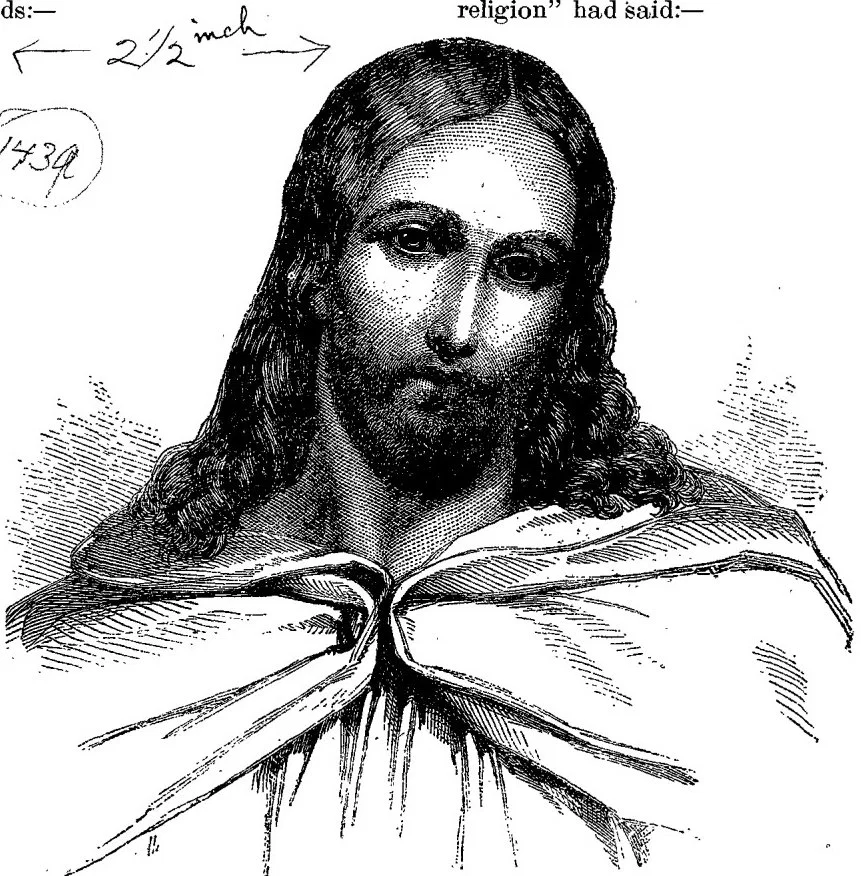
THE AUTHOR OF LIBERTY.
“We hold these truths to be self-evident: that all men are created equal, that they are endowed by their Creator with certain unalienable rights; that among these are life, liberty, and the pursuit of happiness. That to secure these rights governments are instituted among men, deriving their just powers from the consent of the governed.”
While glory will be given to the author of these words—which are like apples of gold in pictures of silver—while glory will be given to the fathers of the republic who builded a nation on these principles; how many will remember the Author of liberty to “give glory to Him?”
Thomas Jefferson, in these immortal words, himself acknowledges that liberty and equality, as “unalienable rights” are endowments of the “Creator.”
The same acknowledgment appears in the preamble to the Bill of Rights drafted by Jefferson and adopted by the General Assembly of Virginia December 26, 1785:—
“Well aware that Almighty God hath created the mind free; that all attempts to influence it by temporal punishments or burdens, or by civil incapacitations, tend only to beget habits of hypocrisy and meanness, and are a departure from the plans of the holy Author of our religion, who being Lord both of body and mind, yet chose not to propagate it by coercions on either, as was in his almighty power to do,” etc.
If the divine origin of liberty were not recognized by the men who promulgated the Declaration of Independence, the fact would still remain that liberty was first heralded to the world by our Lord.
The Declaration of Independence declares that “All men are created equal.”
Nearly eighteen hundred years before, Christ said: “One is your Master, even Christ, and all ye are brethren,” and his disciples had taught that God “made of one blood all nations of men.” Acts 17:26. Therefore “God is no respecter of persons.” Acts 10:34.
The Declaration of Independence says that men are endowed by their Creator with the unalienable right of liberty.
Eighteen centuries before, the Author of “our holy religion” had said:—
“Ye know that they which are accounted to rule over the Gentiles lord it over them; and their great ones exercise authority over them. But it is not so among you: but whoever would become great among you let him be servant of all.” Mark 10:42, 43, R. V.
Lording it over God’s heritage is condemned by the Christian religion, and where there is no lording there is liberty.
The Declaration of Independence declares that governments are instituted among men to secure the rights of liberty and equality.
Christ, in condemning the exercise of governmental lordship and making “rulers” servants of instead of lords over the people, and in making the State “a revenger to execute wrath upon him that doeth evil” and a “praise” or protector to him who “doeth good,” taught nearly eighteen hundred years before the Declaration of Independence was proclaimed that “to secure these rights [liberty and equality] governments are instituted among men.”
While all this is true, how many will think, amid the din and roar, the dining and wining of Independence Day, to “fear God and give glory to him” who is the Author of all liberty, civil and religious, Christian and constitutional. A. F. B.
Slaves of Appetite on Independence Day
How many who will talk fluently of liberty on Independence Day, will themselves be slaves of their appetites and passions? “If the Son therefore shall make you free, ye shall be free indeed.”
News, Notes, and Comment.
WHEN Mr. Justice Brewer delivered that famous opinion of the Supreme Court, under which a learned English divine was admitted into this country that he might assist at the ministrations of “Old Trinity Church” in New York City, the Justice felt called upon to work out, at considerable length, and with elaboration quite extensive, the items which he had taken it upon himself to “nail up and defend”—namely, “that this is a Christian nation.” He approached his subject from various directions, and always with the same results. He shed upon it many different kinds of light, and the letters only came out all the stronger. The “X rays” of an intellect unquestionably forceful, were turned upon it, and the declaration showed, through and through without a flaw, “this is a Christian nation.”
Now, whatever a layman may feel himself at liberty to do, it lies not within the province of an attorney to criticise the Supreme Court of the United States, or to question the utterances of that high judicial body—“the most august tribunal in the world,” as it has been styled. And the methods, or line of reasoning whereby any given conclusion has been reached in the minds of the judges, is as much beyond the purview of the practitioner as is the decision itself. Nevertheless, there is no objection to pointing out that certain facts which the court cites, as pertinent to its view of the legal question involved in a particular case, have also a significance apart altogether from their relation to the issue argued and decided therein.
IN the great “Christian nation case,” for example, the Supreme Court’s opinion, as delivered by Mr. Justice Brewer, calls attention to the fact that nearly every “commission” or royal authority given by European powers to their citizens, to make discoveries, plant settlements, or “stake out claims,” in Western mining parlance, on this continent of ours, mentions, in terms more or less specific, as among the objects contemplated in the grant, “the propagation of the Christian faith among savages now living in darkness.” This, it is considered, constitutes an argument in favor of the proposition that ours is “a Christian country.” So be it. We have here, at any rate, a historical datum of other, if not wider significance.
WITH the single exception of the Dutch, every nation of Europe did, indeed, deem it advisable to proclaim to the world the missionary character of its expeditions to the American shores. (I have found one English “commission” from which this announcement was omitted, I presume by an oversight.) Trade is mentioned as a desirable thing to look out for; the extension of the control of Christian rulers over lands occupied by unbelievers is spoken of as quite desirable; but these are matters of a transitory world, and only a means to an end—the saving of immortal souls to an eternal life, where time and territory and trade shall be no more. In our day, when a nation goes to war, she does not feel called upon to justify herself in the eyes of her own people or of other communities by any pretense of religious zeal or aspiration. Columbus set out westward that he might reach the East and “convert the Great Khan.” But England calmly takes India by the throat and chokes her into submission, without either thinking or talking about the Gospel, though, as a matter of course, behind the bayonets and the artillery, go the clergyman and the “Established Church.” What is the cause of this difference?
It is all due to the change of zeitgeist, or time spirit. After the barbarians who overthrew Rome had parcelled the fair domain of Europe out—not to their satisfaction, for they were continually squabbling, and “rearranging and shifting,” but still, after a fashion—among themselves, there was, for several centuries, a very remarkable zeitgeist dominating the minds of men. The Phenicians were the great traders of antiquity. The Greeks knew and appreciated the value of wealth, and the importance of barter for its acquisition. So did the Romans. These last accumulated worldly goods, at the height of their power and magnificence, largely by plunder; but they also had ships, and profited by the exchange of the products of one country for those of another. But after Rome’s eagles had flown away, never to return, commerce practically ceased. The Barons enriched themselves by robbing each other from time to time. The peasants patiently tilled the soil; there was little inducement for any one of them to “go into business,” for, if he succeeded, it was pretty certain that, sooner or later, some great “lord” would make a “forced loan” out of his accumulations.
A VERY amusing illustration of the popular attitude towards trade is given by Mr. Charles Reade in his great story, “The Cloister and the Hearth,” and it shows a wonderful capacity for entering into the spirit of another age, totally different from that of our own, does the imagining of such an incident. Mr. Reade tells us of a German shoemaker of the period under consideration, who was discovered by a would-be customer sound asleep at the door of his shop, in the middle of the day. The man was quite angry at being disturbed, and his wrath was rather augmented than mollified, when he learned the purpose for which his visitor had called. He entered the store reluctantly, and begged the stranger not to buy a particular pair of shoes which attracted the latter’s fancy. The customer, however, insisted on having what he wanted, and got it at last. As he left, the shoemaker410dropped into his chair again, his face covered with tears, and sobbed himself back into slumber, grievously moaning, “my last pair of guilded shoes—my last pair of guilded shoes!” The genius of commerce was not the zeitgeist.
AND as trade was no part of men’s thoughts, to fight for it would have been considered quite as reprehensible as to live for it and work for it. Hence, wars, in order that they might be commended to the general approval, were always prosecuted under the guise and in the name of religion. There can be no doubt that the first crusade, at least, was quite sincerely organized through the influence of a religious feeling. But it was by no means so with the last. One must read “The Laws of Civilization and Decay,” a most remarkable work, which has lately and deservedly passed into a second edition, in order to fully appreciate the sordid and mercenary motives by which that great expedition was governed, and the astounding atrocities to which it was driven by its controlling impulse of greed and covetousness. There were good, honest, straightforward men who left their homes and families, many of them forever, upon that fateful occasion; but they were few, comparatively, in numbers, and too poor to act alone; so they did the dirty work of the rest, and died at it.
THE Crusaders had revealed to the new Europe which had arisen on the ruins of Rome’s great Empire, the wondrous possibilities of the East. Here was seen an enormous extent of territory, exhibiting a wealth and luxury and magnificence beyond the dreams of mail-clad warriors, plodding peasant, and petty village merchants. While Europe had been busy sacking castles and settling the details of long theological creeds, Asia had for centuries chiefly concerned herself with making things as comfortable and enjoyable as possible in the present life. The most orthodox believers were impressed with the importance of this course when they saw it going on before their very eyes. Legends were many of a grandeur transcendant, almost ineffable, in regions beyond their seas. A glimpse they got into a wondrous charming new world; but Saracen obstinacy prevented more than a glimpse.
IT was maddening. The dwellers in the far-off Fairy Land might be weaker than those who thus blocked the way. Perhaps their vast treasures of gold and silver and precious stones and gorgeous raiment might be easily taken from them by threats; or a very slight degree of violence might prove all that was necessary. Or they might be so savage and simple-minded that a few trinkets would purchase from them a quantity of things that had a real substantial value. Anyway, they must be gotten at, somehow or other. Of course, they were pagans. And, therefore, it was not only a right, but it was a Christian duty, if their hard-headedness rendered such a step necessary, to employ any force whatever, in order to dispossess them of those worldly blessings which it was not thinkable that they should have done anything to deserve at the hands of Providence.
THEY cannot be reached from the East? Very well, then; we must try the West? By this time, the idea of the rotundity of the earth was, if not generally accredited, and though even under the ban of the Infallible Church, by no means universally rejected. Obviously, if it were true, one could get to the East by the simple process of sailing westward. It was a tempting idea. By this means, the rude and implacable Saracen, who now asserted his unholy claims to land which he had conquered, would be outflanked, and approached from the rear. And between him and the adventurers would lie exposed a Paradise of richness and glory, such as the eye of Western man had never seen, nor his mind conceived.
BUT the zeitgeist was still largely religious, and only in part commercial. The last Crusade was entered upon under an express contract between its financial promoter, party of the first part, and its commanding officer, party of the second part, that a great act of spoliation and outrage should be perpetrated before any attempt was made to invade the soil of Palestine; nevertheless, like all of its predecessors it was commissioned in the name of the Father, and Son, and Spirit, and sent forth to do the will of Deity in the work of murder and rapine. And, just so, when it was finally determined to try the experiment of penetrating the eastern arena by a western route, it was deemed necessary to insist that no worldly motive lay at the bottom of the movement—that Christianity, and not avarice was the cause of it all.
WHEN we thus contemplate the early expeditions to this hemisphere as the direct result of the Crusades; when we understand that, like the last crusade itself, they occurred at a time when men’s minds were in a transition state—when the replacement of the zeitgeist of religion by the zeitgeist of acquisition was just about commencing—then we have at once the key to those expressions in the “commissions,” etc., which are sometimes relied upon as evidences that “this is a Christian nation.” They were just as inevitable, under the circumstances, in such instruments, as the similar language in the papal “Bulls” whereby the faithful were exhorted to go forth and expel the infidel from the blessed land of Palestine, the cradle of the Christian Church.
How far were the men of that time sincere in the use411of such language? How far did its use impose upon governments, upon citizens, upon the world at large? No definite answer can be given to these questions, profoundly interesting as they are. But one thing is certain—there was an element of sincerity in those who used them, and to some extent there was a genuine belief in them on the part of those for whose benefit they were promulgated.
THIS historical review, while, as already observed, it is not presented with any idea of challenging the conclusion of our great Forum of last resort, to the effect that “this is a Christian nation,” nevertheless has an important value in an altogether different question—and one of considerable importance. It is hard for us nowadays to appreciate the lofty degree of courage and manly indifference to danger which were required for the voyage of Columbus, and for the wonderful work of the Cabots. Men who ventured as they did, with the scanty knowledge that they possessed, in their frail crafts, without charts, and having compasses of the rudest kind, must have been driven by an impulse stronger than any mere idle curiosity “to see and hear some new thing.” What was the secret of it all?
INCIDENTALLY, these men, and others of their ilk, may have made this land, nominally, as we have been told they did, “a Christian country.” There is no denying that they were uniformly instructed to do so. But a close and impartial scrutiny of history shows that this thing was done, if at all, incidentally or accidentally. America was really discovered not because the people or potentates of Europe were desirous to “bring souls to Christ,” but because people and potentates alike were full of the lust of covetousness, the “sacra auri fames,” or “accursed thirst after gold,” of the old Roman poet. Columbus was sent to convert the “Grand Khan.” Then, as now, there were people “right around home” avowedly unconverted, and others whose conduct plainly showed that their professions of belief in the true faith were based on a misconception of their own mental condition. But the “Grand Khan” whom Columbus set out to Christianize was supposed to sit on a throne of solid gold, studded with diamonds and other precious gems, and his palace glittered with silver trappings, and pillars of alabaster, and chains of pearls, and in the vaults of his treasury lay millions of coin untold. And so, Columbus got his ships from Ferdinand and Isabella.
THE wrath of man worked salvation. A mighty nation has grown up in the land that Cabot ran against when he was groping for a “northwest passage” to the treasure house of El-dorado. As great as any in many other regards, this nation stands unique in the family of commonwealths, as the representative of political ideas to which she owed her birth, and which are the foundation stones of her existence. One of those ideas—a very vital one—one of transcendent consequence—is the idea of a total separation of Church and State. How far this idea is consistent with her posing as “a Christian nation” is not the question here. The purpose of these present paragraphs is simply to point out the fact that, if those whose first coming hither made her life a possibility did anything to give her this characteristic, at least the doing of it was not the active cause of their coming—that, if the only hope and aim in life of those who fitted out and those who conducted the great voyages of discovery had been the propagation of the gospel and the glory of the Saviour, as they understood it, we should never have had a Columbus, a Cabot, a Smith or a Raleigh to tempt the waves, or a Bancroft to record their achievements.
Political Prayer in Ohio.
An illustration of “religion in politics” was furnished at the opening of the Ohio State Republican convention, at Toledo, June 22. The incident calls out the following from the New York Journal of June 24:—
“The country clergyman who opened the proceedings of the Ohio Republican convention with a supplication to the Almighty on Tuesday had a rather singular idea of the ethics of prayer. However, he had a very correct estimate of the mental characteristics of a Republican convention, for it is recorded that at various points in his appeal the assembled delegates applauded wildly, and at the close they clambered upon their chairs and cheered themselves hoarse.”
“Through the efforts of this suppliant, a Deity, supposed to be all-seeing and omniscient, was explicitly informed of the condition of affairs within the Republican party. Especially was he commended to keep an eye on a certain “typical American and father of the Republican party.” . . .
“Continuing, the preacher begged the Almighty to take an active part in fastening the protective system on the United States. He seemed to recognize no impropriety in appealing to that Great Power which rules all the nations of the earth to aid this one people in its effort to discriminate against all others, and to cut off from our markets the workers of every other country. A device which is successful in proportion as it reduces the workers of other lands to want and misery is a curious thing to recommend to the God of all the nations, but Ohio’s political preacher was equal to the occasion. The assembled Republicans shouted themselves hoarse when he lifted up his appeal:— “‘May there be among our lawmakers such wisdom and patriotism and loyalty to American interests as shall mend the breach in the wall of our prosperity, and by protecting our industries give employment to labor, and thereby create a market at home and abroad, upon the pivot of which turns national prosperity.’”412
“For years the prayers offered by political preachers in Congress, Legislatures and conventions have been a scandal to the godly and a cause for merriment among the impious. Of the egregious bad taste of such a performance as that at Toledo there can be no doubt. That all thought of the sacredness of the office the clergyman was filling was banished by the matter and the manner of his supplication was made evident by the fact that his auditors treated the prayer as they would a political stump speech, interrupting with applause whenever stirred by the speaker’s sentiments. Such incidents only blunt the sentiment of reverence, yet they will be repeated as long as political preachers are called upon to open political gatherings with prayer. It would be better to omit the opening ceremonies, since the very class of pulpiteers least fit to discharge the duties of the office invariably seek it.”
Are You a Member of the International Religious Liberty Association?
By A. F. Ballenger
THIS Association was organized to care for the families of those who were imprisoned for conscience’ sake, and to disseminate the principles of religious liberty, especially by means of the printed page. The Association is supported by members who pay one dollar a year as a membership fee and by donations from those interested in its work.
Since its organization, multiplied millions of pages of literature have been distributed and thousands of dollars given in aid of the oppressed, but the signs of the times indicate that the heat of the battle is still ahead of us.
All members receive free, as fast as they are published, all issues of the Religious Liberty Library, a monthly publication with occasional extras, devoted to the discussion of current religious liberty questions.
July 1st is the date for sending letters to members of the Association asking for their annual offerings. These letters will cost nearly $125.00, a sum with which we could circulate half a million pages of tracts. Can not this sum be saved to the cause of truth by our friends sending in their dues and donations this year without waiting for our annual letter. We hereby kindly request that this be done. Those wishing to become members can do so on the payment of $1.00.
Address all communications to the International Religious Liberty Association, 39 Bond St., New York, N. Y. Write your name and address plainly, so that we can print it with our list of subscribers to the Library. Remember the Library is free to members. We sincerely hope that our friends will respond promptly and thus make the annual letter unnecessary.
A. F. BALLENGER, Secretary.
The Sunday Newspaper and Sunday Excursion Train.
By A. Smith
BY A. SMITH.
A GREAT cry is raised by many of the clergy of the land against Sunday excursion trains and Sunday newspapers, holding them responsible as leading factors for much of the prevailing wickedness that exists at the present time.
A newspaper carefully conducted on the principles of civil usage is altogether proper as a promoter of intelligence and social freedom, and is therefore just as properly issued upon one day as another, except for religious reasons only. For the clergy to oppose it therefore, for supposed sabbath desecration, otherwise than by moral suasion, is to transcend the authority conferred upon them as ministers of the gospel by the Author of the Christian religion.
The same principle is true concerning the running of excursion trains, or any other trains, upon Sunday or any other day observed as the sabbath.
That church people themselves are largely responsible for the so-called sabbath desecration complained of, the following quotations indicate. In 1887, there was held in Elgin, Illinois, a Sunday law convention, many leading evangelists being present, at which the following resolution was passed:—
“Resolved, That we look with shame and sorrow on the non-observance of the sabbath by many Christian people, in that the custom prevails with them of purchasing sabbath newspapers, engaging in and patronizing sabbath business and travel, and in many instances giving themselves to pleasure and self-indulgence, setting aside by neglect and indifference the great duties and privileges which God’s day brings them.”
“Dr. Knowles, the editor of the Pearl of Days, said that the Delaware and Lackawanna Railroad found that when their trains were not running on Sunday five hundred Christian ministers in New York City went and used competing lines, giving all their traffic to them. Then the directors said, if these other roads can get the patronage of the preachers on Sunday then what harm is there in our carrying other people on Sunday.”—Battle Creek Daily Journal.
The following extract is from an article written by Rev. C. H. Zimmerman and published in the Union Signal, of Nov. 5, 1891, under the heading “So-called Christians Are the Offenders”:—
“A pamphlet before me with the above title alleges that moral and religious citizens are responsible for the inauguration of sabbath desecration by railroads. Railroad413directors were unwilling to run Sunday trains when the petitions were first sent to them; but they were signed by church members and the directors at length yielded to the demand. These church trains developed an appetite for Sunday travel. If respectable, moral and religious persons could take an excursion to church, others could take excursions to the sea-shore. Though only a few local trains were at first run on Sunday, the public demand increased rapidly, until now they are running all over the land. Carroll D. Wright, then chief of the Massachusetts Bureau of Statistics of Labor, said in his official report: ‘It can safely be asserted that all the facts, so far as ascertained, show that the inauguration and establishment of the Sunday-train system on the railroads which centre in Boston was wholly the work of church-going people, and that it was also for their convenience in going to special churches to which they had become attached. It was not called for, however, by any necessity in enabling them to attend the public worship of God.’”
In this land of liberty, no person is obliged to do any work upon a Sunday newspaper, nor to sell, buy or read it; neither has he any right to forcibly restrain any one else from perfect freedom of choice in the matter. It is also an indefeasible right for any person to go where he pleases by a Sunday excursion train or any other so long as his conduct is strictly civil; and he is amenable to God alone as to how he spends the Sabbath, whether that day be the first, the seventh, or any other day of the week. It is altogether proper for a minister, or any other believer, to persuade men, even with earnest entreaty, to discontinue Sabbath-breaking, but they have no right to use the lash of the law nor the revengeful methods of a boycott to effect a reform.
Men and boys are largely confined in the dusty shops and factories of our towns every day, week in and week out, except on Sunday, while their wives and sisters toil in their hot kitchens or laundries, seldom getting a breath of heaven’s air free from the grime and odors of the none too clean city. But the clergy, largely free from the discomforts of their parishioners, are, some of them, able to go to a lake-side or beautiful park, taking their families and servants with them, and spend weeks of the “heated term” in the enjoyment of the beauties of nature, forbidding the poor of their congregations, under proposed legal penalties, from availing themselves of the only feasible opportunity of enjoying like pleasure, because, forsooth, the Sunday excursion train is their only means to this end.
Every person has a right to keep Sunday as the sabbath if he chooses to do so and to persuade as many others as he can; but when an attempt is made to enforce it by civil law, the advocate will find himself arrayed on the side of the prince of darkness. When an appeal is made to the Bible to sustain Sunday sanctity, a Gibralter of divine authority will resist the attack, for God commands in his Word the sanctity, not of the first, but of the seventh day.
Grandville, Mich.
Somerville Temperance Women Target Sunday Sales
REPORT comes from Somerville, a suburb of Boston, that the Woman's Christian Temperance Union of the place intend to stop the sale of soda water at the drug stores on Sunday and the sale of goods from bake shops. Also, that the board of aldermen have forbidden Sunday sprinkling of the streets. Upon this an antichristian journal remarks: “These fanatics are determined to convince enlightened mankind of what many have already ventured to assert—that religion is a curse.”
Eternal Vigilance Is the Price of Liberty
“ETERNAL vigilance is the price of liberty,”
Card Appealing for Foreign Mission Board Donations
Card.
To all interested in carrying the gospel of Jesus Christ to the inhabitants of other lands and who desire to assist in supporting missionaries already placed and others who may engage in the work, the opportunity is given to make an offering to the Foreign Mission Board of the Seventh-day Adventist denomination.
Such donations should be sent to W. H. Edwards, the Treasurer of the Board, 1730 North Fifteenth Street, Philadelphia, Penn.
The Two Ways: Picture-Chart by W. H. Wild
We have received from the author, Mr. W. H. Wild, a copy of his beautiful picture-chart, entitled, “The Two Ways.” It is designed as a study of the way of salvation that delivers from the way of destruction. It is a beautiful picture, a suggestive chart, an interesting study, and an excellent daily counsellor. All the children will certainly be charmed with it; and all the older folks must surely be pleased with it, on sight. It is 23x30 inches in size, and is printed in twelve clearly defined colors. It must be seen to be appreciated. Price, 75 cents. Address Wild and Hilliard, 67 Kendall St., Battle Creek, Michigan.
TO OUR PATRONS:
By Editor
Write names plainly.
Remit by P. O. Money Order, or Express Order, or by Bank Draft on New York. Personal checks are not desired.
Make all Orders and Drafts payable to Pacific Press Publishing Co., not to the editor or any other individual.
We will receive Postage Stamps in small quantities and any kind of good money. Defaced coins will not be taken. If paper money or coin is sent, register the letter.
THE NEW Webster Dictionary AND Complete Vest-Pocket Library
“I am surprised,” Says PROF. E. A. SHELDON, President of the State Normal School, Oswego, N. Y., “that so much that is valuable for one to know is brought into so small a compass and sold at so small a price.”
THE NEW Webster Dictionary AND Complete Vest-Pocket Library
is full of happy surprises. It successfully combines a Dictionary of 45,800 words; a complete Parliamentary Manual; Literary Guide, etc. Positively the only pocket dictionary giving the full pronunciation of words. Over 300,000 copies sold.
“I shall give this book a place in my vest pocket, a place that no other book thus far has had.”—C. C. Gaines, Pres. of Eastman Business College.
192 Pages, 5⅝ x 2⅝ in., Weight, 2 ounces.
Should be owned by every Student, Business Man, and Person of Intelligence.
Cloth, 25 cents; Morocco, 50 cents; Extra Quality with Three Years’ Calendar, Perpetual Memorandum, and Safety Postage-Stamp Holder, 60 cents.
Address all orders to
PACIFIC PRESS PUBLISHING CO., 39 Bond St., New York City.
A Departure.
By Editor
THE AMERICAN SENTINEL never has, and under its present management, never will, pose as a money-making enterprise. The sole object of its existence is to promulgate the principles for which it stands in defense, and never was it more determined in this than now. We may frankly say, however, that were it not for the loyalty and liberality of its friends it would not be on a paying basis to-day, for it is a well-known fact in newspaper circles that it is rarely the case that a paper is able to pay its way from its subscription receipts alone. The SENTINEL now has a circulation that enables its influence to be felt, and requests have been made for advertising space. After due consideration the management has decided to open its columns to a limited amount of commercial advertising, taking great care to admit only such announcements as it can be assured are perfectly reliable, and which it can, if necessary, personally endorse in its editorial columns. We trust that this move may prove of mutual advantage to all concerned.
WITH OUR ADVERTISERS.
By Editor
—HAVE you ordered “Interesting Facts” advertised in another column? It is worth the money.
—WE have quite a quantity of slightly damaged books that we will sell cheap. Send for list of same.
—“THE little Webster dictionary you advertise is the best thing of the kind I ever saw, and I would not be without it for three times its cost.” This is what a subscriber writes us.
—CONCERNING the value, as a seller, of the Cyclone Washer, advertised in another column, Mr. J. B. Craw, of Bowling Green, Ohio, writes: “My profits for the past six weeks’ whirl of the Cyclone are $100. I have washed all kinds of clothes, and can say that it is the greatest machine on the market. Every lady who has purchased one of me is more than pleased with it.” Write to Messrs. Coon Bros., Battle Creek, Mich., for further particulars regarding rates, territory, etc.
—WE place in our columns this week the new advertisement of the Capital City Commercial College and Capital City School of Shorthand, located at Des Moines, Iowa. The SENTINEL is personally acquainted with these schools, and their management, and knows whereof it speaks when it says that they stand among the very first schools of the kind in the United States. The teachers are all specialists, and the instruction and business discipline are unsurpassed. To those who are contemplating a course in book-keeping or shorthand, we would suggest that they write for an elegant catalogue, which will be sent free, by addressing Mehan & McCauley, Des Moines, Iowa, not forgetting to mention the fact that you were advised to do so by the SENTINEL.
A Greek-English, Lexicon TO The New Testament.
Revised and Enlarged by
THOMAS SHELDON GREEN, M. A.
WITH A PREFACE BY
H. L. HASTINGS,
Editor of the Christian, Boston, Mass.
AND A SUPPLEMENT BY
J. H. THAYER, D. D., LITT. D.
Professor of New-Testament Criticism and Interpretation in the Divinity School of—Harvard University.
Containing additional Words and Forms to be found in one or another of the Greek Texts in current use, especially those of Lachmann, Tischendorf, Tregelles, Westcott, and Hort, and the Revisers of 1881.