IN previous studies we have learned that the great seven-headed dragon of Revelation 12 was a symbol of Satan in his relation to, and control of, the great ruling powers of earth, revealing the great fact that he is the instigator of all oppression, tyranny, and persecution. In chapter 13, verses 1 to 10, the DIRECT agent of persecution is revealed in symbol. It is a seven-headed beast, with ten horns, representing the entire system of satanic rule in the earth from the time of Babylon forward, the different phases of that system being symbolized by the seven heads.
This evil system is composed of a union of Church and State in some of its various forms.
It represents a religious system in which man, or a combination of men, put themselves in the place of God, seek to control conscience, direct worship, and become sponsors of the souls of men. Sometimes in this system the civil power has been dominant, with religion subject to the State, as in most pagan countries; sometimes the State has been dominated by the ecclesiastical power, as in the case of the Papacy. In all forms and conditions the system has been composed of a union of the two, and has always resulted in the oppression and persecution of the good and true, and the inevitable ruin of both Church and State. The various forms of this system, as before set forth, down to the present time, may be named as follows: Babylon, Medo-Persia, Grecia, Pagan Rome, Papal Rome, and page-Christian governments of Europe as now existing.
Chapter 17 brings in a new feature in the system. Chapter 12 reveals the originator and instigator of all — the devil. Chapter 13 reveals the direct agent of the violence done — the lawmaking powers of corrupt government. But in chapter 17 is shown the means by which the devil seduces and controls the powers of earth; and that is by religion, through the corrupt ecclesiastical system, represented in chapter 17 by a harlot. The entire chapter, set from the Revised Version, because a little plainer and from better Greek copies than the Common Version, is as follows:
The Message. Verses 1, 2
And there came one of the seven angels that had the seven bowls, and spake with me, saying, Come hither, I will show thee the judgment of the great harlot that sitteth upon many waters; with whom the kings of the earth committed fornication, and they that dwell in the earth were made drunken with the wine of her fornication.
The Vision. Verses 3-6
And he carried me away in the Spirit into a wilderness; and I saw a woman sitting upon a scarlet-colored beast, full of names of blasphemy, having seven heads and ten horns. And the woman was arrayed in purple and scarlet, and decked with gold and precious stone and pearls, having in her hand a golden cup full of abominations, even the unclean things of her fornication, and upon her forehead a name written, Mystery, Babylon the Great, the Mother of the Harlots and of the Abominations of the Earth. And I saw the woman drunken with the blood of the saints, and with the blood of the martyrs of Jesus. And when I saw her, I wondered with a great wonder.
The Explanation. Verses 7-18
And the angel said unto me, Wherefore didst thou wonder? I will tell thee the mystery of the woman, and of the beast that carrieth her, which hath the seven heads and the ten horns. The beast that thou sawest was, and is not; and is about to come up out of the abyss, and to go into perdition. And they that dwell on the earth shall wonder, they whose name hath not been written in the Book of Life from the foundation of the world, when they behold the beast, how that he was, and is not, and shall come. Here is the mind that hath wisdom. The seven heads are seven mountains, on which the woman sitteth; and they are seven kings; the five are fallen, the one is, the other is not yet come; and when he cometh, he must continue a little while. And the beast that was, and is not, is himself also an eighth, and is of the seven; and he goeth into perdition. And the ten horns that thou sawest are ten kings, who have received no kingdom as yet; but they receive authority as kings, with the beast, for one hour. These have one mind, and they give their power and authority unto the beast. These shall war against the Lamb, and the Lamb shall overcome them, for He is Lord of Lords, and King of Kings; and they also shall overcome that are with Him, called and chosen and faithful. And He saith unto me, The waters which thou sawest, where the harlot sitteth, are peoples, and multitudes, and nations, and tongues. And the ten horns which thou sawest, and the beast, these shall hate the harlot, and shall make her desolate and naked, and shall eat her flesh, and shall burn her utterly with fire. For God did put in their hearts to do His mind, and to come to one mind, and to give their kingdom unto the beast, until the words of God should be accomplished. And the woman whom thou sawest is the great city, which reigneth over the kings of the earth.
The Symbols
1. The beast is identical with that of Rev. 13: 1-10, representing the same dragonic system of government. This is shown by the seven heads, the ten horns, the names of blasphemies upon the heads, and the work that it does. These identify the symbols as representing the same thing beyond the shadow of a doubt. The beast is the agent of the devil, the dragon, because it does its work. It is thought by some that this is indicated by the color. But the color of the dragon is red, or rather fire-colored, or sun-colored, a natural, inherent color, evidently connecting it with the great apostate religion — sun-worship; but the beast is scarlet, a bright red color produced by dye, symbolical of great cruelty and bloodshed.
2. The woman represents a corrupt religious organization. She is elsewhere symbolized as a city (see verse 18; chapter 18: 10; 16: 19), because of the ancient city Babylon, which grew out of the first great apostasy this side of the Flood (Gen. 11: 1-9; 10: 10). But it is not fornication for a literal city to unite with the kings of the earth. It is not fornication for two earthly powers to join together. The woman does not therefore represent a city; but both symbols — the city and the woman — represent a power, or system, which in uniting with the kingdoms of earth, commits fornication.
The meaning of these symbols is not far to seek. The Word of God abounds in illustrations of both. Again and again is the true church of God likened "to a comely and delicate woman" (Jer. 6: 2), and over and over again is she called Zion, the daughter of Zion, Jerusalem, and the daughter of Jerusalem. (See Isa. 1: 8; 37: 22; Jer. 4: 11, 31; Lam. 1: 6, et al.) Her husband is the Lord of Hosts. (Jer. 31: 32; 2 Cor. 11: 2.) To Him alone is she to look for help. He alone should be loved and honored by her; but when the daughter of Zion turns to the nations of the world instead of to God, she becomes a harlot, the daughter of Babylon. In other words, she commits fornication with the kings of the earth, and confusion follows. (See Jeremiah, chapters 2, 3; Isa. 47: 15; Eze. 16: 28; Zech. 2: 7, et al.) The harlot Babylon, of the Revelation, is therefore a so-called church or ruling religious body, which has wandered from truth and set up earthly standards, and thus brought confusion; she has turned from God, her strength, to the world; and, losing the power of His Spirit, she has besought with all the arts of the harlot the power and influence of the world, and made the nations of earth drunken with her wine, the wine of her fornication. The wine, therefore, represents the false doctrines — doctrines not grounded on God's Word, but on human wisdom, doctrines which apostasy would not relinquish for the truth of the Gospel, doctrines to support which she united with the kings of the earth.
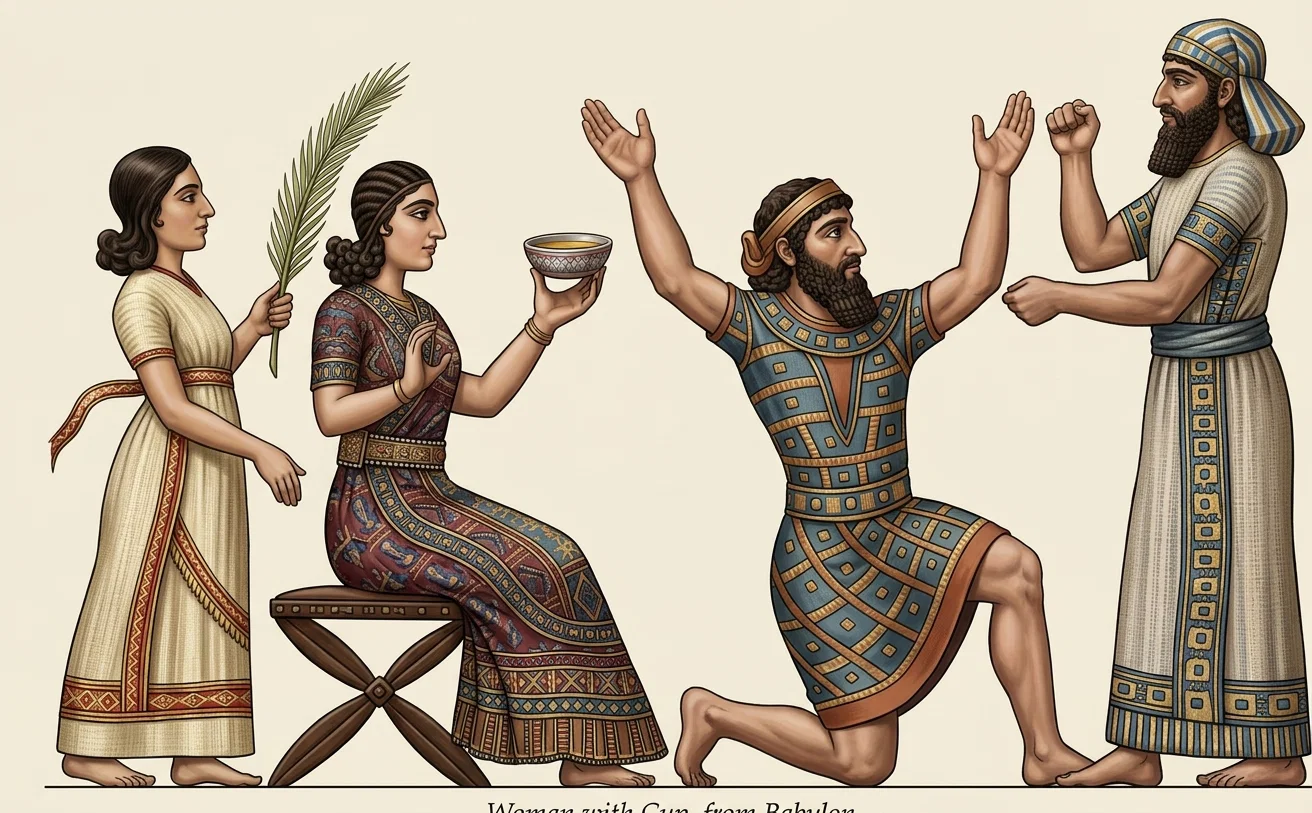
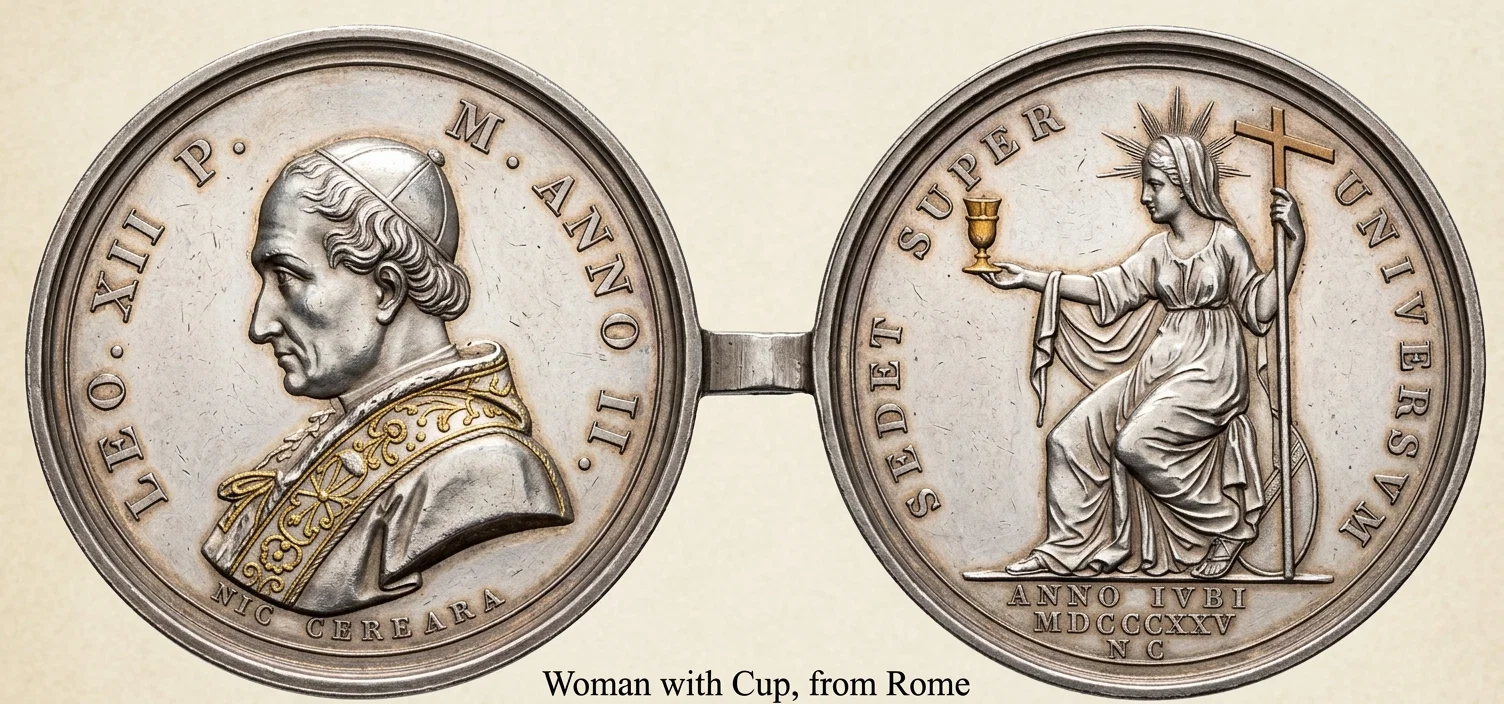
And all the nations of earth have been poisoned with this union of religion with the State, which began with Babylon of old. The rulers of earth have been seduced by the religious teachers and priests. They have quaffed of the cup held out by the siren of the nations, and all have been made drunken. This seducing of the nations, even as a harlot, was characteristic of Babylon of old (Jer. 51: 7), and is engraved on her monuments; as also mystical Babylon has engraved her character upon her medals. (See the accompanying cuts.) As we have learned the meaning of the symbols, let us notice in brief some of the more prominent features of the prophecy:
Its Chronological Application
By this we mean the time to which it applies. Every prophecy of the Apocalypse was given in John's day, when the prophet was a prisoner on the isle of Patmos, whether the prophecy concerned the beginning of Christ's work in the heavenly sanctuary (chapter 5), or the destruction of sin and Satan (chapter 20). But the TIMES to which these prophecies APPLY, their chronological applications, are widely different. The former applies to the time of Christ's ascension from Olivet, the latter to the end of the millennium which will follow the second advent of our Lord. Revelation713 was a prophecy of that great system of evil when it was just entering upon its work under the masterpiece of Church-and-State government — the Papacy. In it is also shown its connection with the past forms of government.
But the chronological application of chapter 17 is at a LATER PERIOD, when the judgment of God is impending, when the Papacy has finished its greatest work, when the wilderness state of the church, the 1,260 years of persecution, is in the past. That the application of this prophecy is to the last days is shown:
1. By the angel that showed John the vision. He is one of those angels to whom is entrusted the fearful mission of pouring out the plagues of God's wrath upon the world. (See verse 1, above.) These angels do not appear in the prophecy except in connection with its closing events. See chapters 15: 1, 6-8; 16: 1; 17: 1; 21: 9.
2. He comes to show John, not the great work of the harlot, but her JUDGMENT, after her great work is in the past. (Verse 1.)
3. The deceiving of the nations, the making them drunken with the wine of her fornication, is also in the past when the angel appears to John. "With whom the kings of the earth COMMITTED fornication, and they that dwell in the earth WERE MADE DRUNKEN with the wine of her fornication." (R.V.)
4. The wilderness state of the church, the very condition which John had before seen was in the past. (Chapter 12: 6, 14.) During this time the true church, the daughter of Zion, was hunted, persecuted, wasted; but the false church, Babylon, was riding in triumphant carnage, drunken with the blood of the saints and martyrs of Jesus. It has been well said that it was the midnight of the world; but it was the noonday of Babylon. No wonder that the prophet said, "And when I saw her, I wondered with a great wonder." (R.V.)
5. The chronological application of the prophecy is shown by verses 7 and 8. The beast that John saw was the beast controlled by the head which existed during the wilderness state of the church. It was during this period that the great apostasy was drunken with the blood of the saints, when it is estimated that fifty million or more of the martyrs of truth were put to death. At the time this prophecy applies, the papal beast, or the beast under the papal head, that which gave the beast the character he then had, existed, from 538 to 1798. The papal beast then "WAS" as a persecuting power. In 1798 its power to persecute, its recognized spiritual domination over the nations, ceased. Since 1798, as a controlling Church-and-State power in the world it "IS NOT." The SYSTEM of Church and State continues to exist in the governments of the Old World, but in a decidedly different form, hence represented by a different head.
But the papal head is to be restored; the beast in that character "is ABOUT TO COME UP out of the abyss, and to go into perdition," indicating that its appearance would be soon and sudden, and its existence brief, so much so that those who "dwell on the earth shall wonder, . . . when they behold the beast, how that he WAS, and IS NOT, and SHALL COME"—not, "and yet is," as in the Common Version.
Rotherham renders the last clause of verse 8, "shall be present;" the Emphatic Diaglott the same. Murdock's Syriac translation renders the last clause, "which was, and is not, and approacheth." Etheridge's Syriac translation renders, "who was, and is not, and shall come again," with the following marginal note: "So all our ancient MSS.; some of the LATE have, 'and is present;' but none read as the Authorized Version." "Shall come," "draweth nigh," or "shall come again," is the proper reading.
THEN, when the beast in that phase "shall come again," will be fulfilled Rev. 13: 3: "And his deadly wound [death stroke] was healed; and all the world wondered after the beast."
"Was," "Is," and "Shall Ascend"
A word right here in regard to the tenses used in verse 8 — "WAS," "IS," "SHALL ASCEND," past, present, future. It has been said that the "IS" refers to John's day. But nothing is more common in the prophecies of Old and New Testaments than the use of the present tense with reference to the future. The prophet is carried forward to the time when the prophecy will be fulfilled, to the time of its application, and there he stands as the representative of the people of God.
Woman with Cup, from Babylon
(Kitto's "Biblical Cyclopedia," Edinburgh, 1856)
Says Hislop in his "Two Babylons," third edition, London: "The Chaldean Mysteries can be traced up to the days of Semiramis, who lived only a few centuries after the Flood, and who is known to have impressed upon them the image of her own depraved and polluted mind. That beautiful but abandoned queen of Babylon was herself a paragon of unbridled licentiousness, but in the Mysteries, which she had a chief hand in forming, she was worshiped as Rhea, the great 'Mother of the gods,' with such atrocious rites as identified her with Venus, the mother of all impurity." Among the famous things captured by Cyrus, Pliny tells us, was the cup of Semiramis, which weighed fifteen talents, or 1,200 pounds.—Plinii, Hist. Nat. lib. 32, cap. 15. What a fit symbol was the Babylonian queen of old of the spiritual fornication of coming ages!
A few examples will make this plain. In Ps. 2: 7 the Lord through the psalmist speaks prophetically of Christ's resurrection, "Thou art My Son; THIS day have I begotten Thee;" but this refers to the resurrection of Christ. (Acts 13: 33.) "For the day of vengeance IS in Mine heart, and the year of My redeemed IS come" (Isa. 63: 4), is another example. It refers to the great day of God's wrath, three millennia to come. Rev. 14: 7 is
Woman with Cup, from Rome
"The Roman Church has actually taken this very symbol [woman with cup] as her own chosen emblem. In 1825, on the occasion of the Jubilee, Pope Leo XII struck a medal, bearing on the one side his own image, and on the other, that of the Church of Rome, symbolized as a 'Woman,' holding in her left hand a cross, and in her right a CUP, with the legend around her, 'Sedet super universum.' 'The whole world is her seat.'" — "Two Babylons," page 6. See also Rev. 17:1, 18. What a striking fulfilment!
another example — "The hour of His judgment IS COME;" not come when the angel told John, but in the future, at the close of the great prophetic period of Dan. 8: 14. It is just the same with the "IS" of Rev. 17: 8; the "IS" refers to that period of time following the overthrow of the persecuting power of the Papacy. The "WAS" applies to the time when that system under the Papacy was in its strength. The "SHALL ASCEND" refers to the Papal head restored; for it is the same beast. The head restored is not the immediate successor of the head which received the deadly wound. There is a head which intervenes between the fall and restoration of Papal Rome. "FIVE are FALLEN [Babylon, Medo-Persia, Grecia, Pagan Rome, Papal Rome], and one IS [the pago-Christian governments of Europe], and the OTHER [Papal Rome restored] is NOT YET come." Having established the chronological application of the prophecy, the various tenses fall into their proper place, and all is harmony.
Mountains and Kings
The fulfilment of verses 9 and 10 has already been set forth in considering the seven heads of the dragon and the beast. They are said to be "seven mountains, on which the woman sitteth." "Mountain" is a symbol of strength and of government, and the world has been so deceived by the wine of Babylon as to believe that the various forms of Church-and-State government were the strength of these governments. Upon the supposed strength of this union the apostate church has always rested, from Babylon to the present time.
"And they [the mountains] are seven kings," or forms of government, which have supported all through the ages the great Babylonian apostasy, founded in earth by Lucifer, "king of Babylon." (Isa. 14: 4, 12.) Babylon, the beginning, is called a "destroying mountain." Jer. 51: 25. That these forms are successive we have before assumed. Here it is proved: "The five are fallen, the one is, the other is not yet come; and when he cometh, he must continue a little while." The six have been named in the past. The restoration of the papal head will be an EIGHTH; for "the beast that was, and is not, is himself also an eighth, and is of the seven; and he goeth into perdition." Verse 11. That is, he has already existed as one of the seven, and when he comes forth again, he will be an eighth, tho not counted in chapters 12 and 13, because a repetition of a form which had once existed, and because it unites with the seventh to form an eighth. As the restoration of the papal head forms the eighth, and as the sixth head now exists, it is evident that another must arise before the Papacy is fully restored.
What Is the Seventh Head?
This we will consider in our next.
Christianity in Business Life
By Phillips Brooks
MEN are asking everywhere this question: "Is it possible for a man to be engaged in the activities of our modern life, and yet be a Christian? Is it possible for a man to be a broker, a shopkeeper, a lawyer, a mechanic—is it possible for a man to be in a business of to-day and yet love his God and his fellow man as himself?"
I do not know what transformations these dear businesses of yours must undergo before they shall be true and ideal homes for the child of God, but I do know that upon Christian merchants and Christian brokers and Christian lawyers and Christian men in business to-day there rests an awful and a beautiful responsibility to prove—if you can prove it—that these things are capable of being made divine; to prove that a man can do the work which you have been doing this morning, and will do this afternoon, and yet shall love his God and his fellow man as himself. If he can not, what business have you to be doing them? If he can, what business have you to be doing them so poorly, carnally, and unspiritually that men look on them and shake their heads with doubt?
It belongs to Christ in men, first, to prove that man may be a Christian and yet do business; and, in the second place, to show how a man, as he becomes a greater Christian, shall purify and lift the business which he does and make it the worthy occupation of the son of God.—Bishop Phillips Brooks.
His Opportunity
A YOUNG preacher in a wild mountain region, several years ago, improved what he counted a favorable opportunity for the delivery of a temperance sermon, which he preached in several of the log schoolhouses in his circuit.
It was the midst of a heated political campaign, with candidates riding about with saddle-bags filled with flasks of moonshine whisky, and many men who were ordinarily sober had accepted the free hospitality of the politicians. Against this practise the young preacher's words were unsparing, and he angered both the candidates and the men who had partaken of their liquor.
As he mounted his horse at the close of the service, he saw about him angry faces, some of them still bloated with the liquor he had been denouncing, for one or two candidates had seized upon the meeting as a good time to be present and to see a number of men together.
A few days afterward he received a message in the roundabout manner of the region—a message emanating from no one and delivered by no one—informing him that if he ever preached again on Brimstone Creek he would be tied to a tree and whipped.
Once a month, on the third Sabbath, was the time of his Brimstone appointment, and there was time for some quiet inquiry, which confirmed the young preacher's suspicion as to the leader of the gang that intended to whip him.
Somewhat earlier than usual on the morning of the third Sabbath of the next month, he rode up the Brimstone, and made a detour to take him past the house of his leading enemy.
"Hello!" he shouted at the fence.
The master of the house came to the door, called off the dogs, and made a surly response.
"Are you going to meeting to-day?" asked the preacher.
"Don't know. Like as not I will, and like as not I won't."
"Well, I rode round this way to say that I will stop in and take dinner with you today. I hope you will come. I'll ride back with you."
"I don't hardly reckon I'll get thar," said the mountaineer. "One of the chaps was sick all night, and he's mighty triflin' this mornin'."
"Let me see him," said the minister, who carried with him a few simple remedies.
After an examination of the sick child, he said to the mother, "Here, give him this once an hour, and I think he will be better by the time we get back to dinner."
The anxious mother was instantly grateful, and even the father was mollified a little.
"If you'll wait till I get my saddle on, I'll ride to meetin' with you," said he.
The sermon that day gave better satisfaction. There was a certain prejudice to overcome, but partly it was overcome already in admiration of the young man's courage, and in astonishment that he rode in under protection of his recent enemy.
Of course, there was no attempt at whipping, and at the close of the service many greeted the young man with sheepish cordiality.
When they returned to the house, the little boy had improved, and the preacher sat down to a good dinner of hot biscuit and fried chicken, the food of preachers in that region, and at the close of the meal he rode off in safety.
There was a meeting in the schoolhouse a few days afterward, and a letter was written, not without great labor, and sent to the young preacher. Not very long ago, in an overhauling of old papers, that letter came to light:
"We want you to keep on preaching on brimstone, and as peter sed to Christ though all forsake you yet will not wee, but we think it would be well to preach the gospel insted of temperance and for the presint give us something mor cimple."
The spelling was not quite beyond reproach, but the Brimstone appointment continued.—Exchange.
Our Bible Reading
Man in Death
1. What question of the ages did the Idumean patriarch give voice to?
If a man die, shall he live again? Job 14: 14.
2. What is said of man's creation?
God created man in His own image. Gen. 1: 27.
And the Lord God formed man of the dust of the ground, and breathed into his nostrils the breath of life; and man became a living soul. Gen. 2: 7.
Note.—There is nothing in these scriptures upon which to build the theory of man's deathlessness. "Image" indicates physical and moral likeness, but it does not necessarily mean immortality more than it means omniscience, or omnipotence. God "only hath immortality." Why invest man with that attribute of Deity, and withhold from him others equally deific? Why seek to confirm the falsehood of Satan, "Ye shall not surely die"? Man was made of the dust, a perfect physical being, a soul, before he received "the breath of life." That life from God—not an entity—made the man a living soul.
3. What was shown him as the consequence of his sin?
In the day that thou eatest thereof thou shalt surely die. Gen. 2: 17.
4. How does Solomon describe man's dissolution?
Then shall the dust return to the earth as it was: and the spirit [the breath of life] shall return unto God who gave it. Eccl. 12: 7.
Note.—That spirit is not an entity put into man, consciously existing before and after it leaves the body; it is life, given to man and beast alike.
5. What is David's testimony to the condition of man in death?
For in death there is no remembrance of Thee. Ps. 6: 5.
The dead praise not the Lord, neither any that do down into silence. Ps. 115: 17.
His breath goeth forth, he returneth to his earth; in that very day his thoughts perish. Ps. 146: 4.
6. What is the testimony of Job?
His sons come to honor, and he knoweth it not; and they are brought low, but he perceiveth it not of them. Job 14: 21.
7. To what does Solomon the Wise bear witness?
The dead know not anything. . . . Also their love, and their hatred, and their envy, is NOW PERISHED. Eccl. 9: 5, 6.
8. What does Peter say?
He is both dead and buried, and his sepulcher is with us unto this day. . . . For David is not ascended into the heavens. Acts 2: 29, 34.
9. What does this absolutely negative condition demand?
If there be no resurrection of the dead, then is Christ not risen. . . . Then they also which are fallen asleep in Christ are perished. See 1 Cor. 15: 13-22.
10. When will this resurrection take place?
For the Lord Himself shall descend from heaven with a shout, with the voice of the Archangel, and with the trump of God: and the dead in Christ shall rise first. 1 Thess. 4: 16.
All that are in the graves shall hear His voice, and shall come forth; they that have done good, unto the resurrection of life; and they that have done evil, unto the resurrection of damnation. John 5: 28, 29.
Note.—Thus is the question answered—if a man die, he shall live again, through the resurrection only, at the second coming of Christ.
Prayer
There is an arm that never tires,
When human strength gives way.
There is a love that never fails,
When earthly loves decay.
And there's a power that men can wield,
When other aid is vain.
That power is prayer which soars on high,
God's listening ear to gain.
—Anon.
The Clouded Sky of Sin
By John Newton
ONE indulged sin may so cloud the sky that it spreads a mist, so that to see what God is doing is impossible.—J. Newton.
Drugs and Doctors
By Editor
SOME time ago the "New York World" investigated drug stores in New York. The "World's Work" declares that the results were terrible. Three hundred prescriptions were presented to pharmacists in all parts of Manhattan. These prescriptions were filled by the druggists and then presented to noted chemists. Fifty per cent of the preparations were found either worthless or positively harmful. In many cases the results would have been dangerous, where such prescriptions contained digitalis, strophanthus, and other powerful heart stimulants. The "World's Work" remarks that it is bad enough to have one's coal short-weight, or short-weight groceries, but these the law will remedy. Not one person in a thousand can know whether a prescription is filled with fresh and effective medicines. We are told that druggists themselves commit little frauds — that if they do not have the particular chemical called for, they supply something else which has, to their mind, the same effect. It is further said that the druggist is under peculiar temptation, because he is continually selling a large amount of patent medicines, most of which he knows to be either positively harmful, or decided frauds. And there you have it.
The "World's Work" suggests that there are ten times too many drug stores, some of them utterly unable to pay rent without selling cold drinks over one counter, which drives the drinkers to buy patent medicines over the other. What the public need to know more than anything else is that drugs do not cure, can not cure. They may relieve and assist nature in some cases. They may be necessary in some great crisis; but in most cases they only relieve symptoms and deceive the one who is ill. The lesson is, leave off drug taking, and put in their place fresh air, exercise, good food, and a clean conscience.
And Doctors
The "World's Work" contends that we have too many doctors. It points out that in France, with a population of 40,000,000, there are 17,000 physicians — one to every 2,353 persons; England has a little more than 40,000,000, with 32,000 physicians, or one to every 1,250 persons; while America has 120,000 physicians — one to every 833 persons.
Dr. Flexner's report on medical colleges, made to the Carnegie Foundation, recommends the extinction of 124 out of 155 of the existing degree-giving schools in the United States and Canada. Doubtless the claim is true that where there are so many doctors, and many of them, like other men, unprincipled, it is quite an advantage, many times, for a physician to keep a patient sick, especially if the patient be a wealthy one.
We agree with the "World's Work"; there are too many doctors of certain kinds. What the individual ought to do is become conversant with the general laws of health himself; and while he would respect the intelligent, conscientious physician, he would have very much less use for the ordinary.
The Religious Trend
By Editor
THE Rev. Dwight Mallory Pratt, of Cincinnati, Ohio, has an article in the June "Homiletic Review" on religious life in our colleges; and while he tries to draw a sunny conclusion from his clouds of premises, he certainly does not awaken any too much hope in the heart of the reader.
First, there is in our religious colleges a feeling of doubt. Nothing, he says, is now taken for granted. He continues:
Our fathers and mothers believed truth because it was in the Bible. That sense of the reality of God, of the sacredness of His Word, was a great asset in religion. It generated reverence, devotion, conviction, and a deep and beautiful piety. . . . That attitude of mind no longer prevails in our schools and colleges, even when instructors are genuinely and vitally religious.
He quotes from President Faunce, of Brown University, as follows:
A situation has grown up in this country which would have seemed inconceivable to ancient Athens or medieval Florence, a situation such as no pagan nation ever tolerated, a situation to-day incomprehensible to either Berlin or London, or even to Cairo or Constantinople, a situation more perilous than any other with which the public is now confronted.
And this Dr. Pratt calls "the modern educational defect." Teachers, we are told, are not chosen because of character or religion, but, is he a man of research? has he the ability to advance human knowledge? President Hyde, of Bowdoin, is thus quoted:
The saddest omen for many of our colleges and universities is the reckless way with which they are filling up their faculties on paper evidence of merely technical acquisitions. Not one man in ten that comes out of our graduate schools in these departments has the personal human attitude which makes him fit to teach a college class.
President King, of Oberlin, uses these words:
At times in our higher education it has seemed as if many in the faculties they recognize as Christian men had suffered almost a religious atrophy.
And Dr. Pratt remarks upon this religious atrophy:
The ordinary observer need not hesitate to challenge the religious quality of any of our colleges, when eminent specialists give such startling arraignment as this.
Dr. Pratt quotes another professor in one of our large State universities, a broad-minded, up-to-date scholar, judicious in temper and in speech, on the religious life and influence of college instructors, as follows:
The faculties of our colleges are in a bad way. A Young Men's Christian Association college secretary, whose work is to introduce Bible study in college fraternities, and of whom I made inquiries, said to me that the faculties were almost without exception willing to have any of their number teach the Bible in the fraternities, but that it was well-nigh impossible to get any of them to do so, as they were so uncertain of their own belief as to be disqualified for the work; and then referred to the head of department of modern languages who had just passed away, and who, in anticipation of death, said that he had no expectation of a future life.
These, Dr. Pratt tells us, are recent, and — are not words of sensational critics, but of men of masterly vision within the front rank of educators.
And he remarks that —
it is trivial to say that there is not serious occasion for challenging the religious influence of many a college and of many an individual instructor, especially from among the younger and immature recruits recently trained within the narrow limits of technical and naturalistic science.
Dr. Pratt further says:
Even the venerable president of our oldest university, after a notable career of scholarship and merited fame, at the time of his retirement gave the public the impression that he had found no adequate anchorage for his faith in historic Christianity, but was still searching for a new religion more suited to scholarly intellects, and to the world's moral needs.
He quotes the metropolitan pastor, under the eaves of one of the larger Eastern universities, from which his son has recently graduated, thus:
I do not think one would err in saying that a positive and assertive faith on the part of the faculty of any of our institutions is not to be found.
These quotations are not from wildly speculative men. They are written by men of eminence and sober thought. They do not describe conditions existing among those of no influence, but among those of the highest influence, those who are molding the life of the young in America to-day. Surely it would seem as tho true, earnest Christians could see the trend of religion, and it would also seem that it would lead them back to the fountain-head of all religion and truth — the Bible.