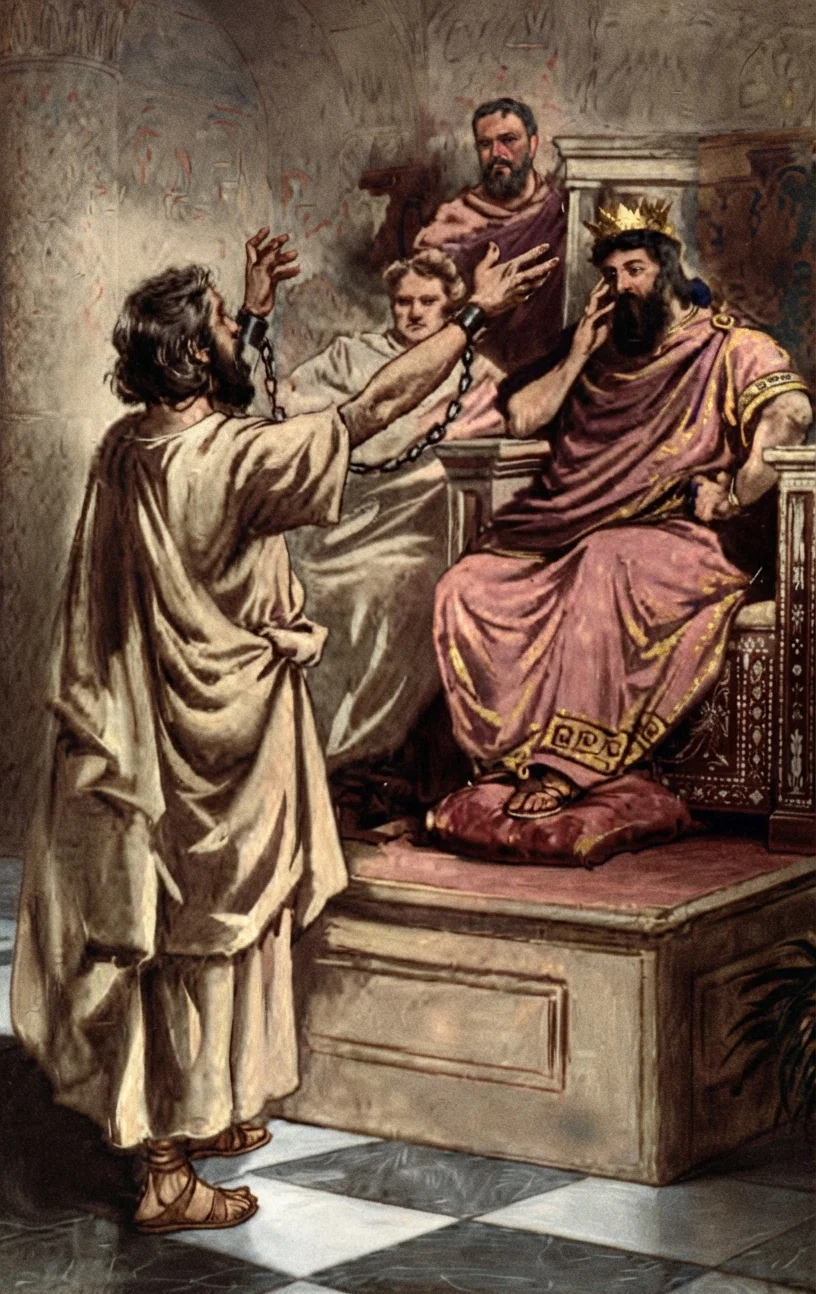
Falsely Imprisoned, Paul Does His Greatest Work While in Bonds
By MRS. E. G. WHITE
DURING Paul's last journey to Jerusalem, he met with many evidences that his active ministry was about to close. "I go bound in the spirit unto Jerusalem," he wrote, "not knowing the things that shall befall me there: save that the Holy Ghost witnesseth in every city, saying that bonds and afflictions abide me."
A long and wearisome imprisonment did indeed await the tried messenger of God; but notwithstanding the fears and entreaties of his friends, he pressed forward on his journey. "None of these things move me," he declared, "neither count I my life dear unto myself, so that I might finish my course with joy, and the ministry, which I have received of the Lord Jesus, to testify the gospel of the grace of God."
AFFLICTION COULD NOT TURN HIM
The apostle allowed not the fear of affliction and imprisonment to turn him from his purpose. But never before had he approached Jerusalem with so sad a heart. He knew that he would find few friends and many enemies. He was nearing the city which had rejected and slain the Son of God, and over which now hung the threatenings of divine wrath.
Remembering how bitter had been his own prejudice against the followers of Christ, he felt the deepest pity for his deluded countrymen. And yet how little could he hope that he would be able to help them! The same blind wrath which had once burned in his own heart, was now with untold power kindling the hearts of a whole nation against him.
HIS ENEMIES SET ON EACH OTHER
The plottings of those who were seeking to hinder the spread of the gospel by silencing the voice of the apostle to the Gentiles, soon resulted in Paul's arrest. During his trial the following day, before the Sanhedrin council, "there arose a dissension between the Pharisees and the Sadducees: and the multitude was divided." In the confusion that followed, the Sadducees were eagerly striving to gain possession of the apostle, that they might put him to death; and the Pharisees were as eager to protect him. "The chief captain, fearing lest Paul should have been pulled in pieces of them, commanded the soldiers to go down, and to take him by force from among them, and to bring him into the castle."
COULD HE HAVE BEEN MISTAKEN?
Later, while reflecting on the trying experiences of the day, Paul began to fear that his course might not have been pleasing to God. Could it be that he had made a mistake after all in visiting Jerusalem? Had his great desire to be in union with his brethren led to this disastrous result? He knew that his enemies, in their desperate malice, would resort to any means to put him to death. Could it be that his work for the churches was ended, and that ravening wolves were to enter in now? The cause of Christ was very near to Paul's heart, and with deep anxiety he thought of the perils of the scattered churches, exposed as they were to the persecutions of just such men as he had encountered in the Sanhedrin council. In distress and discouragement he wept and prayed.
THE LORD STOOD BY HIM
In this dark hour the Lord was not unmindful of His servant. He had guarded him from the murderous throng in the temple courts; He had been with him before the Sanhedrin council; He was with him in the fortress; and He revealed Himself to His faithful witness in response to the earnest prayers of the apostle for guidance. "The night following the Lord stood by him, and said, Be of good cheer, Paul: for as thou hast testified of Me in Jerusalem, so must thou hear witness also at Rome."
Paul had long looked forward to visiting Rome. He greatly desired to witness for Christ there, but had felt that his purposes were frustrated by the enmity of the Jews. He little thought, even now, that it would be as a prisoner that he would go.
HE APPEALED TO CAESAR
Paul was transferred from the Roman fortress in Jerusalem to Cæsarea, the residence of the governor of the province, where for two years he remained a prisoner, appearing for trial before Lysias, Felix, Festus, and Agrippa. Rather than fall into the hands of the Jewish Sanhedrin, to which tribunal Festus proposed to refer his case, the apostle, weary of strife and of the suspense of imprisonment, decided to exercise his privilege, as a Roman citizen, of appealing to Cæsar. Festus knew nothing of the conspiracies of the Jews to murder Paul, and he was surprised at this appeal to Cæsar. However, the words of the apostle, "I appeal unto Cæsar," put a stop to the proceedings of the court. Festus could not do otherwise than send him to Rome.
A PRISONER IN HIS OWN HOUSE
It was with a heavy heart that Paul went forward to his long-expected visit to the world's metropolis. How different the circumstances from those he had anticipated! How was he, fettered and stigmatized, to proclaim the gospel? His hopes of winning many souls to the truth in Rome, seemed destined to disappointment.245
At Rome Paul, instead of being thrown into prison, was permitted to live in his own hired house. Although still chained to a soldier, he was at liberty to receive his friends, and to labor for the advancement of the cause of Christ. Thus for two years he continued his labors, "preaching the kingdom of God, and teaching those things which concern the Lord Jesus Christ, with all confidence, no man forbidding him."
During this time, the churches that he had established in many lands were not forgotten. Realizing the dangers that threatened the converts to the new faith, the apostle sought so far as possible to meet their needs by letters of warning and practical instruction. And from Rome he sent out consecrated workers to labor not only for these churches, but in fields that he himself had not visited. These workers, as wise shepherds, strengthened the work so well begun by Paul, and the apostle, kept informed of the condition and dangers of the churches by constant communication with them, was enabled to exercise a wise supervision over all.
WIELDING A WIDER INFLUENCE
Thus, while apparently cut off from active labor, Paul exerted a wider and more lasting influence than if he had been free to travel among the churches as in former years. As a prisoner of the Lord, he had a firmer hold upon the affections of his brethren; and his words, written by one under bonds for the sake of Christ, commanded greater attention and respect than they did when he was personally with them. Not until Paul was removed from them, did the believers realize how heavy were the burdens he had borne in their behalf.
Before the close of that two years' imprisonment, Paul was able to say, "My bonds in Christ are manifest in all the palace, and in all other places"; and among those who sent greetings to the Philippians he mentions chiefly them "that are of Cæsar's household."
AN ABIDING POWER
And by what means was an entrance achieved and a firm footing gained for Christianity where even its admission seemed impossible? Paul ascribed to his own imprisonment his success in winning converts to the faith from Nero's household. Paul's patience and cheerfulness during his long and unjust imprisonment, his courage and faith, were a continual sermon. His spirit, so unlike the spirit of the world, bore witness that a power higher than that of earth was abiding with him.
The zeal and fidelity of Paul and his fellow workers, no less than the faith and obedience of their converts to Christianity, under circumstances so forbidding, rebuke slothfulness and lack of faith in the minister of Christ. The apostle and his associate workers might have argued that it would be vain to call to repentance and faith in Christ the servants of Nero, subjected, as they were, to fierce temptations, surrounded by formidable hindrances, and exposed to bitter opposition.
Even should they be convinced of the truth, how could they render obedience? But Paul did not reason thus. In faith he presented the gospel to these souls, and among those who heard were some who decided to obey at any cost. Notwithstanding obstacles and dangers, they would accept the light, and trust God to help them let their light shine forth to others.
REMAINED FIRMLY AT THEIR POST
Not only were converts won to the truth in Cæsar's household, but after their conversion they remained in that household. They did not feel at liberty to abandon their post of duty because their surroundings were no longer congenial. The truth had found them there, and there they remained, by their changed life testifying to the transforming power of the new faith.
PAUL BEFORE AGRIPPA
Are any tempted to make their circumstances an excuse for failing to witness for Christ? Let them consider the situation of the disciples in Cæsar's household — the depravity of the emperor, the prodigacy of the court. We can hardly imagine circumstances more unfavorable to a religious life, and entailing greater sacrifice or opposition, than those in which these converts found themselves. Yet amidst difficulties and dangers, they maintained their fidelity.
Not in freedom from trial, but in the midst of it, is Christian character developed. Exposure to rebuffs and opposition leads the follower of Christ to greater watchfulness, and more earnest prayer to the mighty Helper. Severe trial endured by the grace of God develops patience, vigilance, fortification, tude, and a deep and abiding trust in God. It is the triumph of the Christian faith that it enables its follower to suffer and be strong; to submit and thus to conquer; to be killed all the day long, and yet to live; to bear the cross, and thus to win the crown of glory.
Hope
By William Covert
GOD gives man hope through the agency of the Holy Spirit in his heart, and so all the divine attributes are installed by the working of this gentle but mighty power. Rom. 5:5.
Hope is a compound of desire and expectation. The element of desire seeks among apparent possibilities for things that will satisfy the longings of the heart, while expectation is built up out of evidences that are manifested in the cases we study. One desires things which he thinks would bless him, and he expects them when a train of circumstances seems to be making their accomplishment sure.
Hope has eyes looking into the future, and an anchor line fastened by Jesus to the very hold of heaven. It is hope that puts courage into the soul, and that gives mental nerve by which all the wonders of God's graces are done. Hope looks with glad eyes into the to-morrow, and with courage in the present, makes preparations for all the good things which now are, and also that which is to come.
It is hope that fights our battles, and hope that wins our victories.
Without hope all is vanity, and life is but a prolonged death. Indeed, it were a better state to be unconscious in death than to exist when hope is extinct.
Paul writes of a "blessed hope," and truly all that can be called by that sweet word is of the blessed kind. None other can truly be hope.
The child of hope is the child of God, and God's children live by the power of His word, which lies at the foundation of all hope.
WILLIAM COVERT.
Preparing the Way for Christ’s Coming
By Ellen G. White
"CHRIST is waiting with longing desire for the manifestation of Himself in His church. When the character of the Saviour shall be perfectly reproduced in His people, then He will come to claim His own. It is the privilege of every Christian, not only to look for, but to hasten, the coming of our Lord. Were all who profess His name bearing fruit to His glory, how quickly the whole world would be sown with the seed of the gospel! Quickly the last great harvest would be ripened, and Christ would come."
The Danger of Occasional Christianity
"It is not safe to be occasional Christians. We must be Christlike in our actions all the time. Then, through grace, we are safe for time and for eternity."
Promised Concerning the Whole World
By Allen Moon
THROUGH ABRAHAM WE HAVE THIS PROMISE—THE WORKING OUT OF A GREAT PLAN—THE ETERNAL CITY, THE OBJECTIVE
By ALLEN MOON
"AND the Lord said unto Abram, after that Lot was separated from him, Lift up now thine eyes, and look from the place where thou art northward, and southward, and eastward, and westward: for all the land which thou seest, to thee will I give it, and to thy seed forever. . . . Arise, walk through the land in the length of it and in the breadth of it; for I will give it unto thee." Gen. 13:14-17. This promise God has sworn to fulfil literally to Abraham and his seed. The Lord, who was willing to show to the heirs of salvation the immutability of His promise, confirming it by an oath, gave also to Abraham and to his seed many infallible signs of His regard for His promise and oath.
BATTLE WITH THE FOUR KINGS
In Abraham’s day, not long subsequent to the giving of this promise, Chedorlaomer and three confederate kings invaded the land of Canaan, and carried away captives, including Lot, Abraham’s brother’s son, and many of the women of the land. Abraham, on hearing of this invasion, took his trained servants, and pursued after the four kings and their armies, and overtook and conquered them, and brought back all the captives and the spoil.
As Abraham was returning from the defeat of the kings, Melchizedek, king of Salem, went out to meet him. He brought forth bread and wine, for he was at the same time priest of the most high God. Melchizedek had been endowed with a priesthood by Jehovah. Although not in the line of any priesthood by inheritance, the office was directly conferred on him. The name "Salem" means place of peace. Melchizedek, being king of Salem, was therefore king of peace. And as he was king of peace and priest of the most high God, Abraham recognized in him the type of the Son of promise through whom all the world should be blessed, and he accepted the bread and the wine as emblems of the body and blood of the eternal Son. In short, Abraham had before him a complete miniature of the eternal kingdom,—the king, the subjects, and the territory, and Salem, the capital; also the mediator or priest of the most high God. To complete the figure, there must have been in the little city righteous subjects over whom Melchizedek ruled; and Abraham paid tithes in recognition of the divine offices, and also accepted the blessing of the representative of the Son of God.
THEY WENT INTO THE LAND OF PROMISE
It was near the city of Salem that the Lord had met with Abraham and promised him the land. Abraham was at a loss to know the full import of God’s promise. After Melchizedek met him, the Lord confirmed His promise by an oath; but in answer to Abraham’s inquiry, the Lord told him that his seed should be strangers four hundred years in a land not their own, and in the fourth generation his seed should come again into the land where he then was. This promise was literally fulfilled in type to a portion of the seed of Abraham. In the fulness of time, the Lord delivered the Israelites, as the seed of Abraham were called, from the bondage of Egypt; and after forty years’ wandering in the wilderness, all that remained were brought into the land of promise. But Abraham and several generations of his descendants were in their graves before Israel returned to Canaan. Three generations never saw the land of promise, but were all the while in bondage in Egypt.
After the majority of the nations of Canaan had been destroyed according to divine direction, Joshua proceeded to divide the land by lot among the twelve tribes, and these in turn allotted it to the families of the tribes.
JUDAH RECEIVED THE LAND OF SALEM BY LOT
In the division of the land by lot, the land on which Abraham pitched his tent after his separation from Lot, and on which he built an altar and worshiped God, and where the Lord met him and made the promise, fell to the tribe of Judah. In Judah’s portion also was situated the little city of Salem, which had come to be known as Jebus, or Jebusi, because it had fallen into the possession of the Jebusites after the days of Melchizedek. The children of Abraham recognized the city of Melchizedek, and it very soon was known as Jew-Salem, or Jerusalem.
The south border of the land of Benjamin was near to the city of Jebus, as we read: "And the border went up by the valley of the son of Hinnom unto the south side of the Jebusite; the same is Jerusalem: and the border went up to the top of the mountain that lieth before the valley of Hinnom." Joshua 15:8.
THE PORTION WHERE ABRAHAM’S ALTAR WAS
It may be of interest to note here that the portion of Canaan which fell to Judah, the tribe from which the Saviour was to descend, was also the portion in which Abraham built his altar, in which he was called to offer his son Isaac, in which he received the promise, and in it was also the city over which Melchizedek reigned.
Judah and Benjamin failed to dispossess the Jebusites of this little city until the days of David. When Israel demanded a king, and the Lord granted their request, the first man chosen was a Benjaminite. Although the Lord had specially prepared him, within a short space of time Saul twice sorely displeased Him by his acts of rebellion; and the second time, the Lord rejected him from being king, and he soon perished in battle.
DAVID ESTABLISHED JERUSALEM AS CENTER OF WORSHIP
The Lord now directed the prophet to anoint David, of the tribe of Judah, of the city of Bethlehem, to be king over His people Israel. The first act of David after he was anointed and was established in the kingdom, is recorded as follows: "And David and all Israel went to Jerusalem, which is Jebus; where the Jebusites were, the inhabitants of the land. And the inhabitants of Jebus said to David, Thou shalt not come hither. Nevertheless David took the castle of Zion, which is the city of David. . . . And David dwelt in the castle; therefore they called it the city of David." 1 Chron. 11:4-7. Perhaps this was the same castle occupied by King Melchizedek. At any rate, it was in the very city where he reigned in the days of Abraham.
WORKING OUT OF A GREAT PLAN
All the foregoing reveals the working out of a great plan on the part of Jehovah, for He chose Jerusalem to place His name there. David soon removed the ark of God to Jerusalem, and prepared to build a temple of worship on the site of the throne of Melchizedek. This work was consummated by Solomon. The system of worship, in the hands of the Levitical priesthood, was transferred to the temple on Mount Zion. The name "Jerusalem," which still retained the significance of the original "Salem," was expressive of the character of the final abode of saints, as well as that of God. The psalmist wrote, "In Salem also is His tabernacle, and His dwelling-place in Zion." Ps. 76:2. The prophet, speaking for the Lord, said, "For Zion’s sake will I not hold my peace, and for Jerusalem’s sake I will not rest, until the righteousness thereof go forth as brightness, and the salvation thereof as a lamp that burneth." Isa. 62:1.
THE TRUE CITY OF PEACE AND RIGHTEOUSNESS
This refers not to the old city of brick and stone, but to the true place of peace and righteousness. He continues: "The Gentiles shall see thy righteousness, and all kings thy glory: and thou shalt be called by a new name, which the mouth of the Lord shall name. Thou shalt also be a crown of glory in the hand of the Lord, and a royal diadem in the hand of thy God." Verses 2, 3.
The Jerusalem of precious stones, and gates of pearl, with streets of gold, will truly be a royal diadem; and "thou shalt no more be termed Forsaken; neither shalt thy land any more be termed Desolate: but thou [Jerusalem] shalt be called Hephzibah, and thy land Beulah: for the Lord delighteth in thee, and thy land shall be married. For as a young man marrieth a virgin, so shall thy sons marry thee." Verses 4, 5.
This Jerusalem will be a new creation of God, but it will be connected with land; and as the families of Israel received the land about Jerusalem for an inheritance, so likewise247the ransomed, in a much fuller sense, will marry the land, for He says: 'Be ye glad and rejoice forever in that which I create: for, behold, I create Jerusalem a rejoicing, and her people a joy. . . . And they shall build houses, and inhabit them; and they shall plant vineyards, and eat the fruit of them. They shall not build, and another inhabit; they shall not plant, and another eat: for as the days of a tree are the days of My people, and Mine elect shall long enjoy the work of their hands.' Isa. 65:18-22.
JOHN SAW THE CITY COMING DOWN
John the revelator saw the holy city coming down from God out of heaven, and he describes it as having twelve gates, and in them the names of the twelve tribes of the children of Israel. To Ezekiel the prophet was given a vision of the apportionment of the earth to the twelve tribes; and of the eternal city he says: 'The gates of the city shall be after the names of the tribes of Israel: three gates northward; one gate of Reuben, one gate of Judah, one gate of Levi. And at the east side . . . three gates; and one gate of Joseph, one gate of Benjamin, one gate of Dan. And at the south . . . three gates; one gate of Simeon, one gate of Issachar, one gate of Zebulun. At the west . . . three gates; one gate of Gad, one gate of Asher, one gate of Naphtali.' Eze. 48:31-34.
Of the new earth he says: 'Moreover from the possession of the Levites, and from the possession of the city, being in the midst of that which is the prince's, between the border of Judah and the border of Benjamin, shall be for the prince.' Verse 22. Then follows the description of the division of the land—the earth—among the tribes northward and southward and eastward and westward from the city.
THE MOUNT OF OLIVES SHALL CLEAVE
Another prophet says, speaking of the Prince: 'His feet shall stand in that day upon the Mount of Olives, which is before Jerusalem on the east, and the Mount of Olives shall cleave in the midst thereof toward the east and toward the west, and there shall be a very great valley; and half of the mountain shall remove toward the north, and half of it toward the south. . . . And it shall be in that day, that living waters shall go out from Jerusalem. . . . And the Lord shall be King over all the earth: in that day shall there be one Lord, and His name one.' Zech. 14:4, 8, 9.
'Now to Abraham and his seed were the promises made. . . . And if ye be Christ's, then are ye Abraham's seed, and heirs according to the promise.' Gal. 3:16, 29. The Gentiles, being grafted into the twelve tribes, share in the promise to Abraham and to his seed. Abraham and the twelve tribes of spiritual Israel will literally inherit the earth, according to the promise of God.
"Patience of the Saints"
By William Mayhew Healey
THE CHURCH THAT MEETS THE LORD AT HIS COMING TO HAVE THIS GIFT
By
WILLIAM
MAYHEW
HEALEY
"Patience of the Saints" THE CHURCH THAT MEETS THE LORD AT HIS COMING TO HAVE THIS GIFT By WILLIAM MAYHEW HEALEY
WHAT is the "patience of the saints," mentioned in Rev. 14:12, that the people of God will have at the coming of Christ? This is not merely the patience of saints, but it is the patience of the saints, that is, just such patience as was possessed by the saints in the ages past, and is possessed only by saints.
How Is Patience Developed?
Patience is a product of faith and hope, and is developed under trial. To obtain patience such as the former saints had, it would be necessary to pass through trials like theirs. That the people who are prepared for translation at the coming of Christ, will pass through special tests and trials, is plainly pointed out in the word of God.
Persecution Predicted
In Rev. 12:17 we read, "And the dragon was wroth with the woman, and went to make war with the remnant of her seed, which keep the commandments of God, and have the testimony of Jesus Christ." The woman is the symbol of the church. "I have likened the daughter of Zion to a comely and delicate woman." Jer. 6:2.
The "remnant" must be the last of the church to be gathered out of the world. This "remnant" is the company of Rev. 14:12. They "keep the commandments of God." They also "have the testimony of Jesus Christ." That this remnant of the church is faithful is apparent from the statement that they "keep the commandments of God." Persecution always has developed and always will develop patience in those who, under it, remain true to God.
Terrible Struggle Described
In the fifth chapter of the book of James, we have a terrible struggle described as taking place in "the last days" (verse 3), between the "rich men" (verse 1) and the "laborers" (verse 4). In verses 6-8 he says: "Ye have condemned and killed the just; and he doth not resist you. Be patient therefore, brethren, unto the coming of the Lord. Behold, the husbandman waiteth for the precious fruit of the earth, and hath long patience for it, until he receive the early and latter rain. Be ye also patient; stablish your hearts: for the coming of the Lord draweth nigh."
Three Parties in the Conflict
In this great conflict, so long foretold, and now well under way in all parts of the earth, there are three distinct parties,—the "rich" and the "laborers," who are opposing each other, and a third party, of whom nothing is said as to whether they are rich or poor, but it is said that they are "just," and though suffering even to being "condemned and killed," they do "not resist," but "patiently" wait the "coming of the Lord." In verse 10 of this chapter, our attention is called to the suffering of the prophets in the past, as an example of patience. "Take, my brethren, the prophets, who have spoken in the name of the Lord, for an example of suffering affliction, and of patience."
He Waited Seven Days
When the Lord had finished warning the world by His servant Noah, He sent him and his family into the ark, and shut the door, and there kept him waiting seven days before the Flood came. Those were days of trial for Noah's faith and patience, with a jeering mob outside, probably flinging stones at the ark, and sneering at Noah. Why should he be kept there waiting? His work was all done. Suppose after all no rain should come. How could he ever go out again and face the people? Many such queries might naturally arise, but Noah had learned to believe God and be patient.
Acquiring the Grace of Patience
The Lord promised Abraham a son, in whom all nations of the earth should be blessed. Abraham believed God; but as time rolled by, and there was no evidence of the fulfilment of the promise, he became impatient, and under the influence of Sarah, took Hagar to wife, not with any intent of committing sin, but because he had not yet developed patience to wait God's time.
When Moses thought to lead the children of Israel out of Egypt, he lacked patience, slew an Egyptian taskmaster, and was obliged to spend forty years in Midian cultivating this grace. Think of this man, reared and educated at the very throne of Egypt, and heir to its kingdom, spending forty years as a common shepherd, to cultivate patience. With all this, he made one failure, on this point, that shut him out of the promised land.
When the prophet Elijah stood in the mount, he felt overwhelmed with loneliness. With all his labors, and the manifestations of God's power through him, there was not one soul to grasp his hand and give him a cheering word. All this was hard to bear, and yet God had seven thousand souls in Israel who had not bowed to Baal. But Elijah must learn the lesson of patience, and he learned it best alone with God, under human persecution.
Joseph was deserted by his brethren, and248for his faithfulness, was cast into Potiphar's prison. Job, suffering his many afflictions, was without a friend to encourage him. Those who visited him, professing to be friends, only censured him, and tried to point out some fault in him. Even his wife scoffed at his religion and his God.
All these instances and many more teach us that those who have risen to great prominence in the work of God in the past, were placed under great trials until they learned the lesson of patience; and the faithful souls who meet the Lord in peace at His coming, will have the same grace, obtained under similar trial.
Christ’s Humble Walk of Life
"WHEN Christ left His high command, He might have taken upon Him any condition in life that He chose. But greatness and rank were nothing to Him, and He chose the most humble walk of life. No luxury, ease, or self-gratification came into His experience. The truth of heavenly origin was to be His theme; He was to sow the world with truth; and He lived in such a way as to be accessible to all."
Standing in the Breach
By A. M. Dart
A Charge Against Professors in the Last Days—God Searching for Men to Stand Against Apostasy
By A. M. DART
"Ye have not gone up into the gaps ["breaches," margin], neither made up the hedge for the house of Israel to stand in the battle in the day of the Lord." Eze. 13:5. Sin has made a breach, temporarily, in the government of God. The breach has been spanned by the death and resurrection of His Son; and now the Lord uses men, rightly related to Him through the atonement, to stand in the breach and show forth the true principles of His government.
REPAIRERS OF THE BREACH
"And they that shall be of thee shall build the old waste places: thou shalt raise up the foundations of many generations; and thou shalt be called, The repairer of the breach, The restorer of paths to dwell in." Isa. 58:12. The next two verses show that Sabbath reform would be a special feature in making up the breach. Read them.
The text at the beginning of this article is a charge against God's people in the last days of probationary time; for it states that they "have not gone up into the breaches, neither made up the hedge for the house of Israel to stand in the battle in the day of the Lord."
THE DAY OF THE LORD
The "day of the Lord" is a period of time ushered in by the close of probation, and is spoken of as a "destruction from the Almighty," when all hands shall "be faint, and every man's heart shall melt" (Isa. 13:6-9); a day when silver and gold would not save (Zeph. 1:14-18); a day when men would be crying, "Peace and safety" (1 Thess. 5:1-3); but God's people would "know perfectly" about it. Verse 2. Therefore to "stand in the breach" in these days means to warn the people of this awful day. There is escape now, but there will be none then.
In Moses we have an example of one whom God could use to "stand in the breach." "Therefore He said that He would destroy them, had not Moses His chosen stood before Him in the breach." Ps. 106:23. He was a man who could wish his own name blotted out of the book of life if God could not forgive His rebellious people. Ex. 32:32.
DO YOU THUS LOVE?
Do you thus love sinners? He was a man who was sufficiently separated from this world to reject the rulership of a world kingdom, and choose "affliction with the people of God" and the "reproach of Christ" instead. Heb. 11:24-26. Is your faith strong enough to separate you thus from this world?
SEEKING A MAN FOR THE GAP
"And I sought for a man among them, that should make up the hedge, and stand in the gap before Me for the land, that I should not destroy it: but I found none." Eze. 22:30. This was said of the apostate situation in Ezekiel's day. What may be said of to-day?
The position is open for you, dear reader, and success assured; but do not attempt it without counting the cost. "Destruction from the Almighty" on one side, unfading glory in the kingdom of God on the other. But this world must be given up. "Whosoever therefore will be a friend of the world is the enemy of God."
Events That Arrived on Schedule Time
By W. E. Gillis
As in the type, ten days before the day of atonement, or the cleansing of the sanctuary, the priests at Jerusalem were to blow the trumpets announcing the definite time of that solemn event, so in the events connected with the heavenly sanctuary and its cleansing we must expect some similar manifestation as marking the prophetic period of a day for a year.
Are we disappointed? — No. On time, as all of God's appointments have appeared, came the falling of the stars as witnessed over the greater portion of the Western Hemisphere on the night of November 13, 1833.
God had spoken through the prophet Daniel nearly 2,400 years before, saying, "Unto two thousand and three hundred days; then shall the sanctuary be cleansed." Dan. 8:14. And God's prophets at various times in the centuries had written of the stars of heaven falling as a fig-tree casts her green figs in a mighty wind.
And now, just ten years before the cleansing Judgment in the heavenly sanctuary begins, the inhabitants of America are startled by one of the most magnificent sights ever man has been privileged to behold. From one point in the heavens stream forth in all directions multitudes of what appear to be the stars of heaven, in every way fulfilling the description of the scene as witnessed by the ancient prophets. For fully ten hours they fell from the inexhaustible storehouse. The earth at midnight was lightened with their glory, and the astonished beholders were everywhere calling upon God for deliverance from their sins, for they thought that the end of the world had come.
God's people quickly carried the news of the event and its import to all the world. Just as it was impossible for the priests of the typical service, blowing their horns at Jerusalem, to be heard all over the land of Israel, but the event had to be heralded by messengers, so God gave this sign where His followers were most diligent, and bade them carry the news of it to the ends of the earth.
By the fall of 1843 all the nations of the world had been made acquainted with the time for the beginning of the Investigative Judgment. Because God delights in mercy (Micah 7:18-20), the message to which this sign from heaven calls men's attention is magnified by world-wide publications, so that a man though a fool may not err therein.
Reader, the night of sin is about to end. We are in the last watch. When the morning breaks, probation will have ended. Will your name be among those retained in the Lamb's book of life?
W. E. GILLIS.
Are We Just?
By A. E. Place
"THE path of the just is as the shining light." The just man is "just before he is generous." He can never be generous with that which belongs to another.
The just man does not spend money of which he is steward, where or when he would not spend his own.
The just man is as careful of the property or reputation of his neighbor or brother as he is of his own.
The just man is a light in the world. His life seems ever to be saying, "Let there be light," and darkness flees, and the pathway is light.
The consciousness of being just in all our dealing, floods the very soul with light and joy, and lifts it to the higher life.
The just man is a divine dynamo, in fact a complete electric plant, whose light never goes out.
Are we just, or is our path still dark? If dark, let us pray to touch a "live wire," that the dynamo may move.