THE Hon. Cato Sells, commissioner of Indian affairs, in a circular dated March 28, to the five thousand employees in the Indian service, says:
"I believe that the greatest present menace to the American Indian is whisky. It does more to destroy his constitution and invite the ravages of disease than anything else. It does more to demoralize him as a man and frequently as a woman. It does more to make him an easy prey to the unscrupulous than everything else combined. . . . Let us save the American Indian from the curse of whisky. . . . There is nothing that could induce me, since I have taken the oath of office as commissioner of Indian affairs, to touch a single drop of any sort of intoxicating liquor, and this regardless of my attitude on the prohibition question."
And referring to the fact that Congress appropriates $100,000 a year for the suppression of the liquor traffic among the Indians, every employee in that department of the government is exhorted to do his best and to use his influence most strongly for "the protection of the Indian from this, his worst enemy."
There are thousands upon thousands of men in every walk of life and in every part of the country who can tell us the evil things that liquor is doing among all classes of people. But where is there an individual who can honestly say one single good thing for this business that is ruining both the souls and the bodies of men?
A Prayer for Quietness of Heart
"Give me, O Lord, that quietness of heart that makes the most of labor and rest. Save me from passionate excitement, petulant fretfulness, and idle fear, keeping me ever in the restful presence of Thy love."
STIRRING UP OUR NEST
By L. A. R.
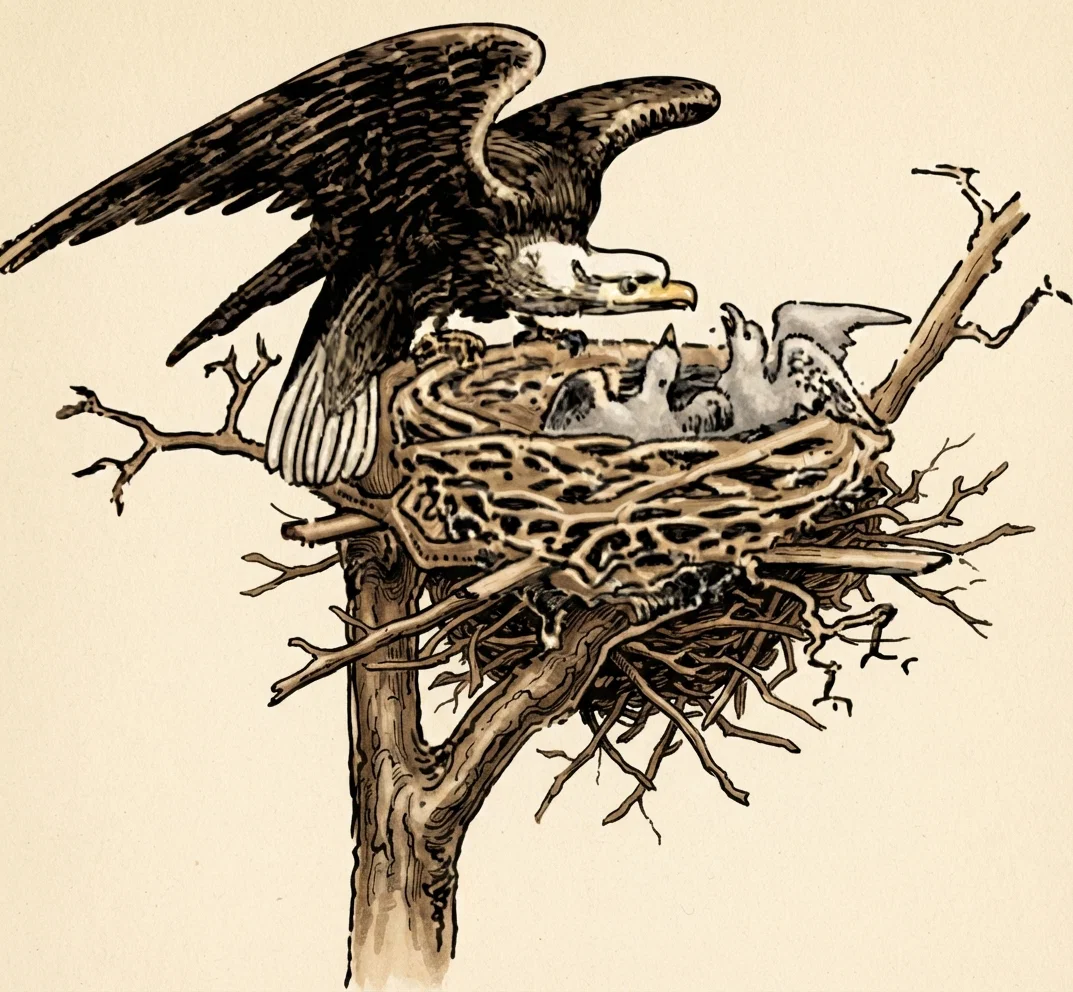
The Eagle Training Her Young—Thrilling Story from Actual Observation—The Impressive and Helpful Lesson
It is a very pleasant thing to us many times to settle down, to get into an easy place and stay there; but it is not progress. God of old called the children of Israel out of Egypt; and all the long, weary way through the wilderness, He did not let them settle down. He stirred them up. At the last, as Moses was about to leave them, in a final sermon to them he explained God's plan. He said:
"As an eagle stirreth up her nest, fluttereth over her young, spreadeth abroad her wings, taketh them, beareth them on her wings: so the Lord alone did lead him." Deut. 32: 11, 12.
THE EAGLE TRAINING HER YOUNG
If the eagle did not stir the little birds out of the nest, they might never learn to fly, might never know their power, might never become eagles. William J. Long, in his "Fowls of the Air," tells of an eagle and her nestling that illustrate this Bible text.
He had found an eagle's nest in a tree many hundreds of feet up in the side of a mountain. One day when he came to visit the nest, he found one of the eaglets gone. The other stood on the edge of the nest, looking down fearfully into the deep abyss below, calling disconsolately the while. He seemed hungry and cross and lonesome.
As an eagle stirreth up her nest, fluttereth over her young, spreadeth abroad her wings, taketh them, beareth them on her wings: so the Lord alone did lead him.
TEMPTING THE HUNGRY BIRD
Soon the mother eagle came swiftly up from the valley with food in her talons. Coming to the edge of the nest, she hovered over it a moment, so as to give the young eaglet a sight and a smell of the food she carried. He saw the food, and his appetite clamored for the morsel. Then the mother bird turned and went slowly down the valley, still holding the food, and in this way inviting the young bird to follow her if he would have it.
The eaglet called after her loudly, and several times spread his wings as if to follow. The plunge, however, was too forbidding. His heart failed him, and he settled back into the nest. Settling his head down into his shoulders and shutting his eyes, he acted as if trying to forget the fact that he was hungry. The mother was seeking to teach him that the time had come for him to use his wings. But he was afraid, and loved his nest. He hated to be stirred out of it.
FLEW OUT AND RIGHT BACK AGAIN
Soon again came the mother, and this time without food. Again she hovered over the nest and sought to get the eaglet to leave. At last she succeeded, but the clumsy little fellow only sprang up and flapped from the nest to the side of the mountain, but a few feet away. Here he sat for a few moments and looked out upon the valley below. Then he flapped back into the nest once more, and paid no further attention to all his mother's assurance that he should fly farther and learn to be an eagle indeed.
BROKE UP HIS NEST AND SET HIM ADRIFT
It was pleasant to the eaglet to stay in the nest and be fed. His mother knew there were greater possibilities for his eagle nature in learning to use his broad pinions and thus soar in the very realm of the clouds; but the little eagle was short-sighted, and was content to let well enough alone. He did not know that for him to have his own way would mean his ruination as an eagle.
Suddenly, as if grown desperate, the parent eagle rose well above the nest. It was a moment of suspense for the watcher, and he held his breath. The young bird stood on the edge of the nest, looking down at the plunge which he dared not take. There was a sharp cry behind, which made him alert, tense as a watch-spring. The next instant, the mother eagle had swooped, striking the nest at his feet, and had sent both nest and eaglet out into the air together.
DISCONCERTED AND TERRIFIED, HE HEADED DOWNWARD
He was out now into the broad expanse of the heavens itself, and he flapped wildly for life; but he was not alone. Over him, under him, beside him, the mother hovered on trained and tireless wings, calling softly to him the while to calm his fearful spirit. And then, as if disconcerted by the lance tops of the spruces, just below him, his flapping grew wilder. He fell faster and faster. Suddenly, perchance from fright, he lost his balance and tipped head downward in the air.
THE MOTHER TO HIS RESCUE
He seemed to realize that all was over now, and folded his wings to be dashed in pieces among the trees; but like a flash, the mother eagle shot beneath him. His little feet touched her shoulders, between her wings. He clutched, righted himself, rested an instant, and found his head. In a moment more she dropped like a shot from under him, leaving him to try his wings and come down alone. A handful of feathers, torn out by his claws, drifted slowly down after them.
The two birds passed from sight among the trees. A little later, through his glass, the watcher saw the eaglet resting in the top of a great pine, and the mother was feeding him.
And then the watcher thought of the saying of the wise prophet who spoke in the ages now gone, and this man watching in the wilderness of America beheld what the man of the wilderness of the Midian desert had seen when he wrote, "As an eagle stirreth up her nest, fluttereth over her young, spreadeth abroad her wings, taketh them, beareth them on her wings: so the Lord."
WILL WE BECOME CONFUSED, OR WILL WE MAKE THE FLIGHT?
There are many people that love the Lord who are apparently confused when God sends them some new revelation of duty, stirs them up out of the nest in which they have settled down so long, and commands them to make flights; and they hold back in fear and in doubt. While we are in this world, journeying through the land of Egypt to the land of God, He will stir us up, and will not leave us to ourselves. It may seem unpleasant and quite disturbing; but unless we trust ourselves out into the place of destiny, we will never come up to what God has planned for us to be. "They that wait upon the Lord . . . shall mount up with wings as eagles." They will make progress, such a progress as can be properly described by the eagle's flight. L. A. R.
"IT SHALL BE FOREVER"
A PROFESSOR in an Eastern university, speaking before a body of ministers not very long ago, assured them that the world would come to an end in about fifteen million years. He said that "eventual cooling of the sun would bring about darkness, cold, and death to all life."
The good old Book says that "whatsoever God doeth, it shall be forever." Eccl. 3: 14.
And again the Book says: "Thus saith the Lord that created the heavens; God Himself that formed the earth and made it; He hath250established it, He created it not in vain, He formed it to be inhabited: I am the Lord; and there is none else." Isa. 45: 18.
This earth became defiled through sin; and Peter tells us it will be melted over by the fires that will consume the wicked and all wickedness, and out of this crucible will come the new heavens and the new earth, "wherein dwelleth righteousness." The theories of evolutionary scientists which would try to make us believe that nature is likely to cut up almost any kind of freaks, are not only disquieting to many simple-minded people, but they are exceedingly absurd. The orderly universe God has given us by His creative power shows that there is an infinite Being who is guiding everything, and as the text says, "Whatsoever God doeth, it shall be forever." And even fifteen million years is a very short time when placed alongside the eternity through which God has made all His suns to shine and all His worlds to revolve.
1. One new yearly subscription and one renewal, or two new, sent at one time, $3.00.
2. Two new yearly subscriptions and one renewal, or three new, sent at one time, $4.00.
3. Three new yearly subscriptions and one renewal, or four new, sent at one time, $5.00.
Five or more copies to one person, six months, each $0.60.
Five or more copies to separate addresses, six months, each $0.65.
Weekly and Monthly SIGNS one year, $2.25.
G. C. HOSKIN, Circulation Manager.
A WORD TO OUR READERS
By Editor
We send no papers from this office to individuals without pay in advance. When persons receive copies without ordering them, they are sent by other parties, and we can give no information in regard to them. Persons thus receiving copies of the SIGNS are not indebted to the office, and will not be called upon to pay for them. Please read the papers you may receive, and hand them to your friends to read.
DATE OF EXPIRATION
The SIGNS wrapper bears date of last issue due on your subscription. Unless renewed in advance, paper stops with expiration date.
If herewith is an order-blank, you will know you have overlooked sending renewal. You will not wish to miss a single issue. Back numbers often can not be furnished.
SCRIPTURE QUOTATIONS
Our authority for the doctrines we teach is the Bible. Quotations are usually from the King James Version or the American Standard Revised.
LAW OF HEAVENLY INHERITANCE
By J. O. C.
The Sure Foundation of the Eternal Heritage—“They Are the Sons of God”—The Heirs Have Received God’s Life
ACCORDING to the laws of nations, it is considered legitimate for any one, without the remotest blood-relationship, to be made a property beneficiary through the expressed will of a would-be benefactor. This has been done, at times, to the disadvantage of those in whose veins flowed the life-blood of the donor, and may have been because of a characteristic notional regard for the favored one, formed, perhaps, by some clandestine association. The provision by which such unjust distributions become possible reveals one of the weaknesses of human enactments.
Then, too, human testamentary documents are not operative while the testator lives, and so in some cases are never fully carried out, because the intended beneficiary dies before the one whose heir he was to be. Perhaps, also, after documentary provision has been made for the disposition of an accumulated fortune, reverses come in and dissipate the entire estate, thus nullifying the claim of inheritance. Upon the first conjecture an heir presumptive never becomes a beneficiary, and on the second count he inherits nothing but bitter disappointment.
FOUNDED ON A SURE BASIS
Were the promise of an eternal inheritance founded on no surer basis, one might well question the utility of renouncing the promises of worldly advancement for a problematical inheritance beyond earthly scenes and labors. But this is not so; for He who provides heritage for His favored ones, does not arrange for them to wait on His decease for their anticipated benefit. Neither does He intend to hand over to their independent control the vast interests of His created possessions. On the other hand, His will provides that every heir to His infinite assets shall enjoy them in His glorious presence and under His most sagacious direction.
There is a possible undervalued thought in the account of man’s creation, where the expression occurs, “In the image of God created He him; male and female created He them.” Gen. 1: 27. Referring to this, the Saviour said that the two were made “one flesh.” The prophet Malachi tells why this was so. He says, “Did not He make one?” That is to say, did not God make male and female one? The prophet then adds: “And wherefore one? That He might seek a godly seed” (margin, “Heb., a seed of God”). Mal. 2: 15. To this end Jehovah’s life was breathed into the “one” (Gen. 2: 7), that his offspring might be the “seed of God,” and so dwell forever in His presence. This life loan was conditional, to be continued only so long as the endowed mind adhered to Heaven’s ways. To disobey the divine injunction would bring death, that is, the forfeiture of God’s life which had been so graciously imparted. Gen. 2: 17.
THE HIGHEST NEXT TO GOD WAS GIVEN
The life of God having been lost to the “one” by breach of condition, his offspring could not then be counted as the “seed of God,” to whom alone belonged the eternal inheritance. As only a divine “seed” could inherit heavenly treasures, a second “Seed of God” must be provided in the flesh, if indeed descendants of the fallen Adam were to be rescued and redeemed. This superadded “Seed” must be of and from God, to insure His offspring an entrance to the joys of a holy inheritance. Therefore the highest Being in the universe, under God, the only-begotten Son of Omnipotence, was brought manward in the “likeness of sinful flesh” (Rom. 8: 3), that He might, as the second Adam, become a life-giving genius to all who would receive Him. 1 Cor. 15: 45; John 3: 16.
Pursuant to this result, He came and tasted death for every man (Heb. 2: 9), and thus prepared a way for the reception of that life which had been forfeited by the progenitor of the race. Had not the Lord of boundless resources provided thus a “Seed” for Himself, the entire lineage of Adam would have been as Sodom and Gomorrah, totally destroyed, and without hope. Rom. 9: 29. But to receive Christ as the holy Seed, one becomes a “temple of God,” in which the indwelling of God’s life atmosphere transforms the earthly being into a child of God, and an heir elect of His infinite possessions.
“THEY ARE THE SONS OF GOD”
This is clearly traced out by the apostle in his most wonderful letter to the Roman brethren. Thus he says, “As many as are led by the Spirit of God, they are the sons of God.” Rom. 8: 14. This transforming Spirit by which earthly souls are led into heavenly sonship, is regarded as identical with “divine life,” as is revealed in verse 10. By substituting the word “life” for the other, one recognizes in verse 16 that the reception of the Spirit is the restoration of the original life lost by our first parents, which witnesses with ours that we are the seed, or children, of God. But the apostle carries his chain of reasoning forward to a most happy conclusion as follows: “If children, then heirs,” yes, “heirs of God” indeed; and because we have been made partakers of the divine “Seed of God,” we are made “joint heirs,” that is, equal heirs with Him.
THE RECOGNIZED HEIRS
Thus the law of heavenly inheritance recognizes as heirs only those who have received God’s life through the spiritual pedigree of the Lord Jesus, who, as the Seed of God, has been made to sinful men wisdom, righteousness, sanctification, and redemption. 1 Cor. 1: 30. But the provision to this end is so ample that every one desiring to receive the prize, may readily avail himself of it. The invitation is to all in these words: “Come unto Me, all that labor and are heavy laden, and I will give you rest.” Matt. 11: 28. These are good words; so “let him that heareth say, Come. . . . And whosoever will, let him take the water of life freely.” Rev. 22: 17. J. O. C.
AROSE FROM WATERY WASTES
The Sierra and Rocky Mountains in the Light of Geology—Were These Mountains Thrown Up at the Flood or Did They Come by Evolution?
A GREAT scientist who has probably written as much upon the subject of science as any other living man, said in a recent article:
“There was a time when no Sierra and no Rocky Mountains existed. Then in the fulness of an inconceivably long time they rose above watery wastes, and lifted up debris that had been lying on the ocean floor, and the sharks were elevated to the Kern County heights, beyond any reasonable doubt.”
The Bible record of the Flood states that “all the fountains of the great deep” were “broken up, and the windows of heaven were opened.” “And the waters prevailed, and were increased greatly upon the earth; and the ark went upon the face of the waters. And the waters prevailed exceedingly upon the earth; and all the high hills, that were under the whole heaven, were covered. Fifteen cubits upward did the waters prevail; and the mountains were covered.” “And the waters prevailed upon the earth an hundred and fifty days.” “And God made a wind to pass over the earth, and the waters assuaged; the fountains also of the deep and the windows of heaven were stopped, and the rain from heaven was restrained; and the waters returned from off the earth continually; and after the end of the hundred and fifty days the waters were abated.” “And the waters decreased continually until the tenth month: in the tenth month, on the first day of the month, were the tops of the mountains seen.” Gen. 7: 11, 18-20, 24; 8: 1-3, 5.
The discoveries that are being made by scientists in all parts of the world call for just such things to have happened on this earth as the foregoing Bible verses narrate. But the disguised infidelity of this time has caused very many of the leading clergymen, as well as others, to speak of the “myth of the Flood.” It is truly marvelous that God should have preserved so many things in all the earth, that they might testify to the unprejudiced and the honestly careful mind that God’s word is literally true.11
THE BIBLE, GEOLOGY, AND SCIENTIFIC PREJUDICE
The actual facts of geology and the Bible story are in perfect harmony; but this age has gone science mad, and the scientist has schooled himself to ridicule the Bible and to sneer at the religion it teaches, and thereby he has filled himself with prejudice. And while he ridicules the prejudices that exist among religionists, he closes his mind by prejudices that are just as strong as anything that may be found in the religious world. Prejudice leads an individual to follow in the prevailing manner of thinking. And each generation in each country has its prevailing style of thought. The prevailing style now is to follow blindly the deductions that evolutionists bring from geological fact; but God’s word stands just the same, and it is in harmony with the facts in every particular.
The divine doctrine of a universal flood is the only sane theory upon which all the findings of the geologists can be explained. God is sending a message to all the world, telling of the soon coming of His Son; and at the same time, He is bringing from the earth, not only in the geological discoveries, but also through the excavations of ancient monuments and ruins in the oldest countries, the direct evidence of the clear truth of His word.
We have a solid foundation upon which we stand when we say that we are not following cunningly devised fables in making known the power and coming of our Lord Jesus Christ. The evidences in favor of the Book and its prophecies are being strengthened on every hand; and it is only unreasoning prejudice, or indifference, or something of that kind, that will keep us from seeing the clear facts. When we see the array of evidence that supports this authentic Word, we may know that as it points us to the soon coming of Christ it tells a true story.
4296 — THE NETHINIMS AND PORTERS
Who were the Nethinims, and what was their work? also the porters? and was their pay given from the tithes? Neh. 10:28.
The Nethinims were servants of the temple. Ezra 8:20. They were probably prisoners taken in war, and were appointed to this service on their embracing the worship of Jehovah. They succeeded the Gibeonites as "hewers of wood and drawers of water for the congregation, and for the altar." Being servants of the temple, they were probably supported from the tithes; for "they which minister about holy things live of the things of the temple." 1 Cor. 9:13.
The porters were gatekeepers. Read 1 Chron. 9:21-29 for a full understanding of their work.
4297 — HE THAT IS BORN OF GOD CAN NOT SIN
Will you please explain 1 John 3:9? I thought Paul said he converted himself anew every day, and from that I get the idea that we are apt to sin at any time.
It is true that Paul was converted daily. "I die daily," he said; and it was by thus being converted daily that he was kept from sin. For man in his carnal nature, sin is natural. "The natural man receiveth not the things of the Spirit of God." But when a man crucifies the flesh, and dies to self, then the Spirit of God becomes the actuating power in his life, and for him to obey God is natural. His higher nature, as one born, or begotten, of God, does not sin; for his seed (the living word of God, made by the Holy Spirit the seed in him of a new life, and the continual means of sanctification) abides in him, and he can not sin. He does not wilfully do anything that he knows to be sin. He does not plan to sin. He may make mistakes; but as long as it is in his heart to obey God, sin is not imputed to him. As long as the seed abides in him, he does not sin. Sin has no place in his life. The principle within his heart is at utter variance with it. The regenerate life is incompatible with sin, and gives the believer a hatred for it in every shape, and an unceasing desire to resist it.
As expressed by Luther, "The child of God, in this conflict, receives indeed wounds daily, but never throws away his arms or makes peace with his deadly foe." Sin is ever active, but no longer reigns. The believer's energies are constantly directed against sin, and the law of God after the inward man is the ruling principle of his true self, though the old nature, not yet fully deadened, may rebel and sin. He who has perfect faith in God, lives the victorious life constantly, hourly, and "Satan can not overcome him whose mind is thus stayed upon God." He will hear the voice behind him saying, "This is the way, walk ye in it," when he turns to the right hand and to the left.
And while all this is true — that God has provided a plan by which we may live a victorious life — yet "He knoweth our frame; He remembereth that we are dust" (Ps. 103:14); and therefore He knows that through the weakness of the flesh, in unguarded moments, we may give way to sin. But that we might not sink in discouragement under these conditions, He has also given us these words: "My little children, these things write I unto you, that ye sin not. And if any man sin, we have an Advocate with the Father, Jesus Christ the righteous: and He is the propitiation for our sins: and not for ours only, but also for the sins of the whole world." 1 John 2:1, 2. Our divine Father desires that we should learn to walk without stumbling; but when we do stumble and fall, He lifts us up and encourages us to press forward.
The word "beasts" is more properly translated in the Revised Version, "living creatures." These living creatures were undoubtedly companies of angels who assumed the form of these various animals,—the lion symbolical of great power and majesty; the ox, of patience and perseverance; the man, of intelligence and reason; and the eagle, of swiftness and glory. These represent the standards under which the twelve tribes were ranged,—the lion, the standard of Judah; the ox, the standard of Ephraim; the eagle, the standard of Dan; and the man, the standard of Reuben. These living creatures were engaged in continually singing praises to God, ever ascribing to Him glory and honor and power for His love and majesty and righteousness.
The same living creatures are referred to in other parts of Revelation, as for instance, Rev. 4:6-9; 5:6, 14; 6:1; 7:11; 14:3; etc. "Daniel and the Revelation," by the late Uriah Smith, gives some splendid help on these verses.
Matt. 17:12 reads: "But I say unto you, that Elias is come already, and they knew him not, but have done unto him whatsoever they listed. Likewise shall also the Son of man suffer of them." John 1:21: "And they asked him, What then? Art thou Elias? And he saith, I am not. Art thou that prophet? And he answered, No."
There seems to be a denial, by John, of what Christ had said; but the teaching of Christ's words is that John the Baptist was Elijah in the work that he did, he was Elijah in the sense that he did a work similar to that of Elijah.
The prophecy of the angel to Zacharias before the birth of John was that he should "go before Him [Christ] in the spirit and power of Elias," and that is what the Saviour referred to in Matt. 17:12. John was sent to an apostate nation with a message of reproof and warning, to prepare the way for the coming of Christ. Mal. 4:5, 6; Luke 1:17. But he was not the literal Elijah, as he himself said in John 1:21. He was an Elijah in the work that he did, but not the Elijah who had once lived upon the earth.
The Bible can not be made to teach the heathen doctrine of the reincarnation of souls.
4300 — THE SHEPHERD'S ROD AND STAFF
In psalm 23 it says, "Thy rod and Thy staff they comfort me." What is God's rod and staff?
The psalmist begins this psalm by saying, "The Lord is my Shepherd"; and since he speaks of the Lord as his Shepherd, he naturally refers to things a shepherd uses. The shepherd's rod and staff are used for the defense of his flock. In the midst of the dark valley, or a wild, uninhabited wilderness, or when entering the shadow of death, the wanderer is without fear while guided and supported by the rod and staff of his protecting Shepherd. In Zech. 11:7 the shepherd has two staves,—one to lead the flock, and the other to defend it. So the protecting shepherd here may be described,—the rod to kill wild animals that attacked the flock, and the staff to draw back the sheep from dangerous places in the mountains that abounded in precipices and dangerous cliffs.
The language itself would show that the rod spoken of in this twenty-third psalm is not the rod that Solomon refers to in the Proverbs, that should be wisely and properly used in the correction of children. On this subject of the "rod of correction," spoken of by Solomon, see the article entitled "Everlasting Punishment in the Home," by Mrs. Loper, in our issue of March 17, page 158.
SYSTEMATIC BIBLE STUDY
ONE of the gems in the reading for this week is, "But of Him are ye in Christ Jesus, who of God is made unto us wisdom, and righteousness, and sanctification, and redemption: that, according as it is written, He that glorieth, let him glory in the Lord." 1 Cor. 1:30, 31. Think of what that text says. Christ Himself, the great Creator, the beginning of the creation of God, and of the wisdom of God, "is made unto us wisdom." He takes us into the great storehouse of His wisdom, and causes us to feast upon it day by day. And then He imparts to us this wisdom and His own righteousness, and gives us His own sanctification and redemption. All of these things Christ is made to the believer.
Read one chapter in Numbers each week-day and two on the Sabbath. Read one psalm each day. Read one chapter in Romans or 1 Corinthians each week-day and two on the Sabbath.