Your ShelfYour Projects

Signs of the Times, Vol. 38, No. 15.

Missions in Moslem Lands
Earlier text: Missions in Moslem Lands

Protestantism Drifting

By G. B. Thompson

V. The Outlook—The New Religion

As showing the drift of Protestantism at the present time, the recent utterances of Dr. Charles W. Eliot, president emeritus of Harvard College, in a lecture given at the close of the Harvard Summer School of Theology, are worthy of note. The high standing of Dr. Eliot, and of Harvard University as an educational institution, and the fact that the lecture was delivered to a class of theological students, make his statements highly significant. To the credit of many it should be said that his utterances have aroused their religious ire, and some have repudiated his statements in vigorous language. Yet those statements find a favorable response in many directions, and show the drift of much of the so-called Protestant teaching at the present time. A few quotations from this lecture may not be out of place here:
The new thought of God will be its [the new religion's] most characteristic element. This ideal will comprehend the Jewish Jehovah, the Christian universal Father, the modern physicist's omnipresent and exhaustless Energy, and the biological conception of Vital Force. . . . The new religion is therefore thoroly non-atheistic, ITS GOD BEING THE ONE INFINITE FORCE; but this one God is not withdrawn or removed, but indwelling, and especially DWELLING IN EVERY LIVING creature.—“Religion of the Future,” pages 19, 20.
A God that is merely an “Infinite Force,” or “Energy,” and is in “every living creature,” is the kind of God the Hindus worship. According to the president emeritus of Harvard, the religion of the future will be pantheism, or a return to heathenism.
The new religion rejects absolutely the conception that man is an alien in the world, or that God is alienated from the world. It REJECTS also the ENTIRE CONCEPTION of man AS A FALLEN BEING, hopelessly wicked, and tending downward by nature.—Page 22.
That is, the religion of the future rejects the fall of man as revealed in the Scriptures, and therefore the need of a Saviour to redeem him from sin. However, we would respectfully call the attention of this noted apostle of this new religion to the fact that man is down now. If he rejects what God says about his fall, he can not reject the evidence of his own senses that he sees all about him, which demonstrates that man is down and the teaching of this new religion will never lift him up. Again he says:
The new religion will not teach that character is likely to be suddenly changed, either in this world or in any other,—altho in any world a sudden opportunity for improvement may present itself, and the date of that opportunity may be a precious remembrance. The new religion will not rely on either a SUDDEN CONVERSION in this world or a sudden Paradise in the next, from out a sensual, selfish, or dishonest life. IT WILL TEACH THAT REPENTANCE WIPES OUT NOTHING IN THE PAST, and is only the first step toward reformation, and a sign of a better future.—Pages 14, 15.
It would seem that a more Christless, crossless, and heavenless, hazy and impotent religion would be hard to invent. It is indeed “another gospel.” No more “sudden conversion” by the power of God, or “repentance” wrought by the aid of the Holy Spirit! No calling men to Jesus any more; just turn over a new leaf and brace up. No Paradise into which the redeemed are to be suddenly taken from this sin-cursed earth. The moral “improvement” that man has a chance to attain to comes to him the same as a business opportunity to get rich. Heaven is to be won by personal merit instead of by the grace of God. Dr. Eliot, of course, has the right to trek out into the wilderness of darkness and skepticism, there to wander without any signboard to guide his footsteps, if he so desires; but it is lamentable that he has so strong an influence to draw the feet of the young and less experienced into the bog of this Evolutionary hypothesis.
Having rejected the only Christian chart, like the mariner on the high sea without compass, he must sail with no fixed assurance of his destination. The doctor seems to have read the horoscope to mean that Christianity, as revealed in modern Protestantism, is dying out, that the age of faith is gone, and that a new religion, without creed or dogma, without either spiritual, temporal, or prophetic authority, without sacraments, without any promises of future reward for good, or compensation for evil, with a pantheistical God, who is everywhere, but nowhere in particular, will dawn on the world. Possibly he is correct, but that time is the doom of the world.
Concerning this new religion a “layman,” quoted in the “Bible Student and Teacher,” defines it as follows:
Of course he does not know that the same religion was proposed to man many thousands of years ago, accepted, and has ever since been worked out by our race, in various forms of native savagery and folly, until the authority of Jesus the Son of God brought in a creed beneficent to man; that the serpent is now glad to steal its humane principles in order to make his religion more plausible than anything which the propensities of human nature had ever been able to make of it. Combining the two master-principles of a nature alienated from God — self-sufficient and supreme self-interest — the new religion runs like wild-fire through the church and the world to-day.
In a recent sermon Dr. Cortland Myer, pastor of Tremont Temple, Boston, Massachusetts, paid his respects to this so-called new religion in the following eloquent and forceful language:
Men talk about the new religion. There never will be again in this world such a thing as a new religion. The new religion is as old as infidelity, and its author is the father of lies. It would drive the supernatural out of the world. It would take your Bible and cast it in the fire. It bows Jesus Christ out without even a shudder, and with just as much howling and blasphemy as the mob had at the foot of the cross. It even puts an interrogation mark after the name of God Almighty Himself.
My friends, the clock has struck the hour again in history. Jesus of Nazareth is being crucified again, and it is your business and my business to push our way this morning down the Damascus road to the green hill outside the city wall and stand by Him. The new religion is good enough, perhaps, for the man who sits in the professor’s chair, or is on the retired list and makes other people tired. But I declare to you that it has not any value in New York City, and I question whether it has any value in Boston, to the man who pushes his way up against the throbbing hearts of his fellow men.
These are good, true words. That there are some who utter stirring protests against this old infidelity masquerading in a new livery, is hopeful, and will bring salvation to some. The address of Dr. Eliot has, to some extent, lifted the curtain and let it be known what is aimed at by the so-called “liberal” religionists. It has been claimed that all that was wanted was a “restatement” of the fundamentals of Christianity, so as to bring them in harmony with present-day scientific research. This was bad enough; but the secret is out now. It is another religion, without a personal Christ, resurrection, or atonement for sin, that is wanted. It sweeps away the Christian religion, established by the Son of God, and substitutes instead a weak, human philosophy. There is a crisis on. These two do not go together any more than God and Belial. We can not carry religion in one hand and this philosophy in the other. We must fully renounce the one if we cling to the other.
How thankful we should be for the great Protestant foundation, the Word of God! While scientists can “guess,” and “conclude” that “probably” certain things “may” have taken place, those who believe the Bible in preference to such speculations can know; they can anchor on a sure foundation. Through all the ages the Word of God has stood the test of criticism, friendly and unfriendly. Scientists have contradicted each other, and devoured each other’s theories as fast as they were born; they have put forth arguments without proof, and speculations unsustained by any testimony.
But the ruins of Nineveh and Babylon, the desolation of Tyre, the degradation of Egypt, the downfall of Jerusalem, the scattering of the Jewish nation, and many other instances, stand as infallible proof and mute testimony to the divine omniscience of the Scriptures of truth. With such unimpeachable testimony piled up about them, it seems remarkable that so many leave their anchorage and drift out upon a shoreless sea of “vague speculation, wild hypotheses, misty theorizing, and uncertain assertion, there to float rudderless, and without chart or compass, into regions of fog and darkness, of skepticism and unbelief.”
But we have reached the end. Sin was introduced into the world by our first parents’ believing Satan’s denial of the words of the Creator; and as we reach the end of the prolonged controversy we are to witness its culmination in one of the most marked and terrible apostasies from the teachings of the Bible since the fall of man.
The drifting of professed Protestantism from her anchorage of nearly four hundred years, and listening to the seducing falsehoods which tend to destroy the foundation of centuries, is an ominous sign of the times. Jesus asked concerning the time of His second coming, “Nevertheless when the Son of Man cometh, shall He find faith on the earth?” The question implies that if faith is found, it will be scarce.
What is needed is a return to the Word and the Word only. Luther, when pressed as to his position, said: “It is impossible to preach the Gospel of Christ without offense. Why, then, should the fear of danger separate me from the Lord and that divine Word which alone is truth? No; I would rather give up my body, my blood, and my life.”
This is our only hope as individuals, the only hope of Protestantism, the only hope of the world.

The Resurrection Morning

By Max Hill
THE Sabbath passed; the early light of dawn That creeps abroad when morning star is gone, Glows faintly from the east on temple wall, On massive dome where morn's first sunbeams fall, To turn the gilded pile to shining gold, Like true shekinah glory as of old.
But ah! the dawn looks on a world's unrest, A world that scorned the purest, holy Guest That ever trod its vales! Unto His own He came, His message bore, and still unknown To His own people, who in cruel pride But spurned His love, maligned, and crucified.
The earthquake shock, the rending temple veil, The midday darkness, pierced by dying wail Of Him they crucified, still hold in awe The hearts of those who felt and heard and saw The charge, the mockery, the cruel blows, The road, the cross, the death by basest foes.
But still true hearts are beating; for behold, Ere yet the first faint tinkle from the fold Is heard, or yet the shepherd is astir, Three women come to view the sepulcher,— The Marys and Salome, faithful three Who followed Him and served in Galilee.
As they approach the lonely, rock-hewn tomb Where He was laid, their hearts are filled with gloom, For hope is gone. Still love and duty plead The boon of service to their dead, and lead Them on to Him, tho with sad voice they say, “But who for us will roll the stone away?”
Downcast their eyes, until they stand before The garden tomb — the stone removed, the door Revealing naught within! All fear forgot, They enter in — but find the Saviour not, Tho one is there, arrayed in spotless white, His form divine, and clothed upon with light.
“Be not amazed,” they hear the stranger speak. “The Nazarene, the crucified, ye seek; He is not here, but risen, and is gone Before in Galilee. Go, follow on, Tell His disciples, and to Peter say The Master goes before upon the way.”
O glorious morn, what gifts of life you bring! O cruel Death, where now your boasted sting? O message sweet! for past the Rome-sealed stone The Master comes, and calls you for His own — In triumph comes, His sacrifice complete! Go forth to-day, thy risen Lord to meet!
Sanitarium, California.

The Human Touch

“WHEN did your reformation begin?” a gentleman asked a Christian man who had formerly been a great criminal.
“With my talk with the earl” (Shaftesbury, noted for his devotion to discharged criminals).
“What did the earl say?”
“It was not so much anything he said, but he took my hand in his and said, ‘Jack, you’ll be a man yet.’ It was the touch of his hand electrified by his soul of love.”
There are living in your town, on your streets, perhaps, men and women who are in despair. Yes, long ago they went away from God. Down into the depths they plunged. Now all is lost. Purity is gone. Courage is gone. Faith is gone. Hope flickers but feebly. They could be saved if some one would only show them compassion. Stretch out your hand and rescue them by a touch of love!
A gentleman visiting a glass manufactory saw a man molding clay into the great pots which later were to be used in shaping the glass. Noticing that all the molding was done by hand, he said to the workman:
“Why do you not use a tool to aid you in shaping the clay?”
“There is no tool that can do this kind of work,” replied the artisan. “We have tried a number of tools, but somehow it needs the human touch.” —Anon.

The Mark of a Saint

The mark of a saint is not perfection, but consecration. A saint is not a man without faults, but a man who has given himself without reserve to God.— W. T. Richardson.

XXIII. The End of the Reign of Sin

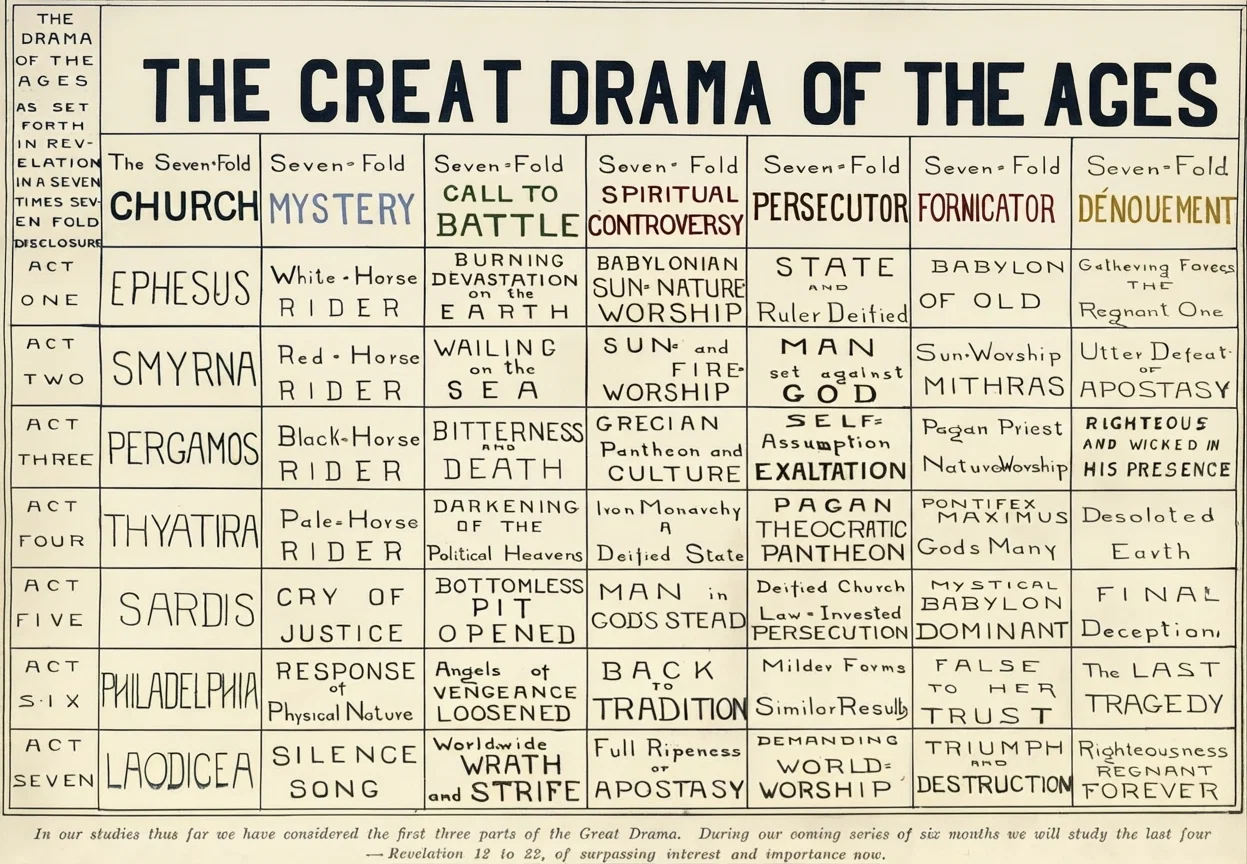
THIS lesson closes with the first part of the book of the Apocalypse. We have passed over three series of seven — the churches, the seals, the trumpets — which end with this lesson. We have studied God's message to His church in her sevenfold manifestation, in which the sins and defects of the people are plainly portrayed, as well as their faithfulness, their endurance, their love, their loyalty. The great love and sympathy of the Master spares naught of reproof or admonition or praise or blame, of warning or appeal, which will help in uplifting the purchase of His blood to a character worthy eternal life, in making them overcomers with Him.
In the opening of the seven-sealed book, we have a marvelous revelation of God's will, God's purposes, God's plans for the salvation of man and the putting away of sin. Therein is shown how God reigns and rules above all plagues, wars, famines, pestilences, and deaths of every form. This prophecy is supplemented by an episodial prophecy, the sealing work of Rev. 7: 1-3, a reform on the law of God and the Sabbath, world-wide and of vital importance, then Christ's coming.
The seven trumpets cover practically the same period covered by the seals. This line of prophecy predicts the breaking up of the Roman Empire and the scourge of God upon apostasy. It is God's pointing out and permitting the logical development of wrong principles of government among the nations of men, whether Roman or Greek, whether Goth or Scyth, whether Vandal or Turk, is dominant. All the evils may be traced back to God's law, the subversion of the right principles of true government.
The two episodial prophecies break in after the sounding of the sixth trumpet, both belonging to the time of the sixth trumpet, and both having to do with the Word of God and its opening prophecies for the last days. These done and we enter upon the closing events of the seven trumpets in Rev. 11: 14-19. Let us note first —

The Answer of the Text

[The answers to the questions are from the American Revised Version. Omitting questions, and disregarding sometimes the capital at the beginning and the period at the close of an answer, the text may be read continuously. In notes and comments both versions are used without designation.]
1. What announcement is made at the close of the sounding of the sixth trumpet? The second wo is past: behold, the third wo cometh quickly. Verse 14.
2. What followed the little period indicated by the word "quickly"?
And the seventh angel sounded; and there followed great voices in heaven, and they said, The kingdom of the world is become the kingdom of our Lord, and of His Christ: and He shall reign forever and ever. Verse 15.
3. What representative class was especially affected?
And the four and twenty elders, who sit before God on their thrones, fell upon their faces and worshiped God. Verse 16.
4. For what did they give thanks?
Saying, We give Thee thanks, O Lord God, the Almighty, who art and who wast; because Thou hast taken Thy great power, and didst reign. Verse 17.
5. What five declarations do the elders make?
And the nations were wroth, and Thy wrath came, and the time of the dead to be judged, and the time to give their reward to Thy servants the prophets, and to the saints, and to them that fear Thy name, the small and the great; and to destroy them that destroy the earth. Verse 18.
6. What closing event is next seen?
And there was opened the temple of God that is in heaven; and there was seen in His temple the ark of His covenant; and there followed lightnings, and voices, and thunders, and an earthquake, and great hail. Verse 19.

Note and Comment

1. The second wo.—The long, desolating scourge of Mohammedanism reaches down to 1840. It was indeed a wo upon the world; but a greater is yet to come, the climax of all woes. "Quickly," as before stated in our studies, has been applied to the little period between 1840 and 1844; but may it not include a longer period, even the waiting time of "the days of the voice of the seventh angel, when he is about to sound"? We are sure that if our readers will study carefully verse 7 of chapter 10 they will see that there are days belonging to the seventh trumpet angel before he sounds, days when he is about to sound. So both Revised Versions, Hinds's Interlinear rendering from the Textus Receptus, Alford, Vincent, "Word Studies in the New Testament," similarly books of Rotherham's translations before us, and others. Alford says that the words "when he is about to sound" are used in their strictest propriety, for when the seventh angel does sound the completed time of the fulfilment is simultaneous with his blowing. So that it is properly said that the fulfilment comes in the days when he is about to blow. When "he shall begin to sound" is inadmissible."
Our notes of week before last were written before Alford's comment on the text was read, but it seemed to us that the words were so clear that there was no room for any other conclusion. Alford confirms this. "In the days of the voice of the seventh angel, when he is about to sound, then is finished the mystery of God." The Gospel work will be concluded in these tense, waiting days. Then the trumpet blows.
2. The seventh angel sounded.—Long he waits. Man's patience would have long ago been exhausted. Behold the patience and forbearance of God in order that every soul may be won to His mighty Gospel! Then he sounds; then Christ leaves the throne of His Father, the antitypical Priest for the putting away of sin (Zech. 6:13; Ps. 110:1; Rev. 3:21; 1 Cor. 15:24, 25); and then He shall enter upon the kingdom He has purchased, beginning His reign in the New Jerusalem with His people (Dan. 7:13; Rev. 20:4; 3:21). The people of the kingdom of this world, usurped by Satan, delivered to him by man when man yielded himself (Luke 4:5, 6), will have tried every scheme of government that sinful man could devise to secure the rights of man and stability of rule, and failed in them all. Christ begins His everlasting reign, and the great voices in heaven reveal the fact, and all the holy ones rejoice in the triumph of our Lord and of His Christ.
PATMOS
PATMOS
3. The four and twenty elders.—Christ glorified human assistants in His priestly work. (See chapter 4:4, issue of Jan. 24, 1911.) They are peculiarly representative of the church of God. In their finite vision they could not see how the great God could work out all that He had promised, or how righteousness could triumph over sin; but they believed, and served on. Now belief is justified in demonstration. The reign of evil and the pleading of persecuted captives are forever consigned to the oblivion of the past. To God give they all the glory.
4. Thy great power.—God's power has been through all the ages manifest through the creation and the upholding of all things in His marvelous universe. When sin entered and man became its slave, God placed that power in His Gospel, on the demand that every believing soul break the power of sin, to set the prisoner free, to enable him to walk in liberty; for "the Gospel . . . is the power of God unto salvation to every one that believeth." Rom. 1:16. Men, singly and in mass, have rejected His power, and counted the message cold, dead, human, inadequate. Some in each age have believed and demonstrated in regenerate, holy life His power. Now at the sounding of the great trumpet comes Christ the Lord in the same power, but manifest in transcendent glory, before which the nations of the earth perish.
5. The nations were wroth.—The elders are speaking still. They sum up events that are connected with Christ's coming. The wrath of the nations is particularly demonstrated in the great battle of Armageddon, set forth in later chapters. Read Jer. 25:15-33, showing how all nations shall drink of the wine of wrath, and as the result the whole earth become convulsed with war, and the slain shall be scattered from one end of the earth to the other. This is the result of human rule without God. And Thy wrath came.—Men in rejecting God's mercy have invited His wrath, His justice, against sin and all identified with it. It must not be allowed to destroy the universe, nor to triumph over the good. Hence the manifestation of God's wrath in justice. The time of the dead to be judged.—This began in the examination of the cases of those whose names had been written in the Book of Life, "in the days of the voice of the seventh angel, when he is about to sound," in the finishing of the mystery of God. Those whose cases are there found, do not come into judgment. John 5:24. Those whose sins are not then found to be blotted out will die. God and His saints will enter upon examination of their cases during a thousand years, at the end of which time their just sentences are meted out. 1 Cor. 6:2, 3; Rev. 20:4, 11-13. Give their reward.—God's children do not enter upon their reward at death. They sleep in their prison-house, and when Christ comes they are called forth to immortality and enter upon their eternal reward. 1 Cor. 15:51-54; Matt. 16:27; Rev. 22:12. Destroy them that destroy the earth.—When the Lord comes it will have been eternally demonstrated that man apart from God has no power to govern himself or others. Man's reign is set forth in the great image of Daniel 2. His kingdom begins with gold, passing through silver, brass, iron, to clay—utterly worthless, brittle clay. Then Christ comes in the stone which smites the image on the feet, and His kingdom fills the whole earth. Man's rule, apart from God's interference and the conservative and preservative power of righteousness from Him, has ever been destructive. Christ destroys at His coming all that is left of Armageddon. Rev. 19:21; 2 Thess. 2:8; Isa. 11:4. Thus far the words of the elders.
6. Opened the temple.—Covering the days of the voice of the seventh angel and revealing the cause of all the wrath. In that temple is seen the ark of God's covenant, a copy of which on earth was placed on tables of stone on which was written the Decalogue and above which was the mercy-seat. See Ex. 25:10-22; 31:18; Deut. 5:22; 10:1-5. To man God gave the copy of ark and law. He left the original in heaven. Man may cleave the gold from the ark, melt the adoring cherubim over the mercy-seat, break in pieces the tablets on which Divinity engraved the law, put to death those upon whose hearts the Spirit has written it, and in whose affection it is enshrined, even as they did Jesus Christ; but they have not touched the foundation of God's government, they have only bruised and broken themselves on the thick bosses of His buckler. "Forever, O Lord, Thy word is settled in heaven." Once more in the end of the Gospel age God's law will be preached in all its fulness of letter and spirit, the law of the Creator, revealed in the precepts of His downtrodden Sabbath. Once more His Gospel will be preached, the Gospel of our Vicarious Sacrifice, our all-sufficient High Priest, in all its fulness. The sadness of it all is that many will have none of either; therefore the wrath to the uttermost symbolized by the lightnings, the voices, the thunders, the earthquake, the mighty hail, of the plagues of chapter 16. Thank God there is shelter now from all these. We can now make God our refuge. To His faithful ones is the word which we have already had: "Because thou didst keep the word of My patience, I also will keep thee."
In our studies thus far we have considered the first three parts of the Great Drama. During our coming series of six months we will study the last four - Revelation 12 to 22, of surpassing interest and importance now.

Meditation

By Calvin Green
THE sun is slowly sinking Behind the western sky; The shadows of the evening O'er earth begin to lie. The western sky is tinted With a deep and rosy glow, While the eastern hills are glinted By the sunlight falling low.
The air is calm and peaceful, And a murmur low is heard From out the swaying forest, As of distant waters stirred; The birds are swiftly winging Their homeward way to rest; While the robin sings in twilight In his spreading maple nest.
The flowers close their petals, And droop as wearily; The child of God is thoughtful As recedes another day. The angels have its record, And soon with flight above They'll bear it for an entrance On pages kept in love.
In the silent hours of darkness, Of helplessness in sleep, Will we be kept from evil? Will angels vigil keep? Will we be spared till sunlight Shall bring another day, Refreshed by this restorer For the duties in our way?
The somber robe of evening Now closes o'er the scene, And the moon with borrowed radiance Sheds forth its silver screen; The stars appear like jewels Studding the cloudless sky, And quietly all nature Retires in rest to lie.
" 'Tis then the humble Christian Bows low in faith to pray To One who kept him safely Through all the hours of day, As he invokes the presence, Divinely pure and blest, With peaceful, silent Nature He sinks to quiet rest." Ft. Atkinson, Wisconsin.

Decorative Separator

—★—

What Will Be Its Fruit?

By Delvin Rees Buckner
THE newly opened, fragile April flower That nods bewildered in the orchard field, Is born into its sphere of life to wield Its tiny mite of influential power For good or ill. There'll come some future hour When all its secret hopes must be unsealed, Th' appointed time when it must duly yield Its treasured fruit — sweet, sound, decayed, or sour. Quite like a blossom is a babe, so frail And weak, a gift a God compassionate Has given man to add unto his joy. With what deep thanks the mother's heart should hail The means that Heaven gives to cultivate Good tendencies within her growing boy!
Cristobal, Canal Zone, Panama.

“Here Am I; Send Me”

By Emma Hildreth Adams
USUALLY, if not always, in periods of impending peril to communities or nations, there has stood out from the front ranks of the people some one man, fearless, faithful, unbribable, having foresight to discern in the distance the inevitable consequences of vicious national or party policy and conduct; and who has been steadfast in heralding the danger, the hazard in such threatening contingencies.
Such a man was Isaiah (Esaias) during the historically great harvest-yielding reigns of four of the most powerful kings of Judah — Uzziah, called Azariah in 2 Kings 15:1; Jotham; Ahaz, the astounding apostate; and devout, valiant, loyal Hezekiah, son of Ahaz.
These four reigns embrace a period of one hundred thirteen years. Of these years Uzziah occupied the throne during fifty-two. Through forty-five of them he prospered mightily, under the guiding influence of the prophet Zechariah. Then, “when he became strong,” like Solomon before him, “his heart was lifted up” with confidence in his own might and power; and one day he attempted to usurp the office and prerogative of the priests, and defiantly essayed to offer incense upon the altar in the temple.
Instantly he was smitten with leprosy in his forehead, and was compelled to pass the seven final years of his life in a “house apart,” “cut off from the house of the Lord,” with Jotham ruling in his stead. 2 Chron. 26:16-21.
The office and eminent services of the prophet Isaiah began toward the close of Uzziah’s reign, for he tells us (Isa. 6:1) that “in the year that King Uzziah died,” he had, in a remarkable vision, the peculiar experience during which were uttered the clarion words heading this article, “Here am I; send me.”
But not until Isaiah had undergone a most singular and fundamental preparation for his awaiting commission could he exclaim vehemently, gladly, eagerly, “Here am I; send me.”
It required FIRE from off the temple altar, that glowing coal of divine grace, to cleanse the soul and efface all stain of world life; to infuse into his lips the force, the efficacy, the independence necessary for the charge which was to be laid upon him, with which he was to be entrusted. It needed the glow incited by the Spirit of God to irradiate his sin-clouded mind, the ardor inspired by the voice of Jehovah to animate his total being, that he might approach his task free, clean, adequate; might announce with no restraint, “Here am I; send me.”
But God does not ask all His willing servants to bear adverse messages to headstrong, rebellious nations; to carry stinging admonitions to false worshipers; to accept startling commissions to His apostatized children; to utter dire prophecies against insolent representatives of His government, His character, His purposes touching the earth and its races; tho under any of these conditions one might joyfully respond, whenever, wherever ring out the inspiring questions, “Whom shall I send, and who will go for us?”—“Here am I; send me.”
The divine Father controls other and widely different occasions for saying to those who love Him, as He did to Isaiah, “Who will go for us?” Daily to thousands of devoted followers, spring opportunities — sometimes minute, sometimes important, sometimes tremendously urgent — for speeding back to Him, by mental or spiritual wireless, “Here am I; send ME.”
Now the occasion requires but a kindly smile and a moment of time for some sad-hearted fellow voyager; now but a quick grasp of the hand and a tender word for one tortured with pain; now but a few sentences of sane advice to one impeded by doubt, hesitating as to choice of paths, and craving counsel; now but a quick, keen, pungent warning to him who stands at the threshold of misdemeanor or of crime; now but a shelter for a night for one who has not where to lay his head. To all such may the coal-purified, the glow-infused servant entreat the listening Master, “Here am I; send ME.”
Yet further: In the dark quarters of cities, where gloomy homes crowd like thickets of the tropical wood; where total lives of men and women are scant, bare, wasting away; where the world, here and now, alone appeals to them; where opportunity to step outward and upward holds back, keeps out of sight; and, saddest of all, where the life-giving rays of the Gospel of the Son of Man flash in only now and then, — are the depths, rayless and cold, into which the Spirit-equipped herald may beseech, “Here am I; send me.”
Further: Day by day, in these final, speeding hours of this dispensation, when the flinty purpose of a powerful tithe of mankind is solely to mountainize wealth; to acquire power over armies of their fellows; to enlarge the cost of their food, apparel, implements, pleasures; to lessen their personal comforts; to curtail their freedom; to dwarf their civic rights; to acquire dominion over wide areas of God’s acres and their munificent products; when protest against such sweeping absorption is just, is due; when defense of man’s inherent right to think and believe as seems to him best, is imperative, — then may men who possess safe influence, sound views, controlled sentiments, step forth and plead with Him in whose hand is the destiny of all mankind, “Here am I; send me to the field of need.”

The Place Beautiful

By Harriette A. Yergin, M.D.
THE beautiful, beautiful throne of our God, With its glimmering, glorious glow, On the sides of the North of the Mount of the King, Where the roses and lily-flowers grow!
The beautiful River of Life over there, Flowing down from the throne of the King, To the left and the right, sparkling clear in the light, Through all of earth's June-time and spring!
O, the beautiful songs of the saints of our God In that land of immortal delight, Swelling up to the dome of that rapturous home Through life's splendorous ocean of light!
The beautiful hills and valleys of rest! Heart of man, you can never conceive The richness and glory the Lord has prepared For all who will trust and believe.
Chicago, Illinois.

Polygamy: Is It of God or the Devil?

Where Did It Originate?

IN Gen. 4: 16-24 we find that the first record is of the descendants of Cain, a murderer. In Gen. 6: 1, 2 we learn that when the sons of man began to multiply, the sons of God took the daughters of men to wife. Was God pleased with it? No; for corruption unparalleled followed. Polygamy was one of the sins that brought the Flood on the earth.
If polygamy is of God, where is the command? We read in Gen. 2: 21-24 that the Lord took but one rib from Adam and made him one wife. If God meant Adam to have two wives, why did He not take two ribs and create two wives? Adam was to multiply and replenish the earth, and surely if he ever needed more than one wife it was then.
In Gen. 7: 13 it is recorded that when Noah and his sons entered the ark, there went with them “Noah’s wife, and the three wives of his sons with them.” Again, surely if it was necessary for a man to have more than one wife it was at this time; but God took only one each for them. What is the record of those who chose to take more than one wife? — We find that it was trouble and vexation of spirit continually.
What trouble came into good old Abraham’s family when he took his second wife? — He had to send her and her son away to live after giving them some bread and a bottle of water. Men should have learned by his mistake. Jacob also had trouble because of his two wives, tho it was not wholly his fault. Gen. 29: 18-30. He loved but one, and no one can truly love more than one.
We read in Matt. 19: 4 Jesus’ words: “He which made them at the beginning made them male and female,” not male and females. “They twain shall be one flesh.” Mark 10: 8. Not they three or four should be one flesh. The followers of Mormonism say there is a ban on their church because people are not good enough to practise polygamy. Pray where is the example of those who were good enough? I fail to find it in the Scriptures. Polygamy originated in licentious heathenism, not in God’s plan.
A. M. M.

The Sympathy of Jesus

It is the sympathy of Jesus that brings Him closer to me than any other quality in His character. I adore His sinlessness, I bow before His wisdom; but my heart clings to His sympathy. Somewhere in the storm I know He is, and through the tumult of the gale I can hear Him say, “It is I; be not afraid.”—Donald Sage Mackay.

Decorative Separator

—★—

Decorative Separator

—★—
Continue reading: The Meaning of the Resurrection