Your ShelfYour Projects

Signs of the Times, Vol. 9, No. 23.

General Articles
Earlier text: Report of Labor

THE NATURE AND TENDENCY OF MODERN SPIRITUALISM.

By Eld. J. H. WAGGONER.
This is a thorough expose of the system of spiritualism. The author has carefully studied the subject, and has given such copious extracts from a large library of spiritualist publications, as to fully condemn them in their teachings and in their practices, by their own testimony.
It is also shown from the prophetic scriptures that spiritualism is one of the most impressive signs of the times. 184 pp. Price, 20 cents.
Address, SIGNS OF THE TIMES, Oakland, Cal.

The Christian Alliance in Tulare County

THEY have a “Christian Alliance” in Tulare County. Its organ, the Alliance Messenger, says that it is “an unsectarian organization of Christian people with the threefold object: to fight infidelity in all its varied forms; to elevate the standard of personal piety in the churches; and to work together in the cause of temperance.” “It embraces Catholics as well as Protestants, in its membership, and does not make church membership requisite for admission.”
We are aware that there are many in the churches who are not Christians, and we cannot say that some who are Christians may not be found outside the churches. But we fear the number of such in Tulare County will not be found large enough to greatly swell the ranks of the Alliance. But this is the tendency of the age—to ally the church with the world, and call it “advanced Christianity.”

A Southern California Paradise.

This is the title of a book of 132 double-column pages, published by R. W. C. Farnsworth, Pasadena, Los Angeles Co., Cal. It is "a historic and descriptive account of Pasadena, San Gabriel, Sierra Madre, and La Cañada," suburbs of Los Angeles. The title will not be considered inappropriate by those who have looked upon the orchards, the vineyards, the orange groves, the "gardens and pleasant walks" of the places described in this book. The articles on the various subjects are written by residents of the several places, and they have succeeded as well as it seems possible to do in attempting to make those appreciate the natural advantages and splendid improvements of the country who have never seen anything resembling it. It has a lovely climate, is capable of producing fruits and grains native to both a temperate and semi-tropical climate. Added to this the complete system of water supply, and the neatness of the lots, farms, and dwellings, make it as nearly a paradise as anything we can well imagine.
The book is got up in a style worthy of the subject. Fine illustrations, excellent print on heavy tinted paper. Paper covers, 75 cents. Boards, embossed in gold, $1.25. Printed at the office of the Pacific Press, Oakland, Cal., where they may be obtained. Also for sale by James T. White & Co., 23 Dupont St., San Francisco, and by the publisher at Pasadena.

Time of Camp-Meetings.

NORTH PACIFIC, Beaverton, Or., June 20-26 MICHIGAN, Alma, “ 20-26 MINNESOTA, Minneapolis, “ 21-26 DAKOTA, Parker, Turner Co., June 27 to July 2 TEXAS, Waxahachie, July 13-23 VIRGINIA, New Market, Aug. 2-7 OHIO, Galion, Crawford Co., “ 15-21 MASSACHUSETTS, “ 23-28 VERMONT, Aug. 30 to Sept. 4 MAINE, Waterville, Sept. 6-11 ILLINOIS, “ 11-18 NEBRASKA, “ 19-25
Mrs. E. O. B.—Examine the contents of the Signs, and you will soon see an answer to your question.

College Catalogue.

THE first Annual Catalogue of Healdsburg College is now ready for circulation.
All the friends of the College should make a commendable effort to give it a judicious distribution. If you are acquainted with worthy young people that you think might be persuaded to attend the College, give them a catalogue, and use your influence in helping them to decide aright.
Persons desiring catalogues will please send their orders to Pacific Press, Oakland, as those who usually attend to College correspondence will be away from Healdsburg during much of the vacation.
The catalogue is for free distribution. Send stamp for postage.

Heat in California.

THE glory of California—of having "the best climate in the world"—is in great danger of passing away. Last week the thermometer passed just above 100° in San Francisco, while in Oakland it varied in different localities from 102 to 108. Heavy rains continued in the spring as late as May 16. A few more through lines of railroad, and a corresponding increase of telegraph lines, may enable San Francisco to interchange climates with New York. It is hoped here that iron will prove a non-conductor of cyclones.

Age of Santa Fe.

THERE has been some conjecture as to the age of the city of the holy faith, but we have learned what its citizens think by receiving a card of admittance to the "Tertio-Millennial Anniversary Celebration," to be held at Santa Fe, New Mexico, July 2 to August 3. We would be pleased to attend.
Lest some should think, as we did at first sight, that "Tertio-Millennial" has to do with a new religious movement, we will state that the managers of the celebration mean by it "the third of a millennium," it being claimed that the city was founded 333 years ago.

Theological Nihilism.

Dr. RANKIN, in a paper read before the American Congregational Club in New York, made some apt remarks about Henry Ward Beecher. He said there "is a movement in religious thought that corresponds to the movement in civil thought, which is known as nihilism." Of an article of Beecher's in the North American Review he said "he blew sky high his eminent father and his theology, together with the theology of a large family of brothers and thousands of his brother ministers (not to speak of that of a long series of sermons from the 'Plymouth pulpit')" and characterized it "as of the dynamite order. All the arts of rhetoric, poetry, and ridicule, all the invective of old time infidelity and atheism, all the probabilities and possibilities of modern science were put into the compound, the fuse lighted and the skies have rained fragments of bodies of divinity from that day to this."
Beecher is no doubt entitled to the name of the great "theological nihilist" of the age. And his purpose is as aimless as that of his cousins in Russia. He tears down everything, and builds up nothing, leaving a sort of theological anarchy behind him. It is a pity that such an erratic man should have received so great homage, and been permitted to undermine the faith of so many in the truths of the gospel of Christ. He has done far more than Ingersoll to destroy genuine faith in the Bible.

Looking Down the Ages.

THE publisher, John Burns, St. Louis, Mo., has favored us with a copy of a book of 160 pages with the above title, by J. T. Walsh. Years ago we knew something of Mr. Walsh as a vigorous writer, whom we considered sometimes rather erratic. But we have lost sight of his name for a score of years, until its appearance in this book. We shall give the book a careful reading as soon as possible. From the Introduction we copy the following paragraphs, which ought to receive the hearty indorsement of every lover of the Bible and its truths:—
“Some claim that the prophecies cannot be understood until they are fulfilled, and, indeed, that they were never intended to be understood until accomplished. There are prophecies difficult to understand, and which in all their details may not be fully understood until fulfilled; but God has given us grand outlines of future events, and these, as well as some of their details, can be understood by the diligent student of prophecy.
“A chief reason why the prophecies have not been better understood, is, they have been ignored—they have not been read, much less studied. This is true, even of many preachers of the gospel, who ought to be prepared to bring out of the sacred treasures of God’s word, ‘things new and old.’
“A large portion of the Bible is prophetic, and to ignore that portion, or to neglect to study it with all diligence, is to treat its divine author with irreverence and disrespect. The prophecies were intended to be understood, and hence we read: ‘Blessed is he that readeth, and they that hear the words of this prophecy, and keep those things which are written therein: for the time is at hand.’ Rev. 1:3. And what is said of the blessedness of the reader and hearer of Revelation, I suppose is equally true of other prophecies.
“‘All Scripture given by inspiration of God is profitable.’ ‘Holy men spoke as they were moved by the Holy Spirit.’ Let us then with humble hearts, and prayerful spirits, free from all bias and prejudice, carefully study the prophetic map spread out before us, and learn ‘the deep things of God.’
“The prophecies of the Old Testament must be studied in connection with the New Testament, where many of them are repeated, thus throwing additional light on the prophetic chart of the ages and events yet to come.”

Our Country's Growth.

To ANY one who is acquainted with Chicago and the surrounding country, the following description of the Chicago post-office fifty years ago cannot fail to be of interest. The postmaster of 1832 is still living, and gave the following facts to an Inter-Ocean reporter:—
“In 1832 the post-office was situated in an upper room of a log building which stood on Lake Street. The building was partly occupied by an Indian trader, and in the other part, the smallest corner, was the post-office. Jonathan V. Bailey was the postmaster, and I was his deputy. There was not much for either of us to do, but while we kept the office I bought hides and traded with the Indians. When the Black Hawk War broke out in 1832, Bailey’s wife, who was delicate, became so frightened that he had to take her away, and I was left in charge of the office. Bailey never returned, and as deputy postmaster I kept the office for three years. At first there was not more than 1½ pounds in the whole collection of letters and papers that came to the place; but before the end of my term it increased until it weighed about 100 pounds. A good part of the time I kept the office in a candle box. When any one called for a letter I took down the box and looked over the whole collection. I knew very well whether there were any letters or not, but I liked to be accommodating to the people, and would let them see for themselves that none of the letters in the box belonged to them. A Frenchman came once a week from Niles, Mich., and in a pair of saddle-bags thrown over his horse carried all the mail that came to Chicago. This was the office for all the northern counties in this State and about half of Wisconsin. The people of Cook, DuPage, Will, McHenry, and La Salle Counties, and all the territory between here and the Mississippi River, came into Chicago for their mail. They did not come very often—once in two or three weeks—and then one man would come in from a county and inquire for all his neighbors. There were little settlements scattered about, a few families in a place. Up where Milwaukee now is there was one man living, but at Green Bay there was a settlement, and an Indian came down for the mail. I was paid off for my services in having the honor of serving the Government. Gen. Jackson was President and W. T. Barry was Postmaster-General. I remember both of them—that is, in my official relations.”

THOUGHTS ON BAPTISM.

By Eld. J. H. Waggoner.

AN EXAMINATION OF THE ACTION, SUBJECTS, AND RELATIONS OF THE ORDINANCE OF BAPTISM.

Also, a Brief Refutation of the

HISTORICAL CLAIMS FOR TRINE IMMERSION.

SECOND EDITION, REVISED AND ENLARGED.
Prices, post-paid,—In flexible cloth, 35 cents; paper covers, 25 cents.
Address, SIGNS OF THE TIMES, Oakland, Cal.

EARLY WRITINGS OF MRS. WHITE.

Comprising "Experience and Views" and "Spiritual Gifts Volume One," bound in one volume. This makes a neat and attractive book of nearly 200 pages, and should be read by old and young. The matter and the style in which it is presented are so interesting that no one who has read one chapter will forego the pleasure and profit of reading the remainder. Price, 75 cents.
Address, SIGNS OF THE TIMES, Oakland, Cal.

THE SIGNS OF THE TIMES, PUBLISHED WEEKLY, AT OAKLAND, CAL., FOR THE Missionary Society of Seventh-day Adventists.

A twelve-page Religious Family Paper, devoted to a discussion of the Prophecies, Signs of the Times, Second Coming of Christ, Harmony of the Law and Gospel, with Departments devoted to Temperance, The Home Circle, the Missionary Work, and the Sabbath-school.
Price Per Year, . . . . . . . . . $2.00 In Clubs of five or more copies to one address, to be used in Missionary Work, . . . . . . . . . 1.50 Address, SIGNS OF THE TIMES, Oakland, Cal. —OR— REVIEW AND HERALD, Battle Creek, Michigan. MRS. ELIZA PALMER, Sec. N. E. Tract Society, South Lancaster, Mass. ELD. J. N. LOUGHBOROUGH, Ravenswood, Shirley Road, Southampton, England. MRS. C. L. BOYD, Salem, Oregon.

Appointments.

I WILL meet with the church at Vacaville, Sabbath, June 16, at Woodland, June 23, and at Arbuckle, June 30.
S. BROWNSBERGER.

C. C. RAMSEY

Providence permitting, I will be in San Juan, San Benito Co., Cal., Sabbath, June 16. I shall expect to see all the Sabbath-keepers in that section of country.

C. C. RAMSEY

A Brief Sketch of the Origin and Progress of Seventh-Day Adventists.

Our field of inquiry leads us back only to the great Advent movement of 1840-44. Respecting that movement it is presumed that the public are more or less informed; but they may not be so well aware of the causes which have led since that time to the rise of a class of people calling themselves Seventh-day Adventists.

THE DISAPPOINTMENT.

Adventists looked for the end of the world in 1844, because of the prophecy in Dan. 8: 14, which says that at the end of the prophetic period of 2300 days the sanctuary should be cleansed. They computed that time to end in that year. They held that the earth was the sanctuary then to be cleansed, and that its cleansing was to be accomplished with fire which would accompany the manifestation of the Lord from heaven. Hence they supposed the Lord would then come. There were, of course, many other facts and arguments in support of the view that the second coming of Christ was near, but what we have stated was the principal argument for fixing upon that particular time for the occurrence of the event.
The time passed, and the coming of Christ did not take place as was expected. It then became apparent that a mistake had been made in one or both of the following points: either the period of 2300 days did not end at that time, or the cleansing of the sanctuary was not to be the burning of the earth by fire at the second coming of Christ. While there was a possibility of their being mistaken on both these points, a mistake on either one would be sufficient to account for the fact that the Lord did not then appear.
A movement which had enlisted the whole interest of thousands upon thousands, would not, of course, be abandoned without reflection. The ground was looked over, and two methods adopted for explaining the disappointment. One class jumped to the conclusion at once that they were wrong on time, and the prophetic periods had not ended. Another class, on a careful survey of the whole field, impressed with the strength and harmony of the argument on chronology, saw no ground to change their views upon that point, but became satisfied that the mistake lay in the subject of the sanctuary and its cleansing. This class are the ones now known as Seventh-day Adventists.

SEVENTH-DAY ADVENTISTS SET NO TIME.

They do not believe that any prophetic period given in the Bible reaches to the coming of Christ, or was designed to mark the day or year of that event. As already mentioned, they believe the chronological argument of the great Advent movement of 1844 was all right, locating the termination of the longest prophetic period, the 2300 days, in the autumn of that year. The prophecy said that then the sanctuary should be cleansed. That sanctuary they found to be, not the earth, which is never so called, but the sanctuary of which Paul so fully and definitely treats in his epistle to the Hebrews, "the sanctuary" and "true tabernacle" in Heaven, "which the Lord pitched and not man," of which Christ, our great High Priest, is minister while "on the throne of the Majesty in the Heavens." Heb. 8: 1, 2. The tabernacle erected by Moses in the wilderness of Sinai about 1500 years before Christ, Ex. 25 and onward, which was the sanctuary of the first covenant, Heb. 9: 1, from that time till the first advent, was a type, figure, or pattern of this heavenly sanctuary of the new covenant. Heb. 9: 9, 23, 24. The ministration of the sanctuary consisted of two grand divisions, which were accomplished every year; the daily ministration, and a brief service in the most holy place, or second apartment of the sanctuary, which completed the yearly round of service. This latter work was called the cleansing of the sanctuary, and was performed by the priest. So, likewise, the cleansing of the heavenly sanctuary, Heb. 9: 23, must be performed by Christ while yet a priest, before he takes his kingdom and appears in his glory.
The view we take of the prophecy, consequently, is that the termination of the 2300 days in 1844 brought us to the commencement of this last portion of Christ's work as priest in the true tabernacle above, called the cleansing of the sanctuary; not a cleansing from physical impurities, but from the presence of our sins, imparted to it through the blood of Christ there ministered in our behalf. This explains at once the mistake in 1844, and shows our present position. We are now in the time of the cleansing of the sanctuary; a period of brief but indefinite duration, reaching to Christ's coming.
While, therefore, we do not throw away the prophetic period, we believe they are to be understood, we believe also that they have been correctly interpreted, and have all terminated; so that now we have no data from which to reason respecting a definite time for the Lord to come.

THE SEVENTH DAY.

Two causes have operated to introduce the observance of the seventh-day Sabbath among Adventists, and thus to develop that class known as Seventh-day Adventists.
First, a Seventh-day Baptist sister, Mrs. Rachel D. Preston, from the State of New York, moved to Washington, N. H., where there was a church of Adventists. From them she received the doctrine of the soon-coming of Christ, and in return instructed them in reference to the claims of the fourth commandment of the decalogue. This was in 1844. Nearly that whole church immediately commenced the observance of the seventh-day.
The Sabbath question began immediately to be agitated among Adventists, and within a few months, many from their ranks commenced its observance.
Secondly, another cause which has tended to strengthen them in the observance of the seventh-day Sabbath is the subject of the sanctuary, to which we have already alluded. It was seen at once that the central object in the sanctuary, in whichever dispensation we view it, is the ark of God, which was enshrined in the most holy place. This ark was prepared expressly as a receptacle for the tables of stone on which were written the great moral precepts of God's government, the ten commandments. Thus attention was called to the law of God. It was also seen that if the law in the ark of the heavenly sanctuary, Rev. 11: 19, is the great original, and that deposited in the typical sanctuary was only a copy, or transcript, that law must read the same now as it read then, and the idea of any change is placed beyond the range of possibilities; that heaven and earth, as Christ in his first sermon declared, would sooner pass than one jot or tittle would pass from the law; and that the fourth commandment requires of the second house of Israel what it required of the first, and has required from Eden down, the observance of the seventh day of the week as the grand and glorious memorial of our creation at the hands of God.

Their Publishing Work.

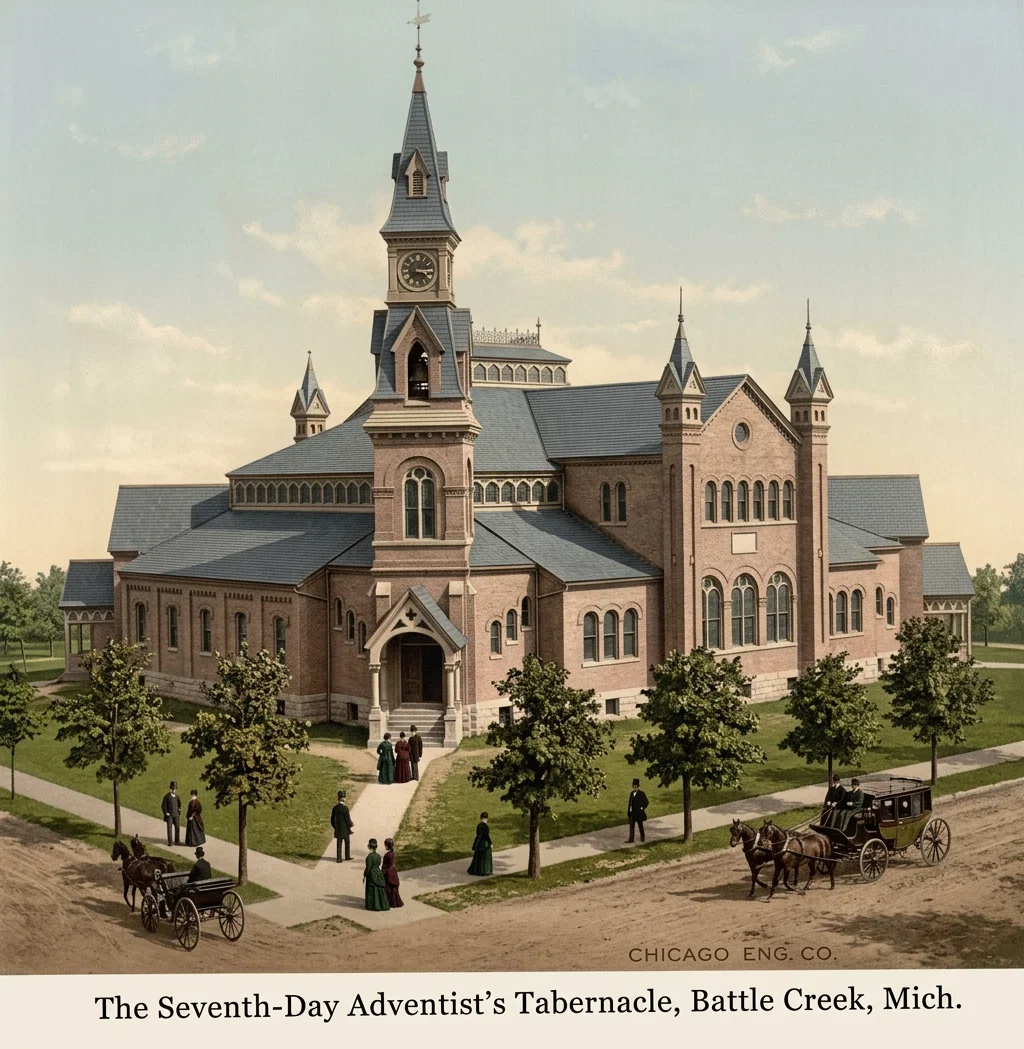
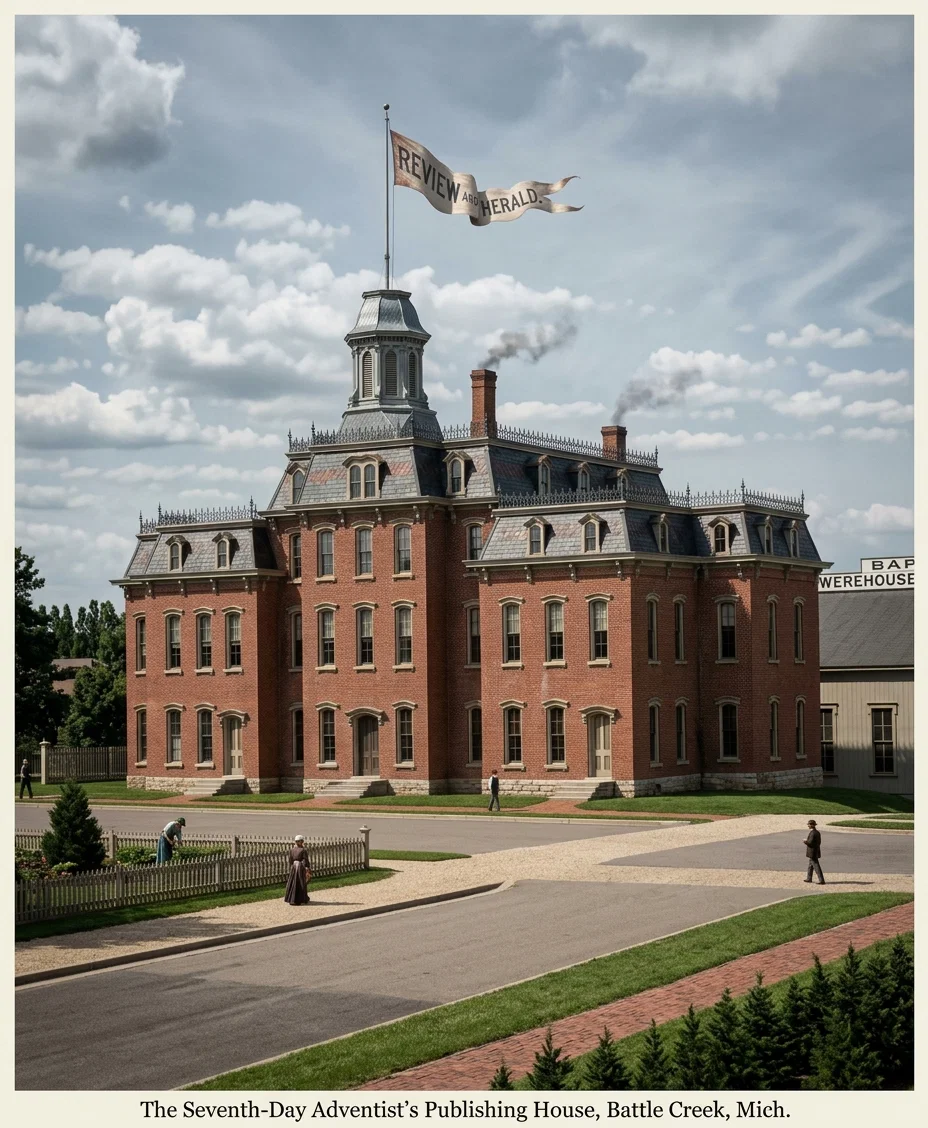
In November 1850, Eld. James White commenced the publication of the ADVENT REVIEW AND SABBATH HERALD, the first periodical issued by the denomination; and in 1861, a legally incorporated association, under the name of the Seventh-Day Adventist Publishing Association, was organized in Battle Creek, Mich.
Besides a large list of English works, forty-four are now issued from this office in the Danish language, twenty-three in Swedish, fifteen in French, and thirty-one in German.
The different periodicals issued at the present time by the denomination, the titles of which are given elsewhere, have an aggregate monthly circulation of from 150,000 to 200,-000 copies.
Books on the prophecies and other Bible subjects have been issued largely from the beginning, and have now reached an aggregate of about three hundred million of pages.
Nearly two hundred hands are regularly employed in the work, and the capital invested is over two hundred thousand dollars.

THEIR ORGANIZATION.

This is exceedingly simple. A body of believers associate together, taking the name of Seventh-day Adventists, and attaching their names to a covenant simply to keep the commandments of God and the faith of Jesus. The Bible is their only creed. A clerk is chosen to keep the records of the church, and an elder, elected by vote of the church, is ordained to look after its spiritual interests. If the church is large, its temporal affairs are assigned to one of more deacons, chosen by vote of the church for this purpose.
Evangelists are ordained ministers, who travel from place to place to preach the gospel, and are the only ones competent to ordain local elders and deacons.

NUMBERS.

They now number 660 churches, with an enrollment of 17,169 members, according to the returns made to the General Conference of Dec. 1, 1882. But owing to the scattered condition of this people, a large proportion of them are not so situated as to belong to any of the church organizations, single families being scattered all the way from Maine to California and Oregon, in all the Northern States, and in many of the Southern. The whole number is estimated at thirty thousand.

CONFERENCES.

The churches in a State combine to form a State Conference, of which there are twenty-seven, viz: Maine, New England (including in this division only New Hampshire, Massachusetts, Rhode Island, and Connecticut), Vermont, New York, Pennsylvania, Ohio, Michigan, Indiana, Illinois, Wisconsin, Minnesota, Iowa, Nebraska, Dakota, Missouri, Kentucky, Tennessee, Kansas, Texas, California, Upper Columbia, North Pacific, Colorado, Virginia; Province of Quebec, Denmark, and Sweden.
The next outward sweep from the State Conference is the General Conference. This is composed of delegates, ministers or laymen, from all the State Conferences. This Conference also annually elects its executive committee of three, to have charge of the doings of the denomination in all parts of the field. The president of the General Conference is the highest officer in the body. The object of the General Conference is to unify the work in all localities, equalize labor, and supply destitute fields with help. Twenty-one annual meetings have been held by this organization.

THE HEALTH AND TEMPERANCE REFORM.

At the present time the whole body of S. D. Adventists are abstainers from the use of alcoholic drinks of all kinds. Tobacco, in all its forms, is also discarded, none addicted to its use being received into the churches except upon the promise and expectation of its immediate abandonment.
A society known as the American Health and Temperance Association has been recently organized among this body of Adventists, which requires of its members to sign one of the following pledges:
TEETOTAL PLEDGE.—I do hereby solemnly affirm that with the help of God I will wholly abstain from the voluntary use, as a beverage, or in any equivalent manner, of alcohol, tea and coffee, and from the use of tobacco, opium, and all other narcotics and stimulants.
ANTI-RUM AND TOBACCO PLEDGE.—I do hereby solemnly affirm that with the help of God I will wholly abstain from the voluntary use of alcohol in any form, as a beverage, or in any equivalent manner, and from smoking, chewing, or snuffing tobacco, or using it in any other form, and from in any way encouraging the use of these poisons.
ANTI-WHISKY PLEDGE.—I do hereby solemnly affirm that with the help of God I will totally abstain from the voluntary use, as a beverage, or in any equivalent manner, of all liquors or substances containing alcohol.
The Association has subsidiary State societies and local clubs in nearly all parts of the United States. All S. D. Adventists, with very few exceptions, are signers to the teetotal pledge.
For the purpose of inculcating the principles of this reform and for the introduction of improved methods of medical treatment, especially for chronic invalids, the "Health Reform Institute" was founded Sept. 5, 1866. The institution was legally incorporated April 6, 1867.
A subscription of twenty-six thousand dollars was raised, which has since been increased by additional subscriptions, and the workings of the institution to over sixty thousand.
Increasing patronage demanding more facilities, a large building 120 by 130 feet, four stories high above the basement, provided with modern improvements, and opened for patients April 10, 1878. The old main building and seven cottages are also occupied by the institution, now known as the Medical and Surgical Sanitarium.

The International Tract and Missionary Society.
The object of this organization, which embraces twenty-eight State, or branch societies, is first, to systematically canvass the country with religious books, tracts and pamphlets, to obtain subscribers for our various periodicals, visit the sick, call upon, converse and pray with families and individuals; and second, in a more general way, to seek out openings for reading matter, and fill them, in all parts of the world.
Although of recent organization, between two and three hundred thousand dollars have been employed in carrying forward this work. Thousands of volumes, largely bound books, have been placed in public libraries, on board vessels, etc.
A distribution of about six million pages of reading matter, besides about five hundred thousand periodicals has been made annually for several years in the past. The present year their missionary operations have more than doubled. Five thousand bound books alone have been presented to libraries. A large number have been sold, also thousands of subscribers have been obtained for periodicals, in advance of other years. Mission and reading-rooms have been opened in New York, San Francisco, Liverpool, etc. from which publications are sent to every civilized nation.
The work is successfully carried on among the Danes, Norwegians, Germans, Swedes and French in this country; also in England, Switzerland, Denmark, Sweden, Norway, Germany, France, Italy, and the West Indies.

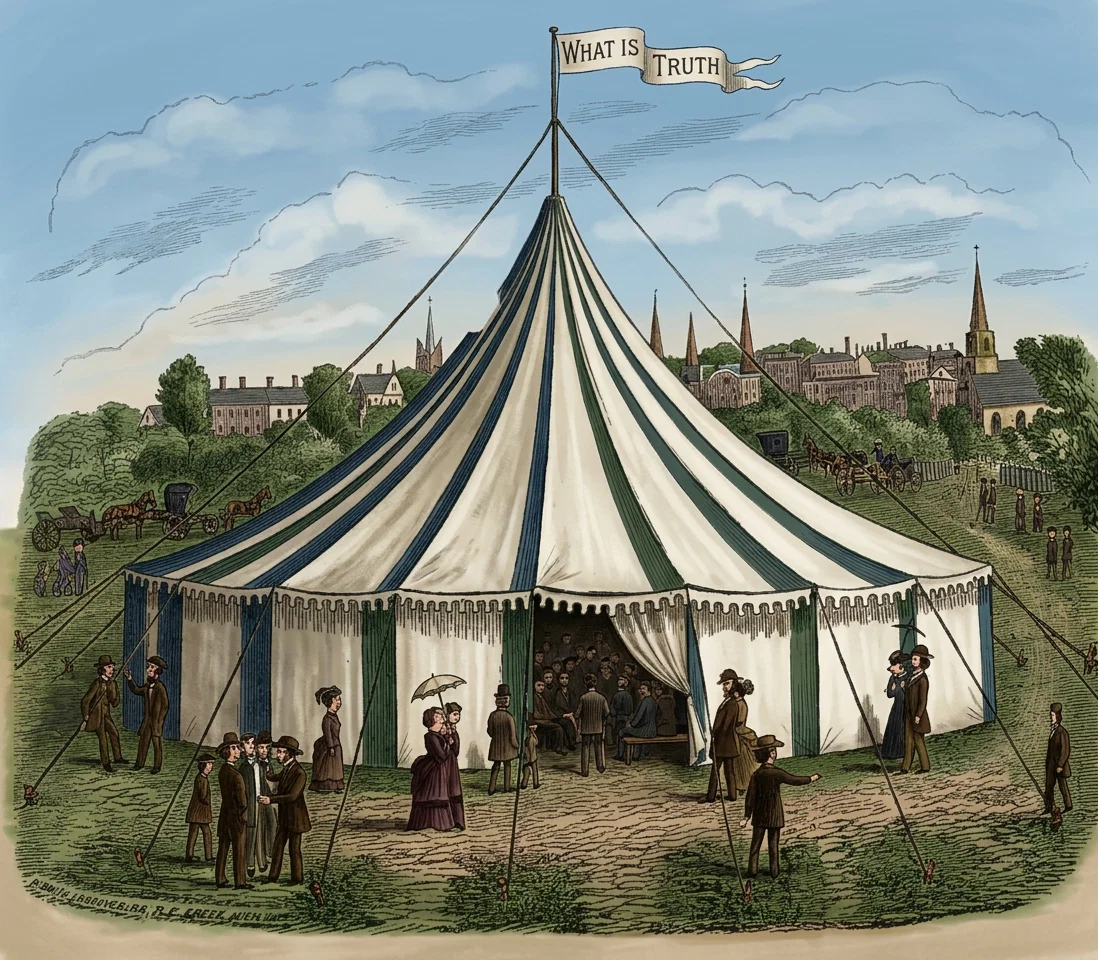
A CAMP-MEETING

— BY THE —

SEVENTH-DAY ADVENTISTS

WILL BE HELD

ON THE FAIR GROUND,

— AT —

WORCESTER, MASS.

CONTINUING FROM

August 23 to 28, 1883.

The following eminent speakers are announced for the occasion:

Elder GEO. I. BUTLER,

President General Conference.

Elder I. D. VAN HORN,

Formerly President North Pacific Conference,

Elder URIAH SMITH,

Editor Advent Review and Sabbath Herald, Battle Creek, Mich.

Mrs. E. G. WHITE,

Oakland, Cal.

BIBLE TOPICS OF VITAL INTEREST

To all CLASSES and CREEDS will be presented. Above all, it is most earnestly desired that the Spirit of God will be so shed down that many souls may be converted unto the Lord.
A most cordial invitation is extended to all the Citizens of Worcester and the surrounding country to attend. Ample entertainment provided for man and beast, at reasonable rates.

— FREE RETURN TICKETS —

Can be had on the ground of the Secretary, for all who come on the Worcester & Nashua, New York & New England, Providence & Worcester, Fitchburg, Cheshire, and Boston & Maine railroads.

✣ Regular Services Daily, at 10.30 A. M., 2.30 and 7.30 P. M. ✣

THE BEST OF ORDER WILL BE INSISTED UPON.

☞ Let there be a General Attendance. ☛
Periodicals issued by the Denomination.

THE ADVENT REVIEW AND SABBATH HERALD, sixteen pages, monthly, . . . $2.00
THE GOOD HEALTH, thirty-six pages, monthly. A journal of hygiene, devoted to physical, mental and moral culture, . . 1.00
THE YOUTH'S INSTRUCTOR, a four page illustrated weekly, . . . . . . . . . . . . . .75
THE ADVENT TIDENDE, a Danish semi-monthly, . . . . . . . . . . . . . 1.00
ADVENT HAROLDEN, a Swedish monthly, sixteen pages, . . . . . . . . . . . . . .75
STEMME DER WAHRHEIT, a German monthly, eight pages, . . . . . . . . . . . . . .50
The above are published at Battle Creek, Mich.
THE SIGNS OF THE TIMES, twelve pages, weekly, . . . . . . . . . . . $2.00
Published at Oakland, Cal.
LES SIGNES DES TEMPS, French, sixteen pages, . . . . . . . . . . . 1.25
Published at Bâle, Switzerland.
TIDERNES TEGN, Danish, monthly, . . . . . .70
SUNDHEASBLADET, “ “ . . . . . . . .70
HELSOOG SJUKVARD, Swedish, monthly, .70
Published in Christiana, Norway.
An English edition is printed in Southampton, England. Sample copies sent free.
Headquarters for New England, International Tract and Missionary Society, SOUTH LANCASTER, MASS.
Catalogue of publications sent on application.

You have reached the end of this edition.

Signs of the Times · Jun 14, 1883