S. D. A. Publishing Association · Battle Creek, Mich. · Aug 18, 1886
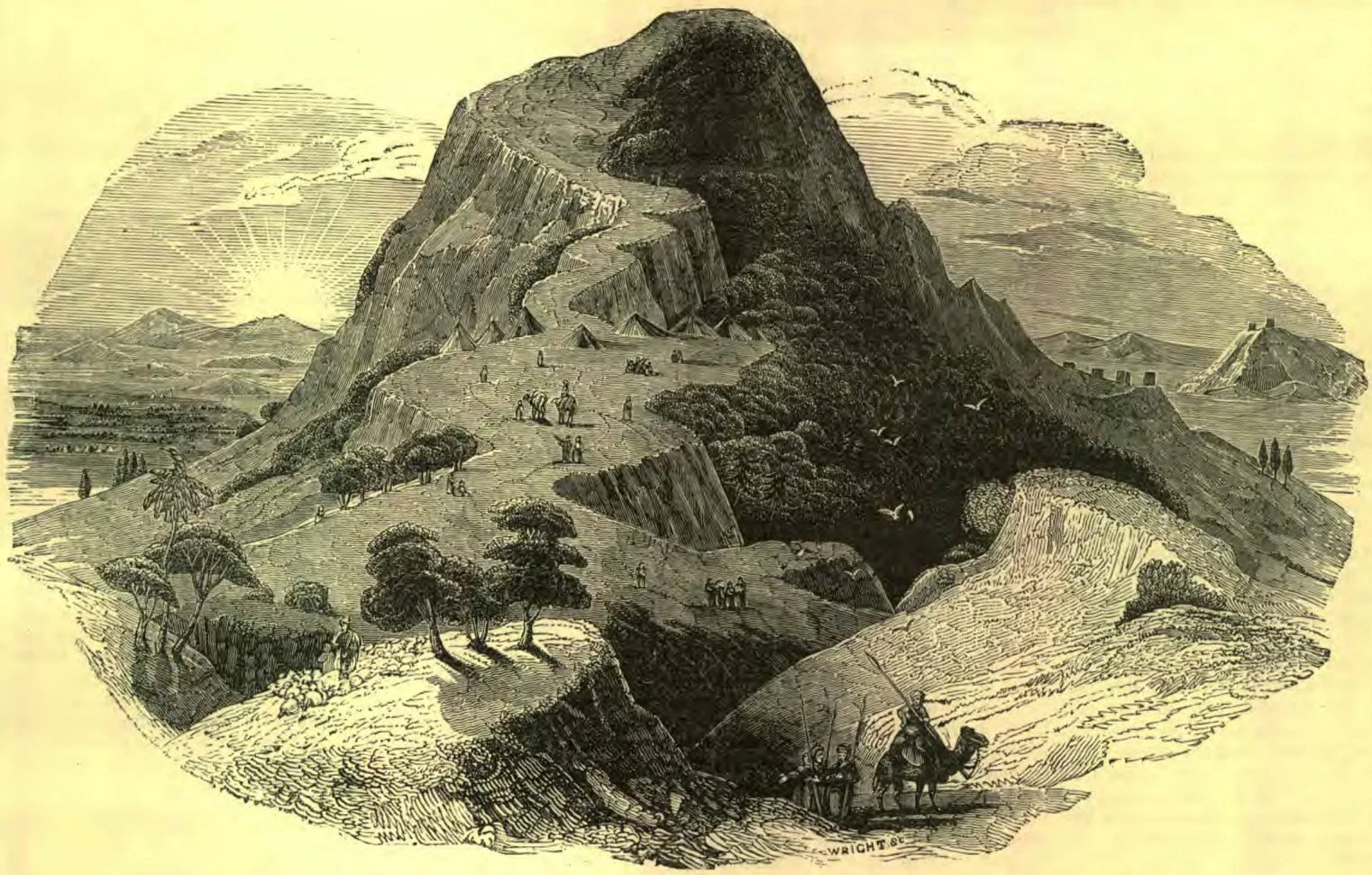
From Mount Tabor: A View of Esdraelon
By W. E. L.
FROM MOUNT TABOR.
Perhaps one of the finest views to be obtained in the Holy Land is that which greets the traveler’s eye from the summit of Mt. Tabor. Away to the westward stretches a triangular plain, the largest and most fertile in Palestine. Its eastern side, extending from Mt. Tabor southward to Engannim is fifteen miles in length; the southwestern, hemmed in by the hills of Samaria and the Carmel range, is eighteen miles in length; and the northern, bounded by the hills of Galilee, twelve miles. On the eastern side, three valleys branch off from the great plain toward the Jordan valley, like three fingers from the palm of the hand. The southernmost of these valleys lies between the Samarian hills and the rugged cliffs of Gilboa; the middle one, called the valley, or plain, of Jezreel, between Gilboa and Little Hermon; and the northern, between Little Hermon and Tabor.
Mt. Tabor, which stands at the northern arm of the plain, lies entirely apart from the surrounding mountains except where a low ridge connects it with the hills of Nazareth. It is a symmetrical, rounded mass of limestone, bare and rocky on its southern side, but on its northern covered with oaks, terebinths, and syringas to its very summit. On its level top may be found the ruins of an old wall, with broken remains of cisterns, vaults, towers, and houses, going to prove that here once stood a fortified town, while vestiges of convents and churches give hints of the days of the Crusaders.
Mt. Tabor rises above the surrounding country fifteen hundred feet; was this the “high mountain apart,” where Jesus was transfigured before his disciples? So tradition and the priests who dwell in the Greek chapel on its summit would have us believe; but the ruins of the old town go to prove the contrary, for it is hardly probable that Jesus would have taken his disciples so near a populous town to show them the glorious spectacle of his transfiguration; there are other “high mountains” near here where the scene might have occurred.
But the tradition which makes Tabor the site of the transfiguration is not the only thing that lends an interest to the locality. Hundreds of years before, Tabor was the rallying place of a little army, when Barak, under the direction of Deborah the prophetess, gathered there his ten thousand men and swept down on the hosts of Sisera and of Jabin king of Hazor, as they lay pitched in the plain near the southern end of the Carmel range. And thus reads the ancient chronicle: “The kings came and fought; then fought the kings of Canaan in Taanach by the waters of Megiddo; they took no gain of money. They fought from heaven; the stars in their courses fought against Sisera. The river Kishon swept them away, that ancient river, the river Kishon.” Standing on Tabor, you can see the line of the river Kishon, as it flows along the southern part of the plain and follows the northern slope of Carmel to the sea. And you will know how, when the clouds broke and the torrents descended on Sisera’s discomfited hosts, it converted the springy soil of the head waters of the Kishon into a veritable marsh where the nine hundred chariots of iron proved worse than useless, and the proud captain was fain to flee on foot for his life. “The stars in their courses fought against Sisera.”
Perhaps you will remember another battle that occurred near here in the valley of Jezreel on the southern side of Little Hermon, when Gideon and his picked three hundred put to rout the Midianites. You remember the stratagem they employed to gain the victory, stealing upon the slumbering camp of the enemy under cover of darkness, and dividing themselves into three companies, each man armed with a trumpet and a lighted lamp in a pitcher; and how at a blast from their intrepid leader, they raised the rallying call of Manasseh, broke their pitchers with a din like the clash of arms, letting the light blaze forth, and with a mighty blast from the three hundred trumpets, shouted, “The sword of the Lord and of Gideon!” And all the startled host “ran and cried and fled.”
Though you can from Tabor look over the greater part of this historic battle ground, there are other and tenderer memories stirred by the view that greets you. Just opposite, on the northern slope of Little Hermon, lies Nain, a desolate cluster of ruins and hovels. On the hillside, a three hour’s walk to the west from where we imagine the gate of the city must have been, lies an old cemetery, with rounded, whitewashed tombs, answering for headstones. We can imagine how, long years and years ago, from these city gates there “was a dead man carried out, the only son of his mother, and she was a widow.” And Christ, going toward the gates of Nain, “saw her, and had compassion on her, and said unto her, Weep not. And he came and touched the bier; and they that bare him stood still. And he said, Young man, I say unto thee, Arise. And he that was dead sat up, and began to speak. And he delivered him unto his mother.”
Farther to the eastward lies Endor. In which one of these cave dwellings could it have been that Saul, forsaken by his God, sought the woman having a familiar spirit and beheld the invited though unwelcome apparition of Samuel? The town, even to the present day, has a weird aspect, in keeping with the home of a wizard, and the inhabitants partake of its squalor and misery.
To the south, rise the bald peaks of Mt. Gilboa, where Saul met his ill-timed fate. We can well imagine, when we see its barren summit, that the words of David have been literally fulfilled: “Ye mountain of Gilboa, let there be no dew, neither let there be rain, upon you, nor fields of offerings: for there the shield of the mighty is vilely cast away, the shield of Saul, as though he had not been anointed with oil.”
To the north may be seen the outlines of the basin that holds the Sea of Galilee, and you can catch a glimpse of its blue waters at the upper end. But how shall we go on to tell of Shunem, Jezreel, and all the places of interest between Tabor and Carmel; or describe to you the rounding sweep of Carmel, as it skirts the plain to the south, and at last dips its feet in the blue waters of the Mediterranean? How often the Saviour must have passed up and down these hills, or across the plain, passing to give comfort130to a sin-laden soul, to heal the sick, to give sight to the blind; how often from this very mount of Tabor he looked on the scene that greets our eyes, and drew rest and comfort from it, as he did from all his Father’s works. Pleasant were it to look on the spots he viewed, to tread the ground he trod! W. E. L.
A SINGLE STITCH.
By Susan Coolidge
ONE stitch dropped as the weaver drove His nimble shuttle to and fro, In and out, beneath, above, Till the pattern seemed to bud and grow As if the fairies had helping hands;— One small stitch which could scarce be seen. But the one stitch dropped pulled the next stitch out, And a weak place grew in the fabric stout; And the perfect pattern was marred for aye By the one small stitch that was dropped that day.
One small life in God's great plan, How futile it seems as the ages roll, Do what it may, or strive how it can To alter the sweep of the infinite whole! A single stitch in an endless web, A drop in the ocean's flow and ebb! But the pattern is rent where the stitch is lost, Or marred where the tangled threads have crossed; And each life that fails of its true intent Mars the perfect plan that its Master meant.
—Susan Coolidge.
THE STATUE OF LIBERTY.
By L. E. Orton
At the time of our Centennial Exhibition, in 1876, France proposed to be represented by something expressive of the close relationship existing between our country and the one that, during our forefathers’ struggle for freedom from the British yoke, had rendered us such invaluable service. It should be a gift emblematic of our attainment of the first century of independence, and should also be the seal of the more valuable gift they made us in 1777, when, but for the timely aid of France in money and soldiers, the barefoot sufferers of Valley Forge would have been obliged to disband, and the colonists would have remained King George’s subjects.
The sculptor Bartholdi, Edward Laboulaye, and other public-spirited Frenchmen discussed the project. It grew in favor, and at last it was decided that the gift should be some work of art; so Bartholdi was commissioned to visit the United States to select a subject and a site.
Coming into the harbor of New York, it flashed, like an inspiration, across his mind that a colossal statue of Liberty holding high a lighted torch, and placed upon Bedloe Island, with her face turned oceanward toward Europe, would be the fittest thing.
He returned to France; and as this gift was to be a testimonial of love from the people to the people, a public subscription was opened. Rich and poor contributed of their francs, until the sum of $250,000 was secured, and the work begun. Bartholdi devoted eight years of incessant labor to it, besides a large portion of his fortune.
The United States naturally sought to build a fitting pedestal to so magnificent a statue. An architect’s plan was accepted and $200,000 expended in its erection; yet it was unfinished, and the statue was nearly ready for shipment from France. In this extremity the committee applied to Congress for an appropriation of $100,000 to complete the pedestal. Their application was denied, but the New York World came to the rescue by opening a subscription in May, 1885, and appealing to the patriotism and pride of the people to raise the requisite amount. The people all over the country responded generously; not millionaires alone, but, as in France, so here, the trades-people, school-children, and laborers poured in their contributions of dollars and dimes. In twenty-one weeks from the time the call was made, the hundred-thousand-dollar fund was complete, and work was immediately resumed on the pedestal.
The statue arrived last summer; and the whole city dressed itself in holiday attire, to give it a welcome. A naval escort, consisting of four U. S. war ships, was sent down to meet the French transport Isere and bring it up the bay. This escort was augmented by commercial ships, fleets of yachts, excursion boats, and others in line of procession. It was a fair scene to look upon that bright June morning. As the ships, decorated with a multitude of flags of both nations, came up through the Narrows, the guns from Forts Wadsworth and Hamilton thundered a welcome, which was echoed by those of the escorting squadron. On landing the French naval officers at Bedloe Island, the “Marseilles” (the national song of France) was sung, and on their departure for the city, “Hail Columbia,” was given.
The pedestal is built of granite, and is 150 feet high. It is the largest one in the world; no other approximates to it either in size or in value.
The statue of “Liberty Enlightening the World” is a female figure, clad in flowing draperies, with a torch held in her up-stretched right hand. It is what sculptors call of “heroic” size, a man being able to stand upright in the arm. It is the same height as the pedestal; so that when completed, the torch will be three hundred feet above the sea. An ordinary forest tree is fifty feet high; imagine six of these, above each other, and you have an idea of the great height. The torch alone is large enough to hold eight persons. The statue is of the finest quality of bronze, beaten out with hammers, necessitating the labor of many men; and is to be fitted over a complete frame-work of steel.
It is to be lighted by electricity. The general plan is to have four large lights placed at the four corners of the base, so situated as to reflect directly on the statue, which can thus be seen in the darkest night; and also to have a forty foot shaft, or beam light, shooting directly up into the heavens from the torch, which can be seen ninety miles at sea. This latter is the first light mariners will see when heading for this port, and it will consequently take the lead of all the light-houses on this coast. It will be finished the middle of this month, and is to be dedicated the third of September, the one hundred and third anniversary of the signing, by the European powers, of the treaty at Paris, recognizing the independence of the United States.
At the dedication, President Cleveland will represent our nation, and formally accept the gift; while France will be represented by the French minister and Bartholdi. When that ceremony is concluded, the dream of Bartholdi, as he came up the harbor that summer morning, ten years ago, will be fulfilled.
“Welcome to Liberty!
She comes across the emerald sea;
To patriot hearts so dear,
So gladly welcomed here,
The gift of freedom to the free!”
L. E. ORTON.
THE MIRROR.
By Ellen G. White
God has given in his word a mirror into which the sinner may look and discover the defects of his moral character. That mirror is the royal law of God, the ten commandments. We are to compare our character with the law of God, and if that law condemns us, if we are breaking any of its requirements, then our garments are defiled by sin; and all the efforts we may make in our own strength will not efface one stain, one spot of sin. We must go to Jesus, humble the heart before him, and confessing our sins, forsake them. We must cease to transgress the law of God, but exercise repentance toward God and faith toward our Lord Jesus Christ. Jesus is the only one who can remove these defiled garments of sin, and clothe us in the robe of Christ’s righteousness.
But there is something for you to do, in seeking the Lord with an earnest purpose of heart and forsaking your sins; for Jesus will not save you if you continue to transgress the law. You must, through faith in Christ, overcome sin. Through the strength Jesus gives you, you must day by day be engaged in washing the garments of your character and making them white in the blood of the Lamb. How thankful we should be to God that we do not have to make these efforts in our own finite strength! Jesus brings us divine help to aid our human efforts.
Do not be led astray with the error of the wicked. The tempter’s voice will be heard on every side, telling you that you are not now required to keep the law of God. This is a device of Satan. God has a law, and men must keep it. If they disregard these rules, they will not have that perfection of character that will give them an entrance into the mansions above. None need to make a mistake in regard to the character required to become members of the royal family, children of the heavenly King; for God wrote these ten holy rules on tables of stone and kept them in the ark made for them, called the ark of God’s testimony. The cover of this ark, of pure gold, was called the mercy-seat, to signify that although death was the penalty for transgressing the law, mercy came through Jesus Christ to pardon the repentant, believing sinner.
The only hope of any man lies through Jesus Christ, who brought the robe of his righteousness to put upon the sinner who would lay off his filthy garments. There are very many who cling to their filthy garments, which Christ stands ready to remove, choosing the spots and stains of sin rather than the pure robe of Christ’s righteousness. The pure and holy garments are not prepared to be put on by any one after he has entered the gate of the city. All who enter will have on the robe of Christ’s righteousness, and the name of God will be seen in their foreheads. This name is the symbol which the apostle saw in vision, and signifies the yielding of the mind to intelligent and loyal obedience to all of God’s commandments. There will be no covering up of sins and faults to hide the deformity of character; no robes will be half washed; but all will be pure and spotless.
Now in these hours of probation I hope that our youth will receive the truth in the heart, that they may be sanctified through it. The more you know of the life, teachings, and character of Jesus, the more you will love him. The better you understand the self-denial and self-sacrifice of Christ in behalf of fallen man, the more in earnest you will be to identify yourself and all your interests with Jesus Christ. Every excuse to do otherwise than this is a device of the enemy. Do not rest satisfied unless your heart is drawn out after Christ more and more. If you will read the Scriptures, and try to understand the utterances of God, that you may obey his will, you will have divine enlightenment. Then you will want to tell others of this love that animates your soul; and the more your conversation is upon Christ and his life of self-denial and self-sacrifice, the more you will have of the light and love of Jesus to talk about. You will have a fresh and living experience daily, which you cannot keep shut up to yourself. You will feel the deepest grief to see others neglect this great salvation.
Those who identify their interests wholly with Christ will want to serve him, and the more they work the works of Christ in seeking to bless others, the more will Jesus impart his light and his love to them, that they may communicate it to others. Be guarded that you do not try to teach others unless you are a daily learner in the school of Christ yourself. We must repeat his lessons; we must manifest his spirit of kindness, patience, forbearance, and love. You cannot impart to others that which you have not yourself. Keep the light and love of God burning in your hearts, that you may help others; for more zeal, greater devotion, and more steady, earnest faith is needed. You must do much watching and praying, as well as searching of the Scriptures if you learn the precious lessons of faith. You must guard against making feelings a criterion; this of itself is no evidence that you are a child of God, or that you are not. “By their fruits ye shall know them.” It is obedience and faith that unite us with Jesus Christ. You must learn the simple art of taking God at his word; then you have solid ground beneath your feet.
Now is the time to consult the mirror of God’s word, to look carefully to see if you do not stand condemned by it. If you stand condemned, then change at once your habits; for you can never reach the hand of Christ by continuing to transgress the law of God. But when you exercise repentance toward God because you have transgressed his law, then your only hope is to have faith in Jesus Christ. If we sin, we have an advocate with the Father, Jesus Christ the righteous. Come to Jesus by living faith. Put off evil, which clings to the soul to poison all its springs of action. We must fight against the sins that war against the soul. You cannot in your own strength do this work, but come to Jesus in faith. He will help you and strengthen you to put away evil tendencies, and will array you in the true beauty of his character. We are exhorted to put on the Lord Jesus. Simple faith and obedience go hand in hand. Your faith without obedience to God’s holy law is of no value, but obedience to God and faith in the Great Sacrifice offered,—that his blood was shed for you, and you will accept the righteousness of Christ,—will make you an overcomer. Put your trust in Jesus Christ, and he will bring you off more than conqueror. MRS. E. G. WHITE.
A SUMMER DAY.
By Sel.
OVER the fields the daisies lie
With the buttercups under the azure sky;
Shadow and sunshine side by side
Are chasing each other o’er meadows wide;
While the warm, sweet breath of the summer air
Is filled with the perfume of blossoms fair.
Ferns and grasses and wild vines grow
Close where the waters ripple and flow,
And the merry zephyrs the livelong day
With the nodding leaves are ever at play;
And birds are winging their happy flight
’Mongst all things beautiful, free, and bright.
There’s a hum of bees in the drowsy air,
And a glitter of butterflies everywhere;
From the distant meadow—so sweet and clear—
The ring of the mower’s scythe we hear,
And the voices of those who make the hay
In the gladsome shine of the summer’s day.
Sing, little robin, sing and wait
On the old rail fence for your tardy mate,
All hearts rejoice in the happiness
Of the perfect day. Like a sweet caress
It lies on our hearts, and fills our eyes
With the sunlight born of the tender skies.
—Sel.
A GOOD MAN'S TENDERNESS.
BOYS are sometimes tempted to think that to be tender-hearted is to be weak and unmanly. Yet the tenderest heart may be associated with the strongest and most forcible mind and will. Take, for example, the story told of him to whom we owe our wonderful railway system. George Stephenson went one day into an upper room of his house and closed the window. It had been left open a long time because of the great heat, but now the weather was becoming cooler, and so Mr. Stephenson thought it would be well to shut it. He little knew at the time what he was doing. Two or three days afterward, however, he chanced to observe a bird flying against the same window, and beating against it with all its might again and again, as if trying to break it. His sympathies and curiosity were aroused. What could the little thing want? He at once went to the room and opened the window to see. The window opened, the bird flew straight to one particular spot in the room, where Stephenson saw a nest—that little bird's nest. The poor bird looked at it, took the sad story in at a glance, and fluttered down to the floor, broken hearted, almost dead.
Stephenson, drawing near to look, was filled with unspeakable sorrow. There sat the mother bird, and under it four tiny little young ones—mother and young all apparently dead. Stephenson cried aloud. He tenderly lifted the exhausted bird from the floor, the worm it had so long and bravely struggled to bring to its home and young still in its beak, and carefully tried to revive it; but all his efforts proved in vain. It speedily died, and the great man mourned for many a day. At that time the force of George Stephenson's mind was changing the face of the earth, yet he wept at the sight of this dead family, and was deeply grieved because he himself had unconsciously been the cause of death.—Exchange.
NOT ASHAMED OF THEIR RELIGION.
The Emperor Constantine at one time desired to test his courtiers as to whether they were sincere in the profession of the Christian religion. He therefore permitted a proclamation to go forth, stating that whoever would not, on the following day, sacrifice to the gods, should be dismissed from his service. Soon a number of characterless fellows reported to him that they felt it their duty to comply with his demand. But there were some honest, God-fearing souls who came to him and said, “Most gracious Master and Emperor, next to God there is no one dearer to us than your majesty. If asked to die for the welfare of your majesty, we will cheerfully do so, only do not demand of us to do this, for it is against God and our consciences.” Whereupon the Emperor, turning to the faithless and wavering ones, said: “Ye unfaithful knaves! how would you prove faithful to me, when you are untrue to your own souls, your salvation, your God, your conscience, your religion, and your own hearts? Leave my royal court at once, or I will severely punish you.” But those who were not ashamed of their religion, he raised to great honor, and declared that they were more precious to him than large treasures of gold.
THE PRIMARY CLASS.
By Eva Bell Giles
Our first care in teaching children should be to avoid unnatural and artificial methods. It is impossible to draw straight lines or rules, and say, “There is the artificial; here is the natural.” We must make the children a study, and thus be sure that our teaching is adapted to their wants—that it is really food to them.
The good farmer observes the nature, not only of his seed, but also of his soil; and adapts the one to the other. That would be a strange man who should take in his hand a basket filled with a dozen varieties of seed,—corn, rye, melons, squashes, peas, and hay,—and going through his various fields,—the garden, the new land, the sandy soil and the rocky,—should scatter the seed promiscuously. And just as short-sighted is he who thinks the minds of children and adults are to be handled alike. In order to teach successfully, we need to study the child-mind until it becomes so familiar that we shall know how to adapt the seed to the soil.
A geologist never passes a cliff without noticing the formation; and a botanist will notice a peculiar flower as he rides along the road. A teacher of children should study with equal care the words and ways of every group of children seen by the fireside or along the street. We must study their modes of thinking and of expressing thought, and try to imitate them; we must go to the children instead of expecting them to come to us.
Having obtained such an insight into child life, we shall find it quite easy to interest the little ones; for interest them we must, if we would teach them. And we must begin early, remembering the first impressions are strongest. Too many times the feeling exists, even if not expressed, that it matters little what the infant is taught—they are too small to remember much anyway, and the main thing is to amuse them. But here we make a sad mistake. They remember better than you think. The little minds are active; and if we do not claim their interest, something else will. The story is familiar, but it well illustrates the point: An abbot wanted to buy a field near his monastery. The owner would not sell it, but at last consented to lease it for the growth of one crop. The abbot planted it with acorns. With oaks growing on it, he was sure of the land as long as he and his fraternity might want it. Satan sometimes outwits good people in a similar way. He gets the first planting of the children’s hearts, and he has them for life.
One who does not love the children and the work of teaching them, and who feels no glow of enthusiasm as he presents precious truths to the eager little minds, can never teach them successfully. In no branch of teaching is there so much encouragement as with the children. One has so much less of formality and conventionalism to contend with than among those who are older. The eager little things, when once their timidity is overcome, are always ready to meet you more than half way; and the hearty response which any effort in their behalf is sure to call forth, is certainly reward enough for all our labor.
There is danger, with some of us, that we get beyond the simplicity of childhood. We seem to forget that we were ever children, and so fail to enter into the feelings and sympathies of the little ones as we otherwise might. A good old minister, patting a little boy on the head, said, “I was once a child like you.” The little one looked up wonderingly at the tall form and silver hair, and said, “Why, that must have been more’n a year ago.” So our memories of childhood should be so warm and vivid that, in one sense, it shall not seem to us “more than a year ago” since we were children. If we are ever tempted to feel that in coming to the simplicity of childhood we are “getting down,” we shall do well to remember that in order to develop the noblest manhood and womanhood, according to the Bible standard, we must “become as little children.”—Eva Bell Giles.
FLOWERS OF SOUTHERN CALIFORNIA.
Flower shows have become quite common, and some are described as very fine; but we doubt if a more beautiful floral display was ever made than that at the exhibition held this summer at Los Angeles, Southern California. One naturally inquires, after reading the description given by a correspondent of the Boston Transcript, if it is possible for anything to surpass it. But the Good Book teaches that Paradise restored will eclipse it all. The Transcript says:—
“The chef d’œuvre was a bank of roses, six feet wide, which contained 100,000 blossoms, and was kept fresh from the beginning to the end of the festival—two weeks. Besides this, there was a ‘special’ rose booth, and great masses of the ‘queen of flowers’ were seen in each of the thirty-five booths in the hall. The rose booth attracted much attention. The roof was composed of the lovely white Banksia, and within were single specimens in great variety, each notable for special size or exquisite tint. One lady brought over one hundred varieties from her garden in Pasadena, and another two hundred from Boyle Heights, where she has under cultivation twice that number.
“In the Tustin booth, the central figure was a bed of 7,000 pansies, marked in every conceivable manner, and all from one garden. In one week over 20,000 were used. The pansy booth (a separate exhibit) had at the start one thousand dozen blossoms, and they were sold and replaced daily.
“The ice-cream booth was decorated entirely with calla lilies and evergreens. It was 26 by 18 feet in size and elevated above the floor of the hall, so that about 10,000 callas were used at one time in its ornamentation. These are not fancy figures, but the result of careful estimates. A lyre upon the stage was 13 feet high, and 7 feet across the top, and contained 1120 callas. In front of the stage there was a fountain with a pool 18 by 24 feet in size. This was surrounded by callas and ice-plants, with beds of small flowers, such as verbenas and geraniums of all colors, in beautiful devices.
“The largest flower-piece in the tabernacle was a representation of the old San Gabriel mission, established in 1771. This was 12 feet long, 5 feet high, and 2½ feet wide. The tile roof was illustrated by double red geraniums, the gray, time-worn walls by marguerites, the floor by wild-flowers. The Mariposa lily, a beautiful wild-flower, swung in the bell-towers, and around the structure were mosses and rooted ferns. Think of the number of blossoms required, when thus massed together, during two weeks! And this was only one of many skillful pieces of work.
“The lemonade well was guarded by a Yucca palm, the curb smothered in ferns, ivy, and flowers, the ‘old oaken bucket’ replaced by a gorgeous floral basket, and the well-house roofed with evergreens and blooming vines.
“A ‘Temple of Euterpe,’ provided by the town of Orange, was circular in form and roofed with pampas plumes, surmounted by a blazing banner of geraniums. Here were seen all kinds of musical instruments, composed of flowers; and singing birds hung up in their cages amid the drooping vines.
“A typical California farm-house was represented in scarlet geraniums, sweet alyssum and smilax, with a path of roses leading to it, up a green bank. A ship filled with daisies sailed on a sea of roses, and on an immense platter in the same booth were 1500 daisies.
“The above, though but a hint of the whole, will give some conception of the scene when the brilliant electric lights flashed over the masses of color and the richly-dressed attendants at the booths, while an excellent band of music, from its station among tropical foliage, dispensed sweet strains that added to the fascination of the hour.
“As nearly as can be estimated, one million buds and blossoms were used in the course of the festival, in variety far exceeding any other exhibit ever known, and all grown in the open air. One lady furnished from her own garden a bouquet six feet high, which contained over 500 kinds of flowers. Some children brought in 150 varieties of wild-flowers, there being over 200 in this county. The bulbous booth was full of varieties; and of roses there were ‘no end.’ Such a sight was never seen before.”
IMPORTANT BIBLE SUBJECTS.
LESSON 20.—SABBATH IN THE NEW TESTAMENT.
1. How did Jesus regard the commandments? John 15:10.
2. Then must he not have kept the Sabbath?
3. What direct evidence have we that Christ kept the Sabbath? Luke 4:16.
4. What is the meaning of the word “custom”?—“Frequent repetition of the same act; way of acting; ordinary manner; habitual practice; usage.”
5. How can people show themselves to be Christians? 1 John 2:6.
6. What apostle is specially noted as being a follower of Christ in respect to the Sabbath? Acts 17:1, 2.
7. Can you cite other instances of this practice by Paul and his fellow-laborers? Acts 13:14, 42, 44; 18:4.
8. While at Antioch in Pisidia, what did Paul say of the relation of the Jews to the prophecies concerning Christ? Acts 13:27.
9. How often did he say these prophecies were read?—Every Sabbath day.
10. What did James say on the same subject? Acts 15:21.
11. What do these texts prove?—They prove that in the New Testament no day is recognized as the Sabbath except the day on which the Jews habitually worshiped. The regular reading of the Scriptures in the synagogues was only on the seventh day of the week, and since that is said to have been “every Sabbath day,” it shows that no day but the seventh day is recognized as the Sabbath.
12. When the prophets and apostles wrote the Bible, by whose authority did they write? 2 Peter 1:21.
13. Then what is indicated by the fact that the seventh day both in the Old Testament and the New, is always spoken of as the Sabbath?—That the Spirit of God attests that the seventh day is the Sabbath. Christians must call a thing by the same name that God does.
14. After Christ had healed a man on the Sabbath day, what did he say? Matt. 12:12.
15. What does this indicate?—That Christ recognized a Sabbath law.
16. Where is the only law for the Sabbath? Ex. 20:8-11.
17. Why is not this commandment repeated in the New Testament?—Express warrant is needed to warrant a change; but it is not needed to warrant a continuation. . . . When once bidden to walk in a straight line, it does not require the successive impulse of new biddings to make us persevere in it. But it would require a new bidding to justify our going off from the line, into a track of deviation.—Dr. Chalmers; 14th lecture on Romans.
19. Why then must we expect to find no change in the Sabbath law? James 1:17.
THE SWEET SONG OF SONGS.
By G. Massey
The leaf tongues of the forest, the flower-lips of the sod,
The happy birds that hymn their rapture in the ear of God,
The summer wind that bringeth music over land and sea,
Have each a voice that singeth this sweet song of songs to me:
“This world is full of beauty, like other worlds above;
And if we did our duty, it might be full of love.”
— G. Massey.
SINGING SANDS.
It might startle the little readers of the INSTRUCTOR should the sand piles in which they make sand pies begin to sing. When any of you walk upon the clear sand of the seashore, you would do well to listen for the music, for it is said to be true that some sands give out sound; and you know it is those persons who keep ears and eyes open who find out these things. Some of the wise people who have listened to the music tell what they know, and here is what has been printed about it in one of our late exchanges:—
“Everybody has heard of the singing beach at Manchester, Mass., the sand of which for a distance of about a fifth of a mile gives out a sound when walked upon, or even when stirred by a stick, but it is not so generally known that in 1884 inquiry among the superintendents of the life-saving service showed that samples of the singing sand could be found in twenty-six different places on our coast. It is said that later investigation has increased the number to seventy-four in America and thirteen abroad.
“At Manchester an experiment showed that the sound evoked from the sand by driving a stick into it could be heard at a distance of 140 feet over the roar of the surf. Professor Bolton, of Trinity College, and Julien, of Columbia, have been making a study of the subject, and their conclusions are thus given:—
“The singing sand may occur in comparatively small patches in the midst of ordinary sand. It always occurs between the limits of high and low tide. The same sand does not produce sounds at all seasons, nor does it always give forth like sounds. When wet, it does not emit sounds. Samples, when transported in bags, lost their sonorousness, but retained it when sent in bottles.”
“The leading theory is that the sound is produced by friction between the angular particles, and the conditions are believed by Professor Julien to be perfect dryness, uniformity of grain, varying from one-fifth to one-tenth of an inch in diameter, and freedom from dust.”
WHERE IVORY COMES FROM—ITS USES.
MAMMOTH tusks of ivory occasionally come to this country from Siberia, but as these have been lying exposed for centuries, and probably for thousands of years, and often buried in ice, the “nature” has gone out of them, and they are not fit for the cutler’s use. The teeth of the walrus and hippopotamus are used in considerable quantity, and, being of suitable size, are used whole for making expensive carved handles.
Ivory of the best quality comes from the west coast of Africa under the names of Cameroon, Angola, and Gaboon ivory. This is brought down from the interior, and retains a large proportion of the “fat” or gelatine, from the fact, probably, that it is more recently from the animal. In this state it is called “green” ivory. It is more translucent and not so white as the Egyptian and other kinds, called “white” ivory, that had been lying a longer time and in a more sandy region, and exposed to the heat of the sun until the animal matter has disappeared.
The excellence of the “green” ivory consists in its greater toughness, and in its growing whiter by age, instead of yellow, as is the case with the whiter varieties. Yet buyers of cutlery, through ignorance of these qualities, usually prefer the whiter kinds, which, on that account, are more in demand for the Sheffield trade, and have more than doubled in price since 1879.
The sales of ivory occur every three months at London and Liverpool, and sales are also held to a limited extent and at irregular intervals at Rotterdam. At Liverpool only ivory of the best quality and from the west coast of Africa is offered. Buyers from Germany and France and agents of American consumers attend these sales, and it is estimated that about one-quarter of the whole amount goes to Sheffield, another quarter to London, and the other half to Germany, France, and the United States.—Chambers’ Journal.