The Youth’s Instructor, Vol. 34, No. 33.

From Mount Tabor: A View of Esdraelon
Earlier text: From Mount Tabor: A View of Esdraelon

WHAT IS GOING ON IN NATURE'S WORKSHOP?

The following curious story we clip from the Christian Advocate of New York. We shall watch with interest the result of the professor's investigation, to learn the cause for this remarkable upheaval of the soil in these parts. The paragraph reads:—
“The garden of Albert Smith, in South Sodus, N. Y., is said to have been a well-behaved and well-cultivated patch of nature for nearly sixty years. Two weeks ago an area of thirty-eight square feet rose three inches above the normal surface in a single night, and two inches more during the day. The next morning it was seven inches above the surrounding land. This yeast-like process has been going on until now the spot is three feet higher than the rest of the garden, and still rising. A Cornell professor is going to visit the eccentric garden and explain the phenomenon.”

MYSTERY OF THE PRIVATE HARP.

Few persons, perhaps, are aware that they possess a pair of harps. They are called the organs of Corti, after their discoverer, and are located in the ear. They are estimated to have 8,700 strings, being, of course, microscopic and varying in length from one five-hundredth to one two-hundredth of an inch. If you hold a properly tuned violin near a piano when the E string is struck, the E violin string will vibrate and make a sound; and thus it is with all the strings. Now, the 8,700 strings of the human ear harp have such a wide compass that any appreciable sound in the universe has the corresponding tone string, and the sound is conveyed through the connecting filament to the auditory nerve, thence to the sensorium, and thus a knowledge of the sound is received by the mind.—Sel.

Iridium Is the Heaviest Known Metal

IRIDIUM, when hammered, is the heaviest metal known, its specific gravity being 23, that is, any given amount of it weighs 23 times as much as the same bulk of water. Rolled platinum comes next in weight; specific gravity, 22.069; then hammered gold, 19.361; uranium, 18.36, and tungsten, 17.

Letter Budget.

Here we have a letter from the daughter of Eld. J. O. Corliss, Lulu V. Corliss, written from Melbourne, Australia. She says: “I have never written to the Budget before, although I am nine years old, and have had the INSTRUCTOR ever since I can remember. I have one little brother four years old. His name is Burr. We keep the Sabbath with our father and mother, and we both attend Sabbath-school. I learn the lessons in Book No. 4. Our school was organized on the fourth of July, 1885, with only ten members, all of us from America. Now we have a membership of ninety-four. The fourth of next July [1886] we expect to have a reunion. I want to be a good girl and meet the INSTRUCTOR family at the time of the great reunion in the new earth.”
Lulu’s letter was written about the middle of June, and we suspect their Sabbath-school numbered about one hundred before the reunion was held.
May and Eva Briggs, of Muskegon Co., Mich., write that they have a good Sabbath-school of twenty-five members. Eva says: “The snow has nearly all gone off, and the birds have come.” May writes: “I live in the village. My pa works in the bushel-basket factory. He can make fourteen dozen baskets a day, and gets a cent apiece for them. I do not like to live in the village very well. I like the country, where we can have hens, cows, etc. I want to live so I can meet all of God’s people when the Saviour comes.”
How many little boys and girls can tell how much Mr. Briggs earns in a day? You must keep in mind that these letters were written last spring. About the same time a nicely printed letter came from a little girl in Missouri, and this is what it said:— “I am a little girl six years old. My name is Anna Wren. I went with my pa to-day to see the school-house in Kansas City where sixteen little children were killed by a cyclone. Two sweet little girls were found locked in each other’s arms, dead!”
Oh, how sad,—that sixteen precious children should be torn from their homes and parents so suddenly, and in such a cruel way. And such calamities happen very often nowadays; sometimes right near us, sometimes farther off, and many times away in the islands of the sea. Then of our own acquaintances and friends, how many lives are put suddenly out by some misfortune or accident, as the upsetting of a boat, by falling into the water, by wading beyond one’s depth in the water, by being thrown from a horse or carriage, or by some other similar circumstance! And very often some of our own dear INSTRUCTOR family are taken suddenly from our number. Do not these things make you homesick for the new-earth state, where no sorrow exists? May we all heed the lesson, and be sure that we are abiding in Christ, and he in us, and then, though we “walk through the valley of the shadow of death, we will fear no evil.”
Three letters were received in one envelope from Miner Co., Dakota. One of them was written by Lydia M. Barnhart, of McCook Co., and one by Minnie L. Perry, of Turner Co., little girls who were attending the missionary Institute taught by Eld. Whitney. The third letter was from Vivian L. Devereaux, who says: “My auntie who is staying with us this winter and attending school is writing this letter for me because I don’t know how to write yet. My papa is canvassing all the time. I am a little girl five years old. I am trying to be good to my little brother and sister so the Lord will love me. I go to Sabbath-school.”
It was very kind of your auntie to write your letter for you, Vivian, and you will in turn be very good to her.
Also three letters were sent together from Montgomery Co., Kan. Rosa and Anna Alexander and Josie Hausterry attend the same Sabbath-school and all study in Book No. 2. These girls all say they “have never missed a Sabbath from the Sabbath-school, have been perfect in their lessons every time, and take part in the social meetings.”
A perfect record, surely! May these dear girls all have as fair a record in heaven.
Jennie E. Higby, of Lewis Co., N. Y., writes: “I am ten years old. I have six sisters and three brothers. My sister Louie is working in the cause at Watertown. My little brother Delbert and I have lots of fun playing with our little dog Nelson, and sliding down hill; and we expect to enjoy ourselves still more when we begin to make maple sugar and can pull candy together. My mamma has taken the INSTRUCTOR two years. I like the paper very much, and like to read the Budget. There are nine keeping the Sabbath about here, and we have Sabbath-school either at my mamma’s or my oldest sister’s house every Sabbath. I learn my lesson in Book No. 2. I want to meet you all in the earth made new.”
We suspect this wide-awake little girl is very helpful to mamma, a comfort to brothers and sisters, and a little example of joy and blessedness to all who know her. Should it not be so?

TALKS ABOUT THE LAW.

“Thou shalt have no other gods before me.”
THERE was once a little girl who sat by her mother, trying to study the first commandment, which was her Sabbath-school lesson, but she could make nothing out of it; and her mother, being a wise woman, always told her to study by herself first, and only ask help after she had learned all that she could in this way. “What troubles you, Mamie?” asked her mother.
“Oh, this horrid lesson, the first commandment! I asked papa last night what it meant, and he said it meant we shouldn’t love anybody better than God; and I’ve been trying ever so long to make myself believe I did love God better than I loved you and papa, but, mamma, I do not, and it’s no use trying to think I do; so I’ll just put the old lesson away.”
The mother said nothing, but an hour or two afterward she said to Mamie: “I wish you would bring me that vase you broke yesterday; I want to see whether I can mend it or not.” The little girl went very quickly to get the vase for her mother, for it was one her father had prized very highly, and by accident Mamie had broken it the day before. When she brought it, her mother looked at it very closely, and then took from a drawer a bottle of cement and began putting the pieces together. Mamie watched her mother with great anxiety, for she would have given almost anything to have had the vase whole again. The last piece was put in, and the vase was left for the cement to harden. After luncheon, Mamie and her mother came back and found it could be lifted easily without coming apart. Mamie clapped her hands with joy, for no one could notice that it had been broken, except for a little streak of cement which had hardened on the outside.
“Now, Mamie,” said her mamma, “if papa notices that little streak, no doubt he will ask who has broken the vase; and if he does, I wish you to tell him it hasn’t been broken at all; that you saw that streak when he first brought it home.”
“O mamma! what do you mean?”
“Just what I say; tell your papa exactly what I have told you.”
“But, mamma, I cannot do that.”
“What do you mean, Mamie? You cannot do as I tell you? It is a strange kind of love you have for your mother, to disobey her! Go directly, when your father comes in, and do as I say, if he says anything about it.”
“But, mamma, it would be a lie.”
“Well, what if it is? If you love your mother, and she tells you to do any wrong, pray tell me why you cannot do it?”
“Why, mamma, because—be—because.”
“Well, why?”
“Be—because God says we must not.”
“Oh! then you do love God better than father or mother?”
“O mamma!” said Mamie, “I see now—trying to do right is loving God best!”—Christian Union.

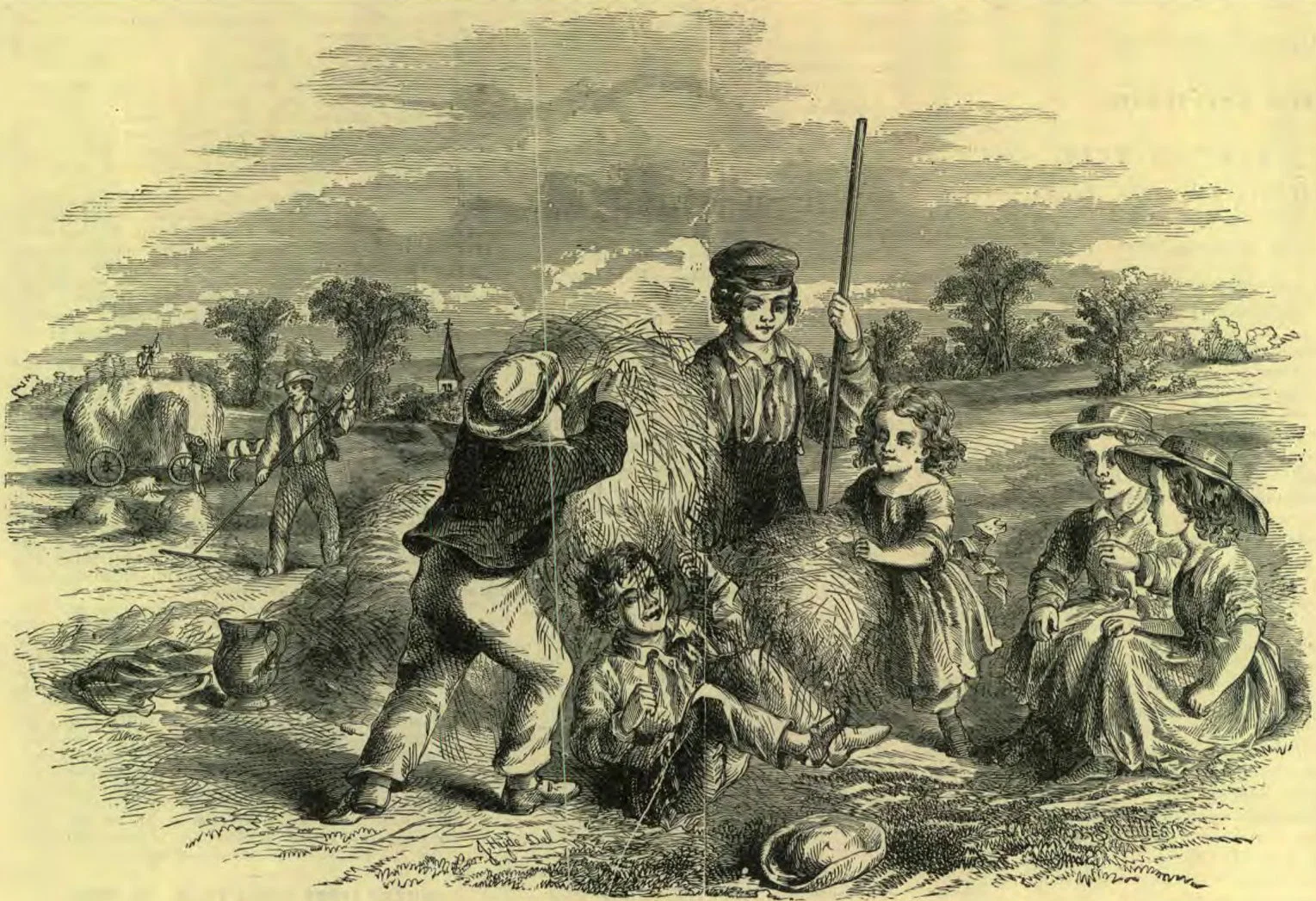
A HAYING SONG.

OVER the meadow floats the mist, Rolling softly away, Up on the hills the sun has kissed Brightens the yellow day. Faintest breath of the morning breeze Shakes the dew from the orchard trees, Sways the bough where robin is saying, "Wake, O wake! It is time for haying!"
Cows are lowing in haste to try Pastures moistened with dew; Swallows twitter, and brown bees fly, Scenting the blossoms new. Meadow-larks, out of sight, repeat, Over and over, "Sweet, O sweet! Grass, and clover, and lilies blowing, Round my nest like a forest growing."
Through the meadows the mowers tread, With a sturdy stroke and true; And oh! for the lilies, so tall and red, When the gleaming scythe sweeps through. Balancing over the grasses light, Dropping with laughter out of sight, "Ho, ho, ho!" hear the blackbird singing, "Give me a day when scythes are swinging."
In fragrant furrows the grass is laid, The golden sun climbs high; The mowers sharpen the ringing blade, And glance at the western sky. Hark! the quail with his warning call Whistles loud from the mossy wall, "Mower, whet!" while the sun is shining, Storms may come with the day's declining. —Emily Huntington Miller.

You have reached the end of this edition.

The Youth’s Instructor · Aug 18, 1886