THERE are more devices in existence at the present time for pandering to the gambling mania than at any previous time in the world's history. It is also true that more money is being wasted at the present time over the gambling table than ever before. Fortunes are won and lost over a single table in a single night. The spirit of willingness to risk what one has in the chance of getting more is permeating almost every avenue of society, and is being fostered by those who ought to stand as a bulwark against its encroachments.
One of the most common forms of the gambling manifestation at the present time is in the guessing lottery. All kinds of senseless guesses are invented, such as guessing the number of bees in a jar, the number of votes in some election, or the population of some city or state. There is no possible way of ascertaining the correct solution, and yet the guesser must advance, risk, a certain sum of money before his guess will be recorded. This is purely a game of chance. It is gambling, pure and simple, and he who engages in it is a gambler—on a small scale, it may be, but on a scale sufficiently large to lead straight to the table of the professional gambler. The paid guess is a stimulant to the gambling appetite; it is a feeder of the gambling house. It bridges the gulf between right and wrong at a place where the walls of that chasm seem almost to meet; but once across, the guesser is in the territory of the enemy.
We have seen from time to time unmistakable evidence of the increase of this spirit among men and women. Deplorable as the fact is, it is a fact nevertheless, which must be admitted by all who read; and the paid guess is one of the principal members of the faculty in the gambling school. Fast and furious is the pace set by the great deceiver in these days, and he is strewing the path with his victims on the right hand and on the left. The Christian can not afford to tamper with the pitfalls of the enemy, even tho he find them built up in the church in the form of the grab bag and other games of chance. The Christian's life is a serious business, and is not worked out along any of these lines.
YET IS HE MAN AND NOT GOD.
By Editor
Presumably, for it is the law of poor human nature, many weak souls will yield their little belief in the Bible and the God of the Bible because of Lyman Abbott's latest utterance in the interests of infidelity. Not that we believe that Dr. Abbott so intended his declaration, for he doubtless believes that his faith is larger, broader, better; but his utterance will, nevertheless, make for infidelity.
The utterance was made in a sermon before Harvard students at Cambridge, Mass., December 18. Thus he expressed himself, according to the New York World report:
I wonder if you students in Harvard will understand me when I say that I no longer believe in a great first cause. My God is a great and ever-present force, which is manifest in all the activities of man and all the workings of nature.
I believe in a God who is in and through and of everything—not an absentee God, whom we have to reach through a Bible or a priest or some other outside aid, but a God who is closer to us than hands or feet. Science, literature, and history tell us that there is one eternal energy, that the Bible no longer can be accepted as ultimate, that many of its laws were copied from other religions, that the Ten Commandments did not spring spontaneously from Moses, but were, like all laws, a gradual growth, and that man is a creature of evolution, not a creation.
And all this is the doctrine of New Thought, as it is also the doctrine of the tempter in the primeval Garden. It is a flat contradiction of the Bible. In his own personal consciousness Dr. Abbott has tried the Book, and in his judgment it is wanting. In other words, in the last analysis, it is Dr. Abbott against the Bible and the God which the Bible reveals, and the Bible is wanting; Dr. Abbott is judge and jury, why should he not justify himself and condemn the Book and its Author, and set up a god of his own, Dr. Abbott, to whom others beside himself will bow? Yet there is a Higher Court.
We are doing him no injustice. He who departs from the recognized and verified standard, has no one but man to depend upon, and Dr. Abbott, like many others, prefers to trust to himself.
The Bible reveals a personal God, with a habitation, a throne, a central seat of government. It also reveals that to all parts of His universe pulses out the Spirit, the life-force, the energy, of God. As to how that will affect man morally and eternally, depends solely on man's relation to God's law, the law of His life.
That there are laws in the Bible similar to those found in other codes of laws is not strange. Many of these laws grow out of the very nature of things, such as laws for protection of life and property, and even less enlightened nations would selfishly see their necessity.
But the Bible does not declare that the Ten Commandments sprang spontaneously from Moses; it clearly proves that the law is as eternal as God. But it does declare that man is a creation and not a product of evolution, and blessed be God, He who created can recreate; He who spoke the world from chaos to cosmos can speak from the chaos of sin to the cosmos of righteousness the sinner who has faith in Him.
We are sorry to see men in their old age turning from God to self. We are grieved at heart to see great and precious talent, God-given, used to tear down the Book and the religion which has changed the face of the world, transformed deserts into vineyards, savagery and barbarism to civilization, demons incarnate into saints of God.
But the religion of Christ and the Bible will stand. It will go on transforming man till Christ shall leave His mediatorial seat and come again. It will stand when all the religions which make men gods, or which count men as having God within themselves irrespective of faith, and all other schemes of self-salvation, shall have perished in their own utter weakness and innate corruption. Within that Book and the religion of that Book is the eternal potency of God, pledged to every believing soul; and we beg of our readers to cleave to it with perfect heart; for those who trust in the God of the Bible “shall not be ashamed nor confounded world without end.”
SUNDAY ENFORCEMENT NEWS AND COMMENT
By John D. Bradley
BY JOHN D. BRADLEY.
The New Orleans Diogenes of November 28 reported that “Sunday-law violations” was a matter under examination by the grand jury then in session in that city.
It was reported from Lestershire, N. Y., on November 28, that “the chief of police intends to see that Sunday is observed by the hotel men.”
Four barbers were fined $10 each in the municipal court of St. Paul, Minn., on November 30, “for shaving men on Sunday.” “The arrests were made on complaint of J. M. Lockwood, business agent of the barbers’ union.”
The New Orleans Item of November 28 reported that “the police continued their rigid enforcement of the Sunday law yesterday, with the result that eight alleged violators were arrested.”
The Cincinnati Post of November 28 reported that the barbers’ union of that city had just “solicited the financial aid of the Methodist ministers in the effort to enforce the Sunday closing law.” There is no doubt that the union will receive the support of the Sunday clergy in the accomplishment of this object.
One of three specific charges upon which ten American fishing craft were seized and fined by Canadian fisheries authorities for illegal fishing near St. George, New Brunswick, recently was that “they had fished on Sunday.” On the two charges of having illegally-caught fish in their possession, and of having fished on Sunday, the boats were fined $100 each.
On November 24 it was announced from East Liverpool, Ohio, that the mayor of that place, “the only prohibition mayor in the State,” had “issued an order against the transaction of any kind of business in the city on Sunday.” Only eating places and drug stores were excepted in the closing order. “There is much opposition to the edict and a strenuous endeavor will be made to have it rescinded.”
The Hackensack (N. J.) Record reports that “complaints come from New Milford about certain11carpenters who work at their trade in that village on Sunday just the same as on any other day in the week, to the annoyance of the peace and quiet of the community, and thereby depriving other men of a job on regular work days.” It is remarkable how harmful honest industry on Sunday is. Of course it would be much better for the community if these men spent Sunday in idleness or carousing instead of honest work. Idleness and vice is better than industry on Sunday, according to the logic of the Sunday enforcement propaganda.
A DISPATCH from Jackson, Tenn., under date of November 26, reads:
Baum Brothers were acquitted in the Circuit court yesterday of the charge of doing business on Sunday. This firm was indicted last summer, when the crusade led by Rev. de Armond, a young preacher, was made under an old statute against all selling on Sunday. Several paid their fines in the magistrate’s court, but Baum Brothers appealed to the Circuit court with the result stated.
At a meeting of the ministers’ alliance of St. Louis, Mo., on November 28 a letter was presented from “Rev. J. H. Leiper, of Portland, Ore., secretary of the Southwest Sabbath Association,” stating that a meeting was soon to be held “by the Portland ministers of the different denominations” in the interest of a movement “to close the gates on Sundays at the Lewis and Clark Exhibition next year,” and that “some expression as to Sunday closing was desired from the ministers of St. Louis.” In response to this communication, the following, “formulated by the alliance’s board of counselors,” were “unanimously” adopted:
The ministers’ alliance of St. Louis, composed of all the evangelical bodies in the city, in this closing week of our great Exposition, desires to express itself touching the value to our city of having the gates of the Exposition closed every Sunday.
In compliance with the Christian sentiment of the country, the National Government has closed the gates of the St. Louis Exposition on Sabbath, and we believe this has been the greatest testimonial to the Christian convictions of America and a notice to all the world that this is a Christian land.
We believe that the Christian sentiment of this country having been respected as to its convictions touching the Sabbath, the people have responded in a larger patronage at the Exposition than would otherwise have been given.
We have had the visitors at our churches on Sabbath, filling our churches all the summer, and thus the Gospel has had a far better chance to be ministered to the multitudes than would have been possible if the multitudes had been tempted by an open Exposition. In our churches we have had an inspiration through the widening acquaintance with Christian brethren from the larger kingdom of Christ. We have had quiet Sabbaths on our streets. St. Louis homes have been less disturbed by coming and going of people than would have been the case if the Fair were inviting their presence, and this has preserved to the St. Louis housekeepers themselves better opportunities to observe the sacredness of the day and to attend to their own spiritual life.
We join most heartily with the ministerial association of Portland in its efforts to secure for the Lewis and Clark Exposition the closing of the gates on Sabbath.
Such a document serves the very useful purpose of exhibiting the thoroughly religious nature of the Sunday-closing sentiment. If by “the Christian sentiment of the country” be understood the religious sentiment of the great portion of the church people of the country, and by “Sabbaths” be understood Sundays, nothing could be more accurate than the statement that “in compliance with the Christian sentiment of the country, the National Government closed the gates of the St. Louis Exposition on Sabbaths.” But by what right does the National Government enact into law and enforce religious or “Christian” sentiment? However it may be as to this being “the greatest testimonial to the Christian convictions of America and a notice to all the world that this is a Christian land,” it is certain that it is not a testimonial to American consistency and loyalty to American principle, nor is it a notice to all the world that this is a land where the principle of separation of church and state is kept inviolate.
A “UNION service of the Protestant churches” of Woonsocket, R. I., was held on November 27 in the interests of “Sabbath observance,” or more accurately in the interests of the Sunday enforcement organization of that part of the country, the “New England Sabbath Protective League.” The meeting was presided over by the Methodist minister and was addressed by the secretary of the above organization, Rev. Martin D. Kneeland, D.D.
He began by speaking of the work the league had done in closing the St. Louis Fair on Sunday, altho religious services are allowed to be held there. The league is trying to have the United States Government maintain its past attitude toward this great question. He mentioned the fact that the late Senator George F. Hoar was the president of the league, and other members and officers were Senator Frye, of Maine, and Senator Hawley, of Connecticut, and many other prominent persons. He told of the work of the league, and a subscription was taken for the work. A set of resolutions was adopted which deprecate the use of Sunday by political parties for political rallies and debates. And yet if this be a Christian nation, and politics the business of the Christian, one can hardly see the logic of preventing the agents of that Christian institution from doing a “Christian” act on Sunday.
No. 60 New York Ave., N.W., Washington, D.C.
PREPARE WAR.
ONE of the striking prophecies of the Bible concerning the last days is found in Joel 3:9–14, as follows:
“Proclaim ye this among the Gentiles: Prepare war, wake up the mighty men, let all the men of war draw near; let them come up; beat your plowshares into swords, and your pruning-hooks into spears; let the weak say, I am strong. Assemble yourselves, and come, all ye heathen, and gather yourselves together round about; thither cause thy mighty ones to come down, O Lord. Let the heathen be wakened, and come up to the valley of Jehoshaphat; for there will I sit to judge all the heathen round about. Put ye in the sickle, for the harvest is ripe; come, get you down; for the press is full, the fats overflow; for their wickedness is great. Multitudes, multitudes in the valley of decision; for the day of the Lord is near in the valley of decision.”
And this is God's declaration of what will be despite all the peace congresses of men. Red savages do not daub themselves with war paint, hold their war dance, prepare their weapons and provisions because they love peace, or expect peace. Neither do white savages. The fearful and constantly-increasing cost of war during the last few decades is a striking fulfilment of our Lord's word. Put beside the above prophecy the following from the New York World of December 23:
If Congress should pass the resolution of Mr. Bartholdt, of Missouri, for the compilation of statistics showing the cost of war and war preparations in all countries since 1800, it will be found that the price should “stagger humanity.”
Charles Sumner said in 1845 that it would be “difficult, if not impossible, to arrive at an exact estimate of the cost” of standing army, navy, fortifications and arsenals and militia. To these, he said, must be added the enormous loss caused by the withdrawal of “millions of hardy, healthy men, in the bloom of life, from useful, productive labor.” Mr. Sumner found that from 1789 to 1843 our Government had spent $246,620,055 for all civil purposes, and in the same time, deducting the cost of the war of 1812 with Great Britain, had spent $1,335,000,000 in preparation for war, plus $400,000,000 for militia. Eighty cents of every dollar raised by Federal taxation in time of peace was a tribute to the fetich of war.
The Federal Government nowadays appropriates about $200,000,000 a year for direct warlike preparations, or in seven years more than it did in the first fifty-three years of its existence.
How about the world-cost of war?
The debts of nations given in The World Almanac exceed $30,000,000,000. These do not nearly represent the cost of a century's war, but only that portion of the cost which remains unpaid and a charge upon the people. Only in a few cases, like Canada and New Zealand, does public debt represent other than war expenditure, and these sums are more than balanced by “left-over” debts from the eighteenth century.
The earth has 1,487,000,000 inhabitants, or 207,580,000 families. Its permanent load of war debt is $1,000 for every family.
THE WAR IN THE ORIENT.
There has been little news during the week from the two great armies now facing each other in Northern Manchuria. The rigors of winter seem to have made campaigning practically impossible, and only light skirmish actions are reported.
The Japanese general who has had charge of operations against Port Arthur, General Nogi, has been wounded and sent to the hospital at Dalny. He was wounded while directing operations against “203 meter hill.” The Russians have now abandoned what is known as the New Town of Port Arthur, but the Japanese fear to occupy it lest it should prove to be mined. All the Russian advance positions fronting the right wing of the Japanese army have been captured by the Japanese. The latter are now in a position to drop shells into any part of Port Arthur. They have captured the entire fort on Rihlung Mountain, having undermined under its foundations and blown them up. About half the Russian garrison in this fort were killed in the explosion, and forty guns captured.
It is rumored that a part of the Russian Baltic fleet has been recalled. Work is being rushed on what the Russians term the third squadron, and it is probable that the Baltic fleet will not go to the East until this squadron is also ready.
DISTRICT OF COLUMBIA SUNDAY BILLS.
Mr. K. C. RUSSELL, chairman of the Religious Liberty Bureau, Tacoma Park Station, Washington, D. C., has issued an important circular, from which we take the following:
It will be remembered that last spring it was feared that Congress would pass a Sunday bill for the District of Columbia. On April 6 a bill did pass the House of Representatives, and it is now pending the third reading in the Senate. This could very quickly be passed, when it comes to the final issue, unless most earnest efforts are put forth in remonstrating against it at once. We shall do all we can to have the final action deferred until after we are granted a hearing.
The Sunday measure now pending before the Senate is entitled, “An Act Requiring Certain Places of Business in the District of Columbia to be Closed on Sunday.” This bill is doubtless introduced as a feeler or a forerunner to another that has been introduced in the House, the title of which is, “A Bill to Further Protect the First Day of the Week as a Day of Rest in the District of Columbia.” This last is a very much more stringent measure than the former. The text of both of these will be found in the Review for December 15.
It will appear evident to all that these are very dangerous measures, and that, should they become law, they would give great prestige and influence for similar legislation throughout the whole country. In fact, that is the object of the manager of the International Reform Bureau, for he desires this as a first step, and then, after the states are marshaled into line, he desires to bring their combined influence to bear upon the Congress of the United States for a national Sunday law.
Persons who desire to petition Congress against these dangerous measures can procure blanks from the Bureau, at the above address. It is a matter that concerns every one, for all such legislation is a menace to religious liberty, and the best time to combat it is before it finds a place upon the national statute books. “Eternal vigilance is the price of liberty.”
A Critical Year.
A correspondent of the New York Sun, writing from London concerning the outlook of the new year, gives a striking setting forth of the conditions as they are:
The crisis in the world's history which the year now closed has developed so rapidly is, in the opinion of the most careful observers, approaching a climax. Its effects will influence the destinies of nations throughout the country and beyond. No one denies the momentous importance of the situation upon which the new year dawns. In a word, the world is entering upon the most critical year of modern human record. There are those who believe Japan's comet-like appearance in the firmament will be followed by as rapid a wane. There are those who believe on the other hand, that the world will see before another new year the disruption of the Russian empire and the re-making of the map of Europe and Asia. Those who share the latter opinion are increasing in numbers daily among statesmen, as well as among general observers throughout Europe. Their thoughts are anxiously devoted to the grave problem of whether such a national tragedy can be enacted without destroying the world's general peace.
One event alone might seriously disturb the situation. The death of Francis Joseph would let loose the whirlwind of conflicting ambitions of Berlin, Vienna, and Budapest which might work disaster to Central Europe.
It must be said that Europe is unanimous in regarding the czar's method of meeting the crisis indicated by the two imperial rescripts of the present week as the weakest and most futile course that could possibly be adopted. The manifesto shows indecision in every line, and indecision in the face of the existing emergency is nothing less than a crime. The immediate effect of the manifesto is that the entire civil population, outside of the bureaucracy, rich and poor alike, openly talk disloyally. There is energetic despair over this new proof of the czar's utter incompetency. There will be plots, and bombs will be in Russia before long; it can only be hoped they will be directed against the real enemies of the country who are responsible for its ruin and humiliation.
These words of a competent observer of world events show the doubt, uncertainty, and fear of the future that now exist in the hearts of men. “Men's hearts failing them for fear,” is a Scriptural delineation of these trying times.
The liberal element in Russia and among those Russians who are outside of Russia is planning a propaganda of education in the principles of liberty. The lessons are to be couched in language that can be understood by the common people. Reformers expect by these means to expand the political consciousness and capacity of Russia until a majority of the people are prepared to manage, and, if necessary, to fight for, free institutions. Various devices will be employed to carry these lessons to the people. Teachers of these principles in the guise of factory hands, clerks, railway servants, soldiers, traders, and country peddlers will distribute the literature where possible.
Riots continue in different portions of Russia. A monument of Alexander II. was recently destroyed by dynamite. The ferment in that locality continues, and the police are searching houses at night for anarchists. At Lodz and other towns the police are guarding the churches. At Cracow, Russian Poland, the Russian church was attacked with dynamite. The walls and several graves were destroyed. In quelling the riot which ensued, a Russian colonel was killed. The assassin was killed by the soldiers, and many others were either killed or wounded.
The Russian Government has set about the work of revising the laws that have to do with the peasant class in order to bring about a betterment of the condition of that class, and thus bring about a better feeling toward the government on the part of the peasants; but the czar's attitude as manifest in his two recent rescripts is doing more to alienate feeling than can be remedied by any revision of the peasant laws.
The powers are again growing anxious over affairs in Turkey. The situation in Macedonia is said to be growing serious. There are also many fights on the border between Greek and Bulgarian bands, which Turkey seems to be doing nothing to prevent.
The official election returns from all the states have now been made public. They are as follows: Roosevelt, 7,627,632; Parker, 5,080,054; Debs, 391,587; Swallow, 260,303; Watson (Populist), 114,637; Corrigan (Socialist-Labor), 33,453.
A TRIP TO LOS ANDES.
By William Steele
BY WILLIAM STEELE.
In company with Brother Balada I started to visit some of the brethren who live in the country beyond the beautiful city of Los Andes which is situated at the foot of the Andes mountains.
The train carried us through several beautiful valleys similar in many respects to the valleys of Oregon and Washington, with growing grain and orchards bearing fruit. The greater part of the fruit here is different from that of the States, altho grapes and peaches are very abundant.
There are three different classes of travel on the trains here, first, second, and third. The rich ride in the first class, the common people in the second, and the poor in the third. Suffice to say the third class has the most passengers, as the most of the people are poor.
As a Seventh-day Adventist mission worker is never overburdened with money, we rode third class, which is less than one-half the cost of second class, a ride of more than one hundred miles for only sixty cents, gold. The cars were crowded. In Chile all the men and the majority of the women smoke cigarettes. So if it had not been for the beautiful scenery outside, the ride would not have been a very enjoyable one.
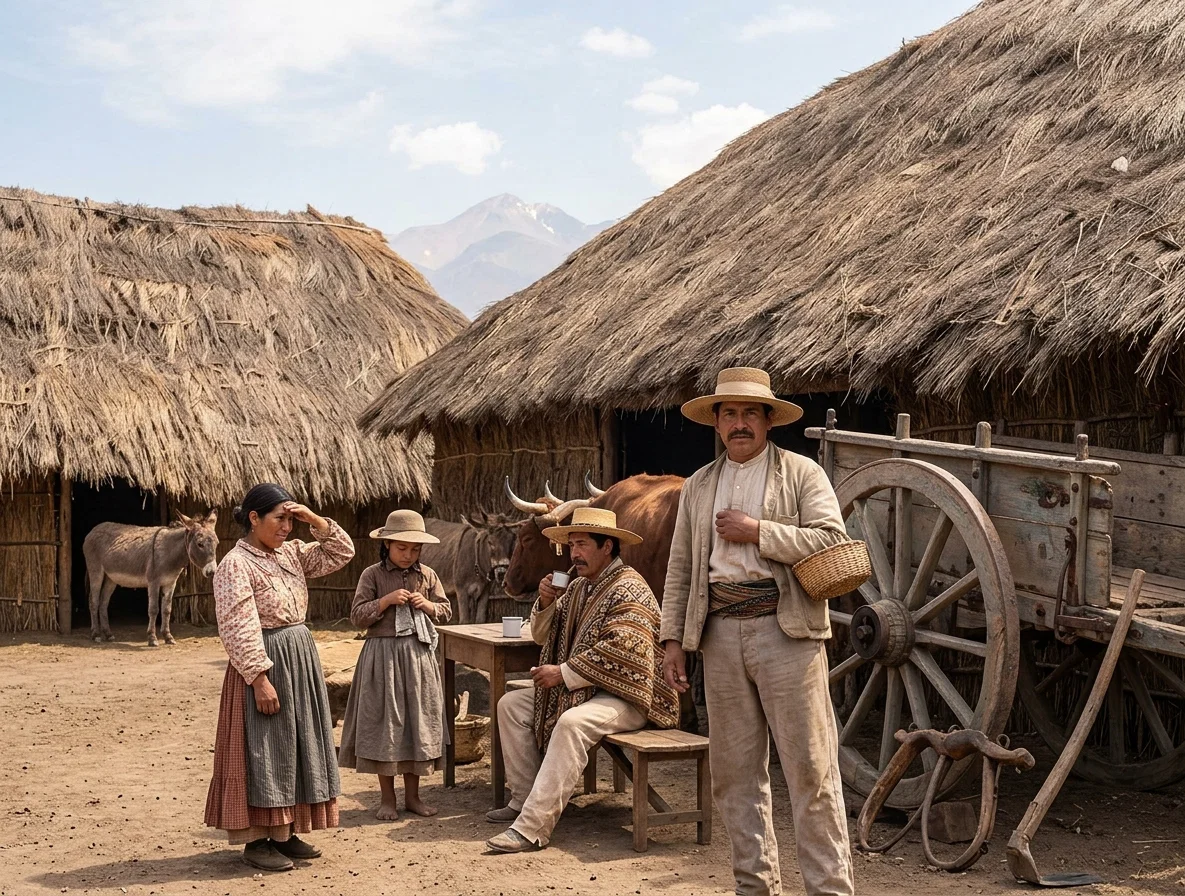
As far as I know, there is not a wagon or carriage in this country like those used in the United States. In some places they use the same kind of carts as were used in ancient Egypt. The majority of them have two very large, high wheels. Ox carts are very numerous; but many of the carts are drawn by horses, one horse being hitched in the shafts, while a second is hitched at the side by a single tug. This horse carries a saddle on which the driver usually rides. The horses all have their tails docked, as the people try to be English.
Two of the brethren met us at the station with two burros and a horse, on which we were to ride to their home, a distance of fifteen miles.
In Chile burros are used more than horses or mules for carrying burdens. It is no uncommon sight to see a little burro loaded so that about all one can see of it is its ears and tail and four small feet. One of our burros was loaded with personal effects, so only two of us could ride at one time. Five miles of the distance there was no road, simply a trail among the rocks. As it was dark when we reached this trail, I had a new experience in climbing mountains in the dark, where a single mistep might result disastrously. We arrived safely at our destination at 8.00 P.M., and found all the brethren gathered to welcome us, this being the third visit they had received since accepting the truth some four or five years ago.
A Farm House In Chile.
A Chilean supper, consisting of soup and vegetables, awaited us, and was very acceptable. After supper a short meeting was held. The next morning we had a good meeting which lasted two or three hours. In the evening the ordinances of the Lord's house were celebrated, and all seemed to be strong in the faith.
During the afternoon we spent a few hours climbing mountains and enjoying the beautiful scenery. The mountains are covered with shrubs and cactus. The people keep goats and burros which feed on the shrubbery. These animals are the principal source of income to the people.
The next morning, in company with one of the brethren, I returned to Los Andes to sell a few Las Senales de Los Tiempos (our Spanish paper) before returning to Valparaiso. After walking the entire distance, I succeeded in disposing of enough to amount to $8.50; also took a few subscriptions for the paper.
I did not see a house in the country that is as good as the sheds we keep stock in at home. The houses are made of mud with a thatch roof. They have no floors or windows, and some of the doors always stand open. The housewife has no cook stove, but cooks on a fire built in the middle of the room or on a brasero which is a kind of kettle twelve or fourteen inches in diameter, in which a fire is built. Altho the most of the native Chileans are very poor, yet in the cities can be seen people as well dressed as in any place in the world.
The wealthy people and the foreigners live in the cities. If one goes to the parks on Sunday or on a feast day, one sees the people resplendent in diamonds and expensive clothing. They think of everything but God, the Giver of every good and perfect gift. They seem so eager for pleasure, that one often wonders how they can be halted in their mad rush long enough to hear the warning message.
A short time before our visit to Los Andes, in company with the same brother, we made a trip to Quillota, a small city about an hour's ride from Valparaiso. We only remained between trains. During that time I spent about two hours in selling papers, but sold enough to amount to $4.60.
The work is onward in Valparaiso. Seven adults who have accepted the Sabbath through attending the meetings, desire to be baptized, and unite with the church. There are others who will be ready for baptism in a short time. Last Sabbath, October 29, I spoke to the people for the first time without an interpreter.
While sitting here writing this afternoon, we felt a very decided shock from an earthquake. At first the house seemed to tremble, then to shake, and then suddenly lifted up and the windows rattled. It gives one a very peculiar sensation, hard to be described—a feeling of uncertainty.
I thought, If this apparently small thing can cause these heavy, solid buildings to tremble and shake, how will it be in the great day of the Lord, when He arises to "shake terribly the earth."
There is no safety except in the Rock of Ages. In Him we have a safe and sure abiding place, a strong tower. Praise His name. We need the prayers of God's people for the success of the work in Chile.
Valparaiso, Chile.
OUR WORK AND WORKERS.
A NEW house of worship is being erected at Black Rock, Ark.
A NEW church schoolhouse has been erected by the church in Elk Point, S. D.13
Six new members were received into the church in Cincinnati, Ohio, December 10.
DECEMBER 10, four students of Fernando (Cal.) College were buried with their Lord in baptism.
THE WELCOME VISITOR says that at the last service of the week of prayer in Academia, Ohio, “eight young persons decided to serve the Lord from henceforth.”
REPORTING to the Southwestern Union Record, Brother J. I. Taylor notes the accession of six persons to our ranks as a result of meetings held at Culleoka, Texas.
THE third annual commencement exercises of the Iowa Sanitarium Training School were held at Des Moines, December 29. The address was delivered by Brother A. G. Daniells, president of the General Conference. There were seven graduates.
TWO persons baptized, and others awaiting the opportunity, near Ussery, Ark., together with the addition of three members to the Hot Springs church, is the substance of a report by Brother H. L. Parker in the Southwestern Union Record.
WRITING from Memphis, Tenn., Brother H. C. Balsbaugh reports concerning Sister Balsbaugh’s Bible-work with the colored people, that six of her readers are now walking in the light of the Sabbath truth. He also reports two others who have accepted the truth through our literature.
“THE LORD’S DAY, the Test of the Ages,” by M. C. Wilcox, treats of the institution of the Sabbath, the restoration of the Sabbath to the Israelites after leaving Egypt, the change of the Sabbath, the Gospel of Christ and the Sabbath, etc., and we think it would be a most excellent pamphlet to get into the homes of the people this winter.—Worker’s Bulletin.
NOVEMBER 26, a new church was organized at Long Beach, Cal., by Brother C. Santee, president of Southern California Conference, with thirty members, some of whom had formerly been members of other churches, and some had newly come to the faith under the labors of Brothers J. F. Ballenger and S. T. Hare. The First Christian Church of that city granted the privilege of the baptistry for baptizing candidates, and proffered its use at any time it might be desired.
THE churches in Washington, D. C., made a good record during the week of prayer. Brother A. G. Daniells, in the Review, says it was “an occasion of great blessing and encouragement to the churches.” The encouragement is shown in their responses to the calls for missionary funds. The church at Takoma Park, where the new institutional buildings are being erected, gave $574; the M Street church added $387; and the two smaller churches—the Eighth Street and the U Street—gave $63.24.
IT is encouraging to learn that the systematic effort to place the Review, our excellent church paper, in every Seventh-day Adventist family in this country, is meeting with a good degree of success. We are sure that if all our people were reading, from week to week, the stirring missionary reports with which the Review abounds, the missionary spirit would be greatly revived, and a new impetus would be given to the circulation of our pioneer missionary literature. Let the effort to place the “good old Review” in all Adventist homes go forward. With the new year is a good time to begin. It is only $1.50 a year.
“THY WILL, NOT MINE.”
‘Into Thine outstretched hand
We lay it all;
Only at Thy command
Can ill befall;
And secret good must hide
In seeming ill,
Welcomed and loved, because
It is Thy will.
Thy will that takes the sting
From every care;
Thy will that joy can bring
From our despair;
Thy will that turns to gain
Our shame and loss,
That lets the crown remain,
And takes our cross.
Dear Lord, Thy gracious will,
Once understood,
We in Thy hands lie still;
Make Thou us good.
No fear, no care have we,
No way, no choice;
Whate’er Thy teaching be,
We must rejoice.
Even the rod is sweet
In Thy employ,
There can be at Thy feet
Nothing but joy;
And naught but sweetest peace
In any smart,
For souls whose life is hid
In God’s great heart.