The American Sentinel, Vol. 11, No. 49.

Self-Government and the Integrity of the Individual
Earlier text: Self-Government and the Integrity of the Individual

DOES A NATIONAL RELIGION PROMOTE NATIONAL GROWTH.

BY M. E. KELLOGG.
A NATIONAL REFORMER, writing Sunday-school notes for the Christian Statesman, lays down this proposition:—
Whenever altars and temples and religions multiply in a nation, national unity ceases, and national disintegration and decay set in. Civil governments are to preserve national unity not by compelling uniformity of faith, but by national recognition of one supreme God, of one divine ruler.
Should we admit that the first of the above statements is true, what follows? As surely as national disintegration and decay is a condition that every nation should dread, and prevent if possible, so surely must Spain, Russia, and other States having one faith very generally believed in and obeyed, be justified in doing all they can to prevent the entrance into their realms of other faiths than the one already established there. For what nation desires disintegration and decay? Upon that ground, even Turkey would be justified in refusing her consent that missionaries of other faiths than Islam shall enter the country.
The second statement contradicts itself. Civil government should not compel uniformity of faith, but should compel the recognition of one divine ruler! This may not be compelling uniformity of faith in a very narrow, sectarian sense; but in a broad sense it is. To compel the recognition of God is as surely compelling men as it is to compel a specified form of baptism.
Human beings have a very constant habit of thinking that nothing is arbitrary and unnecessary compulsion, unless it trenches upon their particular habit or doctrines. To make others believe, or at least nominally accept, what they believe, is perfectly proper, but for others to do the same by them is quite another thing.
But we have not yet fully considered the principle laid down in the first statement that while religions multiply, “national unity ceases, and national disintegration and decay set in.” The United States of America is a living, national witness that the statement is incorrect. Here is a nation, one of whose fundamental principles of government is that religion shall be free, that all faiths might here multiply. And to prevent all friction and consequent disintegration as the result of religious friction, which surely has ruined many nations, the Church and the State, religion and the civil government, were separated, so that whether a man professes any religion or no religion at all, that would not prevent his cordial support and maintenance of the government. It was also the intention of the founders of this nation that it should forever so remain. “Congress shall make no law respecting an establishment of religion, or prohibiting the free exercise thereof,” was the first amendment to the United States Constitution. This provision was intended to cut off all hopes of establishing a national religion here even in the broadest sense. The Jew, Christian, Catholic, Protestant, infidel, agnostic, and Mohammedan—all are equal, and all can subscribe to the Constitution; and the addition of anything to the national law which they cannot subscribe to, would be dangerous to the country.
This system of government has been in operation one hundred and twenty-one years, and no one questions the fact that a very large share of our national prosperity is the result of it. This nation has stood forth as a marvel of progress, a miracle of national growth. Its power and influence have been felt across the sea, in the lands where persecution once held sway; and the degree of liberty now enjoyed by the people of those nations is but the reflection of our own superior freedom. Does any one dare to assert that, if this nation had adopted a narrower system of government, had established a national religion even of the broadest kind, the nation would have grown as it has, or that its influence over other nations would have been so marked and beneficent? For our part, we do not hesitate to state that it would not.
Christianity is the last religion which should plead for national recognition. Before it received such recognition it was beautiful in holiness and magnificent in power. When it became the recognized religion of Rome its beauty was tarnished, its power gone, and itself but a name for an engine of tyranny. When the adherents of any religion plead for a national recognition of their religion by law, they show that their hope is in an arm of flesh. A yielding to such demands by this nation, to the degree that this has already been done, is in itself a signal of disintegration and decay. If our nation is to be preserved, it can be done only by scrupulously maintaining the religious freedom guaranteed in the Constitution, as its framers originally intended.

Reform Bureau Sunday Closing Campaign Among Young People

IN the Union Signal, of Nov. 19, 1896, the Reform Bureau, of Washington, D. C., says that “at the Washington Endeavor convention, of 1896, which met at a time when the sabbath was more attacked and less defended than ever before,” it was suggested by this bureau, “that all young people’s societies should this year make the defense of the Lord’s day a specialty, each society appointing a permanent Lord’s day committee, as a part of its organization, which committees should endeavor, (1) to close post-offices by local option petitions to the postmaster-general, and on a larger scale by petitions to Congress; (2) to circulate pledges against Sunday cycling for pleasure; (3) to urge the patronage of daily papers having no Sunday editions, etc. This plan was officially approved, so far as Endeavorers are concerned, by the Golden Rule. The postmaster-general, after conference and correspondence with the Reform Bureau, had previously closed the local post-office in Mount Vernon, N. Y., a city of seventeen thousand inhabitants, on petition of a majority of the adult receivers of mail—a petition originated by the Endeavorers but supported by all the other young people’s societies—by this act giving the public to understand that he would do so in other like cases, restoring the local option plan originated by Mr. Wanamaker.”
“Subsequent to the convention the movement was taken up by the young people’s societies of all kinds in all parts of the land, not in small towns only, but also in large cities, especially for suburban offices.”
“The Woman’s Christian Temperance Union, which was earlier in the crusade against Sunday mails, will welcome this reinforcement of young people and give it the benefit of its maturer thought and its staying qualities; and preachers’ meetings will, of course, see that it has no lack of wise and brave leadership.”
Has the Scripture said in vain, “The leaders of this people cause them to err, and they that are led of them are destroyed”?

NO PART IN POLITICS?

How the church of Rome “never takes part in politics” is illustrated by an editorial in The Sun, of Nov. 17, 1896, on “The Expulsion of the Jesuits from Ecuador.” It says that “President Alfaro has issued a decree for the expulsion of the Jesuits from the republic of Ecuador, which is one of the most Catholic countries of South America. Last year, when Alfaro took command of the revolution which he brought to success, he met with the determined opposition of the church. Not a few of the ecclesiastics took up arms against him, and a member of the hierarchy, Bishop Schumacher, held command of a military division which fought for his overthrow. Alfaro also made the charge that millions of dollars belonging to the funds of the religious orders were used against him. ‘My campaign,’ he said in a manifesto, ‘is a most difficult one, because of the enemy’s hypocritical pretense that they are fighting for religion.’
“As soon as the revolutionary leader gained success in the war which opened last year and ended in the early part of this year, he began to enforce measures of revenge. His threats were so alarming that a large number of priests fled from Ecuador and took refuge in Peru and Colombia, and they were followed by the inmates of several convents, some of whom came to this country. He also began to confiscate the lands and other property of the church, which, as he said, had been dishonorably employed against the revolution.
“All this time he exercised power merely as a revolutionary chief, and without any authority derived from the constitution or from popular suffrage. Last month, when a convention to frame a new constitution was held at Guayaquil, Alfaro, now in office as chief executive, at once manifested his antagonism to the church party. He induced the convention to adopt provisions for limiting the power of the church, for diverting portions of the church income, and for putting restraints upon the church’s control of its property. He also secured the adoption of constitutional provisions concerning the religious orders that were regarded as inimical by the church. It is doubtless under the authority thus conferred upon him that he has issued the decree to expel the Jesuits from Ecuador.
“We presume that he has been stimulated to go to this extremity by the still existing hostility of the church to the successful revolution. Bands of his enemies who fled to Peru and Colombia have recently made their appearance on the frontier of Ecuador and have attempted to stir up the people to renew the war against him. ‘Hereafter,’ said Alfaro a short time ago when assured that the church would still defy the revolution, ‘I shall be as severe as formerly I was magnanimous toward the people at enmity with my government.’ Soon after the opening of the war he charged the Jesuits with engaging in intrigues against him; he has many times repeated the charge. He parodied the cry of Gambetta when he said: ‘Jesuitism is the enemy.’
“The hostility between Alfaro and the church, so long as it lasts, will surely constitute a menace to his government. As we have already said, Ecuador is one of the most Catholic countries among all the Catholic countries of South America. Under the constitution which has just been reformed, that religion has prevailed there to the exclusion of every other, and the income of the Roman Catholic Church was derived from the government.
“It will be unsafe for General Alfaro to persist in his opposition to the power of the church for the sake of the revolution. He cannot disregard the danger of a counter-revolution.”
And this is the way that that church “never takes part in politics.”

NEWS AND NOTES.

TURKEY for the Turks, seems to have been the watchword of the Turkish government in the terrible scenes lately enacted on Turkish soil; and this watchword is certainly as justifiable as that of “Russia for the Russians.” It is true that Turkey differs in her methods from her great “Christian” neighbor on the North, but it may be a question whether simple butchery at home is not preferable to a lingering death from the hardships of Siberian exile.
THE Christian Statesman, of November 21, publishes a “call for a convention, in the interest of national righteousness and Christian Endeavor,” to be held in Chicago, December 16, 17. The convention will be purely a “National Reform” affair, yet the organ of the “National Reform” party advertises it as being “in the interest of . . . Christian Endeavor.” This is a public announcement of what was already visible to observing eyes,—namely, that National Reformers and Christian Endeavorers stand on the same platform.
THE official organ of the party whose aim is to force the United States Government to profess religion, has discovered a logical connection between the President’s National-Reform Thanksgiving proclamation and the settlement of the Venezuelan difficulty. The proclamation was issued November 4, and the agreement between England and the United States touching the Venezuelan question was concluded only eight days later. “Was there ever,” says that journal, “a more complete or fuller illustration of that golden promise of God’s word: ‘Them that honor me I will honor’?” To be sure, this controversy might have been settled long ago if these two “Christian” powers had not been so jealous for their national “honor”; and, moreover, the English government, which has acquired no particular “honor” in the Venezuelan settlement, has long maintained a State church, which is certainly a more direct national espousal of “Christianity” than is contained in the President’s proclamation; but, for “National Reform” purposes, any objection which these facts might present to the view that in the Venezuelan agreement God honored the present administration for the character of its Thanksgiving proclamation, is outweighed by the evidence contained in the mere proximity of the one event to the other. The “National Reform” organ finds a reason for this religious action by the President and Secretary of State, in “the Christian Endeavor convention held in the Capital of the nation last July, with its three great tents pitched on the government’s property at the very door of the White House,” and in this it probably comes much nearer the truth.
THE Roman Catholic doctrine that the public schools ought to be a medium for the inculcation of religion, is based by Catholics upon the ground that without this the schools are “Christless.” “Everywhere,” says the Catholic Review, of November 28, “the Catholic Church opposes the exile of Christ from public schools.” But would Christ be exiled from the public schools by excluding from them the teaching of the Roman Catholic religion? What Protestant will maintain that He would? And yet this Roman Catholic claim rests upon exactly the same “logic” as that which underlies the idea that the national Constitution is a “Godless” document because it does not recognize any national deity.
A WRITER in the Western Watchman (Catholic), of November 19, states that the pope has sent the papal delegate at Constantinople, Mgr. Bonetti, to the Sultan, “bearing an autograph letter from the pontiff of the Christians to the head of the followers of the Crescent,” in which Leo “besought the Sultan in the name of God to put an end to the Armenian atrocities.” He hopes that the result will be such as will add new glory “to the halo which for ages has sat upon the radiant brow of that immortal guardian of right—the papacy.” It is well to remember, in connection with such statements, that upon a former memorable occasion the “pontiff of the Christians” sent forth with his blessing a great “Christian” expedition to slaughter the Turks in and around Jerusalem and recover possession of the “holy sepulcher.” “Peter the Hermit” first proposed the idea, and when he had made it popular, the pope took the movement under his auspices that the “glory” of it might accrue to the papacy. What the pontiff has in mind to-day is not so much the cessation of slaughter as the brightening of the papal “halo.” If the former were his object, he might send an autograph letter to General Weyler.
THE Catholic Review, of December 5, concludes some mournful reflections upon the warlike conditions which prevail to-day throughout Europe, with this statement: “There can be no peace, no disarmament, without mutual confidence, and this can never be hoped for until the natural union has been effected of the European States under the presidency of that potentate in whom alone all would have perfect trust and by whom none of them would be betrayed—the pope.” It was under the presidency of the pope that the nations of Europe experienced the “peace” of the Middle Ages, during which such military figures as Charlemagne and Charles V. rose to prominence. The “Christian” nations of the world were then happily united in one “faith,” which they firmly maintained while their armies clashed on the field of battle! Besides this, no little exercise of arms was required in the extermination of the millions of “heretics” with which Europe was filled. Truly it was great “peace” that the civilized world enjoyed under the “presidency” of the pope! We do not sigh for a return of that régime.
THE Ram’s Horn, a prominent religious journal, says in its issue of November 5: “This nation is to be Christian or pagan. There is no middle ground. Which shall it be?” This is true enough if the nation is to profess a religion, for paganism embraces the whole field of religion outside of Christianity. And it is further true that if we are to have a governmental religion, that religion will most certainly be pagan, since Christianity does not operate by the force of civil governments, but by faith and love. There have been many instances of the profession of Christianity by a civil government; but in every case the religion manifested was pagan; in every case it led the government to persecute true Christians. Every student of history knows this. How then will it be with the profession of Christianity by our own government?
A CORRESPONDENT of the N. Y. Sun, of Nov. 17, 1896, in the following pertinent paragraph, calls attention to a condition of things that must certainly arrest the serious consideration of all thoughtful persons:—
“In the face of the facts that Bibles by the million almost may be had for the asking, that is, the Word of God is easily obtained without money and without price, and that editions of the New Testament have long been published for a penny a copy in England, and nearly as cheap in this country, and immense sums of money are gathered by Bible societies, to be expended in disseminating the Scriptures printed in the English language and in almost every existing tongue, the language of the Bible is, apparently, more and more ignored by the people at large. While ministers of the gospel profess to preach Christ and him crucified, it is a fact too well known that utterances from the pulpits of the nation savor more of the things of this life than of the life that is to come. True, a text and a portion of Scripture are read and followed by long prayers and artistic singing, but one listens in vain for the glorious and comforting language found in the ‘Sermon on the Mount,’ preached by the man Jesus, who had not where to lay his head. Is it not a fact that the growing neglect and ignorance of the Bible among the people is an outgrowth of secular preaching that has taken the place of gospel preaching in the pulpits of all denominations of Christians?”

INTERESTING FACTS.

At this time when so much is being said concerning the nations of Europe, we believe it will be interesting to everybody to see the picture of some of the people who stand at the head of the various governments. The above heading is the name of a little book, which contains besides 74 pages of very interesting facts brought out in various ways, an album of 21 fine half-tone cuts direct from the photographs of European royalty, and includes Victoria, Queen of England; Christian IX., King of Denmark, and his Queen; Frederick, Crown Prince of Denmark; Oscar, King of Sweden; Sophia, Queen of Sweden; the King and Queen of Greece; Alexander III., Czar of Russia; and Maria Dagmar, Czarina of Russia; Wilhelm II., Emperor of Germany, and his wife; Josef I., Emperor of Austria, his Queen and her son; and others of equal importance and renown.
This little book contains a total of 96 pages, nicely bound, in heavy paper, and was sold by the publisher at 25 cents. We will send it post-paid, till Christmas, if our stock holds out that long, for 13 cents per copy, two copies for 25 cents. Send now. Postage stamps will be received.
Address, PACIFIC PRESS PUBLISHING CO., 39 Bond St., New York City.

Fighting Against God

Is the title of a sixteen-page tract just issued as No. 41 of the Religious Liberty Library in which PICTURE, POETRY, and PROSE unite in teaching Christian principles of freedom of conscience.
7 FINE HALF-TONE ILLUSTRATIONS 7
The pages shown below are reduced facsimiles of pages 6 and 7 of this tract.

CAN NATIONS CONTEND WITH GOD?

“AT his wrath the earth shall tremble, and the nations shall not be able to abide his indignation.”
For a nation to compel a subject to disobey the laws of a foreign nation, when it knows it is powerless to protect him in so doing, is but to murder its citizen in cold blood, and merit international contempt.
Will the government attempt to protect its citizens against the wrath of an offended God? Will it declare war on the King of kings? Can it marshal its hosts and hurl its serried columns against the Eternal City?

“WE OUGHT TO OBEY GOD RATHER THAN MEN.”

“WHEN they went from nation to nation, and from one kingdom to another people; he suffered no man to do them wrong: . . . saying, ‘Touch not mine anointed, and do my prophets no harm.’”
If God had intended that his children should submit to governments in matters of conscience, he would not have protected Daniel in the lions’ den, the three Hebrews in the fiery furnace, nor have delivered Peter and John, Paul and Silas; from their prison cells, where they were placed for disobeying human enactments.

GOD AND THE POWERS THAT BE.

“RENDER therefore unto Cæsar the things that are Cæsar’s; and unto God the things that are God’s.”
God has ordained that governments should exist among men. To these governments he has commanded his people to render tribute, honor, and respect. He has commanded them to be obedient to every ordinance of man, not for fear of punishment, but for the Lord’s sake. So long as a government enforces ordinances of men,—such laws only as are necessary for the protection of men in the enjoyment of their equal, natural rights,—they will not come in conflict with the Christian.

Large Type BIBLES

For Those with Poor Eyesight

We have many inquiries for a Bible of convenient size to use and carry, and with large clear print. The Bible, specimen type of which is shown below, we think will meet the requirements of the case. (Specimen of type shows only one column of the Bible. It is a two-column book like most Bibles, the full size of page being 5½ x 8⅝ in.) Persons desiring such a Bible as this are usually elderly persons, and want simply the Scriptures themselves, without helps or references. This Bible contains a Family Register, Tables of Weights and Measures, and 16 excellent Maps, but has no references or other additional matter. It is printed from clear, new, small pica type, and is bound in French Morocco, limp round corners and has gilt edges. Sent postpaid on receipt of price. Order by number.

PRICE:

No. 1730. French Morocco, Limp Covers, Round Corners, Side and Back Title in Gold, Gilt Edges, Postpaid, $2.00.
Address,
PACIFIC PRESS PUBLISHING CO.
39 Bond St., New York.
18 W. Fifth St., Kansas City, Mo.
12th & Castro Sts. Oakland, Cal.

Before He Is Twenty: Five Perplexing Phases of the Boy Question

“Before He Is Twenty,” —OR— “Five Perplexing Phases of the Boy Question,” IS A VERY HELPFUL BOOK FOR PARENTS.
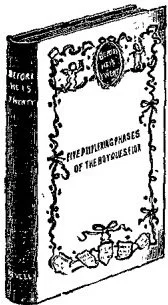
It is divided into five chapters, by as many different writers, each treating of a particular phase of a boy’s life.
The first chapter, “THE BOY AND HIS FATHER,” by Robert J. Burdette, is alone worth many times the price of the book to any father of a young boy.
The other chapters, “WHEN HE DECIDES,” “THE BOY IN THE OFFICE,” “HIS EVENINGS AND AMUSEMENTS,” and “LOOKING TOWARD A WIFE,” are all important and helpful.
104 pages, bound in cloth, embossed in jet and gold, price, . . . . . . . . . . . . . . . . . . . . . . 75 cents.
PACIFIC PRESS PUBLISHING COMPANY, BOND STREET, NEW YORK CITY.

Wilt Thou Rally Thy Legions to Battle
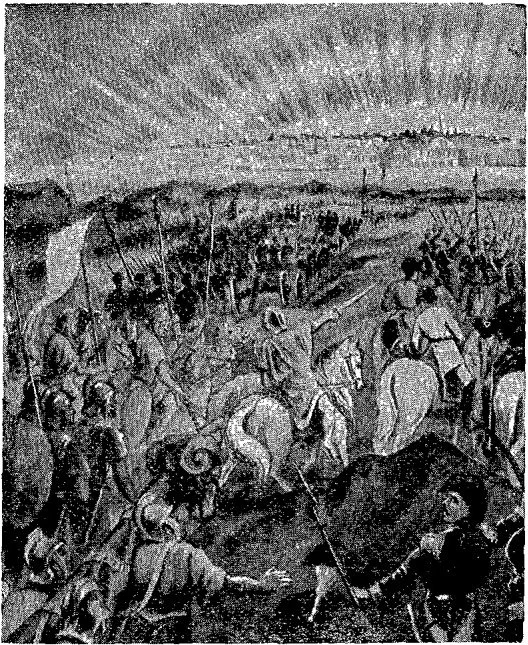
Wilt thou rally thy legions to battle, And march on the City of Light, Whence angels excelling in power Were hurled to the regions of night!
Wilt thou compass the city eternal, Its towers and battlements raze, And train thy batteries brazen On the throne of the Ancient of Days?

The Gospel Primer

A BOOK FOR THE CHILDREN.

Contains 160 pages of matter, which will interest the old as well as the young. There are thirty-three full-page illustrations, which, in themselves, teach many gospel truths.
The book has been re-written, and such additions have been made as it was thought would be of profit to its readers. Considerable prominence and much thought have been given the

WORD-METHOD DEPARTMENT.

It is not only desirable that the child should learn to read well in as few lessons as possible, but it is of greater importance that the mind should be developed spiritually while thus engaged. In the twenty-two pages devoted to this method, the child may learn to revere its Maker, and to love all for whom the Saviour gave his life. Such lessons, so early learned, are not easily forgotten.
With the words which have been taught in the word-method, a short story has been written on the Creation. A few new words are introduced in this account of God's work in the beginning, and a practical lesson is taught of the power, wisdom, and stability of God's word.
The same style and purpose is carried out in writing on other subjects. The aim is to keep the mind upon the things of God while teaching the child to read, and thus lead him to remember his Creator in the days of his youth.
The book has been enlarged by the addition of thirty-two pages of valuable matter. It is a most desirable book for teaching, as well as a pleasant and attractive feature of the home. It is beautifully illustrated, printed on fine paper, and bound in heavy board, with handsome design in colors.
_REGULAR PRICE OF BOOK, - - - .35_
_WITH SENTINEL, one year, - - $1.15_

The Grand Trunk Railway OF CANADA AND THE Chicago & Grand Trunk Railway

Form the GREAT THROUGH LINE to all Points in the West, AND OFFER TO THE TRAVELING PUBLIC THE ADVANTAGE OF THROUGH TRAINS WITHOUT TRANSFER, AND A VIEW OF

THE ST. CLAIR TUNNEL,

“THE LINK THAT BINDS TWO GREAT NATIONS.”
It is the greatest submarine tunnel in the world, extending from Port Huron, Mich., under the St. Clair River to Sarnia, Ontario, and connecting the Grand Trunk Railway System of Canada with the Chicago & Grand Trunk Railway. It has just been completed at a cost of $2,700,000.
The tunnel proper is a continuous iron tube, nineteen feet and ten inches in diameter and 6025 feet, or more than a mile, long. The length of the approaches, in addition to the tunnel proper, is 5603 feet, making all told a little over two miles.
Trains of the Grand Trunk and Chicago & Grand Trunk Railways are hauled through this tunnel by engines specially constructed for the purpose. They are said to be the largest engines in the world. The entire weight of the engine and tender rests upon ten drive-wheels. The weight of one of these monster engines in actual service is found to be approximately one hundred tons.
N. J. POWER, G. P. A. Grand Trunk Ry., MONTREAL, CANADA. W. E. DAVIS, G. P. & T. A. C. & G. T. Ry., CHICAGO, ILL.
FRANK P. DWYER, Eastern Passenger Agent, G. T. Ry., 271 BROADWAY, NEW YORK CITY.

New England Sabbath Protective League Meeting in Providence

A MEETING of the “New England Sabbath Protective League” was held in Grace Church, Providence, R. I., November 23. Martin D. Kneeland, secretary of the league, was present and addressed the meeting, and considerable time was also occupied by several local preachers. The meeting gave its attention principally to a consideration of Sunday desecration in Rhode Island, and especially in the city of Providence.
The Rev. Floyd Tomkins, Jr., who is president of the Rhode Island branch of the league, spoke especially of the methods to be employed in putting a stop to Sunday desecration in Providence. His speech showed that he had caught the true spirit of “National Reform” work. “Get hold of our aldermen,” he said, “and plague the lives out of them until we get what we want. . . . Go to the Commissioner of Public Works and worry him incessantly until the work of repairing the streets is stopped on the sabbath day.” “Get hold of the Park Commissioners and labor with them until they are ready to lie down and die, and we may yet accomplish something with them.” It is only a slight variation of the usual “hold-up” demand—“Your money or your life.” The “Sabbath Protective” leaguers mean that legislators shall either yield or “lie down and die.”

Sunday Law Pressure on Oakland City Council

The Sunday-law forces in California have of late been laying siege to the Oakland City Council, with what results we have not yet learned. They asked the council to pass an ordinance suppressing “Sunday sports, such as shooting matches, bicycle races, Sunday concerts, picnics, dances, races, ball games, and all such carnal amusements as lead to dissipation and disturbance of the peace.” And they asked this, says their official organ, the Christian Statesman, “as a police arrangement and sanitary measure, and that a weekly rest may be secured to laborers and employés.” The public will probably be puzzled to understand why the civil power should prohibit amusements on the ground that they are “carnal;” for it is obvious that this word expresses the objection to them in the minds of those demanding this Sunday legislation. All is “carnal” that is not “spiritual.” The distinction which the term expresses is religious entirely. And the use of this religious term shows plainly enough that it is a religious observance of Sunday which the Oakland City Council is asked to enforce.

Preachers, Politics, and the Duties of Churchly Office

THE daily Journal, of this city, very properly remarks that “if the preachers come to be politicians, they ought to give up the immunities which churchly place confers, and accept the responsibilities of politics.”

Denver Police Board and the Sabbath Play Controversy

THE police board of Denver, Col., decided recently, says a “National Reform” journal, that a certain play given in that city was “too immoral to be played on sabbath evening.” We had always supposed that an immoral play was too immoral to be proper on any day. Are we mistaken?

Prohibition Party Loses Ballot Place in New York

ONE noteworthy result of the recent election in New York State, is the elimination of the Prohibition Party, their ticket having failed to poll the number of votes (10,000) requisite to entitle it to a place on the official ballot, under the laws of the State. The New York Sun points out that the Prohibition ticket will not be entitled to a place in the State campaign again until after 1898.

Colorado Judge Upholds State Sunday Law

JUDGE ABBOTT, of Denver, Colo., has decided that the Sunday law of that State is constitutional. In remarking upon the conflicting decisions extant upon the subject, he said that “the decisions against the constitutionality of sabbath laws seem more logical;” yet in spite of logic he decided this law to be constitutional! We have not learned whether an appeal will be taken to a higher court; but upon such a decision as that we should think that it surely would.

Christian Endeavor's Attitude Toward Politics and Citizenship

For illustrations of the familiar phrase, “a distinction without a difference,” Christian Endeavor literature treating on the attitude of that religious body toward politics, offers a fruitful field for search. Here is an illustration from the Christian Endeavorer; for December, 1896:—
It [Christian Citizenship] does not mean that the society or church as such is “going into politics,” but it does distinctly mean that every Christian shall demand with all his righteous might that Christ shall rule the caucus and the common council as he does the Church.
How much more than this could the Endeavor society or the Church, as such, effect by “going into politics”? Or in what other way would they seek to manipulate politics to gain their ends?

WCTU and California Sabbath Association Petition the Legislature

The Woman’s Christian Temperance Union have united with the California State “Sabbath Association” in presenting to the State legislature the following petition:—
We, the undersigned, residents of California, respectfully ask your honorable body to enact a sabbath law that will prohibit all amusements inconsistent with the proper observance of the day, and that at the same time will secure the necessary weekly rest to all classes of weary toilers.
Notice that no attempt is made to disguise the character of what is asked in this petition. It is a “sabbath law.” The petition is to be circulated for signatures in all parts of the State.

Roman Catholic Church Dissatisfied With Manitoba School Settlement

THE Roman Catholic Church in Canada is not satisfied with the terms of the settlement of the Manitoba School controversy, notwithstanding it allows Roman Catholic teaching in the public schools after a certain hour each day wherever there may be twenty-five Catholic children in attendance. Archbishop Langevin is quoted by a Catholic journal as saying, “The settlement is a farce; the fight has only begun.” Having obtained one concession in the line of what she seeks, the church will of course fight all the harder for more.

Green's Greek-English Lexicon to the New Testament

THERE has been laid upon our table a copy of Green's Greek-English Lexicon to the New Testament, revised and enlarged, published by H. L. Hastings, 47 Cornhill, Boston, 1896. It is a neat little book of 216 pages, 3⅞x6½ inches in size and ⅜ of an inch thick, containing every word in the Greek New Testament, with reasonably full definitions, and with references to passages where the words are used. The preface says: “There are contained in the Greek New Testament about 5,594 words; but in the whole Greek literature the words are a great multitude, which perhaps no man has ever numbered. The student of the Scriptures is not anxious to master or explore this vast wealth of Greek literature; but his ambition is to know something of those 5,594 New Testament words in which the message of God's mercy is conveyed to fallen man. Hence he must pass by the bulk of Greek literature, and confine his investigations to those few Greek words which are used in the New Testament to convey to man the treasures of divine truth. . . . It is for the accommodation of such students, who know little of the Greek language, but who desire to ‘Search the Scriptures,’ and of others more scholarly who yet find it needful to refresh their memories as to the sense of Greek words, that this Lexicon is offered.” It is printed in medium type that brings no strain on the eyes. Taken altogether it is the neatest and handiest book of the kind that we have ever seen. To those who would like such a book, certainly this is just such a book as they would like. And who that wishes really to study the Scriptures would not like to have such a book? Price 35 cents.

You have reached the end of this edition.

The American Sentinel · Dec 10, 1896