The Youth’s Instructor, Vol. 38, No. 14.

THE COUNTERFEIT

The Youth’s Instructor

Apr 2, 1890

S. D. A. Publishing Association · Battle Creek, Mich. · Apr 2, 1890

THE COUNTERFEIT.
THERE is a coin, a shameful counterfeit; 'T was found beside the railroad track, where it By heavy wheels in two parts had been cut, And hurled with other litter underfoot. Its plated surface glitters in the sun With vain pretense of merit never won.
Its sides display, unconscious of disgrace, Our nation's motto, Liberty's fair face, The American eagle with his wings stretched forth, And words which claim "One Dollar" as its worth; And worse than all, so out of place, unjust, The pious words engraved, "In God we trust."
But notice, where the center is exposed, How black the filling which this glass inclosed; And, dropped upon the floor, it rings like lead. Its glory now is gone, its beauty fled. The drawn mask proves it valueless as dust, And honest eyes turn from it in disgust.
What we would seem, oh, let us strive to be! Contented with our own to that degree That all false colors we would scorn to wear, Though perfect they should make us to appear. Attainments true, though humble, will command Respect, where mere pretense could never stand.
A truth is by all other truth sustained, But falsehood is by every truth arraigned; All facts will harmonize and bear inspection, But falsity protrudes and waits detection; So he who feigns to be what he is not, Must shun keen eyes, and never cease to plot.
A look unguarded, or a careless word, An accident, a silence, oft afford A clue to what is thought to be concealed, And One there is to whom all is revealed; True worth, or lack of worth, his eye shall see, So, as we would appear, oh, let us be!
IDA IDEN HOLLY.
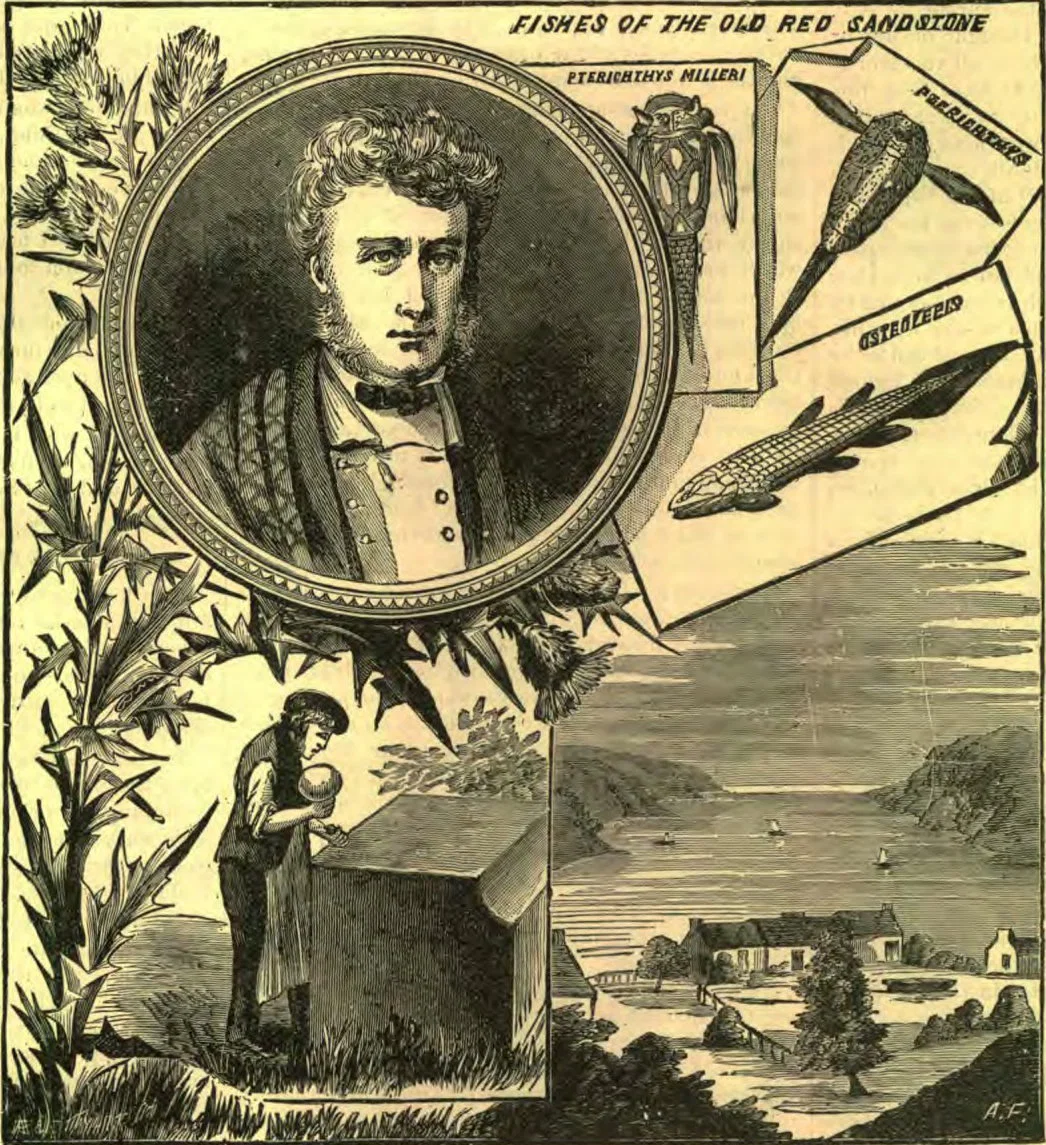
FISHES OF THE OLD RED SANDSTONE

HUGH MILLER.

Hugh Miller was a Scotchman and a stone-mason. He learned his trade early in life, and worked hard. Some boys would have thought, after they had done so big a day’s work, they ought to have the rest of the time for play. But Hugh Miller wanted it for reading. He loved books, and though he had but little school education, he became a learned man, a writer, an editor, and a geologist. It would be well worth while for any boy or girl who feels disposed to complain of lack of schooling, to read the life of Hugh Miller, and see how he employed every spare moment in reading and studying. For he was not content with story books. The wonderful things in nature, in the flowers, and even among the stones, excited his curiosity, and he liked to read the books that told about them. And as he worked in stone, he learned by observation, and in time he became a great geologist. True, he had to work hard and wait patiently for his wisdom and his fame, but the real secret of it was that he made good use of his spare minutes when a boy. This gave shape to all his after life. Instead of taking all his exercise in play, he took it in the fields and among the rocks. And then he was eager to get all the time he could for his loved books. He was always contriving to have a few minutes here and there, so that he could read. Bacon’s “Essays” was one of his favorite books, and they are deep reading for most men.
Another good thing for him was that he kept his head clear. In those days everybody drank a little; for he was eighteen in 1820, and people had not learned so much about temperance then as they have now. They thought a little drink was good. This is what Miller tells us about it:—
“I learned to regard the ardent spirits of the dram-shops as high luxuries; they gave [or seemed to give] brightness and energy to both body and mind, and changed dullness and gloom into exhilaration and enjoyment. Whisky was simply happiness doled out by the glass and sold by the gill. The drinking usages of the business in which I labored were many at this time. When a foundation [of a house] was laid, the workmen were treated to drink. They were treated to drink when the walls were leveled for laying the joists. They were treated to drink when the building was finished. They were treated to drink when an apprentice joined the squad, when his ‘apron was washed,’ when his time was out. Occasionally, they treated one another to drink. “In laying the foundation-stone of one of the houses built this year by Uncle David and his partner, the workmen had a ‘royal founding pint,’ and two whole glasses of whisky came to my share. A full-grown man would not have deemed a gill of whisky an overdose, but it was too much for me. When the party broke up, and I got home to my books, I found, as I opened the pages of my favorite author, the letters dancing before my eyes, and that I could no longer master the sense. I have the volume at present before me, a small edition of the ‘Essays’ of Bacon; for of Bacon I never tired.”
“I felt that the condition into which I had brought myself was one of degradation. I had sunk for the time, by my own act, to a lower level of intelligence than that on which it was my privilege to be placed; and though the state could have been no very favorable one for forming a resolution, I in that hour determined that I would never again sacrifice my capacity for intellectual enjoyment to a drinking usage; and with God’s help, I have been able to hold my determination.”
Here is a point we should particularly notice. Drink hurts the brain and nerves. It hinders or perverts the action of the mind, even when taken in small quantities. And the mind is what makes the man. We do not think enough about this. We talk about what it does to the stomach, and blood, and heart, and liver; but the worst mischief of it is that which is done to the brain. Hugh Miller recognized that, and saved his brain to serve his God and his fellow-men, and left a name that will last for ages.—Julia Coleman.

PERSEVERANCE

“SIR,” said a boy, stopping before a man on his cart, “do you want a boy to work for you?”
“No,” answered the man, “I have no such want.”
The boy looked disappointed; at least the man thought so, and asked:—
“Don’t you succeed in getting a place?”
“I have asked at a good many places,” said the boy. “A woman told me you had been after a boy; but it is not so, I find.”
“Don’t be discouraged,” said the man, in a friendly tone.
“Oh, no, sir,” said the boy cheerfully, “this is a big world, and I feel certain that God has something for me to do in it.”
“Just so, just so,” said a gentleman who had overheard the talk. “Come with me, my boy. I am in want of somebody like you.”
It was the doctor, and the doctor thought any boy so anxious to find his work would be likely to do it faithfully when he found it.
If everybody had the spirit of this little lad, there would be no idlers in the world, standing on the corners, sitting in the shops, waiting for work to come to them. Work does not often come to us. Almost everything worth having, like ore in the mine, must be sought for.—The Organizer.

THE AZORES FESTIVALS.

In the city of Ponta-Delgada, at St. Michael’s, the principal of the Azores Islands, occur in the spring of the year so many religious festivals that the place may be said to be given over to what practically amounts to a drunken religious frenzy, culminating on the sixth of May in the grand procession of Santo Christ. Santo Christ is an image undoubtedly made in Rome, and sent from there probably in the sixteenth century, though the nuns insist that it came down from heaven, that it possesses miraculous powers, and that the nails and hair upon it grow, and are cut yearly before its removal from the chapel to a place in the procession at the spring festival. At its introduction it was little thought of, but at present it is the most popular idol in all the Azores, and votive offerings and other gifts have been presented to it, amounting in value to many hundreds of thousands of dollars, while the jewels with which it is decked are worth £90,000 ($432,000).
The image is kept in the chapel of the Esperança church. For ten days before the festival the doors are thrown open, a grated barrier being substituted, and the eager multitude are permitted to feast their eyes on the decorated image, which is surmounted by flowers, with silver hanging lamps before it, while, leading in a sort of avenue to it, are rows of tall silver vases holding flowers, and candlesticks with lighted candles. The image is cared for by a few aged nuns, who, as they were friendless and alone, were, at the time of the expulsion of the monks and nuns, spared and pensioned for this purpose by Dom Pedro, ex-emperor of Brazil.
On the eve of the festival the image is carried from the chapel to the church. The streets then are thronged with people, entire families coming in from the suburbs. Most of the people are walking, but many sit perched sidewise on the high saddles of the comical little donkeys, while boats from the island of Santa Maria, forty-five miles south, bring hundreds of people. Formerly great multitudes gathered from the further islands, but superstition is waning in the “isles of the sea,” and the light of a better gospel is dawning, so that comparatively few from any great distance now attend.
The Azoreans are as passionately fond of fire-works as are the Chinese, and on this as well as on other festive occasions, large quantities are used, rockets flying day and night. Contributions pour in from all over St. Michael’s to pay the expense of the fire-works for Santo Christ. At night, in the region of the church, men, women, and children settle themselves on the stone floors for rest and sleep; in fact, every available place in all the city is thus appropriated. In addition to the other accommodations, a benevolent lady contributed a sum sufficient to erect a large shelter for such homeless ones, and it is open daily from 5 P. M. to 5 A. M.; but it falls far short of being adequate for the vast crowds that still attend.
The following is a description of the image as given by a traveler:—
“The chapel was brilliantly illuminated, and was the only light part of the church, the light from it falling on the faces of those who knelt in worship. Inside of the chancel rail, under a canopy of artificial flowers, blazing with jewels and clothed with rich red velvet, was the celebrated figure. It was a wooden image, almost life-size, of the Man of Sorrows,—a simply carved representation of the upper part of the figure only; but whoever cut those features from a block of wood had not only the touch of genius, but a heart capable of feeling the significance of the life of him whom it represents. The sadness, the weariness, the patience, which are expressed in the bent head and meekly crossed hands, seemed a rebuke to every feeling other than that of infinite pity and sympathy for what seemed to us such ignorant, mistaken worship. The sharpness of the contrast between the meek face and its surroundings was really painful. Above the head was a great circle of diamonds, filled in with designs, also in diamonds. On the poor hands were as many rings as could be put there, and they held a large conventional bouquet of diamonds. The jewels in the “glory” and the bouquet are the richest, but the collar is also very rich, and numerous heavy gold chains were about it. There is a finer cape than that which we saw, one of blue velvet embroidered with pearls, which was given by King John of Portugal, and watches and other jewels were not shown. The chancel was filled with natural flowers in silver vases, but it would have been considered a disrespect not to have had the canopy of artificial ones, as, no doubt, flowers are too common there to be considered so valuable a gift. They had certainly given of their best, and there was no want of solemnity in the upturned faces of the picturesque crowd.”
The following is his description of the procession that takes place on May 6, Santo Christ’s day.
“In the afternoon we walked down from our home on the hill into the crowded streets, jostling against many boxes of pine-apples which were being hurried to the steamer that was to take them to London, bade farewell to friends also going in the boat, and reached our destination at about three o’clock. We had a most favorable point of observation. The narrow street inclined a little from the square, and we could see the whole of the moving throng, so much more picturesque than ours, as the women wear either the long black ‘capotes,’ with their enormous hoods, or gay handkerchiefs on their heads. The number of orange and yellow handkerchiefs was wonderfully effective among the black capotes. The servants opposite strewed branches of the incense tree, faya, and pine, and the petals of flowers thickly on the street.
“As the procession came into sight, it was like a beautiful picture, perfect in coloring. Framed by the white houses, on which were bright banners, was a dark mass of color, enlivened by the vivid hues of the gay handkerchiefs. In the midst of it advanced slowly the great red, flower-covered canopy, under which we caught occasionally the flash of jewels. Before and after it were masses of red and white and light blue, the dresses of the different societies accompanying it. As it came nearer, we could distinguish the military escort, and the robes of the priests. The heavy figure was on a platform, which was carried by some of the wealthiest and most important men of the city, and immediately behind it walked the Civil Governor and his suit in full uniform. Formerly, indeed until quite recently, ladies of the highest class walked under it barefooted, considering it an act of the greatest piety.
“At intervals, little girls gayly dressed carried trays on which were symbols of the Passion. Each of these little girls is dressed by some family of position. In fact, all the expenses are provided for by private families, even to paying the priests who participate in the ceremonies. As soon as the first notes of the music were heard near us, all, excepting our Protestant party, fell on their knees, and remained kneeling till after the procession had passed. When it reached us, we retreated into the house, but it stopped in front of the house opposite—a distinguished favor—that the devout residents might offer a prayer. This favor is granted to a very few, and I imagine is dependent on the amount contributed to the expenses of the occasion.
“Then it moved on, and from our balcony we could see it as it wound through the larger numbers of the Praca di Municipio, where the Moorish coat of arms on the old Town Hall tells of another form of worship that those walls have witnessed. All through the city the same scenes testify to the hold that festival has on the hearts of the people. One little incident seemed to us very touching. An old woman, who came to gather up the branches, kissed each handful as she put it into her apron.
“It was quite dark before we heard from Mrs. Brown’s the signal of the conclusion of the ceremonies. In the quiet of our favorite balcony we listened to stories of belief in the miraculous powers of the piece of wood we had just seen, and of the solemn litany with which it was borne in times of distress. We were told of summers of severe drought, when the Santo Christ was carried thus, without jewels or rich draperies, and the kneeling people joined in the litany, and screamed and cried to it. In the twilight, the sorrowful, patient face, thorn-crowned, seemed even to us to have some real power, and we wondered in what lonely workshop or quiet cell the unknown hand had been guided to do a work which still speaks to the hearts of thousands, after the lapse of three hundred years.” W. S. C.

Fight Bravely for the Cause of Truth

FIGHT bravely for the cause of truth and right Through the long day, and when the setting sun Shall bid thee hail the welcome shades of night, All heaven and earth shall own thy victory won.

A PET WOODPECKER.

The golden-winged woodpecker, otherwise called the flicker and high-hole, is one of the best known of American birds; a handsome creature, somewhat larger than the robin, with a red crescent on the back of its head, a black crescent on its breast, and especially noticeable for the yellow lining of its wings and tail. A New York gentleman, some years ago, took a young one from the nest and brought it up, and found it to be a very interesting pet.
The bird could thrust out his tongue two or three inches, and it was amusing to see his efforts to eat currants from the hand. He would run out his tongue, and try to stick it to the currant. Failing in that, he would bend his tongue around it like a hook, and try to raise it by a sudden jerk. But he never succeeded; the round fruit would roll and slip away every time. He never seemed to think of taking it in his beak.
His tongue was in constant use to find out the nature of everything he saw; a nail-hole in a board, or any similar hole, was carefully explored.
This curious organ gained him the respect of a number of half-grown cats that were about the house. I wished them to get acquainted with him, so that the danger of their killing him might be lessened, and for that reason I used to take kittens and bird on my knee together. At such times the woodpecker's curiosity was sure to be excited by the kittens' eyes, and leveling his bill as carefully as a marksman levels his rifle, he would hold steady for a minute, and then dart his tongue at the bright round object.
This was held by the cats to be very mysterious, being struck in the eye by something invisible to them. They soon acquired such a terror of the bird that they would run away whenever they saw his bill turned in their direction.
My high-hole was never surprised at anything, nor afraid of anything. He would advance upon the turkey gobbler and the rooster, holding up one wing as high as possible, as if to strike with it, and scolding all the while in a harsh voice as he shuffled along toward them. I feared at first that they might kill him, but I soon found that he was able to take care of himself.
His favorite diet was ants. When I turned over stones, and dug into ant-hills for his benefit, he would lick up the ants so fast that a constant stream of them seemed to be going into his mouth.
He stayed with me till late in the autumn, when he disappeared. Probably he yielded to the migratory impulse, and went South.—Youth's Companion.

THE SKIPPING-ROPE EVIL.

The skipping-rope fever usually begins early in the fall. It attacks indiscriminately girls of all ages. When the thermometer drops from ninety to sixty degrees, there is not one young girl out of a hundred but feels the natural and inherited hunger for the skipping-rope.
Now there are two ways of jumping the rope. One is for the girl to turn it herself, going forward as if on a run, instead of jumping always in the same place. This way, in moderation, is healthful; for it is an easy, natural motion, straining no part of the body unduly.
The other way to jump the rope is to get one girl at one end, and another at the other, and then jump until tripped or tired out. The latter method is always the favorite, first, because it becomes a game instead of an exercise, and secondly, because the girl has nothing to occupy her hands, and can devote all her energies to jumping.
Here is where the danger comes in. The steps are all up and down, up and down, for three and even four minutes on a stretch. Every time the girl alights after a spring, she produces a slight—very slight—brain concussion. The action of the heart is greatly increased. After a full meal, to indulge in rope-skipping, particularly with other girls to turn, means dyspepsia and misery in a few years.
Every one of these dangers is increased tenfold by that momentarily accelerated jumping-jack game of “salt, vinegar, mustard, pepper,” in which the jumper tries to jump as fast as the turner turns, until both are ready to drop from exhaustion.
“How many turns can you jump?” is prolific of more evil to girls than their mothers dream of. The determined rivalry with which two children will jump up and down till gasping for breath, their pulse at one hundred and twenty a minute, and the well-nigh invisible blue veins in their foreheads swollen out by the quick, irregular pumping of the heart, is something wonderful to see.—Golden Days.

ROBBIE'S VICTORY.

ROB PRESTON put on his coat and hat, and came out of school very slowly, with a troubled look on his bright, sunny face. Some of the boys were already outside, and were whispering and laughing about something. Rob knew what it was, but he had no wish to join it; still, instead of hurrying away, as he might have done, he lingered irresolutely.
The truth was, Robbie was fighting a real battle with himself. There was a new scholar in school, little Annie Hoffman. Her father was a miserable drunkard, and they were as poor as poor could be. Her mother had done her best; but little Annie was a pitiful sight in her faded, out-grown, ragged garments.
Rob had discovered, in some way, that a few of the rougher, more thoughtless boys were going to make some fun for themselves when she came out of school to go home, and all the afternoon his conscience had been pleading earnestly with him.
“You ought to try to stop them,” it said.
“But they wouldn’t hear a word to a little boy like me,” he answered. “Then you must help Annie; she will be frightened if they laugh at her.” “Then they will laugh at me,” said Robbie, and he fairly shivered with dismay at the mere thought of the shout they would give if he showed himself Annie’s champion.
“Well, suppose they do laugh,” answered Conscience, pitilessly. “If you are mamma’s little man, oughtn’t you to be brave enough to bear that? You were wishing the other day that you could do something brave and good; here is a chance for you; if you cannot do this little thing, you will not be very apt to do anything very great.”
So this afternoon had passed, and now Rob must decide one way or the other; but it seemed to him that he was no nearer to making up his mind than at first.
“We’ll have some prime fun,” he heard Tom Rogers say; “she’s the greatest looking object I’ve seen, for her age.”
“Halloo, there!” he called out, as Annie appeared in the doorway; “is that a rag-bag I see walking around?”
The little group around him shouted as he spoke, and Rob’s face grew crimson.
“Don’t, please, boys,” he said, pleadingly; “she isn’t to blame, and it will make her feel so to be laughed at.”
“Oh, run home, little Molly Coddle,” said Tom, with a sneer. “It will take more than you to stop me.”
Rob walked on a few steps. What should he do? Oh, dear, why couldn’t he go right home? He could not stop them; they would only laugh the more if he did anything.
“But Annie will feel as if she had a friend.”
“I can’t,” said Rob, with a little choke; and boy that he was, his eyes filled with tears as he turned toward the gate.
“O Rob Preston, I’m ashamed of you,” said Conscience; “how shall you feel when mamma gives you a good-night kiss? Will you want to look up into her face? Won’t you feel ashamed to think what a coward you have been? Shall you want to tell her all about it?”
There was just a moment’s hesitation; then Robbie turned and went quickly up to the steps, where Annie stood, quivering with fear.
“Come with me, Annie, I am going your way,” he said; and Annie caught hold of his hand instantly.
“I’m so afraid,” she almost sobbed; “I’m never coming again. I didn’t want to to-day, but mother cried and wanted me to.”
“I’ll tell you,” said Robbie, comfortingly, “we will go right to my home, and tell my mamma. She always knows what to do.”
So they went bravely down the walk, and though the boys tried to laugh, they could not make much of a success at it.
“He was a plucky little fellow,” said one, after the two had gone.
“Yes, and more of a gentleman than any of us, if we are older,” said another.
Mamma soothed and comforted little Annie, and sent her home happy, with one of her own Annie’s outgrown dresses, that just fitted her, and a promise to come and see her mother.
When she had gone, mamma stooped and kissed Robbie.
“My own precious laddie,” she said fondly.
“But I wasn’t brave at first; I wanted to run away like a coward, only I thought of you, and how ashamed I should be to have you know about it,” said Rob.
“That was right, dear; but remember God sees and knows always; mamma might not, perhaps; but we cannot hide anything from him. Think of that when you are tempted. We must try very hard not to do anything we are ashamed or sorry to have God know, mustn’t we?”
“I’ll try; but, O mamma, sometimes it is so hard even to do right in little bits of things.”
“I know, dear; but remember we can always have help if we ask for it.”—Kate S. Gates.

Teddy and Dottie Confess the Broken Window

Pretty soon it got dark, and the shade was pulled down. Then Teddy got up.
But when Teddy and Dottie went to bed, they both felt very sober.
Mamma heard them say their prayers, then she kissed them, and went quietly down-stairs.
Then Teddy said, “Let’s tell.”
“Let’s,” said Dottie.
They called mamma, and said to her, “Mamma, we broke the dining-room window.”
“We played ball,” said Dottie.
“And we thought we wouldn’t tell,” said Teddy.
“And then we thought we would,” said Dottie.
“My dears,” said mamma, “I am sorry you did not obey me about playing ball in the house. But I am very glad you did not make things worse by telling a lie. Our Saviour forgives our sins when we are sorry for them, but a lie leaves an ugly stain on a little heart and a little tongue.”
When mamma was gone down, Teddy said, “I’m glad we didn’t tell a lie; for, don’t you see, we couldn’t ever untell it.”
Dear little children, remember that you can never untell a lie. Be thankful if you can say, “I have never told a lie.” And try with all your hearts always to be able to say so.—The Sunbeam.

HANSEL AND HIS FRIENDS.

HANSEL was very lonesome. He said one day to his auntie, “Tauntie, why is it the good Father gives me no one to play with? I want my little Louisa, who played with me across the big waters. I have no playmates.” Then his Tauntie said, “Liebchen, mein, why not play with the little girl and boy next door?” But Hansel only shook his head, and said, “But they do not speak my German speech, and I cannot understand theirs. Louisa and I did have good times together; for we could talk to each other. But in this new American home whom can I play with?”
“You shall have some playmates who will know you and love you just as well as though you spoke the speech of America. Just wait till your birthday comes.”
“My birthday comes next week.”
“Yes, Liebchen, and then you will see your new playmates.”
“How hard it will be to wait for my birthday to come, Tauntie!”
“Be patient, dear child; it will come.”
Hansel awoke early on the morning of his birthday, but he found his Tauntie up before him.
“Come with me,” she cried, and he followed her joyously into the door-yard. Back of the house was a little shed. Just under its shadow stood a large box and a coop.
“Do my new friends live in these boxes, Tauntie?”
“Yes, and you may open the door and see them.”
He opened the big box, and two bright eyes peeped at him.
“Oh, a rabbit,” he cried, “a pretty, snow-white rabbit!”
He took it in his arms, and it cuddled close to him. He stroked the long, white ears, and Bunnie rubbed his pink nose lovingly against Hansel’s cheek. The little boy laughed with joy. Tauntie gathered clover, and Bunnie ate it from Hansel’s hand. The child chattered sweet German words of love, and Bunnie answered with eyes and ears.
“Oh, he understands my German speech, Tauntie mein!”
“Come, now, put him back for a little while in his house, and open this other box.”
Hansel did so, and from the coop out walked a nice, good, motherly hen. Hansel clapped his hands for joy, and ran to the house for food for “Hühnchen,” as he called her.
Then Hansel was never sad or lonely again. He spent hours every day with Bunnie and Hühnchen, and gave them tender care. Every morning he took part of his breakfast out to share with them, and as they ate, he thanked the good Father that these dear little friends loved him and understood him.—Sel.

DON'T TELL A LIE.

“Let’s play ball,” said Teddy.
“Yes, let’s,” said Dottie.
Teddy had a tennis racket, Dottie got a ball, and they had a fine game.
Crash! went a pane of glass in the window.
And then both remembered that mamma had told them not to play ball in the dining-room.
“What shall we do?” said Teddy.
“Don’t let anybody see it,” said Dottie. “And when they do, let’s say we don’t know.”
They picked up the glass, and threw it away. Then Teddy sat down before the broken place in the window. He grew very tired of sitting there. But he was afraid to get up, lest some one would see it.

Sing a Song of Spring-Time

SING a song of spring-time— Dainty sylvan flowers, Bluebirds in the oak-tree Foretell the summer hours. Swallows, robins, thrushes, Singing loud and gay— Who could ask for sweeter sounds Than these on a spring day?
SING a song of spring-time—
Dainty sylvan flowers,
Bluebirds in the oak-tree
Foretell the summer hours.
Swallows, robins, thrushes,
Singing loud and gay—
Who could ask for sweeter
sounds
Than these on a spring
day?
SING a song of spring-time— Dainty sylvan flowers, Bluebirds in the oak-tree Foretell the summer hours. Swallows, robins, thrushes, Singing loud and gay— Who could ask for sweeter sounds Than these on a spring day?

A LESSON IN PERSEVERANCE.

What would you do if you could neither see, nor hear, nor talk? Can you for a minute imagine how dreary life would be if you were deprived of these blessings?
I want to tell you about a little girl who has never seen the sunshine, who cannot hear her dear mother’s voice, and who cannot talk, because she cannot hear, and so does not know what sound is like. Would you not think that such a little girl would be sad? On the contrary, she is one of the happiest children in the world. Her name is Helen Keller.
Helen was born in the South, in Tuscumbia, Alabama, and she is now nearly ten years old. When she was a baby, she could see and hear as well as any one, and had learned to say a few words; but one day she grew very sick, and when she got well, she could neither see, nor hear a sound.
As Helen’s body grew, her mind grew too, but she had no way of telling what she thought. She invented some signs for telling her wants, but there were a great many other things Helen wished to know about. She would fall into fits of violent rage because she could not make any one understand what she meant.
By this, Helen’s parents knew that her baby days were over, and that they must find some way to let her mind out of its prison—they must find some one to teach her language. So Helen’s papa wrote up to Boston, and obtained a good teacher, who had once almost lost her eye-sight, and had been obliged to go to the school for the blind, though she can now see as well as any one.
She taught Helen the finger alphabet, spelling the names of objects with one hand, while Helen passed her fingers lightly over her teacher’s hand, and tried to spell them the same way with her other hand. Her delight was unbounded when she had learned to spell a name for her baby sister, of whom she is very fond. All her lessons were like so many plays. She had to be put on a chair to learn the use of the word on, and into a closet to learn what into meant.
After she had learned to spell words with her fingers, she was given a primer, with raised letters, such as the blind use, and she was much displeased because her own name was not found in the book. “She was so delighted with the book,” says a lady friend of Helen’s, “that she would sit for hours feeling the different words, and when she touched one with which she was familiar, a peculiarly sweet expression would light up her face.”
A friend gave Helen some slips of paper on which were printed in raised letters all the words which she knew. Can you imagine her delight at being able to make sentences herself?
Now you would like to know how a little girl that is blind and deaf and dumb could write letters. This same lady has told us. “Helen learned to write these same sentences [the ones she spelled from the printed slips] with pencil and paper on a writing-board such as the blind use—a piece of pasteboard with grooves in it, which is placed under the writing-paper, the letters being written in the grooves, each groove forming a line. At first Miss Sullivan [Helen’s teacher] guided her hand, but soon Helen learned to write alone—and she writes a very neat, firm hand-writing. The first sentence she wrote was, ‘Cat does drink milk.’ When she found that her dear mother could read what she had written, she could scarcely restrain her joy and excitement. For now Helen had found two doors leading out of her prison—the finger alphabet, with which she could talk to those around her, and the written alphabet, by means of which she could communicate with friends at a distance.
“Would you believe it possible that Helen could read and write letters? Not such letters as you and I write, but letters written according to the Braille system. Each letter of the alphabet is represented by pin-pricks placed in different positions, and the blind can read what has been written by feeling of the pin-pricks. A little sharp-pointed instrument like a stiletto is used for punching the holes, through a piece of brass containing square perforations, each of which is large enough to hold one letter of the alphabet. The paper is firmly fastened into a sort of wooden slate covered with cloth, but can easily be removed when the page is filled.
“In four months Helen learned to use and spell correctly more than four hundred and fifty words! On the first day of March, 1887, the poor child was almost like a dumb animal: she knew no language nor a single letter. In July, of the same year, she had not only learned to talk fluently with her fingers, but had also learned to read raised type, to write a neat, square hand, and to write letters to her friends!”
Helen has also been taught arithmetic, and she has a type-slate on which she works out her examples. It is “like those the blind use. The types have raised numbers on one end; the slate itself is of metal, covered with square holes, into which Helen sets the types, just as we would write down figures.”
Helen has a diary, in which she is fond of writing down the new things she has learned. It would be interesting to give you some of the things she has written in this book, but there is not space. But to show you what an interesting little letter-writer she is, I will give you one letter which she wrote home when she was in Boston:—
“MY DEAR MOTHER: I think you will be very glad to know all about my visit to West Newton. Teacher and I had a lovely time with many kind friends. West Newton is not far from Boston, and we went there in the steam-cars very quickly.
“Mrs. Freeman and Carrie and Ethel and Frank and Helen came to station to meet us in a huge carriage. I was delighted to see my dear little friends, and I hugged and kissed them. Then we rode for a long time to see all the beautiful things in West Newton. Many very handsome houses and large, soft, green lawns around them, and trees, and bright flowers and fountains.
“The horse’s name was ‘Prince,’ and he was gentle and liked to trot very fast. When we went home, we saw eight rabbits and two fat puppies, and a nice little white pony, and two wee kittens, and a pretty curly dog named ‘Don.’ Pony’s name was ‘Mollie,’ and I had a nice ride on her back; I was not afraid. I hope my uncle will get me a dear little pony and a little cart very soon.
“I played with many little girls, and we had fun. I rode on Carrie’s tricycle, and picked flowers, and ate fruit, and hopped and skipped and danced, and went to ride. Many ladies and gentlemen came to see us. Lucy and Dora and Charles were born in China. I was born in America, and Mr. Anagnos was born in Greece. Mr. Drew says little girls in China cannot talk on their fingers, but I think when I go to China, I will teach them. Chinese nurse came to see me; her name was Asin. She showed me a tiny atze that very rich ladies in China wear because their feet never grow large. Amah means a nurse. We came home in horse-cars, because it was Sunday, and steam cars do not go often on Sunday. Conductors and engineers do get very tired and go home to rest. I saw little Willie Swan in the car, and he gave me a juicy pear. He was six years old. What did I do when I was six years old? Will you please ask my father to come to train to meet teacher and me? I am very sorry that Eva and Bessie are sick. I hope I can have a nice party my birthday, and I do want Carrie and Ethel and Frank and Helen to come to Alabama to visit me.
“With much love and thousand kisses. “From your dear little daughter, HELEN A. KELLER.”
Do you not think you could learn a good lesson from the life of this little blind girl? Think how many more advantages you have because you can use your eyes and your ears. Do you try as hard as little Helen does to learn? When you feel discontented because you cannot have all the nice things you want, just stop and think of some of these people who are forever shut out from the commonest sources of enjoyment; and thank the heavenly Father every day that he has given you sight and hearing and the power to tell your thoughts. W. E. L.
Continue reading: REVERENCE FOR AGE