Your ShelfYour Projects

Review and Herald, Vol. 88, No. 24.

A Song of Praise
Earlier text: Modern Salvation

The West Australian Camp-Meeting

OUR West Australian camp-meeting was held March 9-19, at Fremantle, near Perth. The West Australian Conference is quite far removed from our other conferences in the union, there being a large stretch of country, which is mostly desert and uninhabited, between the eastern states and this section. West Australia is a state of immense size, comprising almost one third of the area of the entire continent. The United Kingdom, Germany, France, Italy, and a few other countries could be neatly tucked within the borders of West Australia, so far as area is concerned; yet the population is only about three hundred thousand. But considering that about ten years ago there were only forty-six thousand people, it will be readily seen that the population of the state is growing. Perth, the chief city, contains a population of about sixty thousand, and is in every sense an up-to-date city. The gold-fields, some three hundred miles or more in the interior, have attracted a great many people; and Kalgoorlie, which has grown up quickly, is an up-to-date town of about thirty thousand people.
If it had not been for the great water-scheme, whereby the people are supplied with water, few would be able to live in the district. When the sparsely settled conditions of the country are considered, such a water-scheme seems all the more wonderful. A thirty-one-inch pipe has been laid for a distance of about four hundred miles, carrying water from the coast into this dry, sandy country. There are some twenty-six other towns off the track of this pipe, which also draw their water from the same supply, the pipe being tapped, so that the entire mileage of water-pipe is said to be about eight hundred miles; 2,607,000 gallons of water are used daily. Some of the towns supplied are fifty miles distant from the main.
West Australia has been much maligned by travelers who have simply skirted the coast, and have seen little more than the dry, barren appearance near the ports of call. They have become used to the proverbial alliteration applied to West Australia,—“Sun, sin, sand, sorrow, and sore eyes.” But, notwithstanding the bad name which the state has received, there is much to attract; and the fact that it is steadily going ahead proves the untruthfulness of these reports. While there is much land that is worthless, there is still much that is very valuable, and in many sections the rainfall is quite abundant. Gold is not the only product; there are some excellent farming districts, and the fruit grown is as fine as any that is found elsewhere on the continent.
We had an excellent camp-meeting. All the business moved off harmoniously. God's presence was realized by all, and at the close of the meeting there were many testimonies of praise to him for blessings received.
Each department of the conference showed God's prospering hand, and substantial gains were made. Some new Sabbath-keepers were present at the meeting, and these thoroughly enjoyed the instruction given. The attendance was quite good. Plans were laid for aggressive work in the different departments.
The West Australian intermediate school at Darling Range has had a prosperous year, having made a gain of about $3,500. An excellent class of students has been in attendance, and our people are counting much on the school to supply future laborers for the harvest-field.
The foreign field came in for its share of consideration. The conference voted a second tithe to the union conference on behalf of the island field, and besides this a donation of about $575 was given in cash and pledges at the close of the meeting. A large sum was also raised at the same time for the tent fund and the students' aid fund.
Pastors W. L. H. Baker and E. Hilliard are president and vice-president of the West Australian Conference.
Twenty-four hundred miles from Sydney seems a long distance to go to attend a camp-meeting; but after meeting our brethren and sisters in West Australia, and sharing with them in such a good feast, it does not now seem too great a distance. The immense distances to be covered in these sparsely settled states certainly present a difficulty to our general workers. The long and tiresome sea trips, which seem to become more and more monotonous as the years go by, make us long for the time spoken of by the prophet, when “there shall be no more sea.” Then all these great desert lands will blossom as the rose. May the Lord hasten that day, and may a goodly number of souls be gathered out for his coming from the West Australian Conference. J. E. FULTON.

Good Tidings From Chang-sha, China

WE have just received an encouraging letter from Brother Cush Sparks, telling of a revival at Chang-sha, Hunan. The Lord knows how my wife and I have longed for this, and now we praise him that the answer seems to have come. Brother Sparks tells us that Elder I. H. Evans and Dr. A. C. Selmon have visited Chang-sha, attending the semiannual workers’ meeting. Their joy and surprise must have been great when they found an average of about seventy-five persons gathering daily to study the Word of God and its application to existing problems. On the Sabbath, so many sought admission that it was necessary to remove the partition which separated the reception-room from the chapel, in order to provide seats for the people.
But not only at Chang-sha is the blessing coming. Two of the book-sellers, who were absent about a month, related that their sales had risen to 46,000 cash (about forty-six dollars in American money). Another, of whom it seems much less was expected, was gone two weeks, and his sales amounted to 11,000 cash (about eleven dollars). To those unacquainted with China, these totals may appear insignificant; but my experience is that such totals have been rarely exceeded even by foreign workers. Moreover, it should be remembered that Hunan is one of the well-worked fields in regard to Christian literature. Truly, this is the Lord’s doing, and it is marvelous in our eyes. O for greater faith to expect great things from God, and to attempt great things for God!
PERCIVAL J. LAIRD.

Progress in Indiana

ARRANGEMENTS have been made to hold six tent efforts in Indiana preceding our camp-meeting in Indianapolis, August 3–13. The tents will be located at Marietta, Indianapolis, Newcastle, Kendallville, Greensburg, and Carbon.
Reports received from the laborers during the first five months of this year show many additions to the faith. Elder W. A. Young reports eight new Sabbath-keepers at Rochester. Elder A. L. Miller, who has been holding meetings in Indianapolis, reports additions to the churches each month as a result of the efforts of himself and the faithful Bible workers in this city.
Elder U. S. Anderson, who has held meetings at Muncie and Elnora, reports about twelve new Sabbath-keepers this year. Elders J. M. Ellis and E. R. Lauda just closed a series of meetings near Medaryville, at which place six or eight have taken their stand for the truth. Elder O. S. Hadley’s efforts on the West Side, Indianapolis, have also been blessed by the addition of some to the church.
Brethren Hubbard and Allen, who are now holding a tent-meeting at Marietta, report a number of new Sabbath-keepers at Waldron and Salem, where they have held meetings. Five of the sanitarium family were baptized recently by N. H. Pool. Five have accepted the truth at Carbon and New Harmony, as a result of efforts by Elder H. M. Kelley.
After our good camp-meeting last fall, Brethren J. H. N. Tindall and C. E. Garnsey, who came to this conference from Loma Linda, began meetings at Hartford City. The Lord blessed the efforts of these brethren. Brother Tindall’s parents, one brother, and two sisters were living at Hartford City; and before the meetings closed, he had the privilege of seeing his mother, his brother and wife, and his two sisters and their husbands, accept the message for this time. It was the writer’s privilege to visit the Hartford City church on January 1, and baptize twenty-four who had taken their stand for the truth as a result of the efforts of these brethren. Later in the spring, meetings were held in a church about two miles from Hartford City, at which time fourteen others began the observance of the Sabbath, eleven of them being baptized on Sunday, May 28. Not only are these all thoroughly grounded in all points of doctrine, but, to show their appreciation of the work that has been done for them in bringing the light of truth to them, they have faithfully paid their tithes and given liberally to the support of other branches of the work, and have purchased a new tent, 52 x 72 feet, in which to hold meetings this summer in Indianapolis.
We are also pleased to state that, in addition to the growth in membership, there has been a substantial increase in the tithe, each of the past twenty months showing an encouraging increase over the corresponding month of the preceding year. Following is a comparative statement of the tithe sent to the Indiana Conference treasury for the first five months of the years 1909, 1910, and 1911:—
1909 1910 1911
January, $1,272.23 $1,414.91 $1,576.18
February, 1,020.08 1,668.94 1,670.79
March, 1,460.54 2,137.44 2,482.56
April, 1,729.53 1,816.47 2,305.22
May, 1,007.22 1,473.69 1,828.20
Totals, $6,489.60 $8,511.45 $9,862.95
We are deeply grateful for the Lord’s guidance, and thank him for his constant blessings upon the efforts made to advance the cause of truth in Indiana.
MORRIS LUKENS.

Emmanuel Missionary College

When a young person asks for admission to one of our schools, the questions arise: What is his past record? what is his present standing and character? what is his desire? what is his purpose for the future? are his qualifications, physically, intellectually, and morally, such as to fit him for a place in the school? And just as naturally, on the other hand, and just as rightfully, too, the young man or young woman may inquire: What is the history of this institution? what is its character? what is it doing for the physical, intellectual, and moral uplift of those who come to it? how well is it filling its mission? and what product is it sending forth? If the ideals and work of the institution are in harmony with the ideals and purpose of the individual, the question of entrance is settled.
It is the purpose of this article briefly to mention some of the things Emmanuel Missionary College stands for, what it has done and is doing. As is well known, it is the successor of the Battle Creek College; and it is now about ten years since the General Conference of 1901 unanimously decided to dispose of the buildings of that institution, and locate in the country. This action was taken as being necessary to the proper giving and receiving of a balanced education.
The college stands for the maintenance and development of the physical powers. This is accomplished by the performance of domestic duties by all the students, and by work in the cooking and sewing departments, in the broom-shop, in the carpentry department, in the printing-office, and in the agricultural, horticultural, and gardening departments of the farm. In every depart-ment the work is of an educative character, looking toward the promotion of habits of promptness, neatness, thoroughness, accuracy, and rapidity of execution; as also toward the strengthening of the attributes of faith, hope, courage, patience, and perseverance, all of which are necessary to the triumphs of success.
Indeed, a proper amount of physical exercise is demonstrated to be conducive to the healthful growth not only of the physical powers, but also of all the mental faculties and the spiritual graces. In every department a certain number of hours' work is required of each student as an apprentice, for which he receives no pay. When he reaches that degree of proficiency which makes his work remunerative, he receives a reasonable wage, which enables him, in part, to defray his expenses while obtaining an education.

Industrial Departments

Cooking, sewing, and the cultivation of flowers are provided especially for the young ladies; but to learn how to do plain sewing, and how to prepare a good, substantial meal, it is the privilege of every student in the school.
The broom-making department furnishes material financial aid to several students.
In the carpentry shop the student is taught how to saw, plane, make a joint, and, if it should become necessary, how to erect an entire building.
Students in printing learn typesetting, in connection with proof-reading and composition in the English department. Some also learn to do presswork. The volume of work in this department has more than doubled during the past two years, and it is crowded to its utmost capacity.
The college farm consists of 264 acres, about seventy acres of which is in fruit, 120 acres in cultivation for farm and garden products, and the remainder in wood and pasture. The soil is being brought up by the raising of leguminous crops, such as clovers and peas. In the dairy herd there are twelve cows, which produce an average of about two hundred pounds of milk a day throughout the year. The herd, which consists of Guernsey and Jersey grades, is run for quality and quantity of milk, “and there is not a single star boarder in the herd.” The average test of the milk is above five; that is, five pounds of butter fat to one hundred pounds of milk. This is considered a high test. Instruction is given to students in connection with the work done. Poultry-raising also constitutes a part of the work of this department. At present buff and white leghorns are the predominating breeds. An accurate record is kept of each farm crop, of each cow in the herd, and of the poultry department, showing the amount of outlay and of income, so as readily to determine the sources of losses and gains.
While the spirit of commercialism is avoided, yet the principles of thrift and economy are carried out in every part of the work in each department. This is illustrated in the keeping of bees for gathering the nectar and fertilizing the flowers of the orchards and certain farm crops, and also by the manufacture of maple-sirup. On the farm there are about five hundred maple-trees large enough for tapping. A steam-evaporator is in use, and a superior article is produced.
When Baum's scale reads 32°, the temperature of the liquid being 60° F., a gallon of sirup weighs eleven pounds, and is ready to be taken off. At this time, the boiling-point of the sirup is 219° F. When the boiling-point registers 238° F., it is ready to sugar.

Opportunities for Summer Employment

In the fruit department the student who takes a special interest in his work, and becomes expert, is urged to remain in the employ of the department for the summer season, after which he may be asked to take charge of portions of the work, thus gaining experience as an instructor. In this way, he is prepared to take the direction of similar work in other of our institutions. The cannery, which is a branch of this department, has proved a success, as is evident from the fact that it has supplied practically all the fruits and vegetables for the college dining-room, besides making large shipments of canned fruit to some of our sanitariums, both in the Lake Union Conference and in other conferences. Large quantities of natural fertilizer are being purchased for the gardening department this spring. Intensive rather than extensive methods are followed, as being more successful, from both a financial and an educational point of view.
This department is using a sprayer equipped with a three-horsepower gasoline engine, a two-hundred-gallon tank, and a ten-foot tower, so that the spray can be thrown to a sufficient height to reach the top of the tallest trees. Spraying has become an absolute necessity for San Jose scale, for fungus growths, and for insect pests. Spraying for the scale is begun before the buds open in the spring; for fungus growths and insect pests, during the spring and summer months, with repetitions from time to time, until within a few weeks before the picking of the fruit.

Thorough Class Work Required

The intellectual work is strong and thorough in every department. Bible study stands first, there being one distinctive Bible class in either the English Bible or ancient language department for every year of the course. The preparation of Bible readings is a part of the work of the advanced class in Bible doctrines. Some of the members of this class are holding a series of Sunday-evening meetings, giving a course of lectures in a country schoolhouse a few miles from the college. Quite an interest is being awakened, the attendance increasing from week to week. Prof. W. E. Videto, who is in charge of the Bible department, has in preparation a series of lessons on Isaiah, Jeremiah, Ezekiel, and the minor prophets, for use in Bible classes.
The work of the English department is thorough and efficient in every way, and is sufficient for the needs of workers in any part of the Lord's vineyard. In every recitation, in every class, it is endeavored to emphasize the fundamentals recommended by the General Conference, Educational Convention,—spelling, grammar, and punctuation.
In the mathematical department, the work is intended to give all that is necessary for use in the study of the sciences, as taught in our schools.
In the modern language department, strong work is being done in German. Next year we hope to give Spanish.
The music department is well equipped with instruments, having five pianos, four of which are new, and a large vocalion.
In the ancient languages, Latin is offered for its special use in the study of English, in the study of the sciences, for medical students, and for its help to those who expect to enter foreign fields. Greek and Hebrew are taught for the purpose of enabling the student to do critical reading of the Holy Scriptures in the original, as well as for their help in laying a foundation for the study of other languages.
The library contains about thirty-four hundred volumes, and is used for original research by many students in almost all classes.
The commercial department gives not only the principles of bookkeeping, but also business practise. The head of this department has collated about seventy-five typewritten pages of passages in the Bible and Testimonies, with quotations from other influential sources, setting forth Christian business principles. This is used in connection with the regular drills in the commercial classes. It is well classified, and would make good reading for any one who is, or ever may be, engaged in any line of business.
The shorthand department is growing steadily, showing a good increase in enrolment over last year. Besides being a mental drill without a superior, the mastery of shorthand is one of the best stepping-stones to positions of responsibility in such lines as reporting, teaching, and editorial work. The openings and opportunities for well-educated, well-qualified shorthand writers are almost unlimited. More strong, bright, Christian young people should take up this work.

Financial Condition

Financially, the school has prospered during the past three years. For 1909 the ledger showed a gain of $1,500; for 1910, of $2,700. This year it is expected that there will be no loss, although since the reincorporation the operating department has taken over the indebtedness of the old Seventh-day Adventist Educational Association, and has assumed the payment of interest on these debts. This, together with the loss of nearly all the fruit on account of the freeze during the spring of 1910, has made the year an especially hard one.
The attendance is gradually increasing from year to year, the enrolment for the year just closed being 160.

The Higher Interests

But the spiritual interests in the school stand uppermost in the minds of all the workers. On Tuesday morning of each week the chapel service is given to the school for meetings of the canvassers', foreign missionary, and Missionary Volunteer bands, while on each Thursday morning the chapel service is given to the special seeking of the Lord in prayer divisions, the faculty meeting apart from the students every alternate week. Both the band meetings and the social services are attended by practically all the students. On other mornings, chapel talks are given not only on topics of interest in the general work of the school, but on instructive topics, such as the lives of great missionaries, like Carey and Morrison; of Reformers, like Luther and Melanchthon; and of statesmen, like Washington and Lincoln, as well as on other topics of general interest in the religious, social, and political worlds. These are given by both teachers and students.
The church-school has been turned over to the college, and is under the supervision of the head of the normal department. In it the normal students are getting practical experience.
The Friday evening social service is perhaps the most interesting and profitable of the week. The Young People's Missionary Volunteer meetings are held Sabbath afternoons, and are one means of developing consecrated workers for the field.
Much benefit also comes to the school from the visits of our leading brethren who come to the institution from time to time to attend institutes, conventions, and other general meetings, or who stop a few days as they pass through these parts. Their earnest talks stir up the missionary spirit among students and teachers, and lead them to renewed consecration to the great work of giving the gospel to the world in this generation.
Each summer there is held a summer school of six weeks' duration. The time for opening this school the coming summer is set for June 14. Those who attend receive credit on the college records for all work successfully completed. Any desiring further information as to the work of the college may obtain it by corresponding with the president, Prof. O. J. Graf, Berrien Springs, Mich.
J. H. HAUGHEY.

Praise the Lord for Victory and for His Keeping Power

“It is Satan’s plan to weaken the faith of God’s people in the Testimonies.”
“If you lose confidence in the Testimonies, you will drift away from Bible truth, and skepticism in regard to vital points of our faith will follow.”
“I have been shown that unbelief in the Testimonies of warning, encouragement, and reproof is shutting away the light from God’s people.”
Several years ago, while in the trying climate of Egypt, I had a sunstroke; and while under a terrible nervous depression, I came back to this country. While in this weakened condition, Satan filled my heart with doubts, discouragement, and unbelief. Time and again, death would have been welcome, if I had had the assurance that I was prepared for it.
During my illness at times it seemed as if I should be crushed under the power of the enemy. Darkness and despair filled my soul, and the most trying experience of my life followed.
In my distress I cried unto the Lord, and I can truly say that my heart is full of gratitude that he heard and delivered me. With Isaiah I can say: “And in that day thou shalt say, O Lord I will praise thee: though thou wast angry with me, thine anger is turned away, and thou comfortedest me. Behold, God is my salvation; I will trust and not be afraid: for the Lord Jehovah is my strength and my song; he also is become my salvation.”
My companion was ever strong in faith and confidence that God would raise me up to health and strength, and her prayers as well as those of others who have prayed in my behalf have been answered. The invigorating air among the hills of New Hampshire has been very beneficial, and I have regained my physical health and strength. Best of all, the prayers of those who have remembered me at the throne of grace have been answered, and the past year has been one of increasing faith in God, in his Word and works, and in the spirit of prophecy. LOUIS F. PASSEROIS.

Kumamoto, Japan

KUMAMOTO is a city of one hundred thousand population, and is situated near the center of Kiushiu Island. We opened tent-meetings here April 28, and are having a good attendance, which is increasing each evening. Already quite a number are coming for special Bible studies, and each evening some remain to ask questions; some also come an hour before meeting opens, and wait through the children's meeting and the song service.
We have a very small company of workers for so large a city. Before our tent efforts, we visit all the houses with the printed invitations; thirty thousand of these have been used at this place. We hope soon to organize a good church here. As we get more help in Japan, more young people trained for service, and more faith that something can be done, we shall see greater results from our work.
Not much is accomplished, however, by carrying the message into unentered provinces and cities, unless the new believers can be properly cared for. The companies in Kiushiu have suffered somewhat the past winter from poverty, death, and other causes common to all lands; but at the same time there has been a decided growth. Since January, thirteen have taken their stand for the commandments in this island, and quite a number are still considering taking this step. This was the result of Bible work alone; but during the next four months, while the tent will be kept busy, we hope for more.
A Health number of our Japanese paper is being prepared; and while we find ourselves very busy with evangelistic work in this part of Japan, it is my hope that the Lord will at this time give our people such a desire to work that no fewer than five thousand copies of this number may be sold in Kiushiu. In Nagasaki we have been, and still are, training every member to canvass and will give Bible readings. The people are extremely poor, and it might seem too bad to ask so much of them, but we believe that this is the way to establish them in the faith. In giving the message to others they must know it for themselves; and in doing such work they become attentive and stronger Christians. It makes them happy to know they have helped some one else. No doubt some of you can remember how happy you were to receive this message that has united us as a people; but the Lord himself says, “It is more blessed to give than to receive.”
So, dear friends, as long as the cry of fifty million Japanese can be heard from across the waters, you have the blessed opportunity of giving. In the third century a “woolen shirt and a white garment” is said to have been given to each convert; in Japan other churches than ours often serve tea and cakes after meeting, and give new converts some little gift; but we have a message that will help the people to break their evil habits and win a home in heaven. Popular ministers in Japan tell the people there is a “lot of good in Buddhism;” but unless they bear the name (and that is all many do bear) of Christ, they can not be saved. “Bring along your tobacco and sake” (rice wine), they say; “a little is all right at first, but after a while you will learn how harmful such things are.” It is a rare thing to find a person in Japan who does not drink or smoke; some children learn to smoke before they learn to feed themselves. Let us be up and doing; for “the night cometh, when no man can work.”
W. L. FOSTER.

Sowing the Seed

One day last fall a lady was visiting St. Louis for a few days, leaving her home at Orchardville, Ill., on Tuesday and returning the next Saturday. While there, she saw the Adventist tent, and attended a meeting one night. She secured a few leaflets, and one of the workers sent her more reading-matter. She began keeping the Sabbath, and sent to our conference (Southern Illinois) for help. The president requested me to visit the place a few weeks ago, and the result was that we decided to hold a course of meetings. We held the first meeting, May 8; about seventy-five persons were at the service. The number now reaches over one hundred every night. Four persons are keeping the Sabbath. We have organized a Sabbath-school, and hope to see the work grow and develop till others unite with us. Brother E. F. Ferris is assisting me in the work here. W. Woodford.

New Mexico

EAST LAS VEGAS.—We began house-to-house work with literature in this place about the first of February; also held some public services in the Baptist church, which we had the privilege of using free of charge while they had no pastor.
Some who had once loved the truth, but had become discouraged by the way, have returned to obedience. On April 22 we organized a church of twelve members. Since then two more have united, one by profession of faith and one by letter. Next Sabbath some who have found the joy of the Saviour will follow him in the blessed ordinance of baptism.
We have a few interested Bible readers, and some are reading the tracts that are being distributed on the envelope plan. This is an excellent way to obtain Bible readers. I have employed that method at different times in the last fifteen years, and find that excellent results are obtained.
About May 12 we started a training-class for Bible workers. The conference is helping to support the sisters who have come to take the studies and drill, and they spend a portion of their time in selling papers to cover the remaining expenses. We are having an interesting time, and regret that more are not here to share the benefits of the class. We are carrying three lines of work, one of which is the preparation of Bible studies, the members of the class giving these studies to their readers. A drill in reading is also being conducted in connection with our history study. This class will continue its work till camp-meeting, August 17. It is not too late for others to come in.
For the last six weeks we have been going eighteen miles into the country each Sunday, and presenting the message to a community of intelligent farmers who are trying the merits of dry-farming. Two services have been held each time. We are now presenting the Sabbath truth, and a deep interest is manifested. While they desire to hear the word of God, some men from the city are doing a work similar to that of Elymas the sorcerer. Acts 13: 6-9. Thus far the people are with us, and we are earnestly praying for a harvest of souls. Pray for us and for the work here.
C. AND MARY C. MCREYNOLDS.

Eastern Cuba

Nine months have passed since we landed in Cuba. Three months of this time we spent with Elder E. W. Snyder and his fellow laborers in Havana, where we received valuable help and experience in the study of the language and the customs of the people. It was decided by the West Indian Union Committee that we make eastern Cuba our field of labor; so we are living in Camaguey, a city of about thirty thousand population.
Missionaries of other denominations tell us that this is the hardest place on the island to labor, on account of the strong Catholic element here. There are fourteen Catholic churches in this place, and another is in course of construction.
We have two self-supporting schools and one church company in eastern Cuba. The church is located at Omaja, and the schools are at Las Minas and Las Tunas respectively.
We also have three canvassers who are actively engaged in the book work. I just received word from Brethren C. L. and H. C. Bond that they had reached the city of Santiago de Cuba safely, were centrally located, and had begun to make a few sales. Our other canvasser, Brother Emmeneger, is working on the north coast near Puerto Padre, and is finding some interest there.
Our schools are doing good work, and the church at Omaja is in a good spiritual condition. Recently we took into church fellowship two sisters who were baptized last quarter. About fifty persons gathered beside a stream that flows through one of our beautiful tropical forests, to witness this solemn rite.
Here in Camaguey our work has consisted largely of selling papers and holding cottage meetings, the latter being held mostly among American families who were interested in our work and wished to know what we teach. We are glad to report that one family has decided to accept the message. The members of this family returned to the home land this week. Before leaving, they declared that their sojourn in Cuba had not been in vain. Our Spanish papers are selling well, and many are studying the message.
We ask the prayers of God's people that we make no mistakes in the work which he has entrusted to us.
I. P. DILLON.

The Marine Bible Society

THE Marine Bible Society, known as the San Francisco Ship Mission, wishes to inform our people how they can assist in a far-reaching missionary work.
Before the earthquake and fire, we had an office and a mission room in the shipping center for our work. Since then and up to last September we have been operating from our home office. We are now established in a new building opposite the large union ferry depot, and near the great shipping interests of this famous city and harbor.
It is needless to speak of the three quarters of a million people who live on the shores of this bay, or of the multitudes who visit the metropolis every year. In the future this host will be increased by the international exposition, which will be an attraction to the world.
We wish to supply each of the fifty important steamships that enter this harbor with two paper binders. These will be stamped with the name of the paper or magazine each contains, and the name of the ship on which it is placed. This will take about one hundred binders, each costing from $1.50 to $2 in half morocco. We wish a club of one hundred copies of the weekly Signs, and clubs of each of our various magazines, to place in each binder fresh from the press. When you consider that the better classes of people travel on these boats, and they sail north, south, to the far East, to the islands of the sea, and to European ports, you will wish to have a part in this good work.
In order to reach the ships lying at anchor here, and to visit points on the bay that are now hard of access from shore, we have purchased a gasoline launch. This is owned by the conference, and about half enough money has been raised to purchase an engine for it. We need the boat this fine weather, and ask for gifts to complete the payments on it. The boat will be called the “Glad Tidings.”
One of the chefs of a Pacific Mail steamship has become greatly interested in the truth, and is now selling books to his companions. Another employee of the same company has stated his intention of fully joining us; and a steward for another company said, recently, “My sister is an Adventist, and I am going that way. I am glad to get the Signs.” I meet young men in the navy from Seventh-day Adventist families, and from various parts of the United States, also young men in the army who are on their way to the island possessions. These are supplied with literature on the various phases of our message.
Contributions for the purpose specified above may be sent to Marine Bible Society, Room 19, No. 10 East St., San Francisco, Cal.
CHAS. W. PETER, Secretary.

Williamsdale (N. S.) Academy

We are glad to report a prosperous season for the Williamsdale Academy the past year. The school closed with its full number of students, with the exception of three who were called home. Sabbath, May 6, seven of the students went forward in baptism, and united with the church. These, with three who had previously been baptized and joined the church, make ten who have given themselves to the Lord and his work this year.
While at times the work in this northern field seems to move slowly, God has some precious souls here. Two of our graduates, Mr. R. A. Hubley and his wife, started for their new field of labor in Newfoundland, May 29. We are glad that the time has come when we can begin to help supply the needy fields near us.
Our prospects are bright for a full school next year. We have added to our force of teachers, and Miss Therese Barrett, of Cape Britton, and Miss O. M. Russell, of South Lancaster, Mass., will connect with the school next year. Both are teachers of some experience. We urge all parents in the Maritime field to see that their boys and girls are sent to the academy next winter. Any who may desire a calendar will receive the same by writing to Prof. J. L. Stansbury, Williamsdale, East, Nova Scotia.
Brethren, remember the Maritime Conference in your prayers. We need your support in this way very much.
J. O. MILLER.

A Great Demand for Religious Literature
The following recently appeared in one of Washington's daily papers:—
“The American Tract Society, just completing eighty-six years, reports very great demand for religious literature, at home in English, Italian, and Polish, and on the foreign mission fields in almost all languages. Millions of copies of tracts and periodicals were issued by it last year, and since its organization it has reached a total of not less than 776,000,000 copies. Imperative demands upon the society are made by workers in China, who declare that twice before has the opportunity come for Western civilization to change and modernize China, and failed for lack of literature. The opportunity coming a third time, leaders there are appealing to England and America for Christian tracts. Thirty tract societies have been set up in the far East, and presses to print Christian literature are run night and day. Some time ago the society declared that not less than $1,000,000 is needed to supply even a part of the demand. In its latest report, issued last week, it declares another million ought to be used in America, in part among immigrants, or $2,000,000 in all. Missionary societies are also joining in the appeal, the purpose being to issue in larger measure than heretofore literature that can be used by all.”
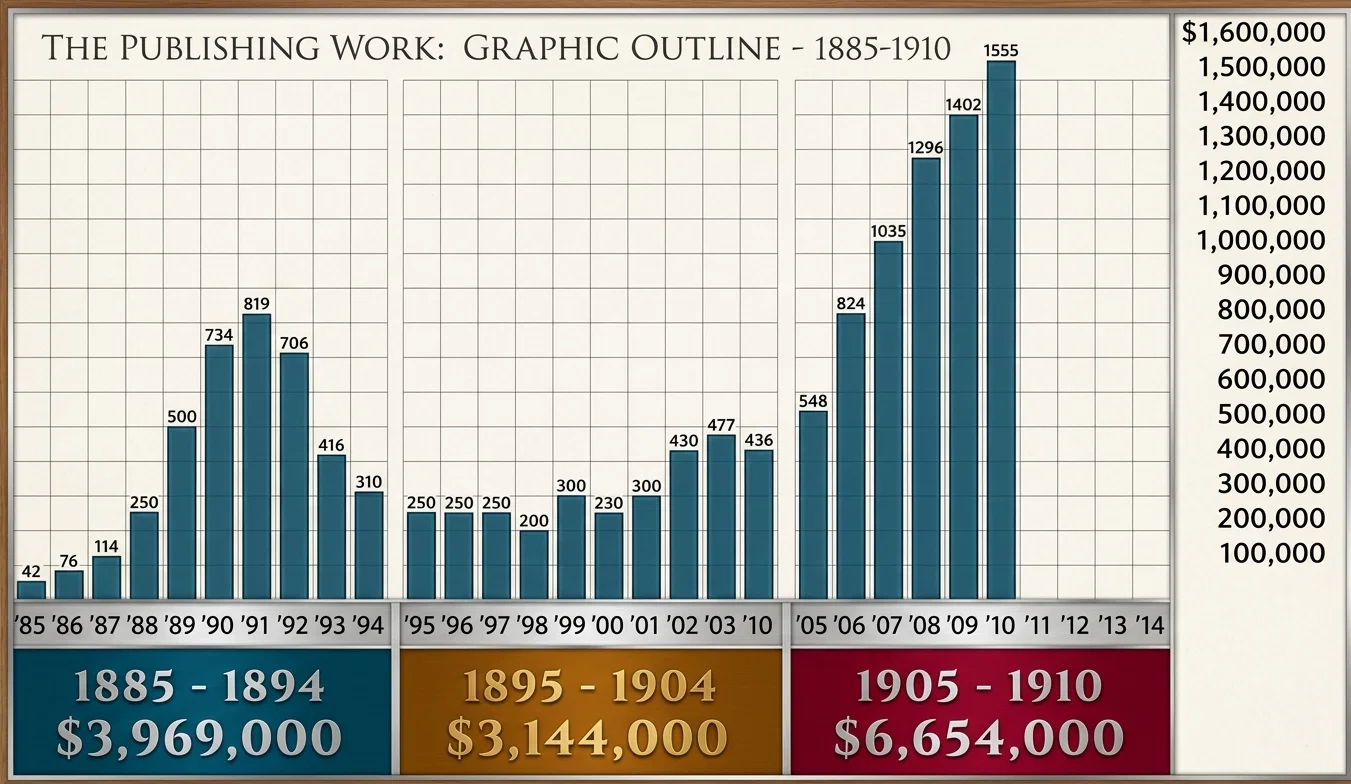
THE PUBLISHING WORK
GRAPHIC OUTLINE - - - 1885-1910
THE PUBLISHING WORK GRAPHIC OUTLINE - - - 1885-1910
We feel that this call for literature from the various nations of earth ought to be a signal to those who are giving the last warning message to the world to step in and meet the demand.
The call must necessarily include colporteurs and canvassers, that the literature may be placed in the hands of the people of these nations. Who will respond to the call? K. C. RUSSELL.
Continue reading: Streams of Light That Encircle the World