Your ShelfYour Projects

Signs of the Times, Vol. 36, No. 21.

Our Everlasting God
Earlier text: The Spirit World and a Future Life

Staying with the Stuff

It is a common expression with many who seek to be excused from doing active missionary work that they will “stay by the stuff.” They make themselves believe that the old rule made by David that those who remained behind to care for the property of the army should share equally with those who went to war: “As his part is that goeth to the battle, so shall his part be that tarrieth by the stuff: they shall part alike.”
Read the story of the events which called forth this just rule. It is in 1 Samuel 30. David and his men had gone to war with Achish, but the princes of the Philistines refused to allow David to fight with them, and demanded that the Hebrew fugitive warrior be sent to his home at Ziklag. On their arrival at that city, they found that an enemy had taken the city, burned it with fire, and carried all the women and children captive. At the word of the Lord the sorrowing soldiers pursued the fleeing enemy.
But the pace was too hard for all the men; two hundred of the six hundred were compelled to stop; “but David pursued, he and the four hundred men.” An abandoned servant of the fleeing spoilers guided the army to the spot where they were encamped, and David fell upon them, destroying practically all, and recovering all the captives and the spoil, which they carried back to their city. On their way they came to the two hundred who were too faint to follow David. Some of the company suggested that these be given their wives and children, but no more; but David severely rebuked them, saying, “Ye shall not do so, my brethren, with that which the Lord hath given us, who hath preserved us, and delivered the company that came against us into our land. For who will harken unto you in this matter? but as his part is that goeth down to the battle, so shall his part be that tarrieth by the stuff: they shall part [share, A.R.V.] alike.”
Note some particulars: Every one of the six hundred went to the limit of his strength, stopping only when exhausted.
Only one third remained behind, the larger number pressing on.
Those who remained claimed none of the spoil; there is no record that they so much as asked for any of it.
So it may be logically said that only those who have enlisted, who have worn out in the service, who have been compelled to remain “with the stuff,” may expect the victor’s reward. With man it is as it was with Saul when he was chosen to be king of Israel; instead of standing out before the people, ready to serve them, he was hiding among the stuff. It may have been modesty, but the result was the same. In the destruction of Jerusalem, when the time was ripe to escape, when the call came to get out of the city, the instruction was: “In that day, he which shall be upon the housetop, and his stuff in his house, let him not come down to take it away.” Doubtless there were those who clung to their possessions and were destroyed; and doubtless there will be those—thousands of them—in the last great day who will go down to eternal destruction because they clung to the things of earth when they should have been active in the work of the Lord—who staid with the stuff when they should have pressed on to the help of the Lord against the foe. It is a poor excuse, an inadequate hiding-place for many an unfaithful soldier. H.

The Worth of Religion

If our religion is worth aught to us it ought to make us better. A religion that will not make a dishonest man honest and keep an honest man in the right way, is unworthy of preservation either as a present asset or as a relic of the past. The quicker we let it go and get the genuine in its place the better. It ought to make us not only morally honest, but intellectually honest; a distinction which is oftentimes made, but which in most instances is a distinction without a difference; and yet sometimes prejudice and early teaching lead men to be intellectually dishonest, or, putting it in the mildest form, inconsistent, who are morally honest. There is need that the moral power and spiritual discernment be applied not only to the matter of morals pure and simple, but to the intellectual exercises of the mind as well. Truth demands not simply holy living, but consistent, logical thinking. It was not a meaningless expression, not an expression which applied only in part to the Father and the Son, when Jesus declared that “I and My Father are one.” The oneness included not only the moral phase of unity but the intellectual phase and every other aspect, and He prays that His children may be one even as He and the Father are one. More than this, the apostle pleads with them that they may all speak the same thing that they be perfectly joined together in the same mind and in the same judgment.

The Bible in Greece

(From Our Own Correspondent)
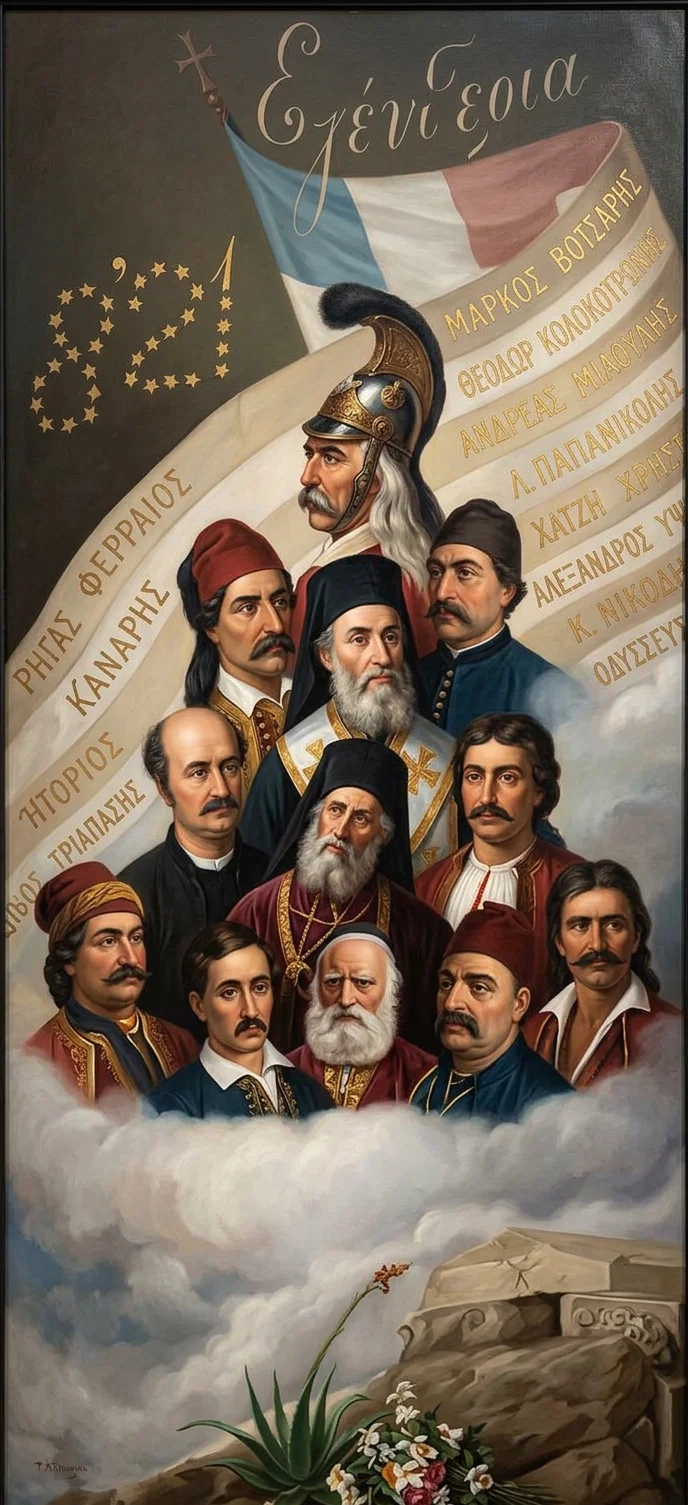
Heroes of the Revolution. At the top is General Kolokotrones. First below him, to the left, Marco Bozzaris. In the center, Patriarch Gregory V, murdered by janizaries.
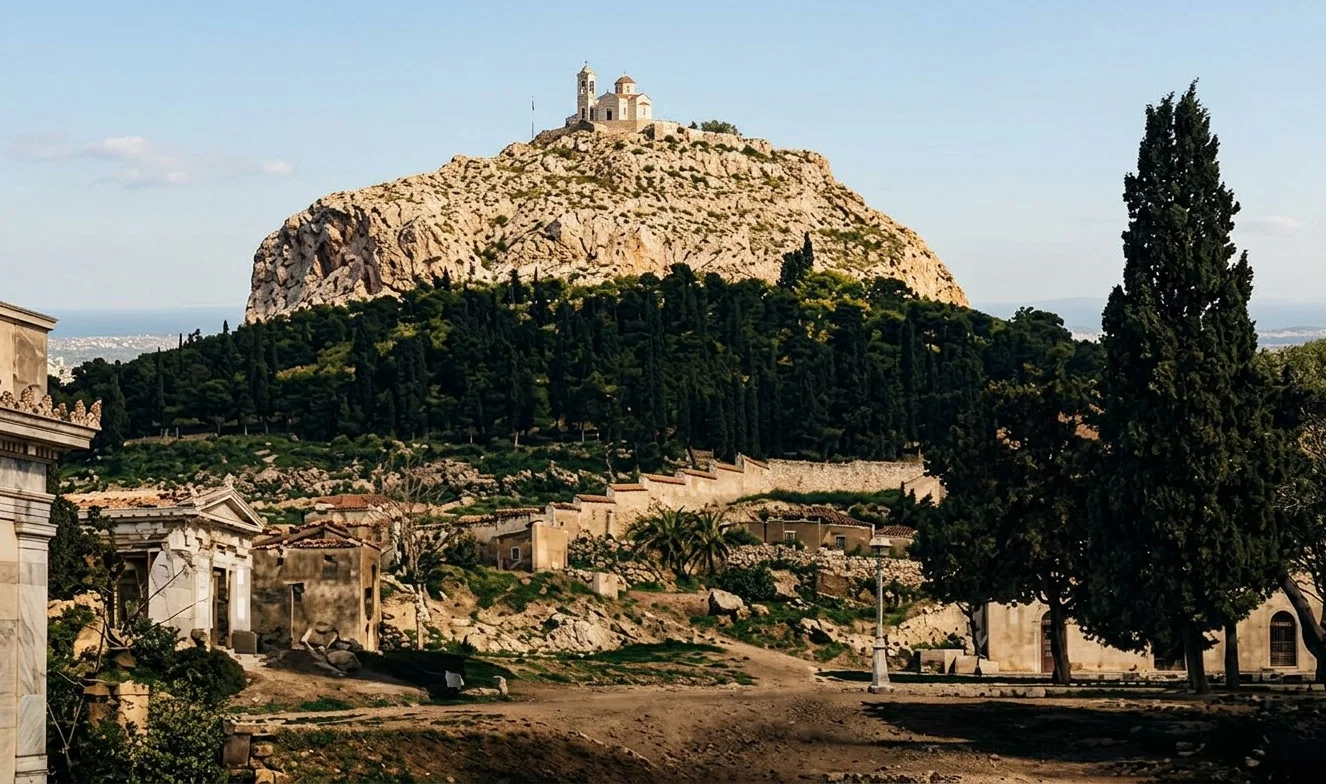
Mount Lycabettus, which overlooks Athens. On the summit is the chapel of St. George, built by Queen Olga.
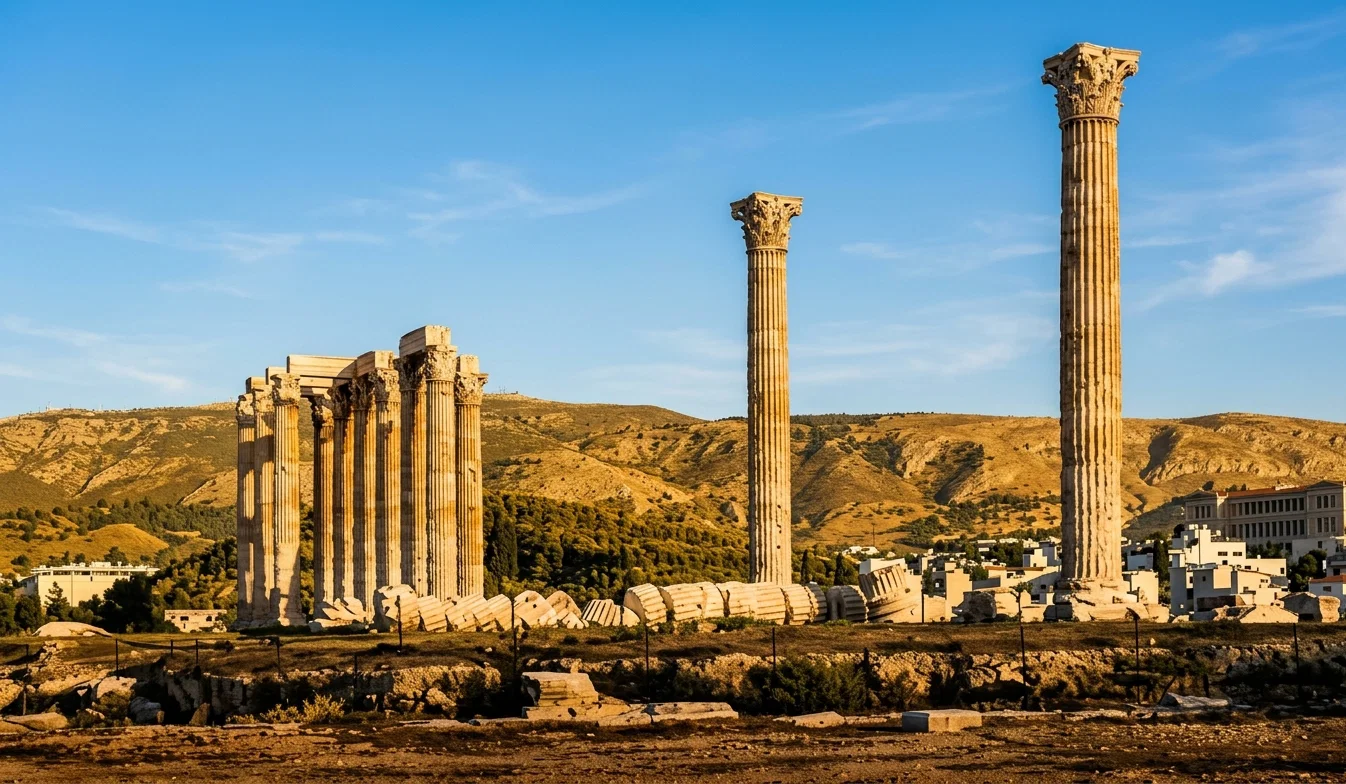
Temple of Zeus Olympus (Olympieion). Familiarly spoken of by the Greeks as “The Columns.” Here was held the great mass-meeting of the trades unions, students, and populace.

IV. The Episode of 1901

HAVING noticed in our preceding article some of the conditions existing in Greece that called forth strong opposition to the translation and distribution of the Scriptures in the common language, we are now prepared to follow and better understand the movements of the student demonstrators and the issues growing out of them.
The students did not leave the newspaper office to which they first went until assured that the printing of the translation would cease, the chief of police having so promised. They then went in a body to the Metropolitan to insist upon an immediate decision of the Synod on the protest sent in by the theological school. In his response the Metropolitan said:
“As to the question of the day, I find myself in the happy position to assure you that not only as president of the Holy Synod, but as an individual, I cherish the same sentiments that you do. I am sure also that the Holy Synod which has already taken up this question with care, will not consent to this innovation.”
“The church has had, has, and always will have, the Holy Scripture as she received it from the hands of the Evangelists, because as is known, the entire Scripture was written in Greek [sic!]. I promise to present your protest to the Holy Synod.”
The next day the students visited the offices of the “Acropolis” a second and third time, demanding the retraction of what had been said in the morning issue of that paper about the course of the students the day before, employing the same violent measure as on that first visit. As they passed through the streets they were cheered and commended by the crowd on the sidewalks and the trains, while women waved their handkerchiefs and applauded from the balconies. “Bravo, boys! They’ll never destroy our religion.” And the boys responded, “Long live our religion! Down with the translation!”
The Synod had written the Patriarch of Constantinople for advice on the question of translating the Gospel, and had received an answer recommending the prohibition of every translation of whatever nature. The students therefore procured a picture of the Patriarch and bore it on a standard in their procession to the office of the “Acropolis” and of the “City,” another paper that had commented favorably on the translation, whose sign was also destroyed and copies of the paper burned.

The Queen Suspected

On their first visit to the “Acropolis,” its proprietor had said to the students, “Why don’t you go to the palace and make your complaints? The queen was one of the first to begin the translating of the Gospel.” There had already been mingled with the shouts of the demonstrators the cry, “Down with the rubles! Down with the Slavs!” thus intimating that the queen, being a Russian, was seeking through her benevolent work of translating the Gospel, to profane the religion of the Greeks and to betray the nation into Russian hands. Now a deputation of students headed for the palace, shouting on the way, “Down with the rubles! Down with the deniers of the faith!” At the palace a committee of three presented a request to the king to stop the profaning of their religion and to prohibit rigidly every form of translation.

Theologian to the Rescue

In the afternoon the students were addressed by a professor of theology in the university, who said:
“From the time of Cyril arose the question of translating the Bible, but all the Synods and patriarchs condemned it. It is a weak and illogical argument that some of the patriarchs did not refuse permission to translate the Holy Scripture, because that happened only at a time when external pressure was great, and was done to ward off national calamity.”
What this “external pressure” was is told by a member of Parliament thus: “It is true that Gregorius V did grant such a permission, but it was given to the Protestants for fear of his being removed from the patriarchal throne. His act was not recorded in the official proceedings of the patriarchate and after the execution of that patriarch, the Holy Synod declared void a permission obtained by force for translating the Gospel.”
The theologian continued:
“Now the government and the Holy Synod and theological school have declared themselves against every form of translation. The students have taken the right course in a question of so great importance, not only from an ecclesiastical but a national point of view. If the necessary measures are not taken by the proper authorities for the settling of the question in harmony with the traditions of the church and the interests of the nation, then the university, and I myself, placing myself at the head of the students, will take steps to secure this end.”

Decision of the Holy Synod

The Synod handed down its decision the next day. It reads as follows:
“The Holy Synod of the Church of Greece, firmly adhering to the usages transmitted to it by the fathers, and of one accord from the beginning and forever with the yet uncontroverted opinion of the Orthodox Church, sleepless guardian also of the sacred traditions of the church—the second luminous and life-giving source of the Christian religion—the preservation of which has been entrusted to her by both ecclesiastical rulings and civil laws, “Rejects and disapproves and condemns as sacrilege, every change or alteration by translation into simpler Greek language, of the original text of the sacred Gospel, not only as superfluous, but also as a violation of the usages of the church, constituting an offense against the conscience, and a distortion of its [the Gospel’s] divine import and teaching.
“It is commanded you [bishops], and through you all the clergy, in the name of the Synod, to exhort continually your flock through paternal admonitions and persuasions, that no one at any time read any translation of the sacred Gospel whatever as forbidden and condemned by the church.
“Sufficient copies are sent herewith for distribution to the clergy under you and for reading in the churches.
“Done the 17th of October and given out the 7th of November, in the year of our Saviour, 1901, in Athens.
“Signed: Procopius, Bishop of Athens, Pres.; Methodius, Bishop of Syros, Tenos, and Andros; Arsenius, Bishop of Hydra and Spetsa; Neophytus, Bishop of Triphyllia and Olympia; Gregorius, Bishop of Paronaxia.
“By the First Secretary, “MELETIUS SAKELLAROPOULOS.”
This decision was telegraphed by the Department of the Interior to all the provinces, where there was already considerable agitation over events at the capital.
Apropos of this decision the “Onward” says in its leading editorial:
“The principal blame in this whole affair of the translation of the Gospel belongs to His Holiness the Metropolitan and to the government, for both could have put an end to the matter by a more timely intervention. But His Holiness the Metropolitan permitted the translation to incite and offend the people for two months and then presented us with a decision dated three weeks ago.
ROYAL PALACE IN ATHENS
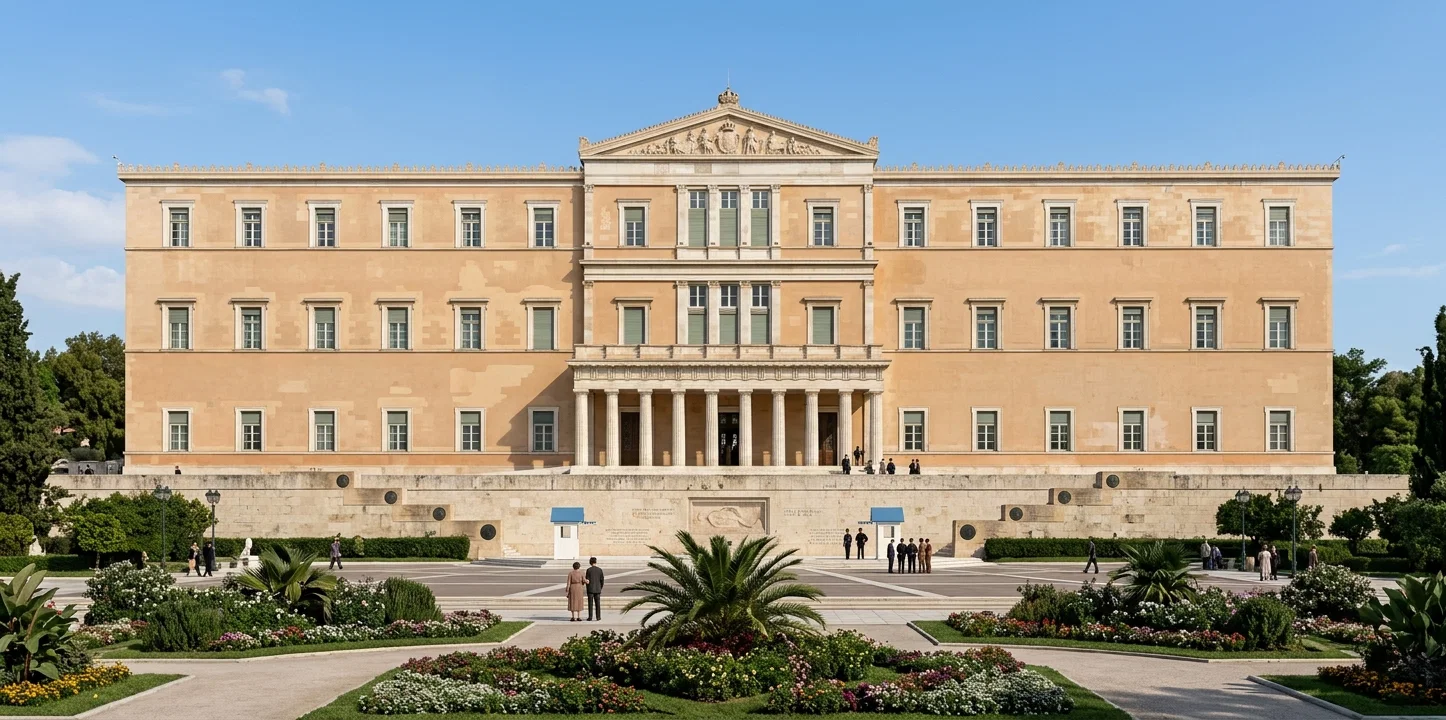
Erected 1834-38, of Pentelic marble and limestone. Its spacious gardens were laid out by Queen Amelia, first queen of Modern Greece. Visited by student demonstrators in 1901.
ROYAL PALACE IN ATHENS Erected 1834-38, of Pentelic marble and limestone. Its spacious gardens were laid out by Queen Amelia, first queen of Modern Greece. Visited by student demonstrators in 1901.
“But a supplement to the decision of the Synod is needed. All the translations that have been printed and are in circulation ought to be seized and destroyed. Then the affair would be closed. The nation would be indebted to the students of the university, who through their noble and drastic initiative, saved the church and the language from the greatest of dangers.

Not Anathema

“Some of those who are opposed to the translation, in their righteous indignation are urging that the translations already made be anathematized [a curse put upon them so that any one who reads them would suffer excommunication]. But we regard this extreme. One of the translations was published under the patronage of the queen. No Greek would believe that the queen is guilty of suspicious tendencies, and that it is allowable to include her and her work in so serious an ecclesiastical punishment.

But Excommunication

“Instead of anathematizing the translations already published, from which we shall be relieved by their seizure, the Holy Synod can excommunicate every one who dares in the future to attempt a translation of the Gospel.”
After the decision of the Synod was given out, the students took up the cry of excommunication. Joined by a large number of citizens they marched through the principal street of Athens on their way to make another demonstration before the Metropolitan, shouting, “Inadequate [the decision]! Inadequate! Excommunication! Excommunication! We want excommunication!” The Metropolitan promised to submit their demand to the Synod.

Trades Unions Act

On the same day at a session of the Federated Trades Union of Athens and Piraeus, it was unanimously voted to call a general mass-meeting the next day in the square of Zeus Olympus, (1) To give the people opportunity “to declare positively and formally their desire to have the sacred Gospel remain intact;” and (2) “to petition the Holy Synod of Greece to issue a decree of excommunication against those who have profaned it [by translation]. In case the Synod of Greece should not comply, to petition the Ecumenical Patriarch and the Holy Synod of Constantinople as the highest authority in the Orthodox Church, to issue the desired bull of excommunication.”
That night a large body of students armed themselves with revolvers and took possession of the university to prevent its being seized by the authorities and closed.

At the Mass-Meeting

Here are three brief extracts from speeches made:
“You must persevere in this holy controversy till the last moment. We are the sons of the heroes of 1821 [Greek War of Independence]. Our fathers won their freedom only through the Gospel and faithfulness to their religion. We must sustain their honor to-day.”
“Those who have taken advantage of the simplicity of the masses have translated and distributed many thousand copies of the Gospel. Now the Holy Synod must order these books to be seized and destroyed.”
“Unknown enemies, without swords and guns, are undermining the Christian religion. If they came against the Gospel, no one would fear them; but they come as its friends and protectors, and this is what we must fear the more.”
Here is the text of the resolutions passed:
“The students of the university and the tradesmen of Athens and Piraeus, having assembled today (Nov. 8, 1901) in general mass-meeting at the Columns of Zeus Olympus to consider the question of the profaning of the Gospel, and the inadequate decision handed down by the Holy Synod, after many addresses setting forth the leading features of the situation, unanimously adopted the following resolutions:
1. “That the original text of the sacred Gospel be preserved in the future intact and immaculate, as it was received by the divine [sic] fathers of the church.
2. “That we petition the government to grant permission to the Holy Synod of Greece to impose its regular excommunication upon those who have profaned our sacred Gospel, thus supplementing their incomplete decision of yesterday.
3. “That the same ecclesiastical authority seek through the proper court the seizure and destruction of every copy of the translation.”
Copies of these resolutions were sent to the king, the government, and the Metropolitan.
There remains to be told in our concluding article: Riot and Bloodshed, Resignation of the Metropolitan, Funeral of the Victims, Eulogy of the Martyrs, Anathema and Excommunication, Queen Olga Again, Rays of Hope.
W. E. HOWELL.

Boston World’s Tercentennial Exposition

The Boston “Herald” makes the early announcement that a world’s fair will be held in that city in 1920, the World’s Tercentennial Exposition, commemorating the 300th year of the landing of the Pilgrims.

Recanted

Recanted.— The Woman’s National Daily, in a despatch from Chicago, April 12, tells us that the “Rev. F. E. J. Lloyd, the Episcopal minister who embraced the Roman Catholic faith two years ago, has recanted and returned to the Episcopal Church. To-day he began a three years’ service as a ‘penitent layman’ in order to acquire the right to officiate as an ordained minister again.” During the time that he was a Catholic he delivered a series of lectures over the country on “Why I Became a Roman Catholic.” He ought to go over the same ground and tell the people how he made his mistake.

American Railroad Speed Records

It may be of interest to our young readers to know that the fastest railroad time ever made in the United States, was over the Philadelphia and Reading line in July, 1904. The four and eight-tenths miles from Egg Harbor to Brigantine Junction, N. J., was made in two and one half minutes. The average speed was one hundred and fifteen and two-tenths miles an hour. For a long distance record, the Burlington Road furnished the track, a record of ninety-eight and seven-tenths miles an hour over a stretch of fourteen and eight-tenths miles, made in May, 1902.

Truth Is Not Settled by Vote

The truth can not be settled by vote. Human majorities have never been on the side of the religious truth for the time. This is because the unconverted heart will not yield to truth’s claims. It is never wisdom, therefore, to put to vote before any audience the matter of Bible doctrine or teaching. It is a matter which rests entirely between the individual soul and his God. If men vote in truth’s favor, it is no more truth. If they vote against it, it is no less truth. The wise teacher of truth will, therefore, never compromise it by even seeming to submit it to a popular vote.

Labor Questions.—

At the convention of the anthracite coal miners, on the 28th ult., the agreement made by their representatives in conference with the mine owners was approved by unanimous vote, and on the 29th it was signed. The term of it is three years. It is identical with the agreement which expired on March 31, except that certain provisions have been added.—— The strike of employees in the carrying trade on the Great Lakes is now in force, and it involves about 30,000 men. The controversy began with the refusal of the marine engineers to sign contracts in which there was an open-shop clause.—— In Pittsburg, the threatened strike of the street-railroad employees has been averted. The demand for higher pay was withdrawn, and the company will make a more satisfactory arrangement of work hours.—— Carpenters, bricklayers, and painters in Montana are on strike for an increase of wages.— The Independent.

Kaffraria, South Africa

KAFFRARIA is located in the eastern portion of Cape Colony and lies south of Natal, bordering on the Indian Ocean. There is a colored population in Cape Colony of nearly 2,000,000, and about half of these are in Kaffraria. There are several tribes in this section, but all speak one language. The soil is fertile and generally well watered, hence it is a good country in which to grow grain and graze stock. Here, as elsewhere, the natives’ wealth consists largely in cattle, sheep, and goats. Many of them have horses, but these are rarely used for any other purpose than to ride.
I will confine my remarks to a consideration of the southern portion of Kaffirland where our mission is located. In this section corn, wheat, oats, barley, and vegetables are grown, also an abundance of apples, peaches, pears, plums, oranges, lemons, and pineapples. In fact, this is a healthful and fruitful section, and with a moderate amount of rain the country yields an abundance of cereals, fruits, and vegetables. There are but few of the natives, however, who have planted fruit-trees, altho they are very fond of fruit.
There are large sections of the country that have been reserved for the natives, and these are thickly populated. In fact they are so crowded that thousands of them seek homes among the white farmers and gladly pay a good rental for land upon which to grow their food and graze their stock. Large numbers of the men go to Johannesburg and Kimberley to work in the mines where they receive good wages. As a rule they remain but a short time, five or six months, and then return home and buy cattle with their money.
Lovedale Institute
Lovedale Institute
There are two tribes, the Amaxosa, or Kaffirs, and the Fingoes, for whom we have begun to labor. Among these tribes are two classes, commonly called “the school Kaffir” or the Christian native, and “the red Kaffir” or the heathen native; and these two classes are nearly equally divided in numbers. The “red Kaffirs” are so called because they paint their faces with clay which makes them look hideous, and wear red blankets. They are among the most degraded human beings it has ever been my lot to meet. Altho there are schools in abundance, very few have any interest to send their children to them. They live to eat, drink, and find pleasure. They are not allowed to work on Sunday, so they spend the day largely in drinking native-brewed beer and in dancing.
As before stated, schools are plentiful. The villages, which are usually but three or four miles apart, have one or more schools in them. These schools are under the supervision of the various churches, and are aided by the government. The children are taught from the beginning in both the English and the native languages, and their education is carried on in these schools till they complete the fourth standard, and then those who desire to do so enter the Lovedale Institute and there complete the seventh standard. This prepares young men and women to be teachers and to fill many other positions of usefulness. All the village schools are conducted by native teachers.
It is not uncommon to find three or four denominations in each village. Each of these has its own church, and often sectarian lines are quite sharply drawn. The Christian native has great respect for the Bible, and a “Thus saith the Lord” is usually the end of all controversy with him; for he accepts the Bible just as it reads. Unfortunately some translators have put some of their own ideas of the Scripture into their translations, rather than the text as it is.
The earliest missionaries who came into South Africa began their work in this section. Just prior to this time a prophet arose among the natives by the name of Ntsikana. His life and prophecies were written out, and we have been able to secure a copy. He prophesied that the white men would come into their country, and said, “This is a wise race; but be careful not to take all their wisdom. The main thing for you to receive from them is the word of God. Take care of the button that has no hole [money], it will mislead many.” And again, “to show that sin will have increased in the world,” he said, “Even a small child will smoke.” He prophesied that the railway train, “wagons with fire and smoke,” would pass through that country, and to-day the trains are running there. His last words were an exhortation in behalf of his children. “Do not allow my children,” said he, “to return to red clay and heathenism; take them to Gwali mission station. I am going home to my Father.” So saying he died. This was in the year 1821.
So far as I have been able to learn, all the natives have great respect for this prophet and believe his sayings to be the truth. We find them a great help when speaking on the signs of the times. When we present the theme of the coming of the Lord, they are deeply impressed. We have sold fully 3,000 pamphlets on the subject of the coming of the Lord in the native language, besides a large number in the English, which has caused many of these people to begin to think. Truly the Gospel of the establishment of the kingdom of Christ is being heard by all nations, and soon will “the end come.”
W. S. HYATT.

De Profundis

By Reginald Wright Kauffman
OUT of the deep! Out of the deep For them that wake and them that sleep; For them that sleep no more to wake, And them that wake with hearts that break; There, by the blue Sicilian sea, Out of the deep they call to Thee.
O God, so mighty is Thy blow That why they fall they may not know; So vast the Law Thyself hast writ That they may never measure it: Yet, tho Thou send this agony, Out of the deep they call to Thee.
With tongues that lie so still in death, With tortured mouths that scarce draw breath, In ruin dealt for no offense, In poverty and pestilence: When Thy love seems a mockery, Out of the deep they call to Thee.
And we — through all this world of Thine, Who blindly follow Thy design — Still in each terror-mastered soul, Tho strength be shattered, faith is whole; From land to land and sea to sea, Out of the deep we call to Thee.
Somehow, at last, the night shall fade, Sometime the riddle plain be made, Somewhere the broken lives of men Be gathered by Thy hand again: O Maker, not destroyer, we — Out of the deep we call to Thee.
— From The Circle Magazine for March.

Our Work and Workers

BROTHER CHAS. NELSON baptized six candidates at Vernal, Utah, April 18.
AT Butler, Okla., a new church was dedicated recently, and three were baptized.
EIGHT have just been added to the church at Montrose, Colo., six by letter and two by baptism.
EIGHT persons, five of them men, were baptized by Brother C. E. Leland at Placerville, Cal., recently.
AT Chiltons, Va., a neat little church building, valued at five hundred dollars, was dedicated on Sunday, April 18.
LABORS by Brother and Sister M. J. Allen at Niagara Falls, Ont., have had good results. Six are ready for baptism, and about a dozen are deeply interested.
IN connection with his own work, Brother B. L. Dieffenbacher, of Canon City, Colo., conducts regular Sunday evening meetings. Ten in all have accepted the truth as a result.
FOURTEEN at Leominster, Mass., decided to unite with those who keep all the commandments of God, Brother A. E. Sanderson states that many of these are entering upon their first experience in the Christian life.
BROTHER J. K. JONES, writing from Fall River, Mass., reports the baptism of six in the Taunton River, April 25, by Brother H. C. Hartwell. These accepted of present truth through the labors of Brother Jones.

Wanted for Missionary Work

MRS. BELLE McCABE, McLoud, Okla., wishes clean copies of the SIGNS and Watchman for missionary purposes.

The Missionary Idea

BY MRS. A. E. ELLIS
THIS little volume aims to be a suggestive help to every missionary worker whose heart has been touched with a sense of the world's need.
Part One is designed to stimulate a healthy interest in missionary work, both "Home" and "Foreign." Each of the 16 subjects is arranged in the form of a "Lesson" with carefully prepared questions.
Part Two consists of contributed, selected, and arranged matter which, besides its inspiring character, will suggest to the thoughtful reader ways in which missionary information may constantly be gathered and missionary sentiment encouraged.
Part Three gives an outline of the work done in mission fields since 1874, with a brief history of each mission, and outline map of the more important.
317 pages in two handsome bindings. Paper covers 50c. Cloth bound $1.00, post-paid

The Riots at Adana.—

There have been several outbreaks of fanaticism during the past week and the danger is not entirely over, but it is believed that there will be no more serious massacres. The reason why the riot was unchecked for many days was because the local authorities were uncertain of the outcome of the struggle in Constantinople and feared to take any decisive action, lest they should find themselves upon the wrong side. Accordingly they let Turks and Armenians fight it out among themselves. The few Turkish soldiers that were stationed to guard the mission buildings at Adana and Hadjin deserted, leaving the hundreds of girls in the mission schools unprotected. After the disorder had abated, many of the girls were sent down to Mersina to avoid the pestilence which followed the massacres. There were 1,400 sick and wounded in Adana. Smallpox and other epidemic diseases have broken out. Great numbers have perished from starvation. A large part of Adana has been burned, including the Jesuit and Armenian churches and schools. The American Mission building, the Catholic Sisters’ school and one Gregorian church have been saved. The bodies of the murdered Armenians are being gathered up in carts and dumped into the river. Rev. Mr. Gibbons, of Hartford, Conn., reports counting a dozen cartloads being carried to the river within half an hour on Saturday morning. Latakia is filled with refugees from the adjacent villages which have been destroyed by the Mohammedans. The number is estimated at 5,000, and the supply of food and medicine is altogether inadequate. The government at Constantinople is doing what it can to check the disorders in Asia Minor. The Governor-General of Adana, who was placed in power by Abdul Hamid, has been removed and a new governor-general sent to the province, with 3,000 reliable soldiers from Salonika. A military tribunal has been organized to court-martial the leaders in the massacre. Parliament has appropriated $100,000 for the relief of the sufferers in that region.—The Independent.
Continue reading: Story of Pitcairn Island