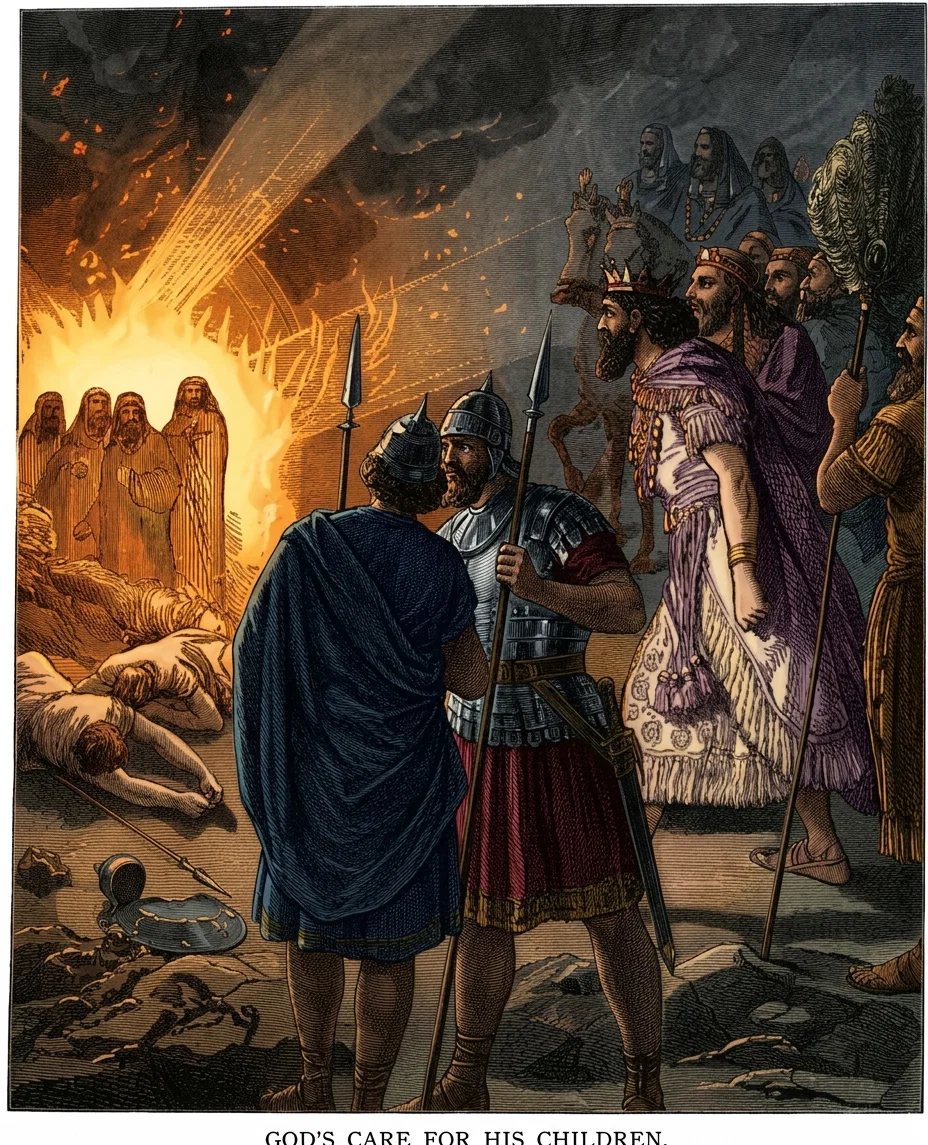
"NEBUCHADNEZZAR the king made an image of gold, whose height was threescore cubits, and the breadth thereof six cubits; he set it up in the plain of Dura, in the province of Babylon. Then Nebuchadnezzar, the king, sent to gather together the princes, the governors, and the captains, . . . unto the dedication of the image which Nebuchadnezzar the king had set up." "Then an herald cried aloud, To you it is commanded, O people, nations, and languages, that at what time ye hear the sound of the cornet, flute, harp, sackbut, psaltery, dulcimer, and all kinds of music, ye fall down and worship the golden image that Nebuchadnezzar the king hath set up."5
"At that time certain Chaldeans came near, and accused the Jews. They spake and said to the king Nebuchadnezzar, O king, live forever. . . . There are certain Jews whom thou hast set over the affairs of the province of Babylon, Shadrach, Meshach, and Abed-nego; these men, O king, have not regarded thee; they serve not thy gods, nor worship the golden image which thou hast set up."
These men who thus accused the Hebrews had been saved from death by Daniel's appeal to the king in their behalf, but they were envious of the three Hebrews, and were desirous of hurting their influence; they therefore carried the complaint to the king that these men had dared to disobey his commands.
The thought that his slightest wish should not be respected at the dedication of the image, filled the king with rage, and he commanded that the men be brought before him. "Is it true, O Shadrach, Meshach, and Abed-nego, do not ye serve my gods, nor worship the golden image which I have set up?" How short-lived is the exaltation bestowed by men! How little dependence can be placed in them! These three men, once honored, and intrusted with great responsibilities, are now the objects of the wrath of a king whose will is law. Truly we can not trust in princes.
As the three Hebrews stood before the king in their moral dignity, innocence, and purity, he was convinced that they were superior to the men in his kingdom. They had always been faithful in the performance of their duties, and he decided that he would be gracious, and give them a second trial. "If ye be ready," he said, "that at what time ye hear the sound of the cornet, flute, harp, sackbut, psaltery, and dulcimer, and all kinds of music, ye fall down and worship the image which I have made; well; but if ye worship not, ye shall be cast the same hour into the midst of a burning fiery furnace." And then, with hand stretched upward in defiance, he asked, "And who is that God that shall deliver you out of my hands?"
His senses were perverted by the prospect of his own greatness, and he seemed to lose all knowledge of a monarch above all earthly kings. When his dream was shown him by Daniel, he had acknowledged, "Of a truth it is, that your God is a God of gods, and a Lord of kings;" but he now took all this back, and sought to demonstrate before the representatives of the different nations, who had assembled at the dedication of this image, that he, the king of Babylon, was the greatest king in the universe, and that all must bow low to his supremacy, and submit as slaves to his will. And all went well in the carrying out of this arrangement till the disobedience of the Hebrew captives.
With the furnace in sight, the captives answered the king's horrible threat, saying: "O Nebuchadnezzar, we are not careful to answer thee in this matter. If it be so, our God whom we serve is able to deliver us from the burning fiery furnace, and he will deliver us out of thine hand, O king." Their faith rose with the knowledge that God would be glorified in this transaction, and with a firm, triumphant ring of implicit trust and confidence in their voices, they said, "But if not, be it known unto thee, O king, that we will not serve thy gods, nor worship the golden image which thou hast set up."
When the king saw that his will was not received as the will of God, he was "full of fury," and the form of his visage was changed against these men. Satanic attributes made his countenance appear as the countenance of a demon; and with all the force he could command, he ordered that the furnace be heated seven times hotter than its wont, and commanded the most mighty men to bind the youth, and cast them into the furnace. He felt that it required more than ordinary power to deal with these noble men. His mind was strongly impressed that something unusual would interpose in their behalf, and his strongest men were ordered to deal with them.
The king's command was urgent. He was anxious to punish the men who had dared to exercise their will in opposition to his will; and without delay, with all their clothing upon them, they were cast into the fire. "Therefore because the king's commandment was urgent, and the furnace exceeding hot, the flame of the fire slew those men that took up Shadrach, Meshach, and Abed-nego."
Surrounded by the officers of his government, by the Chaldeans, and by distinguished and great men from many countries, the king, filled with Satanic fury, looked on the scene, waiting to see how soon the men who had defied him would be utterly consumed. But his triumph suddenly came to an end. He saw something that he thought must be an illusion. He turned pale, and, shading his eyes with his hand, he directed his gaze to the furnace, watching it with intense interest. All did not discern as quickly as did the king the result of his cruel project. With alarm he asked his great men, "Did not we cast three men bound into the midst of the fire?" "True, O king," was the reply. With a voice trembling with excitement, he cried, "Lo, I see four men loose, walking in the midst of the fire, and they have no hurt; and the form of the fourth is like the Son of God."
How did this heathen king know what the Son of God was like? Through their steadfast adherence to right principles, the Hebrew captives had been called to fill positions of trust in the courts of Babylon. They were tempted by others to be untrue, in order to gain advantages; but they were faithful in all their business transactions. In life and character they represented the truth; and when they were asked a reason for their course of action, they gave it without hesitation. Plainly and in simplicity they presented the living principles of the truth, and thus those around them were made acquainted with the Source of their strength. In this way the king of Babylon became acquainted with the form of the Son of God.
With feelings of deep humiliation and remorse, the king stood as near the blazing furnace as he dared, and in a clear, loud voice called out, "Ye servants of the most high God, come forth, and come hither." They obeyed the voice of the king, and came forth unhurt, without even the smell of fire upon them.
The fact that these youth came forth from the fire having received no harm, save only that their fetters had been burned away, was beyond the comprehension of the wise men, and made a decided change in the sentiments of the people. The tidings of this wonderful deliverance were carried to many countries by the representatives of the different nations. Thus God was glorified by the faithfulness of his children.
History will be repeated. False religion will be exalted. The first day of the week, a common working day, possessing no sanctity whatever, will be set up as was the image at Babylon. All nations and tongues and peoples will be commanded to worship this spurious sabbath. This is Satan's plan to make of no account the day instituted by God, and given to the world as a memorial of creation.
The decree enforcing the worship of this day is to go forth to all the world. In a limited degree, it has already gone forth. In several places the civil power is speaking with the voice of a dragon, just as the heathen king spoke to the Hebrew captives.
Trial and persecution will come to all who, in obedience to the Word of God, refuse to worship this false sabbath. Force is the last resort of every false religion. At first it tries attraction, as the king of Babylon tried the power of music and outward show. If these attractions, invented by men inspired by Satan, failed to make men worship the image, the hungry flames of the furnace were ready to consume them. So it will be now. The Papacy has exercised her power to compel men to obey her, and she will continue to do so. We need the same spirit that was manifested by God's servants in the conflict with paganism. Giving an account of the treatment of the Christians by the emperor of Rome, Tertullian says, "We are thrown to the wild beasts to make us recant; we are burned in the flames; we are condemned to prisons and to mines; we are banished to islands,—such as Patmos,—and all have failed." So it was in the case of the three Hebrew worthies; their eye was single to the glory of God; their souls were steadfast; the power of the truth held them firmly to their allegiance to God. It is in the power of God alone that we shall be enabled to be loyal to him.
"If ye love me," said Christ, "keep my commandments." "He that hath my commandments, and keepeth them, he it is that loveth me; and he that loveth me shall be loved of my Father, and I will love him, and will manifest myself to him." And has not Christ manifested himself to his faithful children? Did he not walk in the furnace with the captives who refused to yield to the golden image one tittle of the reverence which belonged to God. Did he not manifest himself to John, banished to the Isle of Patmos for his faithfulness? Have not those who have been persecuted for righteousness' sake, who, tho they have been compelled to suffer, have refused to worship the institution of the Papacy, realized the presence of the divine Comforter in their lonely prisons?6
The commandments of finite, sinful men are to sink into insignificance beside the Word of the eternal God. Truth is to be obeyed at any cost, even tho gaping prisons, chain-gangs, and banishment stare us in the face. If you are loyal and true, that God who walked with the three Hebrew children in the fiery furnace, who protected Daniel in the lions' den, who manifested himself to John on the lonely island, will go with you wherever you go. His abiding presence will comfort and sustain you; and you will realize the fulfilment of the promise, "If a man love me, he will keep my words; and my Father will love him, and we will come unto him, and make our abode with him."
MRS. E. G. WHITE.
COMMUNION WITH GOD.
By Mrs. Nancy W. Gath
O SOLITUDE, where are thy charms?
Or hast thou none?
They who such hasty thought express
I envy not their happiness,
Nor their possessions—though from shore to shore
They reach—nor hoarded coffers running o'er,
O solitude!
Youth oft too little prize the blest retreat,
And think to find
Within the social band their joys complete.
Mistaken youth! Such kind
Are transient only; and the more we crave,
The sooner learn their real goal, the grave.
Look not to mortal as a guide supreme
To human joy,
Nor dare of earthly happiness to dream
Without alloy.
'Tis ours to tread the path our Master trod,
And find communion sweet and peace with God.
MRS. NANCY W. GATH.
THE HOLY SPIRIT AND ITS WORK.
By H. F. Phelps
EVIDENTLY there was a time in the eternity of the past when there were no worlds, no heavens or earth. But the eternal One, knowing his power to create and fill the sea of space with countless millions of worlds, and fill them with intelligences,—"sons of God," "sons and daughters of the Almighty,"—these, made eternally happy in the fulness of his own love and power, set about the accomplishment of that "eternal purpose." Eph. 3:11. And so we read: "In the beginning God created the heaven and the earth." Gen. 1:1. "By the word of the Lord were the heavens made; and all the host of them by the breath of his mouth." "For he spake, and it was; he commanded, and it stood fast." Ps. 33:6, 9. The Creator breathed the word, and the universe was filled with worlds. He gave the command, and there they stood. And to this day, and ever forward to all eternity yet to come, he sits "upholding all things by the word of his power." Heb. 1:3. What infinite power! Power divine! And shall finite mortals fear to trust in that power for salvation?
The Primitive Condition of the World.
The primitive physical condition of all the worlds may be known by that of this world, for it is by those things that we see that we may know of the things that we do not see. "For the invisible things of Him, even His eternal power and Godhead, are clearly seen in creation, being understood by the things that are made." Rom. 1:20, transposed. "And the earth was waste and void." Gen. 1:2, R. V. That is, the earth was empty of any living thing, either animal or vegetable. There could not be life, because life can not exist in the darkness. And as physical life is an utter impossibility without physical light, so spiritual life is an impossibility without Christ and his word. Apart from that word which brought all things into existence there can be no spiritual life, for "the words that I speak unto you, they are spirit, and they are life." John 6:63. But the time came in the carrying out of this eternal purpose that God would beautify this world for the abode of one of his sons; for Adam "was the son of God" (Luke 3:38); and the
Holy Spirit Was the Agency.
Thus we read: "And the Spirit of God was brooding upon the face of the deep." Gen. 1:1, R. V. The Holy Spirit was brooding upon the world that it might be prepared for its great and final future. And as the earth was passive under that divine influence of the Holy Spirit, so we too, if we would be fitted for our great, possible, and final future, must remain passive under the brooding influence of the Spirit of God. And at the last we shall be reckoned in the great family of God, among the sons and daughters of the Almighty. Eph. 3:15.
The Spirit of God Made Man.
Man did not come by evolution, springing up from the lower order of animals; but he was created as one of the sons of God, in God's own image. After the world was beautified, after the God-breathed word brought light, abounding vegetation, and all the lower order of animals, then it was that the Holy Spirit in its brooding created man as the crowning work of the Master Artist. "The Spirit of God hath made me, and the breath of the Almighty hath given me life." Job 33:4. And it is ever through the power of that same word in continued action that all the descendants of Adam have received life—but that life now has become mere animal life because of sin; but through the same brooding influence of the Holy Spirit we may be recreated and made again the sons of God. And so it is of a truth that, as Paul says by quoting one of the Athenian poets, "For we are also his offspring." And so being the offspring of God, he is "not far from every one of us; for in him we live, and move, and have our being." Acts 17:27, 28. Thus grand and noble is the ancestry of man. It is all "in him."
Man Was Upright, or Perfect.
Not like the full ripe corn in the ear was man in the beginning, but as the blade when it bursts the clod of the valley. Of course, being the offspring of God through the agency of the Holy Spirit of God, man could not, in the very nature of the case, be anything less than "upright," in the "image" of God. Eccl. 7:29; Gen. 1:26, 27. He was indeed created as one of the sons of God. As stated by a recent writer, "His [man's] nature was in harmony with the will of God. . . . His affections were pure; his appetites and passions were under the control of reason. He was holy and happy in bearing the image of God, and in perfect obedience to his will."—Patriarchs and Prophets, p. 45. And that same Holy Spirit which made man with appetites and passions, all under the control of reason, is still brooding over the fallen sons of God, that these same appetites and passions may be brought again under the control of reason, and man again be found in the image of the Creator.
In the Very Beginning.
It was therefore in the very beginning of the history of the race that the Spirit of God began its office work in this world. It was in the beginning that God sent forth the "Spirit of his Son into our hearts,"—the hearts of men,—that we might cry, Abba, Father. Gal. 4:6. For of a truth he is "our Father," the God and Father of all men by creation, and the Father of the believer through recreation. God chose "us in Him [Christ] before the foundation of the world." Eph. 1:4. The Creator put his own impress upon, and his own Spirit within, the heart of man at creation, that he might grow up into the perfect image of God, in character as well as in form. And thus it is of a truth that the light of Jesus Christ "lighteth every man that cometh into the world." John 1:9. And thus do we see that it is one of the most reasonable things in the world, in the very nature of the case, that the Holy Spirit should continue to brood over every soul of man to draw him to God.
The Perfect Image of God.
Therefore at the creation God left nothing undone for the perfect happiness of the race. And it was by the brooding influence of the Spirit that man was created and was to be brought up into the perfect image of the Creator, as well as in physical form. And though sin entered, and to some extent defaced the image of God in man, placing man where his appetites and passions control him, that same Spirit is still brooding over man, brooding over the race, wooing him to his Maker. And the perfect image of God in character will yet be restored unto all who will submit to the moulding influence of that same Spirit of God. Reader, will you submit to-day? Mercy still lingers for you. Yield now, before it is too late.
H. F. PHELPS.
A NOBLE DOCUMENT.
By Editor
A RECENT number of the Nashville American contains the complaint of an intelligent gentleman, who recently visited Washington, over the tautological and ambiguous way in which modern legislative measures are framed; and presented in contrast a bill introduced in the Virginia Legislature by Jefferson in 1878, and now forming a part of the statutes of Virginia. This will be found in "Rights of the People," pages 90-93, but we reproduce it for the noble sentiments it contains:—
An Act for Establishing Religious Freedom.
Well aware that Almighty God hath created the mind free; that all attempts to influence it by temporal punishments or burdens, or by civil incapacitations, tend only to beget habits of hypocrisy and meanness, and are a departure from the plan of the holy Author of our religion, who being Lord of both body and mind, yet chose not to propagate it by coercions on either, as was in his almighty power to do; that the impious presumption of legislators and rulers, civil as well as ecclesiastical, who being themselves but fallible and uninspired men, have assumed dominion over the faith of others, setting up their own opinions and modes of thinking as the only true and infallible, and as such endeavoring to impose them on others, hath established and maintained false religions over the greatest part of the world, and through all time; that to compel a man to furnish contributions of money for the propagation of opinions which he disbelieves, is sinful and tyrannical; that even the forcing him to support this or that teacher of his own religious persuasion, is depriving him of the comfortable liberty of giving his contributions to the particular pastor whose morals he would make his pattern, and whose powers he feels most persuasive to righteousness, and is withdrawing from the ministry those temporal rewards, which proceeding from an approbation of their personal conduct, are an additional incitement to earnest and unremitting labors for the instruction of mankind; that our civil rights have no dependence on our religious opinions, more than our opinions in physics or geometry; that, therefore, the proscribing any citizen as unworthy the public confidence by laying upon him an incapacity of being called to the offices of trust and emolument, unless he profess or renounce this or that religious opinion, is depriving him injuriously of those privileges and advantages to which, in common with his fellow-citizens, he has a natural right; that it tends also to corrupt the principles of that very religion it is meant to encourage, by bribing, with a monopoly of worldly honors and emoluments, those who will externally profess and conform to it; that tho indeed these are criminal who do not withstand such temptation, yet neither are those innocent who lay the bait in their way; that to suffer the civil magistrate to intrude his powers into the field of opinion and to restrain the profession or propagation of principles, on the supposition of their ill-tendency, is a dangerous fallacy, which at once destroys all religious liberty, because he being of course judge of that tendency will make his opinions the rule of judgment, and approve or condemn the sentiments of others only as they square with or differ from his own; that it is time enough for the rightful purposes of civil government for its officers to interfere when principles break out into overt acts against peace and good order; and, finally, that truth is great and will prevail if left to herself; that she is the proper and sufficient antagonist to error, and has nothing to fear from the conflict unless by human interposition disarmed of her natural weapons—free argument and debate; errors ceasing to be ignorance when it is permitted freely to contradict them.7
Be it therefore enacted by the General Assembly, that no man shall be compelled to frequent, worship, or support any religious worship, place, or ministry whatsoever, nor shall be enforced, restrained, or molested, or burthened in any way in his body or goods, nor shall otherwise suffer, on account of his religious opinions or belief; but that all men shall be free to profess, and by argument to maintain, their opinions in matters of religion, and that the same shall in nowise diminish, enlarge, or affect their civil capacities.
And tho we know well that this assembly, elected by the people for ordinary purposes of legislation only, have no power to restrain the acts of succeeding assemblies, constituted with the power equal to our own, and that therefore to declare this act irrevocable would be of no effect in law; yet we are free to declare that the rights hereby asserted are the natural rights of mankind, and that if any act shall be hereafter passed to repeal the present or to narrow its operation, such act will be an infringement of natural right.
JEWISH CUSTOMS AND TRADITIONS.
By F. C. Gilbert
(By an Israelite.)
The Sanctuary and Its Services.—Continued.
The Table and the Showbread.
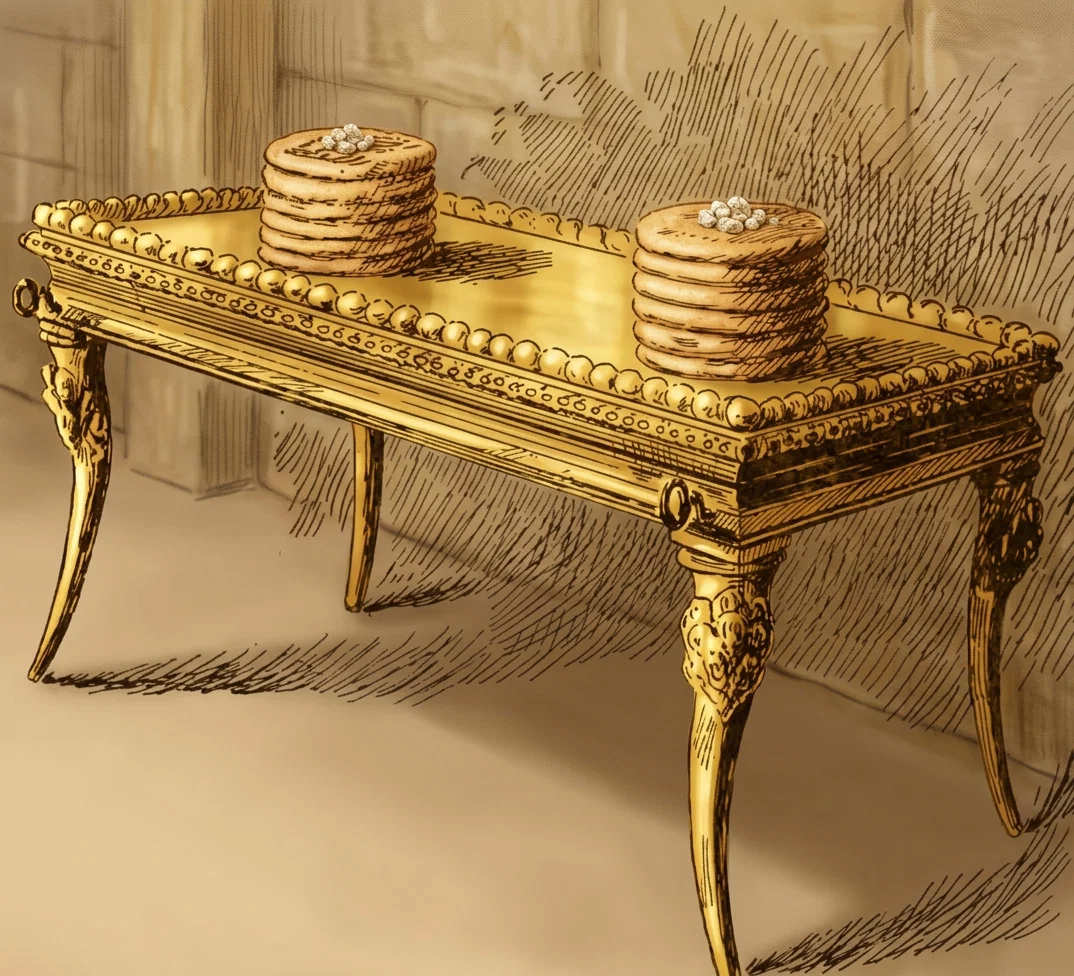
THE third and last article of furniture in the holy place which has not been mentioned is the table of showbread. The word showbread is literally "bread of the presence." This is the meaning of the Hebrew Lechem-Haponim. The reason for this meaning will be noticed later.
The directions for making the table, with all its furnishings, are found in Ex. 25:23-29; and the use of the table was to have bread thereon always before the Lord. Verse 30. When it was finished and ready to be set in its place, the Lord directed Moses to place it on the north side of the tabernacle, opposite the golden candlestick.
Even the making of the bread was not left for man to direct; but, as in all other things connected with the sanctuary, the Lord himself gave orders how it should be made, and who should bake it:—
"And thou shalt take fine flour, and bake twelve cakes thereof; two tenth deals shall be in one cake. And thou shalt set them in two rows, six on a row, upon the pure table before the Lord. And thou shalt put pure frankincense upon each row, that it may be on the bread for a memorial, even an offering made by fire unto the Lord. Every Sabbath he shall set it in order before the Lord continually, being taken from the children of Israel by an everlasting covenant. And it shall be Aaron's and his sons'; and they shall eat it in the holy place; for it is most holy unto him of the offerings of the Lord made by fire by a perpetual statute." Lev. 24:5-9.
"And other of their brethren, of the sons of the Kohathites, were over the showbread, to prepare it every Sabbath." 1 Chron. 9:32.
Thus we learn that it was the Levites who made the bread, and the priests received it from them, and took care of it in the sanctuary. The bread was renewed every Sabbath day; the old was to be given to the priests to eat. And, too, it was to be eaten in the holy place, and none but the priests were allowed to eat it.
As has been noticed in preceding articles, the Lord gave particular instruction that everything that was made in connection with the sanctuary was to be done after the pattern showed Moses in the mount. From this it is evident that God had the original sanctuary in heaven, the pattern of which he showed Moses. This is plainly stated in Hebrews 9. We learn elsewhere that John saw the golden candlestick, and also the golden altar in heaven, at which the angels of God were ministering with the golden censer. Rev. 1:12, 13, 20; 4:5; 8:3. But nowhere is it recorded that any one saw the table of showbread in heaven, with the food thereon. The reason for this is obvious. Since these things on the earth were but a shadow of the things in heaven, and heaven contained the real substance of these object lessons, it was not necessary to have a table there with bread thereon. Christ himself is "the bread of God, which came down from heaven," and upon whom the world feeds. It is Christ who is the bread of life, and who only can satisfy the hungry soul.
The showbread was meant to represent Christ. And this is why it is called the "bread of the presence," for Christ, who is the bread of life, is always in the presence of God, ever prepared and ready to feed all who come unto him. "Then Jesus said unto them, Verily, verily, I say unto you, Moses gave you not that bread from heaven; but my Father giveth you the true bread from heaven. For the bread of God is he which cometh down from heaven, and giveth life unto the world. Then said they unto him, Lord, evermore give us this bread. And Jesus said unto them, I am the bread of life; he that cometh to me shall never hunger." "I am that bread of life. . . . This is the bread which cometh down from heaven, that a man may eat thereof, and not die. I am the living bread which came down from heaven; if any man eat of this bread, he shall live forever; and the bread that I will give is my flesh, which I will give for the life of the world." John 6:32-35; 48-51.
He has ever been giving his life for the world, that whosoever would come and feed upon him might have that everlasting life. While the priests on those days ate of the holy bread, the food the Lord gave the people daily for forty years was to teach them their utter dependence upon God, and that God was the bread of their salvation; for we read that they did all eat that same spiritual meat, and all drank that same spiritual drink; for they drank of that rock that followed them, and that rock was Christ. 1 Cor. 10:3, 4.
What a blessed truth to know that to-day we are all priests of God and of Christ, and can daily eat of the heavenly manna with which he is feeding his people! He, the "bread of the presence," can still be in the presence of God interceding in behalf of his people, yet feeding them with his own life. And after enjoying the bread of God during the six days, the table is supplied anew every Sabbath day, that we may, as it were, eat the bread direct from the table, as we can appreciate it more on that day by feeding upon him constantly. So that we can truly say we receive a double portion of the bread on the Sabbath. What blessings there are in Him! How he does truly feed his people with the bread from heaven!
The priests had nothing to do with the preparation of the food. It was brought to them all baked and prepared; they were simply to place it upon the table, and with the dishes thereon to partake of the food when the time came. So it is with the Christian. Christ is the bread; he has prepared it for us; he has given us the means with which we can eat this bread, and all we have to do is to receive and partake of it,—appropriating it to our own lives, and receiving nourishment therefrom.
The bread which the priests ate was unleavened bread, made of the finest flour possible. There was no leaven of any kind found in the life of Christ. It was a pure life, not diluted or adulterated with the corruptions of this world. Hence when we eat of the food which came down from heaven, we receive the food of truth and sincerity, which will enable us to grow into men and women of God. And as Christ gave his life for the world, that all may feed on him, so we, as Christians, should give our lives to the world, that the hungry souls who are seeking for the heavenly manna may see that we have been fed from God's bountiful table, and are willing, if necessary, to give our lives that others may be fed also; for "as he is, so are we in this world." Then the world will see that there is much more in the Sabbath than merely a day in the week different from what others keep. They will learn that it is the day in which God feeds his people with more of the heavenly manna than is received upon any other day, and many hearts will turn to this precious truth of God, and also will eat more of his flesh and drink more of his life, which is the bread he came down from heaven to give.
Dear readers, do we realize what it is to be a Christian? Do we realize what Jesus Christ has done for us by giving his life to the world? May God help us to feed more upon him each day, view him more as he is in all his glory and loveliness, that the longing which thousands of hearts have to-day to know the truth may be satisfied, to taste and see how good the dear Lord is. Ps. 34:8.
"Bread of our souls, whereon we feed,
True manna from on high,
Our guide and chart, wherein we read
Of realms beyond the sky."
"Bread of heaven,
Feed me till I want no more."
F. C. GILBERT.
South Lancaster, Mass.
The Prison Editor
By Editor
THE following is among the latest deceptions to please particular customers. We are told that a prominent dry goods house in New York keeps a man whose principal duty is to be discharged to appease irate females who make complaints to the manager. It is stated that at times this man is discharged from the employ of the firm as many as ten times a day. This is equivalent to the "prison editor" of Japanese papers. For infraction of the publication laws somebody must go to jail, and so the prison editor's chief duty is to expiate the newspaper's offense by languishing in a cell.
Tell Hopeful Things
By Dwight Lyman Moody
Don't be cast down. If you know any hopeful thing, go and tell it to everybody you know. If you know anything discouraging, go and tell it to the Lord.—Moody.
Christ's Spirit Is the True Spirit
By Heubner
CHRIST'S Spirit is the true Spirit; men out of him are spiritless, however "full of the spirit" such unchristian people may fancy themselves.
No Work for God Is Small
By Dwight L. Moody
Don't ever call anything you do for God small. A work for God may seem small, but if he's there you can't tell what may come of it.—Moody.
Permission Before Lending Borrowed Articles
NEVER lend an article you have borrowed, unless you have permission to do so.
The Second Advent
By Editor
No. 552. The Second Advent.
(1) Does the second advent take place before the plagues come upon the wicked, and after the tribulation of the saints at the hands of the beast? Are the saints caught up between the tribulation and the plague? If they are not then caught up, whence come the men in heaven not able to enter the temple on account of God's glory? Rev. 15:8. (2) Do the saints sit in judgment on the earth or in the air? Rev. 20:4. If not upon earth, when do they return to set up the everlasting kingdom? Over whom do they reign during the thousand years? Rev. 20:5, 6. If in the air, why? since the earth will be freed from the wicked if the plagues come before the wicked are caught up. C. E. C.
(1) The second advent of Christ takes place after the plagues are poured out upon the wicked; for those whom the plagues do not destroy are destroyed at his presence, when he appears. See Rev. 16:17 and 19:21. His coming is yet future under the sixth plague. See Rev. 16:15. The tribulation of the saints under the persecuting power of the beast extended from A.D. 538 to 1798. See Dan. 7:25 and parallel scriptures. The saints are therefore caught up after both the tribulation and plagues. Rev. 15:8 in the original does not say “no man,” but “none,” or “no one.” See Revised Version. Yet there are men in heaven. When Christ ascended he led “a multitude of captives” (Eph. 4:8, margin), who were raised at his resurrection (Matt. 27:52, 53). These assist him in his heavenly work. Rev. 4:4.
(2) The saints sit in judgment in heaven in the holy city, with Christ. Compare John 14:1-3; Rev. 20:4; 14:1-5; 19:1. The everlasting kingdom begins in the holy city above, the capital of the new earth, which will come down upon the earth at the close of the thousand years. Revelation 20 and 21. The saints reign in judgment with Christ over the wicked, a judgment which will be executed at the close of the thousand years. The last question has been answered in the foregoing. For further information see Bible Students’ Library, No. 55 (“The Judgment, Its Events, and Their Order”) and No. 65 (“The Great Day of the Lord”); prices, respectively 15 and 5 cents.