The Youth’s Instructor, Vol. XLIX, No. 44

HIS CHOOSING

The Youth’s Instructor

November 7, 1901

Review and Herald Publishing Company · Battle Creek, Mich. · November 7, 1901

HIS CHOOSING

If He had let me take the pleasant way Whereto my steps were bent, The path where birds sing in the boughs all day, Shaded and well content,
I had not found, beyond the leagues of sand, Toil-worn, the mountain-crest From which mine eyes look over to that land Wherein shall be my rest.
If he had let me slumber as I craved, Pillowed in grasses deep Beside the stream whose murmuring waters lave The silver coasts of sleep.
I had not heard his footsteps drawing nigh Across the lonely place; Unknown, unloved, they would have passed me by, Nor I have seen his face. — Mabel Earle.

PICTURESQUE BRAZIL

The physical features of Brazil are indeed of exceeding beauty. Its surface, diversified with mountains, hills, and plains, interspersed with noble rivers, and in some places with lovely lakes, is everywhere covered with a verdure luxurious and beautiful. The greater part of the country consists of high table-lands of an elevation of from one thousand to three thousand feet, limited, to the north and west, by the great continental depressions of the Amazon and Paraguay lowlands, especially those of the Amazon, can be judged from the fact that fifteen hundred miles back from the ocean, an altitude of only two hundred and fifty feet is reached.
Although the table-land of Brazil is often spoken of as being mountainous, it is said by the best authorities to be largely composed of plains, interspersed with valleys and numerous rivers. The real mountains, lying in the eastern and central portions of Brazil, may be regarded as two distinct chains. The eastern, or maritime, chain, extending from the southern extremity to almost the meridional limits of the country, is comparatively narrow, and is separated from the central chain by the plateaus of the San Francisco and the Parana basin. Between the ocean and the maritime chain lies a narrow, low strip of land, much of which is very arid; some of that nearest the ocean is inclined to be marshy.
The rivers of the lowlands are useful as a means of internal communication. Thus, for instance, the great Amazon, with its affluents, alone affords free navigation for over thirty thousand miles. Next in length are the Tocantins, the Parahyba, and the San Francisco. But many of the rivers of the more elevated districts are unnavigable, either wholly or in part, on account of the many rapids and waterfalls found in their courses. The settlers usually build their homes along the streams, large or small, as they depend upon these for their water supply, such a thing as a well being almost unknown in Brazil. I have ridden for hours through the virgin forests, where the land was of the best; but because no stream flowed through that section, there was not a planter to be found.
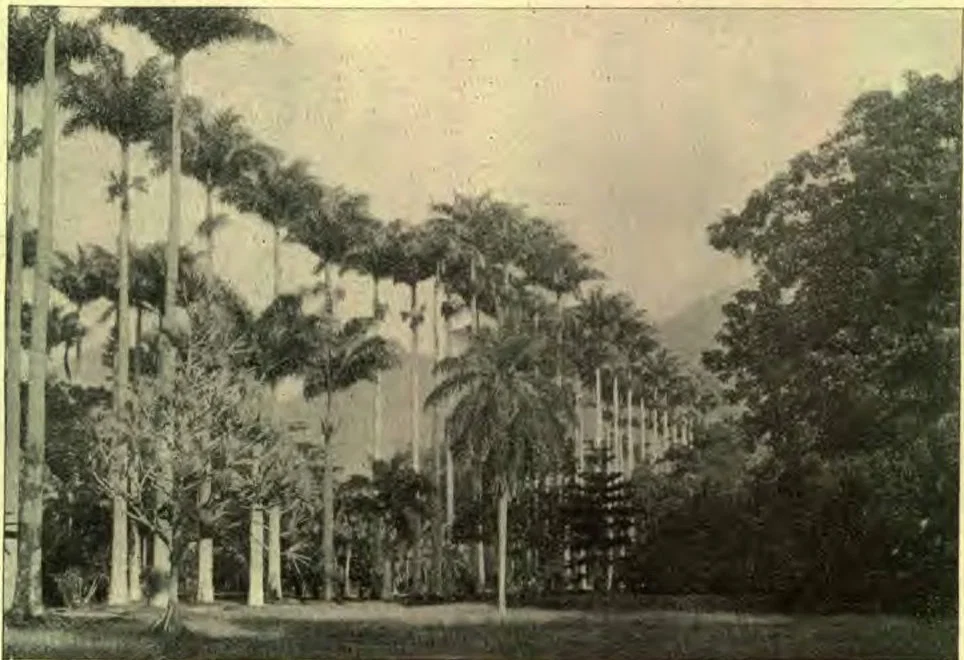
PALMS, BOTANICAL GARDENS, RIO DE JANEIRO
As to the actual geological and mineral structure of this vast country, it can be said that it is practically unknown. The mountains are largely composed of granite rock, while a species of mica is also abundant; marble is seldom found. Iron ore of a good quality, yielding as high as seventy-two per cent of iron, is found in large quantities, yet little is mined, most of the metal consumed in the country being imported. Gold is found in many of the provinces, with almost all the precious stones known to commerce. Among other metals found are silver, copper, and lead. Extensive coal-beds have been discovered; yet all coal consumed in the country is imported, and is consequently very high-priced, having reached as high a figure as fifteen dollars a ton, in United States money. And this, as you know, is still more in the currency of Brazil.
The climatic conditions of Brazil, though for the most part tropical, vary considerably, the country extending over such a range of territory. In addition to this, the altitude reached in some places—the greatest height being almost thirty-five hundred feet—gives a salubrious and even, bracing climate.
Of the Brazilian flora it is said that there have been twenty thousand varieties classified. Botanists have for convenience divided the country into three zones, the equatorial, the plateaus, and the coast.
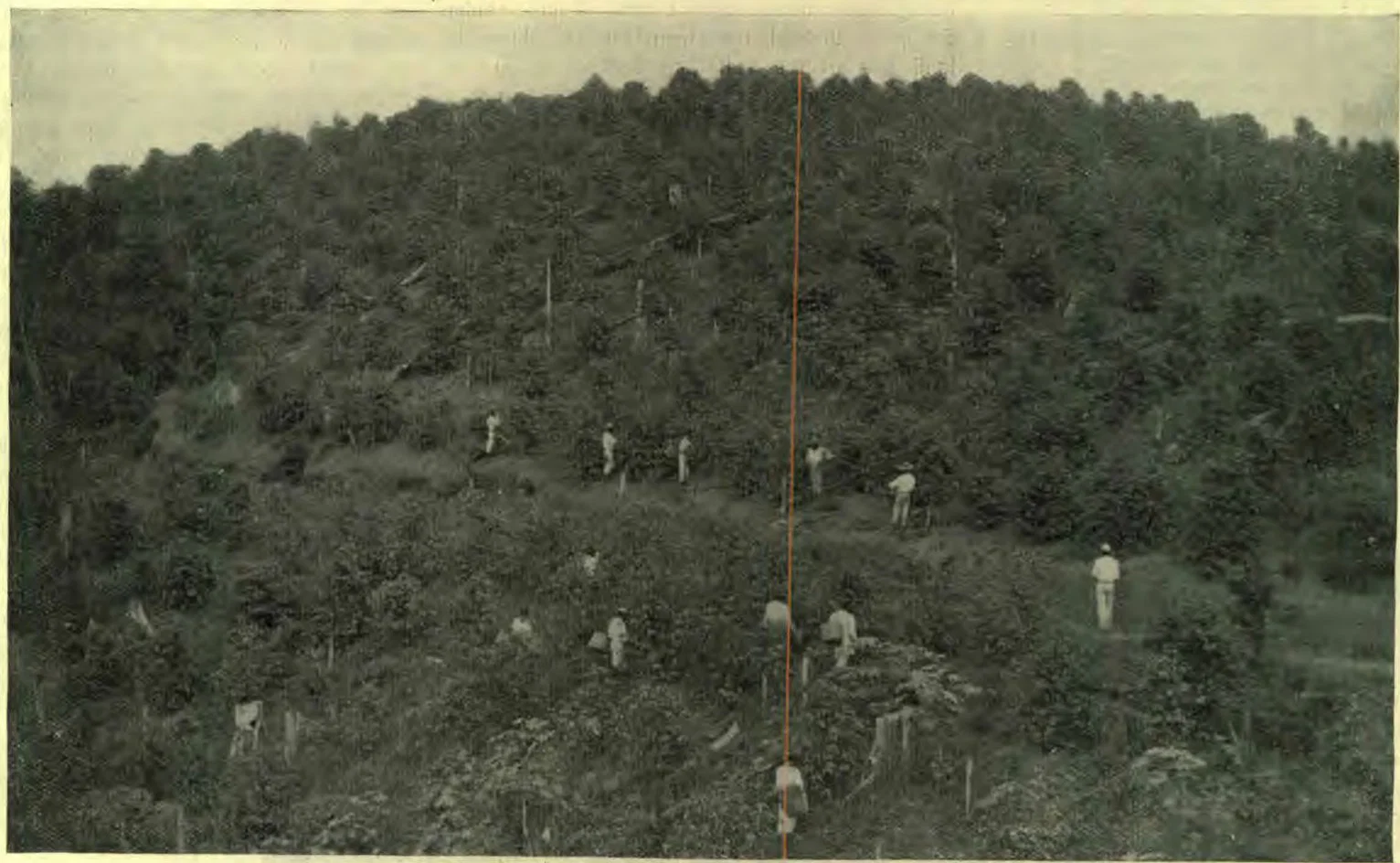
Of this vast flora we have space to mention only a few varieties. The castanheiro, or chestnut tree, known in botany as the Bertholletia excelsa, furnishes the famous Brazil-nuts. It is found extensively in the equatorial zone. Caoutchouc, the gum from which the so-called “india-rubber” is made, is an important article of commerce in the Amazon territory. Of palms there are many varieties, some one or other of them found almost in all parts of Brazil. Many species of useful wood are also found, among which might be mentioned rosewood; a variety of cedars; granna, closely resembling black walnut in color, only much harder; and many others. Coffee and cocoa are also important articles of commerce, especially coffee, which forms Brazil’s chief export. Of aromatic plants there are also a great number, one of the principal being vanilla.
The fauna of Brazil, like the flora, are of extraordinary richness. The wide range of territory along with varied climatic and other conditions, all contribute to making a home for the almost countless varieties of beasts, birds, and insects. Many persons make their living by catching beetles and butterflies for European markets. There are also numerous kinds of fish. Many of the poor people living along the coast subsist almost wholly from the products of fishing.
Wherever man looks in Brazil, whether at objects animate or inanimate, he may read of a wise and all-powerful Father, who is himself love, and who made all things beautiful to show this love to men, thereby to draw them to himself.
To point lost man to this all-wise, all-powerful, and all-loving Heavenly Father, we are laboring here in Brazil. And our daily prayer is for wisdom and power that we may so do our work that some may find him. F. W. Spies.

LESSONS FROM THE LIFE OF JOSEPH

IV

“Him hath God exalted with his right hand to be a Prince and a Saviour, for to give repentance to Israel.” These words were spoken of Jesus, but they apply well to Joseph. For two years he waited in prison for the gratitude of the butler to awaken to life. The recognition came at last. Is our gracious Deliverer still waiting for us to acknowledge his love?
The call came from Pharaoh. A nation was in peril; a crisis had come, and where was the man to meet the emergency? Ah, the stone set at naught by the builders, the rejected and despised Joseph, he was the tried, sure foundation. He was made the corner-stone. From the scene in the Egyptian court, where inquiry was made for the man who could unlock the future concealed in the king’s dreams, the mind goes to that scene in heaven where one is wanted who is worthy to unlock the seals, and read the future of the work of God. No one was found except Jesus, the Lion of the tribe of Judah. So now no one could attempt this work until Joseph was brought forward. The wisdom of God marked him who had so faithfully endured the contradiction of sinners, who had not turned his face away from God in any dark hour, as the one to whom the work of saving the nation and the people must be committed. To this end, all earthly power was given to him. To Joseph every knee must bow. All who would be saved must obey him.
Through the plenteous years the work of gathering went on under Joseph’s direction. Great stores, boundless and sufficient, were collected by him. Though Joseph had so much, the people seemed to pay no heed. They had no store. He alone trod the winepress, and of the people there was none with him. So when want and famine stalked forth, only Joseph had the power to save. All merit and all resources centered in him. To him must the people look. For some time they did not seriously feel the famine, but in a few years the faces of all men were anxiously turned to Joseph and his stores of food. Soon all the money was in his hands. Then all the cattle were passed over to Joseph for food. Then the land was sold for food, and finally the people, having no kind of resource, and being face to face with death, sold themselves. Joseph did not purchase all those things for himself, but for Pharaoh. So Jesus sought not his honor, but the honor of him who sent him. Then it could be said of the Egyptians that they were not their own. They and all they had were bought with a price. They had been redeemed from death, and saved from ruin. Joseph was exalted from prison to become a “prince and a saviour.”
The years of returning plenty were drawing on, but the people had no land, no seed, no cattle, nor were they their own. So they came to Joseph, not with complaints, but with gratitude. He told them to go back to their lands. He furnished them seed and cattle and food, and all necessary things, and required them to give back to Pharaoh only one fifth of what they raised. Any one who could as a slave have such a chance would think himself well off. And the people were well content. They were happy that they had found in Joseph such a wise benefactor.
Jesus has saved us from eternal death and ruin. He has redeemed us. He has bought us, with all we have, from the power of Satan. Our land, our cattle, our strength, our very selves, all belong to God. He lets us live on his lands, furnishes us life and all we have, and then only asks us to give him one tenth. Just half as much as Joseph asked! O, is he not good? G. C. TENNEY.

PICKING FLAWS

On an overland train the other day an old gentleman and a younger man were passing the time in telling each other of their experiences. By and by the subject of religion was broached, and it soon became evident that the speakers held very different ideas regarding it.
COFFEE-PICKING IN BRAZIL (SEE PRECEDING PAGE)
The young man was just telling how an old minister had tried to convert him. He would allow the old gentleman to make a few statements, and then, as he expressed it, “would pick a world of flaws in them.” Or if that were not enough to silence the good man, he would ask infidel questions—“stunners and regular posers,” he called them. So while the old minister was very patient, he finally had to allow that the young man was “too smart for him.”
The old gentleman listened attentively to his companion’s story, and finally said: “So far as that experience goes, it is almost identical with mine. As a boy, I hated religion, too. Father could seldom get the preacher over to dinner when I was about,—he was always busy or something,—but I keenly suspected he didn’t relish the idea of an argument with me. I’d been reading infidel books, you see, and was anxious to argue with the deacons in our home church. Father reasoned with me a good deal, of course, but I regarded him as ‘behind the times.’
“One evening when father came home, he told me there was to be an outdoor meeting in the park next day, and said it would please him if I would go. Two young men were going through our section giving Bible readings, and speaking on the prophecies. Father met one of them, and said they had the most convincing truth he had ever heard.
“Partly out of curiosity, and partly that I might argue with father, I went. When I reached the park, one of the young fellows was standing in his wagon, speaking. I couldn’t help admiring him, he seemed so honest and earnest. Still I felt he was like all the others—‘a fanatic.’
“He was talking on the prophecies; and as I was rather weak on them, never having studied them myself, I was glad I had come, and listened attentively. The young man knew what he was talking about, made his points quickly, and clinched them from a history I myself had studied. This was a new field to me. Was it possible there was a great line of truth I had never known of?—Yes, it was; and the longer that young fellow talked, the more disgusted I became with myself. He was right, and I was wrong!
“When meeting was over, I said to myself, ‘Tom Fletcher, you’re a fool!’ I was completely broken up. The words kept ringing in my ears all the way home, and I’ve never forgotten the experience. Whenever I am tempted to repeat a mean bit of gossip, or to ‘pick flaws,’ as people say, I stop, and think, ‘Tom Fletcher, there’s something here you haven’t heard, and perhaps don’t understand, so don’t be a fool.’”
The “smart” young man hadn’t any remarks to make; and having no “posers and stunners” to meet the occasion, soon changed his seat.
EDISON J. DRIVER.

Making Each Day Count for Others

Let this and every dawn of morning be to you as the beginning of life, and let every setting sun be to you as its close; let every one of these short lives leave its sure record of some kindly thing done for others — some goodly strength or knowledge gained for yourselves.—Ruskin.

Letting God Choose Our Field

“God will not let us preach for him unless we let him choose our field.”

AN ALLEGORY

A youth, taking a journey, came upon a place where his road parted in two ways, one of which he must needs take. Just at the parting of the ways were set two gates, and he turned first to that upon his right hand; over it, in letters of gold, was written the word Life, and under its arch stood One of gentle mien, who bore a shepherd’s rod in his hand. Running toward him, the youth bowed himself, and asked, “Sir, how may I obtain that Life, the name of which I see above this gate?”
Then, as the Gatekeeper looked upon him, he loved him, and said: “I am the door: by me, if any man enter in, he shall be saved, and shall go in and out, and find pasture.”
“The words,” said the youth, “are like apples of gold in pictures of silver. But what burdens must I bear if I enter this way?”
“If thou wouldst follow me,” said the Shepherd, “thou must daily take up thy cross. My yoke, too, thou must take upon thee; but my yoke is easy, and my burden is light.”
“What guarantee canst thou offer me, that I shall gain this Life, if I become one of thy followers?” asked he who sought entrance.
“The key of the house of David hath been laid upon my shoulder. I am he that openeth, and no man shutteth. I am the Resurrection and the Life,—he that liveth and was dead; and behold, I am alive forevermore.”
On hearing these gracious words, the heart of the young man burned within him, for he spake as one having authority, and not as other men.
“Sir,” said he, “knowest thou aught of this way? Hast thou ever walked therein?”
“I took upon me the form of a servant, and was made in the likeness of men: in all things it behooved me to be made like unto my brethren. In all their afflictions I was afflicted.”
“Then I am minded to enter by this Gate,” said the youth. “What lack I?”
“The gate is strait,” answered the Shepherd. “It is easier for a camel to go through the eye of a needle than for a rich man to enter. Go thy way, sell whatsoever thou hast, and give to the poor; and come, take up thy cross, and follow me,” and he stretched his hands out lovingly toward the young man.
But when the young man heard that saying, he went away sorrowful, for he had great possessions.
So then, as it was impossible for him either to go back or to stand still, he turned his face toward the other gate, which lay on his left hand. Its top and sides were covered with the names of many desirable things, such as Pleasure, Fame, Power, Riches, and many others, all written in brilliant letters. But among them all, and through them all, ran the legend, in black letters, “The wages of sin is death.” Thereat the youth trembled, and would have drawn back had not a very fair maid appeared at the gate.
“Sir,” she cried, “I perceive that thou desirest to enter this way; come in, and welcome, in the name of my master.”
“What is thy master’s name? and how knowest thou that I desire to enter?” asked the youth.
“The name of my master is most honorable, being the most ancient in the world. He is the First Adam, and gives his time wholly to the task of furthering the pleasures of all his subjects. And I know thy mind is to enter this gate; for I lately saw thee turn aside from yonder narrow gate. It is well that thou hast escaped, for the way is not to be endured for hardships. The One that is over the way is despised and rejected of men; he hath no form nor comeliness, and when we see him, there is no beauty that we should desire him.”
“But,” said the young man, “I like not this legend which I see written on the gate,—‘The wages of sin is death.’”
“This is not the true name of the way; the legend was not placed there by my master, who hath lived in this place all his life, but by One who never walked in this way, nor even entered this gate. My master hath tried much to blot the words out, but hath never succeeded. The name of the highway is this,—‘A Way That Seemeth Right unto a Man.’ But come in! come in!” and she laid hold on his hand to draw him within the gate.
“May I bring in all my possessions?” asked the youth.
“Surely thou mayest. The gate, as you see, is wide, and the way is very broad.”
Then the maid, whose name was Carnal Mind, led him up to the top of the gate, and from there she showed him all the beauties of the kingdom of this world. “All these,” she promised, “will be thine, if thou wilt but serve my master.”
So the youth was content to stay, and he received the name of Lo-Ammi, and became a traveling merchant, who dealt in gold, and silver, and precious stones, and pearls, and fine linen, and silk, and scarlet, and sweet wood, and vessels of ivory, and vessels of wood, and vessels of brass, and vessels of iron, and vessels of marble, and cinnamon, and odors, and ointment, and frankincense, and wine, and oil, and fine flour, and wheat, and beasts, and sheep, and horses, and chariots, and bodies and souls of men.
Here, too, the traveling was very easy; for whenever he walked abroad, he found that the road sloped gently downward; but he was not a little troubled by seeing always, at the farther end of the road, a blackness of darkness, which grew larger as time passed, and he drew nearer to it; for he found that he must still go forward.
But as often as she saw him looking sad or thoughtful, Carnal Mind led him away to satiate his soul with the attractions of the place.
At times she led him to the river which flowed there, whose name was Love-the-World, but the more he drank of it, the more fiercely his thirst burned. At other times she led him to the orchards, and bade him pluck the tempting fruits that hung there, such as, Lust-of-the-Flesh, Lust-of-the-Eyes, and Pride-of-Life; but as he ate them, they were as ashes between his teeth, and he turned away, crying, “Vanity of vanities! all is vanity!”
Year by year his possessions became greater, and he was clothed in purple and fine linen, and fared sumptuously every day; yet was he not satisfied; for he spent his money for that which was not bread, and his labor for that which satisfied not.
After he had been a long time in the place, and had grown very rich, he said to himself, “Soul, thou hast much goods laid up for many years; take thine ease, eat, drink, and be merry.”
But that night he dreamed that One said unto him, “Thou fool, this night thy soul shall be required of thee: then whose shall these things be, which thou hast provided?”
Then he awoke in great fear, and a Shining One stood by him, who took him by the hand, and said, “Up! get you out of this place; for the Lord will destroy this city.” And the Shining One led Lo-Ammi to the head of a street called Repentance, and said, “Escape for thy life; look not behind thee.”
By this time Carnal Mind was also awake, and she pursued after him, calling on him to return; but he would not. And as he ran on, he came again to that narrow Gate where was the Shepherd, who, as the man drew near, cried, “Enter in at the strait gate.” Then as the rays of the rising sun fell upon Lo-Ammi, the purple and fine linen that he wore were in his eyes as filthy rags; and as he saw them, he was distressed, and cried, “Alas, Master! I can not enter; for I am clothed in filthy garments; and I have heard that all who walk this way with thee are clothed in white.”
Then said the Shepherd to those that stood by, “Take away the filthy garments from him.” And they put on him a robe that was whiter than the snow; and his name was changed to Ammi. Then as the Gatekeeper took him by the hand, and drew him within the Gate, there was heard in heaven a great shout of joy, and the voice of harpers harping with their harps in the presence of God.
ELIZABETH ROSSER.

BIBLE OR CIGARS

Not long ago a man was asked by his sister to buy her a very good Bible. All Bibles are good, but some have maps, and notes and helps to the understanding of them, and they are well bound, to last. Of course they cost more.
The young man looked it over, eyed it. “Pretty good price for a book, isn’t it?”
“Yes,” said the dealer, “about the price of a box of cigars.”
The young man’s overcoat had told the story— they do sometimes, even in church, and you have to breathe your neighbor’s stale smoke. It is poor breathing!
He bought the Bible! — Selected.

The Sunshine of Friendliness

“THE sunshine of friendliness will soon melt the ice of reserve in which so many people are wrapped, and which sometimes makes us hesitate about speaking to strangers whom we see at church or school, or as newcomers in our neighborhood.”

Discretion in Friendship: A Talmudic Saying

Thy friend hath a friend, and that friend hath a friend; wherefore be discreet.—The Talmud.

THE GATEMAN

At the railroad crossing the gateman stands, Turning the crank in his faithful hands. Bent and wrinkled, yet strong and true To the daily duty ’tis his to do. The sun may shine, or the clouds may frown, July be torrid, December cold, Yet there, in his suit of well-worn brown, He guards the way for the young and old. Keeping with steady, tireless brain A watch for the inbound, outbound train, He signals the passage of each through the town, As with “Tinkle!” and “Tinkle!” the gates go down.
How the waiting children caper and dance, And the restless horses curvet and prance! How the servant-maids, upon errands bent, View the intruders with discontent,— While heavy car and elegant coach Rumble along on the shining rails, And on the busy ones’ time encroach With the vexing burden delay entails,— As, mindful of duty’s stern command, In spite of impatience, of fret, or frown, The gateman puts to the crank his hand, And steadily turning, the gates go down.
O, I would that on every road to-day, Where sin and its train hold right of way, Some gateman as ready as this might stand, Turning the crank in his faithful hand,— That ever when danger should threaten those Whose path must cross the enticer’s track, Some gate a-tinkle might interpose, And hold from disgrace the weak ones back,— Some safeguard be built for unwary feet, To halt them midway in the perilous street, And to signal to each, spite of fret or frown, “Stand back for your life, while the gates are down!”
— Marcia Selman.

THE TRUE MOTIVE IN CHRISTIAN SERVICE

(November 10-16)

To Whom Service Belongs.—

Ye are bought with a price: therefore glorify God in your body and in your spirit. Be not ye the servants of men.

Two Motives of Service—

(a) Love of God. For the love of Christ constraineth us.
(b) Love of self. All their works they do to be seen of men.

Requirements for Acceptable Service—

(a) One Master—No servant can serve two masters: for either he will hate the one, and love the other; or else he will hold to the one, and despise the other.
(b) Singleness of Purpose—This one thing I do, forgetting those things which are behind, and reaching forth unto those things which are before, I press toward the mark.
(c) Faith in Jesus—He that believeth on me, the works that I do shall he do also. All things are possible to him that believeth.
(d) Not to Be Seen of Men—When thou doest thine alms, let not thy left hand know what thy right hand doeth: that thine alms may be in secret: and thy Father, which seeth in secret, himself shall reward thee openly.

No One to Judge Another’s Motives.—

Judge not, that ye be not judged. Thou art inexcusable, O man, whosoever thou art that judgest; for wherein thou judgest another, thou condemnest thyself; for thou that judgest doest the same things. The Lord seeth not as man seeth; for man looketh on the outward appearance, but the Lord looketh on the heart.

Christ’s Warning Against Ostentation in Service.—

Take heed that ye do not your alms before men, to be seen of them: otherwise ye have no reward of your Father which is in heaven. Therefore when thou doest thine alms, do not sound a trumpet before thee, as the hypocrites do in the synagogues and in the streets, that they may have glory of men.

Great Object of All Acceptable Service.—

He that winneth souls is wise. Herein is my Father glorified, that ye bear much fruit.

SUGGESTIONS

1. All are bought with the blood of Jesus; therefore he has a right to the service of all. But he never compels service. All the riches of his love, all its wonder and sweetness, are held out to those whom he purchased with his own life, but none are compelled to become his yoke-fellows.
2. Paul was a straightforward servant. Like the wise builder, he sat down and reckoned up the cost, declaring, “What things were gain to me, I counted loss for Christ.” He set out to run a race; his aim was definite, and he had staying power. He did not run well for a season, and then turn back and go the other way because there were obstacles in his course.
3. While it is well for us to consider seriously the motives that actuate our service,—to look into our own hearts, and try our inner motives in the light of Christ’s unselfish life,—we must not allow ourselves to become discouraged at what we see. All our works are acceptable only as they are wrought in Him; but we have the assurance that he loves to dwell with the humble, trusting, loving heart; and that no service, however lowly, if done out of love to him, will fail of his acceptance and blessing.
4. Do not fail to read the article on “The True Motive of Christian Service,” in the Review of November 5. The following selected notes from “Mount of Blessing” will be very helpful in preparing this study:—

NOTES ON THE TOPIC

1. “Jesus did not teach that acts of kindness should always be kept secret. Paul the apostle, writing by the Holy Spirit, did not conceal the generous self-sacrifice of the Macedonian Christians, but told of the grace that Christ had wrought in them; and thus others were imbued with the same spirit. He also wrote to the church at Corinth and said, ‘Your zeal hath stirred up very many.’ Christ’s own words make his meaning plain,—that in acts of charity the aim should not be to secure praise and honor from men. Real godliness never prompts an effort at display. Those who desire words of praise and flattery, and feed upon them as a sweet morsel, are Christians in name only.”
2. “We are to give in sincerity, not to make a show of our good deeds, but from pity and love to the suffering ones. Sincerity of purpose, real kindness of heart, is the motive that Heaven values. The soul that is sincere in its love, wholehearted in its devotion, God regards as more precious than the golden wedge of Ophir. ‘There is no service like his that serves because he loves.’”
3. “The work of beneficence is twice blessed. While he that gives to the needy blesses others, he himself is blessed in a still greater degree. The grace of Christ in the soul is developing traits of character that are the opposite of selfishness,—traits that will refine, ennoble, and enrich the life. Acts of kindness performed in secret will bind hearts together, and will draw them closer to the heart of him from whom every generous impulse springs. The little attentions, the small acts of love and self-sacrifice, that flow out from the life as quietly as the fragrance from a flower,—these constitute no small share of the blessing and happiness of life. And it will be found at last that the denial of self for the good and happiness of others, however humble and uncommended here, is recognized in heaven as the token of our union with him, the King of Glory, who was rich, yet for our sake became poor. The deeds of kindness may have been done in secret, but the result upon the character of the doer can not be hidden. If we work with wholehearted interest as a follower of Christ, the heart will be in close sympathy with God; and the Spirit of God, moving upon our spirit, will call forth the sacred harmonies of the soul in answer to the divine touch.”
4. “Christ does not say that man will not or shall not serve two masters, but that he can not. . . . Just where the conscience of the Christian warns him to forbear, to deny himself, to stop, just there the worldling steps over the line, to indulge his selfish propensities. . . . No one can occupy a neutral position; there is no middle class, who neither love God nor serve the enemy of righteousness. Christ is to live in his human agents, and work through their faculties, and act through their capabilities. Their will must be submitted to his will; they must act with his spirit. Then it is no more they that live, but Christ that lives in them. He who does not give himself wholly to God is under the control of another power, listening to another voice, whose suggestions are of an entirely different character. Half-and-half service places the human agent on the side of the enemy, as a successful ally of the hosts of darkness. When men who claim to be soldiers of Christ engage with the confederacy of Satan, and help along his side, they prove themselves enemies of Christ.”
5. “One day alone is ours, and during this day we are to live for God. For this one day we are to place in the hand of Christ, in solemn service, all our purposes and plans, casting all our care upon him, for he careth for us. ‘I know the thoughts that I think toward you, saith the Lord, thoughts of peace, and not of evil, to give you an expected end.’ ‘In returning and rest shall ye be saved; in quietness and in confidence shall be your strength.’”

TRUE AND UNTRUE MOTIVES IN SERVING OTHERS

If we carefully analyze the real motives that prompt us, we shall often blush to find how utterly unchristian they are.
Many persons are educated from childhood to think a certain kind of lies is not to be regarded as such. How many mothers there are, who, on a busy day, looking out of a window just in time to see some gossiping neighbor turn in at the gate, will drop some such remark as, “Oh, my, there’s Mrs. White coming to take up my time. I do wish she would stay at home, and attend to her work, and let me attend to mine;” and then, a moment later, when the visitor steps in at the front door, will greet her guest with a hearty welcome. Perhaps the visitor suggests, “I am afraid my coming will break into your work,” and receives the reply, “Oh, no, don’t think that for a moment. I was not doing anything important, and I am so glad to have you come.”
Many, as we said, have been trained, more or less, to this kind of falsehood, until it is sometimes extremely difficult to determine, when a certain kind act is performed, or certain encouraging words are spoken, whether they represent the real promptings of a generous heart, or whether there is not some selfish motive back of it all.
This has become so prevalent that the true worker for God is met at almost every turn with the remark, “Well, he has an ax to grind.” May the Lord keep us from hypocrisy, falsehood, and wrong motives in all our dealings, not only with our immediate associates, but with humanity in general. DAVID PAULSON.

A BLESSED OPPORTUNITY

God gave me something very sweet to be mine own this day,— A precious opportunity a word for Christ to say; A soul that my desire might reach, a work to do for him,— And now I thank him for the grace, ere yet the light grows dim.
No service that he sends me can be so welcome aye, To guide a pilgrim’s weary feet within the narrow way; To share the Shepherd’s quest, and so, by brake and fen, To find for him his wandering lambs, the erring sons of men.
I did not seek this blessed thing; it came a rare surprise, Flooding my heart with dearest joy, as, lifting wistful eyes, Heaven’s light upon a dear one’s face shone plain and clear on mine; And there an unseen third, I felt, was waiting,— One divine.
So in this twilight hour I kneel, and pour my grateful thought In song and prayer to Jesus for the gifts this day hath brought. Sure never service is so sweet, nor life hath so much zest, As when he bids me speak for him, and then he does the rest.
— Selected.

CLARIBEL

The sound of footsteps on the stair, A sudden glint of golden hair, A fairy form beside my chair,— 'Tis little Claribel.
Intent on mischief or on play, Her feet run to and fro all day; Through what forbidden paths they stray, 'Tw would take me long to tell.
She wants to know the “reason why” Of everything in earth or sky; And into secrets deep would pry, This daring Claribel.
She dropped her dolly down the well, And helped the chickens from the shell, Then wept sore when they lifeless fell. How could she this foretell?
She tears my books, my patience tries; And when I chide, she lifts her eyes With looks of innocent surprise,— Mischievous Claribel!
Sometime these hands that vex me so, May have some gracious work to do, May help to lighten human woe, And error’s night dispel.
So when the fond “good nights” are said, And on the pillow rests her head, I softly breathe beside her bed A prayer for Claribel.
VIOLA E. SMITH.

BEDTIME THOUGHTS

Our little Blue-Eyes is going to bed, But never alone goes she; For Doris and Dorothy over the way In nightgowns white I see. So here is a thought for your dear little head: Across the street they are going to bed.
And all through the town, where we can not look, They are going to bed by the score, Till I seem to hear, “Good night!” “Good night!” Passed on from door to door. So here is a thought for your small curly head: All over the city they’re going to bed.
And the thousands of children throughout the land, As westward the sun goes fast, Will say their prayers and climb into bed, Till all will be sleeping at last. Now here is a thought for your wise little head: Thousands of children will soon be in bed.
And all over the world, as the sun journeys on, An army of girls and boys Will don their nightgowns and say good night, Leaving their games and toys. Oh, here’s a big thought for your small curly head: Millions of little ones tucked into bed! — Selected.
Continue reading: BOB THE PIGEON