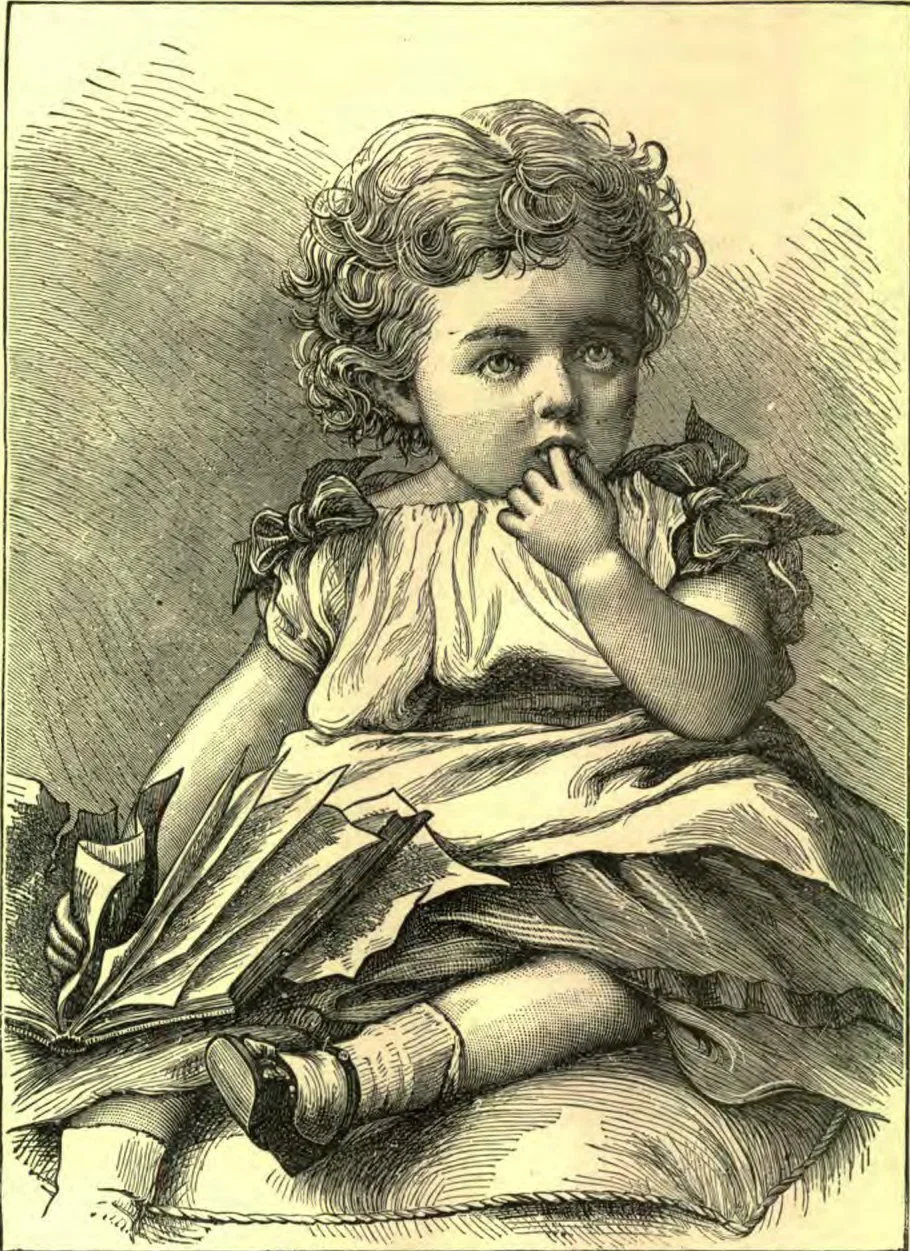
Bob was only an ordinary blue pigeon, and not at all handsome. I found him one morning on the ground under my pigeons’ nests. He had been thrown out of his nest, as other young pigeons often are, but for some reason he could not fly. When I found him, he was almost starved. I took him to the house, and tried to feed him, but he would not eat. Then I opened his bill, and put food into his mouth; but still he would not swallow it. Finally I thought what was the matter,—his mother had always fed him, and I must imitate her method.
WITH LOOK OF INNOCENT SURPRISE
A pigeon feeds her young differently from other birds. She sticks her bill so far down the young bird’s throat that her head is literally in its mouth. This is because she secretes a fluid very much like milk in her crop, and disgorges it, along with seeds and grains of various kinds, into the young bird’s throat. So I opened my pigeon’s mouth, and placed wheat far back in its throat. This it swallowed readily, fluttering its wings, and squealing plaintively for more. It never knew when it had enough.
When I came to water it, I learned something else. A pigeon does not drink like an ordinary bird. I tried to give it water from a jar lid, but it would only stick its bill to the bottom, and push; then I tried pouring the water down its throat with a spoon, but that did not work very well, as it tried all the time to get its head down. One day when I had a tin cup of water and a spoon, trying to give it a drink, I learned a lesson. The bird got out of my hands, and hopping to the cup, stuck its whole head under water, and drank as long as it could hold its breath. I have since learned that a pigeon will stick its head under water until its whole head is covered, if it is very thirsty, and that it never raises its head, like other birds, to let the water run down.
One day a cat tried to kill Bob, and although he escaped, the experience caused him to form an undying hatred for cats. Ever afterward if a cat came near, he would begin cooing and threatening, and if it came nearer, he would boldly attack it. He would fly right into its face and bite its ears, and beat it with his wings till it would retreat, seeming to know that a cat will not meet a direct attack. All the cats on the farm soon learned to fear him.
It was some time before Bob learned to fly, because he was so well fed that he was too heavy. Pigeons feed their young all they can eat until they are full feathered, at which time they weigh more than at any other in their life. Then they give them nothing but water for a week or ten days, so that they will become light enough to fly. If the young bird does not get hungry enough to venture to fly, the parents finally push it out of the nest. I have seen it take both father and mother to drive a young bird away from home. I did not starve Bob, so I had to teach him to fly by tossing him into the air several times every day.
Bob never chose a mate, and never seemed to care much for the company of the other pigeons. He made his home in the kitchen, roosting on the wood-box. On a cold winter day he delighted to sit under the stove, much to the disgust of the cats, which would fain have done the same; but he would not allow one of them even in the house when he was there.
One day a strange cat, which had been catching my other pigeons for some time, came prowling about the house, and attempted to catch Bob. But he was on guard, and met the attack boldly. They fought for about twenty minutes, the cat being determined to win. Wings gave the bird a great advantage, and the cat had to retreat with his ears torn to shreds by the bird’s bill. But Bob was wounded. The cat had stuck one claw into his esophagus, and the wound never healed. Whenever he ate small seeds or soft food, some of it would collect between the esophagus and the skin of the neck, and of course it soon began to decay there. It was removed once; but as it continued to collect, it soon caused his death.
I have told only of Bob’s warlike traits. He was a very affectionate, winsome pet, loving above everything else to be fondled and petted. He especially enjoyed sitting on my shoulder, and rubbing his head and bill over my face, cooing softly while he did so. He fought nothing but cats, and then only in self-defense.
FLOYD BRALLIAR.
A Good Thing to Keep: Temper
A good thing to keep — temper.
DIVISION I—GEOLOGY
By O. C. Godsmark
Chapter IX—Our Earth's Internal Temperature
§83. It is commonly claimed by geologists that this earth was once a molten mass of liquid fire; that by rotating about a given center, it assumed a globular form; and that through the lapse of incalculable ages, its outer surface gradually cooled down, until it reached its present condition. It is also affirmed that the earth is still, internally, in this superheated condition, only the outer crust having cooled to its present state. The first proposition will be discussed under its proper heading. As to the second,—that relating to our earth's present internal condition,—we ask (1) Is it reasonable? and (2) Do the actual facts in the case warrant such a conclusion? Let us see.
§84. First, suppose that all that is claimed regarding the past is true. Let us, for the argument's sake, suppose that this globe was once a rapidly revolving mass of liquid fire. What, we ask, would of necessity be the condition of its surface, after the cooling process had been carried on long enough to form a hardened crust?
§85. First, a mass of matter the size of our earth, rotating at even its present velocity, being in so gaseous a form as it is claimed this was, would never have assumed so complete a spherical form as has the earth. Centrifugal force would have driven so fluid a body into a much more oblated spheroid than we find our earth to be. Its poles would have been far more flattened than they really are.
§86. Secondly, being in such a fluid condition, and cooling down so gradually, it would have formed a smooth, even surface, a condition we know does not exist, nor does any approach to such a condition exist.
§87. Thirdly, It is a universal law of physics that heat expands, and cold contracts. This being true, the outer surface of this great globe, in cooling down, must of necessity have contracted, leaving the inner portion still heated, and consequently in an expanded condition. Now, what, we ask, would have been the condition of our earth had it ever passed through such an experience as this? Think for a moment. The contracting of the outer surface would have drawn the crust together in great cakes, or patches of land, leaving immense V-shaped cracks, or fissures, many miles in depth, from which would issue gas and smoke from the still heated and expanded center. To illustrate this, notice the cracks that open so noticeably in the block-paved streets of our large cities on a very cold winter's morning. The extreme cold of the previous night causes a shrinking, or drawing together, of large sections of the paving. A similar drawing apart of the land may be seen by noticing the deep cracks that appear in clay soil when the sun's rays have rapidly evaporated the moisture from the roadside after a hard rain.
§88. From the foregoing illustrations it will readily be seen how entirely false are the unscriptural teachings that our earth was once in a heated, molten condition. In place of great chasms, miles in breadth, and many times deeper than broad, appearing everywhere, we see the crust crowded together, and piled up in exactly the opposite condition.
§89. We are told that the temperature of our earth's crust increases at a definite, given rate of one degree for every fifty or sixty feet in depth that we enter its bosom. We do not deny the fact that there is an increase in temperature in many places; but is this a universal condition? The fact is that where there is any increase in temperature, the rate varies so greatly that it seems probable that it is due merely to local conditions. See Section 72. The well at Grenelle gives an increase of one degree for every sixty feet descent; the Killingworth mine in England shows one degree for every forty-five feet; while in Yakutsk, Siberia, the increase is one degree for every twenty-seven feet descent, showing that in that country at least it must be from local causes; for in Northern Siberia the ground remains frozen to a depth of six hundred and sixty feet the year round. There are many exceptions to this rule given by infidel scientists, regarding the increase of temperature as we descend into the earth's crust; as, for instance, the salt wells of Michigan, and the gas- and oil-wells of Indiana, Ohio, Pennsylvania, and California, many of which reach a depth of more than two thousand feet, and show no such rise in temperature.
The “stratum of invariable temperature” ranges, in the temperate zone, at from fifty to ninety feet below the surface, where the thermometer remains stationary the year round.
§90. If the earth is actually so hot inside that at a depth of twenty-eight miles, iron would fuse, and all metals be melted (see Dana's Geology, page 699), does it not seem that the poles, approaching, as they do, 13.2 miles nearer the center than does the equator; or nearly half the distance to the fusing-point of iron, would show a much higher range of temperature than they now do, even if they do not receive quite so much of the sun's heat as other portions of the earth?
§91. Again: If the earth's center is so hot as is claimed, why are the ocean depths so extremely cold? Fresh water freezes at a temperature of thirty-two degrees Fahrenheit, while salt water does not congeal until the mercury falls to 28.3° F. But for that fact, our ocean beds would be one solid floor of ice. Supposing an increase of one degree for every fifty feet we approach the earth's center, an ocean whose bed averaged only two miles in depth would have a temperature of boiling water. Imagine what the temperature would be where the earth's indenture is twice and even three times as great. These facts do not at all accord with the much-vaunted theory of evolution. In place of being extremely hot, our sea-beds are cold, our polar regions are cold, and our gas-, salt-, and oil-wells are as likely to produce cold results as warm. In view of these facts it is hard to believe the theories of the world regarding the earth's formation and history. The statement made by Thompson—that the earth loses annually sufficient heat to melt seven hundred and seventy-seven cubic miles of ice—is a hard proposition for a believer in God's word to accept.
QUESTIONS
Give three reasons why the evolution theory of the earth's internal heat is incorrect. If the theory of evolution were true, tell what we would have in place of mountain chains. Give reason and illustrations. Is there a universal increase in temperature as we pierce the earth's depths? How much nearer are the earth's poles to its center than is the equator? How much farther would they have to approach the center, according to the accepted theory, to be the temperature of melted iron? According to the same theory, what would be the temperature of our oceans? Which of the oceans would be the hottest? Why? What can you say of the actual temperature of our polar regions? The ocean depths? At what temperature does fresh water freeze? Salt water?
DR. O. C. GODSMARK.
THE PARABLE OF THE MUSTARD SEED
(November 16)
FIND the references in the Bible and “Christ’s Object Lessons.”
1. How many parables have we studied now?
2. Where are they recorded in the Bible?
3. In what three chapters do we find a parable of the mustard seed?
4. What is the meaning of the word “parable”? See dictionary.
5. What two things has every parable compared that we have thus far studied?
6. Is the same comparison made in this week’s lesson?
7. To what question of the Saviour’s is the parable of the mustard seed an answer?
8. Why should Jesus ask this question? Had he not already shown what the kingdom of God is like?
9. What does the grain of mustard seed show concerning the kingdom that the seed of other parables does not?
10. What does the mustard seed become when it is grown? How does it compare with all herbs?
11. What does this fact teach us concerning the kingdom of God when it is grown? Compare Dan. 2:35, 44; note .
12. What good promise is given to those who are least? Luke 9:48.
13. What thought does Mark give concerning the growth of the mustard tree that the other gospel writers do not?
16. To whom did the branches of the mustard tree afford shelter and shadow?
17. Does the righteous Branch ever give shelter to any? Ps. 61:3. Does it afford a shadow also? Isa. 32:2.
18. What, then, are the other branches to do?
19. To how many must the gospel shelter be given? Rev. 14:6.
20. In Christ’s day how did his people regard the other nations? Acts 10:28; note .
21. In what parable did Christ say, “The field is the world”?
22. In the first parable what did the sower do in order to sow?
23. What lesson, then, were the disciples to learn from this instruction?
24. Christ gave no explanation of the parable of the mustard seed. What can you find to show that they understood it?
25. How many times did Christ give this parable? Notice when Luke records the parable.
NOTES
HEALING THE IMPOTENT MAN AT BETHESDA
By W. S. Sadler
(Concluded)
Had an Infirmity Thirty and Eight Years.—This was a case of extreme wretchedness. The man had been afflicted with this disease for thirty-eight years. It is a case illustrating the connection between sowing and reaping—sin and sickness. From the words which Jesus afterward spoke to him, we might judge that this man's affliction was the direct result of his individual transgression. This poor soul was waiting, and had been waiting for years, at the pool,—waiting for some sign or wonder. He waited long; and this is true of every Christian who is waiting for unusual and extraordinary things to happen. He must wait until the waiting itself has shown him the folly of waiting, or else fall a victim to the deceptive wonder-working of the arch-deceiver.
Jesus Saw Him Lie.—It is written that Jesus saw him lying there. What an encouragement it should be to every suffering and afflicted soul to realize that Jesus sees those who lie upon beds of affliction. Not only is that true, but Christ shares every sorrow and every pain with his suffering children. The question may be asked, Why did Jesus select this one man to be healed? Divine Wisdom alone can answer; but (1) might it not have been that his was the worst case of all, he having been in that terrible condition thirty-eight years? or (2) that Jesus knew his to be the only case that would be benefited spiritually by his physical restoration? It is an encouraging thought for the soul in the slough of despond or the depths of despair, that Jesus is both able and willing to lay his healing hands upon even the worst cases.
Wilt Thou Be Made Whole?—Christ asked the sick man: “Wilt thou be made whole?” This apparently singular question was full of meaning and significance. Christ did not ask, “Wilt thou be freed from pain?” “Dost thou desire to escape the inconveniences of thy affliction?” etc. His question was a simple, pointed one: “Wilt thou be made whole?” And in this question he asks of every inquiring soul to-day, “Dost thou desire simply to be free from the consequences of sin? Is thy repentance like unto Balaam’s, who repented only when he saw the drawn sword of the destroying angel? Dost thou repent to save thyself punishment by and by? Dost thou repent to gain future rewards? Or hast thou seen the exceeding sinfulness of sin, and wilt thou be made whole, physically, mentally, and morally?” This is the question that Jesus asks every soul that seeks his face. What is your answer? Can you in sincerity answer, “Yes,” to the Master’s question? If you can, then with a willing heart you must walk in every ray of light that shines across your pathway; and with patience and diligence sow for physical and spiritual health; for true wholeness is only perfect health of body and perfect health of soul,—holiness unto the Lord.
Some who would be made whole are unwilling to pay the price of complete self-surrender. They are not willing to allow wholeness, which is only another word for holiness, to control their eating, their dressing, and their acting. He who would be made whole must forever give up the spirit of murmuring and the tendency to lukewarmness. He must put on the whole armor of God, and fight diligently the good fight of faith.
Jesus Said, Rise, Take up Thy Bed, and Walk.—Jesus did not ask this poor sufferer, perhaps palsied and otherwise afflicted, even to have faith in him. He simply said, “Rise, take up thy bed, and walk.” But the man had faith enough to take hold of the divine word, even though Jesus had given him no assurance of help. Christ quickly disappeared from the man whom he had healed, and was not seen of him until later, in the temple, when he was making a thank-offering for the blessing of restored health. He took up his bed and walked. This poor man obtained healing by obedience. The teaching that promises healing without obedience is a snare and a delusion. The evidence that this man was made whole lay in his immediate and implicit obedience to the Master’s command. The willingness to obey and carry out the Master’s orders was but a part of the cure which the Master had wrought, and which he foreshadowed in his question: “Wilt thou be made whole?”
He That Was Healed Wist Not Who It Was.—Very often men and women receive the benefit of light and truth concerning right methods of living,—health and dress reform,—to such an extent that they almost entirely regain their lost health. At the same time they seem in almost utter ignorance of many vital truths connected with that light which has so greatly benefited them. Often the medical missionary discovers that the one who has been physically helped, like the subject of this miracle, knows nothing of the divine Master whose help he has received. This should not be regarded as discouraging; for if the benefited soul is sincere and in earnest, he will be given subsequent opportunities to learn more of the great Healer, and to accept additional light as fast as he is prepared for it.
Sin No More, Lest a Worse Thing Come unto Thee.—It was here that Christ spoke to the restored man the words that contained the greatest lesson of the miracle. “Sin no more, lest a worse thing come unto thee.” When questioned why he carried his bed on the Sabbath day, he replied: “He that made me whole, the same said unto me, Take up thy bed and walk.” This man was ignorant of the enmity of the Jews and the Pharisees toward Jesus, and he told them of his remarkable experience only to honor and glorify the one who had healed him. The Jews found fault with Christ because he had healed on the Sabbath day. How singularly inconsistent to seek to accuse a man of doing good on the Sabbath day, when they themselves were violating the law in concocting miserable schemes for his persecution, and even for the taking of his life! Christ says, in explaining his act to the infuriated Jews, “My Father worketh hitherto, and I work,” intimating that the creation which God gave existence to in six days’ work, he himself must uphold on the Sabbath; and that, in restoring life, in healing this poor man, Christ was but working in harmony with his Father, who, every Sabbath day, kept the man’s heart beating. Christ’s work is but the reflex of his Father’s work. W. S. SADLER.
A Baby’s First Wardrobe
By Mrs. F. M. Kellogg
Is the most trying proposition a young mother can meet. Often everything she makes is wrong. For 30 cents in stamps you can get twenty-two guaranteed patterns drawn on anatomical and hygienic lines, with full instructions for making. Also an illustrated booklet on care of the body—free. All in plain envelope. Everything essential to know. For information on garments for other ages, send stamp.
MRS. F. M. KELLOGG,
207 Hubbard St., - - Battle Creek, Mich.
GRAND TRUNK R'Y. SYSTEM.
By W. C. Cunliffe
Taking Effect June 2, 1901.
Trains leave Battle Creek.
WEST-BOUND.
No. 9, Mail and Express, to Chicago .......... 12.15 P. M.
No. 7, Limited Express, to Chicago .......... 7.00 A. M.
No. 1, Chicago Express, to Chicago .......... 9.23 A. M.
No. 3, Lehigh Valley Express, to Chicago .......... 3.50 P. M.
No. 5, International Express .......... 2.17 A. M.
No. 75, Mixed, to South Bend .......... 7.30 A. M.
Nos. 9 and 75, daily, except Sunday.
Nos. 1, 3, 5, and 7, daily.
EAST-BOUND.
No. 10, Mail and Express, East and Detroit .......... 3.45 P. M.
No. 8, Limited Express, East and Detroit .......... 4.50 P. M.
No. 4, Lehigh Express, East and Canada .......... 8.02 P. M.
No. 6, Atlantic Express, East and Detroit .......... 2.10 A. M.
No. 2, Express, East and Detroit .......... 7.00 A. M.
No. 74, Mixed (starts at Nichols yard) .......... 7.15 A. M.
Nos. 10 and 74, daily, except Sunday.
Nos. 4, 6, 8, and 2, daily.
W. C. CUNLIFFE, Agent,
BATTLE CREEK.
Let There Be Light
The “METROPOLITAN” gas lamp produces six times the light of an ordinary gas jet or 16-c. p. electric light at a cost of....
½c. per Hour.
Made in several styles and successfully used in store, church, office or home. Satisfaction guaranteed. Write!
AGENTS WANTED.
Omaha Gas Lamp Co., OMAHA, NEB.
SELF-PRONOUNCING S.S. Teachers' Reference Bible
By Editor
Contains the Celebrated Teachers' Helps, Comprising nearly 400 pages. Also a complete series of fifteen new maps.
DESCRIPTION
IMPERIAL SEAL BINDING, TUCK EDGES, known as “DIVINITY CIRCUIT.” ROUNDED CORNERS. FULL RED UNDER GILT EDGES.
We offer this Bible, postpaid, for only six new yearly subscriptions at 75 cents; or twelve new six months' subscriptions at 40 cents.
We will also send it, postpaid, with the INSTRUCTOR one year for $2.25. For 20 cents extra we will stamp your name in gold upon the cover. Address—
THE YOUTH'S INSTRUCTOR, Battle Creek, Mich.
A LIFE OF TERROR
THE life of the sultan of Turkey is one long effort to protect himself from the hand of the assassin. Yielding to the fancy that his life is constantly sought, Abdul Hamid spends his energies in making himself safe. His palace at Yildiz has been called a “monument to fear,” and such it would seem to be. Architects and engineers work on it constantly, rebuilding a part here, making an alteration there, providing another secret chamber or place of retreat, or putting in some fancied addition to its security. It is surrounded with a wall thirty feet high, guarded by the picked troops of the empire, and is said to be assassin-proof, bomb-proof, earthquake-proof, fire-proof, microbe-proof—everything, in fact, but fear-proof. A writer in Everybody’s Magazine says:—
“One day the sultan received Monsieur Vámbéry, the Hungarian Orientalist, informally at the palace. This was not an unusual thing; for the professor has been Abdul’s tutor, and was almost his intimate friend. Quite naturally, therefore, the sultan turned to the one guard in the apartment, and ordered him to retire.
“The guard took a step backward and halted, as rigid as before. Abdul repeated the order, with the same result. Once more he commanded, and this time the man obeyed. Then the sultan, smiling, explained. It often happened that he wished to show apparent faith in a guest. He would order the guard to retire, and the guard, after that one step, would remain, the sultan meanwhile going on with the conversation under the seeming impression that the man had really gone. The man understood that only the third command was to be taken literally.
“When the sultan had finished this confidence, he invited the professor to sit opposite him at the little table, and have some tea. Now the sultan does not take sugar, and so he forgot to offer any to his guest. The bowl was at the sultan’s elbow, and the professor was not used to asking monarchs to wait upon him. Still, he hardly wished to drink the tea as it was, and he leaned over the table to reach for the sugar.
“In a flash the sultan was on his feet, his hand at his pocket, his face pallid. The gesture of the harmless old savant looked to him like assassination.
“Again: when the Prince of Samos was retiring from an audience, he stumbled, in his backward steps, and fell. Instantly the sultan pressed a spring behind the throne. The wall opened, and he vanished within, safe from the suspected attack.
“Abrupt gestures in his presence often cost very dear. The histories of several victims of such mistakes are on record. One was a gardener in the royal park, whom Abdul shot dead for rising too quickly to an attitude of respect. At another time he found the child of a palace servant playing with his mislaid revolver, and had her tortured in the hope of discovering a plot.”
What a contrast between the life of this ruler and the serene peace of that other king, who, his life openly sought, exclaimed, “I will both lay me down in peace and sleep: for thou, Lord, only makest me dwell in safety,” and again, “What time I am afraid, I will trust in thee.”
The Life Boat: Missionary Fuel for Chicago Workers
EVERY line in the Life Boat is original matter. It deals with personal experience. It faithfully chronicles modern miracles of grace, that are wrought now just as much as in the days of old. It suggests practical ways of work for others. It deals, in a way that ought to inspire others, with some of the experiences of those who are faithfully laboring to uphold the Master’s kingdom in the large city of Chicago. In short, the Life Boat furnishes missionary fuel for missionary fire. Attractive inducements are offered to agents. Write at once to The Life Boat, 2 & 4 Thirty-third Place, Chicago, for outfit and full particulars.
Faithfully Performing Our Daily Share of Work
To every one of us is given, daily, a special and distinctive task,—“our share” of the great world-family’s work. Shall we, no matter how hard or unpleasant it may be, perform our task faithfully—yes, and cheerfully? or shall we shirk, slight, and neglect it, or perhaps leave it forever undone?
The Lasting Harm of Unkind Speech
An unkind speech is one of the hardest things in the world to forget. Though forgiveness has been sought and given, though atonement ample and full has been made, and though we ourselves are determined that the ugly memory shall not come into mind,—come it will at the most unwelcome time. Perhaps even this experience is to teach us this lesson that we can never learn too well,—the care with which we should guard our intercourse with others. It is so easy to wound those who love us, so easy to speak, in a moment of anger, a word whose bitterness shall be a cause of heartache for years. How often and how earnestly should we pray, with the psalmist, “Set a watch, O Lord, before my mouth; keep the door of my lips.”
The Influence of a Pleasant Voice
Another thing: though the lips be guarded never so zealously; though nothing but pleasant, courteous words are allowed to pass their portals, the impression may still be far from soothing, or agreeable, or winning if the voice does not work with the words. And it is so difficult to keep that most wonderful and sensitive musical instrument—the human voice—in tune! Only the most constant watchfulness and persistent training will keep it under control, and produce sweet and harmonious results. “Peak like oo do when oo laugh,” called a sick child to her anxious father; and that little word has a meaning for us all. Nothing is ever gained, but much that is precious is lost, by a whining, fretful, “mournful” voice. The influence of the pleasant voice often goes even farther than the words themselves.
Is Fancy Work Worth the Time?
HAVE you “no time to read,” and yet time enough for doing a foolish bit of fancy work, that shall eat up a dozen precious hours? “No time” to spend with some aged friend, lending your bright face for an hour to her lonely day, and yet time enough to work for hours sewing dainty lace on a piece of linen to give to some girl friend? “No time” to fill some of the many opportunities for service that are coming to you daily,—to you, if you will but watch for them,—and yet plenty of time to work roses and violets and intricate vines and leaves on a square of linen? There may be, and no doubt are, times when these things are right and proper; but should not one always be sure, before she gives up a precious hour to them, that they are right for her, considered apart from what any one else may think, or say, or do? Fancy handkerchiefs, dainty doilies, and fussy knickknacks are too high-priced when bought at the cost of overworked mothers, neglected sick and aged, and the opportunity for self-improvement. And we believe the price is so high that no thoughtful girl will consider it worth while to pay it.
THE INSTRUCTOR PREMIUM BIBLE
Continues to please all who have it. One of our ministerial workers not long ago earned one of these Bibles, and in writing to acknowledge its receipt, he said:—
“The INSTRUCTOR Premium Bible was a pleasant surprise. The helps are excellent, and altogether I consider it a prize. If our people only knew what an excellent Bible it really is, they would purchase it on the conditions on which it is offered, rather than buy elsewhere. Thus, besides getting a most satisfactory bargain, they would get the INSTRUCTOR a whole year free.”
If you are interested in earning or buying a new Bible, read the particulars concerning the INSTRUCTOR Premium Bible, given on page 351.
The Hygienic Caterer: A New Monthly Periodical
The Hygienic Caterer is a new eight-page monthly hailing from Guadalajara, Mexico, and “devoted to the best interest of correct dietary.” It is edited and published by D. D. Fitch, whose experience in hygienic cookery qualifies him to speak with some authority upon these subjects. Yearly subscription price, thirty-five cents. Single copies, three cents.
For Every Day of the Week
Sunday:
“One of the greatest arts in life, and one of the most neglected, is that of finding happiness in little things.”
Monday:
Close to my heart I fold each lovely thing
The sweet day yields; and, not disconsolate,
With the calm patience of the woods I wait
For leaf and blossom when God gives us spring!
— Whittier.
Tuesday:
It is a very solemn thought that God will excuse you from serving him if you want to be excused. He does not wish to do it, but he will do it.—Moody.
Wednesday:
“A heart-memory is better than a head-memory. Better to carry away a little love of Christ in our souls than if we were able to repeat every word of every sermon we ever heard.”
Thursday:
The dear Lord’s best interpreters are humble human souls;
The gospel of a life like theirs is more than books or scrolls.
From scheme and creed the light goes out, the saintly fact survives;
The blessed Master none can doubt revealed in holy lives.
— Whittier.
Friday:
The Lord Jesus can not fully save you while there is one point of controversy between you and him. Let him have that one last thing, the last barrier and film to a life of blessedness, and glory will come, filling your soul.—F. B. Meyer.
Sabbath:
“As thy days, so shall thy strength be.” Deut. 33:25.