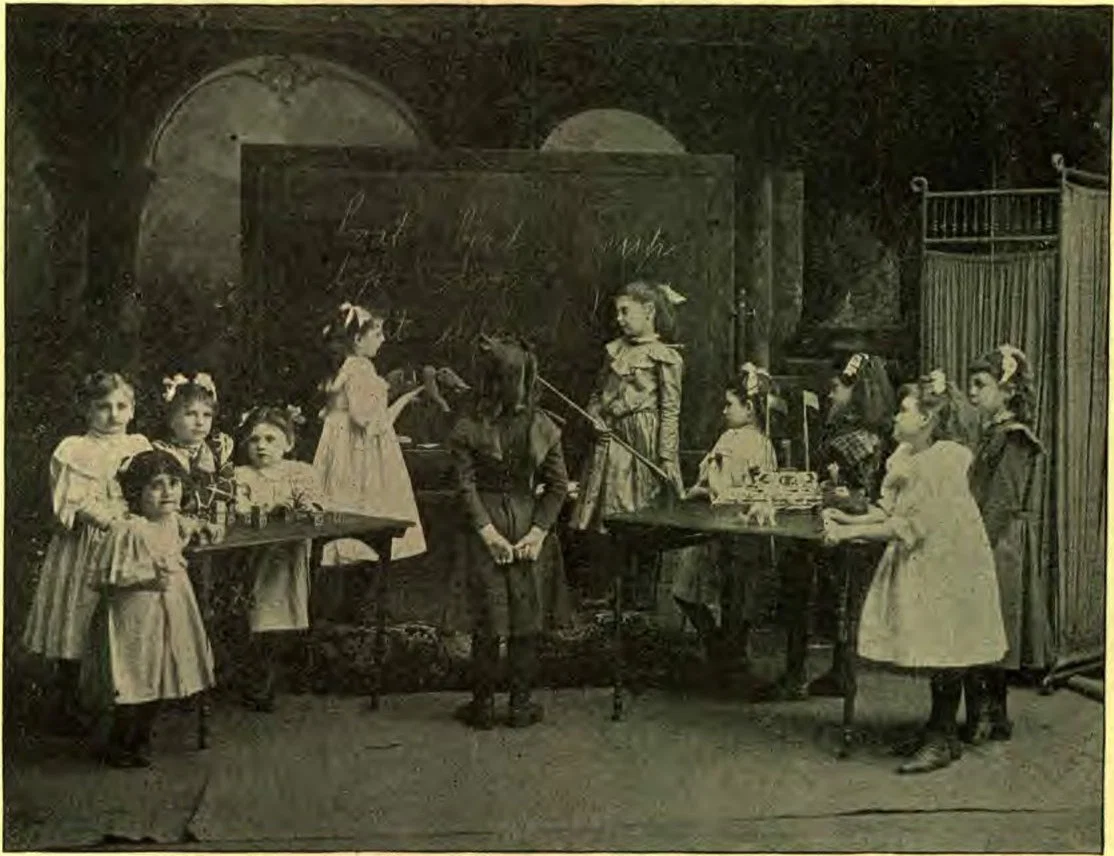
Few of the little folks who read this page realize the number of deaf-mute children there are in the world. Why, in the city of Chicago nearly a hundred girls are cared for in one school alone. This school is a silent one, and the pupils are never sent out in the hall for whispering. School never opens with singing, for a golden silence reigns at all times. They rise at six o’clock in the morning. Some of the larger children make the beds, put on the white spreads, and tidy up the sleeping-room, while others help dress the babies. Indeed, there is a general spirit of good nature and helpfulness through the whole school. At seven o’clock they go into the chapel for morning worship. They are very attentive and devout.
Each day has its separate duties for the inmates of the “Silent School.” Besides the ordinary studies, which range from the first to the eighth grade, there are housekeeping, cooking, millinery, and dressmaking classes. The dressmaking department has been divided. One class makes the dresses for the larger girls, and the other works on the children’s clothes. There are no idle hands in the silent school. Every one has his allotted share. Even the little ones, numbering eleven, and ranging from four to seven years, are taught order with their toys. Six little dolls and six little cups and saucers play a prominent part in their method of arithmetic. It is a great strain on the instructor to teach numbers, so it must be done in the most attractive way, to catch and hold the children’s attention.
The most interesting class in the silent school is the baby class. The youngest child in the house is four years old, a little brown-eyed Italian, with wavy black hair, and a most lovable manner. Her name is Mary Yanzitor. She came into the parlor the other day to see me, bowed politely, and threw me a kiss; all this in serious earnest, not a smile to be seen; then when I passed the four fingers of my right hand across my lips (the sign of candy), she laughed, and pressed her hand to her heart, which means, “I love.” Another little girl equally interesting is a Polish child, Regina Zagorske. She is five years old, bright and intelligent, and misses none of the fun in the playroom. I wish you could all see that room. In it there are building-blocks, elephants with rolling eyes and long tusks, balls to bounce, and above all, a large blackboard provided with colored chalks. This last seems to be the children’s greatest delight, as it is a means of expression, and helps them not only to express their own thoughts, but to understand one another.
THE SILENT SCHOOL
Now, dear children, you who have been blessed with the double gift of speech and hearing, have you ever for a moment stopped to think how thankful you should be that you can hear the music of the birds, the loving voices of your parents and friends, and that you can speak and sing? There is another thing—we should be very careful to listen to nothing that is evil, or that will make it easier for us to do wrong; and we should pray every day that our lips may be kept from foolish, idle talk.
“STOP, THIEF”
By Aunt Betty
“THIEF” is a disagreeable name to apply to any one; but a thief there certainly was. Father Nichols said the heap of potatoes in the root-cellar was diminishing altogether too rapidly. Mother Nichols said she was cooking no more than usual. And Harry, whose task it was to bring them to the house, said he never needed to uncover them, for there were always enough lying out on the covering, which was of sacks; for it was not yet cold enough to put earth over them. Here was a mysterious case, one that would bear watching. Yet who was to be watched? To be sure, the blue jays passed in and out at will; and they were thieves, too, and helped dig the potatoes every fall; but they couldn’t pull the sacks off, and they certainly wouldn’t crawl under them. And it wasn’t a gopher; for no gopher-burrow opened into the cellar.
But Constable Cat volunteered her services, and we were quite sure the thief was caught, when she came marching in, one day, dragging a big, gray wood-rat, and calling loudly for the family to come and admire her exploit. But where was the plunder?—Under the hay, probably; for the root-cellar joined the hay-barn.
A few days later Father Nichols invited mother and Harry out to see a “find” he had made in the barn. Away up in one corner, on top of the hay,—there they were, pink Early Roses, all about the same size, a little larger than a hen’s egg,—a bushel and a half!
AUNT BETTY.
THE VISITOR THAT CAME TO STAY
When Gordon Deems first got out to the country, early in June, he was too happy for anything. “I hope our old town house will burn down,” he cried, “so we need never go back to town to live, never—never—never!”
But as the summer drew to a close, Gordon looked at the trees and grass and flowers and butterflies and birds with very different eyes: he was tired of the country. If there had been another little child in the family, perhaps it would have been different, but Gordon was all the sons and daughters the family owned.
“I wish we had some company in this house,” Gordon said, discontentedly, pulling his dog’s tail for lack of something better to do; “over at the Cullen’s they have two little girls and a boy for company.”
“I found out to-day that we have a guest,” said Gordon’s mother; “one that came without any invitation, and evidently intends to spend the summer.”
“Sure enough, mama, without any fooling?”
“Well, it’s sure enough, and yet there is some fooling in it, too.”
“Is the visitor old or young, mama?”
“She is a young member of an old family.”
“Then it’s a girl,” said Gordon, somewhat disappointed.
“She wears a white lace bonnet,” said Mrs. Deems.
“Where does she stay?”
“I see her oftenest in the back yard.”
“The back yard!” cried Gordon; “that is a very strange place for company to stay.”
“Suppose you go and look for her,” suggested Mrs. Deems.
The little boy was gone an hour; and when he came in again, he was so full of chatter about an ant-hill he had found, that his visitor in a lace bonnet seemed forgotten.
“Did you find my summer company?” asked his mother, presently.
“Ma’am? Oh-h! I forgot. No, mother, but I’m going to look for her again to-morrow. Will she be here to-morrow?”182
“Didn’t I tell you she had come to stay all summer?”
“I’ll find her to-morrow, then,” said Gordon.
But while looking for this mysterious guest the next day, the little boy found a wren’s nest, and for several days he was intensely interested to see how many worms it took to feed those tiny birds. “They eat as much as elephants!” he declared, when he had counted thirty-nine meals in one day that the hard-working birds had carried to the nest.
Finally his mother had to introduce him to her company. In a far corner of the back yard, quite in the shade of the hedge, grew a tall and graceful plant of wild carrot, with finely branched foliage and delicate clusters of lace-like blossoms.
“How Miss Daucus Carota got here is her own secret,” said Mrs. Deems; “I did not invite her, nor send for her, nor see her come; but here she is, and very welcome, I’m sure.”
“What did you call her, mama?”
“Her company name is Daucus Carota, but her nickname, or home name, is ‘Wild Carrot;’ besides that, she is called ‘Birds’ Nest’ and Queen Anne’s Lace.”
“Why did you say she belonged to an old family?” asked the inquisitive small boy.
“Because nearly two thousand years ago Pliny says the carrot was brought to Rome from Candia; and from another writer we learn that ladies in Queen Anne’s day wore it in their hair.”
“And how about the ‘bird-nest’ name?” asked Gordon.
“Ah, my little questioner,” said Mrs. Deems, “that you can find out for yourself by watching our guest until she is ready to leave.”
Gordon is still watching the wild-carrot plant in the corner of his back yard. Which one of my little readers has seen her flower stems get dry and brown, and then rise in close curves to form a nest, in which eggs might be laid, but never are?—Sunday School Times.
CHARCOAL
By Ralph Benton
“CHARCOAL?” slowly repeated the druggist. He pronounced the word softly, as if he were studying how far the question would lead. Then he said, “The charcoal that we sell for medicine is made in two different ways.”
Sandy McLaurin had been helping in the drug store. One of his tasks was to fill some small boxes with willow charcoal. There was now a lull in business, and the druggist was in the back room; so Sandy asked the question about what he had been handling.
“One way,” continued the druggist, “is to arrange long, thick pieces of wood in a cone-shaped pile. This pile is then covered with sod, or earth, leaving one small opening at the top, and several at the bottom. Then the wood is set on fire, and gradually the holes through the sod (left to make a draft at first) are closed. The wood burns slowly, because the air is kept from it, and finally is changed into sticks of charcoal, instead of crumbling to ashes, as when burned in a stove. As a last step the charcoal sticks are crushed into powder in a mill.”
“Another way of making charcoal is to put heavy pieces of wood into closed iron cylinders, which are then heated. The principle is the same as in the old-fashioned way, when wood is covered with sod; that is, the wood is burned away from contact with the air. All the big powder-mills make charcoal in this way.”
“Is charcoal used in gunpowder?” asked Sandy.
“Yes. In fact, a large proportion of all the charcoal that is made is consumed in manufacturing powder.
“Charcoal is largely composed of the chemical element carbon. An element, I think I told you once, is a substance that has never been decomposed, or split up into other simpler substances. Gold and silver and copper are elements. The whole world is made up of about sixty-seven elements. By and by you will learn that the elements are the A B C of chemistry. You will learn that water is made up of hydrogen and oxygen gases; salt is formed of sodium and chlorine; and sugar contains carbon, hydrogen, and oxygen. Everything that you eat or drink or wear is composed of some of the sixty-seven elements. We’ll go back to carbon, however; that is what started my talk of ‘elements.’”
“Carbon has a wonderful family. The aristocrat of it is the diamond. I thought you would look surprised at that remark. Nevertheless, all those diamonds that you see in the jeweler’s window are pure carbon. They are carbon crystallized—the most permanent of gems, for they can neither be melted nor dissolved. The czar of Russia has set in the end of his scepter a diamond that is said to be worth three quarters of a million dollars, and there is one in England that weighs much less than a silver dollar, but it is valued at six hundred and twenty-five thousand dollars.
“The closest relative of the diamond is a smooth black substance called graphite. In one form you handle it every day, for graphite is used in making lead-pencils. Gas-carbon is a cousin of the diamond, and is obtained, as you might imagine from the name, in the process of making gas.”
“Why, I thought only three things came from bituminous coal,—gas, coal-tar, and coke,” remarked Sandy.
“You are correct, Sandy; but gas-carbon is another name for coke,” the druggist answered. “Now, the diamond gives exquisite and inimitable sparkles of light, which make it of great value as a jewel; but it gives only the pleasure of possession. Its sober-hued cousin, coke, affords broad beams of light, making the path of night easy to travel, and lessening the crime that used to prevail in dimly lighted city streets. For from coke the long, black pencils, or ‘carbons,’ used in arc-lights are made. First the coke is ground to fine powder. Then it is mixed with molasses, and made into a very thick dough. After being rolled into long cylinders having a thickness about equal to the diameter of a twenty-five-cent piece, it is baked. And night after night, in all seasons, the power that we know as electricity is at work in millions of pieces of carbon all over our great country, giving us light and comfort and safety.
“Yet,” continued the druggist, “I can’t say that this is the most marvelous effect coming directly from carbon. No doubt you know that steel is a certain form of iron, but, like many older people, you don’t know exactly how it differs from ordinary iron. Well, the difference is that steel is iron containing a very small proportion of carbon, from .75 per cent to 1.5 per cent, which causes the iron to become very, very hard. The surgeon, the carpenter, the engraver, and every one else who uses edged tools would be in a serious plight if obliged to depend on iron alone. With steel, however, a keen edge can be secured. The railroads in these days are almost all equipped with steel rails, which last longer than those of ordinary iron. All our wonderful cruisers and battle-ships wear outside cases of heavy steel plates. They are as strong as floating forts, and can withstand shocks and shots that would have sent an old-fashioned man-of-war to the bottom.
“So you see that the black, smudgy willow charcoal has interesting and useful relatives.”
—Ralph Benton, in St. Nicholas.
Dwelling in the House of the Lord
“One thing have I desired of the Lord, that will I seek after; that I”—in my study; I, in my shop; I, in my parlor, kitchen, or nursery; I, in my studio; I, in my lecture-hall—“may dwell in the house of the Lord all the days of my life.” In our “Father’s house are many mansions.” The room that we spend most of our lives in, each of us at our tasks or our work-tables, may be in our Father’s house, too; and it is only we that can secure that it shall be.—Alexander Maclaren.
12. What promise has Jesus given to all who believe in him? John 14:27; note 6.
13. What does the Lord say this peace will do for us? Phil. 4:7.
14. When one is thus blessed, what will he desire to do? Heb. 13:15; note 7.
NOTES
1. Let us not forget the order in which the offerings were made. First came the offering for sin, that one might find pardon. Second, the whole burnt-offering, in which the person, who had been forgiven, gave himself wholly to the Lord, “a living sacrifice.” Third was the peace-offering; for when the sinner had been pardoned, and had become wholly the Lord’s, then he could offer an offering of peace and thanksgiving.
2. All the offerings made were types of Jesus. But Jesus was a perfect offering, the perfect Lamb of God. God gave his best gift, and he did it gladly and willingly. Therefore, only perfect offerings can be accepted by him. He desires that his people shall do toward him as he has done toward them. And, surely, if one appreciates the great goodness of his Heavenly Father, he will wish to offer the very best he has, and offer it with a glad heart.
3. Only a part of the peace-offering was burned upon the altar. The shoulder and breast were given to the priests and their families. The shoulder was called the “heave shoulder;” the breast, the “wave breast.” The breast was waved before the Lord to acknowledge that God was the giver, and had a right to all. The priests were God’s servants, his ministers, and they, with their children, were to eat of the offering of peace and thanksgiving. Their food was provided them in the thank-offerings of God’s people. So it is now. The people whom the Lord has blessed with forgiveness, and who have consecrated themselves to him, will make offerings to183the Lord, which will be a blessing to the servants of God and their families. We may not call our offerings “wave offerings,” but they are just as truly so as they were then; and the Lord will make them a support to those who labor in his cause.
4. The priests were not the only ones to eat of the peace-offerings; the worshiper ate also. The offering was a type of Jesus, and so was to be shared by both the child of God and the minister of God. They both could sit at the Lord’s table, and hold communion with him.
5. The peace-offerings were divided into three kinds: (a) thanksgiving; (b) vow; and (c) free-will. In our service to God we, too, shall be glad to make offerings of thanksgiving, to make vows, and to present to the Lord free-will gifts. He who has peace can not help making these peace-offerings.
6. When Jesus promises peace, he simply promises himself. “He is our peace.” Eph. 2:14. He abides in the heart of every child of his, and by his power brings in quietness and gladness. There may come many trials and temptations, but his peace and joy continue unchanged and unbroken. And he who knows the peace which the Lord gives, will ever find it a blessed service to give his means, his life, and his praise to God, the giver of all. And all such service on his part will be looked upon by the Lord as peace-offerings, a sweet savor of righteousness.
7. Perhaps there is no one thing which a child of God loves to do more than to give praise to him who has brought peace to his soul. He longs to make known that which God has done. He who is ever silent when opportunities are given to praise, may well doubt whether God’s peace is within his heart. Let us not forget to “offer the sacrifice of praise continually.”
Youth's Instructor Letters from Readers and Nature Notes
Stevensville, Mont. Dear Youth’s Instructor: On each side of our home there are mountains. In the summer, when it is hot down in the valley, we can look up and see snow on the mountains. I have two pet pigeons; they are very tame, and will alight on my shoulder, and eat wheat out of my hand. Edward Barker.
North Windham, Conn. Dear Youth’s Instructor: The other day I saw a bird whose name I do not know. It looked something like a robin; the head, the upper part of the back, and the tail were quite black. Under the black feathers were white ones, and the breast was red and white. I should be glad to know its name, for I am very much interested in the study of birds. I am twelve years old, and attend a church school. Clara M. Standish.
From your description, the bird might be the Chewink, sometimes called the Towhee Bunting.
Bethel, Wis. Dear Youth’s Instructor: I am attending our school at this place, and enjoy it very much. It is a grove, and the boys are clearing the land, and piling up the brush to burn. The trees are filled with birds, and there are many wild flowers. I am raising some hens, and shall soon have eggs to sell for missionary money. I enjoy reading the letters in the Instructor.
We children have a work to do,
And all the grown-up people, too;
For Jesus loves us all the same,
And strength will give through his dear name.
Golden H. Covert (11 years old).
Dodge Center, Minn. Dear Youth’s Instructor: Last summer I had a flower garden; and as I pulled the weeds out of one of the beds, I noticed that some of them came out easily, some a little harder, and others were almost impossible to pull out. Then I thought of our habits. Some can be easily changed, others come up out of the heart a little harder, while those which we have practiced longest are almost impossible to get rid of. Gertrude Akins (12 years old).
Marysville, Kan. Dear Youth’s Instructor: I am a boy ten years old. I have received five copies of the Instructor, and I like it very much. I am going around and get subscriptions for it. I have learned all the Sabbath-school lessons in the paper so far. Last summer some king birds built a nest in one of our cherry-trees. When I would go out into the garden, they used to fly down, and snatch at my head. I live by the side of a park. It is full of redbirds. Clinton Hankins.
Dunbar, Neb. Dear Youth’s Instructor: I am taking the Youth’s Instructor, which I paid for myself, and enjoy reading. One Sabbath morning this spring we were all out on the porch getting ready for Sabbath-school, and when mama went into the house for something, she saw a wren flapping its wings against a window, and she called us children in to see it. The poor thing was so frightened we could see the feathers on its breast move when its heart beat. It was so overcome with fright and exertion that it was almost dead, so mama carried it outdoors, and put it in the fork of a tree. When it had rested a while, it flew away to join its mate, which was calling to it. Neva Buckridge.
Pratum, Ore. Dear Youth’s Instructor: Mama took my two sisters and me to see our grandma; it was three and one-half miles. We were going to come home the next day, but it rained too hard, so we stopped there two days. We helped feed the calf and the horse, and gather the eggs. When we were coming home, we saw a sparrow hopping on the ground; we picked it up, and saw that its tail was gone, and its wing hurt. I thought it had been shot. I asked mama if I could take it home, but she said the cat might get it, so we let it go. I am nine years old. Gladys Rosser.
If the men and boys who shoot birds would only stop to think of the suffering caused to those that are not killed, but only injured, and left to suffer, perhaps for days, there would surely be fewer who would seek pleasure in this cruel way. It is often the kindest thing one can do, when finding a wounded bird, to kill it mercifully, and thus end its suffering.
SELF-PRONOUNCING S.S. Teachers’ Reference Bible
Contains the Celebrated Teachers’ Helps, comprising nearly 400 pages. Also a complete series of fifteen new maps.
DESCRIPTION
IMPERIAL SEAL BINDING. TUCK EDGES, known as “DIVINITY CIRCUIT,” ROUNDED CORNERS, FULL RED UNDER GILT EDGES.
We offer this Bible, postpaid, for only six new yearly subscriptions at 75 cents; or twelve new six months’ subscriptions at 40 cents. We will also send it, postpaid, with the INSTRUCTOR one year for $2.25. For 20 cents extra we will stamp your name in gold upon the cover. Address—
THE YOUTH’S INSTRUCTOR, Battle Creek, Mich.
Hearts Good and True
By Faber
HEARTS good and true
Have wishes few,
In narrow circles bounded;
And hope that lives
On what God gives
Is Christian hope well founded.
— Faber.
AN ALL-THE-YEAR-ROUND SUCCESS
By Editor
THAT is what our INSTRUCTOR Premium Bible is—an all-the-year-round success. Every one who gets it likes it, and a great many are getting it. A reader in California, who ordered the Bible as a gift for a friend, says: “Mrs. G—— was delighted with her Bible. She came to thank me, with her face all smiles, and then carried the book around all the afternoon, showing it to the neighbors.”
With this letter the sister ordered another Bible, with a year’s subscription to the INSTRUCTOR, sent to another friend. She also inclosed one dollar as a gift toward keeping up the INSTRUCTOR Mission Fund. Surely this is a good work.
A brother in North Dakota writes: “The INSTRUCTOR Premium Bible is grand. All who have seen it think the same. It is much better than I expected. Any one wishing a good Bible can not get one better or cheaper.”
The INSTRUCTOR Premium Bible is all that is claimed for it—large, plain print, excellent helps, imperial seal binding, rounded corners, and red under gilt edges. The terms on which it is offered place it within the reach of every one who wants a Bible. Would you like one? Read our offer on this page.
Our Premium Testament
By Editor
As an aid to daily Bible study, and to memorizing the Scriptures, there is nothing better than a pocket-edition. We have secured a beautiful Vest-pocket New Testament, size 4 x 2¾ in., that we offer, postpaid, with the INSTRUCTOR one year, for only $1.00. Well printed, in ruby type, as shown; Flexible Covers, Round Corners, Red under Gold Edges,—a splendid little book.
St. Matthew, 13.
42 The queen of the south shall rise up in the judgment with this generation: and shall condemn it; for she came from the uttermost parts of the earth to hear the wisdom of Solomon; and, behold, a greater than Solomon is here.
43 When the unclean spirit is gone out of a man, he walketh through dry places, seeking rest, and findeth none.
44 Then he saith, I will return into my house from whence I came out; and when he is come, he findeth it empty, swept, and garnished.
45 Then goeth he, and tak-
50 For whosoever shall do the will of my Father which is in heaven, the same is my brother, and sister, and mother.
Chapter 13.
3 The parable of the sower and the seed; 24 The parable of the tare, 31 of the mustard seed, 33 of the leaven, 44 of the hidden treasure, 45 of the pearl, 47 of the draw-net. 53 Christ is contemned of his own countrymen.
1 The same day went Jesus out of the house, and sat by the sea side.
2 And great multitudes were gathered together unto him, so that he went into a ship, and sat; and the whole multitude stood on the shore.
This offer is made to both renewals and new subscribers. Address—
THE YOUTH’S INSTRUCTOR,
BATTLE CREEK, MICH
Baby’s First Wardrobe
By Mrs. F. M. Kellogg
HYGIENIC PATTERNS
Complete outfit, based on healthful principles—22 NEAT PATTERNS, with full directions for making, showing necessary material, etc., sent, postpaid, for 50 cents. A beautiful booklet on the proper care of infants also included with every order. Send stamps or silver to — MRS. F. M. KELLOGG, 36 Washington Ave., Battle Creek, Mich.
GRAND TRUNK R'Y. SYSTEM.
By W. C. Cunliffe
Taking Effect Dec. 16, 1900.
Trains leave Battle Creek.
WEST-BOUND.
No. 2, Mail and Express, to Chicago ........................ 12.15 P. M.
No. 1, Chicago Express, to Chicago ........................ 8.30 A. M.
No. 3, Lehigh Valley Express, to Chicago .................. 8.50 P. M.
No. 5, International Express ............................. 2.17 A. M.
No. 75, Mixed, to South Bend .............................. 8.30 A. M.
Nos. 9 and 75, daily, except Sunday.
Nos. 1, 3, and 5, daily.
EAST-BOUND.
No. 8, Mail and Express, East and Detroit ................. 3.45 P. M.
No. 4, Lehigh Express, East and Canada .................... 8.22 P. M.
No. 6, Atlantic Express, East and Detroit ................. 2.10 A. M.
No. 2, Express, East and Detroit .......................... 6.50 A. M.
No. 74, Mixed starts from Nichols yard .................... 7.15 A. M.
Nos. 8 and 74, daily, except Sunday.
Nos. 4, 6 and 2, daily.
W. C. CUNLIFFE, Agent,
BATTLE CREEK.
Chile Plans to Fortify the Straits of Magellan
Chile's New Move.— It is reported in diplomatic circles that Chile has decided to fortify the Straits of Magellan, which are in her territory. In this case, if she desired, Chile could force the ships of all other nations to go around Cape Horn.
Largest Loaves of Bread
In France and Italy are to be found the largest loaves of bread in the world. What is called the “pipe” bread of Italy is made in loaves that measure from two to three feet in length; while in France it is an ordinary sight to see the waiter bring in a loaf measuring from four to six feet in length.
A Horseless Plow.
A West Virginia farmer is making use of an elephant to do his plowing. A circus having broken up in his vicinity, the animal was purchased by him at auction for a moderate amount. Since “the animal eats little more than a horse, and does many times the work, and is gentle and docile,” the enterprising farmer is well satisfied.
The World's Largest Hopyards.
The largest hopyards in the world are to be found in California, along the Sacramento, Russian, and Feather rivers. The largest hopfield is situated at Pleasanton, Alameda County, contains three hundred and sixty-eight acres, and has nearly four hundred and fifty thousand vines under one wire. All the picking of the blossoms must be done by hand.
Slanderous Silence.
Many who flatter themselves that they are not the possessors of a slanderous or evil tongue may be compared to a man of whom it was said that he “never uttered a slanderous word, so that it could be put on record against him; but by means of a nod, or an expressive look, or a shake of the head, of an eloquent silence, he managed to encourage more rumors, and work more mischief in the community than any slanderous tongue.” A man’s silences should be as truthful as his speeches.
A Ticket’s Curious Flight.—
As a north-bound train on a Western road passed one of the stations, a passenger in a forward car raised a window, says the Railway Journal, and in an instant his ticket was blown from his hands outdoors. The passenger naturally gave it up for lost, and was very much surprised when the baggage-master handed it to him a little while later. It appears that when the ticket flew through the window, a south-bound train was passing. The suction of that train, which was moving at a rapid rate, drew the ticket along with it, and, as it passed the rear end of the north-bound train, it blew into the door of the smoking-car, where it was found by the baggage-master.
Sprinkling Streets with Sea-Water.
The Merchants’ Association of San Francisco, Cal., has been trying the experiment of sprinkling a street with sea-water, says the Popular Science Monthly, and finds that such water binds the dirt together between the paving-stones, so that when the street is dry, no loose dust is formed, to be raised by the wind. It has also been observed that sea-water does not dry so quickly as fresh water, so that one load of salt water is equal to three loads of fresh water. The salt water which is deposited on the street absorbs moisture from the air during the night, whereby the street is thoroughly moist during the early morning, and has the appearance of having been freshly sprinkled.
To Convert an Enemy.—
In his “Autobiography,” Benjamin Franklin states that “when he found a man opposed to him, and likely to become his enemy, he immediately contrived to ask a favor of him. The favor was usually granted, and the man not only ceased to oppose him, but became his lifelong friend.” Or, to put it in the words of the well-known saying, “He that has once done you a kindness will be more ready to do you another than he whom you yourself have obliged.”
A Modern Hero.
The following bit of intelligence from Indianapolis, Ind., shows that the world still has many unheard-of heroes: “William Phelps, a colored mill worker, and James Stansbury, were caught inside a boiler when an employee turned on the steam. Both men jumped for the ladder. Phelps reached it first, but stopped, jumped aside, and said, ‘You go first, Jim; you are married.’ He lived for two hours afterward.” Such a man is worthy the commendation, “Greater love hath no man than this, that a man lay down his life for his friends.”
Wellington's Rigid Integrity.
The real-estate agent of the Duke of Wellington once purchased for him some farm lands adjoining the latter's vast estates. Having made the purchase, the agent went to the duke, and told him that he had made “a capital bargain.” “What do you mean?” asked Wellington. “Why, your grace, I bought the farm for so much, and I know it to be worth at least so much more.” “Are you quite sure of that?” “Quite sure, your grace, for I have carefully surveyed it.” “Very well, then, pay the gentleman from me the balance between what you have already given and the real value of the estate.”
Lincoln's Temperance Pledge
While a member of Congress, Abraham Lincoln was once criticised by a friend for “his seeming rudeness in declining to test the rare wines provided by their host.” The friend said to him: “There is certainly no danger of a man of your years and habits becoming addicted to the use of wine.” “I meant no disrespect, John,” answered Lincoln, “but I promised my precious mother, only a few days before she died, that I would never use anything intoxicating as a beverage, and I consider that promise as binding to-day as it was the day I gave it.” “But,” the friend continued, “there is a great difference between a child surrounded by a rough class of drinkers and a man in a home of refinement.” “A promise is a promise forever,” answered Lincoln, “and when made to a mother, it is doubly binding.”
Swallowing a Farm.
The following excellent temperance address by Robert Burdette is worthy of a careful perusal: “My homeless friend with the chromatic nose, while you are stirring up the sugar in a ten-cent glass of gin, let me give you a fact to wash down with it. You may say you have longed for years for the free, independent life of a farmer, but you have never been able to get money enough to buy a farm. But there is where you are mistaken. For some years you have been drinking a good, improved farm at the rate of one hundred square feet at a gulp. If you doubt this statement, figure it out for yourself. An acre of land contains 43,560 square feet. Estimating, for convenience, the land at $43.56 an acre, you will see that it brings the land to just one mill a square foot. Now, pour down the fiery dose, and imagine you are swallowing a strawberry patch. Call in your friends, and have them help you gulp down that five hundred-foot garden. Get on a prolonged spree some day, and see how long it will take to swallow a pasture land to feed a cow. Put down that glass of gin! There is dirt in it—three hundred feet of good, rich dirt, worth $43.56 an acre.”