The Youth’s Instructor, Vol. 37, No. 32.

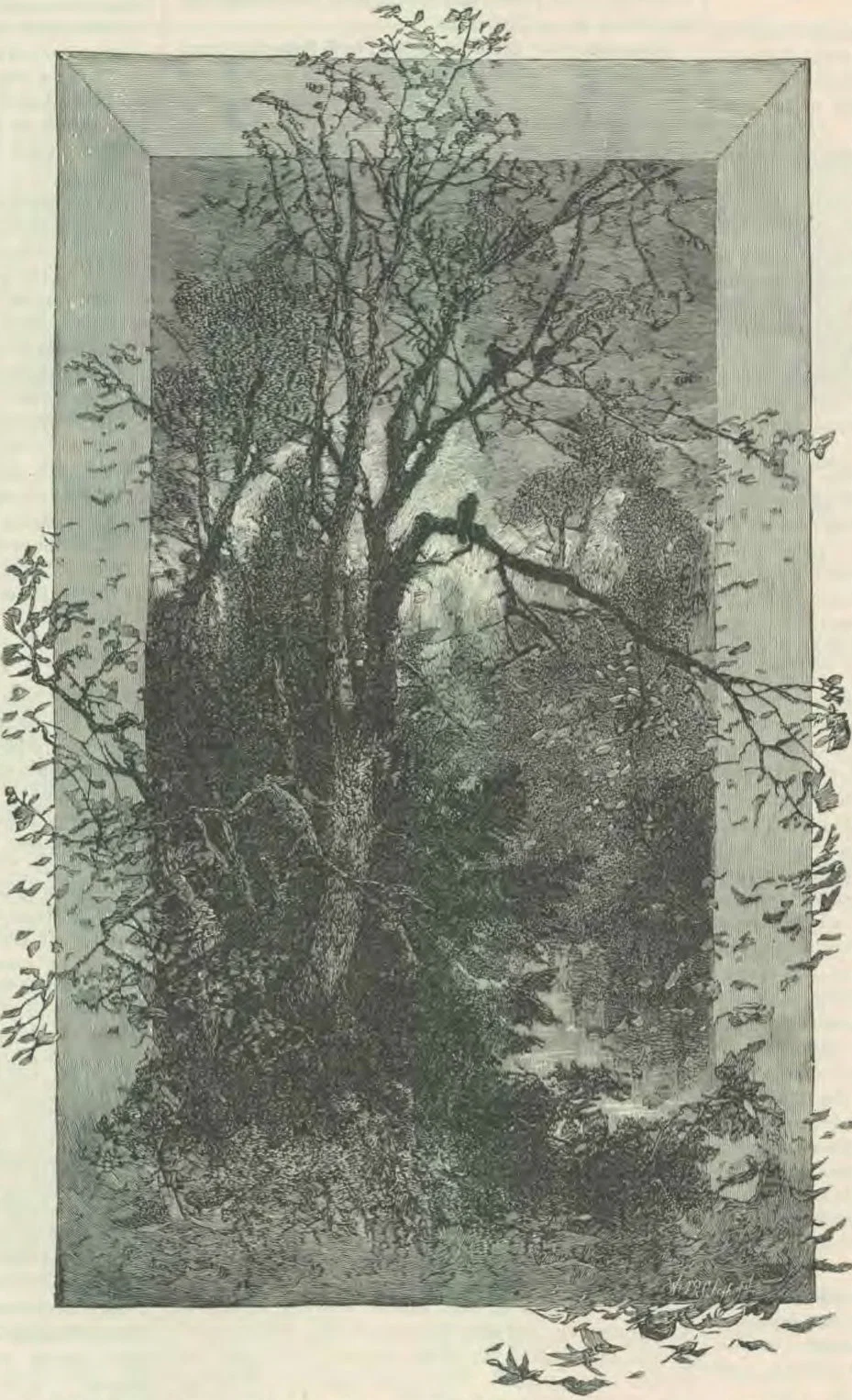
IN THE HEART OF THE WOODS

The Youth’s Instructor

Aug 7, 1889

S. D. A. Publishing Association · Battle Creek, Mich. · Aug 7, 1889

IN THE HEART OF THE WOODS.

SUCH beautiful things in the heart of the woods! Flowers and ferns and the soft green moss: Such love of the birds, in the solitudes, Where the swift wings glance, and the tree-tops toss, Spaces of silence, swept with song Which nobody hears but the God above; Spaces where myriad creatures throng, Sunning themselves in his guarding love.
Such safety and peace in the heart of the woods, Far from the city's dust and din! Where passion nor hate of man intrudes, Nor fashion nor folly has entered in. Deeper than hunter's trail hath gone, Glimmers the tarn where the wild deer drink; And fearless and free comes the gentle fawn, To peep at herself o'er the grassy brink.
Such pledge of love in the heart of the woods! For the Maker of all things keeps the least And over the tiny floweret broods, With care that for ages has never ceased. If he care for this, will he not for thee— Thee, wherever thou art to-day? Child of an infinite Father, see: And safe in such gentlest keeping stay. —Margaret E. Sangster.

A TEMPERANCE STORY WITH THREE HEADS.

MOTHER, Uncle John says may we go to the city with him to-morrow?
“To-morrow? Oh, I don’t know about that, Ross. I don’t want you to miss school for a whole day.”
“He says, mother,” spoke up the other curly-headed boy, “that he is going to give us three object-lessons that will be worth—what did he say they would be worth, Ross?”
“Three times three temperance lectures, he said.”
“Temperance lectures?” said the mother, looking at her tall boys with a sudden anxious pang. “Yes, you may go. Uncle John would not ask you to miss school unless he had a very good reason for wanting to take you with him.”
Ross and John Pratt were twin brothers, so much alike as regards brown eyes, short, crisp brown curls, long, straight noses, and loud, merry voices, that few people were able to tell them apart. In their baby days the black mammy called each “Mars-John-Ross,” not at all knowing which was which.
Their mother had been left a widow when they were only two years old; but it was whispered among her friends that her husband’s death had saved her from a worse fate,—that of a drunkard’s wife. And now her strong cry to God, day by day, was that these two beautiful boys might have strength given them to resist the temptation in their blood to intemperance.
Uncle John had his way, and the boys set out with him on the cars for the city, twelve miles off. There they took the street-cars. It was a cold winter morning, and the idle feet ached with cold in spite of the thick bed of straw in the street-car.
“I say, Uncle John, can’t we walk to whatever place you are taking us?” asked namesake John; “this old tram is just a piece of the frigid zone.”
“No; we couldn’t put in the three visits if we trusted to Shank’s mare,” answered Uncle John. “Shuffle your feet about in the straw.”
The car presently left streets and stores behind, and began to travel through desolate-looking tracts, half field, half suburb, on and on; over poor, unused lands, past scrubby timber, until suddenly a great bare-looking house came into view, looking lonesome and dreary.
“Well,” exclaimed Ross, “I’ve been hearing all my life about ‘the end of pea time,’ and I think we have certainly come to it.”
“Don’t you know what this place is?” asked Uncle John.
“It looks like a jail.”
“Not exactly; it is the alms-house, or what you have always heard called the ‘po’-house,’ where people too old or sick or worthless to earn a living are supported by the State.”
The manager knew Uncle John, and seemed glad to see him; he allowed him to take the boys all over the building. Such sad, worn-out, hopeless, unhappy old lives they saw there! John and Ross began to wish themselves at school.
“Now, Mr. Piper,” said Uncle John, when they came back to the door, “I want you to tell these lads of mine how most of these people came here.”
“Humph!” said the big, gruff manager, “that’s a short horse, and soon curried,—’twas drink. Ef ’twan’t drinkin’ themselves, ’twas some un’s else drinkin’. Ef ’twan’t for drink, we could sell this here pile for old brick.”
“There, boys, here endeth your first lesson,” said Uncle John. Then seeing them look depressed, he proposed a race across the country to catch another horse-car, and soon the chaps were in fine spirits again, racing, jumping, tossing up their heads like a pair of colts.
The next car gave them a long ride too; it seemed to skirt the city, running past machine-shops, tan-yards, and the like.
“Looks as if we were getting into town by the back door,” said young John. “Halloo! I hope that a’n’t another ‘po’-house.’”
It was the city jail and penitentiary, a great handsome pile of stone architecture, clean and well kept, but awfully still and somber.
“Ugh! it feels like a grave,” grumbled Ross.
There they were shown prisoners in solitary cells, and hundreds and hundreds of men and boys in striped clothes and with shaven heads, working in stone and wood and leather.
“Captain,” said Uncle John to their keeper, “I would like to ask if you know any one thing, more than another, that has brought these wretches to this place.”
“Now go ’long, mister,” said the keeper, who, to the boys’ great surprise, seemed a very jolly sort of fellow. “Where have you lived? You a’n’t even passed a s’loon, likely, much less been in one.” And the man winked as if it was a good joke.
“You think it was whisky, then?”
“Think!” he repeated, significantly. “No, I don’t think nothin’ ’tall ’bout it.”
“Here endeth your second lesson,” said Uncle John gravely, as the heavy door swung behind them, shutting them into the free, sweet air again.
“Look here, Uncle John,” said his namesake; “I’d like to graduate from these lessons right here. I don’t want any more of the same kind.”
“One more, John,” said his uncle resolutely, bending his steps toward the water. “One more, and then I’ll let you off.”
A fussy little steamer took them a few miles down the bay, and landed them a short distance from what Uncle John told them was the largest insane asylum in the State.
“It is in the hands of Roman Catholics,” he said; but the State makes a large appropriation to it, and keeps hundreds of poor patients here.”
This was a very beautiful place,—trees, grass, and flowers, all in beautiful keeping; and as for the buildings, the white-capped “sisters” kept everything as white and polished as an ivory cabinet. But the boys felt the chills run down their backs as they walked through the dangerous wards, seeing the wild faces through the grating, and hearing the hideous shrieks and groans.
“Let us go home, uncle!” cried Ross. “This is dreadful!”
“Not till Dr. Magill tells us something of these people and what brought them here,” answered his uncle.
“What brought them here?” echoed the doctor in surprise. “Oh, that would be a long story,—generations long. But I tell you what I do think,” he said with a sudden energy, “that if you preachers could just get men and women to lead sober lives for three or four generations, these halls would be nearer empty.”
Uncle John promised the boys that he would never again take them on such a journey.
“Next time you get a holiday, we’ll go to the park, and have a good time. But I want you to take in, once for all, what drinking does. There is one other place that I might have shown you, and that is the graveyard, where hundreds of drinkers go every year; but the graves tell no tales.”
“Mars-John-Ross,” said one curly-headed boy to his chum,—and this was their favorite name for each other,—“I’d a long sight rather go to that place now than to do anything to bring me to any of the others: wouldn’t you?”
And on this the twins were firmly agreed.—Elizabeth P. Allan.

LOVELY, THOUGH PLAIN.

MAX O’RELL said that what struck him most in America was the total absence of stupid-looking faces. “It is my opinion,” he writes, “that American beauty mainly consists in intelligence and activity of bearing.” As a matter of fact, it may be said that in every country there are far more plain-faced people, of both sexes, than there are beautiful ones, and the most astonishing thing is that plain people are often more lovely than beautiful ones.
If you will run over a book of portraits of famous men and women, you will be surprised to find how plain they are, with hardly an exception. It would be unjust to particularise; but we can all recall great authors, poets, and artists, whose faces were absolutely devoid of beauty, and we have frequently heard the expressions: “Could he have painted that picture?” “Is it possible she is the author of that sweet poem?”
We say this because we somehow think that beauty ought to accompany genius, although we are every day convinced that it does not. But “loveliness” is nearly always an accompaniment of true genius. Loveliness is not beauty; it is something better.
In nature and human nature we find that ordinary beauty of form and feature is external, while real loveliness is internal; and that, when the inner grace comes forth, there is a transformation of the ordinarily apparent plainness into a beauty that becomes a present delight and an everlasting treasure.
A handsome face is only an indication of physical excellence, and may be attached to a doll’s head. A handsome person may become a genius, but it will not be on account of beauty; but a lovely face wins all hearts, sooner or later.
The face, then, is the real index of the heart. A countenance which is always influenced by amiable emotions comes to have, in the course of time, a beauty of the finest kind; for the deepest and most predominating feelings of the heart are stamped upon it; and though it be not a beauty according to the standard of so-called society, it is as noble and superior as it is indescribable.
A lovely person must, first of all, be intelligent, and, secondly, be amiable. Either one of these qualities without the other would be of no advantage. Intelligence teaches the lovely person what to say, and amiability tells him how to say it.
It would be vain to combat against the favorable influence of charm and manner. Engaging manners and bright conversation must and will always sway those brought under their attraction, and it is right that they should do so. Beauty thinks it needs no accomplishment, but plainness cultivates the graces, and becomes lovely.
Sweetness of temper, good nature, ready compliance, forbearance under slights and hindrances, and a toleration of others’ infirmities, go to make up the sum of loveliness, and together form a combination that is simply irresistible.
It is the lovely girls who are popular, not the handsomest girls, who presume on their beauty, and find, when too late, that they have lost friends as well as influence. The lovely girl never wants for friends in any station in life, and if they ever think of her plainness, it is to call it true beauty—that which shines through from the soul, and ennobles the countenance. —Golden Days.

PUTTING HEART INTO IT.

The customer was a prudent matron from the country, careful in her shopping. “It is a pretty piece of goods,” she said, “and just the color I want; but I am afraid it will not wash.” One of the shop-girls behind the counter bowed indifferently, and turned away. The other said, eagerly: “Are you going to another part of the store, madam? For it is my lunch hour, and I will take a sample to the basement, and wash and dry it for you before you come back.”
The colors of the fabric proved to be fast, and the customer bought it, and asked the name of the obliging shop-girl. A year afterward she was again in the same store, and, on inquiry, learned that the girl was at the head of the department.
“She put as much life into her work as ten other women,” said the manager.
One of the most prominent business men of New York said once: “I have always kept a close watch on my employés, and availed myself of any hint which would show me which of them possessed the qualities requisite for success for themselves and usefulness to me.”
“One day when I was passing the window of the counting-room, I observed that the moment the clock struck six, all of the clerks, with but one exception, laid down their pens, though in the middle of a sentence, and took up their hats. One man alone continued writing. The others soon passed out of the door.
“‘Pettit,’ said one, ‘has waited to finish his paper, as usual.’”
“‘Yes. I called to him to come on, but he said that if this was his own business, he would finish the paper before he stopped work.’”
“‘The more fool he! I would not work for a company as for myself.’”
“The men caught sight of me, and stopped talking; but after that I kept my eye on Pettit, who worked after hours on my business ‘because he would have done it on his own,’ and he is now my junior partner.”
The success of a young man or woman in any work or profession depends largely upon the spirit which he or she puts into it. Many good workmen, who are faithful to the letter of their contract with their employers, remain salesmen and book-keepers until they are gray-headed, while others pass over them, and become heads of establishments of their own. To the first class their employment is only so much work for so much wages; they “have no heart in it;” to the second, according to the old significant phrase, it is an outlet for all of their own energy and ambition.
An engine, perfectly finished and competent for its work, with no fire in it is a fit type of the first class; the same engine with its steam up, rushing along the track, of the second.
Be sure, boys, that you are able for your work, and are on the right track. Then don’t spare the steam!—Selected.

THE NOBLE NATURE.

It is not in growing like a tree In bulk doth make man better be, Or standing long an oak, three hundred year, To fall a log at last, dry, bald, and sere: A lily of a day Is fairer far in May, Although it fall and die that night— It was the plant and flower of light. In small proportions we just beauties see; And in short measures life may perfect be. —Ben Johnson.

Good Manners: Politeness Commanded by God

GOOD MANNERS.—NO. 2.

In our first article, we told you that it is well worth the while of any boy or girl to be polite. To what I said then, I will now add that God commands the Christian to be polite, and of course all the INSTRUCTOR family try to be Christians.
Now take your Bibles, and turn to 1 Peter 3:8, and you will find the command, “Be courteous.” If you will turn to the dictionary, you will find that courteous means polite, civil. Then the Bible says, Be polite, be civil. I hope you will all remember. It might be well to write the words in convenient places, so that you can have them before you. We told you also of some things not to do if you would be thought well of. Also of one thing to do. These are not the only ways by which you may show politeness, but you must practice these if you would be polite.
According to promise, I will tell you how rude children were managed—how they were punished—in Bible times. Children were well instructed. Parents were careful in bringing up their children; but then as now, some were so bad the parents could do nothing with them. They had no reform schools in those days, and when a boy got so bad that father and mother could not control him, the law took hold of him, and severely too. Turn and read Deut. 21:18-21. This shows what became of “stubborn and rebellious” boys. Rather severe, but the Lord commanded it. Every child knew all about the law and what to expect, so there was no excuse if he was stoned to death.
God does not require such punishment now, but disobedience to parents is as great a sin now as then, and unless repented of and turned from, will surely keep you out of the kingdom.
There is a passage in Proverbs that reads: “The eye that mocketh at his father, and despiseth to obey his mother, the ravens of the valley shall pick it out, and the young eagles shall eat it.” Chapter 30:17. The bad boy who would not obey his parents, and would have his own way, was put to death by the law, as we have seen.
Persons stoned to death, or put to death by the law in any manner, were looked upon as cursed indeed, and their bodies were often thrown into ravines and other out-of-the-way places, and the wolves and the vultures would devour them. This may have been the fate of many a bad boy. How terrible to die in the open field without burial!
After the ascension of Elijah to heaven, as Elisha was going along the road to Bethel, “little children”—but old enough to have respect for others—came out of the city, and made fun of him, and said to him, “Go up, thou bald head; go up, thou bald head.” Elijah had gone up to heaven, but the people did not believe it, and ridiculed the idea. The young people, hearing the older people talk, caught their wicked spirit, and insulted the old prophet of God, by telling him in a sneering manner to “go up.” God took Elijah up to heaven, and Elisha was left to do his work on earth, and God would have him well treated. Elisha pronounced the judgments of God upon the wicked young people. They paid dearly for their disrespect. See 2 Kings 2:23, 24.
N. J. BOWERS.

Two Views of Things.

There is a quaint Arabian legend which tells of the pilgrimage to Mecca of two devout followers of the Prophet. Abouk journeyed on foot; Selim was mounted on a camel. At nightfall both the pilgrims had reached a spring of water in the desert, where grew a few palm trees. They prepared to spend the night together. “It is a long and tedious journey,” said Abouk. “On the contrary, it is short and pleasant,” answered Selim; “I was cheered by a mirage on the horizon, wherein I saw the spires and temples of the Holy City.” “There was no mirage, no Holy City to be seen!” angrily declared Abouk; “there were, instead, legions of venomous ants in the sand, that bit and poisoned my flesh.” “Not a single ant was on the desert,” rejoined Selim.
The two pilgrims were quarreling fiercely, when a good priest, also journeying toward Mecca, came up. He listened to them patiently. “Peace, my brethren,” he said, at last; “let us leave these questions until to-morrow night to decide. In the meantime, let Selim go on foot, and Abouk ride the camel.” They consented to this exchange of places. On the next night it was Abouk who had seen the glorious vision, and found the journey pleasant, and it was Selim who had been bitten by the ants.
“My brothers,” said the priest, “we all going to Mecca, whether we walk or ride; but Selim cannot see what Abouk sees, unless he stands where Abouk stands.” It is well to change places occasionally.—Argonaut.

“THE DARKEST HOUR.”

I CALLED to see my dear friend lately, and she repeated to me a poem in which these two lines occurred:—
“I'd rather walk with Him in the dark Than to walk alone in the light.”
And I assure you the former is far safer for us than the latter. He never lets us fall, if we hold His hand!—Pansy.

MARY WHITE'S DAISIES.

WHEN little Mary on the green First learned to run alone. 'Twas spring, and all around were seen White daisies, newly blown. She called them lambs, and watched to see Them rise and run away; She called them stars—"How sweet 'twould be If stars came down to play!"
"And see," she cried, "how every one Seems looking up at me! What are you, pretty things? Speak on; Will you my playmates be? You must be flowers, although, indeed, Ma's greenhouse ones are red; And don't you pretty white ones need A window and a shed?
"My mamma says—and mamma knows— Flowers love good children well. My Cousin Rose has hers named rose; And one has little Belle, Called blue-bell, for her eyes are blue; My cousin, Mary Gould, Has hers named marigold; and, true, I have all I can hold.
"O mamma! mamma! come and see! These flowers are such delights. I'm going to name them after me, And call them Mary-Whites!" —Our Little Ones.

THE WOMBAT.

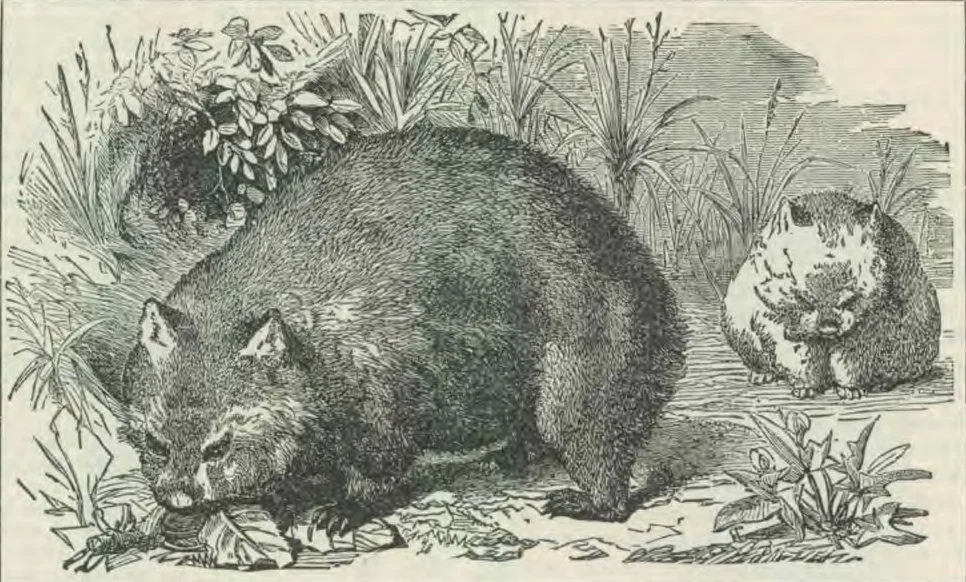
The peculiar looking creature shown in the picture on this page is a native of Australia and Tasmania. There are said to be three varieties of them, though the writer has seen only one,—that which is common to South Australia.
WOMBAT.
WOMBAT.
The wombat has a body a little more than two feet long, and, as may be noticed in the engraving, is very stout and large in proportion. It has a sack under the belly, in which it carries its young, the same as the kangaroo. Its fur is very soft, and generally of a brownish gray color; though some have been found of a pale yellowish brown, some of dark gray, and others almost black.
The legs of these creatures are very short and stout, with sharp, curved claws, which adapt them to burrowing. They live mostly on roots and other vegetable substances, which they gnaw, much after the fashion of a rat. In their walk they resemble the native bear, or sloth, of Victoria, to which they have a likeness in other respects. This walk is a sort of clumsy shuffling, which seems very awkward, and yet it is said that they will move quite rapidly from one point to another, despite the obstacles which may be placed in their way.
They sleep during the day, and go in search of food after nightfall, and are therefore very shy. They are generally quite gentle, but when provoked, bite savagely. The only noise the common wombat makes is a low hissing; but one variety is said to emit a short, quick grunt, when disturbed. They are very easily caught and kept in captivity, but are very indifferent to their keepers. Those seen by the writer were in captivity, and they could not be prevailed upon to move from their snug corner in the straw, only when they wished to eat. They are not very companionable, and so there is little opportunity to get acquainted with them. J. O. C.

OF SUCH IS THE KINGDOM OF HEAVEN.

“Mamma, I am very happy this morning,” said Edith Wise, as her mother kissed her for good morning, and tenderly smoothed back the hair from her little girl’s brow. “I have been lying awake a long time, and it is very beautiful to hear the birds sing their lovely good morning songs; and the smell of the flowers is so sweet, and I have so much to do, mamma, that I can hardly wait till after breakfast to begin.”
May be you think that Edith is going to the woods to find the beautiful flowers that are hiding there; or that with her books she will hurry away to school, and take her place in the class with the other children; or that she will roll her hoop, or frolic with her dog.
But not so is Edith going to spend the day. Her little feet cannot run about as yours can. For a whole year she has lain in bed, sometimes suffering dreadful pain. She is glad now that before she was sick, she went to Sabbath-school, and learned about Christ and his great love for the sick.
All that Edith wanted for her breakfast was a slice of nice brown bread and a cup of milk, so it did not take her long to eat. Then her mother bathed her face and hands, smoothed out her long hair, and put on her pink cambric wrapper, and Edith was ready for her day. Her mother was obliged to do the work for her small family, so while she baked the bread, or ironed the clothes, Edith would have been quite alone but for her great black cat. He was all ready now to jump up on to the bed as soon as her mother should leave her.
“Now, mamma, my bed-table and the paste, if you please,” said Edith, as her mother tucked the pillows in at her back, so that she could lean against them.
As soon as the table was put upon the bed, Tom jumped up, and after turning around several times, trying to find the best spot, he sat down near Edith, purring very loud, as if to say, “Now don’t be lonely, because I am going to stay with you.”
Edith’s table was made of a broad, thin board, raised on four small feet, but so light that it could be put on her bed without troubling her at all. She laid her scrap-book on it, and began turning over the leaves with her pale little hands. This scrap-book was her greatest treasure; she had put all the pictures and cards into it herself, and as she slowly turned the leaves, each one was like a story to her.
One picture was of some children in a boat on the water, coming to the shore; a boy in the bow was reaching out his hand to catch a tall flower, which he hoped to reach in a moment.
On the next page were four little girls having a tea-party with their dolls. Farther on was the kitten’s congress, where a crowd of kittens were sitting around, trying to look wise and sober, but they only looked very silly. Edith always laughed when she came to this one.
Thus Edith turned page by page; it was her little world. When she came to the last, she would paste in new ones. She had some beautiful ones, sent her by a lady who loves to do what she can to make people happy who are shut in by sickness.
This day Edith had pasted in the last picture, and it filled the book full. When it was done, she patted it tenderly, and leaned back against her pillow to rest. But she started up quickly; for she heard the scream of a child and the clatter of a horse’s hoofs upon the sidewalk. Tom heard it too; but he only looked up to see that Edith was all right, when he cuddled down for another nap.
Edith’s mother soon came in to tell her that the little girl from the hotel had been thrown from her pony and very much hurt.
Edith had often wished she was able to ride about, as did this little girl; and now the thought that she too might have to lie in bed and suffer pain as she herself had done so long, made Edith feel very sad; indeed it made her quite ill the rest of the day. Although she was in great pain, she would not let her mother put the scrap-book away; but she kept her hand upon it all the time.
The next day Edith was told that the little girl who had been hurt would have to lie many weeks in bed, but that she would get well. All that day Edith kept looking over the pictures in her scrap-book, and at last she took it up and gave it a long kiss. Edith’s mother saw that something troubled her little girl, but she made believe she did not notice it. But just at night Edith called her mamma, and putting her arm around her neck, said, “Mamma, I want you to take my scrap-book up to the hotel, and give to the little girl who was hurt; and please, mamma, give me my thank-offering box, so that I can put in a penny; for I am so thankful I had something to give her.”—Child’s Paper, adapted.

The Lost Balloon.

“Harry, Harry! come and see my red balloon!” called Elsie Benner, as her cousin came running into the garden.
“It’s my birthday present from Fred. Isn’t it lovely? See, it will go up if I let it!” and Elsie let the string slip slowly through her fingers.
“Let me see it,” said Harry.
Elsie drew it down carefully and gave it to Harry. In a moment he came back showing her how to hold the string, and soon the children watched it floating in the summer air. After a little practice, Elsie let out more and more of the string, until the end slipped through her fingers.
Up, up went the balloon, over the apple-tree, and quite out of sight.
“Oh, dear!” cried Elsie. “It’s gone! What shall I do?”
“Won’t it ever come back?” asked little Bessie anxiously.
“No,” said Harry, “Elsie should not have let go the string.”
“I didn’t let it go,” said Elsie, quickly; “it slipped right out of my hand,” and she threw herself down upon the garden seat, crying bitterly.
“Well, I wouldn’t be such a baby as to cry for a toy balloon,” said Harry.
“I’m not a baby, but you are a bad, hateful boy. You don’t care if I do lose my pretty balloon, and I wish you’d go right straight home!” screamed Elsie, angrily.
Harry walked off without saying another word, leaving Elsie sobbing over her loss.
“Don’t cry, Elsie,” said little Bessie, putting her arms around her sister’s neck. “You may have my b’loon. Mamma tied it to a stick and it can’t get away, you see,” and Bessie tried to put her toy into Elsie’s hand.
“Oh, you dear baby! I don’t want your balloon,” said Elsie, kissing the generous little comforter.
Then she started up quickly saying, “Let’s go and find Harry. I’m sorry I said those cross words to him. I was going to be good all the time, now that I am eight years old.”
Harry met them coming down the walk. He was holding something behind him out of sight.
“O Harry, I’m so glad you didn’t go home. I didn’t really mean those ugly words I said.”
“Who cares for words!” exclaimed Harry. “They slipped out of your mouth just as the string slipped out of your fingers. I suppose you didn’t mean to let them go. But see what I have!” and he held up the lost balloon which Will Baldwin had found in a cherry tree.
All the rest of the summer day the children played happily together; for, although Elsie did not put the thought into words, she felt in her heart that she would never let a chance of being patient and forgiving slip away from her again.—Our Sabbath Visitor.

EVERY-DAY BLESSINGS.

EMILY was walking by the garden wall when she heard some one say,—“O Emily!”
She looked up and saw a very sorry little face peeping over the wall.
“What makes you look so sober, Nannie?” said Emily.
“Oh,” said Nannie, “Uncle George was going to take me riding this morning, and he couldn’t go.”
“That’s too bad,” said Emily. “But as you have to stay at home, hadn’t you better think of the pleasant things at home?”
“I don’t think there are many pleasant things,” said Nannie, shaking her head.
“Don’t you hear the birds sing?”
“Yes.”
“And don’t you see the sunshine? Our little Faith sometimes says it must be God smiling at us, it is so bright and sweet.”
“But I see all these things every day,” said Nannie.
“Yes,” said Emily, “and mamma says that is why we forget to be thankful for them. She says there are many, many poor little boys and girls shut up in hot, close places where there are no birds and sunshine and flowers.”
“I wish we could give them some of ours,” said Nannie.
“So do I. Perhaps we can some day. But till then don’t you think we ought to thank God for giving them to us?”
“Yes, I do,” said Nannie.—Sunbeam.

THE LITTLE MISSIONARY.

I may not go to India, To China, or Japan; To work for Jesus here at home I'll do the best I can. I'll tell of his great love for me, And how I love him too; But, better far, I'll show my love In all that I may do.
The little water-drops come down, To make the flowers grow; The little rivulets flow on To bless where'er they go; The little seeds make mighty trees To cool us with their shade: If little things like these do good, To try I'm not afraid.
I'll be a missionary now, And work the best I may; For if I want to work for God, There surely is a way. I'll pray for those who cross the sea, My offering, too, I'll send, And do all that is in my power This great bad world to mend. —Selected.
Continue reading: NEW YORK BABY-HOUSES