Your ShelfYour Projects

Signs of the Times, Vol. 36, No. 22.

The Heavenly Father

Signs of the Times

Jun 2, 1909

Pacific Press Publishing Association · Mountain View, California · Jun 2, 1909

The Heavenly Father

By MRS. E. G. WHITE
ARISE and go to your Father. He will meet you a great way off. If you take even one step toward Him in repentance, He will hasten to enfold you in the arms of His infinite love. His ear is open to the cry of the contrite soul. The very first reaching out of the heart after God is known to Him. Never a prayer is offered, however faltering, never a tear is shed, however secret, never a sincere desire after God is cherished, however feeble, but the Spirit of God goes forth to meet it. “If thou wilt walk in My ways,” He declares, “I will give thee places to walk among these that stand by,” even among the holy angels that surround His throne.

Suggestive Notes

Schedule for Week Ending June 19, 1909.
Date Morning Evening
June
Su. 13 Ezra 6, 7, 8 John 21
Mo. " " 9, 10 Acts 1
Tu. " Neh. 1, 2, 3 " 2: 1-21
We. " " 4, 5, 6 " 2: 22-47
Th. " " 7, 8, 9 " 3
Fri. " " 10, 11 " 4: 1-22
Sa. " " 12, 13 " 4: 23-37

Suggestive Notes.

Our Old Testament lessons for the week begin with the sixth chapter of Ezra, and close with the book of Nehemiah. Both the books of Ezra and Nehemiah were written by the ones whose name they bear. Ezra was a priest; Nehemiah, a governor appointed of the Lord, and then given the burden of restoring Jerusalem. The record in Ezra begins with the search of king Darius, the son of Hystaspes, for the records concerning the Jews. This record is found and the decree of Cyrus renewed. We are told how God prospered the Jews in the building of the temple.
Darius Hystaspes was succeeded by Xerxes, and he by Artaxerxes Longimanus. Under this latter king not only is the decree of Cyrus and Darius renewed, but greatly enlarged, as recorded in the seventh chapter of Ezra. The remainder of the book records the experiences of the Jews at Jerusalem, their backsliding, their humility, their seeking of God, and the faithful reproofs given by Ezra and others. The book of Nehemiah is a story of the ups and downs, battles and conflicts, defeats and victories of the Jews at Jerusalem under the last reformation. It is typical of God’s work in other ages, especially in the last days. We have the adversaries putting forth every possible effort to hinder Nehemiah and his work, but the answer which he gives them is worthy of the man and worthy of his cause: “I am doing a great work, and therefore can not come down.” And God carries on the work to a glorious success notwithstanding all the efforts of the adversary to hinder. The last reform which Nehemiah undertakes is upon the better observance of the Sabbath.
Our New Testament lessons begin at the last chapter of John and close with the fourth chapter of Acts. The book of Acts was written by Luke. Compare the first verse with the preface to Luke’s Gospel. Acts is said to be one of the most important books of the New Testament. We could lose any other one of them, unless it be the Revelation, much better than we could Acts. That gives us a record of the earthly church and is very valuable indeed, not alone for its teaching, but for the examples. We would have a space of time that would be utterly uncovered by any inspired history were the Acts omitted. It gives us a record of the early church in its victories, its examples, its inspiring testimony to the power of God, working among men in one of the wickedest periods of the world. Our lesson for this week is the story of the waiting in the upper chamber, the final apostasy and death of Judas, the outpouring of the Spirit on the Day of Pentecost, healing of the lame man at the Beautiful Gate of the temple and the imprisonment of Peter and John, and God’s deliverance.

Question Corner

[To Our Inquirers.—(1) The name and address of all who ask questions must accompany questions, not necessarily for publication, in token of good faith, and that we may reply by letter if thought best. All communications will be considered confidential if so desired, and no name will be published unless requested. But we have no time to give to anonymous or unsigned epistles or articles. (2) Let the questions be to the point. Do not say, “Explain Josh. 7:1-8,” but state the thing upon which help is desired. (3) Questions can not be answered immediately in this department. Sometimes it will mean a month or more of waiting. We can not reply to the same question frequently. Read answers to other questions; you may find reply to yours. (4) Members of the Bible Band will kindly enclose stamp if answer is desired by letter. Others will please enclose ten cents. This does not begin to meet expenses oftentimes. (5) “Foolish . . . questions avoid.”]

2857.—Preaching Through Noah.

Please explain 1 Peter 3:18-20. L.
The passage reads as follows: “Because Christ also suffered for sins once, the righteous for the unrighteous, that He might bring us to God; being put to death in the flesh, but made alive in the Spirit; in which also He went and preached unto the spirits in prison, that aforetime were disobedient, when the longsuffering of God waited in the days of Noah, while the ark was a preparing, wherein few, that is, eight souls, were saved through water.” We quote from the American Revised Version.
First of all, the text states that Christ suffered for sins once, the righteous for the unrighteous. He did this that He might bring us to God. He was put to death in the flesh, because He took our sins upon Him. He was made alive by the Spirit, because He was righteous, and in the way of righteousness is life.
That same Spirit that made Him alive is the one Spirit of the Gospel in all ages. It is the same by which He preached to the antediluvians, the sinners of that far-off age. It is assumed sometimes that He did this when He was dead; but that is not the thought of the text. He went and “preached unto the spirits in prison, that aforetime were disobedient, WHEN [at the time] the longsuffering of God waited in the days of Noah.” And then was the time that He preached unto them, “when the ark was a preparing.” 2 Peter 2:5 tells us that Noah was a “preacher of righteousness.” The Gospel he proclaimed was by faith. We are told in Heb. 11:7 that what Noah then did condemned the world, but it made him an heir of the righteousness which was according to faith. Therefore, Noah’s preaching, or God’s preaching by the Spirit through Noah, was at the time that Noah lived and “when the ark was a preparing.”

2858.—Depart and Return.

I notice in the Question Corner, No. 2806—“Departing and Being with Christ,”—that you have evidently made a mistake. You say that the word rendered “depart” in Phil. 1:23 is the same as rendered “return” in Luke 20:35, but there is no such word in the latter text. A. G. A.
There is a mistake. It should have been Luke 12:36 instead of Luke 20:35: “Be ye yourselves like unto men looking for their lord, when he shall return from the marriage feast.” The word is analusai, from the verb analuo. Whether the apostle expected special translation himself or whether he looked for the second coming of Christ, the result would have been the same in either way. The whole tenor of his teaching is that we should be clothed upon by the house from heaven at the second coming of our Lord.

2859.—Evil Spirit from the Lord.

In 1 Sam. 16:14 it is said that an evil spirit from the Lord troubled Saul. Do evil spirits come from the Lord, or does He only permit them to come? B. B. No. 1601.
What the Lord permits is spoken of many times as though He did it. When Saul came to that place that the Spirit of God could not influence him aright, the Lord permitted the evil spirits to influence him; and so it is with every wicked soul. God will do everything in His power to get souls, to win them to Him, to keep them from evil; but when that soul will not be led by the Spirit of God, God leaves him to the course which the soul has himself chosen, and then an evil spirit by the permission of the Lord will come in and take possession. The only way to keep ourselves from such influences is to yield ourselves to that Spirit which always leads for our good.

2860.—Genealogy of Christ.

Please explain why Luke in 3:31 in giving the genealogy of Christ says He was descended from Nathan the son of David, while Matt. 1:7 says from Solomon the son of David. In 2 Sam. 3:14 I see they are two different persons, both sons of David. B. B. 971.
The reason is this, that Luke gives the genealogy of Mary, carrying it clear back to Adam. Joseph is mentioned in verse 23 because he was the legal head. The male is mentioned instead of the female because the genealogy is given and the heirship descended through the male; while Matthew gives the genealogy of Joseph himself through whom the rulership would have come, and who, altho not the literal father of Jesus, was the reputed and legal father. So that on both sides His parents came from the family of David. By comparing the two genealogies it will be seen that the lines cross which would bind absolutely both Mary and Joseph to the royal branch of David.

2861.—Sunday Law.

Would there need to be a Sunday law in operation in California and elsewhere before the prophecies of Rev. 13:15-17 could be fulfilled? J. S.
In its fullest sense, yes; in principle, no. The prophecy, if rightly understood, we believe, shows that there will be a universal Sunday law throughout the dominion of the beasts; the one beast controlling the Old World, the other the New, making the Sunday law itself universal, and yet the principle of beast rule and coercion might be carried out in a local way.

OUR BIBLE BAND

Schedule for Week Ending June 12, 1909.
Day Date Morning. Evening.
Su. June 6 2 Chron. 25, 26, 27 John 16
Mo. " 7 " 28, 29 " 17
Tu. " 8 " 30, 31 " 18: 1-18
We. " 9 " 32, 33 " 18:19-40
Th. " 10 " 34, 35, 36 " 19: 1-22
Fri. " 11 Ezra 1, 2 " 19:23-42
Sa. " 12 " 3, 4, 5 " 20

Suggestive Notes.

Our Old Testament lessons include 2 Chronicles, chapter 25 to Ezra 5. This ground has previously been covered by the record in Kings, altho there are interesting items given in Chronicles which are not given in the parallel books. This is more especially true regarding the fuller history of the kings of Judah. Both histories record the exceeding wickedness of Manasseh. Chronicles gives us the glad information that in his captivity he humbled himself. God heard him and restored him to his kingdom, and effort was put forth on his part to reform it. The good reign of Josiah is told with much detail; yet the kingdom goes on growing worse and worse until at last the Lord removed it with no remedy.
Ezra begins with the proclamation of Cyrus for the return of the Jews to Jerusalem and the rebuilding of the temple, together with the list of those who went with him; the laying of the foundation of the temple; the stopping of the work by various adversaries under the decree of the king Artaxerxes. The Lord then sends messages by Haggai and Zechariah, instructing the Jews that they should go on. This under the reign of the following king Darius. Chapter 5 includes a letter sent by the governor of Syria to king Darius, asking him that search be made to see if the Jews were telling the truth when it was stated that a Persian decree had been given for the rebuilding of the temple. The one named Artaxerxes in Ezra 4:7 is held to be the pseudo-Smerdis, one who obtained the kingdom for a little while by fraud. He was slain that same year, 522 B.C., and Darius the son of Hystaspes succeeded in 521 B.C.
Our New Testament readings begin with John 16 and close with John 20, passing over the solemn and important time of our Lord’s passion. John alone gives us the discourse which concludes with the sixteenth chapter; the wonderful prayer for unity found in the seventeenth chapter, and many interesting incidents connected with the Crucifixion itself. Chapter 20 is a story of that first day after the Resurrection.

God As a Father—2

By Mrs. E. G. White
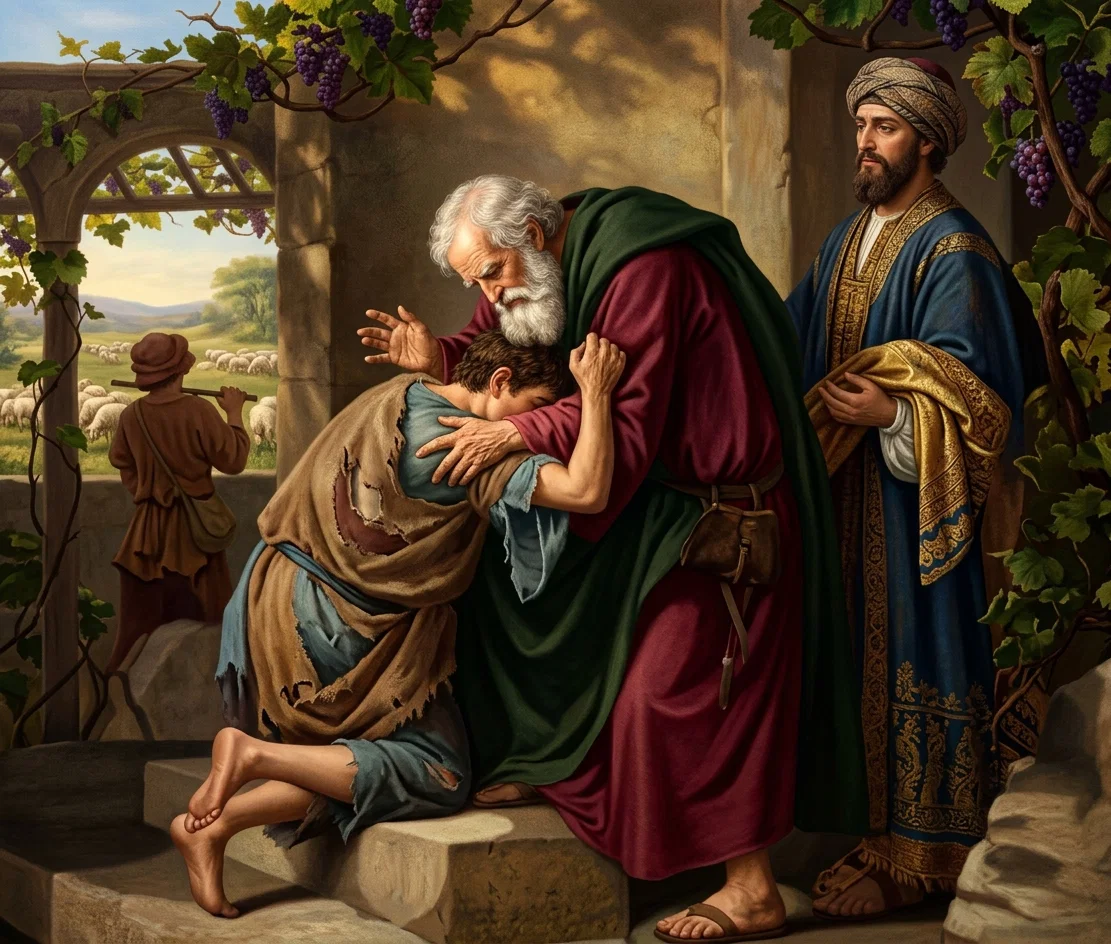
“The father holds him close to his side.”
THE love of God still yearns over the one who has chosen to separate from Him, and He sets in operation influences to bring him back to the Father's house. The prodigal son in his wretchedness “came to himself.” The deceptive power that Satan had exercised over him was broken. He saw that his suffering was the result of his own folly, and he said, “How many hired servants of My father's have bread enough and to spare, and I perish with hunger! I will arise and go to my father.” Miserable as he was, the prodigal found hope in the conviction of his father's love. It was that love which was drawing him toward home. And it is the assurance of God's love that constrains the sinner to return to God. “The goodness of God leadeth thee to repentance.” A golden chain, the mercy and compassion of divine love, is passed around every imperiled soul. The Lord declares, “I have loved thee with an everlasting love; therefore with loving-kindness have I drawn thee.”
The son determines to confess his guilt. He will go to the father, saying, “I have sinned against heaven, and before thee, and am no more worthy to be called thy son.” But he adds, showing how stinted is his conception of his father's love, “Make me as one of thy hired servants.”
The young man turns from the swine herds and the husks, and sets his face toward home. Trembling with weakness, and faint from hunger, he presses eagerly on his way. He has no covering to conceal his rags; but his misery has conquered pride, and he hurries on to beg a servant's place where he was once a child.
Little did the gay, thoughtless youth, as he went out from his father's gate, dream of the ache and longing left in that father's heart. When he danced and feasted with his wild companions, little did he think of the shadow that had fallen on his home. And now as with weary and painful steps he pursues the homeward way, he knows not that one is watching for his return. But while he is yet “a great way off,” the father discerns his form. Love is of quick sight. Not even the degradation of the years of sin can conceal the son from the father's eyes. He “had compassion, and ran, and fell on his neck” in a long, clinging, tender embrace.
The father will permit no contemptuous eye to mock at his son's misery and tatters. He takes from his own shoulders the broad, rich mantle, and wraps it around the son's wasted form; and the youth sobs out his repentance, saying, “Father, I have sinned against heaven, and in thy sight, and am no more worthy to be called thy son.” The father holds him close to his side, and brings him home. No opportunity is given him to ask a servant's place. He is a son, who shall be honored with the best the house affords, and whom the waiting men and women shall respect and serve.
The father said to his servants, “Bring forth the best robe, and put it on him; and put a ring on his hand, and shoes on his feet; and bring hither the fatted calf, and kill it; and let us eat and be merry; for this my son was dead, and is alive again; he was lost, and is found. And they began to be merry.”
In his restless youth the prodigal looked upon his father as stern and severe. How different his conception of him now! So those who are deceived by Satan look upon God as hard and exacting. They regard Him as watching to denounce and condemn, as unwilling to receive the sinner so long as there is a legal excuse for not helping him. But he whose eyes have been opened by the love of Christ will behold God as full of compassion. He does not appear as a tyrannical, relentless being, but as a father, longing to embrace his repenting son. The sinner will exclaim with the psalmist, “Like as a father pitieth his children, so the Lord pitieth them that fear Him.”
What assurance here of God's willingness to receive the repenting sinner! Have you, reader, chosen your own way? Have you wandered far from God? Have you sought to feast upon the fruits of transgression, only to find them turn to ashes upon your lips? And now, your substance spent, your life plans thwarted, and your hopes dead, do you sit alone and desolate? Now that voice which has long been speaking to your heart, but to which you would not listen, comes to you distinct and clear, “Arise ye, and depart; for this is not your rest; because it is polluted, it shall destroy you, even with a sore destruction.” Return to your Father's house. He invites you, saying, “Return unto Me; for I have redeemed thee.”
Do not listen to the enemy's suggestion to stay away from Christ until you have made yourself better, until you are good enough to come to God. If you wait until then, you will never come. When Satan points to your filthy garments, repeat the promise of Jesus, “Him that cometh to Me I will in no wise cast out.” Tell the enemy that the blood of Jesus cleanses from all sin. Make the prayer of David your own, “Purge me with hyssop, and I shall be clean; wash me, and I shall be whiter than snow.”
Arise, and go to your Father. He will meet you a great way off. If you take even one step toward Him in repentance, He will hasten to enfold you in His arms of infinite love. His ear is open to the cry of the contrite soul. The very first reaching out ofthe heart after God is known to Him. Never a prayer is offered, however faltering, never a tear is shed, however secret, never a sincere desire after God is cherished, however feeble, but the Spirit of God goes forth to meet it. Even before the prayer is uttered, or the yearning of the heart made known, grace from Christ goes forth to meet the grace that is working upon the human soul. God meets the penitent soul.
Your heavenly Father will take from you the garments defiled by sin. He will bring you into His banqueting house, and His banner over you shall be love. “If thou wilt walk in My ways,” He declares, “I will give thee places to walk among those that stand by,” even among the holy angels that surround His throne.

The Spirit World and a Future Life

By Prof. Geo. W. Rine

VIII. Powers of the Evil One

THAT there is something wrong with our world no sane person could think of denying. A world in which there is so much anguish of heart, so many scalding tears — a world marked by the unbroken triumph of death, is most assuredly not a normal world, not an ideally good world. If humanity were morally normal, spiritually ideal, it could neither know nor use such terms as sin, crime, pollution, sorrow; sickness, pain, or death. In the words of Inspiration, sin abounds in this world of ours.
Has sin always abounded? and will it always continue to abound? Impossible! For sin is essentially anomalous, abnormal — an infraction of the law of being, of life, of God. Since God is absolute wisdom, truth, and goodness, He can not be the author of sin. Of course we know intuitively that God alone could have created the material and moral universe. But that He created evil is unthinkable. His own Spirit of truth testifies that “God saw everything that He had made, and, behold, it was very good.” Gen. 1: 31.
Whence, then, came sin with all its dire results? Sin implies a sinner. Sin as a mere abstraction can not exist. Sin is an effect whose cause is an intelligence called a sinner. Accordingly, sin had its genesis in some intelligence, who was obviously the first sinner. The identity of the first sinner, or author of evil, is clearly brought to view in Holy Writ. Jesus Christ, who is the manifestation of the righteousness of God, has identified for us the author of sin. To the proud, unbelieving Pharisees He affirmed: “Ye are of your father the devil, and the lusts of your father ye will do. He was a murderer from the beginning, and abode not in the truth, because there is no truth in him. When he speaketh a lie, he speaketh of his own; for he is a liar, and the father of it.” John 8: 44. Since the devil abode not in the truth, he must once have been in the truth. Again, since he is the father of lies, that is, the author of lies, he must have been the first one to forsake truth, and thus the first to introduce evil into the universe of God. “He was a murderer from the beginning” (of sin), for the obvious reason that sin is the cause of death; “for,” says the Holy Spirit, “the wages of sin is death.” Rom. 6: 23. “The soul that sinneth, it shall die.” Eze. 18: 20.

Origin of Sin and of Satan

In Ezekiel 28, beginning with verse 11, Jehovah, through the prophet, addresses Satan under the appellation of the king of Tyrus, as follows: “Thou sealest up the sum, full of wisdom, and perfect in beauty. Thou hast been in Eden the garden of God; every precious stone was thy covering. . . . Thou art the anointed cherub that covereth; and I have set thee so: thou wast upon the holy mountain of God; thou hast walked up and down in the midst of the stones of fire. Thou wast perfect in thy ways from the day that thou wast created, till iniquity was found in thee. . . . Thou hast sinned: therefore I will cast thee as profane out of the mountain of God: and I will destroy thee, O covering cherub, from the midst of the stones of fire. Thine heart was lifted up because of thy beauty, thou hast corrupted thy wisdom by reason of thy brightness.” How felicitously concise, and yet how comprehensive is this divinely given story of the origin of sin and its author. Observe that until the very day that iniquity (sin) was found in Satan, he was the embodiment of wisdom, of perfect beauty, and of moral goodness. He was one of the glorious high cherubim whose effulgent wings extended in grace and beauty over the very throne of the Most High. Ah, he was in Eden the garden of God; yea, upon the very mountain of God. But because of his resplendent beauty his heart became lifted up; he became vain, and sinned. Here we behold the birth of sin — of death. Having sinned, he could no longer dwell in the presence of absolute righteousness, and was cast as profane out of the mountain, out of the presence, of God.
Now, supplement these marvelously suggestive facts with a few equally telling facts bearing upon our subject, found in Isaiah 14, verse 12 and on. The inspired prophet here addresses the same personage in language that fairly glows and palpitates with life and force. Thus: “How art thou fallen from heaven, O Lucifer [day-star], son of the morning! how art thou cut down to the ground, which didst weaken the nations!” In this poetic passage we are shown from what awful height to what awful depth Lucifer (Satan) fell as the consequence of his sin — the first sin God’s universe ever knew. Now follows a succinct statement of the motive that incited Lucifer to the commission of that disastrous original sin. “For thou saidst in thine heart, I will ascend into heaven, I will exalt my throne above the stars of God. . . . I will ascend above the heights of the clouds; I WILL BE LIKE THE MOST HIGH.” Ah, it was pride, self-love, ambition to exalt self to the place of God, that gave birth to sin in the heart of that paragon of all created intelligences.
The sacred writer next gives us a prophetic statement respecting the ultimate fate of the father of sin: “Yet thou shalt be brought down to hell [sheol], to the sides of the pit.” Adverting to Ezekiel 28, middle of verse 18, we read: “Therefore will I bring forth a fire from the midst of thee, IT SHALL DEVOUR THEE, and I WILL BRING THEE TO ASHES UPON THE EARTH in the sight of all them that behold thee, . . . and NEVER SHALT THOU BE ANY MORE.” This divinely pronounced sentence is unmistakable in meaning. Utter annihilation is the black doom that hangs over him whose heart conceived and brought forth sin. He was not alone, however, in his impious rebellion against the sovereignty of God. He seduced a multitude of the angels from their allegiance to their Creator. At the head of these rebel angels he fought against Michael (Christ) and His angels, in heaven. But, thank God, the rebels “prevailed NOT; neither was their place found any more in heaven. And the great dragon was cast out, that old serpent, called the devil, and Satan, which deceiveth the whole world: he was cast out into the earth, and his angels were cast out with him.” Rev. 12: 7-9. Christ, the conqueror of Satan, testified, when on earth: “I beheld Satan as lightning fall from heaven.” Luke 10: 18.
Our Lord, in His graphic word picture of the final judgment (Matthew 25), represents Himself as consigning the irreclaimable sinners to the lake of fire “prepared for the devil and his angels.” The Spirit of truth declares (2 Peter 2: 4) that “God spared not the angels that sinned, but cast them down to hell [Greek, tartarus], and delivered them into chains of darkness, to be reserved unto judgment.” Lexicographers define “tartarus,” into which Satan and his angels are here declared to have been cast, as meaning the dark, void, interplanetary spaces surrounding the world.

The Malign Mission of Satan and His Rebel Host

We all know the story of how this apostate angel of light, through the medium of a serpent, in Eden, compassed the moral fall of the parents of the human race, by seducing them into sin. By inveigling them into believing that they could not die, he led them into defiant disobedience to God, their Creator and only Benefactor. We see, then, that it was Satan who first enunciated that desolating lie; namely, that man is immortal. In the words, “Thou shalt not surely die,” he flatly contradicted God, and involved the human race in sin and death. He thus brought man into spiritual bondage to himself, and usurped the dominion originally given to Adam as the head of the human race. Hence there is great significance in the title, “prince of this world,” given to Satan by our Lord. John 14: 30. The apostle Paul speaks of the devil under the designation of “the god of this world.” 2 Cor. 4: 4. Recall now the emphatic declaration uttered by our divine Master respectingSatan: “He is a liar, and the father of it” (lying). John 8: 44. Unmistakably, then, Satan is the master deceiver, the prince of liars. It is his distinctive business to deceive, to delude, and thus to seduce and to destroy.
Note the testimony of the inspired Peter: “Be sober, be vigilant; because your adversary the devil, as a roaring lion, walketh about, seeking whom he may devour: whom resist steadfast in the faith.” Paul, too, bears witness to the fact that spiritually, “we wrestle not against flesh and blood,” but “against the rulers of the darkness of this world, against WICKED SPIRITS in high places.” Eph. 6: 12, A.R.V. Accordingly we are admonished by the Holy Spirit, through James, to “resist the devil, and he will flee from you.” Most certainly, therefore, we are the objects of satanic wrath. Through craft, cunning, and deceit, Satan, with his cohort of wicked angels, is sleeplessly prosecuting his hellish business of seducing human souls in order to involve them in everlasting ruin. Do we not see, too, that the language of Inspiration uniformly represents Satan as a distinct, concrete PERSONALITY, and not as a mere innocuous abstraction, as so many “wise men” would have it? How grotesquely absurd would be our Lord’s assertion that He “beheld Satan as lightning fall from heaven,” if the latter were only a personified name of the abstract notion of evil! How dare one doubt the testimony of the divine Spirit to the effect that the devil and his angels are “wicked spirits in high places”!”

Overmastering Satanic Deceptions in the Last Days
Both the Old and New Testaments afford numerous prophetic declarations to the effect that in the latter times — in the years immediately preceding the second advent of the Son of God — the enemy of all righteousness would so multiply his delusive snares, in both number and effectiveness, as to render them well-nigh overmastering. In referring to the omens that should indicate the approach of His advent in power and glory, Jesus testified that in those very days, “there shall arise false Christs and false prophets, and shall show great signs and wonders; so as to lead astray, if possible, even the elect.” Matt. 24: 24, A.R.V. In 2 Cor. 11: 14, we are assured that “even Satan fashioneth himself [personates] into an angel of light.”
The thought is that in these latter days in which we now live, Satan would appear in the guise of an angel of light, and personate even the blessed Christ, with such consummate art as to deceive, if possible, the very elect of God’s people. Great signs and wonders will be wrought in order to clinch his lies and make effective his final deceptions. In the most explicit terms the divine Spirit foretold the dire fact that the wrath and aggressive malignity of Satan would be redoubled near the close of time. Note the divine predictive assurance: “Wo to the inhabitors of the earth and of the sea! for the devil is come down unto you, having great wrath, because he knoweth that he hath but a short time.” Rev. 12: 12.
Again, in 1 Tim. 4: 1, it is divinely affirmed: “Now the Spirit speaketh expressly, that in the latter times, some shall depart from the faith, giving heed to seducing spirits, and doctrines of devils.” How clearly we are here shown that even many professors of the Christian faith would be seduced by demon spirits and, in consequence, embrace the teachings of devils. Observe that it is in the “latter times” that these titanic deceptions are wrought. Even stronger language, if that is possible, of the same import is found in 2 Thess. 2: 9-12. Thus: “Even Him whose [Christ’s] coming is after the working of Satan with all power and signs and lying wonders, and with all deceivableness of unrighteousness in them that perish, because they received not the love of the truth that they might be saved,” etc. It is with ALL power and signs and lying wonders that Satan plies his masterly machinations in the days just preceding the coming of the Lord.
We must now briefly note a similar forecast given in Rev. 13: 13, 14. Speaking of a certain power under the symbol of a “beast,” through which Satan should prosecute his delusive arts, the divine Witness declares: “And he doeth great wonders, so that he maketh fire come down from heaven on the earth in the sight of men, and DECEIVETH them that dwell on the earth by the means of those MIRACLES which he had power to do in the sight of the beast.” Further, in verse 14 of chapter 16, we are taught that just before Christ would come as a thief (to unbelievers), the “spirits of devils” would work “miracles,” and go forth to the kings of the whole world, “to gather them to the battle of the great day of God Almighty.”
Is not the inspired evidence overwhelmingly conclusive that in these closing years of time Satan and his host of diabolic angels would ply their hypnotic arts with preternatural malignity and power? And are they not exploiting these very “signs” and “wonders” in this our day, in the awe-struck eyes of all the world? In previous articles of this series some of the marvels and even miracles of present-day Spiritualism were set forth. It is practically certain that these “signs and lying wonders” of the father of lies are being and will be wrought primarily through the agency (the “mediums”) of Spiritualism. In one of Isaiah’s latter-day prophecies (chapter 8), we are given a divine warning against the destructive seductions of Spiritualism, in language unmistakably clear: “And when they shall say unto you, Seek unto them that have familiar spirits, and unto the wizards, that chirp and that mutter; should not a people seek unto their God? on behalf of the living should they seek unto the dead?” Verse 19, A.R.V. Now, does not every spiritualistic medium avow that he does have his familiar “control,” in short, his “familiar spirit”? Every one knows that the last question in the foregoing Scripture citation is God’s strikingly impressive mode of declaring that, on behalf of the living, we should NOT seek unto the dead. The reason is obvious; for the Lord tells us that “the dead know not anything.”
Divination, witchcraft, necromancy, and consulting with familiar spirits, are all abominations in the sight of God. He has unsparingly condemned all these occult practises. Why? Because they are from beneath, of the devil, and are utterly defiling, and ultimately fatal to the soul. He expressly commands His people to “regard not them that have familiar spirits, neither seek after wizards to be defiled by them.” Lev. 19: 31. Again, “The soul that turneth after such as have familiar spirits, . . . I will even set My face against that soul, and will cut him off from among his people.” Lev. 20: 6. “A man or woman that hath a FAMILIAR SPIRIT, or that is a wizard, shall surely be put to death.” Verse 27. In 1 Chron. 10: 13, it is divinely attested that one of the reasons why King Saul perished at the hand of his enemies, was because he asked counsel of one who had a familiar spirit. One of the class of sinners against whom God declares He will be a swift witness in the judgment, are the “sorcerers.” Mal. 3: 5.
It seems incredible that any candid soul can doubt that Spiritualism is accursed of God, and is wholly satanic.
[Note.—In the next and final article of the series, concrete evidence that even the great and wise are being deceived by the delusions of Spiritualism, will be adduced.—G. W. R.]
Continue reading: Unto the Uttermost