AFTER the mass-meeting at Zeus Olympus, the students, tradesmen, and citizens returned in a body to University Square, bearing an old national flag and a picture of the Ecumenical Patriarch before them, their spirits more inflamed than ever.
Riot and Bloodshed
From the beginning the students were much irritated by the presence and frequent interference of the police in their movements, and once or twice already had thrown stones at them and fired their revolvers threateningly into the air. They sent a deputation to the king to ask the removal of the police from the university and its approaches, as their movements were all in the interests of the state and the church. A mob attacked the Prime Minister with stones and revolvers as he alighted from a carriage at his house, but he escaped injury as if by a miracle, and is the present Prime Minister of Greece.
Soon after their return from the meeting at Zeus Olympus, a body of students and citizens started for the office of the Metropolitan again to deliver a copy of their resolutions, and to bring further pressure to bear on the Synod to take immediate action to excommunicate. This body was met at a corner of the principal street of Athens by police and soldiery. An open fight ensued, resulting in the death of eight and the wounding of twenty-eight. The newspapers and the public then started an agitation for the immediate resignation of the Metropolitan as being primarily responsible in the countenance he gave the queen’s translation and in his slowness to make public the decision of the Synod before the students and police were incited to act. The removal of the chief of police and his deputy were also demanded on the ground that they had exceeded their authority in allowing the shooting to be done, altho there appears to be ground for believing that it was begun by the agents of unscrupulous politicians of the opposition to the party then in power, to secure a pretext for seeking the downfall of the ministry, in which they finally succeeded.
Resignation of the Metropolitan
So great was the pressure that the government asked the resignation of the Metropolitan. He was succeeded later by a shrewd politician, said to be much inferior in character to his predecessor, but still in office to-day. Concerning the resignation of the Metropolitan, the “Onward” says:
“The Greek people desire the preservation of a religious system that has been venerated for twenty centuries and which has saved Hellenism in times of the greatest danger. Now that the Metropolitan has resigned as an unworthy guardian of the inviolable usages and traditions of the church and the nation, the chief culprit in creating the present situation has suffered a just penalty.”
Interment of the Dead
The funeral of the victims took place the next day. The students, in accordance with Greek custom, posted notices in public places inviting all the people to attend. An editorial says:
“Surely Athens never saw, and perhaps never will see again, a more touching, more impressive, and more fully attended funeral than that of yesterday. One phrase, and one only, served, in the minds and mouths of all, to characterize the dead—‘Martyrs for the Faith.’ As the procession passed along it was remarked, ‘They are gone, poor fellows, martyrs to the faith. Immortal be their memory.’”
Funeral Eulogies
Two speeches were made at the funeral, the first by our professor of theology. He said in part:
“There are two foundations to every nation—faith and patriotism. That indignation was just which seized the people, especially our noble academic youth, when it became known that the sacred Gospel—that cradle of existence to our nation and to our hopes for the redemption of our beloved fatherland—was incurring danger. The people came together and expressed their indignation against those who dared touch this sacred treasure; and when necessity arose, bared their breasts in behalf of their convictions. Do not weep for the dead. Tears are not appropriate for martyrs to the faith. But, as the ancient Spartan mothers received joyfully their dead sons who had fallen in battle, so let us also rejoice that through the precious blood of these martyrs we have saved our faith. We have saved our Gospel, which was exposed to danger, thus showing that in us there is ever cherished the instinct to defend the faith, ready to break forth into action whenever the latter is in jeopardy.”
The second address was by a member of parliament, who is at present secretary of the interior. He said:
“In this place where our beloved brothers are lying, let us, through a general subscription, raise a mausoleum of marble, magnificent and stately, imperishable in glory and renown; and let us inscribe upon it the names of these noble martyrs to the Christian religion and the inalienable rights of the Greek people. These rights are already engraved in marble, so to speak, and teach all, whoever they may be, in however high a position they may stand, that you may take away everything from the Greek people, even their daily bread, but their ancestral language and their ancestral religion—never.
“Rest in peace, O noble souls! The very heavens mourn with us at this moment [it began to rain], with your fathers and your brothers. The memory of you will never fade from the inmost depths of the Greek heart. Cursed be the assassins [the translators]!”
Here followed, according to Greek custom, the kissing of the dead by thousands of the multitude present.
As from this point on affairs take a more decidedly political turn, the rest of our story can be briefly told.
Anathema and Excommunication
In joint session with the Holy Synod the government confirmed the decision already11given out by that body, which remains in force to-day. No measures were taken to anathematize the translations already produced, for reasons that our professor of theology can better explain than I. Hear him:
“The Holy Synod has not anathematized the translations already produced, for they conscientiously believe that such a course would constitute a condemnation of the Gospel itself.
“Another reason for not anathematizing is this: The church has anathematized and still anathematizes only heresy, only what in reality perverts the Scripture. But when a translation is made from good intentions and in good faith, anathema is not necessary, simple prohibition suffices.”
Response of the students:
“What does the word anathema or excommunication enunciated by four or five priests amount to anyway in comparison with the general proscription which is now imposed by the conscience of every Christian? Be assured that after what has happened it is impossible for any one to dare undertake a translation of the Gospel in the future.”
Queen Olga Again
The chief reason for not excommunicating those who were in any way responsible for a translation, lies in the fact that it would necessarily include Queen Olga, one of the leaders in the movement. And “who knoweth whether [she is] come to the kingdom for such a time as this?” “If [she] altogether holdeth [her] peace at this time, then shall there enlargement and deliverance arise from another place.” One thing is sure, Queen Olga has not altogether held her peace on this matter of bringing the Bible within reach of the common people. Being of the strong religious conviction that she is, shall we not expect that in the fulness of time the Lord will use her influence still further to break down the barriers that have been built up around the word of God?
STADIUM STREET
The principal street of Athens, where the riot of 1901 took place. This street is said to be exactly one ancient stadium in length connecting the two principal squares of the city.
Rays of Hope
One ray of hope that such may be brought about proceeds from Queen Olga’s practise of spending three or four months each summer in Russia, which nation has surpassed Greece in giving free course to the word of God outside of certain arbitrary, stereotyped lines. The example of Russia, whose state church is the same as that of Greece, is not likely to set the queen’s spirit at rest on this question.
Another ray of hope lies in the gratifying consideration that we are just going to press with our first literature in Greek, and it is not impossible that in the providence of God, some of the saving truth of this last message, either in Greek in Greece or in Russian in Russia, may come to the attention of this one of His zealous handmaids among the crowned heads of Europe. It is not the first time the Lord has used a queen to forward His cause in the earth, and why should He not do greater things in these momentous times than ever in the past?
Yet another, and the brightest, ray of hope comes to us from the truth that every time the word of God comes into conflict with tradition, bigotry, and political intrigues, it is sure to make progress toward its rightful place. The status quo in Greece on the Bible question can not continue forever. Altho the word of the Lord has been locked up in an antiquated tongue now for the past eight years, yet those copies of the translation distributed gratuitously by the queen, have not all been destroyed. And the faithful colporteurs of the Bible Society had a free hand for a number of years prior to 1901 in selling Bibles and portions of it up and down the land. Here and there the seed remains, waiting to be ripened by the droppings of the latter rain. “It [My word] shall not return unto Me void, but shall accomplish that which I please, and it shall prosper in the thing whereto I sent it.”
Yes, some fruit has already begun to appear. Since beginning these articles it was the writer’s privilege to find far up in the snow-capped mountains of Albania, a Greek and his wife living up to all the light they had, he having kept the Sabbath of the fourth commandment for seven years, and she for four, without either having ever seen the face of any other Sabbath-keeper, except the Jews. The only reading-matter they had in their possession was an old, backless, incomplete copy of the Bible Society’s translation of the Bible in modern Greek, and a little eight-page tract on the Sabbath. They received joyfully other points of present truth as fast as they were presented. Without a doubt, other copies or portions of the word are doing their work elsewhere, and it only remains for us to search out those who are blessed with its presence, and to minister the word more fully.
And finally, altho in “Free Greece” the entrance of that word which giveth light is thus obstructed by decree of church and state, and altho proselyting is forbidden by law, yet the same God who has opened to the Gospel such unpromising countries as were Russia and Siberia and China, and Bavaria and Turkey, and who is opening Tibet, will in His own time, and that we believe right early, bring into line with His providence the little, refractory, independent kingdom of Greece.
W. E. HOWELL.
Restitution by the Sugar Trust.
In a test suit brought by the government, the American Sugar Refining Company (or sugar trust) was recently found guilty of defrauding the Treasury by a device attached to the scales which determined the weight of the company's imported raw sugar, on which duties are paid. The penalty fixed by the verdict in that suit was $134,116. The government at once set out to collect from the sugar trust about $2,250,000 more, alleging that the Treasury had been defrauded of this sum, at least, by the false weighing of cargoes not involved in the suit which we have mentioned. On the 29th, the sugar trust practically admitted the justice of the charge and settled with the government by paying $2,269,897 in cash, this sum including the $134,116 awarded in the suit that was tried. This payment was made by advice of the trust's counsel. It appears from the statement of these attorneys that there was a prospect that the government's claim would be raised to $3,000,000, and that proceedings for forfeiture of the sugar fraudulently weighed would have increased greatly the sum to be paid. The trust abandons its protest and gives up its right to appeal. This settlement has been approved by the Attorney-General and the Secretary of the Treasury. It does not, however, restrain the government from prosecuting criminally the officers of the trust, or the employees, who were guilty of these frauds. They will be prosecuted vigorously, it is asserted, by attorneys representing the government, and earnest efforts to bring them to justice will be made. The same company, or trust, has been sued by the City of New York for taking water from the public mains by means of pipes running into the refineries and having no meters attached. It has offered to settle by the payment of a sum which the city authorities will not accept. They demand $230,000.—The Independent.
Spiritualism and Mars.
There seems to be a great desire on the part of some people to communicate with Mars. Different methods of doing this have been proposed from time to time. Professor Pickering thinks that $2,000,000 will be sufficient to build a heliograph capable of flashing signals to the planet. Many other propositions are being made, and all of them, we think, seem rather visionary, and some of them, quite ridiculous. The last proposition, and the wildest one of all, is that of communication by thought waves, whatever that may mean. We are told what it means by the information that spiritualistic mediums should be used for this purpose, since they are cheaper than mirrors. The fact that already we have reports from different mediums, and that none of these agree with one another in the slightest, does not at all seem to dampen the ardor of those making the proposition. Lying spirits are not very apt to agree among themselves, and if an appeal is made to mediums for information regarding Mars, the probability is that we shall have a mass of Martian stories, so called, that will be as varied and contradictory as the lying spirits that dictate them can produce.
Ice Jam at Niagara.
Last month, as a result of the terrible hurricane that swept the lakes, Niagara River channel became blocked with ice. So effectual was the jam of ice that water ceased to find its way over the falls for a time. The Ontario Power Company's plant was damaged to the extent of $100,000. Under the orders of Assistant State Engineer Kunzie, the ice was blasted out of the channel, the work lasting from Thursday until the following Sunday. Nothing like this jam has happened there since the winter of 1844-45, and this time lives and property were endangered to a more pronounced extent than at any other time on record.
The Price of Bread.—
Through the speculation of Mr. James A. Patten, of Chicago, and his followers, wheat was cornered in April and the price has risen remarkably. The price of flour has advanced to just about double what it was six years ago. Some bakers have been driven into bankruptcy, but the greatest burden comes upon the poor who must have bread. Money thus forced from those who can not afford to pay it and yet must or starve is bound to have a curse to it as surely as the Lord reigns. The United States Government is about to frame a law to prevent such things in the future.
A Visit to the Kolo Mission, Basutoland
By W. S. Hyatt
As Brother and Sister Emmerson were passing through Cape Town en route to Basutoland, their future field of labor, I decided to visit that country with them. We were nearly two days by rail and one by ox wagon in reaching the mission, and were glad to find a pleasant house with enough furniture in it to enable us to be comfortable. Our native missionary, Murray Kalaka, and others gave us a hearty welcome into their midst. For nearly a year this mission had been without a European missionary, the work being left entirely in the hands of our native worker, and now there was rejoicing to know that help had arrived.
This mission station is located on the western slope of Mount Kolo, and there is a beautiful view extending far over into the Orange River Colony. Basutoland is a country of mountains and valleys. The Maluti Mountains are in the northern part, and some of the peaks are from 10,000 to 12,000 feet high. Many of the large rivers of South Africa have their source among these mountains and flow out in all directions.
Basutoland has frequently been called the Switzerland of South Africa. The scenery in many places is grand. The water at the Maletsunyane Falls takes an unbroken leap of 600 feet. The climate is keen and invigorating during the winter. Snow is to be seen most of the season on the mountains, but in the summer it is delightful, since they get the southeasterly breezes and usually an abundance of rain. There is no malaria, hence a good place for missionaries to recruit who live farther inland where fever abounds. We are thankful to say that here in the midst of South Africa is a country where such can regain their health and strength. Consumptives find this among the best climates in the world.
The valleys and mountainsides are very fruitful, and horses, cattle, sheep, and goats abound everywhere. The native's wealth consists of his ponies, and herds of cattle, and flocks of sheep. He cares but little for money except to increase his stock. If he wants a wife he must pay from ten to fifteen head of cattle for her if among the common people, but for a chief to get a wife of the royal blood he must give from fifty to seventy-five for her. When a man is brought before the paramount chief for a misdemeanor, he is usually fined a large number of cattle, and these the chief takes for his services. A misdemeanor on the part of a chief may cost him several hundred head of cattle. Altho they have an abundance of stock, they seldom use them for food, in fact, they say that meat does not make them strong. They usually have a feast once each year, and seldom eat flesh at other times. We found that a good native cow in milk was worth from $50.00 to $65.00.
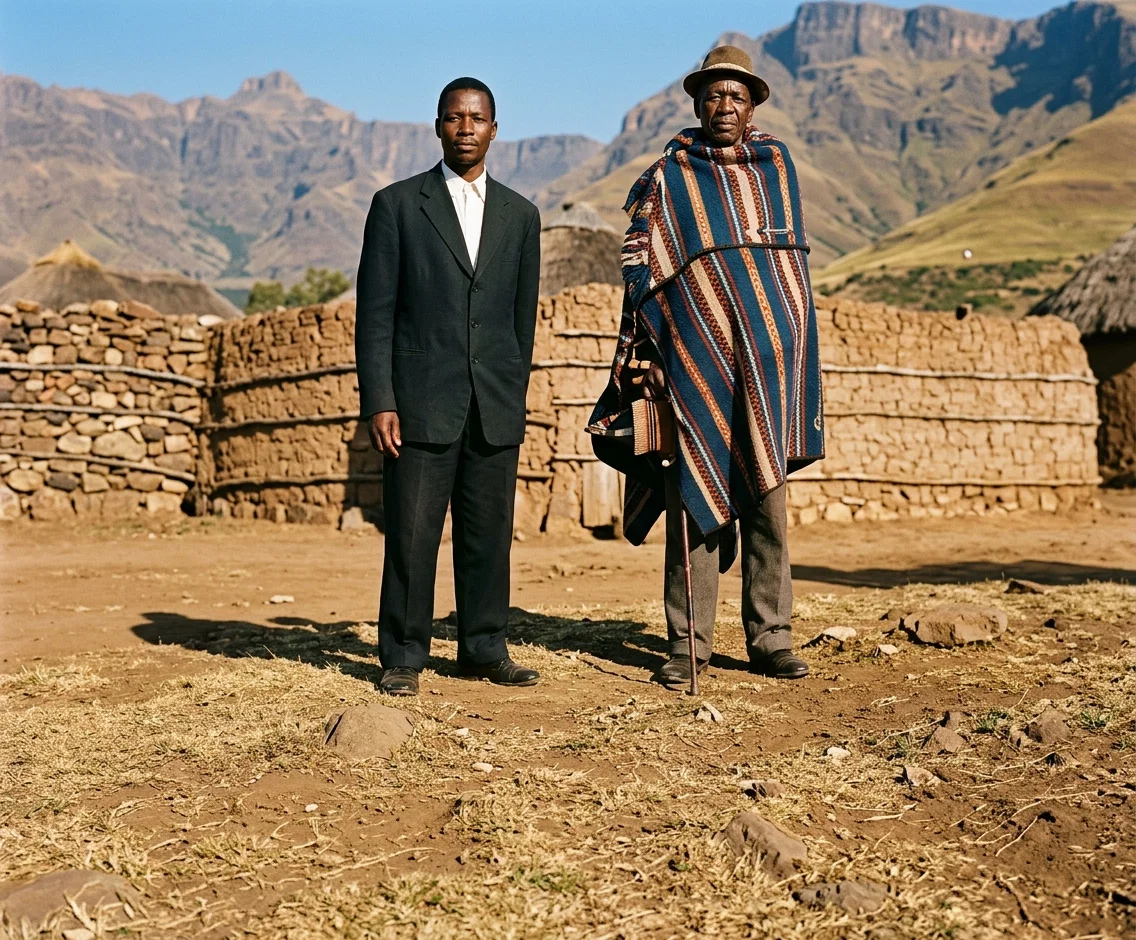
Scene in a Basuto Village
Murray Kalaka and the village chief in the blanket, which is the common manner of dressing.
The tillable land is divided up into plots of from four to eight acres, and each family is supposed to have four of these, one each for wheat, oats, kaffir and Indian corn. The valleys are dotted with these plots; and, as there are no fences, the cattle must always be in charge of a herd boy. With a moderate amount of rain good crops are grown. In fact, Basutoland is called the granary of South Africa. Possibly many of my readers would be surprised to find the natives using the best American plows, but such is the case, as this is no uncommon sight. They sow their Indian corn and plow it under. I do not remember of ever seeing a native planting in rows and cultivating it. They do not get as good crops as they would if they worked on better methods, but when there is no drought they have an abundance. The wheat is cut with the sickle and thrashed or trodden out by the cattle on earthen floors which they have prepared.
At the time of our visit the country was looking its best. The spring showers were springing up rapidly. At the mission the peach and apple-trees were in full bloom. The strawberries were white with blossom, and the grapes were putting out their fruit. We are thankful to say that this mission is well supplied with fruit, and pipes bring down a good supply of water from far up on the side of Mount Kolo. From this supply they are enabled to irrigate a portion of their garden during the dry season, and at this time it is no uncommon sight to see native women coming to the mission with water-pots on their heads and getting water for cooking purposes.
The first Sabbath we were there the little church was well filled with natives, who listened attentively to the words spoken. During my stay we held a few services with the magic lantern. They had never seen anything of the kind before and often expressed their appreciation. They had often heard the Gospel story, but to see it all pictured out before them and carefully explained made a deep impression on many minds. The people came in crowds, and at times we had to have a second service for the benefit of those who came long distances and could not get into the church.
Thousands of the Basutos can read, in fact, many have a fair education. In 1905 the report shows that there were over 200 schools in that country with an attendance of between 14,000 and 15,000 scholars. The government spent nearly $20,000 in helping the schools of the country. This makes it possible to reach and influence the people with our literature. They know our wagon, and always expect that we will have some books to sell to them. While on our way to the railway station we saw a boy running toward us from a village far up the mountainside. He said that his father wanted a book, and while selling to him, another came and bought two more. We feel our need of funds with which to print more books for this people.
There are many encouraging omens in this field. The father of the present paramount chief located our mission and was very kind to our missionaries. The present one offers help in any way he can grant it. He has been known to take his Bible and defend the Sabbath, altho he is a heathen. Several of the leading chiefs have read our literature, and are now believers in the coming of the Lord. We feel sure that from this land there will be many jewels gathered by and by to shine in the crown of our Saviour.
W. S. HYATT.
The Need of Missions
By H.
All men need Christ. There is that in the human heart which cries out for divine guidance. Man is a worshiping being, and has been through all the history of his existence on earth. Even in the darkest heathenism, there can scarcely be found a tribe which does not worship in some way. And all these tribes are included in the men who need Christ. Since all need Christ, should not all be given an opportunity to know Him? More than that, it is surely the duty of some one to take that knowledge to the world.
Our Saviour committed the duty to His disciples. They spent their lives in giving the Gospel to others. Their converts carried it on. Companies were formed, churches were organized, Christianity was established. Always it has been the experience of the one newly converted that he has a burden to tell the glad tidings to his loved ones13and his neighbors, and then to those beyond. This has come to be one true test of conversion. With churches those which have made the most of mission work have been the most virile and progressive. With a waning interest in missions has invariably come a falling away spiritually. Churches which have grown formal and creed-bound, and yet have clung to the mission idea, we find still existing after centuries — their work for souls has kept them alive.
All men need Christ. Shall not the church, recognizing the need, accept the responsibility of bringing the world to Him? The need is great, the time is short, the workers are few; but beyond all the labor is the reward. Not only does there wait for the faithful a crown, but in that crown are stars, jewels of precious souls, saved by grace through the faithful labors of those who answered the call to go.
H.
Do It Now
By Editor
TO-DAY
Don't put off doing a good thing until to-morrow. If you do, another opportunity may be lost. Why not sit right down now and send us an order for some copies of the June Number of the Signs of the Times Monthly? Not necessarily a big order; a few perhaps for a starter. You can probably arrange your work so you can spend a couple of hours a week in this way. The profits, though worth while, are not so much a consideration as is the joy, happiness and spiritual uplifting that accompanies missionary work thus done.
The June Number Is Excellent
Any of its 29 articles on various topics are easily worth 10 cents—the price of the paper. You pay but 4 cents per copy for from 25 to 500 copies.
If “The Voices of the Stones” fails to interest, then some one of the following is sure to:
Discontent and Strife Around the World
A Sabbath Change Foretold
Free from the Law
The Story of a Hod-Carrier
Church Federation
Prohibition Progress in the United States
How Much Water to Drink and When
Vegetarian Recipes
The cover in two colors is striking. It will help you sell.
All you have to do is to sign an order, procure a money-order, and send them to your tract society, or to us, and we will do the rest.
Orders are also filled by the Pacific Press at 1109 E. 12th St., Kansas City, Mo.
SIGNS OF THE TIMES, Mountain View, California
ELO THE EAGLE AND OTHER STORIES
By Floyd Bralliar
BY FLOYD BRALLIAR
This new animal book for young folks is receiving an eager welcome by all nature lovers. ELO THE EAGLE is the first of a series of ten interesting stories of animals, wild and otherwise; being, with one exception, the life histories of boyhood friends of the author. Many strange and laughable anecdotes are related by Mr. Bralliar, all of which are strictly true and vouched for by reliable witnesses.
The book is lavishly illustrated by special drawings, with a full-page half-tone design printed in Luxotype at the beginning of each chapter. Two hundred pages, printed on egg-shell paper, beautifully bound in red cloth. Price, post-paid, $1.00.
Easily sold by young people. Agents wanted.
Pacific Press Publishing Assn.
Mountain View, California
Portland, Ore. Regina, Sask., Can. Kansas City, Mo.
Prayer for Others
EARLY learn to pray for other people than yourself; there are more of them. Pray in the language of the universe, not of your own personality merely, nor of your family, or clan, or race. God is concerned for all mankind; rise to His altitude. Get out of self. As God’s child, your personal needs are sure to be met, tho He loves to have you ask for these. To linger on the small needs of your own life is unworthy. Selfishness is a bar to communion with God. You must fly higher than this, or you will not fly far.—How to Talk with God.
Our Work and Workers
THE brethren at Danville, Va., dedicated a new church April 25.
MAY 1, Brother Isaac P. Dillon organized a Sabbath-school of ten members at Bisbee, Ariz.
SIX members of the church school at Fresno, Cal., were baptized by Brother J. H. Behrens May 8.
FOUR ladies and three young men were baptized by Brother H. C. Hartwell at Tremont Temple, Boston, Sabbath, May 8.
BROTHER F. M. FAIRCHILDS reports nine new believers at Swanton, Md., as the result of efforts he put forth there during the past winter.
FIVE students of Emmanuel Missionary College, Berrien Springs, Mich., two young men and three young women, were baptized Sabbath afternoon, May 8, in the St. Joseph River.
BROTHER G. W. PETTIT writes from Dallas, Ore.: “Sabbath afternoon, April 24, it was my privilege to baptize eight precious souls in the beautiful mountain stream that flows through this place.”
At Valley View, Texas, a severe storm recently destroyed the Seventh-day Adventist church building. A new building was built on the old foundation, and was dedicated April 23. Services are conducted in both English and German.
BROTHER J. F. ANDERSON and Brother O. J. Nerlund report good progress among the Scandinavian people of Duluth, Minn. Fifteen have begun the observance of the Sabbath. Seven of these have been baptized, and three more are ready for baptism.
SPANISH TRACTS
Those who have Spanish-speaking friends, or who wish to circulate Spanish literature will be glad to know that we now have the following
SPANISH TRACTS
TEMPERANCE
Alcoholism a Universal Plague — 1 ct.
Fruits of Alcoholism — 1 ct.
Do Not Marry a Drunkard — 1 ct.
Drinks—Poisons — 1 ct.
Accused of Murder — 1 ct.
Demons’ Council — 2 cts.
It Doesn’t Pay — 2 cts.
Fruit as a Means of Temperance and as a Daily Food — 1 ct.
VEGETARIANISM
New Life — 1 ct.
Some Reflections on the Slaughterhouse — 1 ct.
19 Reasons in Favor of a Fleshless Diet — 1 ct.
Prejudice versus Facts — 1½ cts.
Diet Reform — 2 cts.
SABBATH QUESTION
How Esther Read Her Bible — 2 cts.
From Sabbath to Sunday — 1½ cts.
Elihu on the Sabbath — 3 cts.
Who Changed the Sabbath — 3 cts.
FAMILY BIBLE TEACHER
28 different numbers in envelope, 20 cts.
Address your nearest Tract Society, or
Pacific Press Publishing Association
Mountain View, Cal.
Portland, Ore. Regina, Sask., Can. Kansas City, Mo.
THE MAN OF VALOR.
By A. W. Spaulding
The latest book from the press. By A. W. Spaulding. Equally interesting to young and old. Telling in a most pleasing way of the triumphs of Israel, under the leadership of Jonathan (The Man of Valor), through faith in the power of their God. A most inspiring book, and should be in every home. 247 pages. Price, 75 cents, post-paid. Address this office.