Your ShelfYour Projects

The American Sentinel, Vol. 13, No. 1.

Distinguishing Secular from Godless
Earlier text: Distinguishing Secular from Godless

Protestants Surrendering the Reformation.

BY C. H. KESLAKE.
When the government of the United States began, all was done that was possible to make this nation what every nation ought to be.
It recognized the self-evident truth that “all men are created equal; that they are endowed with certain unalienable rights; that among these are life, liberty, and the pursuit of happiness. That to secure these rights, governments are instituted among men, deriving their just powers from the consent of the governed.”
The noble men who wrote the Declaration of Independence, from which the above is quoted, knew that these rights could not be secure in this country any more than in those which existed before it, unless steps were taken to prevent any church or all churches together having any part in the conduct of its affairs.
They recognized the fact that religion is a matter that pertains to the individual, and that where this is not the case, any profession of that kind on the part of the people comprising the government must be at the best hypocritical, and that it must work injustice to those who may be honest and God-fearing.
Accordingly this principle was incorporated into the Constitution, in the First Amendment, which reads, “Congress shall make no law respecting an establishment of religion, or prohibiting the free exercise thereof.”
This is the principle of Protestantism. In the Augsburg Confession and at the Diet of Spires, in the sixteenth century, the true relation of the church and the state was clearly set forth.
It must follow, therefore, that any attempt to change this feature of the Constitution, and to use the power of the state for the enforcement of religion of any kind, is a square denial of the Reformation, a declaration that its cause was unrighteous, and ought never to have been. But the Reformation was aimed directly against the papacy. Therefore to say that the Reformation was wrong is to say that popery was right; and, consequently, that as Rome never changes, it must still be right.
It would not of course be a matter of surprise to see Catholics themselves contending for this. They could not do otherwise, and still be Catholics. But that there should be those who are professedly Protestant who stand with Rome upon this ground is not only surprising but alarming.
That this is so, no one who is acquainted with the history of this nation in recent years, can question.
For nearly fifty years there has been a regularly organized association—the National Reform Association—which has had for its object the changing of the Constitution, demanding that, at least, certain features of the religion of Christ be enforced by human enactments.
It is not to be understood by the above statement that this association openly espouses Romanism, or that they acknowledge that their work is really Romanistic.
But it must be understood that in prosecuting their work they have felt the necessity of, and have been glad to seek, the coöperation of Roman Catholics.
Thus a leading National Reformer—Dr. Scoville—says, “We may be subjected to some rebuffs in our first proffers, and the time has not yet come when the Roman Church will consent to strike hands with other churches—as such; but the time has come to make repeated advances; and gladly to accept coöperation in any form in which they may be willing to exhibit it. . . . It is one of the necessities of the situation.”
Any rebuffs to which they might be subjected from the Catholic Church would not be because the Catholic Church is opposed to their work. Far from it. They would be only blinds, as it were, until they felt the time was ripe for an alliance to be affected without danger to themselves. This would be when this reform(?) work should become more widespread, and become more firmly engrafted in the Protestant ranks.
The above, from Dr. Scoville, was uttered in 1881. Eight years from that time—1889—the Catholics felt free to express themselves. At the Congress of Catholic Laymen of the United States, then assembled at Baltimore, they said: “What we should seek is an en rapport with the Protestant Christians who desire to keep Sunday holy. . . . We can bring the Protestant masses over to the moderation of the Catholic Sunday.”
On this question of Sunday it was felt, on the part of each, that they could, as Archbishop Ireland, in 1893, expressed it, “stand together in demanding the faithful observance of Sunday.”
Now the Catholic Church repudiates, and always has repudiated, the work of the Reformation, denouncing those who uphold it, as heretics, and up to within a few years ago denounced the Constitution of the United States.
Why is it then that Catholics are willing to unite with these Protestants in the way that is proposed? How can Catholics do this without stultifying themselves in their opposition to the Reformation? The answer is easy. It is because these Protestants, in their zeal for Sunday and Sunday laws, have surrendered all that the Reformation stood for.
Catholics know this, but do Protestants?
It must be conceded that a great many, if not all, Protestants, who are thus engaged are true Christians, men and women who really love the Lord, and who, in this thing, think they are doing God service.
However honest they may be, they are nevertheless, not only striking a blow at the foundation of this nation, but, as before pointed out, are repudiating the Reformation.
With the progress that has been made, by both Protestants and Catholics, how long will it be before the dire work will be completed? Surely not long.

Extra Printing on the Flag Salute Question

We shall print an extra number of papers of this issue, believing that in many communities where the question of the introduction of the flag salute in the public schools is being agitated, it will be a good missionary document to place in the hands of teachers and school boards. The price is one cent a copy. Order through your state tract society.

Please Read This.

THE short-time subscriptions taken last August expire with the present issue. Many of these have already renewed. Those who have not are hereby cordially invited to do so at once, and so receive the paper without interruption.
If it is not convenient to remit for a year, do not hesitate to send in your subscription for a shorter period, say for three or six months. We want you to continue as a member of the SENTINEL family. We shall aim to make the paper, if possible, better the coming year than ever before. In view of the live issues before us, we ask in all earnestness, can you afford to be without the means of keeping in the fullest touch with the developments of the work? We believe the answer will be an emphatic No.

NEWS, NOTES AND COMMENT

WITH real Oriental simplicity, the Chinese minister at Washington, Wu Ting-Fang, in laying before the government a protest against the high-handed action of the “Christian” Powers of Europe, has inquired why these Powers do not partition Turkey, a country that is always causing trouble, instead of turning their carving knives upon China, a country that has always lived peaceably with her neighbors and minded her own business. The Chinese minister, it would seem, has not been educated in Western ideas to the point of understanding the ethical principles of “Christian” diplomacy, as practiced by the nations of “Christian” Europe.
FROM the standpoint of one not trained in diplomatic distinctions of right and wrong, there is much force in Wu Ting-Fang’s inquiry. He says he can see no justice in China’s being carved up like a Christmas cake to be disposed of by the Powers. To see the justice of the proceeding, as the Powers view it, it would be necessary to remind him that China has no army and navy capable of seriously resisting the carving process, whereas Turkey can put into the field nearly a million of well-armed men, whose fighting qualities all Europe understands and respects. It would be necessary to explain to him how very wrong it would be, from a diplomatic standpoint, to begin the work of partitioning Turkey under such circumstances, however proper and laudable the proceeding might be in itself.
IT is really a question for serious consideration in this country, how much deference is to be paid to the opinion of a human individual, when that individual stands in the position of a minister of the gospel. Vastly more depends upon the attitude of the people in this respect, as regards both their material and spiritual interests, than many of them are aware.
IT is an evident fact that there are some prominent clergymen in this country who want their opinions received by the people with a good deal of deference. Their prosperity in the sphere which they have marked out for themselves, depends upon it. Their goal is that of popularity, rather than piety. Wishing their names to be kept prominently before the public, they put forth, at intervals, statements that will be regarded by the people as sensational. If nobody paid any particular attention to their utterances, or held them as being worthy in themselves of more than a passing notice, they would of course not accomplish the object for which they are intended. It is only the deference which the people have been led to pay to them, as if they came from some supermundane source, which makes them of practical effect.
FOR example, we note that Dr. Lyman Abbott has again come before the public with some utterances on the mission of Christ to the world, which are treated by the New York dailies as sensational news. “I do not believe,” he says, “that Christ came to afford men an escape from torment, or to get men into a place of bliss;” and also, “I do not see why an agnostic cannot enter the kingdom of heaven.” Now, of course, Dr. Abbott has a perfect right to hold these opinions and state them to anybody he pleases; but why should they create a sensation merely because Dr. Abbott spoke them? Why should the utterances of any clergyman, merely as such, be regarded as in the nature of important or startling news? They are not important or startling if they are not true; and who knows that they are true? They did not come from any ultimate source of truth; and until the ultimate source of truth is examined, to see what is there said on the subject, they are to be taken merely as the opinions of the one who uttered them. There is no reason whatever why they should be taken more seriously.
THE ultimate source of religious truth is the Word of God. The important question to consider is, then, not what some man has to say on the subject, but what God has said on the subject. What does the Bible say, for instance, concerning the mission of Christ to earth, and the things requisite to salvation? It is just as easy to know this as to know what Dr. Abbott or any other man says about it. Why, then, should not the people know what God has said concerning the matter, and when they know it, take his word as settling the matter fully for all time? To do anything less than this is to indicate a lack of faith in God.
AND this is where the seriousness of the whole matter comes in. For it is a very serious matter not to have faith in God. It is a very serious matter to look no further than to the words of some man for our knowledge of spiritual truth. That is popery; and because the world was led to do that, the world went into the Dark Ages; the world suffered immeasurable loss in both its material and spiritual interests. And to do the same thing now means decay and death in both spiritual and temporal affairs, just as surely as it ever did in the past. Faith in the Word is the great quickener now as truly as it was in the era of the Reformation, or at any other time. There is a broad meaning in the language of Christ recorded in John 6:63, “The words that I speak unto you, they are spirit, and they are life.”
THERE is an example left on record in the Scripture for the people to follow in this matter. It is that of the “noble Bereans.” They heard the preaching of the Apostle Paul; but they did not accept what he said as truth merely because it was Paul who spoke it. They simply “searched the scriptures daily, whether those things were so.” If the people would only adopt this course to-day with respect to the words they hear spoken from the pulpits, it would spoil a great many sensations and some reputations, but would be immeasurably to their own benefit in every way.

Seventh-Day Adventists and the Public Schools.

[THE following, setting forth the views of the Seventh-day Adventist Church of Boulder, Col., on the subject of saluting the flag in the public schools, has been sent us with the request that it be given space in the columns of the SENTINEL. As much criticism has been heaped upon the Adventists, because of their stand in this matter, it seems entirely proper that this request should be favorably received.]
DURING the last few weeks, as is well known to the people of Boulder, there has been much agitation and discussion, both in a public and a private way, of the relations the Seventh-day Adventist church of this city sustains to the Boulder public schools. Nor has the discussion of this matter been confined alone to our own city, but has extended to Denver and neighboring towns, and even gone outside the State. In many instances the erratic utterances and statements of irresponsible parties, and of those outside the Seventh-day Adventist Church, have been accredited to this organization. In view of this it seems but reasonable that the Seventh-day Adventist church of Boulder should state to their neighbors and fellow citizens their true position on the school question.
In the first place, Seventh-day Adventists are in no sense opposed to our system of free public schools, nor are they in any measure whatsoever opposed to the government under which we enjoy our present freedom. Among all the nations of antiquity, and of medieval and modern times, has there arisen no government of man so noble in its purposes, and so true to the principles that should underlie just and wise government. It is in this country, as expressed by Dr. Josiah Strong, that the two great ideas of which the Anglo-Saxon is the exponent—civil and religious liberty—have had their fullest development. For these noble principles our forefathers gave their fortunes, their honor, and their lives. Hence, for the American flag, as representing these great basal principles, which lie at the foundation of our national existence, every loyal heart must hold the highest respect. And of these high and exalted principles, for the defense of which our nation was established, the system of our free public schools was designed to be the great conservator Ignorance and free government are incompatible. Both cannot exist together on the same soil. Hence, for the maintenance of true principles in the home, the church, or the state, education becomes an essential factor. This education may be imparted in the grades, the high school, and the university; or it may be given in private, church, and denominational schools. Into the hands of a truly educated people may be safely entrusted the important interests involving the integrity of social and political life.
But while the Seventh-day Adventists of Boulder most firmly believe in the principles above stated, they cannot but feel that the requirement of the public schools in Boulder in respect to the so called flag salute is a violation both of the spirit and of the letter of these principles. They believe in God, but they do not believe that the attendance of their children at the public schools should be conditioned upon the open avowal of this belief. It is not the right of any State, of any court, of any school board, to require from any American citizen, or from the child of any American citizen, a recognition of God. Every citizen of Boulder, whether he be Christian, Jew, infidel, or pagan, is entitled to the privileges granted by our system of free public schools, and he is entitled to these privileges without any declaration on his part of his belief or disbelief in any deity. Civil government and the system of education provided by civil government should not, nor can they of right, deal with the religious beliefs, views, or prejudices of the individual members of the commonwealth. In doing this they usurp the prerogatives of Deity, and do that which Christ or his Spirit never attempts. Faith in Christ and sincere adoration of the supreme Being must spring from love and not fear, from volition of the will and not force. And while Seventh-day Adventists hold for the principles represented by the stars and stripes the highest reverence, and for the American flag as representing those principles the deepest regard, while they hold in the highest esteem those who fought and bled and died that to us might fall the heritage of freedom’s blessings, they still feel that it is not the province of our public schools to require from the pupils a pledge of their heads and hearts to the maintenance of that flag. This is contrary to the spirit of freedom which the flag represents.
Seventh-day Adventists are uniformly law-abiding citizens. They believe in the support of the government by taxation, and by every laudable means consistent with Christian life; but in principle they are non-combatants. They believe that it is better to suffer wrong than to do wrong; better to leave to God the avenging of every just cause than to take vengeance into their own hands. The Christians of Europe, of Asia, of Africa, are as much the children of God and members of the household of faith as are the Christians of America. With their understanding of the requirements of the gospel of Christ, the members of the church could not enter conscientiously upon any warfare, either public or private, in an individual or national sense, to maim, kill, or destroy their fellows.
Hence, the objection of the Seventh-day Adventists to the flag salute should not be construed as antagonism to the flag or to the government the flag represents.
The church wishes to say in conclusion that for the larger portion of the agitation and controversy over this question in Boulder the church or its officers are in no way responsible. Aside from the publication of an article in the Camera, of this city, by the elder of the church, neither the church nor its officers have authorized, nor been parties to, the publication, in any paper whatsoever, of a single word on this question. And the church does not wish to be held responsible for the undignified representation of this question by others, nor as being governed by personal animosity or feeling, nor as desiring to excite public sympathy in behalf of its cause. Principles are above men, and above personalities, and it is for principle only that the Seventh-day Adventist church of Boulder would contend. And the church trusts that this expression of its conscientious convictions on this question, and not the representations of others, may be taken as voicing its true sentiments.
The above paper was adopted as expressing the sentiments of the Seventh-day Adventist church of Boulder at their regular morning service, Saturday, December 18. Of the two hundred present, there were but three opposing votes.
FRANCIS M. WILCOX, Elder, MRS. GEORGE PEASE, Clerk.

Studies in French History.—3.

“JUST see my new note-book, Charlie,” said Max Smith, as the boys and girls were gathering in the pleasant classroom.
“Why, Max! you here? your brother Jack said last week, you had no notion of coming.”
“Well, I hadn’t, at first, but fact is, Jack came home with his head full, and he just talked me into it; so now I’m going to learn just as much as ever I can from now on.”
“Good; and I see Joe Palmeter and his sister Maggie are coming,—and if there aren’t two, four, six, more!”
“Well, I didn’t think a plain talk about history would ever draw those Barnaby boys,” said Max. “I’m sure I’m glad of it,” he continued, “I feel sorry for those boys, anyway. It’s little help or encouragement they get at home.
“You know Mr. Barnaby didn’t keep his pledge last winter hardly long enough for the ink to dry.”
“Mother says a fellow can’t break off a bad habit unless God helps him,” said Max reverently, “and I guess she’s right.”
By this time the little audience was seated. Professor Carman’s first words were those of cordial welcome to the new comers, and a kindly greeting for them all.
“I am glad to see so many note-books; for this lesson will, I think, contain many points of interest.
“Where were we at the close of the last study? Yes, Edna, I’m sure you know, but I will ask Robert Billings to answer.”
“I believe Constantine professed to be converted,” replied Robert, with a quick glance at his note-book. “Let’s see; he was a Roman emperor, wasn’t he?”
“Yes; and this was about the first part of the fourth century.
“But now we will just go back a little, and mention the people called ‘Franks,’ whom we begin to hear about some 150 years before this. They were very warlike tribes of Germans who came over into Gaul, and gave the people no end of trouble. A Roman general by the name of Aurelian, who afterward became emperor, tried to get rid of them, but he found it no easy task; finally, as they kept on coming, they were grudgingly allowed to stay. Those were troublous times. It was at about this period that the Huns, a ferocious tribe from Central Asia, headed by Attila, called the ‘scourge of God,’ attacked the frightened people of Gaul.
“The path over which he marched with his ruffianly soldiers was red with the blood of his victims. Finally, at the battle of Chalons he was glad to retreat from the Romans. But so evenly matched were the two armies and so frightful had been the loss of each, that the Roman general did not think it wise to follow him.”
“I remember hearing papa read about Attila, once,” said Florence Ray, “and I think he called himself the ‘Hammer of the Universe.’”
“Yes; it was a dreadful title and well earned. Well,” continued the professor, “the Roman Empire fell A. D. 476. That’s right. I’m glad to see so many using their pencils.
“After that the Franks had things pretty much their own way, and the country of Gaul began to be called ‘Francia,’ on account of them.”
“I’ve been wondering all this time, Professor,” said Charlie White, “how the name of France came to be given to Gaul, and now I see.”
“We will now begin with Clovis, the first of the French kings, which you may write in your note books under date of 481 A. D.; but do not forget that although he was a French king, he did not at first really possess any of the country we now call France; so, really, he was only king of the Franks. He came to the throne when he was only fifteen years old.
“Can you think of any other king mentioned in history who was still younger than this?”
Julia March, who was quite a Bible student, answered promptly that Josiah was only eight years old when he was made king of Israel.
“Good. Well, when Clovis was twenty years old, he fought the battle of Soissons against the Romans, and being victorious, this put an end to Roman rule in Gaul.
“King Clovis was very revengeful in his disposition. Once when a foolish Frank displeased him by breaking a vase which the king wanted to preserve, he waited a whole year for his revenge, and then killed him with a battle ax, saying as he did so, ‘So you did to the vase at Soissons.’ I am sure you will all agree with me that King Clovis needed to be converted. He did profess conversion a while after this, but from his conduct we fear he was not wholly free from the folly of paganism.
“We must remember that these German conquerors of Gaul, for a number of hundred years were really as much German in heart and language as ever even though they lived in their conquered territory. So we ought hardly to think of them as French.
“Finally, King Clovis married the beautiful niece of the king of Burgundy. Her name was Clotilda, and she was a Christian. But the term ‘Christian’ in those days did not mean as much as it does to-day. People were called Christians if they had renounced paganism, even though they still held many of its errors. The uncle did not like to give his niece to a pagan, but he did not dare to refuse the great king who had defeated his relatives, the Romans.
“When a little child was born to them, Queen Clotilda had her way, and the little fellow was christened, as the custom was. Afterward, when the child died, its pagan father declared that this was the reason.
“At last, because he was successful in a great battle against the Germans, he kept a vow he had made, and was baptized. This occurred on Christmas day, 496 A. D. Now the people began to pull together more than they had done. King Clovis was keen enough to see that the church had begun to be a very important element of power; so he made the bishops his best friends. Then he began to think of enlarging his dominions.”
Joe Palmeter was getting wonderfully excited. His eyes were shining, and Professor Carman saw that he wanted to ask a question.
“Well, Joseph, what is it?”
“Why, I don’t see how or why the bishops and preachers could help King Clovis very much. I should think soldiers would be the best help to get territory.”
“That’s the way it ought to have been; but we see that the church and state were on terms of the closest intimacy.”
“Well,” said Julia March, “I thought Christ said at one time that his kingdom was not of this world.”
“So he did; but they paid small heed to that in those days; in fact, in all ages of the world there have always been some who have ignored his teachings in this respect.
“The king soon became master of Burgundy, and now his ambitious eyes were turned toward the Visigoths in the South. They did not believe in the same form of Christianity that Clovis did since his baptism, and so the foolish king made this an excuse for fighting them, which was indeed a poor manner of bringing them to his way of thinking.
“Now King Clovis was getting to be so famous that he must have a capital. So he fixed upon a little village named ‘Lutetia,’ originally, but the Romans had given it the name of ‘Paris.’ This was about 500 A. D.”
As those who had note books hastened to write this down as a good point, the teacher said:—
“Now as I see my half hour is up, I will dismiss you. But will ask you at the next study to mention the points which most impressed you to-day, and it will help you to fix the facts in your mind.”
“I’m so glad I came,” said Florence Ray, on the road home that afternoon.
“Yes,” said Edna Phillips, “I’m going to coax Johnnie to attend next time.”
MRS. L. D. AVERY-STUTTLE.

Vatican Plan to Boost Peter's Pence Offerings

A PLAN has been devised at the Vatican, it is reported, for remedying the falling off in “Peter’s pence,” which has of late been causing the papacy some concern. It is that of placing in every Catholic Church throughout the world a statue of St. Peter, together with an alms box, bearing an appropriate inscription. It is characteristic of the papal religion that it appeals to its adherents through the outward senses.

It Stands Alone.

THE AMERICAN SENTINEL is the only weekly paper in the world published wholly in defense of the principles for which it stands. Can you afford to be without its weekly visits?

Subscription Club Praised by St. Louis Reader

MR. F. OTTO SENN, of St. Louis, Mo., in remitting for a nice club of subscriptions to the SENTINEL, expresses himself this way: “I am a reader of the AMERICAN SENTINEL, and support it only because I think it patriotic, and because it is the only religious paper I know of which recognizes and advocates the rights of free-thinkers and non-believers. I wish it continued success and prosperity.”

Why the State Should Not Enforce Morality

Why ought not the state to enforce morality?
Does the church need the support of the state? If not, why?
Is the saying true that “the state can do no wrong”?
Why is it not true that “the voice of the people is the voice of God”?

"A Mouth Speaking Great Things."

“How far had we studied in the prophecy about the horns, Charlie?” asked Mrs. Ross.
“O, away down to the rise of the horn with eyes like a man, and a mouth speaking great things.”
“When was this horn established?”
“In 538 A. D., when Justinian’s decree, which made the bishop of the church of Rome the head of all the churches, was carried into effect by subduing three kings, and by crowning the pope with the tiara. But, mama, what does it mean that the horns had eyes like the eyes of a man and a mouth speaking great things?”
“Eyes like the eyes of a man,” would indicate the far-reaching policy of the papal system. Just think, Charlie, of the organization of the church under the pope. It is a vast secret order. Through the confessional the priests obtain a controlling influence over the people who are taught to look to them for the absolution of their sins, and you know, dear, that when we give our very heart’s thoughts to any one, we bind ourselves to that one by the strongest of ties. This is the reason that God invites us to make him our confidant.”
“But, mama, doesn’t the Bible tell us to confess our faults one to another?”
“Yes; in whatever we have injured another. But David says, ‘Against thee, thee only have I sinned, and done this evil in thy sight.’ We can forgive faults; but sin is an assault upon God, and he alone can forgive sin. But the point of our talk, Charlie, is that through the confessional the people give themselves through the priests to the pope, and keep him posted as to the movements of men, and again the pope gives to the people his commands, so that the church becomes a vast organization to carry out the will of one man. No wonder the pope has been the arbiter of nations and has brought kings to his feet. The history of ages proves that the papal system is controlled by a very far-reaching wisdom, and evidences of craft are abundant and startling.”
“Of course, you know, Charlie, that I am only mentioning this to show you that there is a higher wisdom than the far-reaching wisdom of the papacy, which has foreknown and foretold the movements of men and nations. It is not that I feel any bitterness toward the Catholics. In fact, I am sure that many of them are living up to the light they have better than I have lived up to the light God has given me, and are therefore more acceptable in his sight. But it is the system we are speaking of, and not the individuals that are involved in it. Behind the system is the wisdom of that old serpent, whose power to deceive dragged down principalities and powers from heaven. Lucifer declaring, ‘I will be like the Most High,’ is heard speaking through the mouth of this papal horn.”
“O yes, mama, he had a mouth speaking great things. Now tell me what fulfils that point?”
“You may read the first part of the 25th verse of Daniel 7.”
“‘And he shall speak great words against the Most High,’” read Charlie.
“Now you may turn to 2 Thess. 2:3, 4. What did Paul say must arise before the day of Christ’s second coming?”
Charlie read: “‘Let no man deceive you by any means; for that day shall not come, except there come a falling away first, and that man of sin be revealed, the son of perdition; who opposeth and exalteth himself above all that is called God, or that is worshiped; so that he as God, sitteth in the temple of God, showing himself that he is God.’”
“Now, Charlie, what is counted the greatest treason in earthly governments?”
“Why—why—let me see. In my old Reader there is a speech from Henry Clay, or some other orator, where he says, ‘Charles I had his Cromwell and George III,’—and then some one called out ‘Treason.’ It was at the first agitation over the question of setting America free from England’s rule. Of course, Cromwell was against the king, and took his throne.”
“That’s it, Charlie, and George III found a parallel experience in America’s setting up a new ruler and deposing him. Now the apostle describes a power who will show himself in the temple of God, to take the place of God. Over the door of the Vatican at Rome is written an inscription in Latin which, translated into English, is ‘Pope Pius IX, the best, the highest, and God on earth.’ The title on the crown is ‘Vicarius filii Dei,’ or vicegerent of the Son of God. ‘Lord God the pope’ is another well known title. The claim to infallibility, that is, that the pope cannot err when speaking in an official way, puts him on a level with God. But where does this exaltation of the pope come from?”
“From self,” said Charlie. “He opposeth and exalteth himself.”
“Jesus says, ‘He that humbleth himself shall be exalted.’ And again, ‘Humble yourselves under the mighty hand of God, and in due time he shall lift you up.’ You have given a very good answer, Charlie. Now tell me if you can see any personal reason as to why God has pointed out the pope as one who opposeth and exalteth himself.”
“Why, I don’t know, mama.”
“It seems to me that the pope simply stands as an example of the outworking of self. Charlie, what is the temple of God? Please read 1 Cor. 6:19.”
Charlie read: “‘What? know ye not that your body is the temple of the Holy Ghost which is in you, which ye have of God, and ye are not your own?’ Why, mama, each one of us is God’s temple.”
“Yes. Now when the pope through his decretals sets aside the rule of Christ, does away with his precepts, he commands the obedience of the people, steps into their souls, usurps the throne of God in the heart, and sits as God in the temple of God.”
“O, mama, what a dreadful thing!”
“Yes, Charlie, it is dreadful; but wait, dear, we have each one been guilty of the same thing. Have we set aside Christ’s precepts? Have we let self rule in our own hearts? Have we exalted self above God, and let self sit in the temple of God showing himself to be our God?”
“O mama,” said Charlie, “I didn’t know I had made a pope of myself before. What shall I do?”
“Humble yourself under the mighty hand of God. Give self up to Christ, and let him subdue the usurper and cast him out. Yield your will up to him who bids you to learn of him meekness and lowliness of heart.”
“I see so many dreadful things in my life, mama. I am just full of the papacy. I’ve been trying to be at the head of everything in school, and, O mama, I never saw how sinful I was before. Why, I have had the mouth speaking great things. O mama, its just as natural as can be to be a pope.”
“So it is, Charlie. ‘Catholicism is the religion of human nature,’ some one has said. But now, dear, let us not take the next step into its mystery, and do penance and go into purgatory. Rather let us kneel down, confess our sins to the Lamb of God, who taketh away all guilt, who will impart to us his spotless righteousness, and reveal himself through us day by day as we trust in him.”
Mrs. Ross and Charlie knelt to pray, and though tears were on their cheeks, a happy light filled their eyes as they arose. Mrs. Ross went to the piano, and they both joined in singing—
“Rock of ages, cleft for me, Let me hide myself in thee.”
F. B.

SOMETHING NEW, NEAT, NICE,

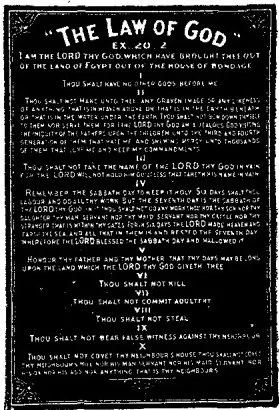
And necessary, if you would know, and have others know the COMPLETE DECALOGUE as God spake it from Sinai’s flaming summit.

A CHART 12x18 INCHES.

Postpaid, 25 Cents.
Postage stamps acceptable.
PACIFIC PRESS PUBLISHING COMPANY, 39 Bond Street, New York City, N. Y.

TO OUR PATRONS:

  1. Write names plainly.
  2. Remit by P. O. Money Order, or Express Order, or by Bank Draft on New York. Personal checks are not desired.
  3. Make all Orders and Drafts payable to Pacific Press Publishing Co., not to the editor or any other individual.
  4. We will receive Postage Stamps in small quantities and any kind of good money. Defaced coins will not be taken. If paper money or coin is sent, register the letter.

That Yellow Tab.

DOES the yellow tab on your copy of the SENTINEL indicate that the time for which you subscribed has expired? If so, it means that your name will be dropped from the list unless we receive your renewal. Can we not confidently look for it at an early date?

SPECIAL OFFER!

THE undersigned has on hand a number of that best of all washing machines—The Cyclone—which he will sell at a specially low price. This machine has been advertised in this paper for a long time and many families have been blessed by its use. The testimonials in its favor are abundant. Write for a circular and be convinced of the merits of the machine, or send $6.50 and get one. Send money by Postal Money Order, Express Money Order, or by bank draft on New York City.
This Special Offer will be extended for A SHORT TIME ONLY, and is made exclusively from this office.
Address,
ALFRED MALLETT, 39 Bond St., New York.
Continue reading: MAP Illustrating the Travels of Paul