Pacific Press Publishing Company · New York · Jan 6, 1898
Distinguishing Secular from Godless
It would be time well spent if a lot many people in this country would learn the distinction between the terms “secular” and “godless.”
Only the Purely Secular Is Truly Non-Sectarian
ONLY that which is purely secular can be truly non-sectarian.
Christ-Likeness and the Duty Not to Judge
HE who would be like Christ, cannot make himself a judge of his brethren.
Christ's Refusal to Answer Peter's Question
“LORD, what shall this man do?” is a question the Saviour refused to answer. Nor will he answer it now.
Why Sabbath Should Not Be Subject to State Regulation
If the Sabbath is the Lord's day why take it out of the Lord's hands, and make it subject to state regulation?
Setting Others Straight Leads to Crookedness
HE who makes it his object to set other people straight, is very sure to get himself crooked in the attempt.
Can the Church Consistently Refuse a Willing State?
If the “Christian” state should want to join the Christian church, how could the Christian church consistently refuse?
The Reformer Who Will Not Set an Example
The modern “reformer” is willing to try almost any scheme for the reformation of his fellow-beings, except that of setting a good example.
Civil Law Cannot Make Men Moral
It is the object of the civil law to keep men civil; but when a person undertakes to make men moral by civil law, he himself becomes most uncivil.
The Civil Sunday and Its Religious Origins
As regards the “civil Sunday,” it is to be remarked that it is singular indeed that a secular institution should have sprung from a pedigree wholly religious.
The Church and Her Name: Union With Earthly Powers
The church should remember that when she is joined with one of the powers of earth, it will be proper for her to change her name. If she wishes to retain her name, she must remain single.
The “Infallible” State.
At the late National Reform convention in Philadelphia, Rev. David McAllister, a leading exponent of National Reform ideas, spoke of the state as being “the infallible interpreter of and the active agent in applying moral law.” This he said was the conception and aim of the National Reform movement.
Let us look for a moment at this “infallible” state.
Where shall we find it? Where is there any record of one, or where is there one that claims to be infallible at the present time?
There is none; but Dr. McAllister doubtless does not claim that there ever was an infallible state or even that there is one in existence now. Yet the National Reform idea is that the state is to become “the infallible interpreter” of moral law.
But how is the state to become infallible? If it never was infallible in the past, and is not infallible now, how is it to acquire infallibility in the future?
Is it to acquire this by being made the “interpreter of and active agent in applying moral law”?
Religious freedom is the soul's declaration of Independence.
The Proper Thing.
By Alonzo T. Jones
A CONTRIBUTOR to the Christian Herald a short time ago, writing from Washington, D. C., a historical and descriptive sketch of the church which President McKinley attends, took occasion to state as though it were a very remarkable thing, that when at church Mr. McKinley partakes of the communion, kneeling at the altar “with the humblest member” of the congregation.
Why this should be considered by anybody as remarkable, is the point to which we would call attention. As a church member he who is the president, is but plain William McKinley. And as a church-member there is no distinction, in standing, between him and the humblest member. The only thing that could consistently be expected, then, is just what was seen, that in his place as a church-member he should receive the communion with the humblest member.
But what is really expected by entirely too large a class of people is that when a church-member is elected president of the United States, or is chosen to some other position in the state or nation, he shall carry with him in the exercise of his privileges of church-membership all the distinction, dignity, and officialism that attaches to him as an officer of the state.
Therefore they expect a governor of a State to be a governor in church and as a church member, and to be addressed as “Governor” by his church brethren; a judge of a court, they expect to be a judge in church as a church member, and to be addressed as “Judge” by his church brethren; and a president of the United States, they expect to be president in his place in church as a church-member, and to be addressed as “Mr. President” or “Your Excellency” by his church brethren.
But this is altogether a mistake. It is nothing else than that insidious ever-lurking spirit of the union of church and state that is always begging for permission to manifest itself. No; though in the White House, or in the Capitol, or as commander-in-chief of the army and navy of the United States, William McKinley is “Mr. President” or “Your Excellency;” yet in his place in church as a church member, he is only plain “Brother McKinley.”
The country is to be congratulated in that Brother McKinley recognizes this vital difference and so disappoints the aristocratic expectations of spectators, by kneeling at the altar and receiving the communion “with the humblest member.” A. T. J.
The Religious State.
NOBODY in this country is, professedly, in favor of a union of church and state; but there are a great many people here who say that the state ought to be religious.
But how is the state to be religious without favoring a church? And what attitude will the church maintain toward the state when the latter professes religion?
Will the church stand off and forbid the state to come within her fold? How would it look for the Christian church to forbid a Christian to unite with her?
When therefore the state becomes Christian, how can the Christian church consistently close her doors against the state?
Loyalty to Country.
THE Boulder (Col.) News thinks that we do not believe in loyalty to the country in which we live, and as regards such loyalty says:—
“Being loyal does not mean that one must go to war whenever the call comes or that he must indorse all the abuses that may exist, or bad laws that may be enacted. He may devote himself to the country by removing those abuses, securing the change or repeal of bad laws, or in any way than he thinks would better the condition of the people.”
This is true; and we never meant to be understood as advocating anything to the contrary. This is the loyalty we believe in exactly. He who is loyal to God will be loyal to his fellow men; and this means loyalty to country in the best and truest sense.
Have You Renewed Your Subscription to the Sentinel?
By Editor
HAVE you renewed your subscription to the SENTINEL? If not, will you not do so to-day?
That Flag Salute.
By Editor
WE did not imagine, when we devoted some space to the subject of the flag salute in our issue of November 25, that we were considering anything more than a local issue. But we were not long in discovering that we had touched a chord which awoke responsive echoes all over the country:
This is very significant. The flag salute is neither local nor accidental. The Boulder incident is but the outcropping of an influence that is at work all through the land. Since noticing that, the news comes that the same salute is being practiced in the Iowa State Normal school, where the young people are trained in the art of teaching, the design being that the graduates as they go out to teach shall introduce the salute in their respective schools. In Pennsylvania the same influence is at work, and experiences similar to those in Boulder have already occurred. Thus the forces are gathering for an attack upon the principles of religious freedom in the public schools; and this will bring the test of loyalty to principle right home to parents everywhere. They will not need to wait till they shall be brought before the courts for breaking Sunday.
But who knew that all this was brewing in our midst?
That Flag Salute.
By Editor
WE did not imagine, when we devoted some space to the subject of the flag salute in our issue of November 25, that we were considering anything more than a local issue. But we were not long in discovering that we had touched a chord which awoke responsive echoes all over the country.
This is very significant. The flag salute is neither local nor accidental. The Boulder incident is but the outcropping of an influence that is at work all through the land. Since noticing that, the news comes that the same salute is being practiced in the Iowa State Normal school, where the young people are trained in the art of teaching, the design being that the graduates as they go out to teach shall introduce the salute in their respective schools. In Pennsylvania the same influence is at work, and experiences similar to those in Boulder have already occurred. Thus the forces are gathering for an attack upon the principles of religious freedom in the public schools; and this will bring the test of loyalty to principle right home to parents everywhere. They will not need to wait till they shall be brought before the courts for breaking Sunday.
But who knew that all this was brewing in our midst?4That is the question. Who knew that the enemy was quietly stealing a march upon the friends of freedom? Did you, reader, know it? And now that it is known, how do you feel about it? Will it pay to know what is going on in this great contest of the principles of liberty and of despotism? or is it the better way to wait and be confronted suddenly by the issue when you are not prepared to meet it?
You had not expected the issue to come in this way? Of course not; that is just the point. For you may be sure of this: the issues which you will be called to face in this contest will not come as you expect them to come. You must be prepared for them not as you expect them to come, but as you do not expect them.
The Proper Thing.
By Alonzo T. Jones
A CONTRIBUTOR to the Christian Herald a short time ago, writing from Washington, D. C., a historical and descriptive sketch of the church which President McKinley attends, took occasion to state as though it were a very remarkable thing, that when at church Mr. McKinley partakes of the communion, kneeling at the altar “with the humblest member” of the congregation.
Why this should be considered by anybody as remarkable, is the point to which we would call attention. As a church member he who is the president, is but plain William McKinley. And as a church-member there is no distinction, in standing, between him and the humblest member. The only thing that could consistently be expected, then, is just what was seen, that in his place as a church-member he should receive the communion with the humblest member.
But what is really expected by entirely too large a class of people is that when a church-member is elected president of the United States, or is chosen to some other position in the state or nation, he shall carry with him in the exercise of his privileges of church-membership all the distinction, dignity, and officialism that attaches to him as an officer of the state.
Therefore they expect a governor of a State to be a governor in church and as a church member, and to be addressed as “Governor” by his church brethren; a judge of a court, they expect to be a judge in church as a church member, and to be addressed as “Judge” by his church brethren; and a president of the United States, they expect to be president in his place in church as a church-member, and to be addressed as “Mr. President” or “Your Excellency” by his church brethren.
But this is altogether a mistake. It is nothing else than that insidious ever-lurking spirit of the union of church and state that is always begging for permission to manifest itself. No; though in the White House, or in the Capitol, or as commander-in-chief of the army and navy of the United States, William McKinley is “Mr. President” or “Your Excellency;” yet in his place in church as a church member, he is only plain “Brother McKinley.”
The country is to be congratulated in that Brother McKinley recognizes this vital difference and so disappoints the aristocratic expectations of spectators, by kneeling at the altar and receiving the communion “with the humblest member.”
A. T. J.
Loyalty to Country.
THE Boulder (Col.) News thinks that we do not believe in loyalty to the country in which we live, and as regards such loyalty says:—
“Being loyal does not mean that one must go to war whenever the call comes or that he must indorse all the abuses that may exist, or bad laws that may be enacted. He may devote himself to the country by removing those abuses, securing the change or repeal of bad laws, or in any way than he thinks would better the condition of the people.”
This is true; and we never meant to be understood as advocating anything to the contrary. This is the loyalty we believe in exactly. He who is loyal to God will be loyal to his fellow men; and this means loyalty to country in the best and truest sense.
Have You Renewed Your Subscription?
By Editor
HAVE you renewed your subscription to the SENTINEL? If not, will you not do so to-day?
The Religious State.
NOBODY in this country is, professedly, in favor of a union of church and state; but there are a great many people here who say that the state ought to be religious.
But how is the state to be religious without favoring a church? And what attitude will the church maintain toward the state when the latter professes religion?
Will the church stand off and forbid the state to come within her fold? How would it look for the Christian church to forbid a Christian to unite with her?
When therefore the state becomes Christian, how can the Christian church consistently close her doors against the state?
The Vital Question.
By Editor
THE Boulder (Col.) News says that in objecting to the flag salute in the public schools, the SENTINEL has made a mountain out of a mole hill. It says that we “totally misapprehend and misinterpret the spirit of the whole matter;” and this statement it explains by saying that the salute—“We give our heads and our hearts to God and our country”—“was not intended to be taken in a narrow, technical sense, not as a declaration of conversion or religion, but as a general expression of reverence for deity and loyalty to country.”
Now this salute consists of a statement so plain and simple that it had not occurred to us that it could be taken in a “narrow, technical sense.” When an individual says he gives his heart to God, we take the expression as meaning just what it says, with no thought of anything technical about it. How would it do as a defense in a breach of promise suit, to plead that although the defendant did say that he gave his hand and heart to the complainant, this was not meant to be taken in a narrow, technical sense, but only as a general expression of esteem?
But aside from this, it should be noted that the real point involved in this matter is not the question of what was meant by the originators of this salute. It is not the question of their motives in introducing it into the schools, or of what good they thought it would accomplish. Doubtless their motives were excellent; we do not question these in the least. Nor is it probable that they themselves saw in it any confession of religious belief; at least, it is quite possible that they did not. But the question is, What did they actually do? What does the flag salute actually require, and what is its real effect?
We are quite ready to believe that the authors of this salute did not know that their gun was loaded, and did not mean to shoot anybody. “I didn’t know it was loaded” is a very common excuse; but the question is, What was the actual result? Beside this, the mere question of what was intended sinks into insignificance.
The News goes on to say that the word “God” in the salute “does not necessarily mean the God of the Bible; it may mean the god of nature, or nature itself, as some put it—even the pagan’s god, if there should be a pagan in the schools.” Well, well! How many gods do the Boulder school authorities want the children to give their hearts to? How many different gods do they believe in themselves? Do they believe that all gods are on an equality, so that the children may with equal propriety be required to give their heads and hearts to any one of them? If not, which one do they mean shall be honored by this flag salute? These are points concerning which the public may well ask for explanation.
If the salute does not mean anything definite, or if it does not mean what it says, it would better be dropped for that reason alone. And if it does mean what it says, then it is a direct invasion of the domain of conscience, whether its authors intended it as such or not.
Civil Law and the Limits of Moral Suppression
WHEN the civil law undertakes to suppress immorality, it finds no logical stopping place short of the Inquisition.
Accept Our Thanks
By Editor
WE desire to extend our thanks for the missionary effort that has been put forth during the past month in behalf of the SENTINEL, and the good lists of subscribers that have been sent in. They have been similar in size and number to those sent in under our special offer last August, and accompanying them have been words of the warmest appreciation of the paper, and the deepest interest in the cause it represents.
The effort is not confined to any particular locality, but has been general. A young man, going to school and clerking in a store nights and mornings, sends in a nice list from Oregon; a man in Wyoming forwards us a list of twenty-five, eight of them taking our Premium Bible; another from Florida sends a dozen or more, and a friend of the paper in Iowa forwards us a list of seventeen subscriptions secured in one day. These cases might be multiplied almost indefinitely, but this will suffice.
We assure our friends, one and all, that we appreciate their efforts, for it shows that they are keenly alive to the situation that confronts us.
During the coming year, the SENTINEL will endeavor to keep fully abreast of the battle it is waging, and deliver its notes of warning so clearly, so earnestly, yet with such tenderness and good will toward all that men and women everywhere will be led to see, acknowledge, and accept as truth the principles for which it contends.
Elder J. Sanborn Renews and Sends Subscriptions
ELDER J. SANBORN, of Sparta, Wis., one of the old-time and warm friends of the SENTINEL, sends us several subscriptions, his own renewal with the number, and says: ‘Of course I cannot do without the SENTINEL. It is so good and always stands for the right.’
“We Have No King But Cæsar.”
By J. O. C.
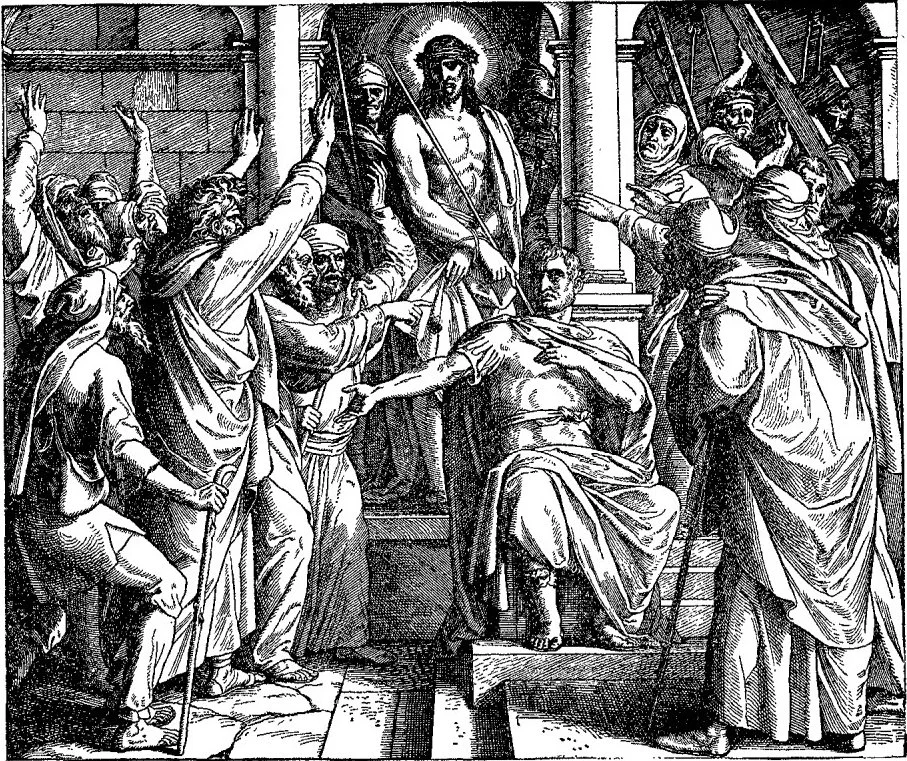
On that fateful day when Pilate had exhausted nearly every resource at hand, in unavailing efforts to save Christ from the power of an angry, infuriated mob, he ventured a last, evasive objection to their demands, in the question: “Shall I crucify your king?” A concert of voices from the chief priests quickly returned the answer: “We have no king but Cæsar.” John 19:15.
Jesus had been dragged by an excited populace before the civil ruler of Judea on charges of a trivial nature, yet they had asked that the sentence of death should be passed upon him. Pilate, suspecting that all was not right in their representation of the case, took the prisoner aside, and questioned him relative to the charges preferred. Finding no cause of condemnation in him, the governor gave a verdict in accordance therewith to the people, who would not receive it. Finding that they could not compass their ends by legal process, the frenzied priests claimed the right, by a religious law of their own, to punish the object of their hatred. Said they: “We have a law, and by our law he ought to die, because he made himself the Son of God.” That is to say, their law regulating religious belief and practice, called for the death of their victim, and therefore the civil power ought not to prevent them from executing its demands.
CHRIST BEFORE PILATE.
This opened a new phase of the controversy to Pilate, and gave him no little anxiety. From what Christ had revealed of himself to the governor when privately examined, he saw that religious malice alone lay at the bottom of the priests’ demand for the blood of Christ. However much he might desire to release the innocent victim of their hatred, he realized that he would not be able to do justice in the matter, without making himself odious in their eyes. Being at that time, too, held under suspicion by the emperor, on account of some irregularity, he feared that, if he offended these fanatical priests, they might accomplish his political overthrow.
Thus timid and undecided, the governor was greatly embarrassed. An earnest appeal, just received from his wife, “Have thou nothing to do with that just man” (Matt. 27:19), coupled with the conviction forced upon his conscience by the private interview with Christ, made him hesitate. He well knew what would have been the right course to take, but his political standing was in the balance. The crafty priesthood fully comprehended the situation, and, taking advantage of the opportunity, quickly exclaimed: “If thou let this man go, thou art not Cæsar’s friend; whoever maketh himself a king speaketh against Cæsar.”
This effort was well-timed on the part of the priests, and had its effect on Pilate. The priests saw this also, and were determined to follow up the advantage thus gained. In reply to the governor’s next appeal for them to consider Christ as their King, they vehemently cried out: “Away with him, crucify him.” Then came the final question from the governor: “Shall I crucify your King?” The answer returned settled the controversy, by deciding Pilate to give Christ into the hands of his accusers. In that the priests covertly insinuated that the governor was not loyal to the emperor. “We have no king but Cæsar,” said they, thus intimating that Pilate had, or was about adopting, another king than Cæsar in the person of Christ.
It seems easy to see from this distance the inconsistency of Pilate’s course, in violating every principle of justice, and his own conscience as well, in yielding to the clamor of the Jewish priests for the life of Christ. Although the Roman civil law assumed control of men’s consciences, yet this judge of the Roman tribunal saw no cause of action against the victim of priestly malice. Notwithstanding this, the mob spirit of the occasion forced the point against the decision of the judge, making him yield to their unjust demands.
Strange as it may seem to some, this was but the legitimate result of religion united with the civil power. By this union, the priests, to whom was committed the administration of religious rites, carried that influence with the civil power that, when a covert threat was made, the civil magistrate gave over to their frenzy, one in6whom “was no sin.” No being could be nobler or purer, yet he was sacrificed to the hatred of fanaticism, for no other consideration than that the one in whose power it was to release or condemn the accused, feared the intrigues of religious leaders, in whose hands was the power of political preferment, or national disgrace.
The power of mischief, maintained by the priesthood of that day, was not peculiar to the spirit of the Jewish religion. Had the priests followed in the way that faith pointed, their disposition would have been merciful, gracious, long-suffering, and abundant in goodness and truth, as was the Source from whence the religion emanated. Ex. 34:4, 5. Where, then, was the difficulty? From whence was their cruel spirit, if not from their religious faith?—It was from the adulteration of their religion with human power, sustained by earthly tribunals. The adoption of this substitute neutralized every element of the refining and ennobling power of God, and left their religion destitute of every heavenly constituent. It thus became subject to the caprice of finite, erring minds, wrought upon by the basest passions of fallen human nature.
It was the same element which is responsible for the spirit of the Dark Ages. Men did not then ruthlessly destroy others, who differed with them religiously, simply because they were Catholics. Protestants of those days acted the same as Catholics when opportunity presented itself. The cruelty then practiced in the name of religion was not the product of Christianity, but the lack of it; not because of Christianity, but in spite of it. The state and the church being united, civil laws were made to maintain the church, of which advantage was taken to coerce the consciences of those who dissented from the dogmas of the church. In other words, men persecuted their fellow men because they were human, and yielded to their own passions of evil, in spite of their profession of goodness.
It would be just the same now, were the state to legislate in behalf of the church, for the reason that human nature has not changed. Give men the power now, and they would use it just the same as others before them have used it, namely, to break down every one who opposed their peculiar ideas of religion. Men grasp for power everywhere,—in religion, as well as in the state. If they cannot secure it in one way, they will in another. The fact that Christ never gave his power in the interest of coercion, and will not grant it now for that purpose, is the reason that ambitious churchmen apply to the state for a power which they may wield as they will.
The power of God is not for man to control in any way, but is designed to influence, guide, and control him. He may not use the power, but the power may, and will use him, if he permits it; otherwise it leaves him alone. If professing Christians would be satisfied with God’s disposition of his power, they could not become arbitrary, and desire to control others in religious matters. It is only when self asserts its desire to control some power in the interest of religion, that he resorts to civil government for it; and when it is secured, he can use it only in a human way, which is far from divine.
The reason for this is plain. When fallen man, who needs God’s power for assistance by the way, and should be subject to it, attempts to take control of that power himself, by which to force others to terms, who are likely to be as near right as himself, he thus essays to rise above, and break away from his Master, and like all servants armed with power, becomes arrogant and cruel. It was at this point where the Jewish priests exclaimed: “We have no king but Cæsar,” and so severed the last link which had united them to the rule of heaven. Will the people of this nation learn lessons of wisdom from the history of the past? J. O. C.
Church and State in the Society Islands.—No. 1.
By B. J. Cady
BY B. J. CADY.
ONE hundred years ago, the first missionaries from England landed in this group of islands and began missionary operations. They found a strong race of people, much larger than the average European. These people were kind in general, and very sociable, so much so that the islands were named “Society Islands.”
They worshiped the spirits of the dead who had been noted as men of renown in olden times, so had many gods or objects of worship. They offered human sacrifices, but were not cannibals.
The king and priests were the leaders in all things pertaining to civil and religious matters. The kings were looked upon as belonging to a higher order of men, as some of their forefathers were supposed to have been deified, and to have performed many marvelous feats. The story is told of one who drank whole rivers of waters, with the gravel and stones in the river beds, and of another who threw a spear from one island to another, a distance of 130 miles. It is said that on its way, the spear passed through a mountain of an intervening island, leaving a tunnel through the mountain.
The priests were in subjection to the king, and usually used their influence to help to carry out the wishes of their ruler. It is said that when the king, for most any petty cause, should become jealous or angry with a man, the priests would see that it was necessary to offer a sacrifice to appease the wrath of their god, so would start out in search of a human sacrifice. They would enter the house where the king’s enemy was, seize and kill him, and drag his dead body to the marae, which is a large heap of stones. The corpse would be cast upon the stones, where it would remain until destroyed by sun, wind, and rain.
After fifteen years of toil, the missionaries saw the first fruits of their labors. In time the king of the largest island embraced the new religion, and traveled with the missionaries from place to place, trying to get the people to accept the new white man’s religion. We are told that7some of the first ones who embraced the Christian religion were very earnest, devoted men, and that there was a great change in their lives for the better.
The first missionaries were men with but little means, and received but little from their native land to help them. They had not been reared in luxury, but were men of faith, who believed that God had called them to preach the gospel to those who were in darkness. After a time, more new missionaries came to the islands, some with more education, and with new, and what was supposed to be broader, ideas as to how the work should be carried forward.
Guns and various weapons of warfare were brought to the islands, and when the heathen became jealous and wished to destroy the new Christian church, weapons of warfare were placed in the hands of the Christians, so that they might be able to combat with the heathen about them. After a few battles, the Christians conquered the heathen, and gradually all adopted the form of Christianity.
The missionaries then thought it would be well to establish their religion by law, and laws like the following were enacted:—
“Jehovah is King of all kings; by him the princes rule and the people have peace.”
“All who break these laws are to be treated the same.”
“Only church members are entitled to hold office in the government.”
“People are not to bathe, wash clothes, or cook food between the hours of 9 A. M. and 3 P. M., on Sundays.”
“Those who do not keep the Sabbath (Sunday) are to be fined.”
“No new religion is to be allowed on the island. If missionaries of another faith teach their religion in this land, and will not refrain from it, they with their converts must be banished.”
I visited one district where they had recently made a new law, that, unless ill, every man, woman, and child must attend church on Sunday. If one failed to reach the church, he was fined twenty cents. I asked the cause of the new law, and was told that their meetings had been very poorly attended for some time, but that since the law had been passed, there had been a good attendance every Sunday. One said, “See how many there are here to-day.” I should think that there were about 150 present, while there was only an average of about ten in attendance before the law had been made. I asked, “What do you do with the money raised by fines?” They replied, “O we keep it until there is enough, and then we are going to have a feast.” I asked who was to superintend the feast, and was told that it was the church, but that all were attending meeting so faithfully then that it might be a long time before they would have enough money to buy the needed things.
It can be readily seen that the object of the laws to which I have referred, was to help the church. It may have been thought by the originators that the native people needed all the help that could be given them by the government. So they had laws made to prohibit them from doing what they looked upon as sin. It was as much as saying: “We look to the Lord to be our God and ruler, and we want this island for the Lord. There is no room for what we call the devil here. So do not bring any other religion to this place, or we will have to cast you out, for ours is the true gospel, and yours is false. We do not want you to teach your erroneous views to our people, for they might believe them and be lost.”
And it was virtually saying to the islanders: “We know what you ought to do to serve God. Now you must do what we tell you that God wants you to do, and if you fail, we must punish you by fines so as to keep you from doing what we believe to be wrong. Do as we tell you to do, and you will be saved. If you do not, we shall punish you so as to make you do right that you may be saved.”
It is to be remembered that the missionaries were the principal ones in getting these ideas expressed in the laws. The object of this article is not to condemn the promoters of these laws, but to consider whether this is the right way to make Christians. If this is the way, we would naturally expect to see quite an improvement in this people during the past 75 years. I wish in another article to give a brief history of the working of the church in the Society Islands, and will let the reader judge by the fruits borne by this church as to the propriety of trying to make Christians by law.