The Story of the Rebellion Against the Government of King Jehovah
By Carlyle B. Haynes
The Great War — No. 6
The Story of the Rebellion Against the Government of King Jehovah
Lucifer Rebels Against King Jehovah
CARLYLE B. HAYNES
THERE was a time when Satan was “in the truth.” But he “abode not in the truth” (John 8:44); that is, he became an apostate, the leader in a great apostasy from, and a great rebellion against, God. The Bible contains several references bearing on the causes of this apostasy, and from a study of these passages a clear idea can be gained as to the reasons for the transformation of Lucifer into the devil.
In speaking of the qualifications of a bishop, or elder, in the church of Christ, Paul uses this language: “Not a novice, lest being lifted up with pride he fall into the condemnation of the devil.” 1 Tim. 3:6. Such a remark would be without point unless it had been a known and accepted fact that the devil had been condemned for pride.
Christ Above Lucifer
While Lucifer in heaven occupied a highly exalted station, there were beings who were far above him. These were the Father and the Son. The angels worshiped the Father as creator of all things, but the Son was coequal with the Father in creation, and the Father had said, “Let all the angels of God worship him” (Heb. 1:6), and therefore the Son also received the worship of the heavenly host, and, with the rest, the worship of Lucifer.
The Son of God was supreme over all the works of creation, for he was “the express image” of the Father’s person, “the brightness of his glory,” and upheld “all things by the word of his power.” Heb. 1:3. High over all the angels of heaven and over the unnumbered intelligences of the myriads of worlds in space, he reigned, and his rule was a rule of love. The angels delighted to serve and obey him.
The Rule of Love
This service and obedience were that of love, a love which was the result of their knowledge and appreciation of the character of Christ. This is the only kind of service that God desires, and he does desire this from all his creatures. He takes no delight in forced obedience, and all the creatures whom he has brought into existence have been given freedom of will to serve him or not to serve him as they may choose. But until Lucifer apostatized all the angels had chosen to obey and serve God, knowing, as they did, the beauty and righteousness of his character. Everything throughout the vast reaches of the heavenly kingdom had been perfectly harmonious. The utmost joy and delight were taken by the heavenly host in fulfilling the purposes of their Creator. They loved God supremely, and each other unselfishly.
Lucifer Covets Christ’s Position
But a change came. Lucifer found the adoration of the angels who were under his leadership pleasant and gratifying, and earnestly desired it to continue and to increase. But there was One they looked up to and adored more than they did himself, yea, One whom they even worshiped. This was the Prince of the kingdom, Prince Immanuel, the Son of God. Dissatisfaction crept into the heart of Lucifer, and he began to look upon the high position of Christ with envy and desire. Instead of banishing these thoughts at once, he cherished them, turning them over in his mind, until the Prince became to him a troublesome rival, and he became convinced that for such a bright and glorious and wise being as himself to remain in a subordinate position was the height of injustice. “Thine heart was lifted up because of thy beauty, thou hast corrupted thy wisdom by reason of thy brightness.” Eze. 28:17. Little by little this dissatisfaction grew upon him, and the feeling took possession of him that the more exalted position which he believed his talents and ability entitled him to occupy was being kept from him by injustice. His heart grew sore and resentful, and he coveted the honor and worship which were rendered to Christ.
This mighty angel forgot that all his talents and ability came from his Creator. He forgot that he had nothing and was nothing except as it had been given him by God. He came to believe that his attributes pertained solely to himself, and began to look upon himself as a rival of God in the government of the universe, who had been unjustly deprived of his rights by one stronger than himself. He determined that he would secure those rights, and take his rightful position in the universe, at all hazards to himself.
“Thou hast said in thine heart, . . . I will exalt my throne above the stars of God; . . . I will be like the Most High.” Isa. 14:13, 14. Having conceived this purpose in his heart, Lucifer did not come out openly against God at once, but went silently about the work of disaffection among the other angels. Heretofore he had sought to make God supreme in the thoughts and affections of those under his leadership, but he now sought to secure their allegiance and loyalty to himself.
A Wonderful Scene
A writer specially gifted and specially qualified to speak on this subject, thus describes the scenes in heaven in connection with the origin of sin in the heart of Lucifer:—
“Now the perfect harmony of heaven was broken. Lucifer’s disposition to serve himself instead of his Creator, aroused a feeling of apprehension when observed by those who considered that the glory of God should be supreme. In heavenly council the angels pleaded with Lucifer. The Son of God presented before him the greatness, the goodness, and the justice of the Creator, and the sacred, unchanging nature of his law. God himself had established the order of heaven; and in departing from it, Lucifer would dishonor his Maker, and bring ruin upon himself. But the warning, given in infinite love and mercy, only aroused a spirit of resistance. Lucifer allowed his jealousy of Christ to prevail, and became the more determined.
“To dispute the supremacy of the Son of God, thus impeaching the wisdom and love of the Creator, had become the purpose of this prince of angels. To this object he was about to bend the energies of that master mind, which, next to Christ’s, was first among the hosts of God. But he who would have the will of all his creatures free, left none unguarded to the bewildering sophistry by which rebellion would seek to justify itself. Before the great contest should open, all were to have a clear presentation of his will, whose9wisdom and goodness were the spring of all their joy.
“The King of the universe summoned the heavenly hosts before him, that in their presence he might set forth the true position of his Son, and show the relation he sustained to all created beings. The Son of God shared the Father’s throne, and the glory of the eternal, self-existent One encircled both. About the throne gathered the holy angels, a vast, unnumbered throng—“ten thousand times ten thousand, and thousands of thousands,” the most exalted angels, as ministers and subjects rejoicing in the light that fell upon them from the presence of the Deity. Before the assembled inhabitants of heaven, the King declared that none but Christ the only begotten of God, could fully enter into his purposes, and to him it was committed to execute the mighty counsels of his will. The Son had wrought the Father’s will in the creation of all the hosts of heaven; and to him, as well as to God, their homage and allegiance were due. Christ was still to exercise divine power, in the creation of the earth and its inhabitants. But in all this he would not seek power or exaltation for himself contrary to God’s plan, but would exalt the Father’s glory, and execute his purposes of beneficence and love.
“The angels joyfully acknowledged the supremacy of Christ, and prostrating themselves before him, poured out their love and adoration. Lucifer bowed with them; but in his heart there was a strange, fierce conflict. Truth, justice, and loyalty were struggling against envy and jealousy. The influence of the holy angels seemed for a time to carry him with them. As songs of praise ascended in melodious strains, swelled by thousands of glad voices, the spirit of evil seemed vanquished; unutterable love thrilled his entire being; his soul went out, in harmony with the sinless worshipers, in love to the Father and the Son. But again he was filled with pride in his own glory. His desire for supremacy returned, and envy of Christ was once more indulged. The high honors conferred upon Lucifer were not appreciated as God’s special gift, and therefore called forth no gratitude to his Creator. He gloried in his brightness and exaltation, and aspired to be equal with God. He was beloved and reverenced by the heavenly host, angels delighted to execute his commands, and he was clothed with wisdom and glory above them all. Yet the Son of God was exalted above him, as one in power and authority with the Father. He shared the Father’s counsels, while Lucifer did not thus enter into the purposes of God. ‘Why,’ questioned this mighty angel, ‘should Christ have the supremacy? Why is he honored above Lucifer?’—Mrs. E. G. White, in “Patriarchs and Prophets,” pages 35-37.
(To be concluded)
An Optical Illusion
By W. S. Chapman
W. S. CHAPMAN
It was a drowsy day in midsummer. Uncle Joe sat at the window, alternately nodding and reading.
“What is that child doing that keeps him so quiet?” called Aunt Mary from the kitchen.
The child was busy playing in the sandy earth of the garden, and as Aunt Mary reached the door, was very quietly lifting sand in its chubby hand and, apparently, slowly pouring it back again without any particular object in view.
“What are you doing, honey?”
“Tum see, mamma.”
Aunt Mary discovered that the little one was endeavoring to force sand into what seemed to be a large ant hole, and so reported to her husband.
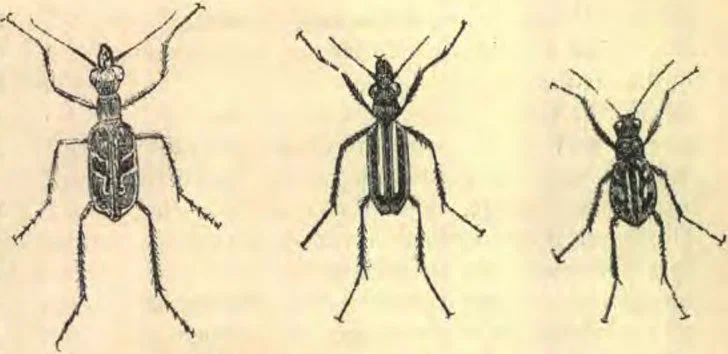
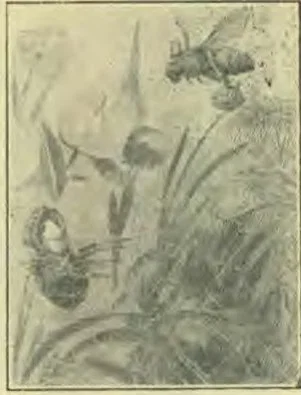
THREE VARIETIES OF THE TIGER BEETLE
“That is not an ant hole, Mary, but is the dwelling place of the larva of the Cicindela, or tiger beetle. These insects belong to the Coleoptera, or those whose hinder wings fold together both ways, and are hid, when not in use, under the forewings, which are made of harder material to form a case, or sheath, for the others. The hinder wings, when spread for flying, are several times larger than the body of the insect. That hole is the opening to the home of the larva of a tiger beetle.”
“If you can keep the baby quiet for ten minutes, or, better still, come into the room and watch from the window where noise will not disturb the grub, you will, possibly, witness something interesting.”
So Aunt Mary brought the little one indoors and sat down in a rocker close to Uncle Joe and where she had a full view of the garden from the window. For some time nothing occurred, then, suddenly, a large grain of sand or a pebble appeared at the mouth of the hole and was lifted above it, then quickly thrown several inches distant. Soon other pebbles came to the surface, and were treated in the same way. Evidently the little inhabitant was cleaning house after the disturbing attack of the baby. This kept up for some time, when a season of quiet followed; then, while both were intently watching in pleasurable anticipation, something happened—the hole disappeared from sight!
So astonished was Aunt Mary that she impulsively handed the baby to Uncle Joe and ran out into the garden, against his protest, for a closer examination. Sure enough, the hole was gone, not a trace remaining10except a little surrounding depression, like a saucer, which always surrounds these tiger beetle holes.
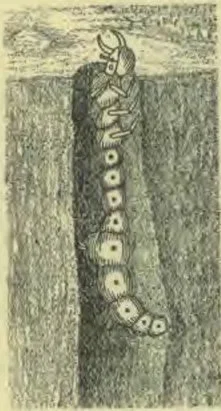
When Aunt Mary returned, Uncle Joe explained that the disappearance of the hole was an optical illusion. The larva, or grub, had ascended to the top of the ground; being head first, his little round head, the color of the sand, exactly fitted the opening, and by a circular movement the insect caused the surrounding sand to fall over him, not only completely concealing his head, but filling the opening level with the surrounding earth, covering it from sight. All that remained above-ground were two strong mandibles, looking like little dry twigs. “In this manner,” Uncle Joe explained, “the tiger beetle waits for his prey. A passing fly or bug ventures upon the inclined sand surrounding the opening, and naturally slides to the center with the intention of ascending the opposite side, but as he starts to pass between the cruel, innocent-looking mandibles, they close upon him, and down into the hole he disappears to his death. In this way, ants, flies, and other small insects and creeping things become victims of this cruel creature.”
LARVA OF THE
TIGER BEETLE
“Are all the holes which we see in the ground made by this grub?”
“No, indeed. A few are made by the ants, but the greater part are the work of wasps and other insects, and are veritable tombs where they store little creatures they capture, to become food for their larvae. This tiger beetle grub is a very pugnacious creature. In China they are so savage that men collect them and arrange regular combats, often betting large sums on the result. Come out into the garden and I will fish for this one, and draw him out of his cave, as the Chinaman does. The holes vary from six inches to a foot in depth. I will take this stray stalk of timothy growing here by the path, and pass it down into the hole until it reaches the bottom, which will be, of course, the head of the grub. At once the savage little grub, you see, seizes it in his strong mandibles and holds on tightly, even while being drawn to the surface. He is like a bulldog, and never lets go his hold even if cut in two. There he lies before you.”
“Notice the fierce expression of his face. His little round head is in two halves. See how the mandibles are depressed into the soft timothy stalk. His white-colored body, so soft, is not intended for life above-ground, and you see by his squirming that he already is beginning to feel uncomfortable.”
“In a few days he will pass through the change from a grub to one of the most active and beautiful of beetles, swift both of foot and wing, and fiercely predatory, attacking every small creature in the way of a grub or insect that crosses his path. This is what gives him the name of tiger beetle.”
Wealth Viewed Through Christ's Eyes
By W. M. Clow
If we look at wealth with Christ’s eyes, we shall be more inclined to the poverty we dread than to the riches which, along with so many more, we often denounce, and so persistently covet.— W. M. Clow.
What the Lord Expects of Us
By J. R. Howatt
WHAT we can do is what the Lord expects us to do, and no more; but, oh, one day it will be a very, very earnest question for us to answer, Have we done for Jesus what we could?—J. R. Howatt.
Worth Within Outweighs the World's Contempt
By Alexander Smith
A MAN can bear a world's contempt, when he has that within which says he's worthy.—Alexander Smith.
Our Summer Boarders
By Etta Squier Seley
THERE are four of them now, and we started with only one—which speaks well for the table we set. Don't you think so?
Two of our patrons wear black hoods all the time, even at table; and the other two wear speckled collars.
Now of course my secret is out, so I will tell you how it all came about. Last summer we discovered that the Oregon junco is fond of crumbs, and can easily be induced to come even into the house for them. That was late in the season, so we did not have much chance to get acquainted then; but one day early this spring I put cracker crumbs and rolled oats on the kitchen window sill, and that very morning I heard a tap, tap, and there was Mr. Junco. He ate a hearty meal and flew away, only to return soon with his little lady. She, too, approved of the menu, and the next day we were delighted to see her bring the baby.
Such a time as she had filling that hungry mouth! The little scamp was almost as large as she, and could fly perfectly; but when his mother was near, he pretended to have no idea whatever of how to pick up his own food. Then the other baby was brought, and the same performance gone through with. It was enough to wear out any mother, for the babies seemed never satisfied.
Then, one day, something very funny happened: the mother junco and one baby came, and Lady Junco tried to coax him to pick up his own food; but he would only sit there with his saucy little head up in the air, squealing out his queer little “chee, chee” hunger call. Then the mother bird filled her bill full of oats, and the baby was sure he had gained his point, so sidled up to her to be stuffed as usual. But here came his first shocking surprise; for Mother Junco swallowed those oats herself, and gave Master Squeaker a sharp rap on the head instead of the coveted food. Then she was off like a flash, and the astonished birdling was left alone on the window sill with food all around him.
For some time he looked about in vain for his mother, but could not see her. We could see her high up in a near-by tree, watching to see what would happen.
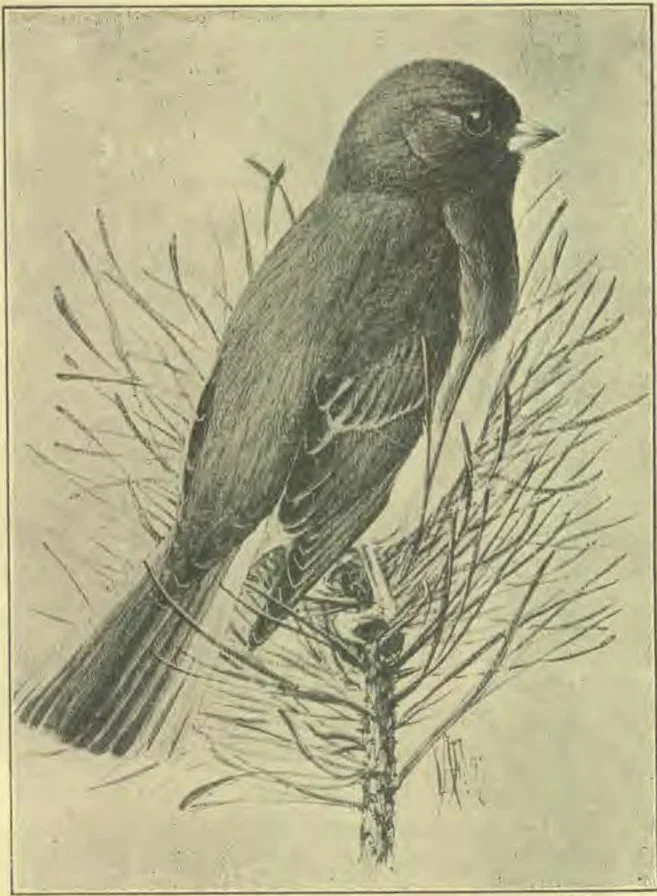
SLATE-COLORED JUNCO
Then he saw the food, and must really have been hungry, for he began picking it up just as if he had always11eaten in that way. The other baby soon learned, too, and now they come regularly to our window table, and do not seem at all disturbed because we are in the room.
It is really very easy to tame them. When grown, they are about the size of a sparrow. They have brown backs and gray breasts, and a jet black hood and collar. Their song is sweet but not at all loud, just a dainty warble. The birdlings are speckled, brown and gray.
The farmers value these little birds highly, because they live chiefly on weed seeds. Even so high an authority as our Oregon Agricultural College advises the public of their value to the country because of their diet.
So, you see, our summer boarders are rather noted people, even if they are small, and wear feathers.—Etta Squier Seley, in Sunday School Times.
A Secret
By Cora Ferris
I’ll tell you a golden secret
I’m sure you’d like to know;
’Tis only a simple secret,
But it cures a heap of woe.
Little annoyances vex you,
And your mouth grows hard the while;
Don’t let it! that’s the secret:
Turn the corners up with a smile!
Keep each of the ends bent upward,
Whatever the effort may cost,
And the troubles and trials will vanish,
And the peace comes back you had lost.
There’s wondrous relief in smiling,
’Tis better by far than tears;
For the happiness spreads to others,
And faith replaces fears.
CORA FERRIS.
Marvelous Strength of Birds
BIRDS can eat and digest from ten to thirty times as much food in proportion to their size as men can. If a man could eat as much in proportion to his size as a sparrow is able to consume, he would need a whole sheep for dinner, two dozen chickens for breakfast, and six turkeys for his evening meal. A tree sparrow has been known to eat seven hundred grass seeds in a day. Relative to the bird’s size, these seeds were as big as an ordinary lunch basket would be to a full-grown man.
A bird’s strength is equally amazing. A white-tailed eagle weighing twelve pounds, with a wing spread of six feet, has been known to pounce on a pig weighing forty-two pounds, raise it to a height of a hundred feet, and fly off with it. The bird had covered a distance of half a mile before the pig’s owner succeeded in shooting the thief.
Birds can and do work far harder than human beings. A pair of house martins when nesting will feed their young ones in twenty seconds; that is, each bird, male and female, makes ninety journeys to and fro in an hour, or about a thousand a day. It must be remembered that on each journey the bird has the added work of catching the worm. Even so tiny a bird as the wren has been counted to make one hundred and ten trips to and from its nest within four hundred and thirty minutes, and the prey it carried consisted of larger, heavier, and harder-to-find insects than were caught by the sparrows. Among them were twenty caterpillars, ten grasshoppers, seven spiders, eleven worms, and more than one fat chrysalis.—Philadelphia Record.
Canvas Apron Device for Gathering Fruit
To simplify the work of gathering fruit which does not necessarily require hand picking, a canvas-apron device has been invented, which in appearance is similar to a large umbrella. It is so arranged that it may be placed about the trunk of a tree, forming a funnel into which apples or oranges are caught as the tree is shaken. In the center of the device is a cloth arranged in such manner as to break the fall of the fruit as it rolls into the chutes and is discharged in baskets or boxes placed on the ground. The canvas is supported by radial arms which may be folded over on one side to permit the device, which is mounted on a cart, to be wheeled between the various rows of trees in an orchard.—Selected.
The Universal Benefactor
By Harrington Knight
ETHEL laid down the paper with a sigh. “It does seem selfish,” she said in a tremulous voice, “to keep on being happy when so many dreadful things are happening.”
Older people than Ethel frequently make that mistake. Sometimes when we know that human beings elsewhere are suffering the extreme of anxiety or want, our own lightness of heart, our interest in trifles, seems unfeeling. We are almost ready to believe that if we can do nothing else for those distant sufferers, we should at least be miserable in their behalf.
There is, however, a fatal flaw in this reasoning. For joy is a universal benefactor. There is not a happy face which does not throw a ray of sunshine into the life of some stranger, though all unconscious of its benefit. There is not a glad voice which does not set joy bells ringing in the heart of some listener, perhaps many of them. The mere presence of a joyous creature in a throng of tired, anxious men and women is a benediction. Eyes follow her as she passes. Like a breath of fragrance from some hidden rose garden the perfume of her joy diffuses itself wherever she goes.
It is a sad thing that there should be so much suffering in the world, but to give ourselves up to brooding over it would only make the sum of human suffering greater, and the sum of joy less, and it is hard to see how this would benefit any one. But on the other hand, if we can keep joyous and light-hearted, we shall bless every creature we come across. Stevenson was right in saying that there is no duty we so much underrate as the duty of being happy.—Harrington Knight.
Judge Not
“JUDGE not; the workings of his brain
And of his heart thou canst not see;
What looks to thy dim eyes a stain,
In God’s pure light may only be
A scar, brought from some well-won field,
Where thou wouldst only faint and yield.”
Put Your Creed Into Your Deed
Go put your creed into your deed,
Nor speak with double tongue.
— Emerson.
The Spider’s Riches
By L. J. Bridgman
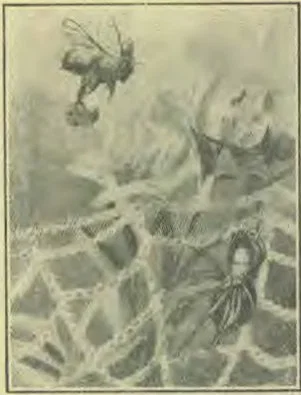
“I AM rich!” said the gay little spider. Her web was all bright With the dewdrops of night In the clear morning light, Like great diamonds sparkling beside her.
“Rich, indeed!” buzzed the big, burly bee. “She’s really quite funny! But I’ve stores of honey Worth actual money! When the sun gets up higher, we’ll see!”
By and by the big bee made a call. Not a diamond there! All had vanished in air, And the web was quite bare! Was the small spider sad? — Not at all.
“Why,” said she, “though my wealth did not stay, I enjoyed every drop Just as long as ’twould stop, And I’m feeling tiptop! It has been a most glorious day!”
“I am rich in my thoughts, Mr. Bee. Though my jewels took wings, I had the dear things, And the next morning brings, Maybe, more of such riches to me!”
So the bee, who was wise in his way, Learned a lesson. “’Tis not,” Said the bee, “what you’ve got, It is what you have thought, That is riches most likely to stay!”
—L. J. Bridgman, in Youth’s Companion.
The Boy Who Is “Ready to Oblige”
By J. L. Harbour
THE more I see of life and of people and the more I come in contact with boys, the firmer grows my conviction that the boy who is always “ready to oblige” has a trait in his character that will be a great help to him when it comes to the making of friends and the advancement of his own interests in life. I do not mean by this that a boy should be obliging from the selfish motive of advancing his own interests. It is the boy who is ready to oblige any one and every one, with no thought of receiving anything in return, who will make friends everywhere he goes.
The past winter I was staying for two or three days in a New Hampshire town. In the family of the people living across the street from my host and hostess was a boy of about fifteen years, who was surely the kind of “ready-to-oblige” boy I have in mind. I had written three or four letters, which I wanted taken to the post office, half a mile distant; and as I had a lame foot from falling on the ice, I could not well go. When I asked my hostess if there was any one in the neighborhood by whom I could send my mail to the office, she said: “Why, yes; there is Paul Blank. He will carry the letters to the office for you. He is a very obliging boy. I never saw a boy more ready to do a favor. I think he really enjoys it. I suppose that is the reason he is so popular.” Paul answered my hostess’s telephone call, and in less than five minutes he was at the house, ready to do our bidding.
When he learned what was wanted, he said: “Why, of course I’ll take the letters to the office! I can go down there in a jiffy on my wheel. Might as well be obliging.”
“That is what you always say, Paul,” replied my hostess.
“Well, isn’t it true?” he asked with a little laugh. “Why shouldn’t a fellow be obliging now and then?”
“Oh, but it isn’t just ‘now and then’ with you when it comes to being obliging, Paul. You are always ready to oblige.”
“Well, it sort of makes a fellow feel good inside when he has done a good turn.”
Happy the boy who feels “good inside” every time he has done a good deed. It proves that he has a generous spirit, and there is no finer possession. It proves that the ugly thing we call selfishness has not been able to get much of a grip on that boy.
Years ago, when I was a boy myself, there was a real “ready-to-oblige” boy in the small town in which I lived. He seemed to take keen delight in doing favors. When about eighteen years old, he left our town and went to the Far West, and it was long years before I saw him again. Then I happened to be in a Western city, and a cousin of mine chanced to mention the name of this boy, who had long been a man.
“I once knew a boy of that name,” I said. “He came out West. I wonder if by any chance the man you have just named is the boy I knew long years ago.”
“Well, if you ever knew him, you knew a fine lad, for only a lad of that kind could develop into the kind of man he is. He is the most kind and obliging man I ever knew.”
“So was the boy of the same name whom I know,” I said.
A little more conversation revealed the fact that the man my cousin had named was the very boy I had played with in my boyhood. I went to see him the next day, and found him to be a big, bright-eyed, jolly man, the very soul of kindness and friendliness. He was most successful in his business, and was still carrying out his policy of always being “ready to oblige.”
I suspect that you know the other type of boy, the boy who is never ready to do a favor, and who is so “grouchy” about it when he does do a favor that one never wants to ask him twice to be obliging. I know that type of boy. He is denying himself a great deal of the joy of life. He is likely to develop into the cold, calculating type of man who is devoid of human kindness and sympathy. I know a man of that type. He is seldom known to do a favor, and no one ever goes to him with a subscription paper, no matter how worthy the cause may be. He has not a particle of that good thing we call “public spirit.” He must have something in return for everything he does. Need I add that he has few friends? He is the most “let-alone” man I happen to know.13
The boy who is always “ready to oblige” is the kind of boy the average employer is looking for. He cannot afford to employ any other kind, if he is in a business that demands the good will of the public and the boy is in a position in which he must meet people. The disposition to oblige has a distinct commercial value. But it is not for that reason alone that one should be obliging. It is because there should be the spirit of service in all of us. We should be “ready to oblige” because this is the real Christian spirit, and because it adds so much to the happiness of life to be kind and helpful to others.—J. L. Harbour, in the Visitor.