Review and Herald Publishing Assn. · Washington, D. C. · July 25, 1905
Traces of Sabbath Observance in Olden Time
By William Ambrose Spicer
3—In Ancient Abyssinia
THE Abyssinians lay claim to great antiquity for their royal house and government. The queen of Sheba, they say, who came from the ends of the earth to see the glory of Solomon, was of their land. Whether this be so or not, Abyssinia is an ancient land with an interesting story.
Although it is not far from the great ocean highway to the East—lying inland west of the southern end of the Red Sea and the Gulf of Aden—it is even yet a country little known. A few travelers have reached it in recent years, and have told us of the land and its people. But missionary work has been discouraged by the government, and very generally the Abyssinians have avoided contact with Europe. They have too often suffered by such contact in the course of history. There seems a change now, and the country is more open. Not long ago the United States sent a representative to negotiate a commercial treaty with King Menelik. He was cordially received in the royal city of Adis Adaba. We hear now of a proposed visit to Europe by the king. As mid-Africa generally is opened up, we shall hear more and more about Abyssinia.
From the point of view of our missionary work, it is a land of special interest to us. We ought to be foremost in entering. In the early centuries Christianity was introduced there. It was before the doctrine of lawlessness had trampled the Sabbath out of sight, and the Christians of Abyssinia were taught to honor and reverence God’s holy day.
In the breaking up of the Roman empire, and later in the Mohammedan invasion of all North Africa and Syria, Abyssinia was cut off from all contact with northern civilization. It was lost to European knowledge. “The Ethiopians slept near a thousand years,” says Gibbon, “forgetful of the world, by whom they were forgotten.”
During all that time the papal church in Europe had grown more and more corrupt, and the Sabbath had been set aside altogether, save as here and there persecuted remnants of the old-time faith kept the light of truth dimly burning amid the darkness.
The Dark Ages passed at last, and the first streaks of the dawn of the Reformation had begun to brighten the horizon. New life was stirring, and men began to explore the world in which they lived. Portuguese navigators rounded the Cape of Good Hope, and made their way up the African east coast. So they found the lost empire of Ethiopia, the present Abyssinia. They found a people with the Bible, keeping up the form of Christianity, and that, too, of a far purer stamp than the Roman Catholic Church knew.
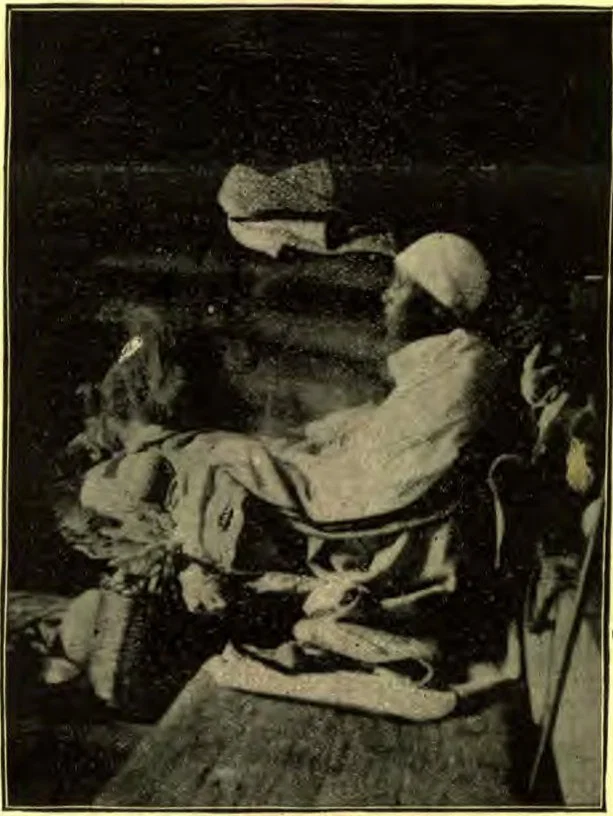
“MY FELLOW PASSENGER,” AN ABYSSINIAN
They knew nothing of the doctrine of mass, of purgatory, or of image worship. And they were keeping the Sabbath. A representative of the Ethiopian church was taken to Lisbon by the Portuguese in 1534. He explained to the king their reason for keeping the seventh day:—
“Because God, after he had finished the creation of the world, rested thereon; which day, as God would have it called the holy of holies, so the not celebrating thereof with great honor and devotion seems to be plainly contrary to God’s will and precept, who will suffer heaven and earth to pass away sooner than his word; and that, especially, since Christ came not to destroy the law, but to fulfil it. It is not, therefore, in imitation of the Jews, but in obedience to Christ and his holy apostles, that we observe that day.”
They had many superstitions mixed with their religion, but it was too Scriptural a faith for Rome to let alone. After a generation of effort and intrigue the Abyssinian church submitted to the pope. He commanded them to give up the Sabbath, and the king made laws threatening severe penalties for Sabbath-keeping. Later the tyranny of the priests of Rome was such that they were expelled, and the Abyssinians succeeded in shutting themselves off again from nearly all intercourse with Europe and the churches of Europe.
Their religion now is no doubt a sad mixture; but they are still witnesses to the fact that those who received the gospel in the earliest centuries received also the Sabbath; and they have not even yet forgotten it. Dean Stanley, the English historian, said of them in his “History of the Eastern Church:”
“There alone the Jewish sabbath is still observed, as well as the Christian Sunday. They (with the exception of a small sect of the Seventh-day Baptists) are the only true Sabbatarians in Christendom.”
Elder L. R. Conradi tells of interesting conversations that he had with Abyssinian Christians not long ago. He says: “While traveling from Beirut to Joppa on the steamer—traveling steerage as I was—I had opportunity to get acquainted with those on board. I noticed six or seven strange-looking, tall persons, and they had shepherd’s crooks. They had very little baggage or clothing with them. They had a place on the boat very close to me. When supper time came, they would stand, leaning on their crooks, and the lady in the party would pray before they sat down to the meal.
“I knew they were Christians, and I was curious to know what kind of people they were. So I got a man who understood the language to interpret for me, and I learned that they were Abyssinians. I began to talk with them a little. ‘We are Christians,’ they said; ‘we are going to Jerusalem to worship at the holy places.’ I asked this man what day he kept. He replied, ‘The Sabbath.’ ‘What day of the week is the Sabbath?’ ‘The seventh day, Saturday,’ he replied. I wanted to be sure; so when I came to Jerusalem, I asked our Brother Krum, ‘Haven’t you an Abyssinian church here?’—‘Yes.’ ‘Let us go up there,’ I said. Friday evening, as the sun set, we went up to the church, and what did I see?—The people assembling for worship. And on the Sabbath day also they assembled for worship.
“I inquired if they had not some man there, a man of learning, with whom I could converse. I was shown to the church of the Holy Sepulcher, where they have a small place that is given to them. They are poor people. Calling there, I was told that the bishop was not there. He had gone back to Abyssinia to see King Menelik; but the sub-priest was there, and I talked with him through an interpreter. I said, ‘Are you Christians?’—‘O, yes.’ ‘Do you believe in Jesus Christ?’—‘Yes.’ ‘Do you believe in the Word of God?’—‘O, yes.’ ‘Do you believe in the ten commandments?’—‘Yes.’ ‘What day of the week do you really keep as the day most holy?’ He said, ‘Sabbath, Saturday, the seventh day of the week.’ Then I asked him, ‘Now why do you keep Sabbath?’—‘Because it is commanded in the ten commandments.’ ‘Do you keep any other day?’—‘Yes; we keep Sunday, too; but Sunday is not so holy to us as the other day.’ ‘Why do you keep that day?’—‘O,’ he said, ‘our forefathers had introduced that.’ And I noticed that when I began to talk on that subject, he did not like to say very much, and he did not have the facts of Scripture as for the other practise.”
These people must hear the message of Sabbath reform also. We are pushing downward toward them from Upper Egypt, and we are pushing up toward them from South Africa.
W. A. SPICER.
New Earth Geography—II
By Arthur Whitefield Spalding
In the preceding article we considered mainly the physical conformation of the new earth. Let us now study the political—if we may, in its first and purer meaning, use such a term—the political geography. The center, geographically as well as governmentally, of the new earth is the capital city, now known as New Jerusalem. (The basis for the most of this part of the article is the forty-eighth chapter of Ezekiel.) It lies foursquare in a plain, surrounded by a group of seven mountains. (“Early Writings,” pages 13, 14. While the passage on the latter page has reference to the temple, which is outside the city, it is evident that the temple and the city are in close proximity.) Its measurement, as given by John, is twelve thousand furlongs in circumference, which by our computation is fifteen hundred miles. This would make it three hundred and seventy-five miles each way. We will further consider the city a little later.
Leaving this part for a time, we will go to the extreme north. Here is the land of Asher. (While the list as given by Ezekiel puts Dan at this extreme northern point, the omission of its name in the catalogue given later by John, indicates that the persistent idolatry and impenitence of that tribe has caused it to be left out; and so we put the next in order, Asher, in the place. This course is supported by the arrangement made by Ezekiel, of the gates in the city, which not only makes the substitution plausible, but seems almost to have anticipated it and provided for it.) We must not suppose this land, though far to the north, to be bleak or forbidding, for that is not a possible thing in the new earth. And while the meanings of the names which mark the northern boundary do not indicate tropical luxuriance, they do show the surroundings to be pleasant and salubrious. It may be that there will be some differences of climate, but not to a degree to be greatly noticed, or such as to make life in one incompatible with life in another.
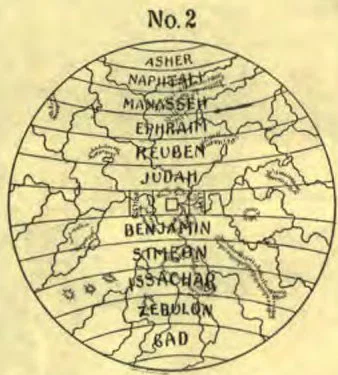
From east to west, the record states, a section is set apart for this tribe, and thus we may suppose it extends around the earth in a broad belt, giving this quarter of the globe to the enduring sons of Asher. Next to them, at the south, comes the land of Naphtali. Upon its southern border the Manassites dwell, and beyond the Manassites’ boundary live their brothers of Ephraim. Reuben comes next, and Judah fills the remainder of the northern hemisphere. Thus six tribes are given inheritance in the north.
To the south of the border of Judah is set apart a strip “in length as one of the other parts,” and the sanctuary of the Lord is in the midst of it. Eze. 48:10. The holy city occupies the center of this territory, and round about on every side of it is a broad tract of land, its suburbs, set apart for cultivation by the priests, the inhabitants of the city. To one side, perhaps the east, perhaps the west, of these suburbs, in the broad strip in which the city lies, and upon the south border of Judah, is the portion of the tribe of Levi. They do not possess the whole of the remainder of this territory, however, for the size of their portion is definitely stated, as that of the other tribes is not, “and the residue,” it is declared, “shall be for the prince,”—that is, the great King of earth.
Passing now to the south, we find next in order Benjamin, and upon his southern border Simeon; then, descending still toward the south, Issachar, Zebulon, and Gad, which last tribe occupies the southernmost position. Thus we may roughly divide the earth after this manner.
No. 2
Every week, upon the Sabbath, and every month, at the new moon, the inhabitants of the earth come up to the great center, for worship of their King and communion with him. From the north throng the people of the tribes of Judah, Joseph, Asher, and their neighbors; from the south come the Benjamites, Zebulonites, Gadites, and the men of their kindred tribes. Great armies, mightier in numbers than the biggest hosts ever marshaled on this earth, and incomparable in power and glory, gather toward the great city. They enter the city through twelve great gates, three on each side, upon each gate being the name of one of the tribes. Rev. 21:12. A majestic angel warder stands at the gateway, not as a guard, but as a sign. Each tribe to its gate; from the south the Benjamites sweep around to the east to enter the southernmost of those three gates, next to the entrance ways of Ephraim and Manasseh; the Gadites part to the left, to enter a gate upon the west side; while the men of Simeon, Issachar, and Zebulon enter the three gates upon the south which bear their names. From the north Reuben and Judah come down, and are joined upon the north side of the city by the Levites, and each tribe enters its own gate. The two northernmost tribes, Asher and Naphtali, have their gates upon the west side, next to that of Gad, though between them flows out the beautiful river of life. Eze. 48: 31-34.
The approach to the city upon every side is through the most varied and beautiful scenes. Through forests of illumined palms, oaks, cedars, firs, these different tribes take their ways, now walking amid groves of citrus, apple, pomegranate, and all manner of fruits, now examining the vineyards whose plants rear their graceful heads without support. (“Patriarchs and Prophets,” page 47.) They pass many houses, whose noble columns support their light framework, and mingle their gleaming brightness with the green and purple of the grape. Cascades along the way fall over ledges, not of broken, somber rock, but of gleaming quartz, of gold and silver, and of many-colored precious stones. Fountains jet and throw their feathery forms aloft in the sunshine, catching in their arms as they rise and descend the swiftly playing colors of the rainbow, such as that which spans the throne. On bridges of crystal and gold, magnificently wrought, the pilgrims cross the streams that throw their network about the city of God, and finally they pass over that wonderful crystal sea that spreads before the gates of the city. No bridges, indeed, do they need, nor paths nor streets to walk in, for there in that country they journey by ways we know not of, and the pilgrimage from far-away Gad can be made without the loss of a moment. But surely, as we are told not only of fields and forests, of flocks and herds, but also of houses and of walls, it is meant that we should see in that coming kingdom things to which our eyes here are accustomed; and so may we be permitted to fill out the picture with conceptions of all things beautiful that even man can make, to humanize and make real that very real world in which we, with the immortal spirit glowing within our incorruptible bodies, shall delight.
But who shall tell the glories of the city within! City it is indeed, but not such cities as we have here. No close-packed rows of houses there! It is the paradise of God, a garden hundreds of miles in diameter, and besides having broad gold-paved avenues, it has winding walks among the trees and the flowers of the garden, in the midst of which are hidden away the palaces of the priests. Country estates, we would call them here. Though near enough to one another to make possible constant intercourse of their owners, they are buried in the midst of the creation of God, where every leaf speaks lessons and every rivulet murmurs new secrets of the glory of our matchless King.
And the palaces, do you think of them as being like the mansions men build here, with solid walls, and roofs impervious to rain? There are no thieves there to break in and steal, nor cold winds to howl down upon a shrinking world, no rain-clouds to mar the face of the sky and threaten men, nor shall the sun light on them fiercely, nor any heat. No, we need not such close-built palaces there! Stately columns of precious worth are reared for walls (“Early Writings,” page 13), and between them twine the flowing vines of many fruits, and what shall roof them better than the trees and vines? (“Patriarchs and Prophets,” page 47.) Here and there, perhaps, we see delicately wrought walls of lattice-work and arabesque, with designs which human genius has most nearly approached in the graceful if too elaborate Moorish art.
We may talk of the glories of that place, we may give our imaginations latitude unbounded, we may please our most artistic conceptions, and yet know that the reality will surpass them; and if we fail to realize their exact form or plan, yet rest assured that what we shall see will not condemn us, but, while amazing, will fascinate and charm us. Does not the contemplation of these things thrill us with a desire for their consummation? But they who enter those pearly gates and tread those green fields of Eden, will now be having a work done in them and by them that is not dreaminess nor speculation; for they who enter there are without spot or wrinkle of character. “Blessed are they that do His commandments, that they may have right to the tree of life, and may enter in through the gates into the city. For without are dogs, and sorcerers, and whoremongers, and murderers, and idolaters, and whosoever loveth and maketh a lie. I Jesus have sent mine angel to testify unto you these things. . . . And the Spirit and the bride say, Come. And let him that heareth say, Come. And let him that is athirst come. And whosoever will, let him take the water of life freely.”
A. W. SPAULDING.
Making Butter Without Churning
A COMMITTEE of the Franklin Institute of Philadelphia has just made public its report on the Taylor process for butter making. It is recommended that Mr. Taylor receive the John Scott Medal and Premium in recognition of the value of his invention. In this new process sweet cream is poured into shallow pans, the bottoms of which are covered with absorbent pads. The pads are composed of heavy, white blotting paper supported on Turkish toweling, and absorb from the cream nearly all of its constituents except the fat.
The cream fat remains as a layer on the surface of the pads, and after several hours’ standing may be rolled off. In this condition the product contains rather too much water and milk proteids; on this account, and because of the absence of salt, it does not keep very well. If, however, the separated butter fat be worked and salted in the same way as the ordinary churned product, the result is a very fine butter.
The process has the advantage of cheapness, since the pads may be used over and over again, lasting, it is said, for six months of daily use. The labor of churning is avoided, and, on account of the use of fresh cream instead of that which has stood for days, the product keeps better than butter made in the ordinary way.—Search-Light.
Fallen Angels
By G. B. Thompson
(Concluded)
SATAN has been described by many as a hideous monster. By others it has been ignorantly asserted that he has no existence as a real being, but is simply a principle of evil. Both of these positions are false and dangerous. They mask the real character of this artful foe, and enable him to better carry on his destructive work. He is a real being, as are all the fallen angels. He is an angel still, though fallen. “Satan was once an honored angel in heaven, next to Christ. His countenance, like those of the other angels, was mild and expressive of happiness. His forehead was high and broad, showing great intelligence. His form was perfect; his bearing noble and majestic.” “I was shown Satan as he once was, a happy, exalted angel. Then I was shown him as he now is. He still bears a kingly form. His features are still noble, for he is an angel fallen. But the expression of his countenance is full of anxiety, care, unhappiness, malice, hate, mischief, deceit, and every evil. That brow which was once so noble, I particularly noticed. His forehead commenced from his eyes to recede. I saw that he had demeaned himself so long that every good quality was debased, and every evil trait was developed. His eyes were cunning, sly, and showed great penetration. His frame was large, but the flesh hung loosely about his hands and face. As I beheld him, his chin was resting upon his left hand. He appeared to be in deep thought. A smile was upon his countenance, which made me tremble, it was so full of evil and satanic slyness. This smile is the one he wears just before he makes sure of his victim; and as he fastens the victim in his snare, this smile grows horrible.”—“Early Writings,” pages 17, 24.
A graphic picture is given in Ezekiel 28 of the fall of Lucifer, under the symbol of the King of Tyrus, a wicked, exalted ruler. Read carefully verses 12-19. Here we learn, that this remarkable being has been in Eden, and was covered with the precious stones which compose the walls of the New Jerusalem (Revelation 21); that he has been upon the holy mount of God, and walked amid the stones of fire, walked the golden streets of the city of God; that he was perfect in his ways and in beauty, and full of wisdom; that God created him to be the anointed cherub that covereth; but self-exaltation entered into his heart, he sinned, and was cast out to be destroyed. This can refer to no other being in the universe except Satan. And he lost all through pride. “How art thou fallen from heaven, O Lucifer, son of the morning! how art thou cut down to the ground, which didst weaken the nations! For thou hast said in thine heart, I will ascend into heaven, I will exalt my throne above the stars [angels] of God: I will sit also upon the mount of the congregation, in the sides of the north: I will ascend above the heights of the clouds; I will be like the Most High.” Isa. 14:12-14. But instead of going up as he desired, he fell. “Yet thou shalt be brought down to hell, to the sides of the pit.” Verse 15. Pride puffeth up, but the Lord lifteth up. “Pride goeth before destruction, and an haughty spirit before a fall.” Prov. 16:18.
God might have destroyed Satan in the beginning, but for wise reasons he did not choose to do so. The Lord desired to set no precedent for mob law. Satan had accused God before the universe of being a tyrant, and had he been immediately blotted from existence, it would, without doubt, have seemed to some loyal angel, or unfallen being who had never beheld sin, and could not understand its subtle workings, as an arbitrary act, and that Satan’s charges were true. A query would have been left in minds that never could have been answered, and sometime in eternity perchance would have caused another revolt. But the patient, gentle, long-suffering God gave him a trial, and let him demonstrate before all created intelligences the kind of kingdom he meant to establish, and what sin really is; and when it is fully developed, amid the plaudits of the universe, he will blot out the hateful thing forever, and destroy Satan and all his host. The Lord declares, “I will bring thee to ashes upon the earth in the sight of all them that behold thee. All they that know thee among the people shall be astonished at thee: thou shalt be a terror, and never shalt thou be any more.” Eze. 28:18, 19.
“Forasmuch then as the children are partakers of flesh and blood, he also himself likewise took part of the same; that through death he might destroy him that had the power of death, that is, the devil.” Heb. 2:14. A lake of fire is prepared for the purpose (Matt. 25:41), and the fallen angels are aware that their doom is certain. Matt. 8:28, 29.
Sin, root and branch (Mal. 4:1), will be rooted out of the earth, and the Lord will have a clean universe once more. Rev. 5:13. There will never be another rebellion to mar the happiness of God’s creatures (Nahum 1:9), but through eternal ages shall abound joy and pleasures forevermore. G. B. THOMPSON.
Arctic Cure for Consumption
A NOVEL project that is expected by those behind it to commend itself to physicians throughout the world has just been inaugurated by a number of Washingtonians. It is based upon the contention of Dr. Frederick Sohon, a Washington physician, that a sojourn in the bracing atmosphere of the arctic regions will cure consumption.
Dr. Sohon has been with Civil Engineer Peary on his last two expeditions seeking for the north pole. He was suffering from tuberculosis when he made his first voyage north, and he found that his long sojourn in the Greenland fiords eliminated the bacilli from his system. Recently he embodied his experience in a paper entitled “The Applicability of the Greenland Fiords to the Treatment of Tuberculosis.”
His views attracted wide attention in the medical world, and as a result a number of men who are interested in stamping out the white plague have decided to give them a thorough test. Under their direction the steamer “Havana,” appointed as a hospital ship, is to leave Halifax for a health cruise along central Greenland.
It is proposed to visit certain sterile and dustless areas which lie under perpetual summer sunshine within the arctic circle, for the cure of early cases of the disease. Dr. Sohon contends that the continuous day of the arctic summer, with its healthful and bracing features, far surpasses any conditions in this country for the cure of tuberculosis.
After leaving Halifax the “Havana” will cruise along the shore of Baffin’s Land and central Greenland, anchoring in various sheltered fiords for the diversion and benefit of the patients, and return to Halifax about September 30. The menu will be that of a first-class hospital. The number will be limited, and advanced cases will not be received.—Search-Light.
A Christian Life
By Violet Hawkesworth
A CHRISTIAN life, have you ever thought
How much is in that name?
A life like Christ, and all he taught
We must follow, to be the same.
How little of ease the Saviour knew
With his life of labor and love!
And if we would walk in his footsteps too,
We must look not to earth, but above.
The darkest hour the Christian knows
Is just before the dawn;
For as the night draws to its close,
It will bring in the morn.
So if you trust, though shadows fall,
And dark your pathway be,
The light, which shines from heaven for all,
Will surely fall on thee.
VIOLET HAWKESWORTH.
Justice and Thoroughly Helpful Manliness
“A PROMPT, strong sense of justice is indispensable to a thoroughly helpful manliness.”
The Flaw in the Loom: Duty and Consequence
“He who is false to the present duty breaks a thread in the loom, and will find the flaw when he may have forgotten its cause.”
An Exercise in English
By E. C. H.
THERE is a deal of poor English in our newspapers. The fourteen erroneous expressions given below, I copied from my reading in about two weeks. And I did not copy all, to say nothing of several gross blunders in spelling. And all these were taken from first-class papers. It will be a good exercise for pupils to correct these errors. And it might be well to encourage them to criticize the language of the newspapers for themselves.
“Passengers would be forced to lay here all night.”
“Savings that can be affected in little things.”
“These formally neglected things.”
“The will bequests all the property.”
“To those whom are interested.”
“The tiger laid in wait for its prey.”
“When an organization has been affected.” (That is, concluded.)
“He laid down on the front side of the bed.”
“Who treats others like he likes to be cared for.”
“Some one whom they had heard could do it.”
“Neither are strong in number.”
“If one follows this way, they will find it easier.”
“A festoon between each pedestal.”
“One of the principle causes.”
These are all errors really found without searching; and most of them are very common.— E. C. H., in School and Home Education.
Rules for One-Hundred-Year Club
SIR JAMES SAWYER, an English physician, has formulated the following eighteen rules for prolonging life to one hundred years:—
Eight hours’ sleep.
Sleep on your right side.
Keep your bedroom window open all night.
Have a mat at your bedroom door.
Do not have your bedstead against the wall.
Exercise before breakfast.
Eat little meat, and see that it is well cooked.
(For adults.) Drink no milk.
Eat plenty of fat, to feed the cells which destroy the disease germs.
Avoid intoxicants, which destroy those cells.
Daily exercise in the open air.
Allow no pet animals in your living-room. They are apt to carry disease germs.
Live in the country if you can.
Watch the three D’s—drinking water, damp, and drains.
Have a change of occupation.
Take frequent and short holidays.
Limit your ambitions.
Keep your temper.
Report from San Francisco, California
By Mrs. D. D. Fitch
THE Young People's Society of San Francisco was organized four years ago. During this time the help and strength it has been to the young people who have been associated with it, the joy it has brought to the sick, imprisoned, and downcast, the influence it has exerted upon the cause of truth, only eternity will reveal. We acknowledge, however, that all good that has been accomplished has been due to God's Spirit impressing different ones to work.
Our young people come and go, some to engage in lines of work elsewhere, but it makes no difference where we are, if we are consecrated to God, he will use us.
From time to time different methods of work which might prove successful are tried; some of these include monthly visits to the county jail. Here we find many young men and women with bright, intelligent-looking faces, and we wonder why they are here. Wrong habits formed and constantly encouraged because they had no knowledge of a better way, probably caused their downfall. We know the plain truths given them from the Word have been an encouragement to many. Only a few weeks ago a young man, a prisoner who had become interested in his soul's salvation through the meetings held, came to us as soon as he was released. We were so thankful for this, because we believe he felt that in us he could find friends, shelter, comfort, sympathy, and a welcome. What a privilege to restore such a one!
The Sailors' Home work has been given a great deal of attention by some of our number. The outcome may seem somewhat discouraging to us, yet we claim the promise, “All things work together for good.”
The Life Boat has not been forgotten. Our Society of about thirty has ordered as high as one thousand copies a month. Of late some of our readers have asked for Signs in place of the Life Boat, so we have been taking Signs to them. We are glad for this request on their part, because it shows they are thinking of what they are reading, and want good, solid food. Some of our members take Signs to the many hospitals of our city. At no time is one more inclined to read and speak of the Great Physician than when on a bed of sickness.
The Home Department of the Society is a means by which much good may be accomplished. Visiting a lady in her own home makes one seem nearer to her than if one should accost her on the street, or perhaps speak to her in church. By a Christlike conduct you can gain her confidence. If she is one of our people, but does not attend Sabbath-school or church service, she will tell you why she does not. Perhaps the children are so many she can not take them all to church; if so, you can care for them the next Sabbath so that she may go. Many ways there are in which we may labor. Tracts and periodicals need to be distributed. Many are being distributed in the city; several thousand pages have been given away by our Society alone.
The Family Bible Teacher has recently been used in this city by several of the young people. This line of work opens the way for Bible readings and cottage meetings. There is so much work to be done, not only in our home field, but in the great foreign fields. Only a few weeks ago a valuable worker was asked to lay down her life in far-away China. Speaking of Dr. M. Miller's death, her husband writes: “The strongest appeals were not sufficient. A consecrated life must be laid down, to arouse us who are in the field, as well as our brethren in America, to push the battle to the front in these neglected fields. Her parting words to us were that we should not become fearful at her experience, but she hoped it would inspire us to take up the work in these difficult fields, stand by it until it is finished, and the harvest reaped.” The young are the ones who must answer these calls, yet few are willing to do so. MRS. D. D. FITCH.
REFERENCE STUDY: “Sketches from the Life of Paul,” pages 246-252.
TOPICS FOR STUDY:—
Festus governor.
Visits Jerusalem.
Interviewed by Paul’s enemies.
Festus returns to Cæsarea.
Paul placed on trial.
False accusers.
Paul’s defense.
Refuses to go to Jerusalem.
Prefers Cæsar’s tribunal to Jewish Sanhedrin.
Willing to die if guilty of wrong.
Appeals to Cæsar.
Notes
“The governor appointed in the place of Felix, was Porcius Festus, a far more honorable ruler. He had a higher sense of the responsibility of his position, and, refusing to accept bribes, he endeavored to administer justice.”
“He (Festus) looked with disgust upon the scene before him,—the Jewish priests and rulers, with scowling faces and gleaming eyes, forgetting the dignity of their office, eagerly reiterating their accusations, in tones that grew louder and louder until the tribunal rang with their cries of rage. Heartily desiring to end it all, he turned to Paul, who stood calm and self-possessed before his adversaries, and asked if he was willing to go to Jerusalem under his protection, to be tried by the Sanhedrin.”
“Paul was weary of strife, weary of the fierce reiteration of charges, again and again refuted, and as often renewed. His active spirit could ill endure the repeated delays and wearying suspense of his trial and imprisonment. . . . He had nothing more to hope for from Jewish priests or rulers; but as a Roman citizen he had one special privilege, he could appeal to Cæsar, and for a time, at least, his enemies would be kept at bay.”
“Festus knew nothing of the conspiracies of the Jews to murder Paul, and he was surprised at this appeal to Cæsar. It was not flattering to the pride of the Roman procurator, that the first case brought before him should be thus referred to higher authority. . . . ‘Hast thou appealed unto Cæsar? Unto Cæsar shalt thou go.’ This was said in a tone and manner which seemed to imply that Paul little knew what an appeal to Cæsar meant.”
“Once more the hatred born of Jewish bigotry and self-righteousness had driven the servant of God to turn for protection to a heathen ruler. It was the same hatred that forced the prophet Elijah to flee for succor to the widow of Sarepta, that constrained the heralds of the gospel to proclaim their message to the Gentiles. It is the same spirit that the people of God in this age have yet to meet. In the great crisis through which they are soon to pass, they will become better acquainted with the experience of Paul.”
G. B. T.
Report of the Grand Rapids (Mich.) Young People's Society
By Edith E. Bruce
THE following is a brief report of the work done by our young people in Grand Rapids during the past four months. We are glad to say that our young people are arousing to a sense of their privileges in this great work for the Master, and are putting forth greater efforts in spreading the gospel of the third angel's message. We feel that God is blessing our feeble efforts, and that the members of the Society are gaining a deeper spiritual experience. Plans are being made and funds raised to help some worthy young person to attend school next year to prepare for service in the great harvest-field.
Bible readings held ........................ 59
Talks given ................................ 12
Tracts given away .......................... 29
Papers given away .......................... 720
Pages of literature given out .............. 1,598
Pages of literature sold ................... 5,016
Missionary visits .......................... 30
Missionary letters written ................. 51
Hours of Christian Help work ................ 15
Articles of clothing given away ............. 10
Offerings in cash ........................... $32.50
We earnestly pray that during the remainder of this conference year our young people may be so filled with the sweet spirit of Christ that they may do much more in his service, making this the very best year in the work for the Young People's Societies. EDITH E. BRUCE.
Lovely Things and Pleasant Tones at Home
“THERE are as many lovely things,
As many pleasant tones,
For those who dwell by cottage hearths
As those who sit on thrones.”