Your ShelfYour Projects

Review and Herald, Vol. 90, No. 35.

Invitation and Promise

Review and Herald

Aug 28, 1913

Review and Herald Publishing Association · Takoma Park Station, Washington, D. C. · Aug 28, 1913

Invitation and Promise

“ATTEND unto Me, O My people; and give ear unto Me, O My nation: for a law shall go forth from Me, and I will establish My justice for a light of the peoples. My righteousness is near, My salvation is gone forth, and Mine arms shall judge the peoples; the isles shall wait for Me, and on Mine arm shall they trust. Lift up your eyes to the heavens, and look upon the earth beneath; for the heavens shall vanish away like smoke, and the earth shall wax old like a garment; and they that dwell therein shall die in like manner: but My salvation shall be forever, and My righteousness shall not be abolished. Hearken unto Me, ye that know righteousness, the people in whose heart is My law; fear ye not the reproach of men, neither be ye dismayed at their revilings. For the moth shall eat them up like a garment, and the worm shall eat them like wool; but My righteousness shall be forever, and My salvation unto all generations.
“Awake, awake, put on strength, O arm of Jehovah; awake, as in the days of old, the generations of ancient times. . . . The ransomed of Jehovah shall return, and come with singing unto Zion; and everlasting joy shall be upon their heads: they shall obtain gladness and joy; and sorrow and sighing shall flee away.” Isa. 51: 4 - 11.

"Digestive Disorders," "Good Bread," and "Pellagra" Number

DON'T MISS READING IT! AGENTS WILL FIND IT A RAPID SELLER
Sixty-five Articles         Thirty Illustrations
PRICES, POST-PAID
PRICES, POST-PAID

SOME SEPTEMBER FEATURES

Beautiful Three-Color Cover
Digestive Disorders
The World's Bread
The Staff of Life—No. 2
Proper Kneading of Good Bread
Americanized Coffee Cakes—No. 1
Types of Digestive Disorders
Causes of Pellagra
Diet and Constipation
Tuberculosis—Prevention of
Correct Styles for Women
Smoking in Public Places
Nurse's Experience in Uruguay
A Prayer for Efficiency
Coffee Substitute
News Notes
Questions and Answers, etc.

BE OUR AGENT!

Send 10 cents for sample copy and particulars. Pleasant and profitable work the year round.
Remit $1.00 for 20 copies; $2.00 for 50; $4.00 for 100; $8.00 for 200. Fifty or more, 4 cents each, post-paid.

ORDER THROUGH OUR NEAREST AGENCY

(If you do not know the address of our Agency, ask "Life and Health," Washington, D. C.)

PRICES, POST-PAID

Single copy  - - - - - $ .10
Yearly subscription  - - - - - 1.00
Six Months  - - - - - .50
(Subscriptions for less than six months not accepted)
Three years (or 3 subs. 1 yr.) - - - 2.00
Five years (or 5 subs. 1 yr.)  - - - 3.00
NO EXTRA CHARGE ON FOREIGN SUBSCRIPTIONS

SEPTEMBER NUMBER NOW READY!

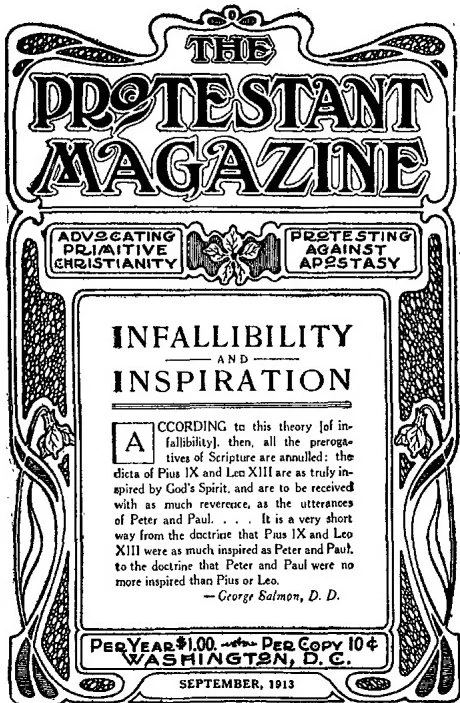
“Infallibility,” “Religious Liberty,” and “Papacy in Prophecy” Special
Subscribe now! If you have never read this valuable magazine, send 10 cents in stamps for sample copy.

SOME SEPTEMBER FEATURES

Striking Double Frontispiece: “Roman Catholic Chaplains and Government Officials”—“The Luther of the Nineteenth Century”
The Roman Catholic Perversion of Religious Liberty
The Infallibility of the Pope
The Dogma of Infallibility a Menace to the State
What Becomes of the Peter’s Pence Collection?
The Papacy Foretold in Prophecy
Reformation Teaching
The Divine Origin of the Scriptures
Condoning Mob Violence
Another Military Mass
A Catholic Event
Demanding Pay for Valuable Services
Romanizing America
“Tenants at Will”
A Catholic Germany
Finding the Easiest Way to Heaven
The Influence of Protestantism in Italy
Twenty Editorial Briefs

Liberal terms to agents. Write for particulars.

TO TEN FRIENDS: You can send $3.00 for 10 six months’ (or 5 yearly) subscriptions, in behalf of friends. Five or more copies, mailed by the publishers to five addresses, or to one address, post-paid, each, 5 cents.

ORDER THROUGH OUR NEAREST AGENCY

(If you do not know the address of our Agency, ask “Protestant Magazine,” Washington, D. C.)
PRICES, POST-PAID
PRICES, POST-PAID

PRICES, POST-PAID

Yearly subscription — — — — $1.00
Six months — — — — .50
(Subscriptions for less than six months not accepted)
Three years (or 3 subs. 1 year) — — — — 2.00
Five years (or 5 subs. 1 year) — — — — 3.00
20 copies ordered at one time — — — — 1.00
50 copies ordered at one time — — — — 2.00
100 copies ordered at one time — — — — 4.00

NO EXTRA CHARGE ON FOREIGN SUBSCRIPTIONS

Watching and Waiting

L. D. SANTEE
O, THE days are passing, fading, And the years glide slow away, And our hearts are aching, yearning, Longing for the coming day When the warfare will be ended And the weary rest in peace, When our Lord, from heaven descended, Gives from pain a long release.
Day by day, our loved ones perish, Sparkling eyes grow dim with pain, Fair forms stiffen into silence; All our tender care is vain. Sadly and with tears we lay them Low beneath the sod to rest; Free are they from all earth's troubles And the storms that sweep its breast.
O, the weary, weary ages! O, the years so filled with woe! Still, there follow in their seasons, Summer heat and winter snow. Patience, patience, ye despairing! Soon will come the King sublime, And eternal hands are weaving Off the measured thread of time.
Moline, Ill.

The Reward of Hospitality

Be Not Forgetful to Entertain Strangers

MRS. E. G. WHITE
FOR a time after appearing before her, Ahab, Elijah remained hidden in the mountains by the brook Cherith. There he was fed morning and evening by an angel from heaven. Later on when, because of the continued drought, the brook became dry, God sent his servant to find refuge in a heathen land. “Arise,” he bade him, “get thee to Zarephath, which belongeth to Zidon, and dwell there: behold, I have commanded a widow woman there to sustain thee.”
This woman was not an Israelite. She had never had the privileges and blessings that the chosen people of God had enjoyed; but she had walked in all the light that was shining on her pathway. And now when there was no safety for Elijah in the land of Israel, God sent him to this woman to find an asylum in her home.
“So he arose and went to Zarephath. And when he came to the gate of the city, behold, the widow woman was there, gathering of sticks: and he called to her, and said, Fetch me, I pray thee, a little water in a vessel, that I may drink. And as she was going to fetch it, he called to her, and said, Bring me, I pray thee, a morsel of bread in thine hand.”
In this poverty-stricken home the famine pressed sore; and the pitifully meager fare seemed about to fail. The coming of Elijah on the very day when the widow feared that she must give up the struggle to sustain life, tested to the utmost her faith in the power of the living God to provide for her necessities. But even in her dire extremity, she bore witness of her faith in the presence of the stranger, who was now asking her to share her last morsel with him.
In response to Elijah’s request for food and drink, she said, “As the Lord thy God liveth, I have not a cake, but an handful of meal in a barrel, and a little oil in a cruse; and, behold, I am gathering two sticks, that I may go in and dress it for me and my son, that we may eat it, and die.” “Elijah said unto her, Fear not; go and do as thou hast said: but make me thereof a little cake first, and bring it unto me, and after make for thee and for thy son. For thus saith the Lord God of Israel, The barrel of meal shall not waste, neither shall the cruse of oil fail, until the day that the Lord sendeth rain upon the earth.”
No greater test of faith than this could have been required. The widow had hitherto treated all strangers with kindness and liberality. Now, giving no thought to the suffering that might result to herself and child, but trusting in the God of Israel to supply her needs, she met this supreme test of hospitality by doing “according to the saying of Elijah.”
Wonderful was the hospitality shown to God’s prophet by this Phoenician woman, and wonderfully were her faith and generosity rewarded. “She, and he, and her house, did eat many days. And the barrel of meal wasted not, neither did the cruse of oil fail, according to the word of the Lord, which he spake by Elijah.”
“And it came to pass after these things, that the son of the woman, the mistress of the house, fell sick; and his sickness was so sore that there was no breath left in him. And she said unto Elijah, What have I to do with thee, O thou man of God? art thou come unto me to call my sin to remembrance, and to slay my son? And he said unto her, Give me thy son. And he took him out of her bosom, and carried him up into a loft, where he abode, and laid him upon his own bed. . . . And he stretched himself upon the child three times, and cried unto the Lord. . . . And the Lord heard the voice of Elijah; and the soul of the child came unto him again, and he revived. And Elijah took the child, and brought him down out of the chamber into the house, and delivered him unto his mother: and Elijah said, See thy son liveth. And the woman said to Elijah, Now by this I know that thou art a man of God, and that the word of the Lord in thy mouth is truth.”
The widow of Sarepta shared her morsel with Elijah, and in return her life and that of her son were preserved. And to all who in time of trial and want give sympathy and assistance to others more needy, God has promised great blessing. He has not changed. His power is no less now than in the days of Elijah. And no less sure now than when spoken by our Saviour is the promise, “He that receiveth a prophet in the name of a prophet shall receive a prophet’s reward.”
“Be not forgetful to entertain strangers; for thereby some have entertained angels unawares.” These words have lost none of their force through the lapse of time. Our Heavenly Father still continues to place in the pathway of his children opportunities that are blessings in disguise; and those who improve these opportunities find great joy. “If thou draw out thy soul to the hungry, and satisfy the afflicted soul; then shall thy light rise in obscurity, and thy darkness be as the noonday: and the Lord shall guide thee continually, and satisfy thy soul in drought, and make fat thy bones: and thou shalt be like a watered garden, and like a spring of water, whose waters fail not.”
To his faithful servants today Christsays, “He that receiveth you receiveth me, and he that receiveth me receiveth him that sent me.” No act of kindness shown in his name will fail to be recognized and rewarded. And in the same tender recognition Christ includes even the feeblest and lowliest of the family of God. “Whosoever shall give to drink,” he says, “unto one of these little ones,”—those who are as children in their faith and their knowledge of Christ,—“a cup of cold water only in the name of a disciple, verily I say unto you, he shall in no wise lose his reward.”

Tithing System God's Plan for All Time

Gospel Order—No. 6

Tithing System God's Plan for All Time

E. K. SLADE
A SYSTEM based upon a principle as enduring as the law of God commands our highest regard. It cannot be of human origin or merely typical in nature, but it must be applicable to the needs of humanity from the beginning to the close of the gospel age. Under the Levitical priesthood, God required that his people pay tithes into the Lord’s treasury, but is it not as clearly revealed that it was required under the Melchizedek priesthood which preceded and followed the Levitical period? Abraham, many years before the Levitical age, “gave him tithes of all.” “Christ, a priest under the Melchizedek order, taught his disciples that tithe paying is required even on the smallest items of increase. Matt. 23:23.”
The tithing system did not originate with Moses or in the days of Moses. “God’s plan in the tithing system is beautiful in its simplicity and equality. All may take hold of it in faith and courage, for it is divine in its origin.”—“Testimonies for the Church, Vol. III, page 388.” In harmony with the foregoing is the following statement: “Just in proportion as God has given his property to man so man is to return to God a faithful tithe of all his substance. This distinct arrangement was made by Jesus Christ himself.”—“Id., Vol. VI, page 384.” “The tithing system reaches back beyond the days of Moses. Men were required to offer to God gifts for religious purposes before the definite system was given to Moses, even as far back as the days of Adam.” “Instead of being of no force now, it was to be more fully carried out and more extended, as salvation through Christ alone should be more fully brought to light in the Christian age.”—Id., Vol. III, pages 393, 392. “God never designed that the law of the tithing system should be of no account among his people; but instead of this, he designed that the spirit of sacrifice should widen and deepen for the closing work.”
By these important statements, which are in perfect harmony with the Bible record, it is clearly seen that the tithing system is of divine origin, that the arrangement was made by Jesus Christ, that it extended back even to Adam’s time and is to be in force until the gospel work is finished, and that instead of its being minimized or inoperative in the closing work, it is to be more fully carried out and more extended in our time. By these statements it is made clear that God’s ancient financial arrangement is to be a distinct part of the closing work with which we are connected. It is not to be set aside nor severed from the plan of God, nor is it to be counted of human origin, possessing only claims of convenience and expediency.
To dwell upon and emphasize these vital truths would seem uncalled for, were it not for the fact that there are those who love to count themselves as connected with the remnant people and the closing work who disregard the tithing system. There is a class who accept the theory, but allow covetousness to lead them to rob God. There is another class who say they believe, but argue that it is not required of them at this time. Both of these classes are on dangerous ground; and that such classes do exist in the church today makes a clear statement of these truths fitting and timely. It is a matter that concerns the whole church, and the burden of responsibility to give enlightenment and bring relief rests upon all members. We have not held these truths in as high esteem as we should. We have come short of giving the proper instructions to those received into church fellowship. Especially is this true of the young. Concerning them it is concluded that from home influences and association with believers they understand all that is required, and gospel finance is scarcely mentioned. When we carefully consider the origin, nature, purpose, and need of the tithing system, and that it is to have a broader and fuller application in the closing work, it will lead to more careful teaching and a stricter regulation in the churches in reference to this point of faith.
Mount Vernon, Ohio.

The Greatest Religious Movement of the Ages; Another Pentecost Due

G. W. REASER

The Last Angel in the Series and the Power to Be Manifest in the Proclamation of His Message

Is there yet before us a great, prophetic revival movement? And if so, may we also obtain a correct impression of the power that will attend it?
With the mere mention of a more full measure of power to accompany God’s closing message in the earth, it would seem that the thoughts of every student of the prophetic word, would go quickly to the first five verses of Revelation 18, for here another angel is represented as coming “down from heaven, having great power,” “and he cried mightily with a strong voice.” The effect of his message is that the whole “earth was lightened with his glory.” Notice how much stronger are the descriptive adjectives applied by inspiration to this angel and to the glorious results of his message than to any of the preceding messengers and the effects of their messages. What does all this indicate for the climax of the Lord’s last series of religious movements in the earth? What blessed hope is herein held out before God’s patiently waiting, commandment-keeping people? Will their hearts erelong be gladdened by seeing this message laid hold of, as it were, by the mighty hand of our God, a new order of things ushered in, and a new era of power, reviving his people and hastening on his work in the earth to a glorious culmination?
That the message of Revelation 18 is not a separate movement organized and proclaimed by another people than those who have given the threefold message, is proved by the fact that that message embodies in a loud cry,—“a strong voice,”—the very essence of the second angel’s message, which thus far we have presented softly. But when Babylon is wholly fallen,—when apostate Protestantism has fully spanned the gulf hitherto existing between the Reformation movement and the Papacy,—and when we ourselves are so dedicated to God for service that he can trust us with the full baptism of the Holy Spirit, then we will raise our voices and swell the loud cry, saying “Babylon the great is fallen, is fallen.” “Come out of her, my people, that ye be not partakers of her sins, and that ye receive not of her plagues,” and thousands will respond to the call.

Christ’s Personal Relationship to the World’s Great Religious Movements

It is surely significant that never in the history of the world has there been a full Pentecostal experience, except at a time foretold in prophecy for a worldwide religious movement. To meet the necessities of such a movement, in its inauguration and progress, the Holy Spirit is given without measure. Such was the famous day of Pentecost and the work of the apostles which followed it, and such will be the closing work of this world’s history. Not my word, but the Word of the living God proves the assertion true.
How significant is the truth that the world’s greatest revivals are coincident in point of time with special dispensations of the work of Christ as our great High Priest in the heavenly sanctuary. A brief explanation will verify this statement. It was important that Christ, having triumphed over sin, Satan, and death and having finally cast Satan out of Heaven (Rev. 12: 5-13), and just at the time when he was to begin his work as our great High Priest in the sanctuary above, should send announcement of these facts, and clothe his apostles with power to proclaim him as the crucified and risen Saviour, now occupying a place “on the right hand of the throne of the Majesty in the heavens.” Heb. 8: 1, 2. These very facts were embodied in Peter’s argument when he declared that Joel’s prophecy pointed forward to the infilling of the apostles with the Holy Spirit (Acts 2: 14-21), and that “thisJesus hath God raised up, whereof we all are witnesses. Therefore being by the right hand of God exalted, and having received of the Father the promise of the Holy Ghost, he hath shed forth this, which ye now see and hear.” Verses 32, 33.
The beginning, then, of Jesus’ work as our great High Priest in the sanctuary above was marked on earth by the wonderful manifestations that came on the day of Pentecost, and Pentecost was therefore a mighty pulse-beat from the throne of the universe to our world, carrying the glad intelligence to fallen humanity that the kingdom of our God and the power of his Anointed had triumphed over the powers of darkness.
Such was Pentecost, and such was Christ’s relationship to the Pentecost movement. The arrival of the Spirit on the day of Pentecost was virtually the announcement of the glorious truth that Jesus had reached the throne of his Father, had cast Satan out of heaven, and was beginning his ministry in the heavenly sanctuary. While yet with his apostles in person, and only a few moments before his ascension, he promised that on reaching heaven he would send the promise of the Father, the Holy Spirit (Luke 24: 49-51), and Peter declared that Christ had reached the Father’s throne and had received the promise from the Father, and sent it forth to rest upon his apostles.
(To be continued)
Phoenix, Ariz.

A Short Sermon

H. A. ST. JOHN
“To him that overcometh will I grant to sit with me in my throne, even as I also overcame, and am set down with my Father in his throne.” Rev. 3:21.

The Final Reward

JESUS was an OVERCOMER. His conflicts with the powers of darkness were many and severe. He was tempted in all points like as we are, but without yielding, or defeat, in a single instance. His faith, love, and loyalty never failed him. He was obedient unto death. Even his death was a crowning triumph. When on the cross, having committed his life to his Father, he said, “It is finished,” and bowed his head and died. All Heaven rejoiced at his complete and everlasting victory. Three days later he had a triumphant resurrection, followed soon by a triumphant ascension to a place at the right hand of his Father, on the throne of the universe. Was there ever such an example of deep trial and humiliation, followed by such a glorious victory and exaltation? Our Heavenly Father exalted Jesus above every creature, and gave him a name above every other name. And all this glory and exaltation is eternal.
As he overcame, even so we may overcome. He is on the throne of grace, and to this throne we can always have access. We are invited to come boldly, and receive grace and strength and all things necessary to help us in every time of need. The victory of Christ assures us of a like final and glorious victory, if we only hold fast the profession of our faith and love unto the end. All such, in that glad day soon to come, will have their mortal, corruptible, and vile bodies changed, and fashioned like unto Christ’s glorious body; and when he sits upon his own throne of glory, they will be privileged to sit with him on his throne, and reign with him forever in his kingdom of glory. In all the universe of God will there ever be another kingdom whose King, subjects, capital, and territory have had such an experience? Christ’s kingdom of glory will ever be a monument of the highest expression of the mercy and love of the eternal Father, and of loyalty and love to him.
Sanitarium, Cal.

Spiritual Gifts

A. T. ROBINSON
“And God hath set some in the church, first apostles, secondarily prophets, thirdly teachers, after that miracles, then gifts of healing, helps, governments, diversities of tongues.” 1 Cor. 12: 28.
EITHER of two constructions might be placed upon the language of this text. The enumeration of these gifts might be understood to mean their relative importance one to the other, or it might be understood to state the order, in point of time, in placing these gifts in the church. Two other translations of this text read as follows: “For God hath placed in his church, first legates; after them, prophets; after them, teachers; after them, workers of miracles; after them, the gifts of healing, and helpers, and leaders, and [various] kinds of tongues” (Syriac translation). “And these indeed placed the God in the congregation first apostles, second prophets, third teachers, after that powers, then gracious gifts of cures, helpers, directors, kinds of tongues” (Emphatic Diaglott).
“First apostles.” Apostles are defined as “men called and sent as leaders to lead out and lay the foundation of any great religious movement.” In the establishment of the early church God raised up apostles, men endowed with a special gift of leadership. These men of God laid the foundation upon which the whole superstructure of the gospel church has been reared. They did their work so faithfully and well that not a beam nor a timber nor even a pin has ever had to be readjusted. The structure has withstood all the attacks of higher criticism. The church of God still stands secure, “built upon the foundation of the apostles and prophets, Jesus Christ himself being the chief corner-stone.” Eph. 2: 20.
“Secondarily prophets.” The gift of prophecy served its place in the development of the early church, supplementing the work of the apostles, and saving the church from distraction and confusion. The record in the book of Acts is a testimony to the value of the gift of the spirit of prophecy in the early church.
“Thirdly teachers.” We have but to turn to the inspired records of the early church to find that the gift of teaching was developed as the work progressed. The apostle Paul, in vindication of his ministry says, “I kept back nothing that was profitable unto you, but have showed you, and have taught you publicly, and from house to house.” Acts 20: 20.
“After that miracles.” The word miracles is from the Greek word dunamis. The definitions of this word, as given in the Greek dictionary, are “miraculous power,” “a miracle itself,” “power,” “strength,” “violence,” “mighty work.” This same Greek word in Luke 24 is translated as follows: “And, behold, I send the promise of my Father upon you: but tarry ye in the city of Jerusalem, until ye be endued with power from on high.” The meaning of this word is different from that of the Greek word usually translated power. This word means the special power of God bestowed directly upon his work in the earth. In other words, it is not delegated power, but the direct power of God upon his work. A manifestation of this power, in the development of this gift in the order named in the text, was seen on the day of Pentecost when God set his hand of power to his work, and thousands of souls were converted in a day. The gift of healing and all the other gifts mentioned in the text followed.
“And by the hands of the apostles were many signs and wonders wrought among the people; (. . . And believers were the more added to the Lord, multitudes both of men and women.) Insomuch that they brought forth the sick into the streets, and laid them on beds and couches, that at least the shadow of Peter passing by might overshadow some of them. There came also a multitude out of the cities round about unto Jerusalem, bringing sick folks, and them which were vexed with unclean spirits: and they were healed every one.” Acts 5: 12-16.
The church of Jesus Christ was made richer in spiritual gifts at the time when Christ ascended to heaven. “Wherefore he saith, When he ascended up on high, he led captivity captive [“a multitude of captives,” margin], and gave gifts unto men.” Eph. 4: 8. The purpose and duration of these gifts in the church are clearly stated by the apostle. “For perfecting the saints, for the work of the ministry, for the edification of the body of the Messiah; until we all become one and the same, in faith and in the knowledge of the Son of God, and one complete man according to the measure of the stature of the fulness of Messiah.” Eph. 4: 2, 13 (Syriac translation). Another translation of this text reads as follows: “For the complete qualification of the saints for the work of service, in order to the building up of the body of the anointed One; till we all attain to the unity of the faith, and of the knowledge of the Son of God, to a full-grown man, to the measure of the full stature of the anointed One (Emphatic Diaglott).

The Gift of Prophecy and the Keeping of the Law Associated

The gift of prophecy, which the apostle Paul mentions as the chief of all thegifts, has never been manifested in the church when God’s people have departed from the law of God. “Now for a long time Israel hath been without the true God, and without an instructing priest, and without law.” 2 Chron. 15: 3 (Spurrell). “Her king and her princes are among the heathen where is no law; also her prophets meet with no vision from Jehovah.” Lam. 2: 9 (Spurrell). “When there is no divine communication, the people shall perish; but whoso obeyeth the commandment blessed is he.” Prov. 29: 8 (Spurrell). “They have set the sanctuary on fire. The habitation of thy name profaned they by leveling it to the dust. They set up their ensigns as tokens of victory.” Ps. 74: 7, 4.
The result of casting down the fourth commandment, and setting up a counterfeit sign in place of the Sabbath of the fourth commandment, which is God’s sign, is stated in the ninth verse of this psalm. Quoting still from Spurrell’s translation, “We see not our prophetical signs, now there is no prophet left, neither is there among us who discerneth for how long.”
The remnant church in fulfilment of prophecy is designated as a commandment-keeping church. “Here [under the sounding of the threefold message of Revelation 14] are they that keep the commandments of God, and the faith of Jesus.” Rev. 14: 12. The remnant church, the church developed under the sounding of the threefold message of Revelation 14, comes upon the stage of action in response to a call of God for his people to come back to the principles of the early church, and as they return to the keeping of the commandments of God, these gifts, which have seemingly been withdrawn from the church for centuries, must again take their place and do their office work in the church. It is reasonable to conclude that when these gifts are reinstated in the remnant church, they will be reinstated in the same order in which they were placed in the early church.
“First apostles.” Just as truly as men were raised up and endowed with the spirit of leadership in the early church, so truly men of God have been raised up and thus endowed in the establishment of this message.
“Secondarily prophets.” The gift of prophecy just as really came in to supplement the work of the leaders in this message, as it did in the early church. Many times in the development of this third angel’s message, from its beginning until the present time, the exercise of this gift has saved this movement from division and perhaps disintegration.
“Thirdly teachers.” It is evident to every Seventh-day Adventist that this work has assumed in a very marked way educational features. Aside from our denominational educational system, every institution connected with our work carries forward the work of teaching. Hundreds and thousands of men and women give their lives going from house to house with the Bible and teaching the people the truths of this message. “After that miracles.” The next complete development in this reinstatement of gifts in the remnant church will be the mighty outpouring of God’s power in the loud cry of the third angel’s message, and then, as in apostolic times, the gift of healing and all these gifts will come in and do their work in the finishing of this message in this generation.
One of the Scriptural characteristics of the remnant church is that the people composing that church shall keep the commandments of God and have the testimony of Jesus, which is defined to be “the spirit of prophecy.” No people can rightfully claim to be the remnant church without claiming this gift in its midst. “Even as the testimony of Messiah was confirmed among you; so that ye are not inferior in any one of his gifts; but are waiting for the manifestation of our Lord Jesus Messiah; who will confirm you unto the end, so that ye are blameless in the day of our Lord Jesus Messiah.” 1 Cor. 1: 6-8 (Syriac). John, “who bore witness to the word of God, and to the testimony of Jesus the Messiah, as to all that he saw.” Rev. 1: 2 (Syriac). “I John, your brother, and partaker with you in the affliction and sufferings that are in Jesus the Messiah, was in the island called Patmos, because of the word of God, and because of the testimony of Jesus the Messiah.” Rev. 1: 9 (Syriac).
When the angel Gabriel, whose mission has always been to bring messages from God to his people in this world, visited John, this servant of the Lord was so overawed by the angel’s presence that he fell down at his feet to worship him. The angel Gabriel said to him, “See [thou do it] not; I am thy fellow servant and of those thy brethren who have the testimony of Jesus.” Rev. 19: 10 (Syriac). “And he said to me: See [thou do it] not: I am thy fellow servant, and of thy brethren the prophets; and of them that keep the sayings of this book.” Rev. 22: 9 (Syriac). A fellow servant is one who serves with others. Gabriel’s message being to minister in the spirit of prophecy would make him the fellow servant of those who have the gift of prophecy in their midst. He declared himself to be the fellow servant of John, of John’s brethren the prophets who lived before his time, and of those who were to keep the sayings of the book of Revelation.
In Rev. 1: 3, the benediction of Heaven is pronounced upon those who keep the sayings of this book. Under the sound of the threefold message, a people is brought to view of whom it is said, “Here are they that keep the commandments of God.” The same spirit of the dragon that sent John to the isle of Patmos because of the testimony of Jesus—the spirit of prophecy—is manifested against the remnant church because of the exercise of the same gift in their midst. “And the dragon was wroth with the woman, and went to make war with the remnant of her seed, which keep the commandments of God, and have the testimony of Jesus Christ.”
College View, Nebr.

To All Nations

G. B. STARR
ONCE more, and finally, God has planned to give to all nations a revelation of his power, his love, and his salvation. The gospel of the kingdom of Christ is to be preached to all nations “for a witness,”—not against them, but to them and for them,—“and then shall the end come.” Matt. 24: 14.
The gospel is the power of God unto salvation. In it is revealed the power and love of God; and as converts are won to it from every nation, they become witnesses to their households and peoples of a power to save from the weaknesses and follies of humanity, from which all else has failed to save them. The changed life is the witness to the gospel. The light heart revealed in the happy countenance bears witness to the work of grace within. “Ye are my witnesses, saith the Lord, and my servant whom I have chosen: that ye may know and believe me, and understand that I am he: before Me there was no God formed, neither shall there be after me. I, even I, am the Lord; and beside me there is no savior. I have declared, and have saved, and I have showed, when there was no strange god among you: therefore ye are my witnesses, saith the Lord, that I am God.” Isa. 43: 10-12.
“Look unto me, and be ye saved, all the ends of the earth: for I am God, and there is none else.” Isa. 45: 22. Those who look unto God and experience the power and joy of his salvation become his witnesses unto the ends of the earth. To carry this “everlasting gospel . . . to every nation, and kindred, and tongue, and people” is the work of the threefold message of Rev. 14: 6-12; and when witnesses of its power to save are raised up in every nation, and through their testimony, their labor of love, their victorious lives, their kindred are reached, and he “that made heaven and earth” is worshiped and known again in every land, “then shall the end come.”
But this is the very work now being accomplished by the everlasting gospel. These witnesses are now in the field, and their living testimony is winning many to the worship and service of God, until it can be said truthfully in every land and among every people, “Here is the patience of the saints: here are they that keep the commandments of God, and the faith of Jesus.” They are here,—God's witnesses of his power and love and salvation; and they are also witnesses to the soon coming of the Son of man in the clouds of heaven, for their presence and work are to be the final and sure sign of the approaching end. Matt. 24: 14; Rev. 14: 12, 14.
Melrose, Mass.

Use Youth Wisely

USE thy youth so that thou mayest have comfort to remember it when it hath forsaken thee, and not sigh and grieve at the account thereof. Use it as the spring-time which soon departeth, and wherein thou oughtest to plant and sow all provisions for a long and happy life.—Sir Walter Raleigh.
Continue reading: She Hath Done What She Could