Your ShelfYour Projects

Review and Herald, Vol. 90, No. 35.

Invitation and Promise
Earlier text: Invitation and Promise

She Hath Done What She Could

This is the record which the Master bore of Mary. He was in the house of Simon, the leper, partaking of his hospitality and preaching the gospel to him and to his associates. Mary, for whom he had rendered a great service in delivering her from the power of the evil one, brought “an alabaster box of ointment of spikenard very precious; and she brake the box, and poured it on his head.” This offering doubtless represented her all. For its purchase she had toiled and economized. She presented it as the token of her highest love for her Saviour.
Some were inclined to question the service. Why had the ointment not been sold and the money given to the poor? Why should not Mary have shown her appreciation in some other way? The Master recognized the motive prompting the sacrifice, and he said, “Let her alone; why trouble ye her? . . . She hath done what she could.”
This is the standard of divine commendation. The test of service is in proportion to the light, the opportunities, the privileges given to each disciple. In the day of final reckoning God will take account of every man,—of the natural ability bestowed, of the place of his birth, of his early environment, of the opportunities afforded him, of the light of which he has been the recipient. Ps. 87:4. The determining factor in the settlement of every destiny will be, Has this man done what he could? Has that woman been faithful where she was placed? Has the minister of the gospel been true to his holy trust? Has the mother been faithful in her home?
Dear reader, have you done what you could? Are you doing it day by day? Have you the consciousness as you lay down the burdens of life at the close of every day that you have done for God and your fellows the best you knew? Have you followed the light? Have you improved your opportunities? Have you been true to your convictions? Have you lived in all good conscience before God? Have you availed yourself of the privileges of prayer? Have you taken Christ at his word and made him your strength and power? Are you doing what you can? This will prove the determining factor in the matter of divine acceptance.

The Gospel of Peace Amidst War

ANOTHER good missionary report comes to us from Mexico. Usually it would be but an ordinary report of progress. But with the news we have lately had from outlying portions of Mexico, it is especially cheering to hear that the work of giving the message of the Lord's soon coming goes right forward in that country, despite troubled conditions in some parts. Soon after his return to Mexico City from the General Conference, Elder G. W. Caviness reports:—
I baptized six here in Mexico City two weeks ago. Brother J. Robles writes from Monterey that eight are ready there to go forward in baptism, and others are interested in studying the message. Their meeting room will not hold the congregations, nor can he and the lady Bible worker give all the Bible readings that the people ask for. Brother J. A. P. Green has taken a company of six canvassers to Puebla, where they are having splendid success.
This is indeed good news from Mexico. May more settled conditions soon prevail in all parts of that distressed country.
But more and more it is borne in upon us that the distressful conditions described in the last-day prophecies are coming upon the world very rapidly. Our work has spread out into nearly all lands; and now it is pretty certain to mean hardship and hindrance to our work wherever war and tumult break upon the world. Once a war in the Balkans had a far-away sound to our ears, save as we saw events leading on toward the gathering Armageddon. Now it has meant to us in the last year scores of our own brethren in trial, and many of them in peril, with the regular conduct of the work sadly interrupted. What the new emergence of conflict in southern and central China may be meaning to our brethren there and to their work, we shall doubtless learn erelong.
Peace is being taken from the earth; and we shall know to the full, no doubt, the meaning of the warning given years ago by the spirit of prophecy, that the work we have not done in times of peace will have to be done amidst the times of war and upheaval that the sure word of prophecy tells us will close the history of the nations. The angels are holding back the elements. We see it plainly. These gusts that blow here and there, threatening to break into the whirlwind of strife that the prophet saw coming up from all the coasts of the earth, are checked and held in. The threatened storm that the nations are preparing for does not break. “Now, just now, is the time to work for foreign missions.” And it is true of home missions as well. Everything in the world cries to us, “Now, just now.”
But while the gathering storm-clouds bid us hasten on, it is good to know by these experiences that come that even amidst war and revolution God's work will move forward to victory.
W. A. S.

The Second Coming of Christ

CHRIST will come the second time. No doctrine of the Scriptures is more positively or clearly set forth. Says the apostle Paul: “So Christ was once offered to bear the sins of many; and unto them that look for him shall he appear the second time without sin unto salvation.” Heb. 9:28.
Other apostles and prophets bear similar testimony, and Christ himself, when among men, stated very plainly that he would return to this earth. To the heart of the Christian no Bible truth appeals with greater power. And well may it rejoice the heart, for that event will usher in the long-looked-for deliverance from sin and all its attendant evils of sickness, suffering, and woe. He will come to take his children home, so that they shall be no longer pilgrims, but at home with all the members of the heavenly family. He will come to banish sin and sinners from the earth, and bring in everlasting peace and righteousness. All this is comprehended in Christ’s return. In consequence this blessed truth has been, in all ages of the world,—

The Hope of the Church

It has been the grand objective point of faith, the time of glorious fruition of cherished hope and longing desire. Of this day Enoch, the seventh from Adam, prophesied; and Abraham, the father of the faithful, saw in it the fulfilment of God’s promise through the Seed. It was the comfort of Job in his affliction, and of Jeremiah in his prison pit. Isaiah, Ezekiel, Daniel, David, Solomon, Joel, Zephaniah, Amos, Micah, and Malachi all proclaim Christ’s coming in words of heavenly inspiration. It is none the less the theme of the New Testament writers. The Lord himself promised to return to his waiting ones. The apostles Paul and Peter and James find in this faith inspiration for their labors, while John closes the canon of Sacred Scripture with the earnest prayer, “Even so, come, Lord Jesus.”
Luther believed that the day of judgment would come within three hundred years of his day. Calvin, Wesley, Alexander Campbell, Richard Baxter, Spurgeon, and hosts of other eminent religious teachers cherished this same faith, and this blessed hope affords joy of heart to Christians in every land at the present day. It has indeed been the hope of the church throughout all the ages of her history.

The Manner of Christ’s Coming

is also plainly revealed. It will not be a local event, known only to a few; it will not be in the secret chamber, nor yet in the desert. Nor will it be in some spiritual manner at conversion or death. His coming will be—
1. Personal. “In my Father’s house are many mansions: if it were not so, I would have told you. I go to prepare a place for you. And if I go and prepare a place for you, I will come again, and receive you unto myself; that where I am, there ye may be also.” John 14: 2, 3.
2. Literal. He will not come by a representative, he will come himself. “For the Lord himself shall descend from heaven with a shout, with the voice of the archangel, and with the trump of God: and the dead in Christ shall rise first: then we which are alive and remain shall be caught up together with them in the clouds, to meet the Lord in the air: and so shall we ever be with the Lord. Wherefore comfort one another with these words.” 1 Thess. 4: 16-18.
3. Visible. When he ascended from his disciples, a cloud received him out of their sight, and two angels appeared to their astonished gaze. These said: “This same Jesus, which is taken up from you into heaven, shall so come in like manner as ye have seen him go into heaven.” Acts 1: 11. To this truth the apostle John bears witness in these words: “Behold, he cometh with clouds; and every eye shall see him, and they also which pierced him: and all kindreds of the earth shall wail because of him.” Rev. 1: 7.

Christ Will Come Soon

We may not know the day or the hour. The definite time has not been revealed, hence they deceive themselves who seek by juggling with figures and prophetic periods to determine the definite day. But very plainly the Bible teaches that we may know when the event is near, even to knowing the generation in which it will occur. Matt. 24: 29-32. Several important lines of prophecy clearly indicate that the last generation of men has been reached, that in the lives of many now living on the earth the opening heavens will disclose the coming of the Son of man in power and glory. We find evidence for this faith in the great prophetic symbols of Daniel 7, 8, and 9, in the line of events recorded in chapters 11 and 12 of that book, in the prophecies of the seven churches, seven seals, and seven trumpets of the book of Revelation, and in the thrilling events recorded in Revelation 12, 13, and 14, culminating in the great world-wide movements now in process of fulfilment before our own eyes. The Lord himself gives an unbroken chain of events reaching from his day to the close of time. This chain has been formed link by link, and we are rapidly nearing the end. The apostles Paul and Peter and James tell us of conditions which would exist in physical, political, social, and religious worlds just prior to the coming of Christ. Those conditions exist today. Prophecy and nature and human events combine to point the way to the coming of the King of kings and Lord of lords.
Based upon these fulfilling prophecies and signs there will be given the world just prior to the end of all things—

A Message of Warning

Says the Lord through the prophet Joel: “Blow ye the trumpet in Zion, and sound an alarm in my holy mountain: let all the inhabitants of the land tremble: for the day of the Lord cometh, for it is nigh at hand.” Joel 2: 1. In accord with this is the message contained in Rev. 14: 6, 7, which is to go to every nation, proclaiming, “Fear God, and give glory to him; for the hour of his judgment is come.”
In consequence of this warning and of the great issues involved in the closing days of earth’s history, in the conflict between truth and error—

Two Classes Will Exist on the Earth

To the larger class, that day will come as an unwelcome visitor, cutting short their sinful plans and pleasures, and calling them to account for all their ungodly deeds. To them Christ’s coming will be a day of darkness and distress. Zeph. 1: 14-18. They will cry to the rocks and mountains to fall on them and hide them from the face of the One who comes with devouring glory. Rev. 6: 15-17. This is the dark picture which sin has made, but there is a brighter scene. To another class, longing for deliverance from sin’s thralldom, that day will come as one of light and gladness. They will look up and say, “Lo, this is our God; we have waited for him, and he will save us. This is the Lord; we have waited for him, we will be glad and rejoice in his salvation.” And why should they not rejoice? They have learned to love the Lord. Into all their experience he has entered, bearing their burdens, comforting their sorrows, inspiring their hopes, as their true and tried Friend. They have learned to love him while absent, and they will doubly rejoice in his presence and personal association.
This inspiring truth Satan has ever sought to veil and to enshroud in mystery. The doctrine of rewards and punishments at death, that the world will be converted before the end of time, and other delusive teachings, have served to cast discredit upon the truth of Christ’s second coming. Such views stand in direct antagonism to the inspired word. In the midst of the confusion and babel of tongues in the religious world, the prophetic word speaks with a clear and certain sound. It tells us where we are living in earth’s history, and what we may expect from the conditions now existing around us. May we heed the warning which God seeks to impart to us in the disclosures of fulfilling prophecy. His voice is speaking in the world today; may we recognize it, and heed its pleadings in our behalf. F. M. W.

Exalt the Word

Many of the records found in the Word of God were placed there as warnings that men might escape the consequences of an unwise course, or might refrain from taking a course which was bound to have disastrous consequences. But the Bible is not devoted wholly to these. Much of it is written that we might know the right by seeing it in active operation.
Inspiration says: “Thou hast magnified thy word above all thy name.” Ps. 138: 2. The record of that fact is given us that we, too, may exalt God’s Word. But the moment we do, we may expect opposition from him who is the enemy of God, of his Word, and of all God’s children. It is a remarkable fact that when Bible societies began to scatter the Word of God by the millions, Satan began an insidious, subtle, and persistent attack upon that Word, that its teachings might be discounted and discredited. This is more than a coincidence; it is an adroit move on the part of the enemy of souls. The deductions of science, which have been overthrowing one another year by year, are supposed to have overthrown the Bible; and among a great many educators the Bible is looked upon as the product of human thought and human aspirations in the childhood period of the race. Its high standard of morality is looked upon as merely the expression of local and human sentiment, and not as a binding obligation laid down by the King of kings, for whose transgression that supreme Judge will hold every individual accountable. Its record of the origin of man is scoffed at, and a humanly devised scheme which is dishonoring to both God and man, is thrust forward to take its place. Against every portion of God’s Word we find some self-appointed censor or sapper working away with desperate diligence, as if in the overthrow of that portion of divine truth he would win the approbation of humanity.
If such persons could but see that they are being used by the adversary as mere pawns in his great game for the conquest of humanity, they would not feel that their position or their work is worthy of the honor or attention they now claim for it. God has set us the example in this matter which we should follow, and it is our only safe example in that matter. He has magnified, exalted, his Word. We must do the same.
God has placed in our hands his Book. It is his own gift to humanity. It reveals God the creator to man the creature. It reveals Jesus Christ the Saviour to men and women in need of salvation. It shows the way out of the wildernesses and swamps and deserts of this world, into the paradise of God. It is the most wonderful book that has ever come into the hands of man—and the most neglected book. And that paradoxical fact is the wonder of the ages—that we should neglect as we do that which means so much to us, and comes to us from such a Giver.
In that Book we learn what we are, and whence we are, and whither we go. In it we learn what we were, and what we became through sin, and what we may become through the unspeakable gift of God.
Being such a book as it is, how can we overestimate the importance of its study? No time is ever lost that is devoted to its perusal; and no time is ever gained that is gained at the expense of the study we ought to give that blessed Book. The farther we get away from that Book, the farther we get from the divine Author of it.
I repeat: from that book I learn whence I am. It declares: “And God said, Let us make man in our own image, after our likeness: and let them have dominion,” etc. “And God created man in his own image, in the image of God created he him; male and female created he them. . . . And God saw everything that he had made, and, behold, it was very good.” Gen. 1:26-31.
In this record of creation man comes forth a complete man and “very good” right from the hands of God. There is something satisfying about that record. We do not read anything about a long upward climb of millions of years from protoplasmic jelly to the estate of manhood. But the great God himself fashions the human in the divine image, and places the divine hall-mark of his own approval upon the finished work of his hands. That is godlike. The divine and the human have come into very close relation. The Creator and the creature have been in closest contact and into the creature the Creator has breathed the breath of life. That is God’s record of his own doings; and the faithful child of God draws nearer and nearer to God as he studies and believes God’s own version of the origin of man.
But there is no portion of the divine Word that has been so persistently attacked as this record of creation. As Satan scoffed at God’s word to Adam and Eve in Eden, so does he and his assistants scoff today at God’s word to man concerning the origin of man. We are told that the Bible version of man’s origin is unscientific—as if God must be bound by some rule of “science” laid down by his own creatures.
The “scientist” therefore, starts the beginning of things with a bit of tremulous jelly slipping about among the slime and ooze of the ocean-bed, down under the dark waves of an untenanted sea. Through some process which even the scientist has never explained and knows better than to attempt to explain, that bit of jelly became inoculated with the principle of life. He does not know how it was done or whence it came. Right there with that failure the theory has hung itself; and yet men will continue their frantic efforts to make it live and move and control the world.
In God’s record man came fresh from the hand of his Maker; but in this substitute for the divine record, this contradiction of the Almighty, man’s origin reaches back through millions of years to a bit of protoplasm in the slime of the sea. There is a vast difference between the two statements of man’s origin, a difference as great as the gulf between God’s government and Satan’s counterfeit. In one, man is the child and handiwork of a loving Creator. In the other, man comes up from the slime of the sea, wriggles up into daylight for a time, and goes out into the darkness again. He comes from nowhere and goes nowhere and consumes millions of years in transit. Satan is shouting in our ears today what he whispered to Eve in Eden, a contradiction of God’s word, “Yea, hath God said!”
Yet ministers of the gospel are preaching that theory as a gospel today, and acquiescing in Satan’s sneer at the origin of the race. When Satan taught man that by disobedience he would evolve into a higher order of being, he was teaching the first lesson in evolution. That progress upward would come through disbelief of the word of God. So does the evolutionist today mount upward, in his own eyes, through casting aside, and turning his back upon, the Word of God. The exponents of that theory have boldly declared that “man will yet fling himself into the heavens and abide.” That was the aspiration of the Babel builders of old when they sought to construct a tower that would be for them the gate to heaven. The theories of man’s origin expounded today in pulpit and college class-room are but the renewal of that old contest of Satan against the word of God. There is nothing of the gospel in them. These theories do not start right to be a gospel. The gospel of God must start with God; for he only can lift man out of the pit into which his disobedience plunged him.
What is the meaning of this bitter attack in this generation upon the Word of God? It means that the culmination of the conflict is near at hand. By undermining the people’s confidence in the Bible, Satan weakens or dissipates the force of all its admonitions and warnings. They will not believe the fulfilment of prophecy or the significance of the signs which show the Saviour’s coming near, and the day of destruction for the ungodly.
At such a time it is the duty of every Christian to follow the example of God in exalting or magnifying the Word, and to study it more diligently that he may exalt it more understandingly and more forcefully. Inspiration furnishes the key to the situation: “Thy word have I hid in mine heart, that I might not sin against thee.” Hidden in the heart, it will show in the life and prove a savor of life unto life. Exalt the Word. C. M. S.

Note and Comment

Unnatural Affection

THE Scriptures declare that in the last days there will be found those “without natural affection.” Affection will run riot, turning from its natural exercise, and will be placed upon that which is unholy and unlawful. One indication of this is seen in the sentimental bestowal of love upon, and the unwise expenditure of means for, animal pets.
A recent news note tells of a funeral for a pet dog in Connecticut in which six thousand dollars was expended for embalming, casket, etc. Another news item tells of a woman in the West who has placed her affections upon a pet pig. He is given a daily bath, his body is perfumed, he is given his food with a spoon, and is cared for by a maid. At night piggy, attired in a beautiful gown, sleeps beside his mistress on a downy pillow. This is only a step farther than the multitude of exhibitions of unnatural affection bestowed upon pet dogs and other animals. And all this while there are thousands of homeless waifs in every city whose pitiable condition cries out for maternal love and sympathy, which are in the power of Christian women to bestow. To the normal mind these exhibitions of affection are disgusting in the extreme.

I Know Not, Lord

LUCINA MOON
I know not, Lord, how dark the night Through which my feet may grope; But this I know, thou art my light, Thy Word my only hope.
I know not, Lord, the devious paths O'er which my way may tend; But this I know, thy Word is sure,— Thou'lt keep me to the end.
I know not, Lord, what I can do To haste this message sweet; But Lord, I consecrate my all, And rest in thee, complete.
And then whate'er thou hast for me Of changes, I'll abide, In storm or calm, in shade or sun, Safe sheltered by thy side.
And when the sheaves are garnered in, And thou, my Lord, dost come, May I be numbered with the blest Who hear the glad “Well done.”
St. Helena, Cal.

Here and There in Central China

R. F. COTTRELL
FOLLOWING our Hunan general meeting, held April 23 to May 4, Elder C. P. Lillie and Evangelist Hwang started on a trip to the southward among our out-stations. They will be away from Changsha some five weeks, and will visit seven or eight stations. From the reports thus far received from them, we are assured that the Lord has richly blessed their labors.
Leaving Changsha at about the same time, with a Chinese assistant, I boarded a small, dirty, overcrowded steam-launch, on which was passed a most uncomfortable twenty-four hours. Another day by rowboat brought us to Hwa Yung, the station which was mobbed by a party of angry Roman Catholics during the visit of Mrs. Cottrell and the writer a year ago.
Within this year marked changes have taken place. The Catholics, who were fined by the magistrate and required to restore the chapel furniture they had smashed, now make no open opposition to our work. The audiences, which did not then understand how to behave in a religious service, are now quiet and orderly; and the singing, which was nondescript, has some semblance of music. The believers who were then reaching out for something they scarcely comprehended, are now organized into an active church of over twenty members. Six shops witness for the Creator’s memorial by closing their doors to business each Sabbath. A goodly class presented themselves for membership, eleven of whom were accepted and received baptism.
This station has been largely self-supporting, and during my visit about thirty dollars was given toward the maintenance of the work. On our departure, a company of thirty escorted us two miles on our journey. We then knelt on the ground, each committing the other to our Heavenly Father’s care, after which the good-bys were spoken. What a contrast to the farewell of a year ago, when fear and apprehension were in every heart!
That night we stayed with a family of inquirers, in a little town that had never before been visited by a foreigner. When a large crowd gathered to see the white man, we took occasion to tell them the gospel story. Later, when the crowd had largely dispersed, our friend gathered in his neighbors and acquaintances, and we held a meeting in his home.
Two days’ travel by rowboat and launch brought us to Ih Yang. Here we established work some two years ago. At the beginning of this year, a church-school was started with forty-two pupils. Over fifty others applied for admission, but for lack of accommodations had to be turned away. Five persons were baptized at this place; and on the last evening of our stay two church-members were united in Christian marriage. Ih Yang has been a fruitful field, and we believe the Lord has yet much people in that place.
Continuing our journey, one day by sedan-chair brought us to Ning Siang. Here Evangelist Li and his wife and the believers gave us a most hearty welcome. Satan has buffeted the little flock at this place through the agency of a crafty, unprincipled magistrate. Although this has dampened the ardor of many of the inquirers, our people are glad to report that every church-member has stood firm. At a previous baptismal service at this place, the candidates were all men, mostly heads of families. At this recent visit, nearly all of the twelve who were buried with their Lord were wives, mothers, or daughters of the former. We rejoice to see whole families taking hold of this message. It is no less an indication of stability here than in the States. Of one family, grandmother, mother, and daughter—three generations, the first seventy-three, and the last thirteen years of age—entered the water together. This makes ninety-two persons whom I have had the privilege of baptizing thus far this year.
Another day by chair brought us to Changsha, where we were glad to find Mrs. Lillie, Mrs. Cottrell, and our native believers all usually well. It had been my expectation to remain in Changsha but a few days, and then pass on to the east of the province, visiting stations; but other matters developing made necessary a visit to Hankow, and at present writing I am aboard a small Japanese steamer for that place.
In Honan and Hupeh the brethren are busy erecting mission cottages, two in each place, so that by early autumn all the buildings should be ready for occupancy. We assure our brethren and sisters that these comfortable homes will be greatly appreciated, and should enable the workers to have added strength and vigor to prosecute the work that is so precious to the hearts of advent believers in every land and clime.

A Perfect Wife

A NEW YORK preacher lays down the following set of regulations as the gage of the perfect wife:—
She will not run her husband in debt.
She will not nag.
She will use her tongue wisely.
She will not neglect her husband and children to learn scientific bridge or make society calls.
She will be neither a gadabout nor a spendthrift.
She will be at home when her husband comes from his business.
She will know that the things for which she asks can be afforded.
She will live and practise her religion, and will endeavor to convert her husband, not by theological arguments, but by Christian example.

Confederacy or Paganism

REV. A. C. HILL, a London pastor now visiting the United States, declares that Americans are losing their religion, and will become a pagan nation within a century unless they return to the fundamental thoughts of Christianity. He says:—
Both the orthodox and the heterodox churches are responsible for this state of affairs. They should seek a common ground of religion rather than a diversity of creed, and on this foundation erect the ethical structure that is necessary for the continued existence of a democratic society.
This is another appeal for such a confederacy of religious forces as will save Christianity from shipwreck. But the same one who warns us against a confederacy also says: “Neither fear ye their fear, nor be afraid.”

Rome Appeals for Help

At a meeting of the American Federation of Catholic Societies recently held in Milwaukee, Wis., a resolution was passed directing that the President of the United States and the American Congress be petitioned to the end that this government should “make vigorous protest to Portugal against the despoliation of Catholic church properties in that country.” Portugal has been a Catholic country for centuries. It is somewhat of an anomaly that Rome should feel it necessary to call upon a Protestant country to protect her against her own children in a country that has been subject to her undisputed sway for hundreds of years. It emphasizes the fact that where Rome rules unhindered she is finally unable to protect even her own interests.

Medical Missionary Work in Mexico

ALICE M. SWAYZE, M. D.
NEARLY twenty years ago the medical mission was opened in Mexico. From the very beginning many came for treatments. Gradually the influence of the work extended, until for a radius of one hundred miles or more the fame of the mission was made known, and many came to receive the benefits of the treatments; and God blessed their coming by restoring their health.
The work has not at all times been carried on as it should be, but the light has never entirely gone out. We still have a dim candle burning, and are praying that the Lord will send young workers, full of the Spirit, to brighten the light and to water the seed that has been sown.
Through the providence of God, the power of the Roman Catholic Church is being broken, that this people may receive the gospel. The real issue of the present revolution is for liberty from Rome. Now is the time to enter the field. Only one third of the people can read; but the most ignorant are learning, and they are buying a one-cent paper daily, to learn what is going on around them. In the country the priests are even forbidding the people to read a newspaper, because they see that the people are being enlightened and that they cannot hold them. Thus the way is opening for our literature.
I shall relate two experiences. A gentleman was taken sick. A doctor was called, and he at once gave powerful sedatives, but not medicine that is called a remedy. The man's relatives begged me to see him only as a friend. I told them that with a few water treatments he would be well; but I had no nurse to give the treatments. He kept on taking the doctor's medicine, and in one month died, leaving a wife and five children. With proper care, we feel certain his life might have been spared.
A father came to the house and begged me to go to see a child of five years, who had been sick with fever for three weeks. In the evening I went. I had just put the child to bed when the doctor came. He reprimanded me for having given the child a bath, as he said it had pneumonia. But on examination I found that it was suffering from calomel poisoning. In three days its temperature was reduced from one hundred and three degrees to normal. The child is now well, and the mother insists that without the treatments it would have been dead in three days.
Had I the strength to attend them, I could have many such cases; but I can do no more than spend three hours in the treatment-rooms in the morning.
Some of my patients of years ago, among the best families, now ask me about our faith. Only in eternity shall we know the results of this medical mission. Satan has fought hard against it; for this reason we know that the work is of the Lord, and we must not give it up. The priests say, “Do not go to that mission, even if you can get well, as once going will have a lasting influence upon you.”
On account of the equable climate, and the fact that this state is not revolutionary, many people are coming into it. Consequently it is a good place for missionary work.
The Lord told Abraham, “Get thee out of thy country.” It was that he might better serve him. So it is with any one who leaves former associates and surroundings,—the bands are broken that hold him, and he is able to let his light shine clearly for this time. We send the Macedonian cry, “Come over . . . and help us.”

MRS. G. F. JONES

Our Mohammedan Sisters—No. 1

MRS. G. F. JONES
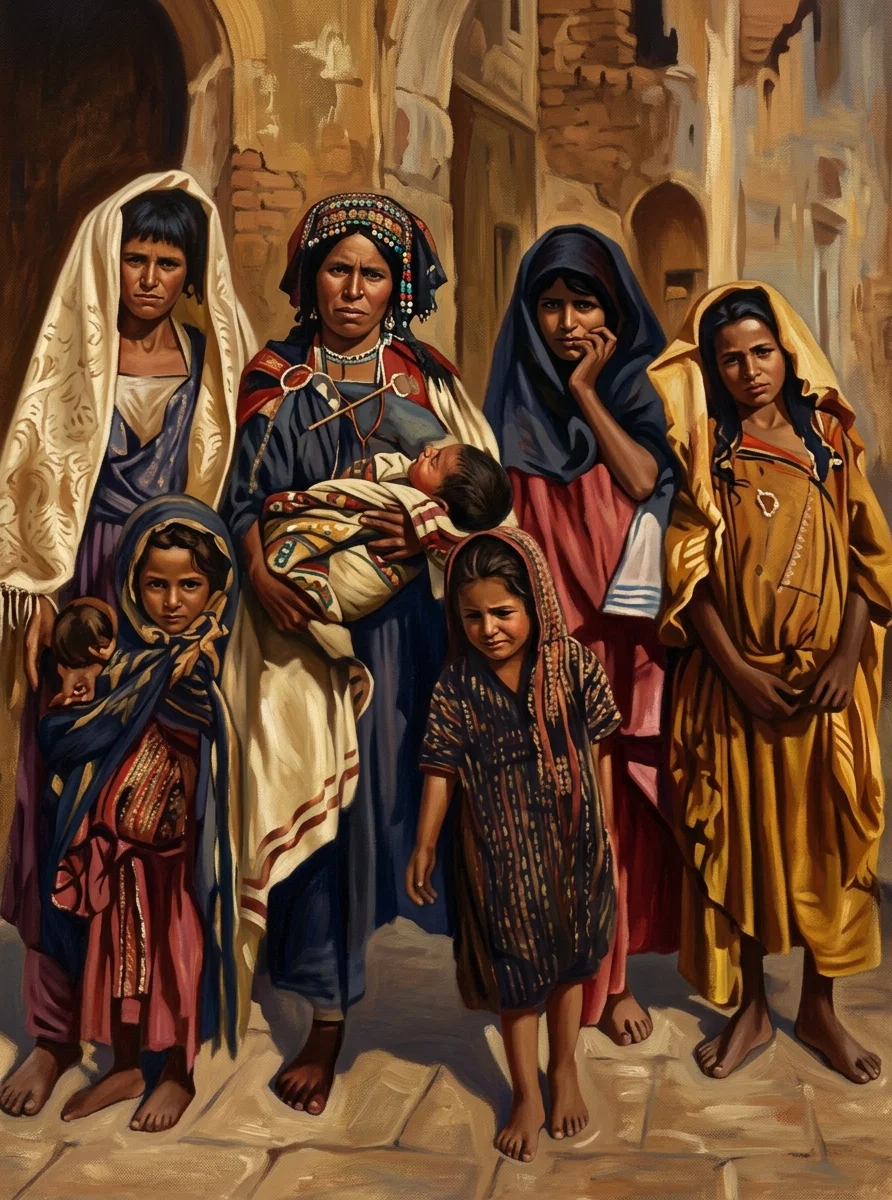
“The threshold of the house weeps for forty days when a girl is born,” is one of the Mohammedan proverbs. “Unwelcome at birth, unloved in her lifetime, without hope at her death,” or, as another puts it, “As a babe she is unwelcome; as a child, untaught; as a wife, unloved; as a mother, unhonored; in old age, uncared for; and when her miserable, dark, and dreary life is ended, she is unmourned by those she has served.” What a sad picture of a hundred million women in the world today!
MOHAMMEDAN WOMEN AND CHILDREN
When a girl is born, it brings sadness to the mother, both because it may mean divorce for herself, and because it will certainly mean a life of misery for her child such as she herself has experienced. In a few short years she must leave her mother and live a life of seclusion in her husband’s house. If she should be among the comparatively few who go to school, then at the age of ten, or at most thirteen, she must lay aside her books and be “hidden” just at the time when she is beginning to love her studies, and naturally it does not take long to forget entirely what little she may have acquired.
Many a little girl of six years of age is compelled to perform heavy household duties, and is scolded and beaten for the slightest offense, and often for none at all. At meal-time she must take the last seat and eat only what is left, but she must never complain.
Many of the children of the better class who do not have to work are allowed the greatest liberty to run the streets without restraint until the time of their betrothal or marriage, which usually takes place between the ages of ten and fifteen. Then they must don the trappings of a harem lady, and in some countries be forever after “hidden.” Although the lot of the women differs somewhat among the numerous nations and tribes where the religion of Islam prevails, those countries adjoining Christian nations being to some extent influenced by them, and there being also a difference according to social position, yet fundamentally the conditions are the same. The evil is there, and at best is revolting and degrading to womanhood.
In Egypt the poorer classes of women have to work hard for a living, and of necessity have a certain amount of freedom, and escape from many of the sufferings of those whose lot is cast in a higher sphere. During the cotton season they labor from four o’clock in the morning till nine at night. Others are venders of fruit, vegetables, etc. Their strength and powers of endurance are marvelous.
Whether rich or poor, veiled or unveiled, in every case they are considered inferior to their husbands. They are not allowed to walk together. In some countries the wife must walk in front, so that the husband can watch her carefully; in others she must walk quite a distance behind, to show her inferiority. If he rides a donkey, she walks behind, making the donkey go; and she also carries the burdens. It would be thought scandalous to be seen side by side; nor must they sit down at meals together. It is not good form to ask a man concerning his wife’s welfare, nor does a man mention his wife under any circumstances.
The following is an instance of how they manage when help for the wife is actually needed. A villager asked a doctor to come and treat his mother. “How old is she?” the doctor inquired. “Thirty,” was the reply. “And how old are you?” “Forty.” “Then how can she be your mother?” A bystander whispered, “It is his wife, only he does not like to say so.”
The Moslem thinks it altogether beneath his dignity to address his wife, except to give orders, and he does not lower himself to answer her questions. She has no title until she has a son, when she is called “the mother of so-and-so.”
While the lot of the poor is sometimes extremely hard, yet it is infinitely preferable to being shut up within four walls from the age of ten for the rest of life, with never an opportunity to enjoy the beauties of nature. A missionary tells of a woman whom she was in the habit of visiting, who had never been outside her home since her marriage, forty years before, and who begged her missionary friend to tell her something about the flowers. Without exception, the higher the rank, the greater the seclusion, except perhaps in Palestine, where it is said the women are not shut up.

Abide With Me

PHYLLIS LEE
Jesus, abide with me; I need thy help divine. O, grant me heavenly graces And seal me ever thine! Abide with me in sorrow; Abide with me in joy, Let me each glad tomorrow For thee my time employ.
Abide with me; I need thee, For I am weak and sore. With heavenly manna feed me, And go thou on before, Leading in paths thou seest Best for my weary feet, Until at last I find in thee My rest and joy complete.
Continue reading: Live Your Life Over