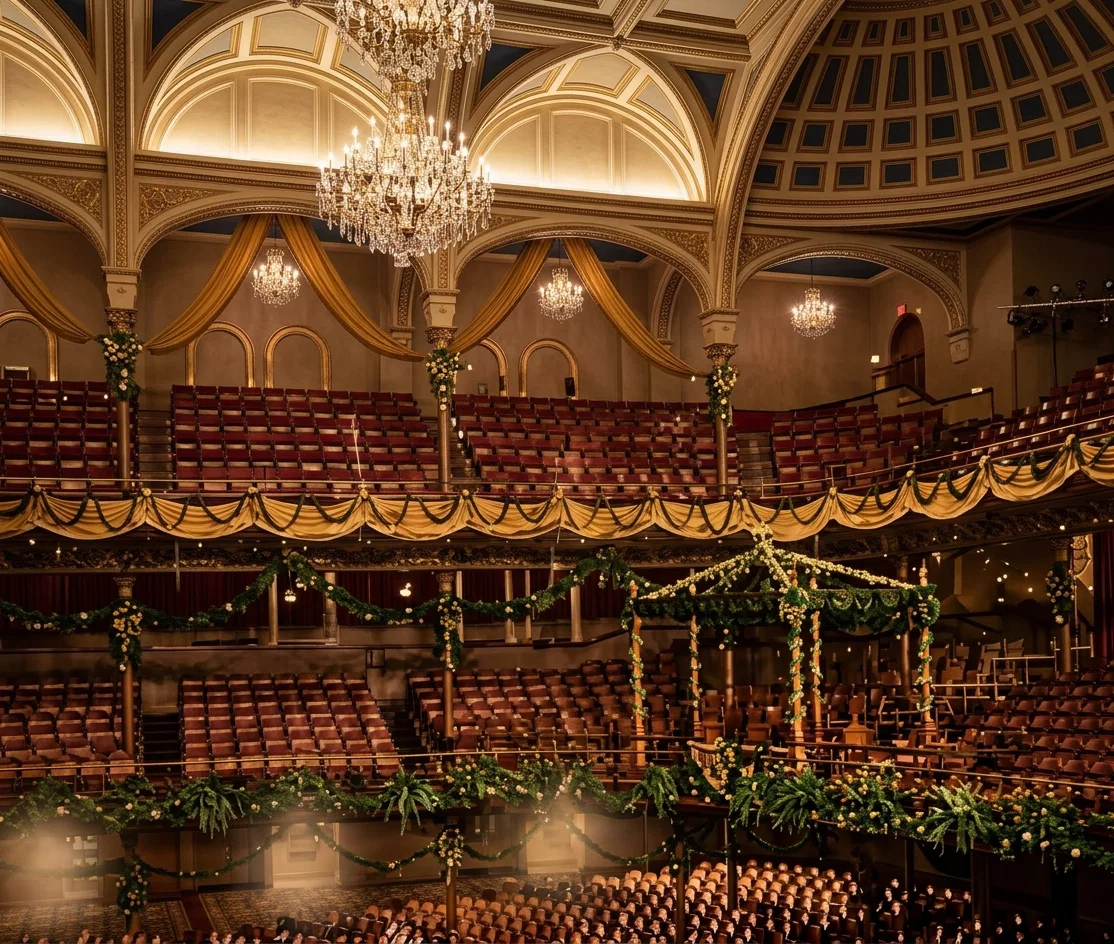
INTERIOR of Massey Music Hall Toronto, Ont., where the Students' Volunteer Movement will hold its world's meeting, February 26 to March 2. The illustration shows about one-third of the hall, the seating capacity of which is about 4,000. The SIGNS representative will send us a report of this wonderful missionary movement.
FORBIDDING THE BIBLE.
A loving, wise father in a foreign land, writes a series of letters to his children in another land, in a language unfamiliar to them. These children are of all ages, from the little child to the adult man and woman. The father sends instruction to his agents to make these letters plain to his children, as their understanding or otherwise involves vital issues. In these letters, in which there are portions adapted to every one of his children, speaking directly to the heart of each one, there are perfect instructions as to the moral conduct of all human affairs. Friends of both father and children, having perfect access to these letters, have done all they can to make these letters plain. They have made many translations, seeking to make them in the very language of the children. Would you not think it strange if the professed friends and agents of that father should forbid the children reading the letters of their father put in their own tongue, unless the reader was wholly under the direction of some one else? Would you not think it cruel thus to keep back these children from the most direct contact with the father?—You certainly would. You would feel that it is the duty of these men to make those letters just as plain as possible, to encourage the children to read them, and so become acquainted with their father.
But not so has the Roman Catholic Church done. It has sought to keep back the children of our Heavenly Father from reading His own Word, which He has sent, not to priest or prelate or pope, but to all, the babes as well as the full-grown. Here is their own statement, what the Literary Digest tells us is “practically official information,” from “a pronounced organ of that church, the Märkische Kirchenblatt.”—
It is true that the reading of the Scriptures in the vernacular has not been allowed to the laity, unconditionally, but only under certain fixed limitations. This order is the outcome of the experience of centuries, which has gradually resulted in a certain discipline in the matter. Therefore, in accordance with the constitution of Leo XIII. of January 25, 1897, under a penalty to be determined by the bishop; and as a great sin, it is forbidden to the average Catholic to read or to have in his possession any edition or copy of the Scriptures in a translation, even if this translation has been given by members of the Catholic Church, unless this work has had the express approval of the Holy See, or has also certain comments of a proper kind, and unless the bishop has given consent to its being printed. Hence only such Bibles in modern languages are allowed as have the approval of the Vatican, in case of editions without comments; and in case notes or explanations are added, these must have the authority of the bishop. In the same way are forbidden all editions and translations made by non-Catholics, especially those of the so-called Bible societies, whose publications are denied to the faithful under the severest penalties. Only those Catholics who are engaged in theological and Biblical studies are allowed to use such translations and editions, and to these only if neither in the introduction nor in the commentaries the doctrines of the Catholic Church are assailed. And in general, it is the duty of a good Catholic, before he begins upon the general reading of the Scriptures, to consult with his spiritual father, and, in conjunction with him, make selections for reading. If the priest fears that the promiscuous reading of the Scriptures will harm his members, he has the right to curtail this privilege or even to deny it altogether.
This is the freedom of access allowed the children to the words of our Heavenly Father by the Catholic Church. Let every soul be free to go to God and His Word. You can get comfort from the Word of God as well as can a priest and without a priest. It is written for you. And, priest, it is written for you. God has greater light and blessing for you than you have ever gotten or ever can get from Latin theology or dry, dead formal liturgy. “All flesh is grass; . . . the grass withereth; . . . but the Word of our God shall stand forever.” Better even to risk a poor translation than the glosses of erring men.
CHURCH AND STATE IN THE PHILIPPINES.
A PROCLAMATION of the civil government's views through Judge Taft, the head of the commission appointed for the government of the islands, has been given to the public. It came about on this wise: A municipal council of Filipinos had interfered with the rights of a Catholic priest. Governor Taft's decision was in favor of the priest. Here is a part of his proclamation as given by Homer C. Stuntz, D.D., in the Christian Advocate of February 6:—
OFFICE OF THE CIVIL COMMISSION, PHILIPPINE ISLANDS, MANILA, P. I. July 31, 1901.
CAPTAIN WALLIS O. CLARK, GOVERNOR OF TARLAC, TARLAC, P. I.—SIR: On July 24 I received a call from Father Eusebio Natividad, a Filipino Roman Catholic priest in the town of Tarlac. He came to complain against the municipal council of the town, that the town was attempting by ordinance or resolution to regulate the fees which he was charging for religious functions performed by him as a priest of the Roman Catholic Church in the church at Tarlac.
Similar complaints have come to me from other parts of the archipelago, and I deem it wise, therefore, in a public letter to the governor of the province where there has been such an abuse of civil authority, to call attention to it, and to point out the fundamental error committed by the municipal council.
The President of the United States in his instructions to the commission used the following words: “Upon every division and branch of the government for the Philippines, therefore, must be imposed these inviolable rules: that no law shall be made respecting an establishment of religion, or prohibiting a free exercise thereof, and that the free exercise and enjoyment of religious profession and worship without discrimination or preference shall forever be allowed.” And again: “That no form of religion and no minister of religion shall be forced upon any community or upon any citizen of the islands; that upon the other hand no minister of religion shall be interfered with or molested in following his calling; and that the separation between State and Church shall be real, entire, and absolute.”
What fees or compensation shall be charged by a minister of religion for religious services performed by him is a matter wholly within the control of the church authorities, and is one in which the civil government, whether municipal, provincial, or insular, can have no voice whatever. No one is obliged by civil law to partake of the sacraments of the Roman Catholic Church; no one is required by law to solicit from the priest the marriage ceremony or the funeral ceremony of the Catholic Church. If he does so, under the government as it now exists in these islands, he does it voluntarily. If, however, his religious conscience requires of him that he should secure the performance of any such ceremony by a priest of the Catholic Church, and deems the fee exacted excessive, he can have no recourse to the civil government, but must apply for relief to the superior ecclesiastical authority in the Catholic Church. Under the government instituted here by the United States, neither priest nor bishop has any power, as such, to control the course of the civil authorities, nor can he, as such, take any part in the government, nor exert any influence upon its course. He may only appeal to the civil authorities, as any other citizen or resident may appeal, for protection to his life, liberty, or property, or that of the religious corporation which he represents. With the entire separation of ecclesiastical influence from civil government must follow, on the other hand, complete abstinence from interference in clerical and ecclesiastical matters by civil officers, as such. The right of each councilor, as an individual, if he be a member of the Catholic Church, to take such action within the church as its rules and discipline may prescribe, to prevent the exaction of excessive fees by priests, is, of course, fully conceded;9but when the councilors meet in a town council, and take official action by municipal ordinance or resolution, they are not acting as individual members of the Catholic Church; they are acting as the agents of civil government, and, as such, they have nothing whatever to do with the government of the church, or with any act of its priest which concerns the administering of religious sacraments or the performance of religious functions, unless those services are carried on and those functions are performed in such a way as to affect injuriously the property rights or the civil rights of the general public, whether Catholic or non-Catholic.
Now, certainly, that is just and reasonable. But the following translation from a tract issued “in Spanish and the vernaculars, gotten out by the ‘Catholic Center,’ as nearly the name of the organization that stands for preserving ‘Holy Church’ as can be put into English,” shows just how Catholics look upon religious liberty and equality:—
To the Conflict, Filipino Catholics!
Not many days since a miserable paper, rabidly impious, saw light in this capital, a monstrous abortion of perversity, a banneret of enrollment in the interests of apostasy, in which freely and unmasked the cry is raised, War against God!
To arms, then, warriors of Jesus Christ! The challenge is thrown down! To the strife, Catholic soldiers! Not with a resort to worldly arms, but to the powers of prayer, of faith, of a union of all true Catholics, of public manifestation of our religious sentiments, to defend them by all the means that are within our power.
Yes! War against God is the infamous motto of this infernal proclamation. They say that they “can not and do not desire to intervene in religious questions;” then, lying with hateful cynicism, they excite the people to make in all parts manifestations of distrust against the Catholic priests. And all under the guise of a pernicious liberty! Buffoons! Pusillanimous and false politicians! You desire to eclipse the sun of the moral world, which is the Catholic faith. We shall walk in darkness. The Philippines will be a Babylon.
Enough of hypocrisies. Enough has our country been deceived. Enough tears and blood have we shed. Shake off the lethargy that overpowers you. Turn your gaze upon your unfortunate country, and have compassion upon it. Will you impassively allow the treasury of your faith to be torn from you by violence? Will you consent that it disappear from the Philippines, because it so pleases four rickety brawlers? The Centro Catholico protests in your name against the low, miserable paper and its reprobate propositions, desiring that this solemn protest be heard the circumference of this archipelago around as a genuine expression of your Christian sentiments. We despise the talkative pygmies. To-day impiety reigns, and it is a time of ruin, of fury, of indignation. Be zealous, therefore, for the law to-day, and give your lives in defense of your parents. Be resolved by the valor of your ancestors, and you shall acquire imperishable fame and eternal renown.
These things speak for themselves. The conflict between liberty and tyranny is beginning anew.
A DEEPER PURPOSE THAN APPEARS.
In view of the avowed purpose of the federation of Catholic societies of America, and in view of the demands which that federation proposes to make for the recognition of the political rights of Catholics, and, further, in view of the implied charge, in those demands, that Catholics are now deprived of their political rights, we quote the words of Archbishop Ireland printed in the Catholic Mirror of February 8:—
I would render this tribute to my American non-Catholic fellow-citizens that they are fair minded, that they are honorable in their dealings, that they are neighborly, and the prejudice of the past has almost totally disappeared—certainly has totally disappeared in public life.
We have had a few years ago a Catholic in the Cabinet; we have two Catholics on the Supreme Bench to-day; and so throughout all the great public life our Catholics are represented. It remains with themselves. I say that of my country, it remains with the Catholics themselves to conquer position and honor.
If all this is true, and we can see every day that it is true, what is it that the federation expects to accomplish? Already, according to the archbishop, the rights of Catholics are respected, and they are receiving their share of the public patronage. What purpose, then, has the federation in view? Evidently to carry through a great movement, by a great, united effort, when the time shall be ripe for the consummation of the plan. Protestantism and republicanism are forsaking their fundamental principles; there is a weakening in the opposition to the papal principle, as indicated by the archbishop’s remarks in the first paragraph quoted; and the opportunity of an age lies before the forces of that power. Rome’s leaders see the drift, and are preparing to make the most of it. They are not deprived of their rights, civil or religious, are not deprived of their share of public patronage or political prestige, as the archbishop admits. The purpose of the federation is deeper and broader than that; it may be more far-reaching in its results than even the immediate leaders of the movement now realize. By its influence and through its efforts the remaining republican and Protestant principles of this government are to be eliminated until the way is opened for the work which this nation is to do in helping to heal that “deadly wound” which the papacy received more than one hundred years ago. The bugles of political and religious apostasy have sounded the retreat, and the heavy tread of the backward march is heard from shore to shore. To hasten that retreat, and to reap the harvest of spoils which that retreat makes possible, is the purpose of this federation of Catholic societies. The time is coming when “all the world” will do homage to that power, worship at its feet (Rev. 13:8-18), except those only whose names are “written in the book of life.” This federation is one of the great forces that will bring that about; but it is not the only force, the only power, that is working to that end. Apostate Protestantism is one of its staunchest allies.
News from Around the World
Sir Robert Ball, professor of mathematics and astronomy at Cambridge University, England, states that American astronomers are now doing more and better work in that field than all the astronomers of Europe combined. He attributes this to their better instruments, better climate, the large sums of money devoted to this branch of science, and states further that “it is also due in part to the superior talents of the American astronomers.”
Because of the present industrial depression in Germany, the people are patronizing the lotteries to an unprecedented extent. Lottery transactions for the year ended February 1 amounted to $47,600,000. The lottery companies state that 70% of this is returned to the people; but if that were true, it would still leave the people 30% poorer than they would otherwise have been.
In spite of the bulletins of victories issued by the Venezuelan Government, reports from Caracas state that the revolution is gaining ground daily. New uprisings are reported in all parts of the country, especially on the Colombian frontier and at Barcelona, where the insurgents are now concentrating.
The North Shore Railway Company, of California, has joined the ranks of the corporations which now require total abstinence from liquor and narcotic drugs on the part of their employees. This company also forbids the use of tobacco to its employees while on duty.
Miss Stone and Mrs. Tsilka have at last been released by the brigands, but the former is not yet able to take the horseback journey necessary to reach the railroad. They are now at Strumitza, Bulgaria. The date of their release was February 23.
On February 21 a serious fight occurred in a St. Petersburg theater between 500 students and a regiment of Dvorniks. Many of the students had arms or ribs broken and some were killed in the battle.
A serious riot occurred in Porto Rico on February 21, because of the importation of Italian laborers to lay track for a trolley road.
After eight hours of what was termed tumultuous debate, the Senate, on February 24, passed the Philippine tariff bill by a vote of 46 to 26, a strictly party vote. Only one amendment was allowed, and that was an amendment restricting the operation of the sedition law enacted by the Taft Commission. The measure provides that goods imported into the Philippines from the United States shall be required to pay the duties levied against them by the Philippine Commission, and that goods imported into the United States from the Philippines shall pay 75% of the Dingley rates, less whatever export taxes may have been paid in the Philippines. The bill exempts the commerce passing between the United States and the Philippines from the operation of the United States navigation laws until July 1, 1904.
With display of bunting, the roar of cannon, and the screaming of countless steam whistles, Prince Henry of Prussia, brother of the German Emperor, was welcomed at New York on February 23. Official welcome was extended to him on behalf of the President, the army, the navy, and the city of New York. Extensive plans have been laid for the entertainment of the prince while in this country. On February 24 he was entertained by the President at the White House, where an elaborate dinner was provided. On the following day the launching of the emperor’s new yacht took place at New York, at which the prince was present, Miss Roosevelt performing the important function of christening the yacht.
An American journalist who has been traveling in the province of Shansi, China, for the purpose of investigating the famine reports, states that the reports have not been exaggerated, but rather that the whole extent of the disastrous famine has not been made known. He states that 30 per cent of the inhabitants of that province died either from the famine or from the disease which accompanied it. The province contained a population of over 8,000,000. Human flesh was openly sold, and the misery of the inhabitants was beyond description. The famine was due to a three-years’ drought.
At the chapel services at the Northwestern Academy in Evanston, Ill., on February 24, the president informed the students that cigarette-smokers were not wanted in the institution, because of the low standing of those who used cigarettes. He stated that only 2 per cent of the users of cigarettes were in the highest grade, while 57 per cent were in the lowest grade. Of the very best students the president said that not one was a cigarette-smoker. Those who would not or could not forsake the practice were plainly told that they must disconnect from the institution.
The eviction of a number of tenants from the holdings of landlords in Ireland, because the tenants refused to pay rent, is stirring up anew the question of compelling the landlords to sell their large holdings to the people. The landlords prefer to keep their estates, and rent them. The people are demanding the right to buy the lands in small holdings. A society of considerable influence in Ireland is urging the tenants to insist upon their demands, and it is feared that trouble is brewing in that part of Great Britain.
During the week there has been a practical reign of terror in the city of Barcelona, Spain. In the strike riots which have continued there and in other places, several encounters have occurred between rioters and the troops, and many lives have been lost. Official reports state that the outbreak has now been quelled. General Weyler has asked the government for a free hand in dealing with the rioters, but Premier Sagasta threatens to resign if such unlimited powers are given to Weyler.
A personal encounter occurred in the Senate on February 22 between Senators Tillman and McLaurin of South Carolina. The Senate immediately went into executive session to deal with the case. The senators apologized for their unseemly conduct, but the Senate declared them in contempt, and their names were temporarily taken from the roll. This takes from them the privilege of participation in the deliberations of the Senate until further action is taken.
An influential English syndicate is preparing to drain the sacred lake in Colombia to secure the gold and jewels which are supposed to be in abundance on its bed. The Spaniards made an effort 300 years ago to do the same thing, but were unable to accomplish it. After storms on this lake, which is in the crater of an extinct volcano, the Indians frequently find gold and precious stones which have been brought to the beach by the action of the water.
On February 24 the Supreme Court at Washington, D. C., delivered its opinion in the case of the State of Minnesota versus the Northern Securities Company in an application of the State to file a bill of complaint in that Court. The motion for leave to file the bill was denied on the ground that the court did not have jurisdiction. It is not expected that this action of the Supreme Court will stop further action by the State of Minnesota.
Correspondence from South Africa brings the intelligence that all the ports of South Africa are blocked with consignments of all kinds of goods from other parts of the world, a congestion which is the direct result of the war. The prevailing conditions make it impossible for the railroads to move the merchandise.
Nineteen persons lost their lives and fifty were more or less seriously injured by a conflagration which destroyed the Park Avenue Hotel, of New York City, and the 71st regiment armory, on February 22. The financial loss on the hotel is placed at over $3,000,000. The persons who lost their lives or were injured were occupants of the hotel, and would have escaped uninjured but for the belief that the hotel was completely fireproof.
The United States Bureau of Statistics has issued an abstract, showing the growth of the nation in one century. In 1800 the area of its territory comprised 827,844 square miles; in 1900, exclusive of Hawaii and Alaska, 3,025,600 square miles. In 1800 the imports were $91,000,000; and the exports $71,000,000. The imports now are nine times as great as then, and the exports twenty-one times as great.
The estimates for the expenses of the British navy for the coming year amount to $152,212,850, which is considerably more than the expenses for the past year. The Secretary of the Admiralty reports that 49 war vessels of different types will be put into the water this year. Next year there would be under construction 60 ships, in addition to 27 others that would be laid down.
Secretary Hay has presented a note to the Russian Government protesting against the present course and policy of Russia in Manchuria, holding that Russia’s present position there constitutes a monopoly of trade and concessions which practically nullifies China’s treaty with this country so far as Manchuria is concerned. The note is welcomed by England and Japan.
Eight high-grade assay offices in Cripple Creek, Colorado, were blown up with dynamite on February 24. The occupants of the various offices escaped with slight injuries. It is believed to have been the work of ore thieves, who have been carrying on a systematic stealing of ore during the past year.
Last month sixty Chinese bandits were killed in a fight with the villagers of Chan Tsuen, aided by a gunboat. The bandits in a body were making a house-to-house canvass of the village when a gunboat came to the villagers’ assistance, placing the bandits between two fires with the result stated.
Boer sympathizers in America are now seeking to induce this government to prevent the further exportation of horses and mules to the British armies in South Africa. Resolutions to that effect were passed at a large meeting held in Washington, D. C., on February 23.
On February 19 one detachment of one of England’s crack regiments, the Scots Greys, was cut up and captured by the Boers. At about the same time the British captured a detachment of the Boers. The acting president Schalk Burger narrowly escaped.
The Interstate Trust Company was recently organized at Trenton, N. J., for the purpose of forming a chain of banks throughout the country, a kind of bank trust. The company has a nominal capital of $100,000,000, but a surplus of nearly $3,000,000.
The House Committee on Ways and Means has voted to recommend a reduction of 20% in the duty on Cuban imports. It is expected that there will be strong opposition to this proposal when it comes before the House for action.
Dr. James Peate, the manufacturer of telescopes, has given to the American University, at Harriman, Tenn., the third largest telescope in the United States, it being exceeded in size by the Lick and Yerkes instruments only.
Thirteen American firms, chiefly manufacturers of machinery, have established permanent, combined headquarters in the city of Adna, Asia Minor, whence they hope to spread the sale of American products throughout Asia Minor.
Sixty-four men are reported to have been killed or wounded during a battle which occurred on the Montenegrin frontier, on February 24, between Albanians and regular Turkish soldiers. The fighting continues.
On February 19 the President announced his determination not to interfere in the Schley-Sampson controversy. He holds that Sampson was technically in command, but that the battle was a captain’s battle.
The latest census of the city of London shows a total population of 6,580,000, occupying an area of 693 square miles. Greater New York occupies 326 square miles, and its population is placed at 3,437,000.
The British Secretary of War states that the British Government has now purchased 446,088 horses for use in the South African war, which is nearly two horses for every man in the field.
It is reported that the Empress of China has issued an edict against binding the feet of girls to make them small, stating that she considers the custom barbarous.
The final ratifications of the Hay-Pauncefote canal treaty were exchanged by the Secretary of State and the British ambassador at Washington, D. C., on February 21.
A dealer in horse feed has cornered the oat market in the Klondike, and advanced the price to 9 cents a pound. Hay is selling there at 6½ cents a pound.
VOICE CULTURE.
Most of us dislike what the children of the last generation used to call “a company voice.” An artificially sweet voice in speaking is as disagreeable to some listeners as the plaint of a screech owl. There are those who contend that it is the never-failing sign of a bad temper, and even more charitably disposed listeners are apt to say to themselves on hearing it, “Too sweet to be wholesome.” To keep a different voice for company from the one in every-day use argues a lack of civilization that few of us would care to plead guilty to, in this generally progressive age, but if we are to have only one voice for all occasions, it would seem to be highly desirable that that voice should be a pleasant one.
The old saw tells us that it is never too late to mend one’s morals or manners, and to this may be added that it is never too late to repair, to some extent, natural or acquired defects in the human voice. We do not mean that toward the middle or end of one’s threescore and ten years of life, one can derive any benefit from practising one’s do re me, etc. It is the speaking not the singing voice which should be mended where mending is needed. Few of us have singing voices that would make us famous either in church or opera; but as the speaking voice, except in the case of professional musicians, is the more important of the two, it is well for us all that the harshest utterance ever inflicted by nature on human speaker can be so modified by determined endeavor to speak gently that, in time, no one will notice its jangles.
The music books tell us of “sympathetic” singing, and lay great stress on its acquirement, should it not be a natural gift. For teaching in regard to the sympathetic voice in speaking, we must look to that common sense, which, according to an old writer, “is of all senses the most uncommon.”11It seems odd that men and women who would not tolerate for a moment a creaking wheel on vehicle or sewing machine, will keep a worse than creaking voice about them all their lives, wondering from time to time why the little children with whom they have to do are inclined to shrink away from them.
“I know,” remarked a mild-mannered spinster to a mother who had just quieted one of her children with a harsh reproof, “that you love your little girl. I can see it in your eyes when you look at her as she plays about the room; but it seems to me that you take particular pains to keep your love out of your voice in speaking to her.”
“Would you have me let her go on teasing the cat in that style?” asked the mother, impatiently.
“Certainly not; but, as you see, your voice in reproving her frightened both her and the cat out of the room.”
“Yes,” returned the mother, looking around. “And I suppose she has gone to the kitchen as usual. I wonder at her having such taste.”
“If you will excuse my candor, I don’t wonder at it in the least. Your cook, if she is that German girl you had from us, has a very pleasant voice and manner. She would not, I am sure, speak harshly to her enemy’s dog, supposing she had an enemy, and naturally your little girl prefers a grown-up companion who does not scold to one who does.”
“And so I am a scold, am I? You speak as if I were one of those fishwives we read of in old novels, and perhaps you will be intimating that I need the ducking-stool.”
“No; the ducking-stool process might make your voice harsher than ever in uttering words of reproof. If you could always bear in mind the fact that you have brought a delicate and sensitive little girl into a world full of sorrow and trouble, it seems to me you would be at more pains to make life easier for her by cultivating a pleasant tone of voice in which to tell her of her little misdoings. A reproving voice that does not jar the nerves of the listener is, if I may improve upon Shakespeare, a super-excellent thing in a woman.”—Christian Work.